
Through the Looking-Glass
Humpty Dumpty
『鏡の国のアリス』第6章 対訳英語学習リーダーです。
重要語句が8つのカテゴリーに色分けされ、ルビ形式で日本語訳が確認できます。
However, the egg only got larger and larger, and more and more human: when she had come within a few yards of it, she saw that it had eyes and a nose and mouth; and when she had come close to it, she saw clearly that it was Humpty Dumpty himself. “It can’t be anybody else!” she said to herself. “I’m as certain of it, as if his name were written all over his face.”
でも、たまごはどんどん大きくなるばかりで、どんどん人間じみてきました。あと数メートルのところまでくると、そのたまごには目も鼻も口もついているのがわかります。そして間近にきてみると、それがまさに他ならぬハンプティ・ダンプティだというのがはっきりわかりました。「ほかに考えられないわ! 顔中にハンプティ・ダンプティの名前が書いてあるくらいはっきりわかる」とアリスはつぶやきました。
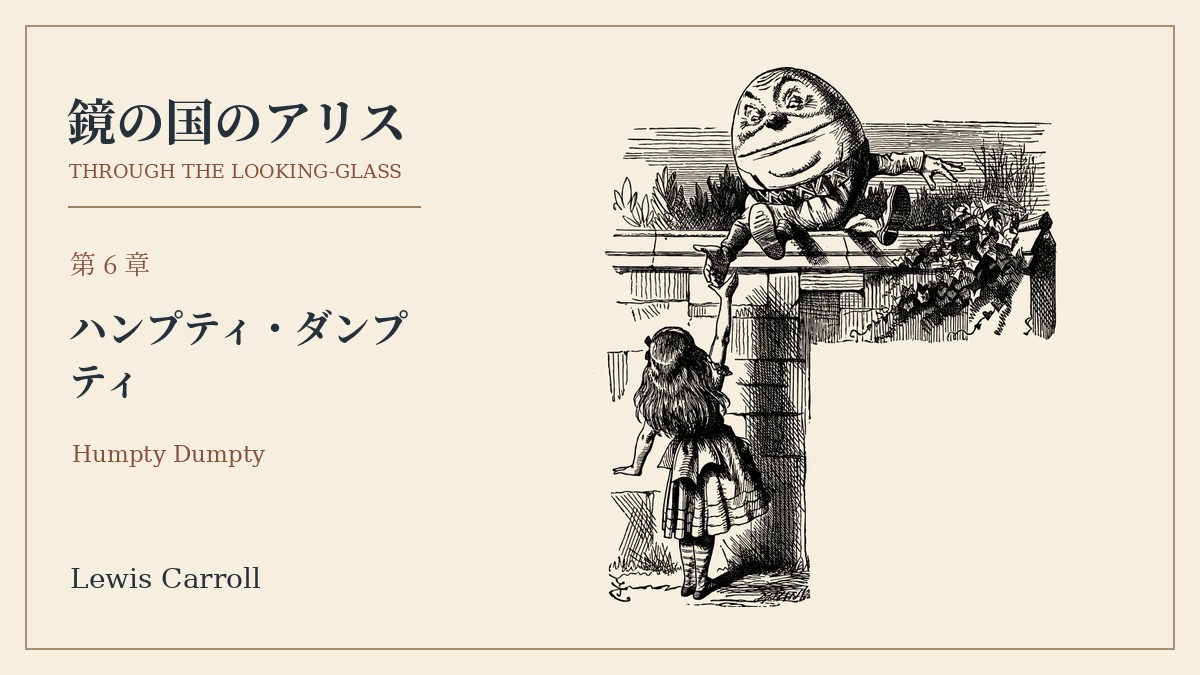
It might have been written a hundred times, easily, on that enormous face. Humpty Dumpty was sitting with his legs crossed, like a Turk, on the top of a high wall—such a narrow one that Alice quite wondered how he could keep his balance—and, as his eyes were steadily fixed in the opposite direction, and he didn’t take the least notice of her, she thought he must be a stuffed figure after all.
それはそれは巨大な顔だったもので、百回書いてもまだ余ったでしょう。ハンプティ・ダンプティは高い壁のてっぺんに、トルコ人みたいにあぐらをかいてすわっていました――それもすごく薄い壁で、どうやってバランスをとっているのか、アリスは不思議でたまりません――そして目はしっかりとあさっての方向に固定されていて、こっちのほうをまるで見ようともしないので、実はぬいぐるみなんだろうとアリスは思いました。
“And how exactly like an egg he is!” she said aloud, standing with her hands ready to catch him, for she was every moment expecting him to fall.
「それにしても、ほんとにたまごそっくりよねぇ!」とアリスは声に出していいながら、腕を広げてかれをキャッチしようとしていました。いまにも落ちてくるものと確信していたからです。
“It’s very provoking,” Humpty Dumpty said after a long silence, looking away from Alice as he spoke, “to be called an egg—very!”
ハンプティ・ダンプティは、ながいこと何も言いませんでした。そして、口を開いたときには、アリスのほうを見ないようにしています。「たまご呼ばわりされるとは、実に不愉快千万――実に!」
“I said you looked like an egg, Sir,” Alice gently explained. “And some eggs are very pretty, you know,” she added, hoping to turn her remark into a sort of a compliment.
「たまごそっくりに見えるって申し上げたんです」アリスはていねいに説明しました。「それに、世の中にはすごくきれいなたまごもあるじゃないですか」とつけくわえて、なんとか自分のせりふをほめことばに仕立てようとしてみます。
“Some people,” said Humpty Dumpty, looking away from her as usual, “have no more sense than a baby!”
「世の中には」とハンプティ・ダンプティは、さっきと同じく目をそらしています。「赤ん坊なみの常識もないようなやつらもいるんだからな!」
Alice didn’t know what to say to this: it wasn’t at all like conversation, she thought, as he never said anything to her; in fact, his last remark was evidently addressed to a tree—so she stood and softly repeated to herself:—
アリスは、なんと答えていいやらわかりませんでした。まるっきり会話らしくないわね、だってハンプティ・ダンプティは、あたしに向かってはなにも言わないんだもの、とアリスは思いました。いや、さっきのせりふだって、見た目には近くの木に向かってのせりふです――そこでアリスは立ったまま、静かに暗唱しました:――
“Humpty Dumpty sat on a wall:
Humpty Dumpty had a great fall.
All the King’s horses and all the King’s men
Couldn’t put Humpty Dumpty in his place again.”
「ハンプティ・ダンプティ壁の上
ハンプティ・ダンプティ大転落。
王さまの馬や兵隊総がかりでも
もとの場所には戻せぬハンプティ・ダンプティ」
“That last line is much too long for the poetry,” she added, almost out loud, forgetting that Humpty Dumpty would hear her.
「最後の行は、この詩にはちょっと長すぎるのよね」とアリスは、ほとんど声に出して言いそうになりました。ハンプティ・ダンプティに聞こえるかもしれないのを忘れていたのです。
“Don’t stand there chattering to yourself like that,” Humpty Dumpty said, looking at her for the first time, “but tell me your name and your business.”
「そんな突っ立って一人でブツブツ言ってるんじゃない。名前と用件を述べたまえ」
“My name is Alice, but—”
「あたしの名前はアリスですけど、でも――」
“It’s a stupid enough name!” Humpty Dumpty interrupted impatiently. “What does it mean?”
「聞くからに間抜けな名前だ!」とハンプティ・ダンプティは、短気そうに口をはさみます。「それでどういう意味?」
“Must a name mean something?” Alice asked doubtfully.
「名前って、意味がなきゃいけないんですか?」アリスは疑わしそうにたずねます。
“Of course it must,” Humpty Dumpty said with a short laugh: “my name means the shape I am—and a good handsome shape it is, too. With a name like yours, you might be any shape, almost.”
「いけないに決まってるだろうが」ハンプティ・ダンプティはちょっと笑いました。「わたしの名前はといえば、これはわたしの形を意味しておる――しかも、すてきでかっこいい形であるな。あんたのみたいな名前では、ほとんどどんな形にだってなれそうじゃないか」
“Why do you sit out here all alone?” said Alice, not wishing to begin an argument.
「なぜたった一人でこんなところにすわってらっしゃるんですか?」アリスは口論をはじめたいとは思わなかったのでこう言いました。
“Why, because there’s nobody with me!” cried Humpty Dumpty. “Did you think I didn’t know the answer to that? Ask another.”
「そりゃもちろん、ここにはほかにだれもいないからだよ!」とハンプティ・ダンプティ。「その程度のものに答えられんとでも思ったか! 次いってごらん」
“Don’t you think you’d be safer down on the ground?” Alice went on, not with any idea of making another riddle, but simply in her good-natured anxiety for the queer creature. “That wall is so very narrow!”
「地面におりたほうが安全だと思わないんですか?」アリスは、別になぞなぞを続けようと思ったわけではなく、単にこの変な生き物に対し、善意から心配してこう言ったのです。「だってその壁、とってもせまいじゃないですか!」
“What tremendously easy riddles you ask!” Humpty Dumpty growled out. “Of course I don’t think so! Why, if ever I did fall off—which there’s no chance of—but if I did—” Here he pursed his lips and looked so solemn and grand that Alice could hardly help laughing. “If I did fall,” he went on, “the King has promised me—ah, you may turn pale, if you like! You didn’t think I was going to say that, did you? The King has promised me—with his very own mouth—to—to—”
「なんともまあ、えらく他愛のないなぞなぞばかりをきくもんだな!」とハンプティ・ダンプティはうなるように言います。「もちろんそんなことは思わんとも! それにもしわたしが仮に本当に落ちたとしても――もちろんそんなことはまったくあり得んことだが――でも、仮にもし落ちたとしたら――」ここでハンプティ・ダンプティは口元を引き締めて、えらく荘厳でえらそうな様子を見せたので、アリスは笑いをこらえるのが精一杯でした。「仮にもし落ちたとしても、王さまが約束なさってくだされて――えへん、なんならあおざめてくれたっていいんだぞ! まさか王さまが出てくるとは思ってもいなかっただろうが、え? 王さまが約束なさってくだされて――しかももったいなくも御自らの口で――は、は、配下の――」
“To send all his horses and all his men,” Alice interrupted, rather unwisely.
「配下の馬や兵隊さんを総がかりで送る、でしょ」とアリスは、いささか軽率にもわりこみました。
“Now I declare that’s too bad!” Humpty Dumpty cried, breaking into a sudden passion. “You’ve been listening at doors—and behind trees—and down chimneys—or you couldn’t have known it!”
「いやまったくこりゃひどい話だ!」ハンプティ・ダンプティはいきなり、憤怒にかられて叫びました。「戸口で聞き耳をたててたな――木に隠れて――煙突にもぐって――さもなきゃそんなこと知ってるわけがない!」
“I haven’t, indeed!” Alice said very gently. “It’s in a book.”
「そんなこと、してませんったら! 本に書いてあります」アリスはとても静かに申しました。
“Ah, well! They may write such things in a book,” Humpty Dumpty said in a calmer tone. “That’s what you call a History of England, that is. Now, take a good look at me! I’m one that has spoken to a King, I am: mayhap you’ll never see such another: and to show you I’m not proud, you may shake hands with me!” And he grinned almost from ear to ear, as he leant forwards (and as nearly as possible fell off the wall in doing so) and offered Alice his hand. She watched him a little anxiously as she took it. “If he smiled much more, the ends of his mouth might meet behind,” she thought: “and then I don’t know what would happen to his head! I’m afraid it would come off!”
「ああそうね! そういうことも本になら書くだろうさ」ハンプティ・ダンプティは、もっと落ち着いた口調で言いました。「それがイギリスの歴史ってもんだからね、つまるところ。さ、このわたしをよっくごらん! わたしは王さまと話したことがあるヤツなんだからな、このわたしが: そんなやつには、ちかってほかにお目にかかったことがあるまい。でも鼻にかけてないのを示すため、あんたと握手してあげようではないの!」そして前にかがむと同時に(そしてそのせいで、ほとんど壁からおっこちかけましたが)ほとんど耳から耳へ届くように、にんまりと笑って見せて、アリスに手を差し出します。アリスは、その手を握り返しながらも、ちょっと心配になってハンプティ・ダンプティを見つめていました。「これ以上にんまりしたら、口の端が裏側でくっついちゃうんじゃないかしら。そしたら、頭はいったいどうなっちゃうことやら! ポロッと落ちちゃうかも!」
“Yes, all his horses and all his men,” Humpty Dumpty went on. “They’d pick me up again in a minute, they would! However, this conversation is going on a little too fast: let’s go back to the last remark but one.”
「そうとも、配下の馬や兵隊を総がかりでな」とハンプティ・ダンプティは続けました。「たちまちまた拾い上げてくれる、まちがいなくね! しかしながら、この会話は先を急ぎすぎておる。もう一つのそのまた一つ前のせりふに戻ろうではないの」
“I’m afraid I can’t quite remember it,” Alice said very politely.
「どうも、はっきり覚えていないんですが」アリスはとてもおぎょうぎよく申しました。
“In that case we start fresh,” said Humpty Dumpty, “and it’s my turn to choose a subject—” (“He talks about it just as if it was a game!” thought Alice.) “So here’s a question for you. How old did you say you were?”
「それならば最初からやりなおそう。こんどはわたしが話題を選ぶ番だ――」とハンプティ・ダンプティ。(「これがゲームかなんかみたいな言い方ね!」とアリスは思いました。)「そこであんたに質問。あんた、いくつだって言ったっけね?」
Alice made a short calculation, and said “Seven years and six months.”
アリスはちょっと計算して言いました。「七つ半です」
“Wrong!” Humpty Dumpty exclaimed triumphantly. “You never said a word like it!”
「ブーッ! おおまちがい」ハンプティ・ダンプティは勝ち誇ったように言います。「あんたそんなこと、一言も言ってやしないだろう!」
“I thought you meant ‘How old are you?’ ” Alice explained.
「『何歳なの?』っていう意味だろうと思ったんですけど」とアリスは説明しました。
“If I’d meant that, I’d have said it,” said Humpty Dumpty.
「そういう意味のつもりなら、そういうふうに言ってるよ」とハンプティ・ダンプティ.
Alice didn’t want to begin another argument, so she said nothing.
アリスはまた口論をはじめる気はなかったので、なにも申しませんでした。
“Seven years and six months!” Humpty Dumpty repeated thoughtfully. “An uncomfortable sort of age. Now if you’d asked my advice, I’d have said ‘Leave off at seven’—but it’s too late now.”
「七歳六ヶ月とはね!」ハンプティ・ダンプティは考え込むように繰り返します。「なんか落ち着かない年頃だわな。さて、もしこのわたしに相談してくれてたら、『七歳でやめとけ』と言っただろうが――もう手遅れだな」
“I never ask advice about growing,” Alice said indignantly.
「育ち方を人に相談したりなんかしません」アリスは頭にきて言いました。
“Too proud?” the other inquired.
「自尊心が許しませんってわけかい」と相手がつっこみます。
Alice felt even more indignant at this suggestion. “I mean,” she said, “that one can’t help growing older.”
そう言われてアリスはなおさら頭にきました。「そうじゃなくて、人が歳をとるのはどうしようもないでしょうって意味です」
“One can’t, perhaps,” said Humpty Dumpty, “but two can. With proper assistance, you might have left off at seven.”
「一人ならそうかもな。でも二人ならどうしようもある。しかるべき助けがあれば、七歳でやめとけたかもしれないのにねぇ」とハンプティ・ダンプティ。
“What a beautiful belt you’ve got on!” Alice suddenly remarked.
「そこにつけてらっしゃるベルト、すごくきれいですね!」アリスはいきなりもうしました。
(They had had quite enough of the subject of age, she thought: and if they really were to take turns in choosing subjects, it was her turn now.) “At least,” she corrected herself on second thoughts, “a beautiful cravat, I should have said—no, a belt, I mean—I beg your pardon!” she added in dismay, for Humpty Dumpty looked thoroughly offended, and she began to wish she hadn’t chosen that subject. “If I only knew,” she thought to herself, “which was neck and which was waist!”
(歳のはなしはもういい加減たくさんだと思ったのです。そして話題を順番に選ぶというのがほんとうなら、こんどは自分の番だ、とアリスは考えました。)「もとい」と考え直して訂正します。「きれいなチョーカーですね、と言うべきだったかしら――いいえ、やっぱりベルト、じゃなくて――あらごめんなさい!」アリスはがっかりして付け加えました。ハンプティ・ダンプティはすっかり怒ってしまったようで、別の話題にすればよかったとアリスは後悔しはじめたのです。「まったく、どこが首でどこがウェストだかわかったらいいのに!」とアリスはこっそり考えました。
Evidently Humpty Dumpty was very angry, though he said nothing for a minute or two. When he did speak again, it was in a deep growl.
しばらく何も言わなかったものの、あきらかにハンプティ・ダンプティはとても怒っていました。そしてやっと再び口をきいたときにも、それは深いうなり声でした。
“It is a—most—provoking—thing,” he said at last, “when a person doesn’t know a cravat from a belt!”
「まったく――なんと言ったらいいか――ベルトとチョーカーの区別もつかんとは――実にまったくもって――不愉快なことこの上ない!」
“I know it’s very ignorant of me,” Alice said, in so humble a tone that Humpty Dumpty relented.
「はい、もの知らずなのはわかってるんですけど」とアリスはじつにへりくだった調子で言ったので、ハンプティ・ダンプティも機嫌をなおしたようです。
“It’s a cravat, child, and a beautiful one, as you say. It’s a present from the White King and Queen. There now!”
「これはチョーカーだよ、おじょうちゃん。しかもその通り、非常に美しいものだね。白の王さまと女王さまからの贈り物なのだよ。どうだね!」
“Is it really?” said Alice, quite pleased to find that she had chosen a good subject, after all.
「まあ、そうなんですか」アリスは、やっぱりこれはいい話題を選んだとわかって、とてもうれしく思いました。
“They gave it me,” Humpty Dumpty continued thoughtfully, as he crossed one knee over the other and clasped his hands round it, “they gave it me—for an un-birthday present.”
ハンプティ・ダンプティは、片ひざを反対のひざのうえにのせて、それをそれぞれの手でつかみました。そして、考え深そうに続けます。「お二人はこれをだね――非誕生日プレゼントとしてわたしに賜ったのであるのだ」
“I beg your pardon?” Alice said with a puzzled air.
「あの、すみません」とアリスは、不思議そうに言いました。
“I’m not offended,” said Humpty Dumpty.
「別に怒っちゃいないよ」とハンプティ・ダンプティ。
“I mean, what is an un-birthday present?”
「そうじゃなくて、いったい非誕生日のプレゼントってなんなんですか?」
“A present given when it isn’t your birthday, of course.”
「お誕生日じゃないときにもらうプレゼントだよ、もちろん」
Alice considered a little. “I like birthday presents best,” she said at last.
アリスはちょっと考えこみました。そしてやっと「あたしはお誕生日のプレゼントがいちばんいいな」と言いました。
“You don’t know what you’re talking about!” cried Humpty Dumpty. “How many days are there in a year?”
「あんた、自分がなに言ってるかわかってんの?」とハンプティ・ダンプティ。「一年は何日?」
“Three hundred and sixty-five,” said Alice.
「三百六十五」とアリス。
“And how many birthdays have you?”
「で、あんたのお誕生日は何回?」
“One.”
「一回」
“And if you take one from three hundred and sixty-five, what remains?”
「それで三百六十五から一を引いたらなんになる?」
“Three hundred and sixty-four, of course.”
「三百六十四よ、もちろん」
Humpty Dumpty looked doubtful. “I’d rather see that done on paper,” he said.
ハンプティ・ダンプティは疑わしそうな顔をします。「紙に書いてもらったほうがいいな」
Alice couldn’t help smiling as she took out her memorandum-book, and worked the sum for him:
アリスはメモ帳を取りだして、計算をしてあげながらも、つい笑ってしまいました。
365 − 1 = 364
365 − 1 = 364
Humpty Dumpty took the book, and looked at it carefully. “That seems to be done right—” he began.
ハンプティ・ダンプティはメモ帳をとって、しげしげと見つめ、「正しいように見えなくもないが――」と切り出しました。
“You’re holding it upside down!” Alice interrupted.
「逆さにお持ちですけど!」とアリスが口をはさみます。
“To be sure I was!” Humpty Dumpty said gaily, as she turned it round for him. “I thought it looked a little queer. As I was saying, that seems to be done right—though I haven’t time to look it over thoroughly just now—and that shows that there are three hundred and sixty-four days when you might get un-birthday presents—”
「いやはやその通りだ!」とハンプティ・ダンプティは、アリスにメモ帳をひっくり返してもらって陽気に言いました。「どうも様子がへんだとは思ったんだ。で、言いかけていたように、正しいように見えなくもない――が、いまじゅうぶんに目をとおしてる暇がないもんでね――そしてこれで、非誕生日プレゼントをもらえるかもしれない日が三百六十四日あって――」
“Certainly,” said Alice.
「そうね」とアリス。
“And only one for birthday presents, you know. There’s glory for you!”
「そしてお誕生日プレゼントの日は一回しかないのがわかる。さあのめや歌えや!」
“I don’t know what you mean by ‘glory,’ ” Alice said.
「のめや歌えやって、なにをおっしゃってるのかわかんないです」とアリス。
Humpty Dumpty smiled contemptuously. “Of course you don’t—till I tell you. I meant ‘there’s a nice knockdown argument for you!’ ”
ハンプティ・ダンプティはバカにしたような笑いを浮かべます。「そりゃわかんないだろうよ――わたしが説明してやるまではね。いまのは『さあこれであんたはこの議論で完全に言い負かされたわけだ』という意味だ」
“But ‘glory’ doesn’t mean ‘a nice knockdown argument,’ ” Alice objected.
「でも『のめや歌えや』って、『これであんたはこの議論で完全に言い負かされた』なんて意味じゃないでしょう」とアリスは反論します。
“When I use a word,” Humpty Dumpty said in rather a scornful tone, “it means just what I choose it to mean—neither more nor less.”
「わたしがことばを使うときには、ことばはわたしの選んだ通りの意味になるのである――それ以上でも以下でもない」ハンプティ・ダンプティはつっけんどんに言いました。
“The question is,” said Alice, “whether you can make words mean so many different things.”
「問題は、ことばにそんないろいろちがった意味を持たせられるかってことよ」とアリス。
“The question is,” said Humpty Dumpty, “which is to be master—that’s all.”
「問題は、どっちがご主人さまかってことだ――単にそれだけの話」とハンプティ・ダンプティ。
Alice was too much puzzled to say anything, so after a minute Humpty Dumpty began again. “They’ve a temper, some of them—particularly verbs, they’re the proudest—adjectives you can do anything with, but not verbs—however, I can manage the whole lot of them! Impenetrability! That’s what I say!”
アリスはわけがわからず、何も言えませんでしたので、しばらくしてからハンプティ・ダンプティがまた口を開きました。「まあ中には気むずかしいことばもあってね――特に動詞は、これがえらく気位が高い――形容詞はどうにでもなるけれど、動詞はそうはいかん――でもこのわたしなら、全部まとめてめんどう見切れる! 不可侵性! わたしに言わせりゃ、つまりはそういうこった!」
“Would you tell me, please,” said Alice, “what that means?”
「もうしわけないですけど、それってどういう意味ですか?」とアリス。
“Now you talk like a reasonable child,” said Humpty Dumpty, looking very much pleased. “I meant by ‘impenetrability’ that we’ve had enough of that subject, and it would be just as well if you’d mention what you mean to do next, as I suppose you don’t mean to stop here all the rest of your life.”
「やっとまともな子らしい口をきくようになったな!」ハンプティ・ダンプティはずいぶん機嫌がなおったようです。「『不可侵性』でわたしが意味しようとしたのは、この話はいい加減もうたくさんで、あんただって残り一生ここに止まってるつもりじゃなかろうし、次にどうするつもりかそろそろ述べたほうがいいぞ、ということだな」
“That’s a great deal to make one word mean,” Alice said in a thoughtful tone.
「ことば一つに、ずいぶんたくさんの意味を持たせるんですねえ」とアリスは考え込んでいいました。
“When I make a word do a lot of work like that,” said Humpty Dumpty, “I always pay it extra.”
「ことばにいまくらいたくさん仕事をさせるときには、給料もよけいに払うんだよ」とハンプティ・ダンプティ。
“Oh!” said Alice. She was too much puzzled to make any other remark.
「まあ」アリスはわけがわからず、ほかに何も言えませんでした。
“Ah, you should see ’em come round me of a Saturday night,” Humpty Dumpty went on, wagging his head gravely from side to side: “for to get their wages, you know.”
「まったく、土曜の晩にことばが群がってくるところを見せたいよ。給料を受け取りにくるわけでしてね」とハンプティ・ダンプティは、頭を左右にえらそうにふってみせます。
(Alice didn’t venture to ask what he paid them with; and so you see I can’t tell you.)
(アリスはハンプティ・ダンプティが何で給料を支払ったのか、きく勇気がもてなかったんだ。そういうわけで、ぼくもきみに説明できないんだよ。)
“You seem very clever at explaining words, Sir,” said Alice. “Would you kindly tell me the meaning of the poem called ‘Jabberwocky’?”
「ことばの説明がとってもお上手みたいですね。よろしければ、『ジャバーウォッキー』という詩の意味を教えていただけませんでしょうか?」
“Let’s hear it,” said Humpty Dumpty. “I can explain all the poems that were ever invented—and a good many that haven’t been invented just yet.”
「聞こうではないの」とハンプティ・ダンプティ。「わたしはこれまで発明された詩ならすべて説明できる――そしていまだ発明されてない詩もかなり」
This sounded very hopeful, so Alice repeated the first verse:
これはなかなか有望そうにきこえたので、アリスは最初の一節を暗唱しました。
“ ’Twas brillig, and the slithy toves
Did gyre and gimble in the wabe;
All mimsy were the borogoves,
And the mome raths outgrabe.”
それは煮(に)そろ時(じ)、俊(しゅ)るりしオモゲマたちが
幅かりにて環繰(わぐ)り躯捩(くねん)する頃
ボショバトたちのみじらしさ極(きわ)まり
居漏(いろ)トグラがほさめる頃
“That’s enough to begin with,” Humpty Dumpty interrupted: “there are plenty of hard words there. ‘Brillig’ means four o’clock in the afternoon—the time when you begin broiling things for dinner.”
「とっかかりはそのくらいで十分」とハンプティ・ダンプティがわりこみました。「むずかしいことばがたくさんある。『煮(に)そろ時(じ)』というのは、夕方四時のことであるな――晩ごはんのために、そろそろ煮はじめる時間である」
“That’ll do very well,” said Alice: “and ‘slithy’?”
「それでしっくりきますね。じゃあ『俊(しゅ)るり』は?」
“Well, ‘slithy’ means ‘lithe and slimy.’ ‘Lithe’ is the same as ‘active.’ You see it’s like a portmanteau—there are two meanings packed up into one word.”
「うむ、『俊(しゅ)るり』は、『俊敏(しゅんびん)でぬるりとした』という意味。『俊敏(しゅんびん)』は『元気がいい』というのと同じことである。おわかりのように、かばんみたくなっておるわけ――二つの意味を一つのことばにつめこんであるのだ」
“I see it now,” Alice remarked thoughtfully: “and what are ‘toves’?”
「それでわかりました」とアリスは考え深げにもうします。「じゃあ『オモゲマ』ってなに?」
“Well, ‘toves’ are something like badgers—they’re something like lizards—and they’re something like corkscrews.”
「そう、『オモゲマ』は、まあアナグマのようなもんだ――トカゲみたいでもある――さらにはコルク抜きのようでもあるな」
“They must be very curious looking creatures.”
「ずいぶんとへんてこな生き物なんですねえ」
“They are that,” said Humpty Dumpty: “also they make their nests under sundials—also they live on cheese.”
「いやホント」とハンプティ・ダンプティ。「それと日時計の下に巣を作るのだね――それと、チーズを食べて生きておる」
“And what’s the ‘gyre’ and to ‘gimble’?”
「じゃあ『環繰(わぐ)る』と『躯捩(くねん)する』は?」
“To ‘gyre’ is to go round and round like a gyroscope. To ‘gimble’ is to make holes like a gimlet.”
「『環繰(わぐ)る』のは、環球儀みたいにぐるぐるまわること。『躯捩(くねん)する』は、コルク抜きみたいに穴をグリグリと開けることである」
“And ‘the wabe’ is the grass-plot round a sundial, I suppose?” said Alice, surprised at her own ingenuity.
「じゃあ『幅かり』っていうのは、日時計のまわりの草地のこと、かしら?」と言ったアリスは、自分の賢さにわれながらおどろいてしまいました。
“Of course it is. It’s called ‘wabe,’ you know, because it goes a long way before it, and a long way behind it—”
「もちろんそうである。『幅かり』と呼ばれるのはだね、そいつが手前にも奥にも横にも、ずっと幅をとってあるからで――」
“And a long way beyond it on each side,” Alice added.
「そしていたるところ、葉ばかりだから?」とアリスは付け加えました。
“Exactly so. Well, then, ‘mimsy’ is ‘flimsy and miserable’ (there’s another portmanteau for you). And a ‘borogove’ is a thin shabby-looking bird with its feathers sticking out all round—something like a live mop.”
「まさにその通り。さてこんどの『みじらしい』というのは『みすぼらしくてみじめ』ってことであるな(ほら、これまたかばんなのだ)。それと『ボショバト』はやせたショボい鳥で羽がそこらじゅうに飛び出しておる――なんか歩くモップみたいなものを考えたらよろしい」
“And then ‘mome raths’?” said Alice. “I’m afraid I’m giving you a great deal of trouble.”
「それじゃ『居漏(いろ)トグラ』って? お手数ばかりおかけして本当に申し訳ないですけど」
“Well, a ‘rath’ is a sort of green pig: but ‘mome’ I’m not certain about. I think it’s short for ‘from home’—meaning that they’d lost their way, you know.”
「『トグラ』は緑のブタみたいなものだな。でも『居漏(いろ)』となると、わたしもよくわからん。たぶん『居場所から漏れた』を縮めたんであろう――つまりは迷子になった、というわけであるな」
“And what does ‘outgrabe’ mean?”
「じゃあ『ほさめる』ってどういう意味?」
“Well, ‘outgrabing’ is something between bellowing and whistling, with a kind of sneeze in the middle: however, you’ll hear it done, maybe—down in the wood yonder—and when you’ve once heard it you’ll be quite content. Who’s been repeating all that hard stuff to you?”
「うむ、『ほさめ』ってのは、ほえるのと口笛の中間で、間にくしゃみみたいなのが入ったものであるね。でも、いずれそれを実際に聞くこともあるだろう――森の奥なんかで――いったん聞いたら、もうそれでじゅうぶんすぎるくらいであるな。にしても、こんなむずかしいものをあんたに暗唱して聞かせたというのは、いったい何者かね」
“I read it in a book,” said Alice. “But I had some poetry repeated to me, much easier than that, by—Tweedledee, I think it was.”
「本で読んだんです。でも、これよりずっとやさしい詩も暗唱してもらいましたよ、えーと――トゥイードルディー、のほうだったかな」
“As to poetry, you know,” said Humpty Dumpty, stretching out one of his great hands, “I can repeat poetry as well as other folk, if it comes to that—”
「詩となるとだねぇ」とハンプティ・ダンプティは、でっかい手を片方のばします。「そういう話になるんなら、このわたしなら、ほかのだれにも負けないくらい詩を暗唱してあげられるよ――」
“Oh, it needn’t come to that!” Alice hastily said, hoping to keep him from beginning.
「ああっ、そういう話にならなくてもいいんですけど!」とアリスはあわてて言って、ハンプティ・ダンプティが始めるのをやめさせようとしました。
“The piece I’m going to repeat,” he went on without noticing her remark, “was written entirely for your amusement.”
ハンプティ・ダンプティは、アリスの発言をまったく無視してつづけました。「わたしがこれから暗唱する詩篇はだね、あんたのためだけに書かれたものであるのよ」
Alice felt that in that case she really ought to listen to it, so she sat down, and said “Thank you” rather sadly.
アリスとしては、そういうことならこれは聞くしかないと思いましたので、腰をおろし、「ありがとうございます」と言いました。ちょっと悲しそうに。
“In winter, when the fields are white,
I sing this song for your delight—
「冬に野原が白い頃
きみのためにこの歌をうたおう――
only I don’t sing it,” he added, as an explanation.
と言っても、ホントにうたうわけじゃないけど」とハンプティ・ダンプティは説明で付け加えました。
“I see you don’t,” said Alice.
「そうお見受けします」とアリス。
“If you can see whether I’m singing or not, you’ve sharper eyes than most.” Humpty Dumpty remarked severely. Alice was silent.
「わたしがうたってるかどうか見たりできるって、ずいぶんといい目をしてるようだねえ」ハンプティ・ダンプティがきつい口調で言います。アリスはだまりました。
“In spring, when woods are getting green,
I’ll try and tell you what I mean.”
「春に森が萌える頃
なんとか意味を説明しよう」
“Thank you very much,” said Alice.
「ありがとうございます」とアリス。
“In summer, when the days are long,
Perhaps you’ll understand the song:
「夏に日が長くなる頃
きみにもこの歌がわかるかも:
In autumn, when the leaves are brown,
Take pen and ink, and write it down.”
葉のしおれる秋の頃
ペンとインキで書き留めて」
“I will, if I can remember it so long,” said Alice.
「はい、そんなに長いことおぼえてられたらだけど」とアリス。
“You needn’t go on making remarks like that,” Humpty Dumpty said: “they’re not sensible, and they put me out.”
「いちいちそうやって口をはさまんでよろしい。はさんでもしょうがないし、わたしも気が散るではないの」とハンプティ・ダンプティ。
“I sent a message to the fish:
I told them ‘This is what I wish.’
「ぼくは魚に手紙をだした
『ぼくの望みはこれだ』と言った。
The little fishes of the sea,
They sent an answer back to me.
海の小さな魚たち
ぼくに答を書き送り
The little fishes’ answer was
‘We cannot do it, Sir, because—’ ”
小さな魚たちの答とは
『遺憾ながらできかねます、それは――』」
“I’m afraid I don’t quite understand,” said Alice.
「なんかよくわかんないんですけど」とアリス。
“It gets easier further on,” Humpty Dumpty replied.
「先にいけばやさしくなる」とハンプティ・ダンプティは答えます。
“I sent to them again to say
‘It will be better to obey.’
「ぼくはもう一度書き送り曰く
『言うとおりにするのが身のためよ』
The fishes answered with a grin,
‘Why, what a temper you are in!’
魚たちはにやりと答え
「ずいぶんご機嫌ななめですねぇ!」
I told them once, I told them twice:
They would not listen to advice.
一回言ったが、二回言ったが
聞く耳もたぬが魚(うお)の性(さが)
I took a kettle large and new,
Fit for the deed I had to do.
ぼくはピカピカやかんをとった
目下の仕事にぴったりだった
My heart went hop, my heart went thump;
I filled the kettle at the pump.
胸はどきどき心ははずみ
自慢のやかんを満たすは泉(いずみ)
Then someone came to me and said,
‘The little fishes are in bed.’
そこへだれかがやってくると
「小魚たちは寝ちゃったよ」と
I said to him, I said it plain,
‘Then you must wake them up again.’
ぼくはそいつにはっきり告げた
「だったらも一度起こしてきてよ」
I said it very loud and clear;
I went and shouted in his ear.”
これは大きくはっきり告げた
耳元間近でどなってやった」
Humpty Dumpty raised his voice almost to a scream as he repeated this verse, and Alice thought with a shudder, “I wouldn’t have been the messenger for anything!”
ハンプティ・ダンプティはこのくだりを暗唱するとき、ほとんど金切り声になりましたので、アリスは身震いしました。「あたし、その伝令さんにはぜったいになりたくないわ!」
“But he was very stiff and proud;
He said ‘You needn’t shout so loud!’
「でもそいつはがんこで高慢で
曰く『そんな怒鳴らなくてもよろしいので!』
And he was very proud and stiff;
He said ‘I’d go and wake them, if—’
そしてそいつはがんこで高慢で
曰く『起こしてもいいが、まず――』
I took a corkscrew from the shelf:
I went to wake them up myself.
ぼくは棚からコルク抜きを手に
自分で魚を起こしに行った。
And when I found the door was locked,
I pulled and pushed and kicked and knocked.
そしてドアに鍵がかかって悩苦(のうく)
押してはひいては蹴ってはノック。
And when I found the door was shut,
I tried to turn the handle, but—”
そして扉がしまっていると見て
ぼくがすかさずまわした取っ手――」
There was a long pause.
長い間がありました。
“Is that all?” Alice timidly asked.
「それだけ?」とアリスはおずおずとたずねました。
“That’s all,” said Humpty Dumpty. “Goodbye.”
「これだけ。さよなら」とハンプティ・ダンプティ。
This was rather sudden, Alice thought: but, after such a very strong hint that she ought to be going, she felt that it would hardly be civil to stay. So she got up, and held out her hand. “Goodbye, till we meet again!” she said as cheerfully as she could.
これっていきなりすぎないかしら、とアリスは思いました。が、立ち去れというのをここまでほのめかされると、このままいたらかなりお行儀わるいな、という気がします。そこで立ち上がり、手を差し出しました。「さよなら、またお目にかかるまで!」となるべく明るい声で言います。
“I shouldn’t know you again if we did meet,” Humpty Dumpty replied in a discontented tone, giving her one of his fingers to shake; “you’re so exactly like other people.”
「またお目にかかることなんか、あったとしてもわたしには見分けがつくまいよ」ハンプティ・ダンプティは怒ったように返事をしながら、指を一本差し出してアリスに握らせました。「あんた、ほかの人間とえらくそっくりだからねえ」
“The face is what one goes by, generally,” Alice remarked in a thoughtful tone.
「ふつうは、顔で見分けるものですけれど」とアリスは慎重にもうします。
“That’s just what I complain of,” said Humpty Dumpty. “Your face is the same as everybody has—the two eyes, so—” (marking their places in the air with this thumb) “nose in the middle, mouth under. It’s always the same. Now if you had the two eyes on the same side of the nose, for instance—or the mouth at the top—that would be some help.”
「わたしが言ってるのも、まさにそういうことだよ。あんたの顔ときたら、ほかのみんなとおんなじだ――目が二つ、そんな具合に――」(と親指で空中に場所をしるし)「鼻がまんなかで、その下に口。いつだって同じ。たとえば目が二つとも片っぽに寄ってるとかすれば――あるいは口がてっぺんにあるとか――それならちったぁ見分けがつこうってもんだがね」
“It wouldn’t look nice,” Alice objected. But Humpty Dumpty only shut his eyes and said “Wait till you’ve tried.”
「それじゃみっともないでしょう」とアリスは反対しましたが、ハンプティ・ダンプティは目を閉じて「試してもいないくせに」と言っただけでした。
Alice waited a minute to see if he would speak again, but as he never opened his eyes or took any further notice of her, she said “Goodbye!” once more, and, getting no answer to this, she quietly walked away: but she couldn’t help saying to herself as she went, “Of all the unsatisfactory—” (she repeated this aloud, as it was a great comfort to have such a long word to say) “of all the unsatisfactory people I ever met—” She never finished the sentence, for at this moment a heavy crash shook the forest from end to end.
アリスはもうしばらく待って、ハンプティ・ダンプティがまた口を開くかどうか見てみました。でも二度と目を開きもしなかったし、アリスをまったく意に介する様子もなかったので、もういちど「さようなら!」と言ってみました。そしてこれにも返事がなかったので、アリスは静かにそこを立ち去りました。でも歩きながら、どうしてもつぶやかずにはいられませんでした。「まったく、どうしようもなく腹のすえかねる――」(このことばは口に出していいました。こんなに長いことばを言えるのはすごく気が休まったからです)「どうしようもなく腹のすえかねる人にはたくさん会ったけど、その中でもあれほど――」でもこの文は結局最後まで言えませんでした。というのもまさにそのしゅんかん、森中に「グシャッ」というすさまじい音がとどろきわたったからです。
原文・日本語訳・朗読
原作:ルイス・キャロル(Lewis Carroll)
原作挿絵:ジョン・テニエル(John Tenniel)
英語原文:Standard Ebooks・Project Gutenberg
日本語訳:© 2000 山形浩生 『鏡の国のアリス』原訳(プロジェクト杉田玄白正式参加作品)
クリエイティブ・コモンズ 表示–継承2.1 日本。対訳の段組み・改行・語注・章扉はオレタン版によります。第1章の1896年版序文後半はこの版で補訳しています。日本語訳とその編集版は同一ライセンスで利用できます。