
Through the Looking-Glass
Looking-Glass Insects
『鏡の国のアリス』第3章 対訳英語学習リーダーです。
重要語句が8つのカテゴリーに色分けされ、ルビ形式で日本語訳が確認できます。
Of course the first thing to do was to make a grand survey of the country she was going to travel through. “It’s something very like learning geography,” thought Alice, as she stood on tiptoe in hopes of being able to see a little further. “Principal rivers—there are none. Principal mountains—I’m on the only one, but I don’t think it’s got any name. Principal towns—why, what are those creatures, making honey down there? They can’t be bees—nobody ever saw bees a mile off, you know—” and for some time she stood silent, watching one of them that was bustling about among the flowers, poking its proboscis into them, “just as if it was a regular bee,” thought Alice.
もちろん真っ先にやったのは、これから旅する国をおおざっぱに見渡すことでした。「地理のお勉強ととってもよく似てるわよね」とアリスは、もうちょっと遠くまで見ようとして、つま先立ちになりました。「主要な河川――ぜんぜんなし。主要な山――あたしが立ってるのが唯一の山だけれど、でも別に名前はなさそうだし。主要な街――あらあら、下でハチミツを集めてるあの生き物、いったいぜんたいなんだろ? どう見てもハチじゃないわ――一キロ先から見えるハチなんていないもんね――」そしてしばらくアリスはだまって立ったまま、花の中を飛び回っているその生き物の一匹をながめていました。吸い口を花につっこんだりしています。「まるでふつうのハチみたい」とアリスは思いました。
However, this was anything but a regular bee: in fact it was an elephant—as Alice soon found out, though the idea quite took her breath away at first. “And what enormous flowers they must be!” was her next idea. “Something like cottages with the roofs taken off, and stalks put to them—and what quantities of honey they must make! I think I’ll go down and—no, I won’t just yet,” she went on, checking herself just as she was beginning to run down the hill, and trying to find some excuse for turning shy so suddenly. “It’ll never do to go down among them without a good long branch to brush them away—and what fun it’ll be when they ask me how I like my walk. I shall say—‘Oh, I like it well enough—’ ” (here came the favourite little toss of the head), “ ‘only it was so dusty and hot, and the elephants did tease so!’ ”
でも、これはどう見てもふつうのハチなんかじゃありませんでした。むしろ、ゾウでした――アリスもじきにこれがわかりましたが、でも気がついて思わず息をのんでしまいました。「じゃああのお花って、すさまじい大きさにちがいないわ!」とアリスは続いて思いました。「小屋の屋根をとっぱらって、くきをくっつけたみたいな――それに、ハチミツの量もすごいはずよ! ちょっと下りてってみようかしら――いえ、いまはダメだわ」と、いまにも丘を駆け下りそうになった自分を制します。そして、急にしりごみしたので、なんとかいいわけを考えようとしました。「追い払うのに、すごく長い枝がないと、あんなのの中に行けないわよね――そしてみんなが、散歩はいかがでしたと聞いたら、すごく楽しいだろうな。こう言うの――『ああ、まあまあでしたわ――』」(そしてここでお気に入りの、頭をちょっとはねあげるポーズ)「『ただいささかほこりっぽくて暑かったのと、それにゾウにいっぱいたかられちゃったのがどうも!』」
“I think I’ll go down the other way,” she said after a pause: “and perhaps I may visit the elephants later on. Besides, I do so want to get into the Third Square!”
しばらく考えてからアリスは言いました。「反対側におりようっと。ゾウはあとで訪ねてみてもいいし。それに、三升目に行きたくてたまらないもの!」
So with this excuse she ran down the hill and jumped over the first of the six little brooks.
そしてこの口実で、アリスは丘をかけおりて、最初の小川六本を飛び越えたのでした。
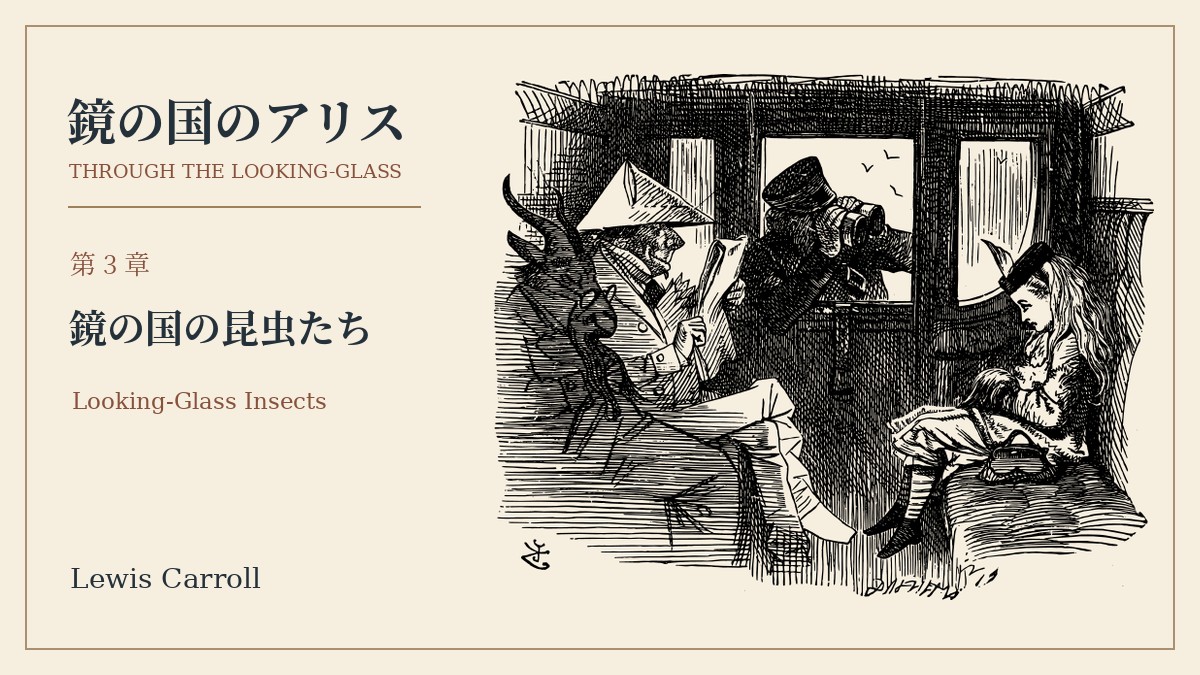
“Tickets, please!” said the guard, putting his head in at the window. In a moment everybody was holding out a ticket: they were about the same size as the people, and quite seemed to fill the carriage.
「きっぷ拝見!」と車掌が、まどから頭をつっこんで言いました。すぐさまみんな、きっぷを出していました。きっぷは人間ほども大きくて、車両がそれだけでいっぱいになりそうです。
“Now then! Show your ticket, child!” the guard went on, looking angrily at Alice. And a great many voices all said together (“like the chorus of a song,” thought Alice), “Don’t keep him waiting, child! Why, his time is worth a thousand pounds a minute!”
「さあさあおじょうちゃん、きっぷを見せるんだよ!」と車掌がつづけ、怒ったようにアリスのほうを見ます。そしてすごくたくさんの声がいっせいにこう言いました(「歌のコーラスみたいだわ」とアリスは思いました)、「おじょうちゃん、車掌さんを待たせちゃダメよ! 車掌さんの時間はお値打ち一分千ポンド!」
“I’m afraid I haven’t got one,” Alice said in a frightened tone: “there wasn’t a ticket-office where I came from.” And again the chorus of voices went on. “There wasn’t room for one where she came from. The land there is worth a thousand pounds an inch!”
「すいません、ないんですけど」とアリスはおびえた声で言いました。「あたしがきたところには、きっぷ売り場がなかったんです」そしてまたもや声のコーラスがはじまります。「この子がきたところには、余裕がなかったのよ。あそこの土地は、お値打ち一ミリ千ポンド!」
“Don’t make excuses,” said the guard: “you should have bought one from the engine-driver.” And once more the chorus of voices went on with “The man that drives the engine. Why, the smoke alone is worth a thousand pounds a puff!”
「いいわけするんじゃない」と車掌さん。「機関手から買えばよかっただろうが」そしてまたもや声のコーラスが始まりました。「機関車を運転する人だよ。なんと、煙だけでもお値打ち一雲千ポンド!」
Alice thought to herself, “Then there’s no use in speaking.” The voices didn’t join in this time, as she hadn’t spoken, but to her great surprise, they all thought in chorus (I hope you understand what thinking in chorus means—for I must confess that I don’t), “Better say nothing at all. Language is worth a thousand pounds a word!”
アリスは「しゃべってもしょうがないわ」と思いました。声はこんどはコーラスしませんでした。アリスがしゃべらなかったからです。でもすごくおどろいたことに、みんなコーラスで考えたのです (「コーラスで考える」というのがどういう意味か、わかってもらえるといいんだけど――というのも白状しちゃうと、このぼくはさっぱりわからないんだもの)「なにも言わないほうがいい。ことばは一言千ポンド!」
“I shall dream about a thousand pounds tonight, I know I shall!” thought Alice.
「今夜は千ポンドの夢を見そう、絶対!」とアリスは思いました。
All this time the guard was looking at her, first through a telescope, then through a microscope, and then through an opera-glass. At last he said, “You’re travelling the wrong way,” and shut up the window and went away.
この間ずっと、車掌さんはアリスをながめていました。最初は望遠鏡を使って、それから顕微鏡を使って、それから双眼鏡を使って。とうとう車掌さんは言いました。「旅行の方向がまちがってるぞ」そして窓を閉めて、あっちに行ってしまいました。
“So young a child,” said the gentleman sitting opposite to her (he was dressed in white paper), “ought to know which way she’s going, even if she doesn’t know her own name!”
「こんなに小さな子供なんだから、自分の名前がわからなくても、行く方向くらいは知らないとダメだね!」と向かいにすわった紳士(白い紙の服を着ています)が言いました。
A Goat, that was sitting next to the gentleman in white, shut his eyes and said in a loud voice, “She ought to know her way to the ticket-office, even if she doesn’t know her alphabet!”
白い服の紳士のとなりにすわっていたヤギが、目を閉じて大声でいいました。「ABCが暗唱できなくったって、きっぷ売り場への道くらいは知ってないとダメだね!」
There was a Beetle sitting next to the Goat (it was a very queer carriage-full of passengers altogether), and, as the rule seemed to be that they should all speak in turn, he went on with “She’ll have to go back from here as luggage!”
ヤギのとなりには、カナブンがすわっていました(総じて、なかなか風変わりな乗客ばかりいっぱい集まった客車でした)。そしてどうやら、みんな順番にしゃべるというのが規則のようで、そのカナブンが先を続けます。「この子は、ここから貨物扱いで戻ってもらわんとダメだね」
Alice couldn’t see who was sitting beyond the Beetle, but a hoarse voice spoke next. “Change engines—” it said, and was obliged to leave off.
カナブンの向こうにだれがすわっているのか、アリスには見えませんでしたけれど、次に聞こえてきた声はずいぶん狼狽(ろうばい)したようすです。「機関車を換えて――」と言って、そのままとぎれてしまいました。
“It sounds like a horse,” Alice thought to herself. And an extremely small voice, close to her ear, said, “You might make a joke on that—something about ‘horse’ and ‘hoarse,’ you know.”
「ロバみたいな声ね」とアリスは思いました。すると耳元で、とっても小さな声が聞こえました。「いまのでだじゃれができるかもね――『ロバ』の『狼狽(ろうばい)』、でね」
Then a very gentle voice in the distance said, “She must be labelled ‘Lass, with care,’ you know—”
すると遠くのほうで、とてもやさしい声が言いました。「その子には『小娘、取り扱い注意』のラベルをつけないといけませんわ――」
And after that other voices went on (“What a number of people there are in the carriage!” thought Alice), saying, “She must go by post, as she’s got a head on her—” “She must be sent as a message by the telegraph—” “She must draw the train herself the rest of the way—” and so on.
そしてそのあと、次々に声がつづきます(「この客車って、ずいぶんたくさん人が乗ってるのねえ!」とアリスは思いました)。「指先でも切手(きって)もらって、郵便で送ったら――」「電信で、電報扱いで送らないと――」「この先、その子に列車を牽かせないと――」などなど。
But the gentleman dressed in white paper leaned forwards and whispered in her ear, “Never mind what they all say, my dear, but take a return-ticket every time the train stops.”
でも白い紙の服の紳士が身をのりだして、アリスの耳にささやきます。「みんながあれこれ言うのは気にしなさんな、おじょうちゃん。でも列車が止まるたびに、戻りのきっぷを買うこと」
“Indeed I shan’t!” Alice said rather impatiently. “I don’t belong to this railway journey at all—I was in a wood just now—and I wish I could get back there.”
「そんなことするもんですか!」とアリスはちょっとプリプリして言いました。「あたしはそもそもこの鉄道旅行には入ってないのよ――さっきまで森の中にいたんだから――できたらそこに戻るつもりよ」
“You might make a joke on that,” said the little voice close to her ear: “something about ‘you would if you could,’ you know.”
またさっきの小さな声が耳元で言います。「いまのもだじゃれにできるよね。森に戻るつもり、なんちて」
“Don’t tease so,” said Alice, looking about in vain to see where the voice came from; “if you’re so anxious to have a joke made, why don’t you make one yourself?”
「そんなにからかわないで」アリスは声がどこからきているのか、あたりを見回しましたが、何も見あたりません。「そんなにだじゃれが好きなら、自分で言えばいいじゃない!」
The little voice sighed deeply: it was very unhappy, evidently, and Alice would have said something pitying to comfort it, “If it would only sigh like other people!” she thought. But this was such a wonderfully small sigh, that she wouldn’t have heard it at all, if it hadn’t come quite close to her ear. The consequence of this was that it tickled her ear very much, and quite took off her thoughts from the unhappiness of the poor little creature.
小さな声がすごく深いため息をつきました。明らかにとっても不幸で、アリスとしても何かなぐさめるようなことを言ったでしょう「ただし他の人みたいにため息をついてくれてればね!」とアリスは思いました。でもそれは実に見事に小さなため息だったので、ごく耳元からきたのでなければ、完全に聞きのがしていたでしょう。その結果として何がおきたかというと、耳をすごくくすぐって、そのせいでかわいそうな生き物の不幸のことを、アリスはすっかり忘れてしまったのでした。
“I know you are a friend,” the little voice went on; “a dear friend, and an old friend. And you won’t hurt me, though I am an insect.”
小さな声は続けます。「きみは友だちだよね。だいじな友だち、昔からの友だち。そしてぼくをいぢめたりしないよね、ぼくが昆虫にはちがいなくても」
“What kind of insect?” Alice inquired a little anxiously. What she really wanted to know was, whether it could sting or not, but she thought this wouldn’t be quite a civil question to ask.
「昆虫って、どんな昆虫なの?」とアリスはちょっと心配そうにたずねました。実はほんとうに知りたかったのは、それが刺す昆虫かどうかだったのですが、そうきくのはちょっとお行儀が悪いかな、と思ったのです。
“What, then you don’t—” the little voice began, when it was drowned by a shrill scream from the engine, and everybody jumped up in alarm, Alice among the rest.
「え、だったらきみは――」と小さな声が言いかけたところで、機関車からの甲高いきしり音でかき消されてしまい、アリスも含め、みんなびっくりして飛び上がりました。
The Horse, who had put his head out of the window, quietly drew it in and said, “It’s only a brook we have to jump over.” Everybody seemed satisfied with this, though Alice felt a little nervous at the idea of trains jumping at all. “However, it’ll take us into the Fourth Square, that’s some comfort!” she said to herself. In another moment she felt the carriage rise straight up into the air, and in her fright she caught at the thing nearest to her hand, which happened to be the Goat’s beard.
窓から首をつきだしたさっきのロバが、静かに頭を戻して言いました。「小川を飛び越えなきゃならないだけですよ」。みんな、これで納得したようでしたが、アリスはそもそも列車が飛ぶということで、ちょっと心配になりました。「でも、それで四升目に行けるわ、それだけはありがたいわね!」とアリスはつぶやきました。つぎのしゅんかん、客車が宙にまっすぐ飛び上がるのが感じられて、こわくなったアリスは、いちばん手近なものを握りしめました。それはヤギのひげでした。
But the beard seemed to melt away as she touched it, and she found herself sitting quietly under a tree—while the Gnat (for that was the insect she had been talking to) was balancing itself on a twig just over her head, and fanning her with its wings.
でもさわったとたんにひげはとけてしまうようで、気がつくとアリスは木の下に静かにすわっているのでした――一方でブヨ(これまで話をしていたのはこの昆虫だったのです)はアリスのすぐ上の小枝でバランスをとって、羽でアリスをあおいでいました。
It certainly was a very large Gnat: “about the size of a chicken,” Alice thought. Still, she couldn’t feel nervous with it, after they had been talking together so long.
たしかに、すっごくおっきなブヨではありました。「ニワトリくらいあるわ」とアリスは思います。でも、いままでずっと話をしてきたもので、今さらこわくなったりもしませんでした。
“—then you don’t like all insects?” the Gnat went on, as quietly as if nothing had happened.
「――だったらきみは、昆虫はみんなきらいなの?」とブヨは、なにごともなかったかのように、静かにつづけました。
“I like them when they can talk,” Alice said. “None of them ever talk, where I come from.”
「しゃべれると昆虫も好きよ。あたしがきたところだと、話す昆虫なんかぜんぜんいないもん」
“What sort of insects do you rejoice in, where you come from?” the Gnat inquired.
「どういう昆虫に熱狂するの、きみのきたところだと?」とブヨがたずねます。
“I don’t rejoice in insects at all,” Alice explained, “because I’m rather afraid of them—at least the large kinds. But I can tell you the names of some of them.”
「あたし、昆虫に熱狂したりはしないわよ。ちょっとこわいんだもの――特に大きいのは。でも、名前なら少しはわかるけど」とアリスは説明します。
“Of course they answer to their names?” the Gnat remarked carelessly.
「もちろん昆虫は、名前を呼ばれたら答えるんだよね?」とブヨはなにげなく言います。
“I never knew them to do it.”
「あたしはそういうおぼえはないけど」
“What’s the use of their having names,” the Gnat said, “if they won’t answer to them?”
「呼ばれて答えないんなら、その子たちは名前なんかあってもしょうがないじゃないの」とブヨ。
“No use to them,” said Alice; “but it’s useful to the people who name them, I suppose. If not, why do things have names at all?”
「そりゃ昆虫には役に立たないだろうけど、でも名前をつけた人間には役にたつんだと思うな。だってそうでなきゃ、なぜそもそもいろんなものに名前なんかついてるのよ」とアリス。
“I can’t say,” the Gnat replied. “Further on, in the wood down there, they’ve got no names—however, go on with your list of insects: you’re wasting time.”
「わかんない。それに、下の方の森では、名前がないんだよ――だけど昆虫の一覧を続けてよ。時間がもったいないし」
“Well, there’s the Horsefly,” Alice began, counting off the names on her fingers.
「そうねぇ、まずウマバエでしょ」とアリスは指折り数えながら名前を挙げはじめました。
“All right,” said the Gnat: “halfway up that bush, you’ll see a Rocking-horse-fly, if you look. It’s made entirely of wood, and gets about by swinging itself from branch to branch.”
「はいはい、あの茂みの半ばくらいのところを見てもらえば、木馬ハエがいるでしょう。全身が木だけでできてて、枝から枝へギシギシ揺れながら動くんだよ」とブヨ。
“What does it live on?” Alice asked, with great curiosity.
「なにを食べてるの?」アリスは知りたくてたまりませんでした。
“Sap and sawdust,” said the Gnat. “Go on with the list.”
「樹液とおがくず。先を続けてよ」とブヨ。
Alice looked up at the Rocking-horse-fly with great interest, and made up her mind that it must have been just repainted, it looked so bright and sticky; and then she went on.
アリスは木馬バエを興味津々(きょうみしんしん)で見上げました。ペンキ塗り立てみたいね、と思いました。色鮮やかでベタベタしてそうだったからです。でも、先を続けました。
“And there’s the Dragonfly.”
「それと、ドラゴンフライ(とんぼ)ね」
“Look on the branch above your head,” said the Gnat, “and there you’ll find a Snapdragon-fly. Its body is made of plum-pudding, its wings of holly-leaves, and its head is a raisin burning in brandy.”
「頭の上の枝をみてごらん。スナップ・ドラゴンフライがいるでしょ。からだはプラム・プディングで、羽はヒイラギの葉っぱ、頭はブランデーの中で燃える干しぶどうだよ」
訳注:すみません、これはイラストの都合もあって、別のだじゃれで置き換えるわけにいきませんでしたです。スナップドラゴンというのはですねぇ、西洋のクリスマスの慣習で、ブランデーをお皿に入れて干しぶどうをそこにまいて火をつけて、それを指で取り出すという遊びでございます。
“And what does it live on?”
「それは何を食べるの?」
“Frumenty and mince pie,” the Gnat replied; “and it makes its nest in a Christmas box.”
「小麦プリンとミートパイ。そして巣はクリスマスのプレゼントの箱の中につくるの」
“And then there’s the Butterfly,” Alice went on, after she had taken a good look at the insect with its head on fire, and had thought to herself, “I wonder if that’s the reason insects are so fond of flying into candles—because they want to turn into Snapdragon-flies!”
「それと、黄斑(きはん)チョウっていうのもいたな」アリスは、頭の燃えている昆虫をよーくながめて、「昆虫が火に飛び込みたがるのって、このせいかしら――みんな、スナップ・ドラゴンフライになりたがってるのかも!」と思ってから続けました。
“Crawling at your feet,” said the Gnat (Alice drew her feet back in some alarm), “you may observe a Bread-and-Butterfly. Its wings are thin slices of Bread-and-butter, its body is a crust, and its head is a lump of sugar.”
「きみの足下をはいずっているのが」(とブヨに言われて、アリスはあわてて足をひっこめました)「バタつきパンチョウね。羽は薄いバタつきパンで、胴体が耳のところで、頭が角砂糖」
“And what does it live on?”
「それでこれはなにを食べてるの?」
“Weak tea with cream in it.”
「クリーム入りの薄い紅茶」
A new difficulty came into Alice’s head. “Supposing it couldn’t find any?” she suggested.
新しいなぞが、アリスの頭に浮かびました。「もしそれが見つからなかったら?」
“Then it would die, of course.”
「そしたら死ぬよ、もちろん」
“But that must happen very often,” Alice remarked thoughtfully.
「でも、それってずいぶんよくありそうだけど」とアリスは考えこんで言いました。
“It always happens,” said the Gnat.
「しょっちゅうだよ」とブヨ。
After this, Alice was silent for a minute or two, pondering. The Gnat amused itself meanwhile by humming round and round her head: at last it settled again and remarked, “I suppose you don’t want to lose your name?”
これをきいて、アリスはしばらくだまって考えこんでしまいました。ブヨはその間、退屈しのぎにアリスの頭のまわりをブンブン飛んでいます。最後にまた枝にとまって、こう言いました。「きみって、名前をなくしたりしたくないよね」
“No, indeed,” Alice said, a little anxiously.
「いいえ、まさか」アリスはちょっと不安そうです。でも、ブヨは気軽な調子で続けました。
“And yet I don’t know,” the Gnat went on in a careless tone: “only think how convenient it would be if you could manage to go home without it! For instance, if the governess wanted to call you to your lessons, she would call out ‘come here—,’ and there she would have to leave off, because there wouldn’t be any name for her to call, and of course you wouldn’t have to go, you know.”
「うん、でもどんなもんだろうね。名無しで家に戻れたらすごく便利だと思わない? たとえば家庭教師が授業できみを呼びたくても、『始めますよ、――』と言って止めるしかなくて、だって家庭教師が呼べる名前もないし、そうなったらもちろんきみもいかなくてすむわけでしょ」
“That would never do, I’m sure,” said Alice: “the governess would never think of excusing me lessons for that. If she couldn’t remember my name, she’d call me ‘Miss!’ as the servants do.”
「それじゃぜったいすまないわ、まちがいなく。先生はぜったいにそんなことで、授業をやめたりしないもの。あたしの名前が思い出せなければ、召使いたちを呼ぶときみたいに『ちょっと!』と言うだけよ」
“Well, if she said ‘Miss,’ and didn’t say anything more,” the Gnat remarked, “of course you’d miss your lessons. That’s a joke. I wish you had made it.”
「ふーん。でももし先生が『ちょっと!』とだけしか言わなかったら、もちろん授業もちょっとしか出なくていいんだよね。いまのはだじゃれだよ。きみが言ったんならよかったのに」
“Why do you wish I had made it?” Alice asked. “It’s a very bad one.”
「どうしてあたしが言ったらよかったと思うわけ? ずいぶん寒いだじゃれなのに」
But the Gnat only sighed deeply, while two large tears came rolling down its cheeks.
でもブヨは深いため息をついただけで、おっきな涙が二つ、ほっぺたを転がりおちてきました。
“You shouldn’t make jokes,” Alice said, “if it makes you so unhappy.”
「そんなに不幸になるなら、だじゃれなんか言っちゃだめよ」とアリス。
Then came another of those melancholy little sighs, and this time the poor Gnat really seemed to have sighed itself away, for, when Alice looked up, there was nothing whatever to be seen on the twig, and, as she was getting quite chilly with sitting still so long, she got up and walked on.
そこにまた、あの憂鬱で小さなため息がきて、今回は哀れなブヨも、ため息で自分をはきだしきってしまったようです。アリスが目をあげると、小枝にはなにも目に入るものはなくて、アリスとしてもじっとすわりっぱなしでちょっと寒くなってきたので、立ち上がって歩き出しました。
She very soon came to an open field, with a wood on the other side of it: it looked much darker than the last wood, and Alice felt a little timid about going into it. However, on second thoughts, she made up her mind to go on: “for I certainly won’t go back,” she thought to herself, and this was the only way to the Eighth Square.
じきに開けた野原にやってきまして、その向こう側に森があります。さっきの森よりずいぶん暗くて、アリスとしてもそこに入っていくのはちょっとだけこわかったんですが、考え直して、森に入ることに決めました。「だって、絶対に戻るのはいやだもの」と思ったし、それに八升目につくには、これが唯一の方法でしたから。
“This must be the wood,” she said thoughtfully to herself, “where things have no names. I wonder what’ll become of my name when I go in? I shouldn’t like to lose it at all—because they’d have to give me another, and it would be almost certain to be an ugly one. But then the fun would be trying to find the creature that had got my old name! That’s just like the advertisements, you know, when people lose dogs—‘answers to the name of “Dash”: had on a brass collar’—just fancy calling everything you met ‘Alice,’ till one of them answered! Only they wouldn’t answer at all, if they were wise.”
「これが、名前のない森ね」とアリスは考えこみました。「入ったら、あたしの名前はどうなっちゃうんだろう。名前を全部なくしちゃうのはいやだな――そうなったら別の名前がつけられるだろうし、どうせひどい名前になるに決まってるもの。でも、そうしたらあたしのもとの名前をもらった生き物を探すのはおもしろいだろうな! 迷子の犬を探す広告とかみたいでしょう――『「ポチ」と呼ぶと答えます:しんちゅうの首輪つき』――だれかが返事するまで、会うものを片っ端から『アリス』と呼ぶのよ! でも、賢ければ呼ばれても返事なんかしないと思うけど」
She was rambling on in this way when she reached the wood: it looked very cool and shady. “Well, at any rate it’s a great comfort,” she said as she stepped under the trees, “after being so hot, to get into the—into what?” she went on, rather surprised at not being able to think of the word. “I mean to get under the—under the—under this, you know!” putting her hand on the trunk of the tree. “What does it call itself, I wonder? I do believe it’s got no name—why, to be sure it hasn’t!”
とかなんとか、いろいろぶつぶつ言っているうちに、森にやってきました。とてもうっそうとして涼しそうです。「なにはともあれ、とっても気持ちよさそうではあるわね」とアリスは木々の下に入りました。「こんなに暑かったところから、こんなひんやりした――ひんやりしたなんだっけ?」とアリスは、ことばが出てこないのにいささか驚いて続けました。「つまりひんやりした――この――この、これの下、なんだけど!」とアリスは、手を木の幹に触れました。「これって、なんて自称してるんだろう。まちがいなく、名前がないんだと思うわ――絶対まちがいなくないわ!」
She stood silent for a minute, thinking: then she suddenly began again. “Then it really has happened, after all! And now, who am I? I will remember, if I can! I’m determined to do it!” But being determined didn’t help much, and all she could say, after a great deal of puzzling, was, “L, I know it begins with L!”
アリスはしばらくだまって考えこみました。それから急にしゃべりだしました。「じゃあほんとうに起きたんだわ! それじゃあ、あたしはだれ? 思い出したいわ、思い出せるものなら! 絶対がんばって思い出すわ」でもいくらがんばっても大した役にはたちません。そしてさんざん首をひねったあげくに、アリスがやっと言えたのはこれだけでした。「『リ』よ、ぜったいまちがいなく『リ』で始まったはず!」
Just then a Fawn came wandering by: it looked at Alice with its large gentle eyes, but didn’t seem at all frightened. “Here then! Here then!” Alice said, as she held out her hand and tried to stroke it; but it only started back a little, and then stood looking at her again.
ちょうど、子鹿がふらりとやってきました。おっきなやさしい目でアリスを見つめましたが、ぜんぜんこわがっていないようです。「おいで! おいで!」とアリスは手をのばしてなでようとしました。でもそれはちょっととびのいて、またじっと立ってアリスを見つめています。
“What do you call yourself?” the Fawn said at last. Such a soft sweet voice it had!
「きみ、なんていうの?」子鹿はやっと言いました。とってもやわらかくて甘い声でした!
“I wish I knew!” thought poor Alice. She answered, rather sadly, “Nothing, just now.”
「それがわかればねえ!」とアリスは思いました。そして、ちょっと悲しそうにこう答えました。「いまはなにもないの」
“Think again,” it said: “that won’t do.”
「それじゃダメだよ。もっとよく考えて」とそれは言いました。
Alice thought, but nothing came of it. “Please, would you tell me what you call yourself?” she said timidly. “I think that might help a little.”
考えましたが、なにも浮かびません。アリスはおずおずとたずねます。「お願い、あなたはなんていうの、教えてよ。そしたらこっちも、思いだしやすくなるかも」
“I’ll tell you, if you’ll move a little further on,” the Fawn said. “I can’t remember here.”
「もうちょっと先までいったら教えてあげる。ここでは思い出せないの」と子鹿。
So they walked on together through the wood, Alice with her arms clasped lovingly round the soft neck of the Fawn, till they came out into another open field, and here the Fawn gave a sudden bound into the air, and shook itself free from Alice’s arms. “I’m a Fawn!” it cried out in a voice of delight, “and, dear me! you’re a human child!” A sudden look of alarm came into its beautiful brown eyes, and in another moment it had darted away at full speed.
そこで両者は、森の中をいっしょに歩いていきました。アリスは子鹿のやわらかい首に、愛しげに腕をまわしています。でもやがて、また開けた野原にやってきました。すると子鹿はとつぜん空中に飛び上がって、アリスの腕をふりほどきました。「ぼくは子鹿だ!」と喜びの声をあげます。「そして、わあどうしよう! きみは人間の子供じゃないか!」その美しい茶色の目に、いきなり警戒の色が浮かんで、つぎのしゅんかんには全速力でかけ去ってしまいました。
Alice stood looking after it, almost ready to cry with vexation at having lost her dear little fellow-traveller so suddenly. “However, I know my name now,” she said, “that’s some comfort. Alice—Alice—I won’t forget it again. And now, which of these finger-posts ought I to follow, I wonder?”
アリスはそれを見送って立ちつくしていました。こんなに急に、愛しい小さな旅仲間を失って、ほとんど泣きそうです。「でも、もう自分の名前がわかるわ。それはちょっとは安心だな。アリス――アリス――もう二度とわすれないわ。さて、あの道しるべのどっちにしたがったらいいのかな?」
It was not a very difficult question to answer, as there was only one road through the wood, and the two finger-posts both pointed along it. “I’ll settle it,” Alice said to herself, “when the road divides and they point different ways.”
これはとっても答えやすい質問でした。森をぬける道は一つしかなかったし、二つの道しるべは、どっちも同じ方向を指していたからです。「道が分かれて、道しるべがそれぞれ別の方向を指すようになったら、かたがつくでしょう」とアリスはつぶやきました。
But this did not seem likely to happen. She went on and on, a long way, but wherever the road divided there were sure to be two finger-posts pointing the same way, one marked to Tweedledum’s house and the other to the house of Tweedledee.
でも、どうやらそんなことにはならないようです。アリスはひたすら前進して、ずいぶん歩いたのですが、道が分かれるたびに道しるべが二つあって、どっちも同じ方向を指しているのです。一つは
トゥィードルダムのおうち方面 →
と書かれていて、もう一つは
トゥィードルディーのおうち方面 →
と書かれています。
“I do believe,” said Alice at last, “that they live in the same house! I wonder I never thought of that before—But I can’t stay there long. I’ll just call and say ‘how d’you do?’ and ask them the way out of the wood. If I could only get to the Eighth Square before it gets dark!” So she wandered on, talking to herself as she went, till, on turning a sharp corner, she came upon two fat little men, so suddenly that she could not help starting back, but in another moment she recovered herself, feeling sure that they must be—
「これってどう考えても、二人とも同じ家にすんでるんだわ! どうしていままで思いつかなかったのかしら――でも長居するわけにはいかないわね。ちょっといって、『ごめんください』と言って、森から出る道をきくだけね。暗くなる前に八升目につかないと!」そこでアリスはさらにぶらぶらとすすみ、ぶつぶつ独り言を言っていましたが、急な曲がり角を曲がると、ちびでデブな二人組に出くわしました。いきなり出くわしたので、思わず飛びのいてしまいましたが、次のしゅんかんには気をとりなおして、これぞまさしく――
原文・日本語訳・朗読
原作:ルイス・キャロル(Lewis Carroll)
原作挿絵:ジョン・テニエル(John Tenniel)
英語原文:Standard Ebooks・Project Gutenberg
日本語訳:© 2000 山形浩生 『鏡の国のアリス』原訳(プロジェクト杉田玄白正式参加作品)
クリエイティブ・コモンズ 表示–継承2.1 日本。対訳の段組み・改行・語注・章扉はオレタン版によります。第1章の1896年版序文後半はこの版で補訳しています。日本語訳とその編集版は同一ライセンスで利用できます。