
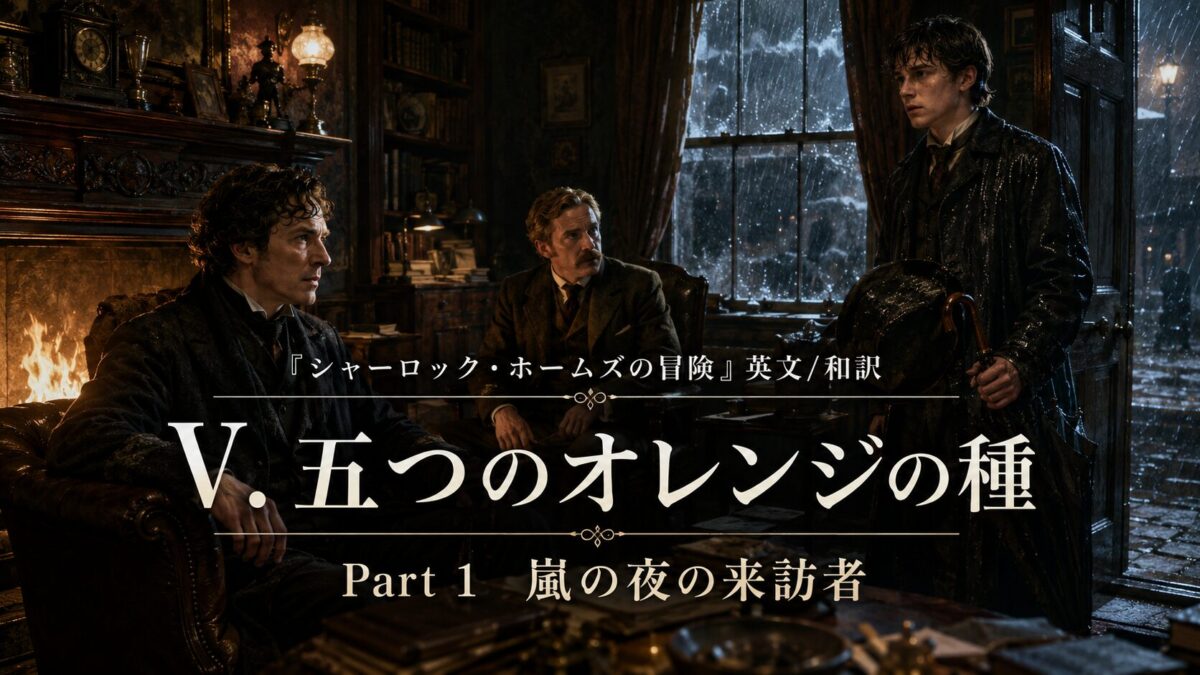
CHAPTER V THE FIVE ORANGE PIPS(五つのオレンジの種)Part 1 のポイント
この章では、嵐の夜に若い紳士ジョン・オープンショーがベーカー街を訪れ、ホームズに奇妙で恐ろしい家族の災難を語り始めます。彼の伯父はアメリカから帰国後、謎の封筒と五つのオレンジの種を受け取り、その後不審な死を遂げていました。
読みどころは、これまでの事件よりも不気味で切迫した空気が強い点です。五つの小さな種、封筒に記された謎の文字、過去のアメリカでの因縁が、まだ姿を見せない危険な組織の影を読者に感じさせます。
この章の英語学習ポイントを開く
- storm:嵐。依頼人が訪れる夜の不穏な雰囲気を作る、場面描写の重要語です。
- envelope:封筒。五つのオレンジの種が送られてくる、事件の中心的な小道具です。
- orange pips:オレンジの種。題名にもなる謎の印で、死の予告のように機能します。
- mysterious:謎めいた、不可解な。伯父の過去や死をめぐる不気味さを表す語です。
- danger:危険。依頼人の身にも迫っている脅威を読み取るための基本語です。
『シャーロック・ホームズの冒険』英文/和訳 V. THE FIVE ORANGE PIPS Part 1 五つのオレンジの種
『The Adventures of Sherlock Holmes』より「THE FIVE ORANGE PIPS」を、全3記事構成で読みやすく整理します。Part 1では、嵐の夜にベーカー街を訪れたジョン・オープンショーが、伯父イライアスに届いた最初の不吉な手紙を語る場面までを扱います。
When I glance over my notes and records of the Sherlock Holmes cases between the years ’82 and ’90, I am faced by so many which present strange and interesting features that it is no easy matter to know which to choose and which to leave.
1882年から1890年までのシャーロック・ホームズ事件のメモや記録をざっと見返すと、奇妙で興味深い特徴を持つ事件があまりに多く、どれを選び、どれを残すべきか判断するのは容易ではない。
Some, however, have already gained publicity through the papers, and others have not offered a field for those peculiar qualities which my friend possessed in so high a degree, and which it is the object of these papers to illustrate.
しかし、すでに新聞を通して世に知られた事件もあれば、わが友が非常に高い水準で備えていた独特の能力を示す場としては、あまり適さない事件もあった。この記録の目的は、まさにその能力を示すことなのである。
Some, too, have baffled his analytical skill, and would be, as narratives, beginnings without an ending, while others have been but partially cleared up, and have their explanations founded rather upon conjecture and surmise than on that absolute logical proof which was so dear to him.
また、ホームズの分析力をもってしても解けなかった事件もある。それらは物語としては結末のない始まりにすぎない。さらに、部分的にしか解明されず、彼が何より重んじた完全な論理的証明ではなく、推測や憶測に説明を頼らざるを得ない事件もあった。
There is, however, one of these last which was so remarkable in its details and so startling in its results that I am tempted to give some account of it in spite of the fact that there are points in connection with it which never have been, and probably never will be, entirely cleared up.
しかし、そのような事件の一つに、細部がきわめて注目すべきもので、結果も非常に衝撃的だったものがある。その事件には、これまで一度も完全には解明されず、おそらく今後も解明されないであろう点があるにもかかわらず、私はその記録を残したい気持ちに駆られるのである。
The year ’87 furnished us with a long series of cases of greater or less interest, of which I retain the records.
1887年は、多かれ少なかれ興味深い事件が長く続いた年であり、私はその記録を今も保管している。
Among my headings under this one twelve months I find an account of the adventure of the Paradol Chamber, of the Amateur Mendicant Society, who held a luxurious club in the lower vault of a furniture warehouse, of the facts connected with the loss of the British barque Sophy Anderson, of the singular adventures of the Grice Patersons in the island of Uffa, and finally of the Camberwell poisoning case.
この一年の見出しの中には、パラドル・チェンバー事件、家具倉庫の地下倉庫で豪華なクラブを開いていたアマチュア乞食協会、英国帆船ソフィー・アンダーソン号の喪失に関する事実、ウファ島におけるグライス・パターソン一家の奇妙な冒険、そして最後にキャンバーウェル毒殺事件がある。
In the latter, as may be remembered, Sherlock Holmes was able, by winding up the dead man’s watch, to prove that it had been wound up two hours before, and that therefore the deceased had gone to bed within that time—a deduction which was of the greatest importance in clearing up the case.
後者の事件では、記憶されているかもしれないが、ホームズは死者の時計を巻き上げることによって、それが二時間前に巻かれていたこと、したがって死者がその時間内に寝床に入ったことを証明できた。この推理は事件解明において非常に重要だった。
All these I may sketch out at some future date, but none of them present such singular features as the strange train of circumstances which I have now taken up my pen to describe.
これらの事件については、いつか概略を書くかもしれない。しかし、今ここで筆を取って述べようとしている奇妙な一連の事情ほど、特異な特徴を示すものはない。
It was in the latter days of September, and the equinoctial gales had set in with exceptional violence.
それは九月下旬のことで、秋分の頃の嵐が異例の激しさで始まっていた。
All day the wind had screamed and the rain had beaten against the windows, so that even here in the heart of great, hand-made London we were forced to raise our minds for the instant from the routine of life.
一日中、風は悲鳴を上げ、雨は窓に打ちつけていた。そのため、人の手で作られた大都市ロンドンの中心にいながら、私たちは一瞬、日常生活から心を引き上げざるを得なかった。
We had to recognise the presence of those great elemental forces which shriek at mankind through the bars of his civilisation, like untamed beasts in a cage.
そして、文明という檻の鉄格子越しに人類へ叫びかける、巨大な自然の力の存在を認めざるを得なかった。それは檻の中の飼いならされぬ獣のようだった。
As evening drew in, the storm grew higher and louder, and the wind cried and sobbed like a child in the chimney.
夕方になると、嵐はいっそう激しく大きくなり、風は煙突の中で子どものように泣き叫んだ。
Sherlock Holmes sat moodily at one side of the fireplace, cross-indexing his records of crime, while I at the other was deep in one of Clark Russell’s fine sea-stories.
ホームズは暖炉の片側で陰気に座り、犯罪記録の相互索引を作っていた。一方、私は反対側でクラーク・ラッセルの見事な海洋物語に没頭していた。
The howl of the gale from without seemed to blend with the text, and the splash of the rain seemed to lengthen out into the long swash of the sea waves.
外から聞こえる嵐のうなりは文章と溶け合うように思われ、雨のしぶきは海の波が長くざわめく音へと伸びていくように感じられた。
My wife was on a visit to her mother’s, and for a few days I was a dweller once more in my old quarters at Baker Street.
妻は母のもとを訪ねており、私は数日間、再びベーカー街の昔の部屋の住人となっていた。
“Why,” said I, glancing up at my companion, “that was surely the bell. Who could come to-night? Some friend of yours, perhaps?”
「おや」と私は友人を見上げて言った。「今のは確かにベルだった。こんな夜に誰だろう。君の友人かね?」
“Except yourself I have none,” he answered. “I do not encourage visitors.”
「君以外にはいない」と彼は答えた。「私は来客を歓迎する方ではないからね」
“A client, then?”
「では依頼人か?」
“If so, it is a serious case. Nothing less would bring a man out on such a day and at such an hour.”
「もしそうなら、重大な事件だろう。こんな日、こんな時間に人を外へ出させるものは、それ以外にない」
“But I take it that it is more likely to be some crony of the landlady’s.”
「だが、大家の古い知人か何かである可能性の方が高いと思うね」
Sherlock Holmes was wrong in his conjecture, however, for there came a step in the passage and a tapping at the door.
しかし、ホームズの推測は間違っていた。廊下に足音がし、ドアを叩く音が聞こえたからである。
He stretched out his long arm to turn the lamp away from himself and towards the vacant chair upon which a newcomer must sit.
彼は長い腕を伸ばし、ランプの向きを自分からそらして、新来者が座るはずの空椅子へ向けた。
“Come in!” said he.
「入りたまえ」と彼は言った。
The man who entered was young, some two-and-twenty at the outside, well-groomed and trimly clad, with something of refinement and delicacy in his bearing.
入ってきた男は若く、せいぜい二十二歳ほどだった。身なりはよく整い、服装もきちんとしており、その物腰には上品さと繊細さがあった。
The streaming umbrella which he held in his hand, and his long shining waterproof told of the fierce weather through which he had come.
手に持った水の滴る傘と、長く光る防水外套は、彼が通ってきた激しい天候を物語っていた。
He looked about him anxiously in the glare of the lamp, and I could see that his face was pale and his eyes heavy, like those of a man who is weighed down with some great anxiety.
彼はランプのまぶしい光の中で不安そうにあたりを見回した。顔は青ざめ、目は重く、大きな不安に押しつぶされている男のように見えた。
“I owe you an apology,” he said, raising his golden pince-nez to his eyes. “I trust that I am not intruding.”
「お詫びしなければなりません」と彼は金縁の鼻眼鏡を目に上げながら言った。「お邪魔でなければよいのですが」
“I fear that I have brought some traces of the storm and rain into your snug chamber.”
「嵐と雨の跡を、この居心地のよいお部屋へ持ち込んでしまったようです」
“Give me your coat and umbrella,” said Holmes. “They may rest here on the hook and will be dry presently. You have come up from the south-west, I see.”
「外套と傘をこちらへ」とホームズは言った。「ここで掛けておけば、じきに乾くだろう。君は南西の方から来たようだね」
“Yes, from Horsham.”
「はい、ホーシャムからです」
“That clay and chalk mixture which I see upon your toe caps is quite distinctive.”
「つま先に付いている粘土と白亜の混じった泥は、かなり特徴的だからね」
“I have come for advice.”
「助言をいただきに来ました」
“That is easily got.”
「それなら簡単に得られる」
“And help.”
「そして助力もです」
“That is not always so easy.”
「それは必ずしも容易ではない」
“I have heard of you, Mr. Holmes. I heard from Major Prendergast how you saved him in the Tankerville Club scandal.”
「ホームズさん、私はあなたのお噂を聞いております。タンカーヴィル・クラブの醜聞であなたが彼を救ったことを、プレンダーガスト少佐から聞きました」
“Ah, of course. He was wrongfully accused of cheating at cards.”
「ああ、そうだった。彼はカードでいかさまをしたと不当に告発されたのだ」
“He said that you could solve anything.”
「少佐は、あなたならどんなことでも解決できると言っていました」
“He said too much.”
「それは言いすぎだ」
“That you are never beaten.”
「あなたは決して負けないとも」
“I have been beaten four times—three times by men, and once by a woman.”
「私は四度負けている。三度は男に、一度は女性にね」
“But what is that compared with the number of your successes?”
「しかし、それもあなたの成功の数に比べれば何でもないでしょう」
“It is true that I have been generally successful.”
「たしかに、概して成功してきたとは言える」
“Then you may be so with me.”
「では、私の場合もそうなっていただけるかもしれません」
“I beg that you will draw your chair up to the fire and favour me with some details as to your case.”
「どうか椅子を火のそばへ寄せて、事件の詳細を聞かせてくれたまえ」
“It is no ordinary one.”
「これは普通の事件ではありません」
“None of those which come to me are. I am the last court of appeal.”
「私のところへ来る事件で普通のものはない。私は最後の上訴裁判所のようなものだからね」
“And yet I question, sir, whether, in all your experience, you have ever listened to a more mysterious and inexplicable chain of events than those which have happened in my own family.”
「それでも、あなたのご経験の中で、私の家族に起こった出来事ほど不可解で説明しがたい一連の事件をお聞きになったことがあるかどうか、疑わしいと思います」
“You fill me with interest,” said Holmes. “Pray give us the essential facts from the commencement.”
「それは非常に興味深い」とホームズは言った。「どうか最初から肝心な事実を話してくれたまえ」
“I can afterwards question you as to those details which seem to me to be most important.”
「そのあとで、私が重要だと思う細部について質問しよう」
The young man pulled his chair up and pushed his wet feet out towards the blaze.
若者は椅子を引き寄せ、濡れた足を炎の方へ突き出した。
“My name,” said he, “is John Openshaw, but my own affairs have, as far as I can understand, little to do with this awful business.”
「私の名はジョン・オープンショーです」と彼は言った。「しかし私自身の事情は、私の理解するかぎり、この恐ろしい事件とはほとんど関係がありません」
“It is a hereditary matter; so in order to give you an idea of the facts, I must go back to the commencement of the affair.”
「これは家系に関わる問題なのです。ですから、事実の見当をつけていただくためには、事件の始まりまでさかのぼらなければなりません」
“You must know that my grandfather had two sons—my uncle Elias and my father Joseph.”
「私の祖父には二人の息子がいました。伯父のイライアスと、私の父ジョセフです」
“My father had a small factory at Coventry, which he enlarged at the time of the invention of bicycling.”
「父はコヴェントリーに小さな工場を持っていましたが、自転車が発明された時期にそれを拡大しました」
“He was a patentee of the Openshaw unbreakable tire, and his business met with such success that he was able to sell it and to retire upon a handsome competence.”
「父はオープンショー式の壊れないタイヤの特許権者で、その事業は大成功しました。そのため、事業を売却し、十分な財産をもって引退することができたのです」
“My uncle Elias emigrated to America when he was a young man and became a planter in Florida, where he was reported to have done very well.”
「伯父イライアスは若いころアメリカへ移住し、フロリダで農園主になりました。そこでかなり成功したと聞いています」
“At the time of the war he fought in Jackson’s army, and afterwards under Hood, where he rose to be a colonel.”
「戦争の時にはジャクソンの軍で戦い、その後フッドのもとで戦って、大佐にまで昇進しました」
“When Lee laid down his arms my uncle returned to his plantation, where he remained for three or four years.”
「リー将軍が降伏すると、伯父は自分の農園へ戻り、そこで三、四年過ごしました」
“About 1869 or 1870 he came back to Europe and took a small estate in Sussex, near Horsham.”
「1869年か1870年ごろ、伯父はヨーロッパへ戻り、サセックスのホーシャム近くに小さな地所を手に入れました」
“He had made a very considerable fortune in the States, and his reason for leaving them was his aversion to the negroes, and his dislike of the Republican policy in extending the franchise to them.”
「伯父はアメリカでかなりの財産を築いていました。そしてアメリカを去った理由は、黒人に対する嫌悪と、彼らへ参政権を広げる共和党の政策への反感でした」
“He was a singular man, fierce and quick-tempered, very foul-mouthed when he was angry, and of a most retiring disposition.”
「伯父は変わった人物でした。荒々しく短気で、怒るとひどく口汚く、そしてきわめて人付き合いを嫌う性質でした」
“During all the years that he lived at Horsham, I doubt if ever he set foot in the town.”
「ホーシャムで暮らしていた年月のあいだ、伯父が町に足を踏み入れたことがあったかどうか、私は疑わしいと思っています」
“He had a garden and two or three fields round his house, and there he would take his exercise, though very often for weeks on end he would never leave his room.”
「家の周囲には庭と二、三の畑があり、そこで運動をしていました。しかし、何週間も続けて部屋からまったく出ないことも珍しくありませんでした」
“He drank a great deal of brandy and smoked very heavily, but he would see no society and did not want any friends, not even his own brother.”
「伯父はブランデーを大量に飲み、煙草も非常によく吸いました。しかし社交は一切せず、友人も求めませんでした。実の弟である父でさえ例外ではありませんでした」
“He didn’t mind me; in fact, he took a fancy to me, for at the time when he saw me first I was a youngster of twelve or so.”
「伯父は私のことは嫌がりませんでした。むしろ気に入ってくれました。初めて会ったとき、私は十二歳くらいの少年だったからです」
“This would be in the year 1878, after he had been eight or nine years in England. He begged my father to let me live with him and he was very kind to me in his way.”
「それは1878年ごろ、伯父がイングランドに来て八、九年たったころでした。伯父は父に、私を自分と一緒に住まわせてほしいと頼み、彼なりに私にはとても親切でした」
“When he was sober he used to be fond of playing backgammon and draughts with me, and he would make me his representative both with the servants and with the tradespeople.”
「しらふのときには、私とバックギャモンやチェッカーをするのを好み、召使いや商人たちに対しては、私を自分の代理人にしました」
“So that by the time that I was sixteen I was quite master of the house. I kept all the keys and could go where I liked and do what I liked, so long as I did not disturb him in his privacy.”
「そのため、十六歳になるころには、私は家の主人同然になっていました。すべての鍵を持ち、伯父の私的な時間を邪魔しないかぎり、好きなところへ行き、好きなことができたのです」
“There was one singular exception, however, for he had a single room, a lumber-room up among the attics, which was invariably locked.”
「ただし、一つだけ奇妙な例外がありました。屋根裏のあたりに一室、物置部屋があり、そこにはいつも鍵がかかっていたのです」
“He would never permit either me or anyone else to enter.”
「伯父は、私にも他の誰にも、そこへ入ることを決して許しませんでした」
“With a boy’s curiosity I have peeped through the keyhole, but I was never able to see more than such a collection of old trunks and bundles as would be expected in such a room.”
「少年らしい好奇心から鍵穴をのぞいたことはあります。しかし、そのような部屋にありそうな古い箱や包みの集まり以上のものは見えませんでした」
“One day—it was in March, 1883—a letter with a foreign stamp lay upon the table in front of the colonel’s plate.”
「ある日、1883年の三月のことです。外国の切手が貼られた一通の手紙が、大佐である伯父の皿の前のテーブルに置かれていました」
“It was not a common thing for him to receive letters, for his bills were all paid in ready money, and he had no friends of any sort.”
「伯父が手紙を受け取るのは珍しいことでした。請求はすべて現金で払っていましたし、どんな友人もいなかったからです」
“‘From India!’ said he as he took it up, ‘Pondicherry postmark! What can this be?’”
「『インドからだ!』と伯父はそれを取り上げながら言いました。『ポンディシェリの消印だ! これは何だろう?』」
“Opening it hurriedly, out there jumped five little dried orange pips, which pattered down upon his plate.”
「伯父が急いで封を開けると、中から五つの小さな乾いたオレンジの種が飛び出し、皿の上にぱらぱらと落ちました」
“I began to laugh at this, but the laugh was struck from my lips at the sight of his face.”
「私はそれを見て笑い出しました。しかし伯父の顔を見た瞬間、その笑いは唇から消えました」
“His lip had fallen, his eyes were protruding, his skin the colour of putty, and he glared at the envelope which he still held in his trembling hand.”
「伯父の唇は垂れ下がり、目は飛び出し、肌はパテのような色になっていました。そして震える手にまだ握っている封筒を、じっとにらみつけていたのです」
“‘K. K. K.!’ he shrieked, and then, ‘My God, my God, my sins have overtaken me!’”
「『K・K・K!』と伯父は叫びました。そして『神よ、神よ、私の罪が私に追いついた!』と言ったのです」
“‘What is it, uncle?’ I cried.”
「『伯父さん、何なんですか?』と私は叫びました」
“‘Death,’ said he, and rising from the table he retired to his room, leaving me palpitating with horror.”
「『死だ』と伯父は言いました。そして食卓から立ち上がると、自分の部屋へ引きこもり、私は恐怖で胸をどきどきさせたまま残されました」
“I took up the envelope and saw scrawled in red ink upon the inner flap, just above the gum, the letter K three times repeated.”
「私は封筒を拾い上げ、内側の折り返し、糊のすぐ上に、赤インクでKの文字が三度繰り返してなぐり書きされているのを見ました」
“There was nothing else save the five dried pips.”
「それ以外には、五つの乾いた種のほか何もありませんでした」
“What could be the reason of his overpowering terror?”
「伯父をあれほど圧倒的な恐怖に陥れた理由はいったい何だったのでしょうか」
“I left the breakfast-table, and as I ascended the stair I met him coming down with an old rusty key, which must have belonged to the attic, in one hand.”
「私は朝食の席を離れ、階段を上っていると、伯父が降りてくるのに出会いました。片手には屋根裏部屋のものに違いない古びた錆びた鍵を持っていました」
“And in the other he carried a small brass box, like a cashbox.”
「もう一方の手には、金庫のような小さな真鍮の箱を持っていました」
“‘They may do what they like, but I’ll checkmate them still,’ said he with an oath.”
「『奴らが何をしようと、私はまだ奴らに王手をかけてやる』と伯父は罵りの言葉を交えて言いました」
“‘Tell Mary that I shall want a fire in my room to-day, and send down to Fordham, the Horsham lawyer.’”
「『メアリーに、今日は私の部屋に火を入れるよう言え。それからホーシャムの弁護士フォーダムを呼びにやれ』」
“I did as he ordered, and when the lawyer arrived I was asked to step up to the room.”
「私は命じられたとおりにし、弁護士が到着すると、その部屋へ上がるよう呼ばれました」
“The fire was burning brightly, and in the grate there was a mass of black, fluffy ashes, as of burned paper.”
「火は明るく燃えており、炉の中には、燃えた紙のものと思われる黒くふわふわした灰が大量にありました」
“The brass box stood open and empty beside it.”
「そのそばには真鍮の箱が開いたまま空になって置かれていました」
“As I glanced at the box I noticed, with a start, that upon the lid was printed the treble K which I had read in the morning upon the envelope.”
「箱に目をやった私は、はっとしました。蓋の上には、朝、封筒の上に見た三つのKが印刷されていたのです」
“‘I wish you, John,’ said my uncle, ‘to witness my will.’”
「『ジョン、お前に私の遺言の証人になってほしい』と伯父は言いました」
“‘I leave my estate, with all its advantages and all its disadvantages, to my brother, your father, whence it will, no doubt, descend to you.’”
「『私はこの地所を、その利点も不利益もすべて含めて、弟、つまりお前の父に残す。そこから間違いなくお前へ受け継がれるだろう』」
“‘If you can enjoy it in peace, well and good! If you find you cannot, take my advice, my boy, and leave it to your deadliest enemy.’”
「『もし平穏にそれを楽しめるなら、それでよい! だが、もしそうできないと分かったなら、私の助言を聞け。その地所はお前の最も憎い敵に譲ってしまうのだ』」
“‘I am sorry to give you such a two-edged thing, but I can’t say what turn things are going to take.’”
「『こんな両刃のものをお前に渡すのはすまないと思う。しかし、これから事がどう転ぶのか、私には分からない』」
“‘Kindly sign the paper where Mr. Fordham shows you.’”
「『フォーダム氏が示すところに署名してくれ』」
“I signed the paper as directed, and the lawyer took it away with him.”
「私は指示どおりに書類に署名し、弁護士はそれを持って帰りました」
“The singular incident made, as you may think, the deepest impression upon me.”
「ご想像のとおり、その奇妙な出来事は私に非常に深い印象を残しました」
“I pondered over it and turned it every way in my mind without being able to make anything of it.”
「私はそれについて考え込み、頭の中であらゆる角度から考えてみましたが、何一つ理解することができませんでした」
“Yet I could not shake off the vague feeling of dread which it left behind, though the sensation grew less keen as the weeks passed and nothing happened to disturb the usual routine of our lives.”
「それでも、その出来事が残したぼんやりとした恐怖感を振り払うことはできませんでした。もっとも、何週間も過ぎ、いつもの生活を乱すことが何も起こらないうちに、その感覚は少しずつ薄れていきました」
“I could see a change in my uncle, however.”
「しかし、伯父に変化が起きているのは分かりました」
“He drank more than ever, and he was less inclined for any sort of society.”
「伯父は以前にもまして酒を飲むようになり、どんな人付き合いにもますます気が向かなくなりました」
“Most of his time he would spend in his room, with the door locked upon the inside.”
「伯父はほとんどの時間を部屋で過ごし、ドアには内側から鍵をかけていました」
“But sometimes he would emerge in a sort of drunken frenzy and would burst out of the house and tear about the garden with a revolver in his hand.”
「しかし時には、酔った狂乱のような状態で現れ、家から飛び出し、拳銃を手にして庭を走り回ることもありました」
“He would be screaming out that he was afraid of no man, and that he was not to be cooped up, like a sheep in a pen, by man or devil.”
「伯父は、自分は誰も恐れない、人間にも悪魔にも、囲いの中の羊のように閉じ込められることはない、と叫んでいました」
“When these hot fits were over, however, he would rush tumultuously in at the door and lock and bar it behind him.”
「しかし、そうした激しい発作が終わると、伯父は慌ただしくドアから中へ駆け込み、背後で鍵をかけ、かんぬきを下ろしました」
“He looked like a man who could brazen it out no longer against the terror which lies at the roots of his soul.”
「伯父は、魂の根にある恐怖に対して、もはや強がることができなくなった人間のように見えました」
“At such times I have seen his face, even on a cold day, glisten with moisture, as though it were new raised from a basin.”
「そういう時には、寒い日でさえ、伯父の顔が湿って光っているのを見ました。まるで水鉢からたった今引き上げられたようでした」
“Well, to come to an end of the matter, Mr. Holmes, and not to abuse your patience, there came a night when he made one of those drunken sallies from which he never came back.”
「さて、この件を終わりまで話します。ホームズさん、あなたの忍耐に甘えすぎないためにも言いますが、ある夜、伯父はいつものような酔った外出に出て、そのまま帰ってきませんでした」
“We found him, when we went to search for him, face downward in a little green-scummed pool, which lay at the foot of the garden.”
「探しに行った私たちは、庭の端にある小さな緑の藻が浮いた池の中で、伯父がうつ伏せになっているのを見つけました」
“There was no sign of any violence, and the water was but two feet deep.”
「暴力の跡は何もなく、水の深さはわずか二フィートほどでした」
“So that the jury, having regard to his known eccentricity, brought in a verdict of ‘suicide.’”
「そのため陪審は、伯父のよく知られた奇行を考慮し、『自殺』という評決を下しました」
“But I, who knew how he winced from the very thought of death, had much ado to persuade myself that he had gone out of his way to meet it.”
「しかし私は、伯父が死を考えるだけで身をすくめるほど恐れていたことを知っていました。そのため、伯父が自ら死に向かったのだと自分に納得させるのは大変でした」
“The matter passed, however, and my father entered into possession of the estate, and of some £14,000, which lay to his credit at the bank.”
「しかし、その件はそのまま過ぎ去り、父がその地所を相続しました。銀行には父の名義で一万四千ポンドほどの預金もありました」