
『白痴』のカラフル対訳について
カラフル対訳で紹介している『白痴』は、パブリックドメインの作品を出典としています。
このサイトで使われている作品は、ロシアの文豪フョードル・ドストエフスキーによる小説 The Idiot を出典としています。 英文は Eva M. Martin による英訳版をもとにしています。 原文は、著作権の切れた名作などの全文を電子化し、インターネット上で公開している Project Gutenberg(プロジェクト・グーテンベルク)、 朗読音声は LibriVox(リブリヴォックス/朗読図書館) の公開音声を出典としています。
原文はProject Gutenberg、音声はLibriVoxで公開されているパブリックドメイン作品を出典としています。
“`『白痴』英文/和訳 PART IV CHAPTER VI
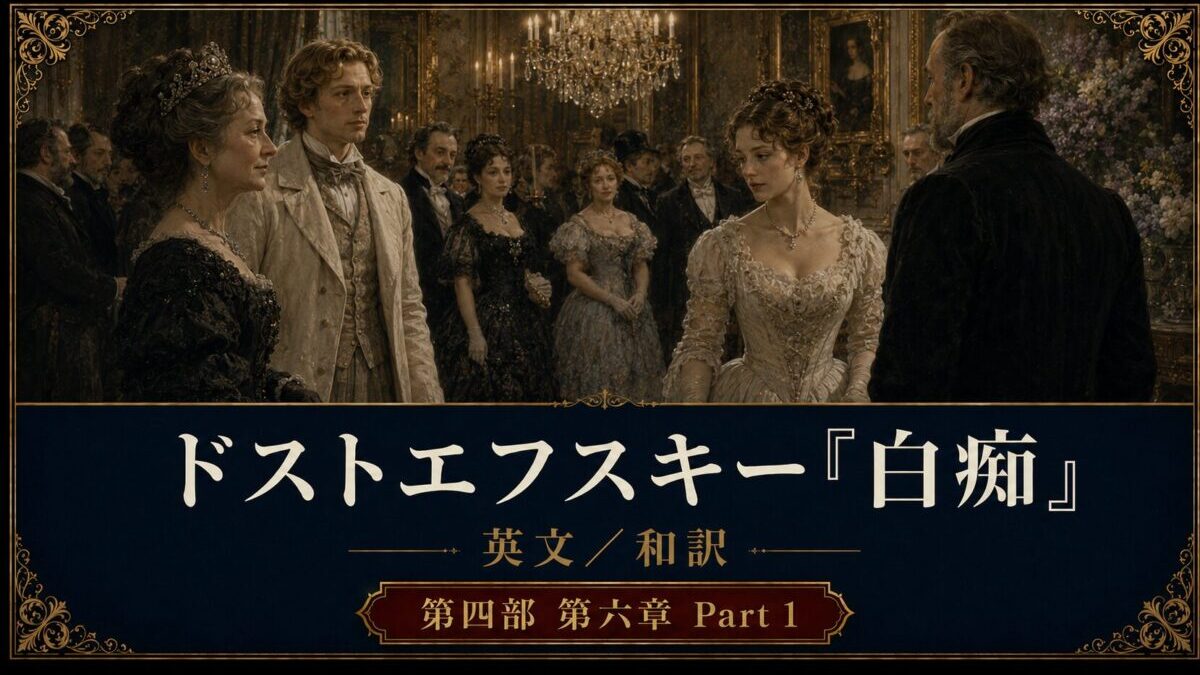
Fyodor Dostoyevsky『The Idiot』PART IV CHAPTER VI です。エパンチン家の夜会、アグラーヤの不安、公爵の緊張、レベジェフの手紙騒動、イヴォルギン将軍の病状、そして公爵が初めて「社交界」に触れる場面を、英文・和訳ペアで整理しています。
As to the evening party at the Epanchins’ at which Princess Bielokonski was to be present, Varia had reported with accuracy.
ビエロコンスキー公爵夫人が出席する予定だったエパンチン家の夜会については、ワーリャの報告は正確だった。
Though she had perhaps expressed herself too strongly.
もっとも、彼女はいくらか言い方を強めすぎていたのかもしれない。
The thing was decided in a hurry and with a certain amount of quite unnecessary excitement.
そのことは急いで決められ、しかもまったく不要な興奮もいくらか伴っていた。
Doubtless because “nothing could be done in this house like anywhere else.”
おそらくそれは、「この家では、何一つよその家と同じようにはできない」からだった。
The impatience of Lizabetha Prokofievna “to get things settled” explained a good deal.
リザヴェータ・プロコフィエヴナの「物事を決着させたい」という焦りが、多くを説明していた。
As well as the anxiety of both parents for the happiness of their beloved daughter.
それに加えて、愛する娘の幸福を思う両親の不安もあった。
Besides, Princess Bielokonski was going away soon, and they hoped that she would take an interest in the prince.
さらに、ビエロコンスキー公爵夫人はまもなく去る予定だったため、彼らは彼女が公爵に関心を持ってくれることを望んでいた。
They were anxious that he should enter society under the auspices of this lady.
彼らは、公爵がこの婦人の庇護のもとで社交界に入ることを望んでいた。
Whose patronage was the best of recommendations for any young man.
彼女の後援は、どんな青年にとっても最高の推薦状だったからである。
Even if there seems something strange about the match, the general and his wife said to each other, the “world” will accept Aglaya’s fiancé without any question.
たとえその縁組に何か奇妙な点があるように見えても、と将軍夫妻は互いに言い合った。「世間」はアグラーヤの婚約者を何の疑問もなく受け入れるだろう。
If he is under the patronage of the princess.
もし彼が公爵夫人の庇護のもとにあるならば、である。
In any case, the prince would have to be “shown” sooner or later.
いずれにせよ、公爵は遅かれ早かれ「披露」されなければならなかった。
That is, introduced into society, of which he had, so far, not the least idea.
つまり、彼がこれまで少しも知らなかった社交界へ紹介されなければならなかったのである。
Moreover, it was only a question of a small gathering of a few intimate friends.
それに、それは数人の親しい友人だけの小さな集まりにすぎない、ということでもあった。
Besides Princess Bielokonski, only one other lady was expected, the wife of a high dignitary.
ビエロコンスキー公爵夫人のほかには、高官の妻である婦人が一人来るだけの予定だった。
Evgenie Pavlovitch, who was to escort the princess, was the only young man.
公爵夫人に付き添うことになっていたエヴゲーニー・パヴロヴィチが、唯一の若い男性だった。
Muishkin was told of the princess’s visit three days beforehand.
ムイシュキンは公爵夫人の訪問について、三日前に知らされた。
But nothing was said to him about the party until the night before it was to take place.
しかし夜会については、それが行われる前夜まで何も知らされなかった。
He could not help observing the excited and agitated condition of all members of the family.
彼は家族全員が興奮し動揺している様子に気づかずにはいられなかった。
And from certain hints dropped in conversation he gathered that they were all anxious as to the impression he should make upon the princess.
また会話の中で落とされたある種のほのめかしから、彼は、皆が自分が公爵夫人にどのような印象を与えるか心配しているのだと察した。
But the Epanchins, one and all, believed that Muishkin, in his simplicity of mind, was quite incapable of realizing that they could be feeling any anxiety on his account.
しかしエパンチン家の人々は誰もが、ムイシュキンは心が単純なので、自分のことで彼らが不安を感じているなど理解できないと信じていた。
And for this reason they all looked at him with dread and uneasiness.
そしてそのため、皆は恐れと不安をもって彼を見ていた。
In point of fact, he did attach marvellously little importance to the approaching event.
実際のところ、彼は近づいているその出来事を驚くほど重視していなかった。
He was occupied with altogether different thoughts.
彼はまったく別の考えに心を奪われていた。
Aglaya was growing hourly more capricious and gloomy, and this distressed him.
アグラーヤは時間ごとに気まぐれで陰鬱になっていき、そのことが彼を苦しめていた。
When they told him that Evgenie Pavlovitch was expected, he evinced great delight.
エヴゲーニー・パヴロヴィチが来る予定だと聞かされると、彼は大いに喜びを示した。
And said that he had long wished to see him—and somehow these words did not please anyone.
そして長いあいだ彼に会いたいと思っていたと言ったが、どういうわけかこの言葉は誰にも喜ばれなかった。
Aglaya left the room in a fit of irritation.
アグラーヤは苛立ちに駆られて部屋を出て行った。
And it was not until late in the evening, past eleven, when the prince was taking his departure, that she said a word or two to him privately.
そして夜遅く、十一時を過ぎて、公爵が帰ろうとした時になって初めて、彼女は彼に私的に一言二言話した。
As she accompanied him as far as the front door.
彼女は玄関まで彼に付き添っていたのである。
“I should like you,” she said, “not to come here tomorrow until evening, when the guests are all assembled.”
「お願いがあります」と彼女は言った。「明日は、お客さまが皆集まる夕方まで、ここへ来ないでいただきたいのです」
“You know there are to be guests, don’t you?”
「お客さまが来ることはご存じでしょう?」
She spoke impatiently and with severity.
彼女は苛立ち、厳しい口調で話した。
This was the first allusion she had made to the party of tomorrow.
これが、彼女が翌日の夜会について初めて口にしたほのめかしだった。
She hated the idea of it, everyone saw that.
彼女がそれを嫌っていることは、誰の目にも明らかだった。
And she would probably have liked to quarrel about it with her parents.
そしておそらく彼女は、そのことで両親と喧嘩したかったのだろう。
But pride and modesty prevented her from broaching the subject.
しかし誇りと慎みが、その話題を切り出すことを妨げていた。
The prince jumped to the conclusion that Aglaya, too, was nervous about him.
公爵は、アグラーヤも自分のことで緊張しているのだと早合点した。
And the impression he would make, and that she did not like to admit her anxiety.
つまり、自分がどんな印象を与えるかを心配しており、その不安を認めたくないのだと思ったのである。
And this thought alarmed him.
そしてその考えが彼を不安にさせた。
“Yes, I am invited,” he replied.
「はい、私は招かれています」と彼は答えた。
She was evidently in difficulties as to how best to go on.
彼女は明らかに、どう続ければよいか困っていた。
“May I speak of something serious to you, for once in my life?” she asked, angrily.
「生まれて初めて、あなたに真面目なことを話してもよろしいですか?」と彼女は怒ったように尋ねた。
She was irritated at she knew not what, and could not restrain her wrath.
彼女は何に対してか分からない苛立ちを覚えており、怒りを抑えることができなかった。
“Of course you may; I am very glad to listen,” replied Muishkin.
「もちろんです。喜んでお聞きします」とムイシュキンは答えた。
Aglaya was silent a moment and then began again with evident dislike of her subject.
アグラーヤはしばらく黙り、それから、その話題を明らかに嫌がりながら再び話し始めた。
“I do not wish to quarrel with them about this; in some things they won’t be reasonable.”
「私はこのことであの人たちと喧嘩したくありません。いくつかのことでは、あの人たちは理性的になってくれないのです」
“I always did feel a loathing for the laws which seem to guide mamma’s conduct at times.”
「ママの行動を時々支配しているように見える法則には、私は昔から嫌悪を感じていました」
“I don’t speak of father, for he cannot be expected to be anything but what he is.”
「父のことを言っているのではありません。父は、彼自身である以外に期待しようがありませんから」
“Mother is a noble-minded woman, I know; you try to suggest anything mean to her, and you’ll see!”
「母が高潔な女性であることは分かっています。彼女に卑しいことを少しでも持ちかけてみれば、すぐ分かります!」
“But she is such a slave to these miserable creatures!”
「しかし母は、ああいう惨めな人たちの奴隷なのです!」
“I don’t mean old Bielokonski alone.”
「老ビエロコンスキー夫人だけを言っているのではありません」
“She is a contemptible old thing, but she is able to twist people round her little finger.”
「あの人は軽蔑すべき老女ですが、人々を指先で操ることができます」
“And I admire that in her, at all events!”
「それについては、少なくとも私は彼女を見事だと思います!」
“How mean it all is, and how foolish!”
「すべてがなんと卑しく、なんと愚かなことでしょう!」
“We were always middle-class, thoroughly middle-class, people.”
「私たちはいつだって中流の人間、徹底して中流の人間でした」
“Why should we attempt to climb into the giddy heights of the fashionable world?”
「なぜ私たちは、上流社会という目もくらむ高みに登ろうとしなければならないのですか?」
“My sisters are all for it. It’s Prince S. they have to thank for poisoning their minds.”
「姉たちは皆それに賛成です。彼女たちの心を毒したことについては、S公爵に感謝しなければなりませんね」
“Why are you so glad that Evgenie Pavlovitch is coming?”
「なぜあなたは、エヴゲーニー・パヴロヴィチが来ることをそんなに喜ぶのですか?」
“Listen to me, Aglaya,” said the prince, “I do believe you are nervous lest I shall make a fool of myself tomorrow at your party?”
「聞いてください、アグラーヤ」と公爵は言った。「私は、明日の夜会で私が失態を演じるのではないかと、あなたが心配しているのだと思います」
“Nervous about you?” Aglaya blushed.
「あなたのことで心配?」アグラーヤは赤面した。
“Why should I be nervous about you?”
「なぜ私があなたのことで心配しなければならないのですか?」
“What would it matter to me if you were to make ever such a fool of yourself?”
「あなたがどれほど馬鹿な失態を演じたとしても、私に何の関係があるのですか?」
“How can you say such a thing?”
「どうしてそんなことが言えるのです?」
“What do you mean by ‘making a fool of yourself’? What a vulgar expression!”
「『失態を演じる』とはどういう意味ですか? なんて俗っぽい表現でしょう!」
“I suppose you intend to talk in that sort of way tomorrow evening?”
「あなたは明日の晩も、そういう言い方で話すつもりなのでしょう?」
“Look up a few more such expressions in your dictionary; do, you’ll make a grand effect!”
「辞書でそういう表現をもう少し調べておくといいでしょう。ぜひそうなさい。きっと見事な効果を上げますよ!」
“I’m sorry that you seem to be able to come into a room as gracefully as you do; where did you learn the art?”
「あなたがあんなに優雅に部屋へ入ってこられるように見えるのは残念です。その技術をどこで習ったのですか?」
“Do you think you can drink a cup of tea decently, when you know everybody is looking at you?”
「皆があなたを見ていると分かっていても、あなたはきちんとお茶を飲めると思っているのですか?」
“On purpose to see how you do it?”
「あなたがどうするかを見るために、わざと見ているのですよ?」
“Yes, I think I can.”
「はい、できると思います」
“Can you? I’m sorry for it then, for I should have had a good laugh at you otherwise.”
「できるのですか? それは残念です。そうでなければ、あなたを見て大いに笑えたでしょうに」
“Do break something at least, in the drawing-room!”
「せめて応接間で何かを壊してください!」
“Upset the Chinese vase, won’t you?”
「中国の花瓶を倒してくださらない?」
“It’s a valuable one; do break it.”
「あれは高価なものです。ぜひ壊してください」
“Mamma values it, and she’ll go out of her mind—it was a present.”
「ママはあれを大切にしていますから、気が狂うでしょう。贈り物だったのです」
“She’ll cry before everyone, you’ll see!”
「皆の前で泣くでしょう。見ていれば分かります!」
“Wave your hand about, you know, as you always do, and just smash it.”
「いつものように手を振り回して、そのまま壊してしまえばいいのです」
“Sit down near it on purpose.”
「わざとその近くに座ってください」
“On the contrary, I shall sit as far from it as I can. Thanks for the hint.”
「逆に、できるだけそこから遠くに座ります。忠告をありがとうございます」
“Ha, ha! Then you are afraid you will wave your arms about!”
「はは! では、自分が腕を振り回すのを恐れているのですね!」
“I wouldn’t mind betting that you’ll talk about some lofty subject, something serious and learned.”
「きっとあなたは何か高尚な話題、真面目で学問的なことを話すでしょうね。賭けてもいいくらいです」
“How delightful, how tactful that will be!”
「それはどれほど素晴らしく、どれほど気の利いたことでしょう!」
“I should think it would be very foolish indeed, unless it happened to come in appropriately.”
「もしそれが適切な流れで出てくるのでなければ、本当にとても愚かなことだと思います」
“Look here, once for all,” cried Aglaya, boiling over.
「いいですか、これだけは言っておきます」とアグラーヤは怒りで沸騰しながら叫んだ。
“If I hear you talking about capital punishment, or the economical condition of Russia, or about Beauty redeeming the world, or anything of that sort, I’ll—”
「もしあなたが死刑のことや、ロシアの経済状態のことや、美が世界を救うとか、そういう類のことを話しているのを聞いたら、私は――」
“Well, of course I shall laugh and seem very pleased.”
「まあ、もちろん私は笑って、とても喜んでいるように見せるでしょう」
“But I warn you beforehand, don’t look me in the face again!”
「でも前もって警告しておきます。二度と私の顔を見ないでください!」
“I’m serious now, mind, this time I am really serious.”
「私は今、本気です。いいですか、今回は本当に本気です」
She certainly did say this very seriously, so much so that she looked quite different from what she usually was.
彼女は確かに非常に真剣にそう言ったため、いつもの彼女とはまったく違って見えた。
And the prince could not help noticing the fact.
そして公爵はそのことに気づかずにはいられなかった。
She did not seem to be joking in the slightest degree.
彼女は少しも冗談を言っているようには見えなかった。
“Well, you’ve put me into such a fright that I shall certainly make a fool of myself.”
「まあ、あなたが私をそんなに怖がらせたので、私はきっと失態を演じるでしょう」
“And very likely break something too.”
「しかも、何かを壊す可能性も大いにあります」
“I wasn’t a bit alarmed before, but now I’m as nervous as can be.”
「以前は少しも怖くありませんでしたが、今はこれ以上ないほど緊張しています」
“Then don’t speak at all. Sit still and don’t talk.”
「それなら、まったく話さないでください。じっと座って、話さないでください」
“Oh, I can’t do that, you know!”
「ああ、それはできませんよ!」
“I shall say something foolish out of pure ‘funk,’ and break something for the same excellent reason.”
「純粋な『びびり』から何か愚かなことを言い、同じ立派な理由で何かを壊すでしょう」
“I know I shall.”
「そうなると分かっています」
“Perhaps I shall slip and fall on the slippery floor; I’ve done that before now, you know.”
「おそらく滑る床で足を滑らせて転ぶでしょう。以前にもそうしたことがありますからね」
“I shall dream of it all night now. Why did you say anything about it?”
「今夜は一晩中その夢を見るでしょう。なぜそんなことを言ったのですか?」
Aglaya looked blackly at him.
アグラーヤは険しい目つきで彼を見た。
“Do you know what, I had better not come at all tomorrow!”
「そうだ、明日はまったく来ないほうがよいですね!」
“I’ll plead sick-list and stay away,” said the prince, with decision.
「病欠を申し立てて、行かないことにします」と公爵はきっぱり言った。
Aglaya stamped her foot, and grew quite pale with anger.
アグラーヤは足を踏み鳴らし、怒りで真っ青になった。
“Oh, my goodness! Just listen to that!”
「ああ、なんということでしょう! ちょっと今のを聞いてください!」
“‘Better not come,’ when the party is on purpose for him!”
「『来ないほうがよい』ですって。その夜会は彼のためにあるというのに!」
“Good Lord! What a delightful thing it is to have to do with such a—such a stupid as you are!”
「まったく! あなたのような、そんな愚か者を相手にするのは、なんて楽しいことでしょう!」
“Well, I’ll come, I’ll come,” interrupted the prince, hastily.
「分かりました、行きます、行きます」と公爵は慌てて口を挟んだ。
“And I’ll give you my word of honour that I will sit the whole evening and not say a word.”
「そして名誉にかけて誓います。私は一晩中座って、一言も話しません」
“I believe that’s the best thing you can do.”
「それがあなたにできる最善のことだと思います」
“You said you’d ‘plead sick-list’ just now; where in the world do you get hold of such expressions?”
「あなたは今『病欠を申し立てる』と言いましたね。いったいどこでそんな表現を覚えるのですか?」
“Why do you talk to me like this? Are you trying to irritate me, or what?”
「なぜ私にそんな言い方をするのです? 私を苛立たせようとしているのですか、それとも何なのですか?」
“Forgive me, it’s a schoolboy expression. I won’t do it again.”
「許してください。学生言葉なのです。もう二度と使いません」
“I know quite well, I see it, that you are anxious on my account.”
「あなたが私のことで不安になっていることは、私はよく分かっています。見れば分かります」
“Now, don’t be angry.”
「でも、怒らないでください」
“And it makes me very happy to see it.”
「それを見ると、私はとても幸せになるのです」
“You wouldn’t believe how frightened I am of misbehaving somehow, and how glad I am of your instructions.”
「私が何か失敗するのをどれほど恐れているか、そしてあなたの忠告をどれほど嬉しく思っているか、あなたには信じられないでしょう」
“But all this panic is simply nonsense, you know, Aglaya!”
「しかし、こうした恐慌はすべて単なる馬鹿げたことです、アグラーヤ!」
“I give you my word it is; I am so pleased that you are such a child, such a dear good child.”
「誓ってそうです。あなたがそんなに子どもで、そんなに愛らしい善良な子どもであることが、私はとても嬉しいのです」
“How charming you can be if you like, Aglaya.”
「あなたは、その気になればなんと魅力的になれるのでしょう、アグラーヤ」
Aglaya wanted to be angry, of course, but suddenly some quite unexpected feeling seized upon her heart.
もちろんアグラーヤは怒りたかったのだが、突然、まったく予期しない感情が彼女の心をつかんだ。
All in a moment.
それは一瞬のことだった。
“And you won’t reproach me for all these rude words of mine—some day—afterwards?” she asked, of a sudden.
「そして、いつか後になって、私のこうした失礼な言葉すべてを責めたりはしませんね?」と彼女は突然尋ねた。
“What an idea! Of course not.”
「なんという考えです! もちろん責めません」
“And what are you blushing for again?”
「それに、またなぜ赤面しているのです?」
“And there comes that frown once more!”
「そしてまたそのしかめ面です!」
“You’ve taken to looking too gloomy sometimes, Aglaya, much more than you used to.”
「あなたは時々あまりにも陰鬱な顔をするようになりました、アグラーヤ。以前よりずっとそうです」
“I know why it is.”
「私はその理由を知っています」
“Be quiet, do be quiet!”
「黙ってください、本当に黙って!」
“No, no, I had much better speak out.”
「いいえ、いいえ、私は話してしまったほうがよいのです」
“I have long wished to say it, and have said it, but that’s not enough, for you didn’t believe me.”
「私は長いあいだそれを言いたいと思っていました。そして言いました。しかしそれだけでは足りませんでした。あなたが信じなかったからです」
“Between us two there stands a being who—”
「私たち二人の間には、ある存在が立っています。その存在は――」
“Be quiet, be quiet, be quiet, be quiet!” Aglaya struck in, suddenly.
「黙って、黙って、黙って、黙って!」とアグラーヤが突然口を挟んだ。
Seizing his hand in hers, and gazing at him almost in terror.
彼女は彼の手を自分の手でつかみ、ほとんど恐怖に近い目で彼を見つめていた。
At this moment she was called by someone.
その時、誰かが彼女を呼んだ。
She broke loose from him with an air of relief and ran away.
彼女はほっとしたように彼から身を離し、走り去った。
The prince was in a fever all night.
公爵は一晩中、熱に浮かされたようだった。
It was strange, but he had suffered from fever for several nights in succession.
奇妙なことだが、彼は数夜続けて発熱に苦しんでいた。
On this particular night, while in semi-delirium, he had an idea.
この特別な夜、半ば錯乱した状態で、彼はある考えを抱いた。
What if on the morrow he were to have a fit before everybody?
もし明日、皆の前で発作を起こしたらどうなるのか。
The thought seemed to freeze his blood within him.
その考えは、彼の血を体内で凍らせるようだった。
All night he fancied himself in some extraordinary society of strange persons.
一晩中、彼は奇妙な人々の異様な社交界に自分がいるように想像していた。
The worst of it was that he was talking nonsense.
最悪だったのは、自分が戯言を話していることだった。
He knew that he ought not to speak at all, and yet he talked the whole time.
彼はまったく話すべきではないと分かっていたのに、それでもずっと話し続けていた。
He seemed to be trying to persuade them all to something.
彼は皆に何かを説得しようとしているようだった。
Evgenie and Hippolyte were among the guests, and appeared to be great friends.
エヴゲーニーとイッポリートも客の中にいて、非常に親しい友人同士のように見えた。
He awoke towards nine o’clock with a headache, full of confused ideas and strange impressions.
彼は九時ごろ、頭痛とともに目を覚ました。頭の中は混乱した考えと奇妙な印象でいっぱいだった。
For some reason or other he felt most anxious to see Rogojin, to see and talk to him.
何らかの理由で、彼はロゴージンに会いたくてたまらなかった。会って話したかったのだ。
But what he wished to say he could not tell.
しかし何を言いたいのかは、自分でも分からなかった。
Next, he determined to go and see Hippolyte.
次に、彼はイッポリートに会いに行こうと決めた。
His mind was in a confused state.
彼の心は混乱した状態にあった。
So much so that the incidents of the morning seemed to be imperfectly realized, though acutely felt.
そのため、朝の出来事は鋭く感じられてはいたものの、十分には理解されていないようだった。
One of these incidents was a visit from Lebedeff.
そうした出来事の一つが、レベジェフの訪問だった。
Lebedeff came rather early—before ten—but he was tipsy already.
レベジェフはかなり早く、十時前に来たが、すでに酔っていた。
Though the prince was not in an observant condition, yet he could not avoid seeing that for at least three days Lebedeff had been behaving very badly.
公爵は観察に適した状態ではなかったが、それでも少なくとも三日間、レベジェフの振る舞いがひどく悪くなっていることに気づかずにはいられなかった。
Ever since General Ivolgin had left the house.
イヴォルギン将軍がその家を出てからのことだった。
He looked untidy and dirty at all times of the day.
彼は一日中いつ見ても、だらしなく汚らしく見えた。
And it was said that he had begun to rage about in his own house, and that his temper was very bad.
そして彼は自分の家で荒れ狂うようになり、気性もひどく悪くなったと言われていた。
As soon as he arrived this morning, he began to hold forth, beating his breast and apparently blaming himself for something.
その朝、到着するやいなや、彼は胸を叩き、何かについて自分を責めているように、大演説を始めた。
“I’ve—I’ve had a reward for my meanness—I’ve had a slap in the face,” he concluded, tragically.
「私は――私は自分の卑劣さの報いを受けました――顔を平手打ちされたのです」と彼は悲劇的に締めくくった。
“A slap in the face? From whom? And so early in the morning?”
「平手打ちですって? 誰からです? こんな朝早くに?」
“Early?” said Lebedeff, sarcastically.
「早いですって?」とレベジェフは皮肉に言った。
“Time counts for nothing, even in physical chastisement.”
「肉体的な懲罰においてさえ、時間など何の意味もありません」
“But my slap in the face was not physical, it was moral.”
「しかし私の平手打ちは肉体的なものではなく、道徳的なものでした」
He suddenly took a seat, very unceremoniously, and began his story.
彼は突然、ひどく無遠慮に腰を下ろし、自分の話を始めた。
It was very disconnected; the prince frowned, and wished he could get away.
それはひどくまとまりのない話だった。公爵は眉をひそめ、そこから逃げ出したいと思った。
But suddenly a few words struck him.
しかし突然、いくつかの言葉が彼をはっとさせた。
He sat stiff with wonder—Lebedeff said some extraordinary things.
彼は驚きで体をこわばらせて座った。レベジェフが途方もないことを言ったからである。
In the first place he began about some letter; the name of Aglaya Ivanovna came in.
まず彼は何かの手紙の話から始めた。そこにアグラーヤ・イワノヴナの名が出てきた。
Then suddenly he broke off and began to accuse the prince of something.
それから突然話をやめ、公爵を何かで責め始めた。
He was apparently offended with him.
彼は明らかに公爵に腹を立てているようだった。
At first he declared that the prince had trusted him with his confidences as to “a certain person.”
初めに彼は、公爵が「ある人物」についての秘密を自分に打ち明けていたと宣言した。
That is, Nastasia Philipovna.
つまり、ナスターシャ・フィリッポヴナのことである。
But that of late his friendship had been thrust back into his bosom.
しかし最近では、彼の友情は胸の中へ押し戻されてしまったという。
And his innocent question as to “approaching family changes” had been curtly put aside.
そして「近づいている一家の変化」についての無邪気な質問も、そっけなく退けられたというのだった。
Which Lebedeff declared, with tipsy tears, he could not bear.
レベジェフは酔った涙を浮かべながら、それには耐えられないと宣言した。
Especially as he knew so much already both from Rogojin and Nastasia Philipovna and her friend.
とりわけ彼は、ロゴージンやナスターシャ・フィリッポヴナ、その友人から、すでに多くを知っていたからである。
And from Varvara Ardalionovna, and even from Aglaya Ivanovna, through his daughter Vera.
さらに、ワルワーラ・アルダリオノヴナからも、娘ヴェラを通じてアグラーヤ・イワノヴナからさえも、知っていたという。
“And who told Lizabetha Prokofievna something in secret, by letter?”
「それに、リザヴェータ・プロコフィエヴナに手紙でこっそり何かを知らせたのは誰です?」
“Who told her all about the movements of a certain person called Nastasia Philipovna?”
「ナスターシャ・フィリッポヴナというある人物の動きについて、彼女にすべて知らせたのは誰です?」
“Who was the anonymous person, eh? Tell me!”
「その匿名の人物は誰だったのです、ええ? 言ってください!」
“Surely not you?” cried the prince.
「まさか、あなたではないでしょう?」と公爵は叫んだ。
“Just so,” said Lebedeff, with dignity.
「その通りです」とレベジェフは威厳をもって言った。
“And only this very morning I have sent up a letter to the noble lady.”
「そしてまさに今朝、私はその高貴な奥方へ手紙を差し上げました」
“Stating that I have a matter of great importance to communicate.”
「非常に重要なことをお伝えしたいと書いたのです」
“She received the letter; I know she got it; and she received me, too.”
「彼女は手紙を受け取りました。受け取ったことは知っています。そして私にも会ってくれました」
“Have you just seen Lizabetha Prokofievna?” asked the prince, scarcely believing his ears.
「今リザヴェータ・プロコフィエヴナに会ってきたのですか?」と公爵は、自分の耳を疑いながら尋ねた。
“Yes, I saw her, and got the said slap in the face as mentioned.”
「はい、会いました。そして先ほど申し上げた平手打ちを受けました」
“She chucked the letter back to me unopened, and kicked me out of the house, morally, not physically.”
「彼女は手紙を開封せずに私へ投げ返し、肉体的にではなく、道徳的に私を家から蹴り出しました」
“Although not far off it.”
「もっとも、肉体的にもそう遠くはありませんでしたが」
“What letter do you mean she returned unopened?”
「彼女が開封せず返したというのは、どの手紙のことです?」
“What! didn’t I tell you? Ha, ha, ha! I thought I had.”
「何ですって! 申し上げませんでしたか? ははは! 言ったつもりでした」
“Why, I received a letter, you know, to be handed over—”
「つまり、私は手渡すべき手紙を受け取ったのです――」
“From whom? To whom?”
「誰から誰へです?」
But it was difficult, if not impossible, to extract anything from Lebedeff.
しかしレベジェフから何かを聞き出すのは、不可能ではないにせよ、非常に難しかった。
All the prince could gather was, that the letter had been received very early.
公爵がつかめたのは、その手紙が非常に早く届いたということだけだった。
And had a request written on the outside that it might be sent on to the address given.
そして封の外側には、指定された住所へ転送してほしいという依頼が書かれていたということだった。
“Just as before, sir, just as before!”
「以前と同じです、旦那様、以前と同じです!」
“To a certain person, and from a certain hand.”
「ある人物へ、ある手からです」
“The individual’s name who wrote the letter is to be represented by the letter A.—”
「その手紙を書いた人物の名は、Aという文字で表されるべきです――」
“What? Impossible! To Nastasia Philipovna? Nonsense!” cried the prince.
「何ですって? ありえません! ナスターシャ・フィリッポヴナ宛てに? 馬鹿げています!」と公爵は叫んだ。
“It was, I assure you, and if not to her then to Rogojin, which is the same thing.”
「そうだったのです、保証します。もし彼女宛てでなかったとしてもロゴージン宛てで、それは同じことです」
“Mr. Hippolyte has had letters, too, and all from the individual whose name begins with an A.”
「イッポリート氏も手紙を受け取っています。しかもすべて、名前がAで始まる人物からです」
Smirked Lebedeff, with a hideous grin.
レベジェフは醜い笑みを浮かべながら、にやにやした。
As he kept jumping from subject to subject, and forgetting what he had begun to talk about, the prince said nothing.
彼が話題から話題へ飛び移り、何を話し始めたのか忘れ続けていたため、公爵は何も言わなかった。
But waited, to give him time.
ただ、彼に時間を与えるために待っていた。
It was all very vague.
すべてが非常に曖昧だった。
Who had taken the letters, if letters there were?
もし手紙があったとして、誰がそれを受け取ったのか。
Probably Vera—and how could Lebedeff have got them?
おそらくヴェラだろう。ではレベジェフはどうやってそれを手に入れたのか。
In all probability, he had managed to steal the present letter from Vera.
十中八九、彼は現在の手紙をヴェラから盗むことに成功したのだろう。
And had himself gone over to Lizabetha Prokofievna with some idea in his head.
そして何か考えを抱いて、自分でリザヴェータ・プロコフィエヴナのもとへ行ったのだろう。
So the prince concluded at last.
公爵はついにそう結論した。
“You are mad!” he cried, indignantly.
「あなたは気が狂っています!」と彼は憤然として叫んだ。
“Not quite, esteemed prince,” replied Lebedeff, with some acerbity.
「完全にではありません、尊敬する公爵」とレベジェフは多少の辛辣さを込めて答えた。
“I confess I thought of doing you the service of handing the letter over to yourself.”
「白状しますと、私はその手紙をあなたご自身にお渡しするという奉仕をしようと思いました」
“But I decided that it would pay me better to deliver it up to the noble lady aforesaid.”
「しかし、先ほどの高貴な奥方へ渡したほうが、私にとって得だと判断したのです」
“As I had informed her of everything hitherto by anonymous letters.”
「これまで私は匿名の手紙で、彼女にすべて知らせていましたから」
“So when I sent her up a note from myself, with the letter, you know, in order to fix a meeting for eight o’clock this morning, I signed it ‘your secret correspondent.’”
「ですから今朝八時の面会を取りつけるために、その手紙を添えて自分から彼女へ一筆送った時、私は『あなたの秘密通信者』と署名したのです」
“They let me in at once—very quickly—by the back door, and the noble lady received me.”
「すると彼らはすぐに、非常に素早く、裏口から私を入れてくれ、その高貴な奥方が私に会ってくれました」
“Well? Go on.”
「それで? 続けてください」
“Oh, well, when I saw her she almost punched my head, as I say.”
「ああ、それで、彼女に会うと、先ほど言った通り、彼女はほとんど私の頭を殴るところでした」
“In fact so nearly that one might almost say she did punch my head.”
「実際、ほとんど殴ったと言ってもよいほどでした」
“She threw the letter in my face.”
「彼女はその手紙を私の顔に投げつけました」
“She seemed to reflect first, as if she would have liked to keep it.”
「最初は考え込んで、手紙を手元に残したいようにも見えました」
“But thought better of it and threw it in my face instead.”
「しかし思い直し、代わりにそれを私の顔に投げつけたのです」
“‘If anybody can have been such a fool as to trust a man like you to deliver the letter,’ says she, ‘take it and deliver it!’”
「『あなたのような男に手紙を届けることを任せるほど愚かな人がいるのなら、これを持って行って届けなさい!』と彼女は言いました」
“Hey! she was grandly indignant. A fierce, fiery lady that, sir!”
「いやはや! 彼女は堂々と憤っていました。激しく燃えるような奥方です、旦那様!」
“Where’s the letter now?”
「手紙は今どこにあります?」
“Oh, I’ve still got it, here!”
「ああ、まだここに持っています!」
And he handed the prince the very letter from Aglaya to Gania.
そして彼は、アグラーヤからガーニャへ宛てたその手紙を公爵に渡した。
Which the latter showed with so much triumph to his sister at a later hour.
その手紙は後に、ガーニャが得意げに妹へ見せることになるものだった。
“This letter cannot be allowed to remain in your hands.”
「この手紙をあなたの手元に置いておくことはできません」
“It’s for you—for you! I’ve brought it you on purpose!” cried Lebedeff, excitedly.
「これはあなたのためです、あなたのためです! わざわざあなたに持ってきたのです!」とレベジェフは興奮して叫んだ。
“Why, I’m yours again now, heart and hand, your slave.”
「なにしろ、私は今また心も手もあなたのもの、あなたの奴隷です」
“There was but a momentary pause in the flow of my love and esteem for you.”
「あなたへの私の愛と尊敬の流れに、一瞬の中断があっただけです」
“Mea culpa, mea culpa! as the Pope of Rome says.”
「メア・クルパ、メア・クルパ! ローマ教皇が言うようにです」
“This letter should be sent on at once,” said the prince, disturbed.
「この手紙はすぐに届けられなければなりません」と公爵は動揺して言った。
“I’ll hand it over myself.”
「私が自分で渡します」
“Wouldn’t it be better, esteemed prince, wouldn’t it be better—to—don’t you know—”
「そのほうがよいのではありませんか、尊敬する公爵、そのほうがよいのでは――つまり――お分かりでしょう――」
Lebedeff made a strange and very expressive grimace.
レベジェフは奇妙で、非常に表情豊かなしかめ面をした。
He twisted about in his chair, and did something, apparently symbolical, with his hands.
彼は椅子の上で身をよじり、手で何やら象徴的な動作をした。
“What do you mean?” said the prince.
「どういう意味です?」と公爵は言った。
“Why, open it, for the time being, don’t you know?” he said, most confidentially and mysteriously.
「つまり、ひとまず開けてみるということです、お分かりでしょう?」と彼は、きわめて内密に、謎めいて言った。
The prince jumped up so furiously that Lebedeff ran towards the door.
公爵はあまりに激しく飛び上がったので、レベジェフは扉のほうへ走った。
Having gained which strategic position, however, he stopped and looked back to see if he might hope for pardon.
しかしその戦略的位置を確保すると、彼は立ち止まり、許しを期待できるかどうか振り返って見た。
“Oh, Lebedeff, Lebedeff! Can a man really sink to such depths of meanness?” said the prince, sadly.
「ああ、レベジェフ、レベジェフ! 人は本当にここまで卑劣な深みに沈むものなのですか?」と公爵は悲しげに言った。
Lebedeff’s face brightened.
レベジェフの顔が明るくなった。
“Oh, I’m a mean wretch—a mean wretch!”
「ああ、私は卑劣な哀れ者です、卑劣な哀れ者です!」
He said, approaching the prince once more, and beating his breast, with tears in his eyes.
彼は目に涙を浮かべ、胸を叩きながら、もう一度公爵に近づいてそう言った。
“It’s abominable dishonesty, you know!”
「それはひどい不誠実です、本当に!」
“Dishonesty—it is, it is! That’s the very word!”
「不誠実です、そうです、そうです! まさにその言葉です!」
“What in the world induces you to act so? You are nothing but a spy.”
「いったい何があなたにそんな行動をさせるのです? あなたはただの密偵です」
“Why did you write anonymously to worry so noble and generous a lady?”
「なぜ匿名で手紙を書いて、あれほど高貴で寛大な婦人を悩ませたのです?」
“Why should not Aglaya Ivanovna write a note to whomever she pleases?”
「なぜアグラーヤ・イワノヴナが好きな相手に手紙を書いてはいけないのです?」
“What did you mean to complain of today?”
「今日あなたは何について訴えるつもりだったのです?」
“What did you expect to get by it?”
「それで何を得ようと思っていたのです?」
“What made you go at all?”
「そもそも何があなたを行かせたのです?」
“Pure amiable curiosity,—I assure you—desire to do a service.”
「純粋な好意的好奇心です、保証します。奉仕したいという願いです」
“That’s all. Now I’m entirely yours again, your slave; hang me if you like!”
「それだけです。今や私は再び完全にあなたのもの、あなたの奴隷です。望むなら私を吊るしてください!」
“Did you go before Lizabetha Prokofievna in your present condition?” inquired the prince.
「あなたは今の状態でリザヴェータ・プロコフィエヴナの前に出たのですか?」と公爵は尋ねた。
“No—oh no, fresher—more the correct card.”
「いいえ、ああ違います。もっとしゃきっと、もっとまともな状態でした」
“I only became this like after the humiliation I suffered there.”
「そこで受けた屈辱の後で、私はこのようになっただけです」
“Well—that’ll do; now leave me.”
「もう十分です。さあ、私を一人にしてください」
This injunction had to be repeated several times before the man could be persuaded to move.
その命令は、彼を動かすまでに何度も繰り返さなければならなかった。
Even then he turned back at the door, came as far as the middle of the room.
それでも彼は扉のところで引き返し、部屋の中央まで戻ってきた。
And there went through his mysterious motions designed to convey the suggestion that the prince should open the letter.
そしてそこで、公爵が手紙を開けるべきだという示唆を伝えるための謎めいた身ぶりをした。
He did not dare put his suggestion into words again.
彼はその示唆を再び言葉にする勇気はなかった。
After this performance, he smiled sweetly and left the room on tiptoe.
この演技の後、彼は甘い笑みを浮かべ、つま先立ちで部屋を出て行った。
All this had been very painful to listen to.
これらすべてを聞くのは、非常につらいことだった。
One fact stood out certain and clear.
一つの事実だけが、確かにはっきりと浮かび上がっていた。
And that was that poor Aglaya must be in a state of great distress and indecision and mental torment.
それは、哀れなアグラーヤが大きな苦悩と迷い、精神的苦痛の中にいるに違いないということだった。
“From jealousy,” the prince whispered to himself.
「嫉妬からだ」と公爵は自分にささやいた。
Undoubtedly in this inexperienced, but hot and proud little head, there were all sorts of plans forming.
疑いなく、この未経験だが熱く誇り高い小さな頭の中では、さまざまな計画が形づくられていた。
Wild and impossible plans, maybe.
おそらく、荒唐無稽で実現不可能な計画もあっただろう。
And the idea of this so frightened the prince that he could not make up his mind what to do.
そのことを考えると、公爵はあまりに恐ろしくなり、何をすべきか決められなかった。
Something must be done, that was clear.
何かをしなければならない。それだけは明らかだった。
He looked at the address on the letter once more.
彼はもう一度、手紙の宛名を見た。
Oh, he was not in the least degree alarmed about Aglaya writing such a letter.
ああ、アグラーヤがそのような手紙を書くことについては、彼は少しも不安を抱いていなかった。
He could trust her.
彼は彼女を信頼できた。
What he did not like about it was that he could not trust Gania.
彼が嫌だったのは、ガーニャを信頼できないということだった。
However, he made up his mind that he would himself take the note and deliver it.
しかし彼は、その手紙を自分で持って行き、届けようと決心した。
Indeed, he went so far as to leave the house and walk up the road.
実際、彼は家を出て道を歩き出すところまで行った。
But changed his mind when he had nearly reached Ptitsin’s door.
しかしプチーツィンの家の戸口近くまで来た時、彼は考えを変えた。
However, he there luckily met Colia, and commissioned him to deliver the letter to his brother as if direct from Aglaya.
しかし幸いそこでコーリャに会い、アグラーヤから直接来たものとして、その手紙を兄へ届けるよう彼に託した。
Colia asked no questions but simply delivered it.
コーリャは何も尋ねず、ただそれを届けた。
And Gania consequently had no suspicion that it had passed through so many hands.
そのためガーニャは、その手紙がそれほど多くの手を経てきたとは少しも疑わなかった。
Arrived home again, the prince sent for Vera Lebedeff and told her as much as was necessary.
家に戻ると、公爵はヴェラ・レベジェフを呼び、必要な分だけ彼女に話した。
In order to relieve her mind, for she had been in a dreadful state of anxiety since she had missed the letter.
彼女を安心させるためだった。手紙がなくなって以来、彼女はひどい不安の中にいたからである。
She heard with horror that her father had taken it.
父がそれを取ったと聞いて、彼女は恐怖を覚えた。
Muishkin learned from her that she had on several occasions performed secret missions both for Aglaya and for Rogojin.
ムイシュキンは彼女から、彼女が何度かアグラーヤとロゴージンの両方のために秘密の使いを務めていたことを知った。
Without, however, having had the slightest idea that in so doing she might injure the prince in any way.
しかし彼女は、そうすることで公爵に何らかの害を与えるかもしれないなどとは、少しも思っていなかった。
The latter, with one thing and another, was now so disturbed and confused.
公爵は、あれこれのことで、今やひどく動揺し混乱していた。
That when, a couple of hours or so later, a message came from Colia that the general was ill, he could hardly take the news in.
そのため、二時間ほど後に、将軍が病気だという知らせがコーリャから届いた時、彼はその知らせをほとんど理解できなかった。
However, when he did master the fact, it acted upon him as a tonic by completely distracting his attention.
しかしその事実をようやく飲み込むと、それは彼の注意を完全にそらし、気付け薬のように作用した。
He went at once to Nina Alexandrovna’s, whither the general had been carried, and stayed there until the evening.
彼はすぐに、将軍が運ばれたニーナ・アレクサンドロヴナの家へ行き、夕方までそこにいた。
He could do no good, but there are people whom to have near one is a blessing at such times.
彼にできることは何もなかったが、そういう時、そばにいてくれるだけでありがたい人間というものがいる。
Colia was in an almost hysterical state; he cried continuously.
コーリャはほとんどヒステリックな状態にあり、絶えず泣いていた。
But was running about all day, all the same.
それでも彼は一日中走り回っていた。
Fetching doctors, of whom he collected three; going to the chemist’s, and so on.
医者を呼びに行き、三人も連れてきたり、薬屋へ行ったりしていた。
The general was brought round to some extent, but the doctors declared that he could not be said to be out of danger.
将軍はある程度意識を取り戻したが、医者たちはまだ危険を脱したとは言えないと宣言した。
Varia and Nina Alexandrovna never left the sick man’s bedside.
ワーリャとニーナ・アレクサンドロヴナは、病人の寝台のそばを決して離れなかった。
Gania was excited and distressed, but would not go upstairs.
ガーニャは興奮し苦しんでいたが、二階へは行こうとしなかった。
And seemed afraid to look at the patient.
そして病人を見るのを恐れているようだった。
He wrung his hands when the prince spoke to him.
公爵が彼に話しかけると、彼は手をもみしだいた。
And said that “such a misfortune at such a moment” was terrible.
そして「こんな時にこのような不幸が起こるとは」恐ろしいことだと言った。
The prince thought he knew what Gania meant by “such a moment.”
公爵は、ガーニャが「こんな時」と言った意味が分かるような気がした。
Hippolyte was not in the house.
イッポリートは家にいなかった。
Lebedeff turned up late in the afternoon.
レベジェフは午後遅くになって姿を現した。
He had been asleep ever since his interview with the prince in the morning.
彼は朝に公爵と面会して以来、ずっと眠っていたのだ。
He was quite sober now, and cried with real sincerity over the sick general.
今ではすっかり酔いも醒めており、病気の将軍を見て本物の誠実さで泣いた。
Mourning for him as though he were his own brother.
まるで自分の兄弟であるかのように、彼のために嘆いた。
He blamed himself aloud, but did not explain why.
彼は声に出して自分を責めたが、その理由は説明しなかった。
He repeated over and over again to Nina Alexandrovna that he alone was to blame—no one else.
彼はニーナ・アレクサンドロヴナに、責任があるのは自分だけで、ほかの誰でもないと何度も何度も繰り返した。
But that he had acted out of “pure amiable curiosity.”
しかし自分は「純粋な好意的好奇心」から行動したのだとも言った。
And that “the deceased,” as he insisted upon calling the still living general, had been the greatest of geniuses.
また、まだ生きている将軍を彼はどうしても「故人」と呼びたがり、その「故人」は最高の天才だったと言った。
He laid much stress on the genius of the sufferer.
彼はその病人の天才性を非常に強調した。
As if this idea must be one of immense solace in the present crisis.
まるでその考えが、この危機において大きな慰めになるに違いないかのようだった。
Nina Alexandrovna—seeing his sincerity of feeling—said at last, without the faintest suspicion of reproach in her voice.
ニーナ・アレクサンドロヴナは、彼の感情の誠実さを見て、ついに、声に少しの非難も込めずに言った。
“Come, come—don’t cry! God will forgive you!”
「さあ、さあ、泣かないで! 神さまはあなたをお許しになります!」
Lebedeff was so impressed by these words, and the tone in which they were spoken.
レベジェフはこの言葉と、それが語られた口調に深く感動した。
That he could not leave Nina Alexandrovna all the evening—in fact, for several days.
そのため彼は、その晩ずっと、実際には数日間、ニーナ・アレクサンドロヴナのそばを離れることができなかった。
Till the general’s death, indeed, he spent almost all his time at his side.
実際、将軍が死ぬまで、彼はほとんどすべての時間をそのそばで過ごした。
Twice during the day a messenger came to Nina Alexandrovna from the Epanchins to inquire after the invalid.
その日、エパンチン家から病人の様子を尋ねる使いが、二度ニーナ・アレクサンドロヴナのもとへ来た。
When—late in the evening—the prince made his appearance in Lizabetha Prokofievna’s drawing-room, he found it full of guests.
夜遅く、公爵がリザヴェータ・プロコフィエヴナの応接間に姿を現すと、そこは客でいっぱいだった。
Mrs. Epanchin questioned him very fully about the general as soon as he appeared.
エパンチン夫人は、公爵が姿を見せるやいなや、将軍について非常に詳しく尋ねた。
And when old Princess Bielokonski wished to know “who this general was, and who was Nina Alexandrovna,” she proceeded to explain in a manner which pleased the prince very much.
そして老ビエロコンスキー公爵夫人が「その将軍とは誰で、ニーナ・アレクサンドロヴナとは誰なのか」と知りたがると、彼女は公爵を大いに喜ばせるような調子で説明し始めた。
He himself, when relating the circumstances of the general’s illness to Lizabetha Prokofievna, “spoke beautifully,” as Aglaya’s sisters declared afterwards.
彼自身も、将軍の病状をリザヴェータ・プロコフィエヴナに説明する時、後にアグラーヤの姉たちが言ったように、「見事に話した」。
“Modestly, quietly, without gestures or too many words, and with great dignity.”
「控えめに、静かに、身ぶりも余計な言葉もなく、非常な品位をもって」話したのである。
He had entered the room with propriety and grace, and he was perfectly dressed.
彼は礼儀正しく優雅に部屋へ入り、服装も完璧だった。
He not only did not “fall down on the slippery floor,” as he had expressed it.
彼は自分で言っていたように「滑る床で転ぶ」ことがなかっただけではない。
But evidently made a very favourable impression upon the assembled guests.
集まった客たちに、明らかに非常に好ましい印象を与えたのである。
As for his own impression on entering the room and taking his seat, he instantly remarked that the company was not in the least such as Aglaya’s words had led him to fear.
部屋へ入り席についた時の彼自身の印象について言えば、彼はすぐに、この集まりがアグラーヤの言葉によって恐れていたようなものでは少しもないと気づいた。
And as he had dreamed of—in nightmare form—all night.
また、一晩中悪夢の形で夢見ていたようなものでもなかった。
This was the first time in his life that he had seen a little corner of what was generally known by the terrible name of “society.”
これは彼の人生で初めて、「社交界」という恐ろしい名で一般に知られているものの小さな一角を見た瞬間だった。
He had long thirsted, for reasons of his own, to penetrate the mysteries of the magic circle.
彼は彼なりの理由で、長いあいだその魔法の輪の秘密に入り込みたいと渇望していた。
And, therefore, this assemblage was of the greatest possible interest to him.
したがって、この集まりは彼にとってこの上なく興味深いものだった。
His first impression was one of fascination.
彼の第一印象は、魅了されたというものだった。
Somehow or other he felt that all these people must have been born on purpose to be together.
どういうわけか、彼はこの人々が皆、一緒にいるために生まれてきたに違いないと感じた。
It seemed to him that the Epanchins were not having a party at all.
彼には、エパンチン家が夜会を開いているのではないように思えた。
That these people must have been here always.
この人々はいつもここにいたに違いないと思えたのである。
And that he himself was one of them—returned among them after a long absence, but one of them, naturally and indisputably.
そして自分自身もその一員であり、長い不在の後に戻ってきたのだが、自然に、疑いようもなく、その一員なのだと思えた。
It never struck him that all this refined simplicity and nobility and wit and personal dignity might possibly be no more than an exquisite artistic polish.
この洗練された単純さ、高貴さ、機知、そして個人的な品位が、もしかすると見事な芸術的な磨きにすぎないかもしれないとは、彼には思いもよらなかった。
The majority of the guests—who were somewhat empty-headed, after all, in spite of their aristocratic bearing—never guessed, in their self-satisfied composure, that much of their superiority was mere veneer.
客の大多数は、貴族的な身のこなしにもかかわらず、結局のところいくらか頭が空っぽだったが、自己満足した落ち着きの中で、自分たちの優越性の多くが単なるうわべにすぎないとは夢にも思わなかった。
Which indeed they had adopted unconsciously and by inheritance.
しかもそれは、彼らが無意識に、相続物として身につけたものだった。
The prince would never so much as suspect such a thing in the delight of his first impression.
公爵は第一印象の喜びの中で、そのようなことを疑いさえしなかった。
He saw, for instance, that one important dignitary, old enough to be his grandfather, broke off his own conversation in order to listen to him.
たとえば、祖父ほどの年齢のある重要な高官が、公爵の話を聞くために自分の会話を中断したのを彼は見た。
A young and inexperienced man.
その公爵は、若く経験の浅い男だった。
And not only listened, but seemed to attach value to his opinion.
それにもかかわらず、その高官はただ聞くだけでなく、彼の意見に価値を認めているように見えた。
And was kind and amiable, and yet they were strangers and had never seen each other before.
しかも親切で愛想がよかった。二人は他人であり、以前には会ったこともなかったにもかかわらずである。
Perhaps what most appealed to the prince’s impressionability was the refinement of the old man’s courtesy towards him.
おそらく公爵の感じやすさに最も訴えたのは、老人が彼に示した礼儀の洗練だった。
Perhaps the soil of his susceptible nature was really predisposed to receive a pleasant impression.
おそらく彼の感じやすい性質という土壌は、本当に心地よい印象を受け入れやすくできていたのだろう。
Meanwhile all these people—though friends of the family and of each other to a certain extent—were very far from being such intimate friends of the family and of each other as the prince concluded.
一方で、これらの人々は、ある程度はその家族や互いの友人ではあったが、公爵が結論したような、家族や互いの親密な友人からはほど遠かった。
There were some present who never would think of considering the Epanchins their equals.
居合わせた者の中には、エパンチン家を自分たちと同等だと考えることなど決してない者もいた。
There were even some who hated one another cordially.
互いを心から憎み合っている者さえいた。
For instance, old Princess Bielokonski had all her life despised the wife of the “dignitary.”
たとえば、老ビエロコンスキー公爵夫人は生涯にわたって、その「高官」の妻を軽蔑してきた。
While the latter was very far from loving Lizabetha Prokofievna.
一方、その妻もリザヴェータ・プロコフィエヴナを愛しているとはとても言えなかった。
The dignitary himself had been General Epanchin’s protector from his youth up.
その高官自身は、エパンチン将軍が若いころからの庇護者だった。
And the general considered him so majestic a personage that he would have felt a hearty contempt for himself.
そして将軍は彼をあまりに威厳ある人物と見なしていたため、もし自分がほんの一瞬でも彼と対等な偉人を装ったなら、自分自身を心底軽蔑しただろう。
If he had even for one moment allowed himself to pose as the great man’s equal.
もしその偉人と同等であるかのように振る舞うことを、ほんの一瞬でも自分に許したならば、である。
Or to think of him—in his fear and reverence—as anything less than an Olympic God!
あるいは、恐れと敬意の中で、その人物をオリンポスの神未満のものとして考えたならば、である。
There were others present who had not met for years, and who had no feeling whatever for each other, unless it were dislike.
その場には、何年も会っておらず、互いに対して嫌悪以外の感情をまったく持っていない者たちもいた。
And yet they met tonight as though they had seen each other but yesterday in some friendly and intimate assembly of kindred spirits.
それにもかかわらず、彼らは今夜、まるで昨日、親しい気の合う仲間の集まりで会ったばかりであるかのように顔を合わせていた。
It was not a large party, however.
しかし、それは大きな夜会ではなかった。
Besides Princess Bielokonski and the old dignitary, who was really a great man, and his wife, there was an old military general.
ビエロコンスキー公爵夫人と、本当に偉大な人物である老高官とその妻のほかに、老軍人の将軍がいた。
A count or baron with a German name, a man reputed to possess great knowledge and administrative ability.
ドイツ風の名を持つ伯爵か男爵で、豊富な知識と行政能力を持つと評判の男だった。
He was one of those Olympian administrators who know everything except Russia.
彼は、ロシア以外のすべてを知っている、あのオリンポス的な行政官の一人だった。
Pronounce a word of extraordinary wisdom, admired by all, about once in five years.
五年に一度ほど、皆が感嘆するほどの並外れた知恵の言葉を発する人物だった。
And, after being an eternity in the service, generally die full of honour and riches.
そして役所勤めを永遠のように続けた後、たいていは名誉と富に満ちて死ぬ。
Though they have never done anything great, and have even been hostile to all greatness.
もっとも、彼らは何一つ偉大なことをしたことがなく、むしろあらゆる偉大さに敵対してきたのだが。
This general was Ivan Fedorovitch’s immediate superior in the service.
この将軍は、イワン・フョードロヴィチの職務上の直属の上司だった。
And it pleased the latter to look upon him also as a patron.
そしてイワン・フョードロヴィチは、彼を後援者とも見なすことを喜んでいた。
On the other hand, the great man did not at all consider himself Epanchin’s patron.
一方、その偉大な人物のほうは、自分をエパンチンの後援者だとはまったく考えていなかった。
He was always very cool to him, while taking advantage of his ready services.
彼はエパンチンの便利な奉仕を利用しながらも、彼に対して常に非常に冷淡だった。
And would instantly have put another in his place if there had been the slightest reason for the change.
そして交替させる少しの理由でもあれば、すぐに別の者を彼の地位に置いただろう。
Another guest was an elderly, important-looking gentleman, a distant relative of Lizabetha Prokofievna’s.
もう一人の客は、年配で重要人物らしく見える紳士で、リザヴェータ・プロコフィエヴナの遠縁だった。
This gentleman was rich, held a good position, was a great talker, and had the reputation of being “one of the dissatisfied.”
この紳士は裕福で、よい地位にあり、たいへんな話し好きで、「不満分子の一人」という評判を持っていた。
Though not belonging to the dangerous sections of that class.
もっとも、その階層の危険な部類に属していたわけではない。
He had the manners, to some extent, of the English aristocracy, and some of their tastes.
彼はある程度、イギリス貴族の作法と、彼らの趣味のいくつかを持っていた。
Especially in the matter of under-done roast beef, harness, men-servants, etc.
特に、生焼けのローストビーフ、馬具、男性使用人などに関してである。
He was a great friend of the dignitary’s.
彼はその高官の大親友だった。
And Lizabetha Prokofievna, for some reason or other, had got hold of the idea that this worthy intended at no distant date to offer the advantages of his hand and heart to Alexandra.
そしてリザヴェータ・プロコフィエヴナは、どういうわけか、この立派な人物が近いうちにアレクサンドラへ自分の手と心を差し出すつもりだと思い込んでいた。
Besides the elevated and more solid individuals enumerated, there were present a few younger though not less elegant guests.
列挙した高位で重厚な人物たちのほかに、若いが決して劣らず優雅な客も何人かいた。
Besides Prince S. and Evgenie Pavlovitch, we must name the eminent and fascinating Prince N.
S公爵とエヴゲーニー・パヴロヴィチのほかに、著名で魅力的なN公爵の名を挙げなければならない。
Once the vanquisher of female hearts all over Europe.
かつてヨーロッパ中の女性の心を征服した人物である。
This gentleman was no longer in the first bloom of youth—he was forty-five, but still very handsome.
この紳士はもはや青春の盛りではなかった。四十五歳だったが、なお非常に美男子だった。
He was well off, and lived, as a rule, abroad, and was noted as a good teller of stories.
彼は裕福で、ふだんは外国で暮らしており、話のうまい人物として知られていた。
Then came a few guests belonging to a lower stratum of society.
次に、社会の下層に属する客が数人いた。
People who, like the Epanchins themselves, moved only occasionally in this exalted sphere.
エパンチン家自身と同じように、この高い領域には時折しか出入りしない人々である。
The Epanchins liked to draft among their more elevated guests a few picked representatives of this lower stratum.
エパンチン家は、より高位の客たちの間に、この下層から選ばれた代表者を数人加えることを好んでいた。
And Lizabetha Prokofievna received much praise for this practice.
そしてリザヴェータ・プロコフィエヴナは、このやり方について大いに称賛されていた。
Which proved, her friends said, that she was a woman of tact.
友人たちによれば、それは彼女が機転のある女性であることを証明していた。
The Epanchins prided themselves upon the good opinion people held of them.
エパンチン家の人々は、自分たちが人々からよく思われていることを誇りにしていた。
One of the representatives of the middle-class present today was a colonel of engineers.
この日出席していた中流階級の代表者の一人は、工兵隊の大佐だった。
A very serious man and a great friend of Prince S., who had introduced him to the Epanchins.
非常に真面目な男で、S公爵の親友であり、S公爵が彼をエパンチン家に紹介したのだった。
He was extremely silent in society, and displayed on the forefinger of his right hand a large ring.
彼は社交の場では非常に寡黙で、右手の人差し指には大きな指輪をはめていた。
Probably bestowed upon him for services of some sort.
おそらく何らかの功績によって授けられたものだろう。
There was also a poet, German by name, but a Russian poet.
また一人の詩人もいた。名前はドイツ風だが、ロシアの詩人だった。
Very presentable, and even handsome—the sort of man one could bring into society with impunity.
非常に見栄えがよく、美男子でさえあり、安心して社交界に連れて行ける種類の男だった。
This gentleman belonged to a German family of decidedly bourgeois origin.
この紳士は、明らかに市民階級出身のドイツ系の家に属していた。
But he had a knack of acquiring the patronage of “big-wigs,” and of retaining their favour.
しかし彼には「大物」たちの後援を得て、その好意を保つ才覚があった。
He had translated some great German poem into Russian verse.
彼はある偉大なドイツ詩をロシア語の韻文に翻訳していた。
And claimed to have been a friend of a famous Russian poet, since dead.
そして、すでに亡くなった有名なロシア詩人の友人だったと主張していた。
It is strange how great a multitude of literary people there are who have had the advantages of friendship with some great man of their own profession who is, unfortunately, dead.
奇妙なことに、文学者の中には、同業の偉人で、しかも残念ながら亡くなっている人物との友情の恩恵を受けた者が、非常に多くいる。
The dignitary’s wife had introduced this worthy to the Epanchins.
その高官の妻が、この人物をエパンチン家に紹介したのだった。
This lady posed as the patroness of literary people.
この婦人は文学者たちの後援者を気取っていた。
And she certainly had succeeded in obtaining pensions for a few of them, thanks to her influence with those in authority on such matters.
そして実際、その種の問題に関する権力者への影響力のおかげで、彼女は彼らの何人かに年金を得させることに成功していた。
She was a lady of weight in her own way.
彼女は彼女なりに重みのある婦人だった。
Her age was about forty-five, so that she was a very young wife for such an elderly husband as the dignitary.
彼女の年齢は四十五歳ほどで、その高官のような年配の夫にとっては、非常に若い妻だった。
She had been a beauty in her day and still loved, as many ladies of forty-five do love, to dress a little too smartly.
彼女は若いころ美人であり、四十五歳の多くの婦人がそうであるように、今でも少し派手すぎる服装を好んでいた。
Her intellect was nothing to boast of, and her literary knowledge very doubtful.
彼女の知性は誇れるほどのものではなく、文学的知識も非常に疑わしかった。
Literary patronage was, however, with her as much a mania as was the love of gorgeous clothes.
しかし文学者の後援は、豪華な衣装への愛と同じくらい、彼女にとって一種の熱中だった。
Many books and translations were dedicated to her by her protégés.
多くの本や翻訳が、彼女の被後援者たちによって彼女に献呈されていた。
And a few of these talented individuals had published some of their own letters to her, upon very weighty subjects.
さらにその才能ある人物たちの中には、非常に重大なテーマについて彼女に宛てた自分の手紙を出版した者もいた。
This, then, was the society that the prince accepted at once as true coin, as pure gold without alloy.
つまり、これこそが、公爵がすぐに本物の貨幣、混じりけのない純金として受け入れた社交界だったのである。
It so happened, however, that on this particular evening all these good people were in excellent humour and highly pleased with themselves.
しかし偶然にも、この特別な晩には、これらの善良な人々は皆、非常に機嫌がよく、自分たちに大いに満足していた。
Every one of them felt that they were doing the Epanchins the greatest possible honour by their presence.
彼らは皆、自分たちが出席することでエパンチン家に最大限の名誉を与えていると感じていた。
But alas! the prince never suspected any such subtleties!
しかし、ああ! 公爵はそのような微妙な事情を少しも疑わなかった。
For instance, he had no suspicion of the fact that the Epanchins had in their mind so important a step as the marriage of their daughter.
たとえば、エパンチン家が娘の結婚というそれほど重要な一歩を考えている以上、あることを考えないはずがないという事実に、彼は気づいていなかった。
They would never think of presuming to take it without having previously “shown off” the proposed husband to the dignitary.
つまり、予定される夫を前もってその高官に「披露」せずに、その一歩を踏み出すなど、彼らには決して考えられなかったのである。
The recognized patron of the family.
その高官は、一家の公認の後援者だった。
The latter, too, though he would probably have received news of a great disaster to the Epanchin family with perfect composure.
その高官もまた、おそらくエパンチン家の大災難の知らせさえ完全な落ち着きで受け取っただろうが、
Would nevertheless have considered it a personal offence if they had dared to marry their daughter without his advice.
それでも、彼らが自分の助言なしに娘を結婚させようものなら、それを個人的な侮辱と見なしただろう。
Or we might almost say, his leave.
いや、ほとんど彼の許可なしに、と言ってもよいだろう。
The amiable and undoubtedly witty Prince N. could not but feel that he was as a sun.
愛想がよく、疑いなく機知に富んだN公爵は、自分が太陽のような存在であると感じずにはいられなかった。
Risen for one night only to shine upon the Epanchin drawing-room.
エパンチン家の応接間を照らすために、その一夜だけ昇った太陽である。
He accounted them immeasurably his inferiors.
彼は彼らを、自分より計り知れないほど下の存在だと考えていた。
And it was this feeling which caused his special amiability and delightful ease and grace towards them.
そしてこの感情こそが、彼らに対する彼の特別な愛想のよさ、愉快な気楽さ、優雅さを生み出していた。
He knew very well that he must tell some story this evening for the edification of the company.
彼は、この晩、集まった人々を教化するために何か話をしなければならないことをよく知っていた。
And led up to it with the inspiration of anticipatory triumph.
そして予期される勝利の霊感をもって、その話へと導いていった。
The prince, when he heard the story afterwards, felt that he had never yet come across so wonderful a humorist.
後でその話を聞いた時、公爵はこれほど素晴らしいユーモリストに出会ったことはなかったと感じた。
Or such remarkable brilliance as was shown by this man.
また、この人物が示したほどの見事な才気にも出会ったことがなかったと思った。
And yet if he had only known it, this story was the oldest, stalest, and most worn-out yarn.
しかしもし彼が知っていたなら、その話は最も古く、最も陳腐で、最も使い古された話だったのである。
And every drawing-room in town was sick to death of it.
町中のどの応接間でも、その話にはうんざりしていた。
It was only in the innocent Epanchin household that it passed for a new and brilliant tale.
それが新しく輝かしい話として通用したのは、無邪気なエパンチン家においてだけだった。
As a sudden and striking reminiscence of a splendid and talented man.
つまり、華やかで才能ある人物の突然で印象的な思い出話として受け取られたのである。
Even the German poet, though as amiable as possible, felt that he was doing the house the greatest of honours by his presence in it.
ドイツ系の詩人でさえ、できる限り愛想よくしていたが、自分がそこにいることでその家に最大級の名誉を与えていると感じていた。
But the prince only looked at the bright side.
しかし公爵は明るい面だけを見ていた。
He did not turn the coat and see the shabby lining.
彼は上着を裏返して、みすぼらしい裏地を見ることはしなかった。
Aglaya had not foreseen that particular calamity.
アグラーヤは、その特別な災難を予見していなかった。
She herself looked wonderfully beautiful this evening.
彼女自身は、この晩、驚くほど美しかった。
All three sisters were dressed very tastefully, and their hair was done with special care.
三人の姉妹は皆、とても趣味よく装い、髪も特別に念入りに整えられていた。
Aglaya sat next to Evgenie Pavlovitch, and laughed and talked to him with an unusual display of friendliness.
アグラーヤはエヴゲーニー・パヴロヴィチの隣に座り、いつになく親しげな様子で彼に笑いかけ、話していた。
Evgenie himself behaved rather more sedately than usual, probably out of respect to the dignitary.
エヴゲーニー自身も、おそらくその高官への敬意から、いつもよりやや落ち着いた振る舞いをしていた。
Evgenie had been known in society for a long while.
エヴゲーニーは、社交界ではずいぶん前から知られていた。
He had appeared at the Epanchins’ today with crape on his hat.
この日、彼は帽子に喪章をつけてエパンチン家に現れていた。
And Princess Bielokonski had commended this action on his part.
そしてビエロコンスキー公爵夫人は、彼のこの行為を称賛した。
Not every society man would have worn crape for “such an uncle.”
「あのような叔父」のために喪章をつける社交界の男は、誰でもいるわけではなかった。
Lizabetha Prokofievna had liked it also, but was too preoccupied to take much notice.
リザヴェータ・プロコフィエヴナもそれを好ましく思っていたが、あまりに心を奪われていて、あまり注意を払わなかった。
The prince remarked that Aglaya looked attentively at him two or three times.
公爵は、アグラーヤが二、三度、自分を注意深く見たことに気づいた。
And seemed to be satisfied with his behaviour.
そして彼女は、彼の振る舞いに満足しているようだった。
Little by little he became very happy indeed.
少しずつ、彼は本当にとても幸福になっていった。
All his late anxieties and apprehensions after his conversation with Lebedeff now appeared like so many bad dreams.
レベジェフとの会話の後に抱いていた最近の不安や恐れは、今では数々の悪夢のように思われた。
Impossible, and even laughable.
ありえないものであり、笑えるものでさえあった。
He did not speak much, only answering such questions as were put to him.
彼はあまり話さず、向けられた質問に答えるだけだった。
And gradually settled down into unbroken silence, listening to what went on.
そして徐々に途切れない沈黙へ落ち着き、起こっていることに耳を傾けた。
And steeped in perfect satisfaction and contentment.
そして完全な満足と充足感に浸っていた。
Little by little a sort of inspiration, however, began to stir within him.
しかし少しずつ、一種の霊感が彼の内側で動き始めた。
Ready to spring into life at the right moment.
それは適切な瞬間に命を得て飛び出す準備をしていた。
When he did begin to speak, it was accidentally, in response to a question.
実際に彼が話し始めた時、それは偶然であり、ある質問に答えたものだった。
And apparently without any special object.
そして明らかに、特別な目的は何もなかった。