
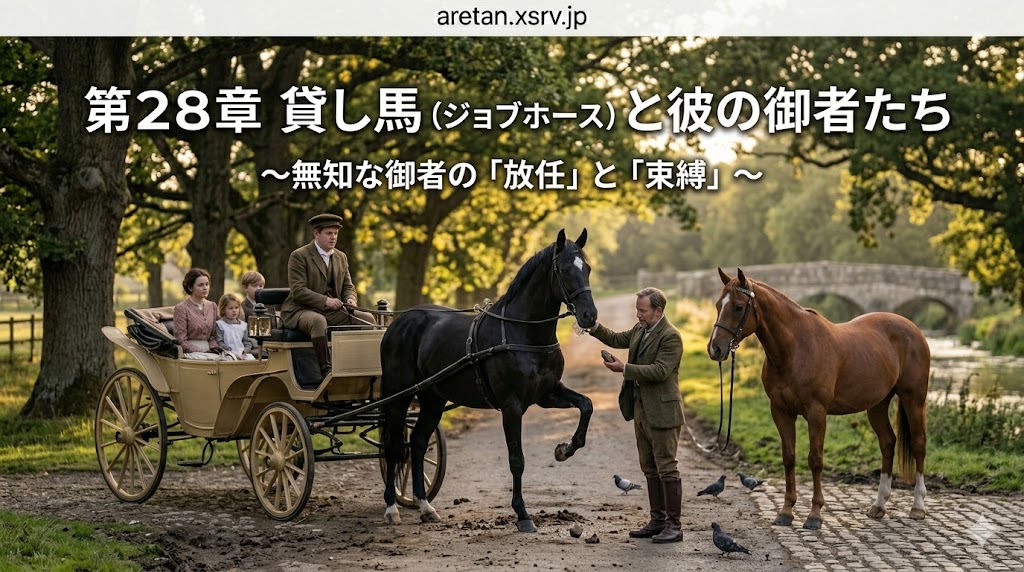
CHAPTER XXVIII:使役馬とその御者たち のポイント
第28章では、ブラック・ビューティーが貸し馬として働くことになり、さまざまな御者や客に使われる日々が始まります。よく扱ってくれる人もいれば、急がせたり乱暴に扱ったりする人もおり、彼の生活は以前より不安定になります。
読みどころは、馬の運命が「誰に使われるか」によって大きく変わる現実です。特定の主人に大切にされていた時代とは違い、使役馬として多くの人に扱われることで、人間の無責任さや思いやりの差がはっきり見えてきます。
この章の英語学習ポイントを開く
- job horse:貸し馬、使役馬。ブラック・ビューティーの新しい働き方を表す章の中心語です。
- driver:御者、運転する人。馬の疲労や安全を左右する重要な存在です。
- hire:借りる、雇う。馬が一時的に使われる立場になることを示します。
- overdrive:酷使する、無理に走らせる。無責任な御者が馬に与える負担を表す語です。
- treatment:扱い、待遇。人によって馬への接し方が大きく違うことを理解するための重要表現です。
カラフル対訳で紹介している作品について
カラフル対訳で紹介している作品は、すべてパブリックドメインの作品です。
このサイトで使われている作品は、著作権の切れた名作などの全文を電子化し、インターネット上で公開している Project Gutenberg(プロジェクト・グーテンベルク)、 および朗読音声を公開している LibriVox(リブリヴォックス/朗読図書館) の作品を出典としています。
原文はProject Gutenberg、音声はLibriVoxで公開されているパブリックドメイン作品を出典としています。
『黒馬物語』Chapter XXVIII: A Job Horse and His Drivers
『黒馬物語』第28章「貸し馬とその御者たち」を、英単語の意味が直感的に入るように色分けしながら、英文と日本語訳をセットで読める形式に整えています。
表示切替
カテゴリ別ハイライト
Hitherto I had always been driven by people who at least knew how to drive.
これまで私は、少なくとも馬車の操り方を知っている人たちに運転されてきました。
But in this place I was to get my experience of all the different kinds of bad and ignorant driving to which we horses are subjected.
しかしこの場所で私は、私たち馬がさらされる、さまざまな種類の悪く無知な運転を経験することになりました。
For I was a “job horse”, and was let out to all sorts of people who wished to hire me.
というのも、私は「貸し馬」であり、私を借りたいと思うあらゆる種類の人々に貸し出されたからです。
And as I was good-tempered and gentle, I think I was oftener let out to the ignorant drivers than some of the other horses, because I could be depended upon.
そして私は気性がよく、おとなしかったので、ほかの馬よりも無知な御者に貸し出されることが多かったのだと思います。私なら頼りにできると思われていたからです。
It would take a long time to tell of all the different styles in which I was driven, but I will mention a few of them.
私がどんなさまざまなやり方で運転されたかをすべて語るには長い時間がかかりますが、そのうちいくつかを話しましょう。
First, there were the tight-rein drivers—men who seemed to think that all depended on holding the reins as hard as they could.
まず、手綱をきつく持つ御者たちがいました。彼らは、すべては手綱をできるだけ強く握ることにかかっていると思っているような人たちでした。
Never relaxing the pull on the horse’s mouth, or giving him the least liberty of movement.
馬の口にかかる引っぱりを決して緩めず、馬にほんの少しの動きの自由も与えないのです。
They are always talking about “keeping the horse well in hand”, and “holding a horse up”.
彼らはいつも「馬をしっかり手の内に保つ」とか、「馬を支えてやる」といったことを話しています。
Just as if a horse was not made to hold himself up.
まるで馬が自分で体を支えるようにはできていないかのようです。
Some poor, broken-down horses, whose mouths have been made hard and insensible by just such drivers as these, may, perhaps, find some support in it.
このような御者たちによって口が硬く鈍くされてしまった、かわいそうな弱りきった馬たちは、もしかするとそこにいくらか支えを感じるのかもしれません。
But for a horse who can depend upon his own legs, and who has a tender mouth and is easily guided, it is not only tormenting, but it is stupid.
しかし、自分の脚を頼ることができ、口が敏感で、簡単に導ける馬にとって、それは苦痛を与えるだけでなく、愚かなことでもあります。
Then there are the loose-rein drivers, who let the reins lie easily on our backs, and their own hand rest lazily on their knees.
次に、手綱を緩めすぎる御者たちがいます。彼らは手綱を私たちの背中にだらりと置き、自分の手を怠けたように膝の上に置いています。
Of course, such gentlemen have no control over a horse, if anything happens suddenly.
もちろん、そのような紳士たちは、何かが突然起きたとき、馬をまったく制御できません。
If a horse shies, or starts, or stumbles, they are nowhere.
馬が物に驚いたり、急に動いたり、つまずいたりすれば、彼らは何の役にも立ちません。
And cannot help the horse or themselves till the mischief is done.
そして災難が起きてしまうまで、馬も自分自身も助けることができません。
Of course, for myself I had no objection to it, as I was not in the habit either of starting or stumbling.
もちろん私自身としては、それに不満はありませんでした。私は急に動いたり、つまずいたりする癖がなかったからです。
And had only been used to depend on my driver for guidance and encouragement.
そして私は、ただ導きと励ましのために御者を頼ることに慣れていただけでした。
Still, one likes to feel the rein a little in going downhill, and likes to know that one’s driver is not gone to sleep.
それでも、坂を下るときには少し手綱を感じたいものですし、御者が眠ってしまっていないとわかっていたいものです。
Besides, a slovenly way of driving gets a horse into bad and often lazy habits.
それに、だらしない運転の仕方は、馬に悪い癖や、しばしば怠けた癖をつけてしまいます。
And when he changes hands he has to be whipped out of them with more or less pain and trouble.
そして持ち主が変わると、その癖を直すために、多かれ少なかれ痛みと苦労を伴ってむちで矯正されることになります。
Squire Gordon always kept us to our best paces and our best manners.
ゴードン氏はいつも、私たちに最良の歩き方と最良の作法を保たせていました。
He said that spoiling a horse and letting him get into bad habits was just as cruel as spoiling a child.
彼は、馬を甘やかして悪い癖をつけさせることは、子どもを甘やかしてだめにするのと同じくらい残酷だと言っていました。
And both had to suffer for it afterward.
そしてどちらも、そのために後で苦しむことになるのです。
Besides, these drivers are often careless altogether, and will attend to anything else more than their horses.
さらに、このような御者たちは全体的に不注意なことが多く、馬よりもほかのことに注意を向けてしまいます。
I went out in the phaeton one day with one of them; he had a lady and two children behind.
ある日、私はそのような御者の一人と四輪軽馬車で出かけました。後ろには婦人と二人の子どもが乗っていました。
He flopped the reins about as we started, and of course gave me several unmeaning cuts with the whip, though I was fairly off.
出発するとき、彼は手綱をだらりと動かし、私はきちんと走り出していたにもかかわらず、当然のようにむちで意味のない一打を何度か与えました。
There had been a good deal of road-mending going on, and even where the stones were not freshly laid down there were a great many loose ones about.
道路補修がかなり行われており、新しく石が敷かれていない場所でさえ、散らばった石がたくさんありました。
My driver was laughing and joking with the lady and the children, and talking about the country to the right and the left.
私の御者は婦人や子どもたちと笑ったり冗談を言ったりし、左右の田園風景について話していました。
But he never thought it worth while to keep an eye on his horse or to drive on the smoothest parts of the road.
しかし彼は、馬に目を配ることや、道の最も滑らかな部分を走らせることに価値があるとは考えませんでした。
And so it easily happened that I got a stone in one of my fore feet.
そのため、私の前足の一つに石が入ってしまうのは、簡単に起こったことでした。
Now, if Mr. Gordon or John, or in fact any good driver, had been there, he would have seen that something was wrong before I had gone three paces.
もしゴードン氏やジョン、あるいは実際どんな良い御者でもそこにいたなら、私が三歩進む前に、何かがおかしいと気づいたでしょう。
Or even if it had been dark a practiced hand would have felt by the rein that there was something wrong in the step.
たとえ暗かったとしても、熟練した手なら、手綱を通じて歩みの異常を感じ取ったはずです。
And they would have got down and picked out the stone.
そして彼らは降りて、その石を取り除いたでしょう。
But this man went on laughing and talking, while at every step the stone became more firmly wedged between my shoe and the frog of my foot.
しかしこの男は笑い話を続け、その間、一歩ごとに石は私の蹄鉄と蹄叉の間にさらに固くくさびのようにはまり込んでいきました。
The stone was sharp on the inside and round on the outside.
その石は内側が鋭く、外側が丸いものでした。
Which, as every one knows, is the most dangerous kind that a horse can pick up.
誰でも知っているように、それは馬が拾ってしまう石の中で最も危険な種類です。
At the same time cutting his foot and making him most liable to stumble and fall.
それは同時に馬の足を切り、馬を最もつまずいて倒れやすくするものなのです。
Whether the man was partly blind or only very careless I can’t say.
その男が少し目が見えていなかったのか、それともただ非常に不注意だったのか、私にはわかりません。
But he drove me with that stone in my foot for a good half-mile before he saw anything.
しかし彼は、何かに気づくまで、石が足に入ったままの私をたっぷり半マイルも走らせました。
By that time I was going so lame with the pain that at last he saw it, and called out, “Well, here’s a go!”
そのころには、私は痛みでひどく足を引きずっていたので、ついに彼もそれに気づき、「おや、これは困ったぞ!」と叫びました。
“Why, they have sent us out with a lame horse! What a shame!”
「なんだ、足の悪い馬を貸し出してきたのか! なんてひどいことだ!」
He then chucked the reins and flipped about with the whip.
それから彼は手綱を乱暴に振り、むちをひらひらさせました。
Saying, “Now, then, it’s no use playing the old soldier with me; there’s the journey to go, and it’s no use turning lame and lazy.”
そして言いました。「さあ、私に仮病を使っても無駄だぞ。まだ行かなければならない道があるんだ。足が悪いふりや怠け者になるのは無駄だ」
Just at this time a farmer came riding up on a brown cob.
ちょうどその時、一人の農夫が茶色の小型でがっしりした馬に乗って近づいてきました。
He lifted his hat and pulled up.
彼は帽子を上げ、馬を止めました。
“I beg your pardon, sir,” he said, “but I think there is something the matter with your horse.”
「失礼ですが」と彼は言いました。「あなたの馬には何か問題があるように思います」
“He goes very much as if he had a stone in his shoe.”
「歩き方を見ると、蹄鉄に石が入っているように見えます」
“If you will allow me I will look at his feet; these loose scattered stones are confounded dangerous things for the horses.”
「よろしければ足を見てみましょう。このように散らばった石は、馬にとってひどく危険なものです」
“He’s a hired horse,” said my driver.
「これは借りた馬です」と私の御者は言いました。
“I don’t know what’s the matter with him, but it is a great shame to send out a lame beast like this.”
「何が悪いのかは知りませんが、こんな足の悪い獣を貸し出すなんて、まったくひどいことです」
The farmer dismounted, and slipping his rein over his arm at once took up my near foot.
農夫は馬から降り、手綱を腕に掛けると、すぐに私の左前足を持ち上げました。
“Bless me, there’s a stone! Lame! I should think so!”
「なんてことだ、石がある! 足を引きずるわけだ!」
At first he tried to dislodge it with his hand.
最初、彼は手でそれを取り外そうとしました。
But as it was now very tightly wedged he drew a stone-pick out of his pocket.
しかしそれは今では非常に固くくさびのようにはまっていたので、彼はポケットから石取り用具を取り出しました。
And very carefully and with some trouble got it out.
そして非常に慎重に、少し苦労しながら、それを取り出しました。
Then holding it up he said, “There, that’s the stone your horse had picked up.”
それから彼はそれを持ち上げて言いました。「ほら、これがあなたの馬が拾っていた石です」
“It is a wonder he did not fall down and break his knees into the bargain!”
「おまけに倒れて膝を壊さなかったのが不思議なくらいです!」
“Well, to be sure!” said my driver; “that is a queer thing!”
「いやはや、本当に!」と私の御者は言いました。「それは妙なことですね!」
“I never knew that horses picked up stones before.”
「馬が石を拾うなんて、これまで知りませんでした」
“Didn’t you?” said the farmer rather contemptuously.
「知らなかったのですか」と農夫はやや軽蔑したように言いました。
“But they do, though, and the best of them will do it, and can’t help it sometimes on such roads as these.”
「ですが、馬は石を拾うものです。どんなに良い馬でもそうなることがありますし、このような道では避けられないこともあります」
“And if you don’t want to lame your horse you must look sharp and get them out quickly.”
「そして馬を足の悪い状態にしたくないなら、よく注意して、すぐに石を取らなければなりません」
“This foot is very much bruised,” he said, setting it gently down and patting me.
「この足はかなり打撲しています」と彼は言い、足をそっと下ろして私をなでました。
“If I might advise, sir, you had better drive him gently for awhile.”
「差し出がましいようですが、しばらくはこの馬をやさしく走らせたほうがよいでしょう」
“The foot is a good deal hurt, and the lameness will not go off directly.”
「足はかなり傷んでいますし、足の引きずりはすぐには消えません」
Then mounting his cob and raising his hat to the lady he trotted off.
それから彼は自分の小型馬に乗り、婦人に帽子を上げて挨拶し、速歩で去っていきました。
When he was gone my driver began to flop the reins about and whip the harness.
彼が去ると、私の御者は手綱をだらだら動かし、馬具をむちで打ち始めました。
By which I understood that I was to go on, which of course I did.
それによって私は、進まなければならないのだと理解しました。もちろん私は進みました。
Glad that the stone was gone, but still in a good deal of pain.
石がなくなったことはうれしかったのですが、それでもまだかなりの痛みがありました。
This was the sort of experience we job horses often came in for.
これが、私たち貸し馬がしばしば経験することだったのです。