
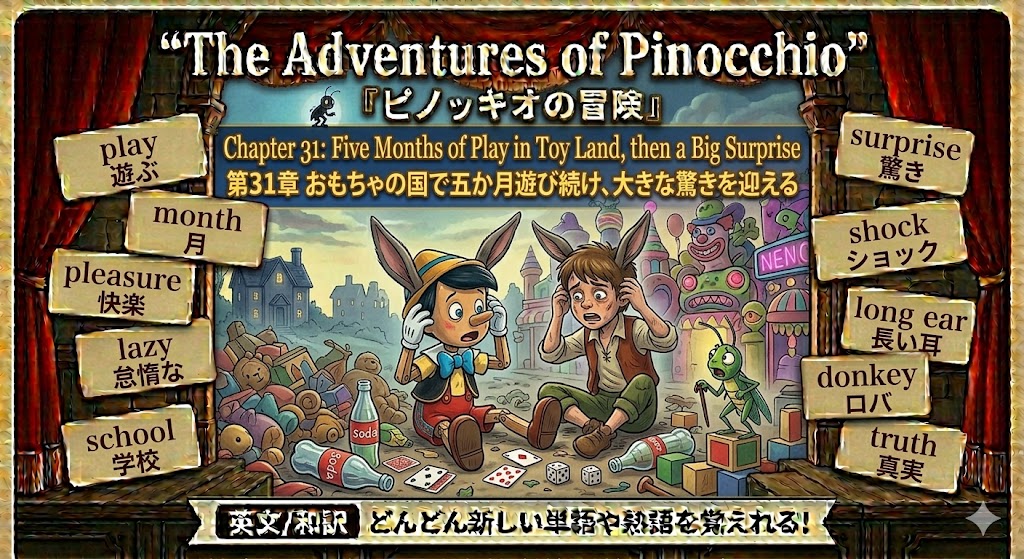
『ピノッキオ』CHAPTER 31
ピノッキオ、おもちゃの国で五か月遊び続け、大きな驚きを迎える
CHAPTER 31 の小説部分を、英単語・重要表現が直感的に入るように色分けした多読用HTMLです。
表示設定
CHAPTER 31
After five months of play, Pinocchio wakes up one fine morning and finds a great surprise awaiting him.
第31章
五か月間遊び続けたあと、ピノッキオはある晴れた朝に目を覚まし、大きな驚きが自分を待っていることに気づきます。
Finally the wagon arrived.
ついに荷車が到着しました。
It made no noise, for its wheels were bound with straw and rags.
それは音を立てませんでした。車輪がわらとぼろ布で巻かれていたからです。
It was drawn by twelve pair of donkeys, all of the same size, but all of different color.
それは十二組のロバに引かれていました。ロバたちはみな同じ大きさでしたが、色はそれぞれ違っていました。
Some were gray, others white, and still others a mixture of brown and black.
灰色のものもいれば、白いものもいて、さらに茶色と黒が混ざったものもいました。
Here and there were a few with large yellow and blue stripes.
ところどころには、大きな黄色と青のしま模様を持つロバもいました。
The strangest thing of all was that those twenty-four donkeys, instead of being iron-shod like any other beast of burden, had on their feet laced shoes made of leather.
何よりも奇妙だったのは、その二十四頭のロバが、ほかの荷役動物のように鉄の蹄鉄をつけている代わりに、革でできたひも靴を履いていたことです。
They were just like the ones boys wear.
それは少年たちが履く靴とそっくりでした。
And the driver of the wagon?
では、その荷車の御者はどうだったのでしょうか。
Imagine to yourselves a little, fat man, much wider than he was long, round and shiny as a ball of butter.
小さく太った男を想像してください。身長より横幅のほうがずっと広く、バターの玉のように丸くてつやつやしていました。
He had a face beaming like an apple, a little mouth that always smiled, and a voice small and wheedling like that of a cat begging for food.
彼の顔はリンゴのように輝き、小さな口はいつも微笑み、声は食べ物をねだる猫のように小さく猫なで声でした。
No sooner did any boy see him than he fell in love with him.
どの少年も彼を見るやいなや、すっかり彼を好きになりました。
And nothing satisfied him but to be allowed to ride in his wagon to that lovely place called the Land of Toys.
そして、その美しい場所「おもちゃの国」へ向かう荷車に乗せてもらうこと以外では、満足できなくなったのです。
In fact the wagon was so closely packed with boys of all ages that it looked like a box of sardines.
実際、その荷車はあらゆる年齢の少年たちでぎゅうぎゅうに詰まっていて、まるでイワシの缶詰のように見えました。
They were uncomfortable, they were piled one on top of the other, they could hardly breathe.
彼らは窮屈で、互いに積み重なるようになっており、ほとんど息もできませんでした。
Yet not one word of complaint was heard.
それでも、不平の言葉は一つも聞こえませんでした。
The thought that in a few hours they would reach a country where there were no schools, no books, no teachers, made these boys so happy.
あと数時間で、学校も本も先生もない国に着くのだと思うと、少年たちはとても幸せでした。
They felt neither hunger, nor thirst, nor sleep, nor discomfort.
彼らは空腹も、喉の渇きも、眠気も、不快感も感じませんでした。
No sooner had the wagon stopped than the little fat man turned to Lamp-Wick.
荷車が止まるやいなや、小さな太った男はランプウィックの方を向きました。
With bows and smiles, he asked in a wheedling tone:
お辞儀と微笑みを浮かべながら、彼は猫なで声の調子で尋ねました。
“Tell me, my fine boy, do you also want to come to my wonderful country?”
「教えておくれ、すてきな坊や。君も私のすばらしい国へ来たいかね?」
“Indeed I do.”
「もちろん行きたいです」
“But I warn you, my little dear, there’s no more room in the wagon. It is full.”
「だが、かわいい子よ、言っておくが、荷車にはもう空きがない。満員なのだ」
“Never mind,” answered Lamp-Wick.
「かまいません」とランプウィックは答えました。
“If there’s no room inside, I can sit on the top of the coach.”
「中に場所がないなら、荷車の上に座れます」
And with one leap, he perched himself there.
そしてひと跳びで、彼はそこにちょこんと乗りました。
“What about you, my love?” asked the Little Man, turning politely to Pinocchio.
「君はどうするのかな、かわいい子よ?」と、小さな男は丁寧にピノッキオの方を向いて尋ねました。
“What are you going to do? Will you come with us, or do you stay here?”
「君はどうするつもりかね? 私たちと来るのか、それともここに残るのか?」
“I stay here,” answered Pinocchio.
「ぼくはここに残ります」とピノッキオは答えました。
“I want to return home, as I prefer to study and to succeed in life.”
「ぼくは家に帰りたいのです。勉強して人生で成功するほうがいいからです」
“May that bring you luck!”
「それが君に幸運をもたらしますように!」
“Pinocchio!” Lamp-Wick called out. “Listen to me. Come with us and we’ll always be happy.”
「ピノッキオ!」とランプウィックが呼びました。「ぼくの言うことを聞いて。一緒に来よう。そうすれば、ぼくたちはいつも幸せだよ」
“No, no, no!”
「だめ、だめ、だめ!」
“Come with us and we’ll always be happy,” cried four other voices from the wagon.
「一緒に来よう。そうすればいつも幸せだよ」と、荷車の中からほかの四つの声が叫びました。
“Come with us and we’ll always be happy,” shouted the one hundred and more boys in the wagon, all together.
「一緒に来よう。そうすればいつも幸せだよ」と、荷車の中の百人以上の少年たちがいっせいに叫びました。
“And if I go with you, what will my good Fairy say?” asked the Marionette, who was beginning to waver and weaken in his good resolutions.
「もし君たちと行ったら、ぼくのよい妖精は何と言うだろう?」と、よい決意が揺らぎ、弱まり始めていた操り人形は尋ねました。
“Don’t worry so much. Only think that we are going to a land where we shall be allowed to make all the racket we like from morning till night.”
「そんなに心配しなくていいよ。朝から夜まで、好きなだけ騒げる国へ行くんだとだけ考えればいいんだ」
Pinocchio did not answer, but sighed deeply once—twice—a third time.
ピノッキオは答えず、深いため息を一度、二度、三度つきました。
Finally, he said:
ついに彼は言いました。
“Make room for me. I want to go, too!”
「ぼくの場所を作って。ぼくも行きたい!」
“The seats are all filled,” answered the Little Man.
「座席はすべて埋まっているよ」と小さな男は答えました。
“But to show you how much I think of you, take my place as coachman.”
「だが、私が君をどれほど大切に思っているか示すために、御者として私の席に座りなさい」
“And you?”
「あなたは?」
“I’ll walk.”
「私は歩くよ」
“No, indeed. I could not permit such a thing. I much prefer riding one of these donkeys,” cried Pinocchio.
「いえ、そんなことはできません。ぼくはむしろ、このロバの一頭に乗るほうがいいです」とピノッキオは叫びました。
No sooner said than done.
言うが早いか、彼はそうしました。
He approached the first donkey and tried to mount it.
彼は最初のロバに近づき、それに乗ろうとしました。
But the little animal turned suddenly and gave him such a terrible kick in the stomach that Pinocchio was thrown to the ground and fell with his legs in the air.
しかしその小さな動物は突然向きを変え、ピノッキオのお腹をひどく蹴ったので、ピノッキオは地面に投げ出され、脚を空中に上げて倒れました。
At this unlooked-for entertainment, the whole company of runaways laughed uproariously.
この思いがけない見世物に、家出少年たち全員が大笑いしました。
The little fat man did not laugh.
小さな太った男は笑いませんでした。
He went up to the rebellious animal, and, still smiling, bent over him lovingly and bit off half of his right ear.
彼はその反抗的な動物のところへ行き、まだ微笑みながら愛情深そうに身をかがめ、その右耳の半分を噛み切りました。
In the meantime, Pinocchio lifted himself up from the ground, and with one leap landed on the donkey’s back.
その間に、ピノッキオは地面から身を起こし、ひと跳びでロバの背中に乗りました。
The leap was so well taken that all the boys shouted, “Hurrah for Pinocchio!”
その跳躍は見事だったので、少年たちはみな「ピノッキオばんざい!」と叫びました。
And they clapped their hands in hearty applause.
そして彼らは心からの拍手を送りました。
Suddenly the little donkey gave a kick with his two hind feet.
突然、その小さなロバは二本の後ろ足で蹴りました。
At this unexpected move, the poor Marionette found himself once again sprawling right in the middle of the road.
この思いがけない動きで、かわいそうな操り人形は、またもや道の真ん中に大の字になって倒れてしまいました。
Again the boys shouted with laughter.
少年たちはまた大笑いしました。
But the Little Man, instead of laughing, became so loving toward the little animal that, with another kiss, he bit off half of his left ear.
しかし小さな男は笑う代わりに、その小さな動物にたいへん愛情深くなり、もう一度キスをして、その左耳の半分を噛み切りました。
“You can mount now, my boy,” he then said to Pinocchio.
「もう乗ってよいよ、坊や」と彼はピノッキオに言いました。
“Have no fear. That donkey was worried about something, but I have spoken to him and now he seems quiet and reasonable.”
「怖がらなくてよい。そのロバは何かを心配していたのだ。でも私が話をしたから、今は静かで分別があるようだ」
Pinocchio mounted and the wagon started on its way.
ピノッキオが乗ると、荷車は出発しました。
While the donkeys galloped along the stony road, the Marionette fancied he heard a very quiet voice whispering to him:
ロバたちが石だらけの道を駆けていく間、操り人形はとても静かな声が自分にささやいているように思いました。
“Poor silly! You have done as you wished. But you are going to be a sorry boy before very long.”
「かわいそうなおばかさん! おまえは自分の望むようにした。でもまもなく、後悔する少年になるだろう」
Pinocchio, greatly frightened, looked about him to see whence the words had come, but he saw no one.
ピノッキオはひどくおびえ、その言葉がどこから来たのか見ようとあたりを見回しましたが、誰も見えませんでした。
The donkeys galloped, the wagon rolled on smoothly, the boys slept, and Lamp-Wick snored like a dormouse.
ロバたちは駆け、荷車はなめらかに進み、少年たちは眠り、ランプウィックはヤマネのようにいびきをかいていました。
And the little, fat driver sang sleepily between his teeth.
そして小さな太った御者は、眠そうに歯の間から歌っていました。
After a mile or so, Pinocchio again heard the same faint voice whispering:
一マイルほど進むと、ピノッキオはまた同じかすかな声がささやくのを聞きました。
“Remember, little simpleton!”
「覚えておきなさい、小さなおばかさん!」
“Boys who stop studying and turn their backs upon books and schools and teachers in order to give all their time to nonsense and pleasure, sooner or later come to grief.”
「勉強をやめ、本や学校や先生に背を向け、すべての時間をくだらないことや快楽に使う少年たちは、遅かれ早かれひどい目にあうのだ」
“Oh, how well I know this! How well I can prove it to you!”
「ああ、私はそのことをどれほどよく知っていることか! それをおまえにどれほどよく証明できることか!」
“A day will come when you will weep bitterly, even as I am weeping now—but it will be too late!”
「おまえが私のように激しく泣く日が来るだろう。だがその時には、もう遅すぎるのだ!」
At these whispered words, the Marionette grew more and more frightened.
このささやき声を聞いて、操り人形はますます怖くなりました。
He jumped to the ground, ran up to the donkey on whose back he had been riding, and taking his nose in his hands, looked at him.
彼は地面に飛び降り、自分が乗っていたロバのところへ走り寄り、その鼻を両手でつかんで見つめました。
Think how great was his surprise when he saw that the donkey was weeping—weeping just like a boy!
そのロバが泣いている――少年のように泣いている――のを見た時、彼がどれほど驚いたか想像してください!
“Hey, Mr. Driver!” cried the Marionette.
「おい、御者さん!」と操り人形は叫びました。
“Do you know what strange thing is happening here! This donkey weeps.”
「ここでどんな奇妙なことが起きているか知っていますか! このロバが泣いているんです」
“Let him weep. When he gets married, he will have time to laugh.”
「泣かせておきなさい。結婚したら、笑う時間があるだろう」
“Have you perhaps taught him to speak?”
「もしかして、あなたが彼に話すことを教えたのですか?」
“No, he learned to mumble a few words when he lived for three years with a band of trained dogs.”
「いや、三年間、訓練された犬たちの一団と暮らしていた時に、彼はいくつかの言葉をもごもご話すことを覚えたのだ」
“Poor beast!”
「かわいそうな動物だ!」
“Come, come,” said the Little Man, “do not lose time over a donkey that can weep.”
「さあ、さあ」と小さな男は言いました。「泣くことができるロバに時間を無駄にしてはいけない」
“Mount quickly and let us go. The night is cool and the road is long.”
「早く乗りなさい。出発しよう。夜は涼しく、道は長いのだ」
Pinocchio obeyed without another word.
ピノッキオはそれ以上何も言わずに従いました。
The wagon started again.
荷車は再び出発しました。
Toward dawn the next morning they finally reached that much-longed-for country, the Land of Toys.
翌朝の夜明けごろ、彼らはついに、あの待ち望まれた国、おもちゃの国に着きました。
This great land was entirely different from any other place in the world.
この大きな国は、世界のほかのどの場所ともまったく違っていました。
Its population, large though it was, was composed wholly of boys.
その人口は多かったものの、すべて少年たちだけで構成されていました。
The oldest were about fourteen years of age, the youngest, eight.
いちばん年上は十四歳くらいで、いちばん年下は八歳でした。
In the street, there was such a racket, such shouting, such blowing of trumpets, that it was deafening.
通りでは、騒ぎや叫び声、ラッパの音があまりにも大きく、耳をつんざくほどでした。
Everywhere groups of boys were gathered together.
いたるところに少年たちの集団が集まっていました。
Some played at marbles, at hopscotch, at ball.
ビー玉遊びをする子もいれば、石けりやボール遊びをする子もいました。
Others rode on bicycles or on wooden horses.
ほかの子たちは自転車や木馬に乗っていました。
Some played at blindman’s buff, others at tag.
目隠し鬼をする子もいれば、鬼ごっこをする子もいました。
Here a group played circus, there another sang and recited.
こちらでは一団がサーカスごっこをし、あちらでは別の一団が歌ったり暗唱したりしていました。
A few turned somersaults, others walked on their hands with their feet in the air.
何人かは宙返りをし、ほかの子たちは足を空中に上げて逆立ち歩きをしていました。
Generals in full uniform leading regiments of cardboard soldiers passed by.
正装の将軍たちが厚紙の兵隊の連隊を率いて通り過ぎました。
Laughter, shrieks, howls, catcalls, hand-clapping followed this parade.
この行進には、笑い声、叫び声、わめき声、やじ、拍手が続きました。
One boy made a noise like a hen, another like a rooster, and a third imitated a lion in his den.
ある少年はめんどりのような声を出し、別の少年はおんどりのような声を出し、三人目は巣穴にいるライオンのまねをしました。
All together they created such a pandemonium that it would have been necessary for you to put cotton in your ears.
それらすべてが一緒になって大混乱を作り出し、耳に綿を詰める必要があるほどでした。
The squares were filled with small wooden theaters, overflowing with boys from morning till night.
広場は小さな木造劇場でいっぱいで、朝から夜まで少年たちであふれていました。
And on the walls of the houses, written with charcoal, were words like these:
そして家々の壁には、木炭で次のような言葉が書かれていました。
HURRAH FOR THE LAND OF TOYS! DOWN WITH ARITHMETIC! NO MORE SCHOOL!
おもちゃの国ばんざい! 算数なんてなくなれ! もう学校はいらない!
As soon as they had set foot in that land, Pinocchio, Lamp-Wick, and all the other boys who had traveled with them started out on a tour of investigation.
その国に足を踏み入れるとすぐに、ピノッキオ、ランプウィック、そして一緒に旅してきたほかの少年たちは、探検の旅に出ました。
They wandered everywhere, they looked into every nook and corner, house and theater.
彼らはあちこちを歩き回り、あらゆる隅々、家や劇場をのぞき込みました。
They became everybody’s friend.
彼らはみんなの友だちになりました。
Who could be happier than they?
彼ら以上に幸せな人がいるでしょうか。
What with entertainments and parties, the hours, the days, the weeks passed like lightning.
娯楽やパーティーのおかげで、時間も日々も週も、稲妻のように過ぎていきました。
“Oh, what a beautiful life this is!” said Pinocchio each time that, by chance, he met his friend Lamp-Wick.
「ああ、これはなんてすばらしい生活なんだ!」と、ピノッキオは偶然友だちのランプウィックに会うたびに言いました。
“Was I right or wrong?” answered Lamp-Wick.
「ぼくは正しかったか、間違っていたか?」とランプウィックは答えました。
“And to think you did not want to come!”
「それに、君は来たくないと言っていたんだからね!」
“To think that even yesterday the idea came into your head to return home to see your Fairy and to start studying again!”
「昨日でさえ、妖精に会うために家へ帰って、また勉強を始めようなんて考えが君の頭に浮かんだんだから!」
“If today you are free from pencils and books and school, you owe it to me, to my advice, to my care.”
「今日、君が鉛筆や本や学校から自由でいられるのは、ぼくのおかげ、ぼくの助言、ぼくの気遣いのおかげなんだ」
“Do you admit it? Only true friends count, after all.”
「認めるかい? 結局、本当の友だちだけが大事なんだよ」
“It’s true, Lamp-Wick, it’s true.”
「本当だよ、ランプウィック。本当だ」
“If today I am a really happy boy, it is all because of you.”
「今日ぼくが本当に幸せな少年でいられるのは、すべて君のおかげだ」
“And to think that the teacher, when speaking of you, used to say, ‘Do not go with that Lamp-Wick!’”
「それに先生は、君のことを話す時、『あのランプウィックとは一緒に行ってはいけない!』とよく言っていたんだからね」
“He is a bad companion and some day he will lead you astray.”
「彼は悪い仲間で、いつか君を道から外れさせるだろう、と」
“Poor teacher!” answered the other, nodding his head.
「かわいそうな先生だ!」と相手は頭をうなずかせながら答えました。
“Indeed I know how much he disliked me and how he enjoyed speaking ill of me.”
「たしかに、先生がどれほどぼくを嫌っていて、どれほどぼくの悪口を言うのを楽しんでいたか知っているよ」
“But I am of a generous nature, and I gladly forgive him.”
「でもぼくは寛大な性格だから、喜んで先生を許すよ」
“Great soul!” said Pinocchio, fondly embracing his friend.
「偉大な魂だ!」とピノッキオは言い、友だちを愛情深く抱きしめました。
Five months passed and the boys continued playing and enjoying themselves from morn till night, without ever seeing a book, or a desk, or a school.
五か月が過ぎ、少年たちは朝から夜まで遊び楽しみ続け、本も机も学校も一度も見ませんでした。
But, my children, there came a morning when Pinocchio awoke and found a great surprise awaiting him.
しかし、子どもたちよ、ある朝がやって来ました。ピノッキオは目を覚まし、大きな驚きが自分を待っていることに気づいたのです。
A surprise which made him feel very unhappy, as you shall see.
それは、これから分かるように、彼をとても不幸な気持ちにさせる驚きでした。