
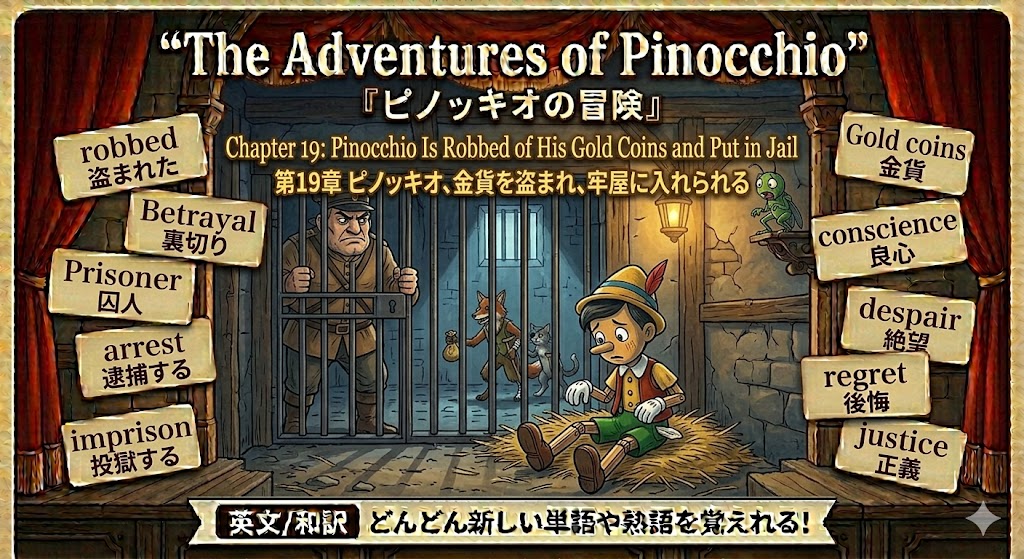
『ピノッキオ』CHAPTER 19
ピノッキオ、金貨を盗まれ、牢屋に入れられる
CHAPTER 19 の小説部分を、英単語・重要表現が直感的に入るように色分けした多読用HTMLです。
CHAPTER 19
Pinocchio is robbed of his gold pieces and, in punishment, is sentenced to four months in prison.
第19章
ピノッキオは金貨を盗まれ、その罰として四か月の牢屋入りを言い渡されます。
If the Marionette had been told to wait a day instead of twenty minutes, the time could not have seemed longer to him.
もし操り人形が二十分ではなく一日待つように言われていたとしても、それ以上長く感じることはなかったでしょう。
He walked impatiently to and fro and finally turned his nose toward the Field of Wonders.
彼は落ち着かずに行ったり来たりし、ついに鼻を奇跡の畑の方へ向けました。
And as he walked with hurried steps, his heart beat with an excited tic, tac, tic, tac, just as if it were a wall clock.
そして急いだ足取りで歩いていると、彼の心臓は、まるで壁時計のように、興奮してチック、タック、チック、タックと鳴りました。
His busy brain kept thinking:
彼の忙しい頭は、考え続けました。
“What if, instead of a thousand, I should find two thousand?”
「もし千枚ではなく、二千枚見つかったらどうしよう?」
“Or if, instead of two thousand, I should find five thousand—or one hundred thousand?”
「あるいは二千枚ではなく、五千枚、いや十万枚見つかったらどうしよう?」
“I’ll build myself a beautiful palace, with a thousand stables filled with a thousand wooden horses to play with.”
「ぼくは美しい宮殿を建てよう。そこには千の馬小屋があり、遊ぶための木馬が千頭入っているんだ」
“A cellar overflowing with lemonade and ice cream soda, and a library of candies and fruits, cakes and cookies.”
「レモネードとアイスクリームソーダがあふれる地下貯蔵室、それからキャンディーや果物、ケーキやクッキーの図書館も作ろう」
Thus amusing himself with fancies, he came to the field.
こうして空想で自分を楽しませながら、彼は畑に着きました。
There he stopped to see if, by any chance, a vine filled with gold coins was in sight.
そこで彼は立ち止まり、万一にも金貨でいっぱいのつるが見えるかどうか確かめました。
But he saw nothing!
しかし、彼には何も見えませんでした!
He took a few steps forward, and still nothing!
彼は数歩前に進みましたが、それでも何もありません!
He stepped into the field.
彼は畑の中へ入りました。
He went up to the place where he had dug the hole and buried the gold pieces.
彼は、自分が穴を掘って金貨を埋めた場所へ行きました。
Again nothing!
やはり何もありません!
Pinocchio became very thoughtful and, forgetting his good manners altogether, he pulled a hand out of his pocket and gave his head a thorough scratching.
ピノッキオはとても考え込み、礼儀をすっかり忘れて、ポケットから手を出し、頭をしっかりかきました。
As he did so, he heard a hearty burst of laughter close to his head.
そうしていると、彼は頭のすぐ近くで、心からの大笑いを聞きました。
He turned sharply, and there, just above him on the branch of a tree, sat a large Parrot, busily preening his feathers.
彼がぱっと振り向くと、すぐ上の木の枝に、大きなオウムが座っていて、忙しそうに羽づくろいをしていました。
“What are you laughing at?” Pinocchio asked peevishly.
「何を笑っているの?」とピノッキオは不機嫌そうに尋ねました。
“I am laughing because, in preening my feathers, I tickled myself under the wings.”
「羽づくろいをしている時に、翼の下を自分でくすぐってしまったから笑っているのさ」
The Marionette did not answer.
操り人形は答えませんでした。
He walked to the brook, filled his shoe with water, and once more sprinkled the ground which covered the gold pieces.
彼は小川へ歩いて行き、靴に水を入れ、金貨を覆っている地面にもう一度振りかけました。
Another burst of laughter, even more impertinent than the first, was heard in the quiet field.
最初よりもさらに失礼な大笑いが、静かな畑に響きました。
“Well,” cried the Marionette, angrily this time, “may I know, Mr. Parrot, what amuses you so?”
「さて」と操り人形は今度は怒って叫びました。「オウムさん、何がそんなにおもしろいのか、教えてもらえますか?」
“I am laughing at those simpletons who believe everything they hear and who allow themselves to be caught so easily in the traps set for them.”
「私は、聞いたことを何でも信じ、自分に仕掛けられた罠にあまりにも簡単にかかるお人よしたちを笑っているのだよ」
“Do you, perhaps, mean me?”
「もしかして、ぼくのことを言っているの?」
“I certainly do mean you, poor Pinocchio.”
「もちろん君のことを言っているのだよ、かわいそうなピノッキオ」
“You are such a little silly as to believe that gold can be sown in a field just like beans or squash.”
「君は、金が豆やカボチャのように畑にまけると信じてしまうほどの、小さな愚か者なのだ」
“I, too, believed that once and today I am very sorry for it.”
「私もかつてはそう信じていた。そして今では、そのことをとても後悔している」
“Today, but too late, I have reached the conclusion that, in order to come by money honestly, one must work and know how to earn it with hand or brain.”
「今になって、しかし遅すぎるのだが、私は結論に達した。正直にお金を手に入れるには、働き、自分の手か頭でそれを稼ぐ方法を知らなければならないのだ」
“I don’t know what you are talking about,” said the Marionette, who was beginning to tremble with fear.
「何を言っているのか分からないよ」と操り人形は言いました。彼は恐怖で震え始めていました。
“Too bad! I’ll explain myself better,” said the Parrot.
「それは残念だ! もっと分かりやすく説明してあげよう」とオウムは言いました。
“While you were away in the city the Fox and the Cat returned here in a great hurry.”
「君が町に行っている間に、キツネとネコは大急ぎでここに戻ってきたのだ」
“They took the four gold pieces which you had buried and ran away as fast as the wind.”
「彼らは君が埋めた四枚の金貨を取り、風のような速さで逃げていった」
“If you can catch them, you’re a brave one!”
「もし彼らを捕まえられるなら、君はたいした勇者だよ!」
Pinocchio’s mouth opened wide.
ピノッキオは口を大きく開けました。
He would not believe the Parrot’s words and began to dig away furiously at the earth.
彼はオウムの言葉を信じようとせず、土を激しく掘り始めました。
He dug and he dug till the hole was as big as himself, but no money was there.
彼は掘って、掘って、穴が自分と同じくらい大きくなるまで掘りました。しかし、そこにお金はありませんでした。
Every penny was gone.
一ペニー残らず消えていました。
In desperation, he ran to the city and went straight to the courthouse to report the robbery to the magistrate.
絶望した彼は町へ走り、盗難を判事に届け出るために、まっすぐ裁判所へ行きました。
The Judge was a Monkey, a large Gorilla venerable with age.
裁判官はサルで、年老いて尊く見える大きなゴリラでした。
A flowing white beard covered his chest and he wore gold-rimmed spectacles from which the glasses had dropped out.
流れるような白ひげが胸を覆い、彼は金縁の眼鏡をかけていましたが、そのレンズは抜け落ちていました。
The reason for wearing these, he said, was that his eyes had been weakened by the work of many years.
彼がそれをかけている理由は、長年の仕事で目が弱っていたからだと、彼は言いました。
Pinocchio, standing before him, told his pitiful tale, word by word.
彼の前に立ったピノッキオは、哀れな話を一言一言、語りました。
He gave the names and the descriptions of the robbers and begged for justice.
彼は強盗たちの名前と特徴を伝え、正義を求めて訴えました。
The Judge listened to him with great patience.
裁判官は大きな忍耐をもって、彼の話を聞きました。
A kind look shone in his eyes.
彼の目には優しそうな表情が輝きました。
He became very much interested in the story; he felt moved; he almost wept.
彼はその話にとても興味を持ち、心を動かされ、ほとんど泣きそうになりました。
When the Marionette had no more to say, the Judge put out his hand and rang a bell.
操り人形がもう話すことがなくなると、裁判官は手を差し出し、ベルを鳴らしました。
At the sound, two large Mastiffs appeared, dressed in Carabineers’ uniforms.
その音で、憲兵の制服を着た二匹の大きなマスティフ犬が現れました。
Then the magistrate, pointing to Pinocchio, said in a very solemn voice:
それから判事はピノッキオを指さし、とても厳かな声で言いました。
“This poor simpleton has been robbed of four gold pieces.”
「このかわいそうなお人よしは、四枚の金貨を奪われた」
“Take him, therefore, and throw him into prison.”
「したがって、この者を連れて行き、牢屋に入れなさい」
The Marionette, on hearing this sentence passed upon him, was thoroughly stunned.
この判決が自分に下されるのを聞いて、操り人形は完全に呆然としました。
He tried to protest, but the two officers clapped their paws on his mouth and hustled him away to jail.
彼は抗議しようとしましたが、二人の役人は彼の口に前足を押しつけ、急いで牢屋へ連れて行きました。
There he had to remain for four long, weary months.
そこで彼は、長くうんざりする四か月を過ごさなければなりませんでした。
And if it had not been for a very lucky chance, he probably would have had to stay there longer.
そして、たいへん幸運な偶然がなければ、おそらくもっと長くそこにいなければならなかったでしょう。
For, my dear children, you must know that it happened just then that the young emperor who ruled over the City of Simple Simons had gained a great victory over his enemy.
というのも、親愛なる子どもたちよ、ちょうどその時、お人よしの町を治めていた若い皇帝が、敵に対して大きな勝利を収めたことを知っておかなければなりません。
And in celebration thereof, he had ordered illuminations, fireworks, shows of all kinds, and, best of all, the opening of all prison doors.
そしてその祝賀として、彼はイルミネーション、花火、あらゆる種類の見世物、そして何よりもすばらしいことに、すべての牢屋の扉を開くことを命じたのです。
“If the others go, I go, too,” said Pinocchio to the Jailer.
「ほかの人たちが出ていくなら、ぼくも出ていくよ」とピノッキオは牢番に言いました。
“Not you,” answered the Jailer. “You are one of those—”
「おまえはだめだ」と牢番は答えました。「おまえはあの連中の一人――」
“I beg your pardon,” interrupted Pinocchio, “I, too, am a thief.”
「失礼ですが」とピノッキオはさえぎりました。「ぼくも泥棒です」
“In that case you also are free,” said the Jailer.
「それなら、おまえも自由だ」と牢番は言いました。
Taking off his cap, he bowed low and opened the door of the prison.
牢番は帽子を取り、深くお辞儀をして、牢屋の扉を開けました。
And Pinocchio ran out and away, with never a look backward.
そしてピノッキオは外へ飛び出し、後ろを一度も振り返らずに逃げていきました。