
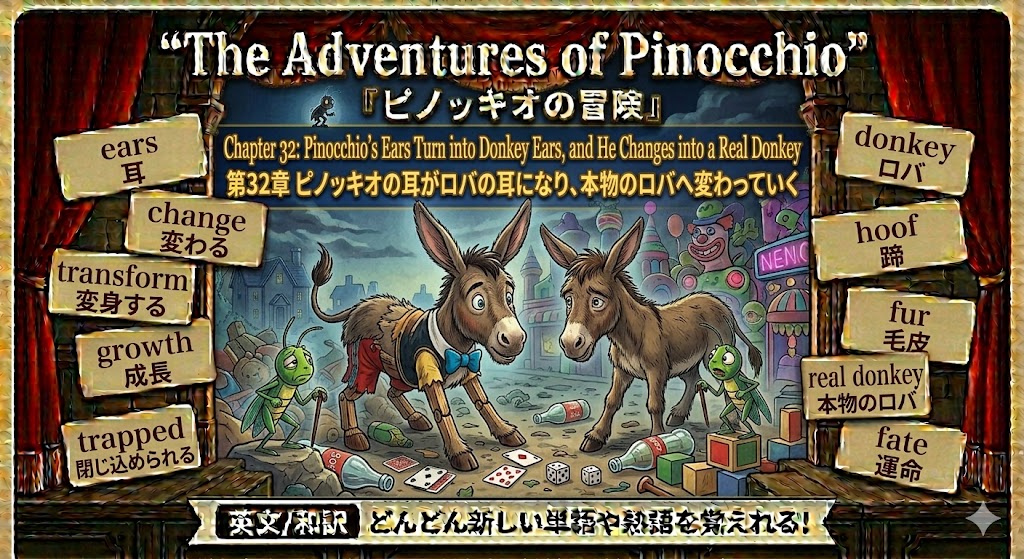
『ピノッキオ』CHAPTER 32
ピノッキオの耳がロバの耳になり、本物のロバへ変わっていく
CHAPTER 32 の小説部分を、英単語・重要表現が直感的に入るように色分けした多読用HTMLです。
表示設定
CHAPTER 32
Pinocchio’s ears become like those of a Donkey. In a little while he changes into a real Donkey and begins to bray.
第32章
ピノッキオの耳はロバの耳のようになり、まもなく本物のロバへ変わって、ロバのように鳴き始めます。
Everyone, at one time or another, has found some surprise awaiting him.
誰でも、いつかどこかで、自分を待ち受ける何かの驚きに出会ったことがあるものです。
Of the kind which Pinocchio had on that eventful morning of his life, there are but few.
しかし、ピノッキオが人生のその運命的な朝に経験したような驚きは、めったにありません。
What was it? I will tell you, my dear little readers.
それは何だったのでしょうか。かわいい読者のみなさんにお話ししましょう。
On awakening, Pinocchio put his hand up to his head and there he found—
目を覚ますと、ピノッキオは手を頭に上げました。そしてそこで見つけたものは――。
Guess!
当ててみてください!
He found that, during the night, his ears had grown at least ten full inches!
彼は、夜の間に自分の耳が少なくとも十インチも伸びていることに気づいたのです!
You must know that the Marionette, even from his birth, had very small ears.
知っておいてほしいのですが、この操り人形は、生まれた時からとても小さな耳をしていました。
So small indeed that to the naked eye they could hardly be seen.
それは本当に小さく、肉眼ではほとんど見えないほどでした。
Fancy how he felt when he noticed that overnight those two dainty organs had become as long as shoe brushes!
その二つの上品な器官が、一晩で靴ブラシほどの長さになっていると気づいた時、彼がどんな気持ちだったか想像してみてください!
He went in search of a mirror, but not finding any, he just filled a basin with water and looked at himself.
彼は鏡を探しに行きましたが、見つからなかったので、水を張った洗面器を用意して自分の姿を見ました。
There he saw what he never could have wished to see.
そこで彼は、絶対に見たくなかったものを見てしまいました。
His manly figure was adorned and enriched by a beautiful pair of donkey’s ears.
彼の男らしい姿には、美しい一対のロバの耳が飾りとして加わっていたのです。
I leave you to think of the terrible grief, the shame, the despair of the poor Marionette.
かわいそうな操り人形が感じた恐ろしい悲しみ、恥、絶望がどれほどのものだったかは、みなさんの想像にお任せします。
He began to cry, to scream, to knock his head against the wall.
彼は泣き、叫び、壁に頭を打ちつけ始めました。
But the more he shrieked, the longer and the more hairy grew his ears.
しかし叫べば叫ぶほど、彼の耳はますます長く、ますます毛深くなっていきました。
At those piercing shrieks, a Dormouse came into the room.
その甲高い叫び声を聞いて、ヤマネが部屋に入ってきました。
A fat little Dormouse, who lived upstairs.
それは上の階に住んでいる、小さく太ったヤマネでした。
Seeing Pinocchio so grief-stricken, she asked him anxiously:
ピノッキオがあまりにも悲嘆に暮れているのを見て、彼女は心配そうに尋ねました。
“What is the matter, dear little neighbor?”
「どうしたのですか、かわいいお隣さん?」
“I am sick, my little Dormouse, very, very sick—and from an illness which frightens me!”
「ぼくは病気なんだ、小さなヤマネさん。とても、とても重い病気で、しかもぼくを怖がらせる病気なんだ!」
“Do you understand how to feel the pulse?”
「脈を診る方法を知っている?」
“A little.”
「少しなら」
“Feel mine then and tell me if I have a fever.”
「それならぼくの脈を診て、熱があるか教えて」
The Dormouse took Pinocchio’s wrist between her paws and, after a few minutes, looked up at him sorrowfully.
ヤマネはピノッキオの手首を両前足でつかみ、数分後、悲しそうに彼を見上げました。
And she said: “My friend, I am sorry, but I must give you some very sad news.”
そして彼女は言いました。「お友だち、気の毒ですが、とても悲しい知らせを伝えなければなりません」
“What is it?”
「何なの?」
“You have a very bad fever.”
「あなたはとても悪い熱を出しています」
“But what fever is it?”
「でも、何の熱なの?」
“The donkey fever.”
「ロバ熱です」
“I don’t know anything about that fever,” answered the Marionette, beginning to understand even too well what was happening to him.
「ぼくはその熱について何も知らないよ」と操り人形は答えましたが、自分に何が起きているのか、あまりにもよく分かり始めていました。
“Then I will tell you all about it,” said the Dormouse.
「それなら、すべてお話ししましょう」とヤマネは言いました。
“Know then that, within two or three hours, you will no longer be a Marionette, nor a boy.”
「つまり、二、三時間以内に、あなたはもう操り人形でも少年でもなくなるのです」
“What shall I be?”
「ぼくは何になるの?」
“Within two or three hours you will become a real donkey, just like the ones that pull the fruit carts to market.”
「二、三時間以内に、あなたは市場へ果物の荷車を引くロバたちと同じ、本物のロバになります」
“Oh, what have I done? What have I done?” cried Pinocchio.
「ああ、ぼくは何をしてしまったんだ? 何をしてしまったんだ?」とピノッキオは叫びました。
He grasped his two long ears in his hands and pulled and tugged at them angrily, just as if they belonged to another.
彼は二つの長い耳を両手でつかみ、まるでそれが他人のものでもあるかのように、怒って引っぱったり、ぐいぐい引いたりしました。
“My dear boy,” answered the Dormouse to cheer him up a bit, “why worry now?”
「かわいい坊や」とヤマネは彼を少し元気づけようとして答えました。「今さら心配しても仕方がないでしょう?」
“What is done cannot be undone, you know.”
「してしまったことは、元には戻せないのですから」
“Fate has decreed that all lazy boys who come to hate books and schools and teachers and spend all their days with toys and games must sooner or later turn into donkeys.”
「本や学校や先生を嫌いになり、おもちゃや遊びで毎日を過ごす怠け者の少年たちは、遅かれ早かれロバになると運命が定めているのです」
“But is it really so?” asked the Marionette, sobbing bitterly.
「でも、本当にそうなの?」と操り人形は激しくすすり泣きながら尋ねました。
“I am sorry to say it is. And tears now are useless.”
「残念ながらそうです。そして今さら涙は役に立ちません」
“You should have thought of all this before.”
「こうなる前に、すべてを考えておくべきでした」
“But the fault is not mine. Believe me, little Dormouse, the fault is all Lamp-Wick’s.”
「でも、悪いのはぼくじゃないんだ。信じて、小さなヤマネさん。全部ランプウィックが悪いんだ」
“And who is this Lamp-Wick?”
「そのランプウィックとは誰ですか?」
“A classmate of mine.”
「ぼくの同級生です」
“I wanted to return home. I wanted to be obedient. I wanted to study and to succeed in school.”
「ぼくは家に帰りたかった。従順でいたかった。勉強して学校で成功したかったんだ」
“But Lamp-Wick said to me, ‘Why do you want to waste your time studying?’”
「でもランプウィックがぼくに言ったんだ。『なぜ勉強で時間を無駄にしたいんだ?』って」
“‘Why do you want to go to school? Come with me to the Land of Toys.’”
「『なぜ学校へ行きたいんだ? ぼくと一緒におもちゃの国へ来なよ』って」
“‘There we’ll never study again. There we can enjoy ourselves and be happy from morn till night.’”
「『そこでは二度と勉強しない。そこでぼくたちは朝から夜まで楽しんで幸せでいられる』って」
“And why did you follow the advice of that false friend?”
「では、なぜその偽りの友の助言に従ったのですか?」
“Why? Because, my dear little Dormouse, I am a heedless Marionette—heedless and heartless.”
「なぜって? だって、小さなヤマネさん、ぼくは軽率な操り人形だからです。軽率で、心ないんです」
“Oh! If I had only had a bit of heart, I should never have abandoned that good Fairy.”
「ああ! もしぼくに少しでも心があったなら、あのよい妖精を見捨てたりしなかったのに」
“She loved me so well and has been so kind to me!”
「妖精はぼくをとても愛してくれて、ぼくにとても親切だったのに!」
“And by this time, I should no longer be a Marionette.”
「そして今ごろ、ぼくはもう操り人形ではなかったはずなんだ」
“I should have become a real boy, like all these friends of mine!”
「ぼくの友だちみんなのように、本物の少年になっていたはずなんだ!」
“Oh, if I meet Lamp-Wick I am going to tell him what I think of him—and more, too!”
「ああ、もしランプウィックに会ったら、彼のことをどう思っているか言ってやる。それ以上のことも言ってやる!」
After this long speech, Pinocchio walked to the door of the room.
この長い話のあと、ピノッキオは部屋の戸口へ歩いていきました。
But when he reached it, remembering his donkey ears, he felt ashamed to show them to the public and turned back.
しかしそこへ着くと、ロバの耳のことを思い出し、それを人前にさらすのが恥ずかしくなって引き返しました。
He took a large cotton bag from a shelf, put it on his head, and pulled it far down to his very nose.
彼は棚から大きな綿の袋を取り、それを頭にかぶり、鼻のところまで深く引き下げました。
Thus adorned, he went out.
こうして飾り立てられた姿で、彼は外へ出ました。
He looked for Lamp-Wick everywhere, along the streets, in the squares, inside the theatres, everywhere.
彼は通り、広場、劇場の中、あらゆる場所でランプウィックを探しました。
But he was not to be found.
しかし彼は見つかりませんでした。
He asked everyone whom he met about him, but no one had seen him.
出会う人みんなに彼のことを尋ねましたが、誰も彼を見ていませんでした。
In desperation, he returned home and knocked at the door.
絶望して、彼は家に戻り、戸を叩きました。
“Who is it?” asked Lamp-Wick from within.
「誰だい?」と中からランプウィックが尋ねました。
“It is I!” answered the Marionette.
「ぼくだよ!」と操り人形は答えました。
“Wait a minute.”
「ちょっと待って」
After a full half hour the door opened.
まるまる半時間たってから、戸が開きました。
Another surprise awaited Pinocchio!
また別の驚きがピノッキオを待っていました!
There in the room stood his friend, with a large cotton bag on his head, pulled far down to his very nose.
部屋の中には、友だちが立っていました。頭には大きな綿の袋をかぶり、それを鼻のところまで深く引き下げていたのです。
At the sight of that bag, Pinocchio felt slightly happier and thought to himself:
その袋を見て、ピノッキオは少しうれしくなり、心の中で思いました。
“My friend must be suffering from the same sickness that I am! I wonder if he, too, has donkey fever?”
「友だちもぼくと同じ病気に苦しんでいるに違いない! 彼もロバ熱なのかな?」
But pretending he had seen nothing, he asked with a smile:
しかし何も見ていないふりをして、彼は微笑みながら尋ねました。
“How are you, my dear Lamp-Wick?”
「元気かい、親愛なるランプウィック?」
“Very well. Like a mouse in a Parmesan cheese.”
「とても元気だよ。パルメザンチーズの中のネズミみたいにね」
“Is that really true?”
「それは本当?」
“Why should I lie to you?”
「なぜ君に嘘をつかなきゃいけないんだい?」
“I beg your pardon, my friend, but why then are you wearing that cotton bag over your ears?”
「ごめんよ、友だち。でもそれならなぜ、その綿の袋を耳の上にかぶっているの?」
“The doctor has ordered it because one of my knees hurts.”
「片方の膝が痛いから、医者がそうしろと言ったんだ」
“And you, dear Marionette, why are you wearing that cotton bag down to your nose?”
「それで君は、親愛なる操り人形くん、なぜその綿の袋を鼻までかぶっているんだい?」
“The doctor has ordered it because I have bruised my foot.”
「足を打撲したから、医者がそうしろと言ったんだ」
“Oh, my poor Pinocchio!”
「ああ、かわいそうなピノッキオ!」
“Oh, my poor Lamp-Wick!”
「ああ、かわいそうなランプウィック!」
An embarrassingly long silence followed these words.
この言葉のあと、気まずいほど長い沈黙が続きました。
During that time the two friends looked at each other in a mocking way.
その間、二人の友だちはからかうような目つきで互いを見つめていました。
Finally the Marionette, in a voice sweet as honey and soft as a flute, said to his companion:
ついに操り人形は、蜂蜜のように甘く、笛のように柔らかい声で、相手に言いました。
“Tell me, Lamp-Wick, dear friend, have you ever suffered from an earache?”
「教えて、ランプウィック、親愛なる友だち。耳が痛くなったことはある?」
“Never! And you?”
「ないよ! 君は?」
“Never! Still, since this morning my ear has been torturing me.”
「ないよ! でも今朝から、耳がぼくを苦しめているんだ」
“So has mine.”
「ぼくの耳もだよ」
“Yours, too? And which ear is it?”
「君も? どちらの耳?」
“Both of them. And yours?”
「両方だよ。君は?」
“Both of them, too. I wonder if it could be the same sickness.”
「ぼくも両方だ。同じ病気なのかな」
“I’m afraid it is.”
「たぶんそうだと思う」
“Will you do me a favor, Lamp-Wick?”
「お願いを聞いてくれる、ランプウィック?」
“Gladly! With my whole heart.”
「喜んで! 心から喜んで」
“Will you let me see your ears?”
「君の耳を見せてくれる?」
“Why not? But before I show you mine, I want to see yours, dear Pinocchio.”
「もちろん。でもぼくのを見せる前に、君のを見たいな、親愛なるピノッキオ」
“No. You must show yours first.”
「だめ。君が先に見せなきゃ」
“No, my dear! Yours first, then mine.”
「いやだよ、君! 君が先で、そのあとぼくだ」
“Well, then,” said the Marionette, “let us make a contract.”
「それなら」と操り人形は言いました。「契約をしよう」
“Let’s hear the contract!”
「その契約を聞かせて!」
“Let us take off our caps together. All right?”
「一緒に帽子を取るんだ。いいね?」
“All right.”
「いいよ」
“Ready then!”
「じゃあ、用意!」
Pinocchio began to count, “One! Two! Three!”
ピノッキオは数え始めました。「一! 二! 三!」
At the word “Three!” the two boys pulled off their caps and threw them high in air.
「三!」の言葉で、二人の少年は帽子を脱ぎ、高く空中へ投げました。
And then a scene took place which is hard to believe, but it is all too true.
すると、信じがたい場面が起こりました。しかしそれはまったく本当のことなのです。
The Marionette and his friend, Lamp-Wick, when they saw each other both stricken by the same misfortune, instead of feeling sorrowful and ashamed, began to poke fun at each other.
操り人形とその友だちランプウィックは、互いが同じ不幸に襲われているのを見た時、悲しんだり恥じたりする代わりに、互いをからかい始めました。
After much nonsense, they ended by bursting out into hearty laughter.
さんざんばかなことを言った末に、二人は心から大笑いし始めました。
They laughed and laughed, and laughed again—laughed till they ached—laughed till they cried.
二人は笑いに笑い、また笑い、体が痛くなるまで笑い、涙が出るまで笑いました。
But all of a sudden Lamp-Wick stopped laughing.
しかし突然、ランプウィックは笑うのをやめました。
He tottered and almost fell.
彼はよろめき、もう少しで倒れそうになりました。
Pale as a ghost, he turned to Pinocchio and said:
幽霊のように青ざめて、彼はピノッキオの方を向いて言いました。
“Help, help, Pinocchio!”
「助けて、助けて、ピノッキオ!」
“What is the matter?”
「どうしたの?」
“Oh, help me! I can no longer stand up.”
「ああ、助けて! もう立っていられない」
“I can’t either,” cried Pinocchio.
「ぼくもだよ」とピノッキオは叫びました。
And his laughter turned to tears as he stumbled about helplessly.
そして彼がどうすることもできずによろよろ歩き回るうちに、その笑いは涙へ変わりました。
They had hardly finished speaking, when both of them fell on all fours and began running and jumping around the room.
二人がそう言い終えるか終えないかのうちに、二人とも四つんばいになって倒れ、部屋の中を走ったり跳ねたりし始めました。
As they ran, their arms turned into legs, their faces lengthened into snouts, and their backs became covered with long gray hairs.
走っているうちに、彼らの腕は脚に変わり、顔は長い鼻面になり、背中は長い灰色の毛で覆われていきました。
This was humiliation enough.
これだけでも十分な屈辱でした。
But the most horrible moment was the one in which the two poor creatures felt their tails appear.
しかし最も恐ろしい瞬間は、この二人のかわいそうな生き物が、自分たちに尻尾が現れたのを感じた時でした。
Overcome with shame and grief, they tried to cry and bemoan their fate.
恥と悲しみに打ちのめされ、彼らは泣き、自分たちの運命を嘆こうとしました。
But what is done can’t be undone!
しかし、してしまったことは元に戻せません!
Instead of moans and cries, they burst forth into loud donkey brays.
うめき声や泣き声の代わりに、彼らは大きなロバの鳴き声を発しました。
They sounded very much like, “Haw! Haw! Haw!”
それはまるで「ヒーホー! ヒーホー! ヒーホー!」のように聞こえました。
At that moment, a loud knocking was heard at the door.
その時、戸を激しく叩く音が聞こえました。
And a voice called to them:
そして声が彼らに呼びかけました。
“Open! I am the Little Man, the driver of the wagon which brought you here.”
「開けなさい! 私は小さな男だ。おまえたちをここへ連れてきた荷車の御者だ」
“Open, I say, or beware!”
「開けろと言っているのだ。さもないと、ただではすまないぞ!」