
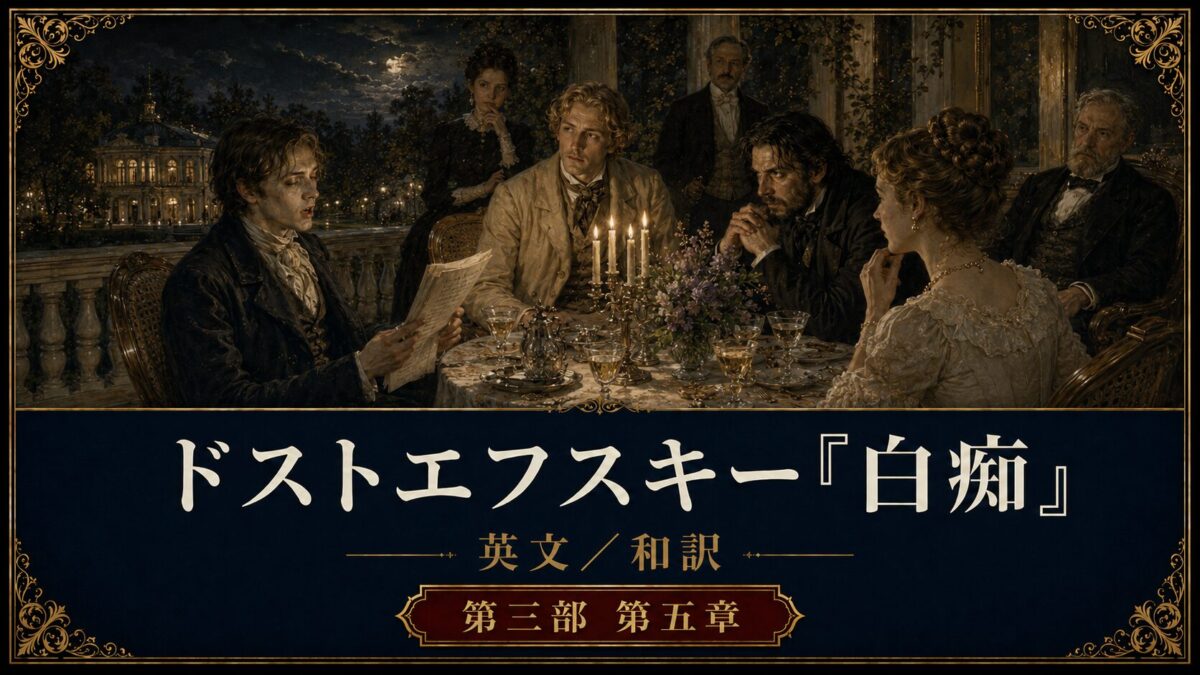
『白痴』のカラフル対訳について
カラフル対訳で紹介している『白痴』は、パブリックドメインの作品を出典としています。
このサイトで使われている作品は、ロシアの文豪フョードル・ドストエフスキーによる小説 The Idiot を出典としています。 英文は Eva M. Martin による英訳版をもとにしています。 原文は、著作権の切れた名作などの全文を電子化し、インターネット上で公開している Project Gutenberg(プロジェクト・グーテンベルク)、 朗読音声は LibriVox(リブリヴォックス/朗読図書館) の公開音声を出典としています。
原文はProject Gutenberg、音声はLibriVoxで公開されているパブリックドメイン作品を出典としています。
“`『白痴』英文/和訳 PART III CHAPTER V イッポリートの「必要な説明」
『The Idiot』PART III CHAPTER V を、英語学習用に「英文→和訳」の順で読みやすく整理し、重要語句を多めに色分けしています。上部の操作パネルで、和訳・色分け・ミニ訳・カテゴリ別ハイライトを切り替えられます。
Hippolyte, who had fallen asleep during Lebedeff’s discourse, now suddenly woke up, just as though someone had jogged him in the side.
レベジェフの演説のあいだに眠り込んでいたイッポリートは、まるで誰かに脇腹を小突かれたかのように、突然目を覚ました。
He shuddered, raised himself on his arm, gazed around, and grew very pale.
彼は身震いし、腕をついて身を起こし、あたりを見回すと、ひどく青ざめた。
A look almost of terror crossed his face as he recollected.
何かを思い出した時、彼の顔にはほとんど恐怖に近い表情がよぎった。
“What! are they all off? Is it all over? Is the sun up?”
「何だ!皆もう行ってしまったのか。もう終わったのか。太陽は昇ったのか」
He trembled, and caught at the prince’s hand.
彼は震えながら、公爵の手をつかんだ。
“What time is it? Tell me, quick, for goodness’ sake! How long have I slept?”
「今何時ですか。お願いです、早く教えてください!私はどれくらい眠っていたのですか」
He added this almost in despair, just as though he had overslept something upon which his whole fate depended.
彼は、自分の運命すべてがかかっている何かを寝過ごしてしまったかのように、ほとんど絶望してそう付け加えた。
“You have slept seven or perhaps eight minutes,” said Evgenie Pavlovitch.
「あなたは七分、あるいは八分ほど眠っていました」とエヴゲーニイ・パヴロヴィチが言った。
Hippolyte gazed eagerly at the latter, and mused for a few moments.
イッポリートは彼を熱心に見つめ、しばらく考え込んだ。
“Oh, is that all?” he said at last. “Then I—”
「ああ、それだけですか」と彼はついに言った。「それなら私は――」
He drew a long, deep breath of relief, as it seemed.
彼は、安堵したように長く深い息をついた。
He realized that all was not over as yet, that the sun had not risen, and that the guests had merely gone to supper.
すべてがまだ終わったわけではなく、太陽もまだ昇っておらず、客たちはただ夜食に行っただけだと彼は悟った。
He smiled, and two hectic spots appeared on his cheeks.
彼は微笑み、頬には二つの病的な紅潮が浮かんだ。
“So you counted the minutes while I slept, did you, Evgenie Pavlovitch?” he said, ironically.
「私が眠っているあいだ、時間を数えていたのですか、エヴゲーニイ・パヴロヴィチ」と彼は皮肉っぽく言った。
“You have not taken your eyes off me all the evening—I have noticed that much, you see!”
「あなたは今晩ずっと私から目を離しませんでしたね。そのくらいは私にもわかっていますよ!」
“Ah, Rogojin! I’ve just been dreaming about him, prince,” he added, frowning.
「ああ、ロゴージン!公爵、私はたった今、彼の夢を見ていたのです」と彼は眉をひそめて付け加えた。
“Yes, by the by,” starting up, “where’s the orator? Where’s Lebedeff? Has he finished?”
「そうだ、ところで」と彼は跳ね起きた。「演説家はどこですか。レベジェフはどこですか。もう終わったのですか」
“What did he talk about? Is it true, prince, that you once declared that ‘beauty would save the world’?”
「彼は何を話したのですか。公爵、あなたが以前『美が世界を救う』と言ったというのは本当ですか」
“Great Heaven! The prince says that beauty saves the world!”
「なんということでしょう!公爵は美が世界を救うと言うのです!」
“And I declare that he only has such playful ideas because he’s in love!”
「そして私は断言します。彼がそんな戯れめいた考えを持つのは、恋をしているからにすぎません!」
“Gentlemen, the prince is in love. I guessed it the moment he came in.”
「皆さん、公爵は恋をしています。彼が入ってきた瞬間に私は見抜きました」
“Don’t blush, prince; you make me sorry for you.”
「赤くならないでください、公爵。あなたを見ると気の毒になります」
“What beauty saves the world? Colia told me that you are a zealous Christian; is it so?”
「どんな美が世界を救うのですか。コーリャが、あなたは熱心なキリスト者だと言っていました。本当ですか」
“Colia says you call yourself a Christian.”
「コーリャは、あなたが自分をキリスト者と呼んでいると言っています」
The prince regarded him attentively, but said nothing.
公爵は彼を注意深く見つめたが、何も言わなかった。
“You don’t answer me; perhaps you think I am very fond of you?” added Hippolyte, as though the words had been drawn from him.
「答えてくれないのですね。もしかすると、私があなたをとても好きだと思っているのですか」とイッポリートは、まるでその言葉を無理に引き出されたかのように付け加えた。
“No, I don’t think that. I know you don’t love me.”
「いいえ、そうは思いません。あなたが私を愛していないことは知っています」
“What, after yesterday? Wasn’t I honest with you?”
「何ですって、昨日のあとで?私はあなたに正直ではありませんでしたか」
“I knew yesterday that you didn’t love me.”
「昨日の時点で、あなたが私を愛していないことはわかっていました」
“Why so? why so? Because I envy you, eh? You always think that, I know.”
「なぜですか、なぜですか。私があなたを妬んでいるからですか。あなたはいつもそう思っているのでしょう、わかっています」
“But do you know why I am saying all this? Look here! I must have some more champagne—pour me out some, Keller, will you?”
「でも、なぜ私がこんなことを言っているのかわかりますか。いいですか!もう少しシャンパンが必要です。ケラー、注いでくれませんか」
“No, you’re not to drink any more, Hippolyte. I won’t let you.”
「いいえ、イッポリート、もう飲んではいけません。私が許しません」
The prince moved the glass away.
公爵はグラスを遠ざけた。
“Well perhaps you’re right,” said Hippolyte, musing.
「まあ、あなたが正しいのかもしれません」とイッポリートは考え込みながら言った。
“They might say—yet, devil take them! what does it matter?—prince, what can it matter what people will say of us then, eh?”
「人々は言うかもしれません――いや、そんな連中はどうでもいい!何の問題があるというのですか。公爵、その時になって人々が私たちについて何と言おうと、いったい何の問題があるのですか」
“I believe I’m half asleep. I’ve had such a dreadful dream—I’ve only just remembered it.”
「私は半分眠っているようです。ひどい夢を見ました。たった今それを思い出したのです」
“Prince, I don’t wish you such dreams as that, though sure enough, perhaps, I don’t love you.”
「公爵、たとえ私はあなたを愛していないのかもしれないとしても、あなたにあんな夢を見てほしくはありません」
“Why wish a man evil, though you do not love him, eh?”
「たとえ愛していなくても、なぜ人に悪を願う必要があるのでしょう、ええ?」
“Give me your hand—let me press it sincerely.”
「手をください。心から握らせてください」
“There—you’ve given me your hand—you must feel that I do press it sincerely, don’t you?”
「ほら、あなたは手をくれました。私が本当に心から握っていると感じるでしょう」
“I don’t think I shall drink any more. What time is it? Never mind, I know the time.”
「もう飲まないと思います。今何時ですか。いや、かまいません、時間はわかっています」
“The time has come, at all events. What! they are laying supper over there, are they?”
「いずれにしても、時は来ました。何ですって、あちらで夜食の準備をしているのですか」
“Then this table is free? Capital, gentlemen!”
「ではこのテーブルは空いているのですね。すばらしい、皆さん!」
“I—hem! these gentlemen are not listening. Prince, I will just read over an article I have here.”
「私は――えへん!この方々は聞いていませんね。公爵、ここにある文章を少し読み上げます」
“Supper is more interesting, of course, but—”
「もちろん夜食のほうが面白いでしょうが――」
Here Hippolyte suddenly, and most unexpectedly, pulled out of his breast-pocket a large sealed paper.
ここでイッポリートは突然、しかもまったく予想外に、胸ポケットから大きな封印された紙を取り出した。
This imposing-looking document he placed upon the table before him.
彼はその重々しい見た目の文書を、自分の前のテーブルに置いた。
The effect of this sudden action upon the company was instantaneous.
この突然の行動が一同に与えた効果は、即座だった。
Evgenie Pavlovitch almost bounded off his chair in excitement.
エヴゲーニイ・パヴロヴィチは興奮のあまり、ほとんど椅子から跳び上がった。
Rogojin drew nearer to the table with a look on his face as if he knew what was coming.
ロゴージンは、何が来るのか知っているような顔つきでテーブルに近づいた。
Gania came nearer too; so did Lebedeff and the others—the paper seemed to be an object of great interest to the company in general.
ガーニャも近づいた。レベジェフやほかの者たちも同じだった。その紙は、一同全体にとって大きな関心の的であるように見えた。
“What have you got there?” asked the prince, with some anxiety.
「そこに何を持っているのですか」と公爵は少し不安げに尋ねた。
“At the first glimpse of the rising sun, prince, I will go to bed.”
「公爵、昇る太陽の最初の光を見たら、私は寝ます」
“I told you I would, word of honour! You shall see!” cried Hippolyte.
「そうすると言ったでしょう、名誉にかけて!見ていてください!」とイッポリートは叫んだ。
“You think I’m not capable of opening this packet, do you?”
「あなた方は、私がこの包みを開けることなどできないと思っているのでしょう」
He glared defiantly round at the audience in general.
彼は一同全体を挑むようににらみ回した。
The prince observed that he was trembling all over.
公爵は、彼が全身震えていることに気づいた。
“None of us ever thought such a thing!” Muishkin replied for all.
「私たちは誰もそんなことは考えていません!」とムイシュキンが皆を代表して答えた。
“Why should you suppose it of us? And what are you going to read, Hippolyte? What is it?”
「なぜ私たちがそんなことを考えると思うのですか。イッポリート、あなたは何を読むつもりなのですか。それは何ですか」
“Yes, what is it?” asked others.
「そうです、それは何ですか」とほかの者たちも尋ねた。
The packet sealed with red wax seemed to attract everyone, as though it were a magnet.
赤い封蝋で封じられた包みは、まるで磁石のように皆を引きつけているようだった。
“I wrote this yesterday, myself, just after I saw you, prince, and told you I would come down here.”
「これは昨日、私自身が書いたものです。公爵、あなたに会って、ここへ来ると言ったすぐあとに書きました」
“I wrote all day and all night, and finished it this morning early. Afterwards I had a dream.”
「私は昼も夜も書き続け、今朝早く書き終えました。そのあと夢を見ました」
“Hadn’t we better hear it tomorrow?” asked the prince timidly.
「明日聞いたほうがよくありませんか」と公爵はおずおずと尋ねた。
“Tomorrow ‘there will be no more time!’” laughed Hippolyte, hysterically.
「明日には『もう時はない』のです!」とイッポリートはヒステリックに笑った。
“You needn’t be afraid; I shall get through the whole thing in forty minutes, at most an hour!”
「心配しなくていいのです。全部読んでも四十分、長くても一時間で終わります!」
“Look how interested everybody is! Everybody has drawn near.”
「見てください、皆がどれほど興味を持っているか。皆が近寄ってきています」
“Look! look at them all staring at my sealed packet!”
「見てください!皆が私の封印された包みを見つめています!」
“If I hadn’t sealed it up it wouldn’t have been half so effective!”
「もし封印していなかったら、効果は半分にもならなかったでしょう!」
“Ha, ha! that’s mystery, that is!”
「はは!これこそ神秘です!」
“Now then, gentlemen, shall I break the seal or not? Say the word; it’s a mystery, I tell you—a secret!”
「さあ皆さん、封を切りましょうか、それともやめましょうか。言ってください。これは神秘です、秘密なのです!」
“Prince, you know who said there would be ‘no more time’?”
「公爵、『もう時はない』と言ったのが誰かご存じですか」
“It was the great and powerful angel in the Apocalypse.”
「黙示録の偉大で力ある天使です」
“Better not read it now,” said the prince, putting his hand on the packet.
「今は読まないほうがよいでしょう」と公爵は包みの上に手を置いて言った。
“No, don’t read it!” cried Evgenie suddenly.
「いや、読まないでください!」とエヴゲーニイが突然叫んだ。
He appeared so strangely disturbed that many of those present could not help wondering.
彼はあまりにも奇妙に動揺しているように見えたので、その場の多くは不思議に思わずにはいられなかった。
“Reading? None of your reading now!” said somebody; “it’s supper-time.”
「読むだって?今は読む時間じゃない!」と誰かが言った。「夜食の時間だ」
“What sort of an article is it? For a paper? Probably it’s very dull,” said another.
「どんな文章なんですか。新聞用ですか。きっと退屈でしょう」と別の者が言った。
But the prince’s timid gesture had impressed even Hippolyte.
しかし公爵のおずおずした身振りは、イッポリートにさえ印象を与えていた。
“Then I’m not to read it?” he whispered, nervously.
「では、読んではいけないのですか」と彼は神経質にささやいた。
“Am I not to read it?” he repeated, gazing around at each face in turn.
「読んではいけないのですか」と彼は繰り返し、一人ひとりの顔を順に見回した。
“What are you afraid of, prince?” he turned and asked the latter suddenly.
「公爵、あなたは何を恐れているのですか」と彼は突然、公爵のほうを向いて尋ねた。
“What should I be afraid of?”
「私が何を恐れるというのですか」
“Has anyone a coin about them? Give me a twenty-copeck piece, somebody!”
「誰か硬貨を持っていますか。誰か二十コペイカ硬貨をください!」
And Hippolyte leapt from his chair.
そしてイッポリートは椅子から跳び上がった。
“Here you are,” said Lebedeff, handing him one; he thought the boy had gone mad.
「こちらにあります」とレベジェフは言って、彼に一枚渡した。彼はこの少年が気が狂ったのだと思っていた。
“Vera Lukianovna,” said Hippolyte, “toss it, will you? Heads, I read, tails, I don’t.”
「ヴェーラ・ルキヤーノヴナ」とイッポリートは言った。「それを投げてください。表なら読む、裏なら読まない」
Vera Lebedeff tossed the coin into the air and let it fall on the table.
ヴェーラ・レベジェフは硬貨を空中に投げ、テーブルの上に落とした。
It was “heads.”
表だった。
“Then I read it,” said Hippolyte, in the tone of one bowing to the fiat of destiny.
「では読みます」とイッポリートは、運命の命令に従う者の口調で言った。
He could not have grown paler if a verdict of death had suddenly been presented to him.
突然死刑判決を突きつけられても、これ以上青ざめることはなかっただろう。
“But after all, what is it? Is it possible that I should have just risked my fate by tossing up?”
「しかし結局、これは何なのですか。私は今、硬貨投げで自分の運命を賭けたというのでしょうか」
He went on, shuddering; and looked round him again.
彼は身震いしながら続け、また周囲を見回した。
His eyes had a curious expression of sincerity.
彼の目には、不思議な誠実さの表情があった。
“That is an astonishing psychological fact,” he cried, suddenly addressing the prince, in a tone of the most intense surprise.
「これは驚くべき心理的事実です」と彼は、激しい驚きの口調で突然公爵に向かって叫んだ。
“It is… it is something quite inconceivable, prince,” he repeated with growing animation, like a man regaining consciousness.
「それは……まったく考えられないことです、公爵」と、彼は意識を取り戻す人のように、ますます活気づいて繰り返した。
“Take note of it, prince, remember it; you collect, I am told, facts concerning capital punishment…”
「公爵、これを記録してください、覚えておいてください。あなたは死刑に関する事実を集めていると聞いています……」
“They told me so. Ha, ha! My God, how absurd!”
「そう聞きました。はは!ああ、なんてばかげているのでしょう!」
He sat down on the sofa, put his elbows on the table, and laid his head on his hands.
彼はソファに腰を下ろし、肘をテーブルにつき、両手に頭をのせた。
“It is shameful—though what does it matter to me if it is shameful?”
「これは恥ずべきことです。もっとも、それが恥ずべきことだとして、私に何の関係があるのでしょう」
“Gentlemen, gentlemen! I am about to break the seal,” he continued, with determination.
「皆さん、皆さん!私は封を切ろうとしています」と彼は決然として続けた。
“I—I—of course I don’t insist upon anyone listening if they do not wish to.”
「私は――私は――もちろん、聞きたくない方に無理に聞いてもらうつもりはありません」
With trembling fingers he broke the seal and drew out several sheets of paper.
震える指で彼は封を切り、数枚の紙を取り出した。
He smoothed them out before him, and began sorting them.
彼はそれを目の前に広げて整え、並べ始めた。
“What on earth does all this mean? What’s he going to read?” muttered several voices.
「これはいったい何なのだ。彼は何を読もうとしているのだ」と、いくつかの声がつぶやいた。
Others said nothing; but one and all sat down and watched with curiosity.
ほかの者たちは何も言わなかったが、皆が座り、好奇心をもって見つめた。
They began to think something strange might really be about to happen.
彼らは、本当に何か奇妙なことが起ころうとしているのかもしれないと思い始めた。
Vera stood and trembled behind her father’s chair, almost in tears with fright.
ヴェーラは父の椅子の後ろに立ち、恐怖のあまり泣きそうになりながら震えていた。
Colia was nearly as much alarmed as she was.
コーリャも彼女とほとんど同じくらいおびえていた。
Lebedeff jumped up and put a couple of candles nearer to Hippolyte, so that he might see better.
レベジェフは跳ね起き、イッポリートがよく見えるように、ろうそくを二本ほど彼の近くに置いた。
“Gentlemen, this—you’ll soon see what this is,” began Hippolyte, and suddenly commenced his reading.
「皆さん、これは――これが何か、すぐにわかるでしょう」とイッポリートは言い始め、突然朗読を始めた。
“It’s headed, ‘A Necessary Explanation,’ with the motto, ‘Après moi le déluge!’”
「表題は『必要な説明』、銘句は『我が亡きあとに洪水よ来たれ!』です」
“Oh, deuce take it all! Surely I can never have seriously written such a silly motto as that?”
「ああ、まったく!まさか私が本気で、こんなばかげた銘句を書いたはずはありませんよね」
“Look here, gentlemen, I beg to give notice that all this is very likely terrible nonsense.”
「いいですか、皆さん。あらかじめ申し上げておきますが、これはたぶん、とんでもないたわごとです」
“It is only a few ideas of mine.”
「これはただ、私のいくつかの考えにすぎません」
“If you think that there is anything mysterious coming—or in a word—”
「もし皆さんが、ここに何か神秘的なものが出てくると思っているなら――つまり――」
“Better read on without any more beating about the bush,” said Gania.
「これ以上遠回しにしないで、さっさと読み続けたほうがいい」とガーニャが言った。
“Affectation!” remarked someone else.
「気取りだ!」と別の者が評した。
“Too much talk,” said Rogojin, breaking the silence for the first time.
「話が長すぎる」とロゴージンが、初めて沈黙を破って言った。
Hippolyte glanced at him suddenly, and when their eyes met Rogojin showed his teeth in a disagreeable smile.
イッポリートは突然彼をちらりと見た。二人の目が合うと、ロゴージンは不快な笑みを浮かべて歯を見せた。
And he said the following strange words: “That’s not the way to settle this business, my friend; that’s not the way at all.”
そして彼は次のような奇妙な言葉を言った。「友よ、この件を片づけるやり方はそれじゃない。まったく違う」
Of course nobody knew what Rogojin meant by this; but his words made a deep impression upon all.
もちろん、ロゴージンが何を意味したのか誰にもわからなかった。しかしその言葉は皆に深い印象を与えた。
Everyone seemed to see in a flash the same idea.
皆が一瞬で同じ考えを見たかのようだった。
As for Hippolyte, their effect upon him was astounding.
イッポリートに対するその効果は、驚くほど大きかった。
He trembled so that the prince was obliged to support him.
彼はひどく震えたので、公爵が支えなければならなかった。
He would certainly have cried out, but that his voice seemed to have entirely left him for the moment.
彼はきっと叫び出していただろうが、その瞬間、声が完全に失われたようだった。
For a minute or two he could not speak at all, but panted and stared at Rogojin.
一、二分のあいだ、彼はまったく話せず、息を切らしながらロゴージンを見つめていた。
At last he managed to ejaculate: “Then it was you who came—you—you?”
ついに彼はやっとこう口にした。「では、来たのはあなたなのですね――あなたが――あなたが?」
“Came where? What do you mean?” asked Rogojin, amazed.
「どこへ来たというんだ。何のことだ」とロゴージンは驚いて尋ねた。
But Hippolyte, panting and choking with excitement, interrupted him violently.
しかしイッポリートは、興奮で息を切らし、喉を詰まらせながら、激しく彼を遮った。
“You came to me last week, in the night, at two o’clock, the day I was with you in the morning!”
「先週の夜、二時に、あなたは私のところへ来たのです。私が朝あなたと一緒にいたその日の夜です!」
“Confess it was you!”
「あれはあなただったと認めてください!」
“Last week? In the night? Have you gone cracked, my good friend?”
「先週?夜に?君、気でも狂ったのか」
Hippolyte paused and considered a moment.
イッポリートは立ち止まるように黙り、しばらく考えた。
Then a smile of cunning—almost triumph—crossed his lips.
それから狡猾な、ほとんど勝ち誇ったような微笑が彼の唇に浮かんだ。
“It was you,” he murmured, almost in a whisper, but with absolute conviction.
「あなたでした」と彼はほとんどささやくように、しかし絶対の確信をもってつぶやいた。
“Yes, it was you who came to my room and sat silently on a chair at my window for a whole hour—more!”
「そうです、私の部屋に来て、窓際の椅子に黙って一時間、いやそれ以上座っていたのはあなたです!」
“It was between one and two at night; you rose and went out at about three. It was you, you!”
「それは夜の一時から二時の間でした。あなたは三時ごろ立ち上がって出ていった。あなたです、あなたなのです!」
“Why you should have frightened me so, why you should have wished to torment me like that, I cannot tell—but you it was.”
「なぜあなたが私をそんなに怖がらせたかったのか、なぜそんなふうに私を苦しめたかったのか、それはわかりません。しかし、あれはあなたでした」
There was absolute hatred in his eyes as he said this.
そう言う彼の目には、絶対的な憎悪があった。
But his look of fear and his trembling had not left him.
しかし恐怖の表情と震えは、まだ彼から離れていなかった。
“You shall hear all this directly, gentlemen. I—I—listen!”
「皆さん、このことはすぐに全部お聞きになるでしょう。私は――私は――聞いてください!」
He seized his paper in a desperate hurry.
彼は必死に急いで紙をつかんだ。
He fidgeted with it, and tried to sort it, but for a long while his trembling hands could not collect the sheets together.
彼は紙をいじり、並べようとしたが、震える手では長いあいだそれらをまとめることができなかった。
“He’s either mad or delirious,” murmured Rogojin.
「こいつは狂っているか、せん妄だ」とロゴージンがつぶやいた。
At last he began.
ついに彼は読み始めた。
For the first five minutes the reader’s voice continued to tremble, and he read disconnectedly and unevenly.
最初の五分間、朗読者の声は震え続け、彼は途切れ途切れに、むらのある調子で読んだ。
But gradually his voice strengthened.
しかし次第に彼の声は強くなった。
Occasionally a violent fit of coughing stopped him, but his animation grew with the progress of the reading.
時折、激しい咳の発作で彼は止まったが、朗読が進むにつれて彼の昂ぶりは増していった。
As did also the disagreeable impression which it made upon his audience.
それと同じく、その朗読が聴衆に与える不快な印象も増していった。
Until it reached the highest pitch of excitement.
そしてそれは、ついに興奮の極みに達した。
Here is the article.
その文章は次の通りである。
MY NECESSARY EXPLANATION.
私の必要な説明。
“Après moi le déluge.”
「我が亡きあとに洪水よ来たれ。」
“Yesterday morning the prince came to see me. Among other things he asked me to come down to his villa.”
「昨日の朝、公爵が私に会いに来た。いろいろな話の中で、彼は私に自分の別荘へ来るよう頼んだ。」
“I knew he would come and persuade me to this step, and that he would adduce the argument that it would be easier for me to die ‘among people and green trees,’—as he expressed it.”
「彼が来て、私にそうするよう説得すること、そして彼の言い方では『人々と緑の木々の中で』死ぬほうが楽だという議論を持ち出すことは、私にはわかっていた。」
“But today he did not say ‘die,’ he said ‘live.’ It is pretty much the same to me, in my position, which he says.”
「しかし今日、彼は『死ぬ』とは言わず、『生きる』と言った。私の立場では、彼がどちらを言おうとほとんど同じことだ。」
“When I asked him why he made such a point of his ‘green trees,’ he told me, to my astonishment, that he had heard that last time I was in Pavlofsk I had said that I had come ‘to have a last look at the trees.’”
「私がなぜそんなに『緑の木々』にこだわるのかと尋ねると、驚いたことに、彼は、以前私がパヴロフスクにいた時、『木々を最後に見に来た』と言ったのを聞いたのだと答えた。」
“When I observed that it was all the same whether one died among trees or in front of a blank brick wall, as here, and that it was not worth making any fuss over a fortnight, he agreed at once.”
「私が、人は木々の中で死のうが、ここにあるような無地の煉瓦壁の前で死のうが同じであり、二週間のことで騒ぐ価値などないと言うと、彼はすぐに同意した。」
“But he insisted that the good air at Pavlofsk and the greenness would certainly cause a physical change for the better.”
「しかし彼は、パヴロフスクの良い空気と緑が、きっと身体に良い変化をもたらすはずだと主張した。」
“And that my excitement, and my dreams, would be perhaps relieved.”
「そして私の興奮や夢も、もしかすると和らぐかもしれないと言った。」
“I remarked to him, with a smile, that he spoke like a materialist, and he answered that he had always been one.”
「私は微笑みながら、彼の言い方は唯物論者のようだと言った。すると彼は、自分は昔からそうだったと答えた。」
“As he never tells a lie, there must be something in his words.”
「彼は決して嘘をつかないのだから、その言葉には何か意味があるに違いない。」
“His smile is a pleasant one. I have had a good look at him.”
「彼の微笑は感じがよい。私は彼をよく見た。」
“I don’t know whether I like him or not; and I have no time to waste over the question.”
「私が彼を好きなのかどうかはわからない。そしてその問題に費やす時間もない。」
“The hatred which I felt for him for five months has become considerably modified, I may say, during the last month.”
「五か月ものあいだ彼に対して抱いていた憎しみは、この一か月でかなり和らいだと言ってよい。」
“Who knows, perhaps I am going to Pavlofsk on purpose to see him!”
「誰にわかるだろう、もしかすると私は彼に会うためにわざわざパヴロフスクへ行くのかもしれない!」
“But why do I leave my chamber? Those who are sentenced to death should not leave their cells.”
「しかし、なぜ私は自分の部屋を出るのか。死を宣告された者は、独房を出るべきではない。」
“If I had not formed a final resolve, but had decided to wait until the last minute, I should not leave my room, or accept his invitation to come and die at Pavlofsk.”
「もし私が最終的な決心をしておらず、最後の瞬間まで待つことにしていたなら、自分の部屋を出ることも、パヴロフスクへ来て死ぬという彼の招きを受けることもなかっただろう。」
“I must be quick and finish this explanation before tomorrow.”
「私は急いで、この説明を明日までに書き終えなければならない。」
“I shall have no time to read it over and correct it, for I must read it tomorrow to the prince and two or three witnesses whom I shall probably find there.”
「読み返して直す時間はないだろう。なぜなら明日、私はこれを公爵と、おそらくそこにいる二、三人の証人に読まなければならないからだ。」
“As it will be absolutely true, without a touch of falsehood, I am curious to see what impression it will make upon me myself at the moment when I read it out.”
「それは一点の偽りもない完全な真実になるはずだから、私自身がそれを読み上げる瞬間、それが私にどんな印象を与えるのか知りたい。」
“This is my ‘last and solemn’—but why need I call it that?”
「これは私の『最後で厳粛な』――いや、なぜそんなふうに呼ぶ必要があるのだろう。」
“There is no question about the truth of it, for it is not worthwhile lying for a fortnight.”
「それが真実であることに疑いはない。二週間のために嘘をつく価値などないからだ。」
“A fortnight of life is not itself worth having, which is a proof that I write nothing here but pure truth.”
「二週間の命それ自体に持つ価値などない。それこそ、私がここに純粋な真実しか書いていない証拠である。」
“N.B.—Let me remember to consider; am I mad at this moment, or not? or rather at these moments?”
「追記――忘れずに考えよう。私はこの瞬間、正気ではないのか。それとも正気なのか。いや、この数瞬間について、そう問うべきだろうか。」
“I have been told that consumptives sometimes do go out of their minds for a while in the last stages of the malady.”
「肺病患者は病の末期に、一時的に気が狂うことがあると聞いたことがある。」
“I can prove this tomorrow when I read it out, by the impression it makes upon the audience.”
「明日これを読み上げた時、聴衆に与える印象によって、そのことを証明できるだろう。」
“I must settle this question once and for all, otherwise I can’t go on with anything.”
「この問題は一度きりで決着をつけなければならない。そうでなければ、私は何も続けられない。」
“I believe I have just written dreadful nonsense; but there’s no time for correcting, as I said before.”
「私は今、ひどいたわごとを書いたのだと思う。しかし前にも言ったように、直す時間はない。」
“Besides that, I have made myself a promise not to alter a single word of what I write in this paper, even though I find that I am contradicting myself every five lines.”
「それに、たとえ五行ごとに自分が矛盾していると気づいたとしても、この紙に書いた言葉を一語たりとも変えないと自分に約束している。」
“I wish to verify the working of the natural logic of my ideas tomorrow during the reading.”
「明日の朗読中に、自分の考えの自然な論理がどう働くのかを確かめたい。」
“Whether I am capable of detecting logical errors, and whether all that I have meditated over during the last six months be true, or nothing but delirium.”
「私が論理上の誤りを見抜けるのか、そしてこの六か月間考え続けてきたことすべてが真実なのか、それともただのせん妄なのかを確かめたい。」
“If two months since I had been called upon to leave my room and the view of Meyer’s wall opposite, I verily believe I should have been sorry.”
「二か月前、もし私が自分の部屋と向かいのマイヤーの壁の眺めを離れろと言われたなら、私は本当に悲しんだだろうと思う。」
“But now I have no such feeling, and yet I am leaving this room and Meyer’s brick wall for ever.”
「しかし今はそのような感情はない。それでも私はこの部屋とマイヤーの煉瓦壁を永遠に離れようとしている。」
“So that my conclusion, that it is not worth while indulging in grief, or any other emotion, for a fortnight, has proved stronger than my very nature.”
「つまり、二週間のために悲しみやその他の感情に耽る価値はないという私の結論は、私自身の性質よりも強いことが証明されたのだ。」
“And has taken over the direction of my feelings.”
「そしてその結論は、私の感情の方向を支配してしまった。」
“But is it so? Is it the case that my nature is conquered entirely?”
「しかし本当にそうなのだろうか。私の性質は完全に征服されたのだろうか。」
“If I were to be put on the rack now, I should certainly cry out.”
「もし今、拷問台にかけられたなら、私はきっと叫ぶだろう。」
“I should not say that it is not worth while to yell and feel pain because I have but a fortnight to live.”
「あと二週間しか生きられないから、叫ぶことや痛みを感じることに価値はない、などとは言わないだろう。」
“But is it true that I have but a fortnight of life left to me?”
「しかし、本当に私にはあと二週間の命しか残されていないのだろうか。」
“I know I told some of my friends that Doctor B. had informed me that this was the case; but I now confess that I lied; B. has not even seen me.”
「私は友人の何人かに、B医師がそう言ったと話したことを知っている。しかし今告白する。私は嘘をついたのだ。Bは私を診てさえいない。」
“However, a week ago, I called in a medical student, Kislorodoff, who is a Nationalist, an Atheist, and a Nihilist, by conviction, and that is why I had him.”
「だが一週間前、私は医学生のキスロロドフを呼んだ。彼は信念として民族主義者であり、無神論者であり、ニヒリストである。だからこそ私は彼を呼んだのだ。」
“I needed a man who would tell me the bare truth without any humbug or ceremony—and so he did—indeed, almost with pleasure.”
「私には、ごまかしも儀礼もなしに、むき出しの真実を言ってくれる人間が必要だった。そして彼はそうした。実際、ほとんど楽しげにそうしたのだ。」
“Which I thought was going a little too far.”
「それは少し行きすぎだと私は思った。」
“Well, he plumped out that I had about a month left me.”
「さて、彼は私に残された時間は約一か月だとずばり言った。」
“It might be a little more, he said, under favourable circumstances, but it might also be considerably less.”
「好条件なら少し長いかもしれないが、かなり短い可能性もある、と彼は言った。」
“According to his opinion I might die quite suddenly—tomorrow, for instance—there had been such cases.”
「彼の意見では、私はまったく突然死ぬかもしれない。たとえば明日にでも。そういう例があったのだという。」
“Only a day or two since a young lady at Colomna who suffered from consumption, and was about on a par with myself in the march of the disease, was going out to market to buy provisions.”
「つい一、二日前にも、コロムナのある若い女性が、肺病を患い、病の進み具合は私とほぼ同じだったのだが、食料を買いに市場へ出ようとしていた。」
“When she suddenly felt faint, lay down on the sofa, gasped once, and died.”
「その時、彼女は突然気が遠くなり、ソファに横たわり、一度あえいで、そのまま死んだ。」
“Kislorodoff told me all this with a sort of exaggerated devil-may-care negligence.”
「キスロロドフはこのすべてを、少し大げさな投げやりさと無頓着さで私に話した。」
“And as though he did me great honour by talking to me so, because it showed that he considered me the same sort of exalted Nihilistic being as himself.”
「まるでそう話すことで私に大きな名誉を与えているかのようだった。なぜなら、それは彼が私を自分と同じ種類の高尚なニヒリスト的存在と見なしていることを示していたからだ。」
“To whom death was a matter of no consequence whatever, either way.”
「そういう存在にとっては、死などどちらにせよ何の問題にもならないのだ。」
“At all events, the fact remained—a month of life and no more!”
「いずれにしても、事実は残った。命は一か月、それ以上ではない!」
“That he is right in his estimation I am absolutely persuaded.”
「彼の見積もりが正しいことを、私は完全に確信している。」
“It puzzles me much to think how on earth the prince guessed yesterday that I have had bad dreams.”
「公爵が昨日、私が悪い夢を見ていることをいったいどうやって言い当てたのか、それを考えると大いに困惑する。」
“He said to me, ‘Your excitement and dreams will find relief at Pavlofsk.’ Why did he say ‘dreams’?”
「彼は私に『あなたの興奮と夢はパヴロフスクで和らぐでしょう』と言った。なぜ彼は『夢』と言ったのか。」
“Either he is a doctor, or else he is a man of exceptional intelligence and wonderful powers of observation.”
「彼は医者なのか、それとも並外れた知性と驚くべき観察力を持った人間なのか、そのどちらかだ。」
“But that he is an ‘idiot,’ at bottom there can be no doubt whatever.”
「しかし根本的に彼が『白痴』であることには、いかなる疑いもない。」
“It so happened that just before he arrived I had a delightful little dream; one of a kind that I have hundreds of just now.”
「偶然にも、彼が到着する直前、私はちょっと愉快な夢を見ていた。最近はそういう種類の夢を何百も見る。」
“I had fallen asleep about an hour before he came in, and dreamed that I was in some room, not my own.”
「彼が入ってくる一時間ほど前に眠り込み、自分のものではない部屋にいる夢を見た。」
“It was a large room, well furnished, with a cupboard, chest of drawers, sofa, and my bed, a fine wide bed covered with a silken counterpane.”
「それは広い部屋で、家具も整っており、戸棚、衣装だんす、ソファ、そして私のベッドがあった。絹の掛け布で覆われた立派な広いベッドだった。」
“But I observed in the room a dreadful-looking creature, a sort of monster.”
「しかし私はその部屋に、恐ろしい姿をした生き物、一種の怪物がいるのに気づいた。」
“It was a little like a scorpion, but was not a scorpion, but far more horrible.”
「それは少しサソリに似ていたが、サソリではなく、はるかに恐ろしいものだった。」
“Especially so, because there are no creatures anything like it in nature, and because it had appeared to me for a purpose, and bore some mysterious signification.”
「とりわけ恐ろしかったのは、自然界にそれに似た生き物など存在せず、しかもそれが何かの目的のために私の前に現れ、謎めいた意味を帯びていたからだ。」
“I looked at the beast well; it was brown in colour and had a shell.”
「私はその獣をよく見た。色は茶色で、殻を持っていた。」
“It was a crawling kind of reptile, about eight inches long, and narrowed down from the head, which was about a couple of fingers in width, to the end of the tail, which came to a fine point.”
「それは這う種類の爬虫類のようで、長さは八インチほど、頭は指二本ほどの幅があり、尾の先へ向かって細くなり、最後は鋭い点になっていた。」
“Out of its trunk, about a couple of inches below its head, came two legs at an angle of forty-five degrees.”
「その胴体から、頭の二インチほど下のあたりに、二本の脚が四十五度の角度で出ていた。」
“Each about three inches long, so that the beast looked like a trident from above.”
「それぞれ三インチほどの長さで、上から見ると、その獣は三叉の矛のように見えた。」
“It had eight hard needle-like whiskers coming out from different parts of its body.”
「体のあちこちから、硬い針のような八本のひげが出ていた。」
“It went along like a snake, bending its body about in spite of the shell it wore, and its motion was very quick and very horrible to look at.”
「それは殻をまとっているにもかかわらず体をくねらせ、蛇のように進んだ。その動きは非常に速く、見ていてひどく恐ろしかった。」
“I was dreadfully afraid it would sting me; somebody had told me, I thought, that it was venomous.”
「私はそれが自分を刺すのではないかとひどく恐れた。誰かがそれには毒があると私に言ったように思った。」
“But what tormented me most of all was the wondering and wondering as to who had sent it into my room.”
「しかし何より私を苦しめたのは、誰がそれを私の部屋に送り込んだのかと、何度も何度も考えてしまうことだった。」
“And what was the mystery which I felt it contained.”
「そして、それが含んでいるように感じられた謎とは何なのかということだった。」
“It hid itself under the cupboard and under the chest of drawers, and crawled into the corners.”
「それは戸棚の下や衣装だんすの下に身を隠し、部屋の隅へ這っていった。」
“I sat on a chair and kept my legs tucked under me.”
「私は椅子に座り、脚を自分の下に引っ込めていた。」
“Then the beast crawled quietly across the room and disappeared somewhere near my chair.”
「するとその獣は静かに部屋を横切って這い、私の椅子の近くのどこかへ消えた。」
“I looked about for it in terror, but I still hoped that as my feet were safely tucked away it would not be able to touch me.”
「私は恐怖の中でそれを探したが、脚を安全に引っ込めている以上、それは私に触れられないだろうと、まだ望んでいた。」
“Suddenly I heard behind me, and about on a level with my head, a sort of rattling sound.”
「突然、背後から、頭の高さあたりで、がさがさというような音が聞こえた。」
“I turned sharp round and saw that the brute had crawled up the wall as high as the level of my face.”
「私はぱっと振り向き、その獣が壁を這い上がり、私の顔の高さまで来ているのを見た。」
“And that its horrible tail, which was moving incredibly fast from side to side, was actually touching my hair!”
「そして、信じられない速さで左右に動いているその恐ろしい尾が、実際に私の髪に触れていたのだ!」
“I jumped up—and it disappeared.”
「私は跳び上がった。するとそれは消えた。」
“I did not dare lie down on my bed for fear it should creep under my pillow.”
「それが枕の下へ這い込むのではないかと恐れて、私はベッドに横になる勇気がなかった。」
“My mother came into the room, and some friends of hers.”
「母が部屋に入ってきた。母の友人たちも一緒だった。」
“They began to hunt for the reptile and were more composed than I was; they did not seem to be afraid of it.”
「彼女たちはその爬虫類を探し始め、私よりも落ち着いていた。それを恐れているようには見えなかった。」
“But they did not understand as I did.”
「しかし彼女たちは、私のようには理解していなかった。」
“Suddenly the monster reappeared; it crawled slowly across the room and made for the door.”
「突然、その怪物が再び現れた。それはゆっくり部屋を横切り、扉のほうへ向かった。」
“As though with some fixed intention, and with a slow movement that was more horrible than ever.”
「何か決まった意図を持っているかのように、しかもこれまで以上に恐ろしい、ゆっくりした動きで。」
“Then my mother opened the door and called my dog, Norma.”
「すると母が扉を開け、私の犬ノルマを呼んだ。」
“Norma was a great Newfoundland, and died five years ago.”
「ノルマは大きなニューファンドランド犬で、五年前に死んだ。」
“She sprang forward and stood still in front of the reptile as if she had been turned to stone.”
「彼女は前へ飛び出し、まるで石に変えられたかのように、その爬虫類の前で立ち止まった。」
“The beast stopped too, but its tail and claws still moved about.”
「獣も止まったが、その尾と爪はまだ動いていた。」
“I believe animals are incapable of feeling supernatural fright—if I have been rightly informed.”
「もし私が正しく聞いているなら、動物には超自然的な恐怖を感じる能力はないはずだ。」
“But at this moment there appeared to me to be something more than ordinary about Norma’s terror, as though it must be supernatural.”
「しかしその瞬間、ノルマの恐怖には普通以上の何かがあるように思われ、それは超自然的なものに違いないように感じられた。」
“And as though she felt, just as I did myself, that this reptile was connected with some mysterious secret, some fatal omen.”
「そして彼女も私と同じように、この爬虫類が何か謎めいた秘密、何か致命的な前兆と結びついていると感じているようだった。」
“Norma backed slowly and carefully away from the brute, which followed her, creeping deliberately after her as though it intended to make a sudden dart and sting her.”
「ノルマはその獣からゆっくり慎重に後ずさりした。獣は彼女の後を、突然飛びかかって刺そうとするかのように、意図的に這って追った。」
“In spite of Norma’s terror she looked furious, though she trembled in all her limbs.”
「ノルマは恐怖していたにもかかわらず、全身を震わせながらも激怒しているように見えた。」
“At length she slowly bared her terrible teeth, opened her great red jaws, hesitated—took courage, and seized the beast in her mouth.”
「ついに彼女はゆっくりと恐ろしい歯をむき出し、大きな赤い顎を開き、ためらい、勇気を出して、その獣を口にくわえた。」
“It seemed to try to dart out of her jaws twice, but Norma caught at it and half swallowed it as it was escaping.”
「それは彼女の顎から二度飛び出そうとしたようだったが、ノルマは逃げようとするそれを捕らえ、半分飲み込んだ。」
“The shell cracked in her teeth; and the tail and legs stuck out of her mouth and shook about in a horrible manner.”
「殻は彼女の歯の間で割れ、尾と脚が口から突き出し、恐ろしい様子で震えていた。」
“Suddenly Norma gave a piteous whine; the reptile had bitten her tongue.”
「突然ノルマは哀れな鳴き声を上げた。爬虫類が彼女の舌を噛んだのだ。」
“She opened her mouth wide with the pain, and I saw the beast lying across her tongue.”
「彼女は痛みで口を大きく開けた。私はその獣が彼女の舌の上に横たわっているのを見た。」
“And out of its body, which was almost bitten in two, came a hideous white-looking substance, oozing out into Norma’s mouth.”
「そして、ほとんど二つに噛み切られたその体から、ぞっとするような白っぽい物質がノルマの口の中へにじみ出てきた。」
“It was of the consistency of a crushed black-beetle.”
「それは潰れた黒い甲虫のような粘り気だった。」
“Just then I awoke and the prince entered the room.”
「ちょうどその時、私は目を覚まし、公爵が部屋に入ってきた。」
“Gentlemen!” said Hippolyte, breaking off here, “I have not done yet, but it seems to me that I have written down a great deal here that is unnecessary,—this dream—”
「皆さん!」とイッポリートはここで朗読を中断して言った。「まだ終わっていませんが、ここには不要なことをずいぶん書いてしまったように思えます。この夢のことなど――」
“You have indeed!” said Gania.
「まったくその通りです!」とガーニャが言った。
“There is too much about myself, I know, but—”
「自分について書きすぎていることはわかっています。しかし――」
As Hippolyte said this his face wore a tired, pained look, and he wiped the sweat off his brow.
イッポリートがそう言った時、その顔には疲れ苦しんだ表情が浮かび、彼は額の汗をぬぐった。
“Yes,” said Lebedeff, “you certainly think a great deal too much about yourself.”
「そうです」とレベジェフが言った。「あなたは確かに、自分のことを考えすぎています」
“Well—gentlemen—I do not force anyone to listen! If any of you are unwilling to sit it out, please go away, by all means!”
「では――皆さん――私は誰にも聞くことを強制していません!最後まで聞く気がない方は、どうぞ遠慮なくお帰りください!」
“He turns people out of a house that isn’t his own,” muttered Rogojin.
「自分の家でもないのに、人を追い出すのか」とロゴージンがつぶやいた。
“Suppose we all go away?” said Ferdishenko suddenly.
「もし私たちが皆出ていったらどうします」とフェルディシチェンコが突然言った。
Hippolyte clutched his manuscript, and gazing at the last speaker with glittering eyes, said: “You don’t like me at all!”
イッポリートは原稿を握りしめ、ぎらぎらした目で最後の発言者を見つめて言った。「あなたは私をまったく好きではないのですね!」
A few laughed at this, but not all.
これに何人かは笑ったが、全員ではなかった。
“Hippolyte,” said the prince, “give me the papers, and go to bed like a sensible fellow.”
「イッポリート」と公爵は言った。「その紙を私に渡して、分別ある人のように寝なさい」
“We’ll have a good talk tomorrow, but you really mustn’t go on with this reading; it is not good for you!”
「明日ゆっくり話しましょう。でも本当に、この朗読を続けてはいけません。あなたの体によくありません!」
“How can I? How can I?” cried Hippolyte, looking at him in amazement.
「どうしてそんなことができますか。どうしてできますか」とイッポリートは驚いて彼を見ながら叫んだ。
“Gentlemen! I was a fool! I won’t break off again. Listen, everyone who wants to!”
「皆さん!私は愚かでした!もう中断しません。聞きたい人は皆聞いてください!」
He gulped down some water out of a glass standing near.
彼は近くにあったグラスの水をぐいと飲み干した。
He bent over the table, in order to hide his face from the audience, and recommenced.
彼は聴衆から顔を隠すためにテーブルに身をかがめ、朗読を再開した。
“The idea that it is not worth while living for a few weeks took possession of me a month ago.”
「数週間生きることに価値はないという考えが、一か月前、私に取りついた。」
“When I was told that I had four weeks to live, but only partially so at that time.”
「私に残された命は四週間だと告げられた時のことだ。ただし、その時にはまだ部分的にそうだっただけである。」
“The idea quite overmastered me three days since, that evening at Pavlofsk.”
「その考えが完全に私を圧倒したのは、三日前、パヴロフスクでのあの晩だった。」
“The first time that I felt really impressed with this thought was on the terrace at the prince’s, at the very moment when I had taken it into my head to make a last trial of life.”
「この考えに本当に打たれたと感じた最初の瞬間は、公爵の家のテラスで、私が人生を最後に試してみようと思いついたまさにその時だった。」
“I wanted to see people and trees, I got excited, I maintained Burdovsky’s rights, ‘my neighbour!’”
「私は人々と木々を見たかった。興奮し、ブルドフスキーの権利を、『私の隣人』の権利を主張した。」
“I dreamt that one and all would open their arms, and embrace me, that there would be an indescribable exchange of forgiveness between us all!”
「私は、誰もかもが腕を広げて私を抱きしめ、私たち全員の間で言い表せない赦しの交換が行われる夢を見た!」
“In a word, I behaved like a fool, and then, at that very same instant, I felt my ‘last conviction.’”
「一言で言えば、私は愚か者のように振る舞った。そして、まさにその同じ瞬間、私は自分の『最後の確信』を感じたのだ。」
“I ask myself now how I could have waited six months for that conviction!”
「今私は、自分がどうしてその確信を得るまで六か月も待てたのかと自問している!」
“I knew that I had a disease that spares no one, and I really had no illusions.”
「私は、自分が誰をも容赦しない病にかかっていることを知っていたし、本当に幻想など抱いていなかった。」
“But the more I realized my condition, the more I clung to life; I wanted to live at any price.”
「しかし自分の状態を理解すればするほど、私は命にしがみついた。どんな代価を払っても生きたかった。」
“I confess I might well have resented that blind, deaf fate, which, with no apparent reason, seemed to have decided to crush me like a fly.”
「認めるが、何の理由も見えないまま私を蠅のように潰すと決めたように見える、あの盲目で耳の聞こえない運命を、私は恨んでもよかったはずだ。」
“But why did I not stop at resentment? Why did I begin to live, knowing that it was not worthwhile to begin?”
「しかし、なぜ私は恨みだけで止まらなかったのか。始める価値などないと知りながら、なぜ生き始めたのか。」
“Why did I attempt to do what I knew to be an impossibility?”
「不可能だと知っていたことを、なぜ試みたのか。」
“And yet I could not even read a book to the end; I had given up reading.”
「それなのに、私は本一冊を最後まで読むことさえできなかった。読書をやめていたのだ。」
“What is the good of reading, what is the good of learning anything, for just six months?”
「たった六か月のために、本を読むことに何の意味があるのか。何かを学ぶことに何の意味があるのか。」
“That thought has made me throw aside a book more than once.”
「その考えのせいで、私は一度ならず本を放り出した。」
“Yes, that wall of Meyer’s could tell a tale if it liked.”
「そうだ、あのマイヤーの壁は、もし望むなら物語を語れるだろう。」
“There was no spot on its dirty surface that I did not know by heart.”
「その汚れた表面の中で、私が暗記していない場所などなかった。」
“Accursed wall! and yet it is dearer to me than all the Pavlofsk trees!”
「呪われた壁よ!それでもそれは、パヴロフスクのすべての木々よりも私には懐かしい!」
“That is—it would be dearer if it were not all the same to me, now!”
「つまり――今となってはすべて同じでなければ、それはもっと懐かしいはずなのだ!」
“I remember now with what hungry interest I began to watch the lives of other people.”
「今思い出す。私はどれほど飢えたような関心で、他人の生活を観察し始めたことか。」
“Interest that I had never felt before!”
「それは、それまで一度も感じたことのない関心だった!」
“I used to wait for Colia’s arrival impatiently, for I was so ill myself, then, that I could not leave the house.”
「私はコーリャの到着を待ちきれない思いで待っていた。当時の私はとても病んでいて、家を出ることができなかったからだ。」
“I so threw myself into every little detail of news, and took so much interest in every report and rumour, that I believe I became a regular gossip!”
「私はニュースの細部ひとつひとつに身を投じ、あらゆる報告や噂にあまりにも関心を持ったので、すっかり噂好きになってしまったと思う!」
“I could not understand, among other things, how all these people—with so much life in and before them—do not become rich.”
「とりわけ私には理解できなかった。これほど多くの命を内に持ち、これほど多くの命を前にしている人々が、どうして金持ちにならないのか。」
“And I don’t understand it now.”
「そして今でも、それは理解できない。」
“I remember being told of a poor wretch I once knew, who had died of hunger.”
「かつて知っていた哀れな男が飢え死にしたと聞かされたことを覚えている。」
“I was almost beside myself with rage!”
「私は怒りのあまり、ほとんど我を忘れた!」
“I believe if I could have resuscitated him I would have done so for the sole purpose of murdering him!”
「もし彼を蘇らせることができたなら、私は彼を殺すというただ一つの目的のために、そうしただろうと思う!」
“Occasionally I was so much better that I could go out; but the streets used to put me in such a rage that I would lock myself up for days rather than go out.”
「時々、外に出られるほど体調がよくなることがあった。しかし街路を見るとあまりにも腹が立つので、外に出るくらいなら何日も閉じこもったものだ。」
“Even if I were well enough to do so!”
「たとえ外出できるほど体調がよかったとしても!」
“I could not bear to see all those preoccupied, anxious-looking creatures continuously surging along the streets past me!”
「私は、何かに心を奪われ、不安そうな顔をしたあの連中が、絶えず街路を波のように通り過ぎていくのを見ることに耐えられなかった!」
“Why are they always anxious? What is the meaning of their eternal care and worry?”
「なぜ彼らはいつも不安なのか。彼らの永遠の心配と苦労には、いったいどんな意味があるのか。」
“It is their wickedness, their perpetual detestable malice—that’s what it is—they are all full of malice, malice!”
「それは彼らの邪悪さ、彼らの絶え間ない忌まわしい悪意だ。そうなのだ。彼らは皆、悪意、悪意で満ちている!」
“Whose fault is it that they are all miserable, that they don’t know how to live, though they have fifty or sixty years of life before them?”
「彼らが皆みじめで、生き方を知らないのは誰のせいなのか。彼らには五十年、六十年の人生が前にあるというのに。」
“Why did that fool allow himself to die of hunger with sixty years of unlived life before him?”
「まだ生きていない六十年の人生が前にあったのに、なぜあの愚か者は飢え死にすることを自分に許したのか。」
“And everyone of them shows his rags, his toil-worn hands, and yells in his wrath.”
「そして彼らは皆、自分のぼろ服や労働で荒れた手を見せつけ、怒りにまかせて叫ぶ。」
“‘Here are we, working like cattle all our lives, and always as hungry as dogs, and there are others who do not work, and are fat and rich!’”
「『私たちは一生家畜のように働き、いつも犬のように腹をすかせている。それなのに、働きもせず、肥えて金持ちの者たちがいる!』と。」
“The eternal refrain!”
「永遠に繰り返される文句だ!」
“And side by side with them trots along some wretched fellow who has known better days, doing light porter’s work from morn to night for a living.”
「そして彼らのそばには、かつてはもっと良い時代を知っていた哀れな男が、小使いのような軽い荷運びを朝から晩までして暮らしている。」
“Always blubbering and saying that ‘his wife died because he had no money to buy medicine with,’ and his children dying of cold and hunger.”
「彼はいつも泣き言を言い、『薬を買う金がなかったから妻が死んだ』と言い、子供たちは寒さと飢えで死んでいく。」
“And his eldest daughter gone to the bad, and so on.”
「長女は身を持ち崩した、などと続くのだ。」
“Oh! I have no pity and no patience for these fools of people.”
「ああ!私はこうした愚かな人々に対して、憐れみも忍耐も持っていない。」
“Why can’t they be Rothschilds? Whose fault is it that a man has not got millions of money like Rothschild?”
「なぜ彼らはロスチャイルドになれないのか。人がロスチャイルドのように何百万もの金を持っていないのは、誰のせいなのか。」
“If he has life, all this must be in his power!”
「命があるなら、そのすべては彼の力で可能なはずだ!」
“Whose fault is it that he does not know how to live his life?”
「自分の人生の生き方を知らないのは、誰のせいなのか。」
“Oh! it’s all the same to me now—now!”
「ああ!今ではもう、私にはすべて同じことだ。今では!」
“But at that time I would soak my pillow at night with tears of mortification, and tear at my blanket in my rage and fury.”
「しかし当時、私は夜になると屈辱の涙で枕を濡らし、怒りと憤激のあまり毛布を引き裂こうとしたものだ。」
“Oh, how I longed at that time to be turned out—me, eighteen years old, poor, half-clothed, turned out into the street, quite alone.”
「ああ、その頃の私はどれほど追い出されることを望んだことか。十八歳の私が、貧しく、半ば裸同然で、たった一人で街へ放り出されることを。」
“Without lodging, without work, without a crust of bread, without relations, without a single acquaintance, in some large town.”
「住む場所もなく、仕事もなく、一切れのパンもなく、親戚もなく、知人一人もいない、大きな町の中へ。」
“Hungry, beaten, but in good health—and then I would show them—”
「飢え、打たれ、しかし健康で――その時私は彼らに見せてやっただろう――」
“What would I show them?”
「何を見せてやったというのだろう。」
“Oh, don’t think that I have no sense of my own humiliation!”
「ああ、私が自分の屈辱を感じていないなどと思わないでほしい!」
“I have suffered already in reading so far.”
「ここまで読んできただけでも、私はすでに苦しんでいる。」
“Which of you all does not think me a fool at this moment—a young fool who knows nothing of life?”
「今この瞬間、皆さんのうち誰が私を愚か者だと思っていないだろうか。人生を何も知らない若い愚か者だと。」
“Forgetting that to live as I have lived these last six months is to live longer than grey-haired old men.”
「この六か月を私のように生きることは、白髪の老人たちより長く生きることだということを忘れているのだ。」
“Well, let them laugh, and say it is all nonsense, if they please.”
「よろしい。彼らが望むなら笑わせておけばよい。全部たわごとだと言わせておけばよい。」
“They may say it is all fairy-tales, if they like; and I have spent whole nights telling myself fairy-tales.”
「望むなら、全部おとぎ話だと言ってもよい。実際、私は夜通し自分におとぎ話を語って過ごしたことがある。」
“I remember them all.”
「私はそれらをすべて覚えている。」
“But how can I tell fairy-tales now? The time for them is over.”
「しかし今、どうしておとぎ話など語れるだろう。その時は終わったのだ。」
“They amused me when I found that there was not even time for me to learn the Greek grammar, as I wanted to do.”
「私が望んでいたギリシア語文法を学ぶ時間さえないと知った時、それらは私を慰めた。」
“‘I shall die before I get to the syntax,’ I thought at the first page—and threw the book under the table.”
「『構文に入る前に死んでしまうだろう』と、私は一ページ目で思い、その本をテーブルの下に投げ捨てた。」
“It is there still, for I forbade anyone to pick it up.”
「それは今でもそこにある。私は誰にも拾うことを禁じたからだ。」
“If this ‘Explanation’ gets into anybody’s hands, and they have patience to read it through, they may consider me a madman, or a schoolboy.”
「もしこの『説明』が誰かの手に渡り、その人が最後まで読む忍耐を持っていたなら、彼らは私を狂人か、あるいは少年だと思うかもしれない。」
“Or, more likely, a man condemned to die, who thought it only natural to conclude that all men, excepting himself, esteem life far too lightly.”
「あるいは、もっとありそうなのは、死を宣告された男であり、自分以外のすべての人間は命をあまりにも軽く見ていると結論するのが当然だと思った男だ、と考えることだろう。」
“Live it far too carelessly and lazily, and are, therefore, one and all, unworthy of it.”
「彼らは命をあまりにも不用意に、怠惰に生きており、したがって誰一人として命に値しないのだ、と。」
“Well, I affirm that my reader is wrong again, for my convictions have nothing to do with my sentence of death.”
「しかし私は断言する。読者はまたも間違っている。私の確信は、私の死刑宣告とは何の関係もないからだ。」
“Ask them, ask any one of them, or all of them, what they mean by happiness!”
「彼らに聞いてみるがいい。誰か一人でも、あるいは全員に、幸福とは何を意味するのか聞いてみるがいい!」
“Oh, you may be perfectly sure that if Columbus was happy, it was not after he had discovered America, but when he was discovering it!”
「ああ、確信してよい。もしコロンブスが幸福だったとすれば、それはアメリカを発見したあとではなく、それを発見しつつあった時だったのだ!」
“You may be quite sure that he reached the culminating point of his happiness three days before he saw the New World with his actual eyes.”
「彼が幸福の頂点に達したのは、新世界を実際の目で見る三日前だったと、確信してよい。」
“When his mutinous sailors wanted to tack about, and return to Europe!”
「反抗的な船員たちが針路を変えてヨーロッパへ戻りたがった、その時である!」
“What did the New World matter after all?”
「結局、新世界に何の意味があったのか。」
“Columbus had hardly seen it when he died, and in reality he was entirely ignorant of what he had discovered.”
「コロンブスはそれをほとんど見ることもなく死んだ。そして実際には、自分が何を発見したのかまったく知らなかった。」
“The important thing is life—life and nothing else!”
「重要なのは命だ。命、それ以外の何ものでもない!」
“What is any ‘discovery’ whatever compared with the incessant, eternal discovery of life?”
「命の絶えざる永遠の発見に比べれば、どんな『発見』にいったい何の意味があるのか。」
“But what is the use of talking?”
「しかし、話して何になるのだろう。」
“I’m afraid all this is so commonplace that my confession will be taken for a schoolboy exercise.”
「このすべてがあまりに平凡なので、私の告白は学生の作文練習だと思われるのではないかと恐れている。」
“The work of some ambitious lad writing in the hope of his work ‘seeing the light.’”
「自分の作品が『日の目を見る』ことを望んで書いている、野心的な少年の作文だと。」
“Or perhaps my readers will say that ‘I had perhaps something to say, but did not know how to express it.’”
「あるいは読者は、『彼には何か言いたいことがあったのかもしれないが、それをどう表現すればよいかわからなかったのだ』と言うかもしれない。」
“Let me add to this that in every idea emanating from genius, or even in every serious human idea—born in the human brain—there always remains something.”
「さらに付け加えよう。天才から生じるあらゆる思想、いや人間の脳に生まれるあらゆる真剣な思想には、常に何かが残る。」
“Some sediment—which cannot be expressed to others, though one wrote volumes and lectured upon it for five-and-thirty years.”
「ある沈殿物のようなものが残るのだ。それは、何巻もの本を書き、三十五年も講義したとしても、他人に表現することができない。」
“There is always a something, a remnant, which will never come out from your brain, but will remain there with you, and you alone, for ever and ever.”
「常に何か、残余がある。それは決してあなたの頭から外へ出てこず、あなたと、あなた一人だけとともに、永遠にそこに残る。」
“And you will die, perhaps, without having imparted what may be the very essence of your idea to a single living soul.”
「そしてあなたは、自分の思想のまさに本質かもしれないものを、生きた魂一つにさえ伝えることなく死ぬのかもしれない。」
“So that if I cannot now impart all that has tormented me for the last six months, at all events you will understand.”
「だから、私がこの六か月間私を苦しめてきたすべてを今伝えることができないとしても、少なくともあなた方には理解してもらえるだろう。」
“Having reached my ‘last convictions,’ I must have paid a very dear price for them.”
「私が自分の『最後の確信』に到達するまでには、非常に高い代価を払ったに違いないということを。」
“That is what I wished, for reasons of my own, to make a point of in this my ‘Explanation.’”
「それこそが、私自身の理由から、この『説明』の中で強調しておきたかったことなのだ。」
“But let me resume.”
「しかし話を戻そう。」
『The Idiot』by Fyodor Dostoyevsky / Translated by Eva Martin をもとに、英語学習用の英文・和訳・語句色分け形式に編集しています。原文の PART III CHAPTER V に対応しています。