
『白痴』のカラフル対訳について
カラフル対訳で紹介している『白痴』は、パブリックドメインの作品を出典としています。
このサイトで使われている作品は、ロシアの文豪フョードル・ドストエフスキーによる小説 The Idiot を出典としています。 英文は Eva M. Martin による英訳版をもとにしています。 原文は、著作権の切れた名作などの全文を電子化し、インターネット上で公開している Project Gutenberg(プロジェクト・グーテンベルク)、 朗読音声は LibriVox(リブリヴォックス/朗読図書館) の公開音声を出典としています。
原文はProject Gutenberg、音声はLibriVoxで公開されているパブリックドメイン作品を出典としています。
“`『白痴』英文/和訳 PART III CHAPTER VI Part 2
Fyodor Dostoyevsky『The Idiot』PART III CHAPTER VI の続きです。英文と和訳をペアで読みやすく配置し、重要語句・心理描写・比喩表現を多めに色分けしています。
“I, too, was burning to have my say!
「私もまた、自分の考えを言いたくてたまらなくなっていました。
“‘In Moscow,’ I said, ‘there was an old state counsellor, a civil general, who, all his life, had been in the habit of visiting the prisons and speaking to criminals.
『モスクワには』と私は言いました。『ある老いた国家評議官、文官の将軍がいました。その人は生涯、監獄を訪ね、罪人たちに話しかける習慣を持っていました。
Every party of convicts on its way to Siberia knew beforehand that on the Vorobeef Hills the “old general” would pay them a visit.
シベリアへ送られる囚人の一団は皆、ヴォロビヨフの丘でその「老将軍」が自分たちを訪ねてくることを、前もって知っていました。
He did all he undertook seriously and devotedly.
彼は自分が引き受けたことを、すべて真剣に、そして献身的に行いました。
He would walk down the rows of the unfortunate prisoners, stop before each individual and ask after his needs.
彼は不幸な囚人たちの列に沿って歩き、一人ひとりの前で立ち止まり、その者に必要なものを尋ねました。
He never sermonized them; he spoke kindly to them—he gave them money.
彼は決して彼らに説教をしませんでした。ただ優しく話しかけ、金を与えたのです。
He brought them all sorts of necessaries for the journey, and gave them devotional books, choosing those who could read.
彼は旅に必要なあらゆる品を持ってきて、信仰書を与えました。読むことのできる者を選んで渡したのです。
He was under the firm conviction that they would read to those who could not, as they went along.
そして彼は、旅の途中で、読める者が読めない者たちに読み聞かせるだろうと固く信じていました。
“‘He scarcely ever talked about the particular crimes of any of them, but listened if any volunteered information on that point.
『彼は、彼ら一人ひとりの具体的な罪については、ほとんど話しませんでした。ただ、もし誰かが自分からそのことを話せば、耳を傾けました。
All the convicts were equal for him, and he made no distinction.
囚人たちは彼にとって皆平等であり、彼は誰も区別しませんでした。
He spoke to all as to brothers, and every one of them looked upon him as a father.
彼はすべての者に兄弟に語るように話し、彼らは皆、彼を父のように見なしました。
When he observed among the exiles some poor woman with a child, he would always come forward and fondle the little one, and make it laugh.
流刑者の中に子ども連れの貧しい女を見つけると、彼は必ず進み出て、その子をあやし、笑わせました。
He continued these acts of mercy up to his very death.
彼は死ぬその時まで、こうした慈悲の行いを続けました。
By that time all the criminals, all over Russia and Siberia, knew him!
そのころには、ロシア中、そしてシベリア中の罪人たちが彼のことを知っていました。
“‘A man I knew who had been to Siberia and returned, told me that he himself had been a witness of how the very most hardened criminals remembered the old general.
『私の知人で、シベリアへ行って戻ってきた男がいました。彼は、最も心の固くなった罪人たちでさえ、その老将軍を覚えていた様子を自分で見たと話してくれました。
In point of fact, he could never, of course, have distributed more than a few pence to each member of a party.
実際のところ、彼が一団の一人ひとりに配ることができたのは、せいぜいわずかな小銭にすぎなかったでしょう。
Their recollection of him was not sentimental or particularly devoted.
彼らの彼に対する記憶は、感傷的なものでも、特別に献身的なものでもありませんでした。
Some wretch, for instance, who had been a murderer—cutting the throat of a dozen fellow-creatures, for instance; or stabbing six little children for his own amusement—would perhaps, without rhyme or reason, suddenly give a sigh.
たとえば、殺人者だった哀れな男がいるとします。十数人の同胞の喉を切った者、あるいは自分の楽しみのために六人の幼い子どもを刺した者。そういう者が、何の脈絡もなく、突然ため息をつくことがあるのです。
He would say, “I wonder whether that old general is alive still!”
そしてこう言うのです。「あの老将軍は、まだ生きているのだろうか」と。
Although perhaps he had not thought of mentioning him for a dozen years before!
それ以前の十数年間、その男は彼のことを口に出そうなどとは考えもしなかったかもしれないのにです。
How can one say what seed of good may have been dropped into his soul, never to die?’
人の魂の中に、どんな善の種が落とされ、それが死なずに残っているか、誰に言えるでしょうか』
“I continued in that strain for a long while, pointing out to Bachmatoff how impossible it is to follow up the effects of any isolated good deed.
私はその調子で長いあいだ話し続けました。一つの孤立した善行がもたらす影響を追跡することがどれほど不可能か、バフマートフに指摘しながら。
Such a deed may work through all its influences and subtle workings upon the heart and after-actions of others.
そのような行為は、人の心や、その後の行動に、さまざまな影響や微妙な作用を及ぼしていくかもしれないのです。
“‘And to think that you are to be cut off from life!’ remarked Bachmatoff, in a tone of reproach.
『それなのに君が人生から断ち切られるとは!』とバフマートフは、非難するような調子で言いました。
He spoke as though he would like to find someone to pitch into on my account.
彼は、私のために誰かを見つけて殴りかかりたいとでもいうように話しました。
“We were leaning over the balustrade of the bridge, looking into the Neva at this moment.
そのとき私たちは橋の欄干にもたれ、ネヴァ川を見下ろしていました。
“‘Do you know what has suddenly come into my head?’ said I, suddenly—leaning further and further over the rail.
『今、突然何が頭に浮かんだか分かるかい?』と私は突然言いました。欄干からますます身を乗り出しながら。
“‘Surely not to throw yourself into the river?’ cried Bachmatoff in alarm.
『まさか、川に身を投げようというんじゃないだろうな?』とバフマートフは驚いて叫びました。
Perhaps he read my thought in my face.
おそらく彼は、私の顔から私の考えを読み取ったのでしょう。
“‘No, not yet. At present nothing but the following consideration.
『いや、まだだ。今のところは、次のような考えにすぎない。
You see I have some two or three months left me to live—perhaps four.
分かるだろう、私にはあと二、三か月、あるいは四か月ほどしか生きる時間が残っていない。
Well, supposing that when I have but a month or two more, I take a fancy for some “good deed” that needs both trouble and time.
では、残り一、二か月になったとき、手間も時間も必要な「善行」をしたくなったと仮定してみよう。
Like this business of our doctor friend, for instance: why, I shall have to give up the idea of it and take to something else.
たとえば、あの医師の友人の件のようなものだ。そうなれば、私はその考えをあきらめて、別の何かに取りかからなければならない。
Some little good deed, more within my means, eh? Isn’t that an amusing idea!’
自分にできる範囲の、小さな善行にね。どうだい、面白い考えではないか!』
“Poor Bachmatoff was much impressed—painfully so.
かわいそうなバフマートフは、強く心を打たれました。しかも痛ましいほどに。
He took me all the way home; not attempting to console me, but behaving with the greatest delicacy.
彼は私を家まで送ってくれました。私を慰めようとはせず、ただこの上なく繊細にふるまってくれました。
On taking leave he pressed my hand warmly and asked permission to come and see me.
別れ際、彼は私の手を温かく強く握り、会いに来てもよいかと尋ねました。
I replied that if he came to me as a “comforter,” so to speak, he would but remind me each time of my approaching death!
私は、もし彼がいわば「慰める者」として私のところへ来るなら、そのたびに私に近づく死を思い出させるだけだ、と答えました。
He would be in that capacity whether he spoke to me in a soothing manner or only kept silence.
彼が慰めるように話しても、ただ黙っていても、彼はその役割を担うことになるのです。
He shrugged his shoulders, but quite agreed with me; and we parted better friends than I had expected.
彼は肩をすくめましたが、まったく私に同意しました。そして私たちは、私が予想していたよりもよい友人として別れました。
“But that evening and that night were sown the first seeds of my ‘last conviction.’
しかしその夕方とその夜に、私の『最後の確信』の最初の種がまかれました。
I seized greedily on my new idea; I thirstily drank in all its different aspects.
私は自分の新しい考えに貪るようにつかみかかり、そのさまざまな面を渇いたように飲み込みました。
I did not sleep a wink that night.
その夜、私は一睡もしませんでした。
The deeper I went into it the more my being seemed to merge itself in it, and the more alarmed I became.
その考えに深く入り込めば入り込むほど、私の存在そのものがそこに溶け込んでいくように思え、ますます恐ろしくなりました。
A dreadful terror came over me at last, and did not leave me all next day.
ついには恐ろしい恐怖が私を襲い、それは翌日じゅう私から離れませんでした。
“Sometimes, thinking over this, I became quite numb with the terror of it.
このことを考えていると、私は時々、その恐怖で完全に麻痺したようになりました。
I might well have deduced from this fact, that my ‘last conviction’ was eating into my being too fast and too seriously.
このことから、私の『最後の確信』が、あまりにも早く、あまりにも深刻に私の存在へ食い込んでいると推測してもよかったはずです。
It would undoubtedly come to its climax before long.
それは間もなく、疑いなく頂点に達するはずでした。
And for the climax I needed greater determination than I yet possessed.
そしてその頂点のためには、まだ私に備わっていない、より大きな決意が必要でした。
“However, within three weeks my determination was taken, owing to a very strange circumstance.
しかし、三週間以内に、非常に奇妙な事情によって、私の決意は固まりました。
“Here on my paper, I make a note of all the figures and dates that come into my explanation.
ここで私は、この説明に出てくるすべての数字と日付を紙に書き留めておきます。
Of course, it is all the same to me, but just now—and perhaps only at this moment—I desire that all those who are to judge of my action should see clearly.
もちろん、私にとってはどうでもよいことです。しかし今だけ、あるいはこの瞬間だけは、私の行為を判断する人々に、はっきり見てほしいのです。
They should see out of how logical a sequence of deductions has at length proceeded my ‘last conviction.’
私の『最後の確信』が、どれほど論理的な推論の連続からついに生じたものなのかを、彼らに見てほしいのです。
“I have said above that the determination needed by me for the accomplishment of my final resolve came to hand not through any sequence of causes.
私はすでに、私の最終的な決意を実行するために必要だった決断は、原因の連続によって生じたものではないと言いました。
It came thanks to a certain strange circumstance which had perhaps no connection whatever with the matter at issue.
それは、おそらく問題そのものとはまったく関係のない、ある奇妙な事情のおかげで訪れたのです。
Ten days ago Rogojin called upon me about certain business of his own with which I have nothing to do at present.
十日前、ロゴージンが私のところへやって来ました。彼自身のある用件のためでしたが、それは今の私には関係のないことです。
I had never seen Rogojin before, but had often heard about him.
私はそれまでロゴージンに会ったことはありませんでしたが、彼のことはよく聞いていました。
“I gave him all the information he needed, and he very soon took his departure.
私は彼が必要としていた情報をすべて与えました。そして彼はすぐに立ち去りました。
Since he only came for the purpose of gaining the information, the matter might have been expected to end there.
彼はただ情報を得るためだけに来たのですから、普通ならその件はそこで終わるはずでした。
“But he interested me too much, and all that day I was under the influence of strange thoughts connected with him.
しかし彼は、あまりにも強く私の興味を引きました。その日一日、私は彼に関する奇妙な思考の影響下にありました。
I determined to return his visit the next day.
私は翌日、彼を訪ね返すことに決めました。
“Rogojin was evidently by no means pleased to see me, and hinted, delicately, that he saw no reason why our acquaintance should continue.
ロゴージンは明らかに、私に会って少しも喜んでいませんでした。そして、私たちの知り合い関係を続ける理由はないと、遠回しにほのめかしました。
For all that, however, I spent a very interesting hour, and so, I dare say, did he.
それにもかかわらず、私は非常に興味深い一時間を過ごしました。あえて言えば、彼もそうだったでしょう。
There was so great a contrast between us that I am sure we must both have felt it.
私たちの間には非常に大きな対照があり、きっと二人ともそれを感じていたに違いありません。
Anyhow, I felt it acutely.
少なくとも私は、それを痛切に感じました。
Here was I, with my days numbered, and he, a man in the full vigour of life, living in the present.
ここにいる私は、余命を数えられる身でした。一方、彼は生命力の盛りにある男であり、現在の中に生きていました。
He had not the slightest thought for “final convictions,” or numbers, or days, or, in fact, for anything but that which—well, which he was mad about.
彼は『最後の確信』や数字や日数のことなど、少しも考えていませんでした。実際のところ、彼が気にしていたのは、ただ一つ、つまり彼が狂っていたものだけでした。
If he will excuse me the expression—as a feeble author who cannot express his ideas properly.
自分の考えをうまく表現できない弱い書き手として、彼がこの表現を許してくれるなら、そういうことです。
“In spite of his lack of amiability, I could not help seeing in Rogojin a man of intellect and sense.
彼には愛想のなさがありましたが、それでも私はロゴージンの中に知性と分別を持つ男を見ずにはいられませんでした。
Although, perhaps, there was little in the outside world which was of interest to him, still he was clearly a man with eyes to see.
おそらく外の世界で彼の興味を引くものはほとんどなかったのでしょうが、それでも彼は明らかに、見る目を持つ男でした。
“I hinted nothing to him about my ‘final conviction,’ but it appeared to me that he had guessed it from my words.
私は彼に自分の『最後の確信』について何もほのめかしませんでした。しかし私には、彼が私の言葉からそれを察したように思えました。
He remained silent—he is a terribly silent man.
彼は黙っていました。彼は恐ろしく無口な男です。
I remarked to him, as I rose to depart, that, in spite of the contrast and the wide differences between us two, les extremites se touchent.
私は帰ろうとして立ち上がるとき、私たち二人の間には対照と大きな違いがあるにもかかわらず、「両極は触れ合う」と彼に言いました。
I explained it to him in Russian as “extremes meet.”
私はそれをロシア語で「両極端は出会う」という意味だと説明しました。
So that maybe he was not so far from my final conviction as appeared.
つまり、彼は見かけほど私の最後の確信から遠く離れてはいないのかもしれない、ということです。
“His only reply to this was a sour grimace.
これに対する彼の唯一の返事は、不機嫌なしかめ面でした。
He rose and looked for my cap, and placed it in my hand, and led me out of the house.
彼は立ち上がって私の帽子を探し、それを私の手に渡し、私を家の外へ連れ出しました。
That dreadful gloomy house of his—to all appearances, of course, as though I were leaving of my own accord, and he were simply seeing me to the door out of politeness.
あの彼の恐ろしく陰気な家からです。もちろん、見た目には、私が自分から帰ろうとしており、彼はただ礼儀として戸口まで送っているだけのようでした。
His house impressed me much; it is like a burial-ground.
彼の家は私に強い印象を与えました。それは墓地のようでした。
He seems to like it, which is, however, quite natural.
彼はその家を好んでいるようでした。もっとも、それはごく自然なことです。
Such a full life as he leads is so overflowing with absorbing interests that he has little need of assistance from his surroundings.
彼のような満ちあふれた人生は、没頭できる関心にあまりにも満ちているため、周囲の環境から助けを受ける必要がほとんどないのでしょう。
“The visit to Rogojin exhausted me terribly.
ロゴージンへの訪問は、私をひどく疲れさせました。
Besides, I had felt ill since the morning; and by evening I was so weak that I took to my bed.
そのうえ、私は朝から具合が悪く、夕方にはすっかり衰弱して、床に就きました。
I was in high fever at intervals, and even delirious.
時々高熱が出て、うわごとさえ言いました。
Colia sat with me until eleven o’clock.
コーリャは十一時まで私のそばに座っていました。
“Yet I remember all he talked about, and every word we said, though whenever my eyes closed for a moment I could picture nothing but the image of Surikoff.
それでも私は、彼が話したことも、私たちが交わした言葉もすべて覚えています。ただ、ほんの少しでも目を閉じると、スーリコフの姿しか思い浮かびませんでした。
He was just in the act of finding a million roubles.
彼はまさに百万ルーブルを見つけたところでした。
He could not make up his mind what to do with the money, and tore his hair over it.
彼はその金をどうすればよいか決心できず、髪をかきむしっていました。
He trembled with fear that somebody would rob him, and at last he decided to bury it in the ground.
誰かに奪われるのではないかと恐怖に震え、ついにはそれを地面に埋めることに決めました。
I persuaded him that, instead of putting it all away uselessly underground, he had better melt it down and make a golden coffin out of it for his starved child.
私は彼を説得しました。それをすべて無駄に地中へ隠すくらいなら、溶かして、飢え死にした子どものために黄金の棺を作ったほうがよい、と。
Then he should dig up the little one and put her into the golden coffin.
それからその小さな子を掘り出して、黄金の棺に入れるべきだ、と。
Surikoff accepted this suggestion, I thought, with tears of gratitude, and immediately commenced to carry out my design.
スーリコフは、感謝の涙を流しながらこの提案を受け入れ、すぐに私の計画を実行し始めたように思えました。
“I thought I spat on the ground and left him in disgust.
私は地面に唾を吐き、嫌悪して彼のもとを去ったように思いました。
Colia told me, when I quite recovered my senses, that I had not been asleep for a moment.
私が完全に正気を取り戻したとき、コーリャは、私は一瞬も眠っていなかったと言いました。
He said that I had spoken to him about Surikoff the whole while.
そして私はそのあいだずっと、スーリコフについて彼に話していたというのです。
“At moments I was in a state of dreadful weakness and misery, so that Colia was greatly disturbed when he left me.
時々、私は恐ろしい衰弱と苦しみの状態に陥りました。そのため、コーリャは私のもとを去るとき、ひどく心配していました。
“When I arose to lock the door after him, I suddenly called to mind a picture I had noticed at Rogojin’s.
彼が帰ったあと、ドアに鍵をかけようと立ち上がったとき、私はふいにロゴージンの家で目にした絵を思い出しました。
It was in one of his gloomiest rooms, over the door.
それは彼の最も陰気な部屋の一つ、ドアの上に掛けられていました。
He had pointed it out to me himself as we walked past it, and I believe I must have stood a good five minutes in front of it.
そこを通り過ぎるとき、彼自身がその絵を私に示しました。そして私は、その前にたっぷり五分ほど立っていたに違いありません。
There was nothing artistic about it, but the picture made me feel strangely uncomfortable.
そこに芸術的なものは何もありませんでした。しかしその絵は、私を奇妙に不安な気持ちにさせました。
It represented Christ just taken down from the cross.
それは、十字架から降ろされたばかりのキリストを描いたものでした。
“It seems to me that painters as a rule represent the Saviour, both on the cross and taken down from it, with great beauty still upon His face.
私には、画家たちは普通、十字架上の救い主であれ、そこから降ろされた救い主であれ、その顔に大きな美しさをなお残して描くように思えます。
This marvellous beauty they strive to preserve even in His moments of deepest agony and passion.
彼らは、もっとも深い苦痛と受難の瞬間でさえ、その驚くべき美しさを保とうとするのです。
But there was no such beauty in Rogojin’s picture.
しかし、ロゴージンの絵には、そのような美しさはありませんでした。
“This was the presentment of a poor mangled body which had evidently suffered unbearable anguish even before its crucifixion.
それは、十字架にかけられる前からすでに耐えがたい苦しみを受けていたことが明らかな、哀れに損なわれた身体の描写でした。
It was full of wounds and bruises, marks of the violence of soldiers and people.
そこには傷と打撲が満ち、兵士や人々の暴力の跡が刻まれていました。
It showed the bitterness of the moment when He had fallen with the cross—all this combined with the anguish of the actual crucifixion.
十字架を背負って倒れた瞬間の苦しみ、そして実際の磔刑の苦痛が、すべて合わさって描かれていました。
“The face was depicted as though still suffering; as though the body, only just dead, was still almost quivering with agony.
その顔は、まだ苦しんでいるかのように描かれていました。死んだばかりの身体が、まだ苦痛で震えているかのようでした。
The picture was one of pure nature, for the face was not beautified by the artist.
その絵は、純粋な自然そのものの絵でした。というのも、画家はその顔を美化していなかったからです。
It was left as it would naturally be, whosoever the sufferer, after such anguish.
その顔は、誰であれ、あれほどの苦しみを受けた後なら自然にそうなるであろう姿のまま残されていたのです。
“I know that the earliest Christian faith taught that the Saviour suffered actually and not figuratively.
私は、最初期のキリスト教信仰が、救い主は比喩的にではなく実際に苦しんだと教えていたことを知っています。
Nature was allowed her own way even while His body was on the cross.
その身体が十字架上にある間でさえ、自然は自然のままに働くことを許されていたのです。
“It is strange to look on this dreadful picture of the mangled corpse of the Saviour, and to put this question to oneself.
救い主の損なわれた遺体を描いたこの恐ろしい絵を見て、次のような問いを自分に投げかけるのは奇妙なことです。
Supposing that the disciples, the future apostles, the women who had followed Him and stood by the cross, all of whom believed in and worshipped Him, saw this tortured body.
弟子たち、後の使徒たち、そして彼に従い十字架のそばに立っていた女たち、彼を信じ崇拝していたすべての人々が、この拷問された身体を見たと仮定してみましょう。
Supposing they saw this face so mangled and bleeding and bruised—and they must have so seen it.
このように損なわれ、血を流し、傷ついた顔を彼らが見たと仮定してみましょう。実際、彼らはそのように見たに違いありません。
How could they have gazed upon the dreadful sight and yet have believed that He would rise again?
彼らはどうしてその恐ろしい光景を見つめながら、それでも彼が復活すると信じることができたのでしょうか。
“The thought steps in, whether one likes it or no, that death is so terrible and so powerful.
好むと好まざるとにかかわらず、死はそれほど恐ろしく、それほど強力なのだという考えが入り込んできます。
Even He who conquered it in His miracles during life was unable to triumph over it at the last.
生前の奇跡によって死に勝利した彼でさえ、最後にはそれに打ち勝つことができなかったのだ、と。
He who called to Lazarus, “Lazarus, come forth!” and the dead man lived—He was now Himself a prey to nature and death.
「ラザロよ、出て来なさい!」と呼びかけ、死者を生き返らせた彼自身が、今や自然と死の餌食となっていたのです。
Nature appears to one, looking at this picture, as some huge, implacable, dumb monster.
この絵を見る者には、自然が巨大で容赦なく、もの言わぬ怪物のように見えます。
Or still better—a stranger simile—some enormous mechanical engine of modern days.
あるいは、もっと奇妙なたとえをすれば、現代の巨大な機械装置のように見えるのです。
It has seized and crushed and swallowed up a great and invaluable Being.
それは、偉大でかけがえのない存在をつかみ、押しつぶし、飲み込んでしまったのです。
A Being worth nature and all her laws, worth the whole earth, which was perhaps created merely for the sake of the advent of that Being.
その存在は、自然とそのすべての法則に匹敵し、全地球に匹敵する存在でした。おそらく地球そのものが、その存在の到来のためだけに創造されたのかもしれないほどです。
“This blind, dumb, implacable, eternal, unreasoning force is well shown in the picture.
この盲目で、もの言わず、容赦なく、永遠で、理性を持たない力は、その絵の中によく表されています。
The absolute subordination of all men and things to it is so well expressed that the idea unconsciously arises in the mind of anyone who looks at it.
すべての人間と物事がその力に絶対的に従属していることが非常によく表現されているため、その絵を見る者の心には、その考えが無意識に浮かび上がります。
All those faithful people who were gazing at the cross and its mutilated occupant must have suffered agony of mind that evening.
十字架とそこにある損なわれた身体を見つめていた忠実な人々は、その夕方、心に大きな苦痛を受けたに違いありません。
They must have felt that all their hopes and almost all their faith had been shattered at a blow.
彼らは、自分たちのすべての希望と、ほとんどすべての信仰が、一撃で粉砕されたと感じたに違いありません。
They must have separated in terror and dread that night.
その夜、彼らは恐怖とおそれの中で散っていったに違いありません。
Each perhaps carried away with him one great thought which was never eradicated from his mind for ever afterwards.
そしてそれぞれが、おそらく一つの大きな考えを胸に抱いて去ったのでしょう。その考えは、その後永遠に心から消え去ることはなかったのです。
If this great Teacher of theirs could have seen Himself after the Crucifixion, how could He have consented to mount the Cross and to die as He did?
もし彼らのこの偉大な師が、磔刑の後の自分自身の姿を見ることができたなら、どうして自ら十字架に上り、あのように死ぬことに同意できたでしょうか。
This thought also comes into the mind of the man who gazes at this picture.
この考えもまた、この絵を見つめる者の心に浮かんできます。
I thought of all this by snatches probably between my attacks of delirium.
私はおそらく、譫妄の発作の合間合間に、これらすべてを断片的に考えていたのでしょう。
It was for an hour and a half or so before Colia’s departure.
それはコーリャが帰る一時間半ほど前のことでした。
“Can there be an appearance of that which has no form?
形を持たないものに、姿がありうるのでしょうか。
And yet it seemed to me, at certain moments, that I beheld in some strange and impossible form, that dark, dumb, irresistibly powerful, eternal force.
それでもある瞬間には、私は奇妙で不可能な形の中に、あの暗く、もの言わず、抗しがたい力を持つ永遠の力を見ているように思えました。
“I thought someone led me by the hand and showed me, by the light of a candle, a huge, loathsome insect.
誰かが私の手を引き、ろうそくの明かりで、巨大で忌まわしい虫を私に見せたように思いました。
He assured me that this was that very force, that very almighty, dumb, irresistible Power.
そして彼は、それこそがあの力、あの全能で、もの言わず、抗しがたい力なのだと私に断言しました。
He laughed at the indignation with which I received this information.
私がその知らせに憤慨すると、彼はそれを笑いました。
In my room they always light the little lamp before my icon for the night.
私の部屋では、夜になるといつも聖像の前の小さなランプに火をともします。
It gives a feeble flicker of light, but it is strong enough to see by dimly.
それはかすかにちらちらとした光を放つだけですが、ぼんやり物を見るには十分です。
If you sit just under it you can even read by it.
その真下に座れば、それで本を読むことさえできます。
I think it was about twelve or a little past that night.
その夜は、十二時ごろ、あるいは十二時を少し過ぎたころだったと思います。
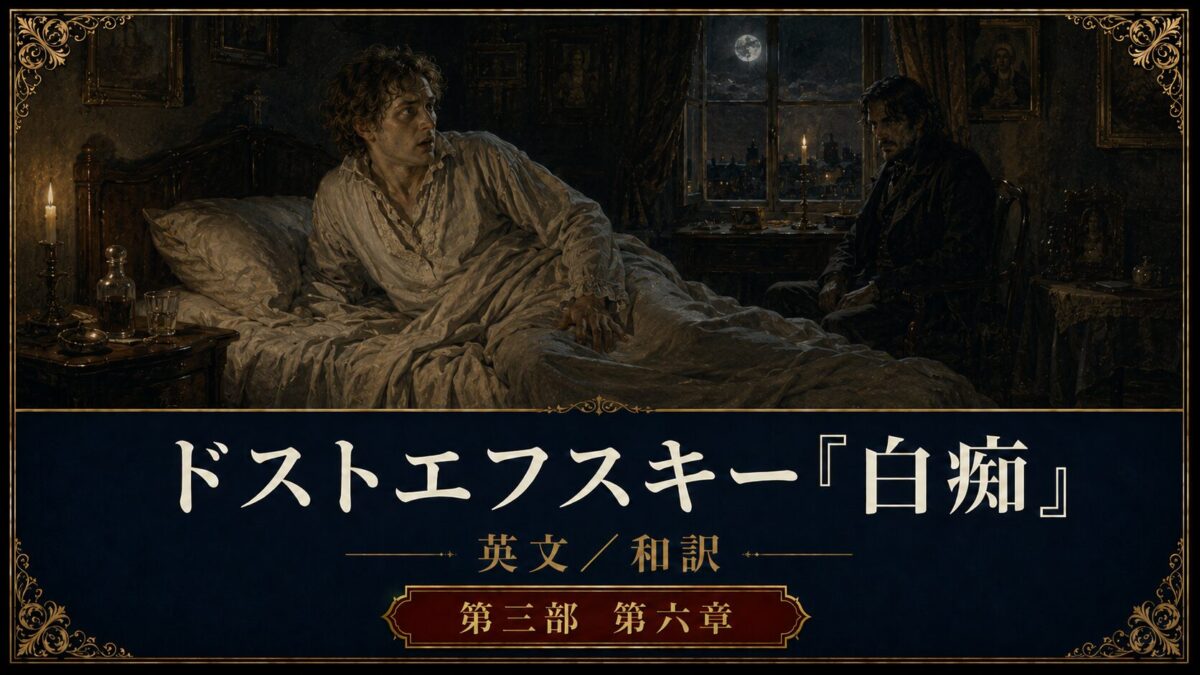
I had not slept a wink, and was lying with my eyes wide open, when suddenly the door opened, and in came Rogojin.
私は一睡もせず、目を大きく開いたまま横たわっていました。すると突然ドアが開き、ロゴージンが入ってきました。
“He entered, and shut the door behind him.
彼は中へ入り、背後でドアを閉めました。
Then he silently gazed at me and went quickly to the corner of the room where the lamp was burning and sat down underneath it.
それから黙って私を見つめ、ランプが灯っている部屋の隅へ素早く行き、その下に座りました。
“I was much surprised, and looked at him expectantly.
私はとても驚き、何か言うのを待つように彼を見つめました。
“Rogojin only leaned his elbow on the table and silently stared at me.
ロゴージンはただテーブルに肘をつき、黙って私を見つめるだけでした。
So passed two or three minutes, and I recollect that his silence hurt and offended me very much.
そうして二、三分が過ぎました。彼の沈黙が私をひどく傷つけ、腹立たせたことを覚えています。
Why did he not speak?
なぜ彼は話さないのでしょうか。
“That his arrival at this time of night struck me as more or less strange may possibly be the case.
彼がこんな夜更けに来たことを、私が多少奇妙に感じたことは、おそらく事実でしょう。
But I remember I was by no means amazed at it.
しかし私は、それにまったく仰天してはいなかったことを覚えています。
On the contrary, though I had not actually told him my thought in the morning, yet I know he understood it.
それどころか、私は朝、自分の考えを実際に彼へ話したわけではありませんでしたが、彼はそれを理解していたのだと分かっていました。
This thought was of such a character that it would not be anything very remarkable, if one were to come for further talk about it at any hour of night.
その考えは、夜中のどんな時刻であっても、それについてさらに話し合うために誰かが来ても、それほど奇妙ではないような性質のものでした。
“I thought he must have come for this purpose.
私は彼がその目的で来たに違いないと思いました。
“In the morning we had parted not the best of friends.
朝、私たちは決して友好的に別れたわけではありませんでした。
I remember he looked at me with disagreeable sarcasm once or twice.
彼が一、二度、不快な皮肉を込めて私を見たことを覚えています。
This same look I observed in his eyes now—which was the cause of the annoyance I felt.
そして今も、同じ表情が彼の目にありました。それが私をいら立たせた原因でした。
“I did not for a moment suspect that I was delirious and that this Rogojin was but the result of fever and excitement.
私は一瞬たりとも、自分が譫妄状態にあり、このロゴージンが熱と興奮の産物にすぎないのではないかとは疑いませんでした。
I had not the slightest idea of such a theory at first.
最初は、そのような考えは少しもありませんでした。
“Meanwhile he continued to sit and stare jeeringly at me.
そのあいだ、彼は座ったまま、あざけるように私を見つめ続けました。
“I angrily turned round in bed and made up my mind that I would not say a word unless he did.
私は怒ってベッドの中で身体を向け直し、彼が話さない限り自分も一言も話すまいと決めました。
So I rested silently on my pillow, determined to remain dumb, if it were to last till morning.
それで私は枕に頭を置いたまま、たとえ朝まで続いても黙っていようと決意していました。
I felt resolved that he should speak first.
彼のほうから先に話すべきだと、私は固く決めていました。
Probably twenty minutes or so passed in this way.
おそらく二十分ほどが、そのようにして過ぎたでしょう。
Suddenly the idea struck me—what if this is an apparition and not Rogojin himself?
突然、ある考えが私に浮かびました。もしこれはロゴージン本人ではなく、幻影だったらどうだろう、と。
“Neither during my illness nor at any previous time had I ever seen an apparition.
病中であれ、それ以前であれ、私は一度も幻影を見たことがありませんでした。
But I had always thought, both when I was a little boy, and even now, that if I were to see one I should die on the spot.
しかし幼いころから、そして今でさえ、もし幽霊を見たらその場で死ぬだろうと、私はいつも思っていました。
Though I don’t believe in ghosts.
もっとも、私は幽霊を信じていないのですが。
And yet now, when the idea struck me that this was a ghost and not Rogojin at all, I was not in the least alarmed.
それなのに今、これはロゴージンではなく幽霊なのだという考えが浮かんでも、私は少しも恐れませんでした。
Nay—the thought actually irritated me.
いや、それどころか、その考えは実際に私をいら立たせました。
Strangely enough, the decision of the question as to whether this were a ghost or Rogojin did not, for some reason or other, interest me nearly so much as it ought to have done.
奇妙なことに、これが幽霊なのかロゴージンなのかという問題の決定は、なぜか本来あるべきほど私の興味を引きませんでした。
I think I began to muse about something altogether different.
私は何かまったく別のことを考え始めていたのだと思います。
For instance, I began to wonder why Rogojin, who had been in dressing-gown and slippers when I saw him at home, had now put on a dress-coat and white waistcoat and tie.
たとえば、家で会ったときには部屋着とスリッパ姿だったロゴージンが、なぜ今は燕尾服と白いチョッキとネクタイを身につけているのか、不思議に思い始めたのです。
I also thought to myself, I remember—‘if this is a ghost, and I am not afraid of it, why don’t I approach it and verify my suspicions?
私はまた、こう考えたことを覚えています。『もしこれが幽霊で、しかも私はそれを恐れていないのなら、なぜ近づいて疑いを確かめないのか。
Perhaps I am afraid—’
ひょっとすると、私は恐れているのかもしれない――』
No sooner did this last idea enter my head than an icy blast blew over me.
この最後の考えが頭に入るやいなや、氷のような突風が私を吹き抜けました。
I felt a chill down my backbone and my knees shook.
背筋に寒気が走り、膝が震えました。
“At this very moment, as though divining my thoughts, Rogojin raised his head from his arm.
まさにその瞬間、まるで私の考えを見抜いたかのように、ロゴージンは腕から頭を上げました。
He began to part his lips as though he were going to laugh—but he continued to stare at me as persistently as before.
彼は笑おうとするかのように唇を開き始めました。しかし以前と同じように、しつこく私を見つめ続けていました。
“I felt so furious with him at this moment that I longed to rush at him.
その瞬間、私は彼に対してあまりにも激怒し、飛びかかりたいほどでした。
But as I had sworn that he should speak first, I continued to lie still.
しかし、彼に先に話させると誓っていたので、私はじっと横たわり続けました。
And the more willingly, as I was still by no means satisfied as to whether it really was Rogojin or not.
それに、私はそれが本当にロゴージンなのかどうか、まだまったく納得していなかったので、なおさらそうしていました。
“I cannot remember how long this lasted.
それがどれほど続いたのか、私は思い出せません。
I cannot recollect, either, whether consciousness forsook me at intervals, or not.
意識が時々私を離れたのかどうかも、思い出せません。
But at last Rogojin rose, staring at me as intently as ever, but not smiling any longer.
しかしついにロゴージンは立ち上がりました。相変わらずじっと私を見つめていましたが、もう笑ってはいませんでした。
Walking very softly, almost on tip-toes, to the door, he opened it, went out, and shut it behind him.
彼は非常に静かに、ほとんどつま先立ちでドアへ歩いていき、それを開けて外へ出て、背後で閉めました。
“I did not rise from my bed, and I don’t know how long I lay with my eyes open, thinking.
私はベッドから起き上がりませんでした。そしてどれほど長く、目を開けたまま横たわって考えていたのか分かりません。
I don’t know what I thought about, nor how I fell asleep or became insensible.
何を考えていたのか、どうやって眠りに落ちたのか、あるいは意識を失ったのか、私には分かりません。
But I awoke next morning after nine o’clock when they knocked at my door.
しかし翌朝九時過ぎ、ドアをノックする音で目を覚ましました。
My general orders are that if I don’t open the door and call, by nine o’clock, Matreona is to come and bring my tea.
私の普段の指示では、九時までに私がドアを開けて呼ばなければ、マトリョーナが来てお茶を持ってくることになっています。
When I now opened the door to her, the thought suddenly struck me—how could he have come in, since the door was locked?
私が彼女にドアを開けたとき、突然ある考えが浮かびました。ドアには鍵がかかっていたのに、彼はどうやって入ってきたのか、と。
I made inquiries and found that Rogojin himself could not possibly have come in, because all our doors were locked for the night.
私は調べてみました。そして、ロゴージン本人が入ってくることはありえなかったと分かりました。夜はすべてのドアに鍵がかけられていたからです。
“Well, this strange circumstance—which I have described with so much detail—was the ultimate cause which led me to taking my final determination.
さて、この奇妙な事情、私がこれほど詳しく述べたこの出来事こそが、私を最終的な決意へ導いた究極の原因でした。
So that no logic, or logical deductions, had anything to do with my resolve.
したがって、論理も、論理的推論も、私の決意とは何の関係もなかったのです。
It was simply a matter of disgust.
それはただ、嫌悪の問題にすぎませんでした。
“It was impossible for me to go on living when life was full of such detestable, strange, tormenting forms.
人生がこのような忌まわしく、奇妙で、苦しめる形に満ちているとき、私には生き続けることが不可能でした。
This ghost had humiliated me.
この幽霊は私に屈辱を与えたのです。
Nor could I bear to be subordinate to that dark, horrible force which was embodied in the form of the loathsome insect.
また私は、あの忌まわしい虫の形を取って現れた、暗く恐ろしい力に従属することにも耐えられませんでした。
It was only towards evening, when I had quite made up my mind on this point, that I began to feel easier.”
この点について完全に決心した夕方近くになって、ようやく私は少し楽になり始めたのです」