
『白痴』のカラフル対訳について
カラフル対訳で紹介している『白痴』は、パブリックドメインの作品を出典としています。
このサイトで使われている作品は、ロシアの文豪フョードル・ドストエフスキーによる小説 The Idiot を出典としています。 英文は Eva M. Martin による英訳版をもとにしています。 原文は、著作権の切れた名作などの全文を電子化し、インターネット上で公開している Project Gutenberg(プロジェクト・グーテンベルク)、 朗読音声は LibriVox(リブリヴォックス/朗読図書館) の公開音声を出典としています。
原文はProject Gutenberg、音声はLibriVoxで公開されているパブリックドメイン作品を出典としています。
“`『白痴』英文/和訳 PART III CHAPTER VII Part 2
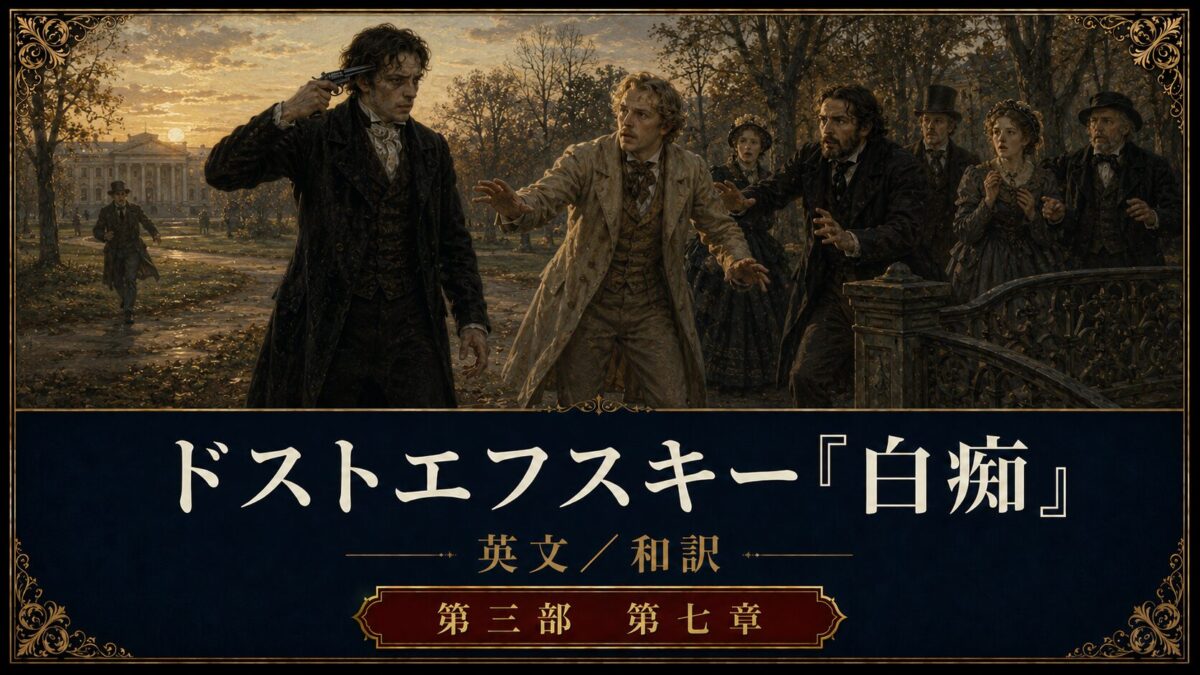
Fyodor Dostoyevsky『The Idiot』PART III CHAPTER VII の続きです。イッポリートの「説明」が終わった直後から、公爵が公園で眠り、アグラーヤに出会う直前までを、英文・和訳ペアで整理しています。
The explanation was finished; Hippolyte paused at last.
「説明」は終わった。イッポリートはついに黙った。
There is, in extreme cases, a final stage of cynical candour when a nervous man, excited, and beside himself with emotion, will be afraid of nothing and ready for any sort of scandal, nay, glad of it.
極端な場合には、神経質な人間が興奮し、感情で我を忘れたとき、何も恐れず、どんな醜聞にも身を投じるどころか、むしろそれを喜ぶようになる、冷笑的な率直さの最終段階がある。
The extraordinary, almost unnatural tension of the nerves which upheld Hippolyte up to this point, had now arrived at this final stage.
ここまでイッポリートを支えてきた、異常でほとんど不自然な神経の緊張は、いまやこの最終段階に達していた。
This poor feeble boy of eighteen—exhausted by disease—looked for all the world as weak and frail as a leaflet torn from its parent tree and trembling in the breeze.
この哀れな十八歳の弱々しい少年は、病に消耗し、親木から引き離されて風に震える一枚の葉のように、誰の目にも弱く、もろく見えた。
But no sooner had his eye swept over his audience, for the first time during the whole of the last hour, than the most contemptuous, the most haughty expression of repugnance lighted up his face.
しかし、この一時間のあいだ初めて彼の目が聴衆を見渡すやいなや、彼の顔にはこの上なく軽蔑的で、高慢な嫌悪の表情が浮かび上がった。
He defied them all, as it were.
彼はいわば、そこにいる全員に挑みかかっていた。
But his hearers were indignant, too; they rose to their feet with annoyance.
しかし聞いていた者たちもまた憤慨していた。彼らはいら立って立ち上がった。
Fatigue, the wine consumed, the strain of listening so long, all added to the disagreeable impression which the reading had made upon them.
疲労、飲んだ酒、長時間聞かされた緊張、そのすべてが、この朗読が彼らに与えた不快な印象に加わっていた。
Suddenly Hippolyte jumped up as though he had been shot.
突然、イッポリートは撃たれたかのように跳ね上がった。
“The sun is rising,” he cried, seeing the gilded tops of the trees, and pointing to them as to a miracle.
「太陽が昇っている」と彼は叫んだ。金色に輝く木々の梢を見て、それを奇跡でもあるかのように指差した。
“See, it is rising now!”
「見てください、いま昇っているのです!」
“Well, what then? Did you suppose it wasn’t going to rise?” asked Ferdishenko.
「それがどうした? 昇らないとでも思っていたのか?」とフェルディシチェンコが尋ねた。
“It’s going to be atrociously hot again all day,” said Gania, with an air of annoyance, taking his hat.
「今日も一日、ひどく暑くなりそうだ」とガーニャは苛立った様子で帽子を取りながら言った。
“A month of this… Are you coming home, Ptitsin?”
「こんなのが一か月も続くとは……プチーツィン、帰るのか?」
Hippolyte listened to this in amazement, almost amounting to stupefaction.
イッポリートはそれを驚いて聞いていた。その驚きは、ほとんど茫然自失に近かった。
Suddenly he became deadly pale and shuddered.
突然、彼は死人のように青ざめ、身震いした。
“You manage your composure too awkwardly. I see you wish to insult me,” he cried to Gania.
「あなたは平静を装うのがあまりにも下手です。私を侮辱したいのが分かります」と彼はガーニャに叫んだ。
“You—you are a cur!” He looked at Gania with an expression of malice.
「あなたは――あなたは卑劣な犬だ!」彼は悪意の表情でガーニャを見た。
“What on earth is the matter with the boy? What phenomenal feeble-mindedness!” exclaimed Ferdishenko.
「いったいこの少年はどうしたんだ? 何という異常な弱気だ!」とフェルディシチェンコが叫んだ。
“Oh, he’s simply a fool,” said Gania.
「ああ、ただの馬鹿だ」とガーニャは言った。
Hippolyte braced himself up a little.
イッポリートは少し気を取り直した。
“I understand, gentlemen,” he began, trembling as before, and stumbling over every word.
「分かっています、みなさん」と彼は始めた。先ほどと同じように震え、一語一語につかえながら。
“That I have deserved your resentment, and—and am sorry that I should have troubled you with this raving nonsense,” pointing to his article.
「私はあなた方の憤りを受けるに値します。そして――この譫妄のたわごとであなた方を煩わせたことを申し訳なく思います」と彼は自分の原稿を指した。
“Or rather, I am sorry that I have not troubled you enough.” He smiled feebly.
「いや、むしろ、あなた方を十分に煩わせられなかったことが残念です」彼は弱々しく笑った。
“Have I troubled you, Evgenie Pavlovitch?” He suddenly turned on Evgenie with this question.
「私はあなたを煩わせましたか、エヴゲーニー・パヴロヴィチ?」彼は突然この問いをエヴゲーニーに向けた。
“Tell me now, have I troubled you or not?”
「今ここで答えてください。私はあなたを煩わせましたか、それとも煩わせませんでしたか?」
“Well, it was a little drawn out, perhaps; but—”
「まあ、少し長すぎたかもしれないが、しかし――」
“Come, speak out! Don’t lie, for once in your life—speak out!” continued Hippolyte, quivering with agitation.
「さあ、はっきり言ってください! 生まれて一度くらい嘘をつかずに――はっきり言ってください!」イッポリートは興奮で震えながら続けた。
“Oh, my good sir, I assure you it’s entirely the same to me. Please leave me in peace,” said Evgenie, angrily, turning his back on him.
「ああ、君、私にとってはまったく同じことだ。どうか私を放っておいてくれ」とエヴゲーニーは怒って言い、彼に背を向けた。
“Good-night, prince,” said Ptitsin, approaching his host.
「おやすみなさい、公爵」とプチーツィンが主人のそばへ近づいて言った。
“What are you thinking of? Don’t go, he’ll blow his brains out in a minute!” cried Vera Lebedeff, rushing up to Hippolyte and catching hold of his hands in a torment of alarm.
「何を考えているんですか? 行かないでください、彼はすぐに頭を撃ち抜いてしまいます!」とヴェーラ・レベジェフは叫び、イッポリートへ駆け寄って、不安の苦悶の中で彼の手をつかんだ。
“What are you thinking of? He said he would blow his brains out at sunrise.”
「何を考えているんですか? 彼は日の出に頭を撃ち抜くと言ったんです」
“Oh, he won’t shoot himself!” cried several voices, sarcastically.
「ああ、彼は自殺なんかしないさ!」と数人の声が皮肉っぽく叫んだ。
“Gentlemen, you’d better look out,” cried Colia, also seizing Hippolyte by the hand.
「みなさん、気をつけたほうがいいですよ」とコーリャもイッポリートの手をつかみながら叫んだ。
“Just look at him! Prince, what are you thinking of?”
「彼を見てください! 公爵、何を考えているんですか?」
Vera and Colia, and Keller, and Burdovsky were all crowding round Hippolyte now and holding him down.
ヴェーラ、コーリャ、ケラー、ブルドフスキーは、いまや皆イッポリートの周りに群がり、彼を押さえつけていた。
“He has the right—the right—” murmured Burdovsky.
「彼には権利がある――権利が――」とブルドフスキーがつぶやいた。
“Excuse me, prince, but what are your arrangements?” asked Lebedeff, tipsy and exasperated, going up to Muishkin.
「失礼ですが、公爵、あなたの手配はどうなっていますか?」とレベジェフは酔い、苛立ちながらムイシュキンへ近づいて尋ねた。
“What do you mean by ‘arrangements’?”
「『手配』とはどういう意味ですか?」
“No, no, excuse me! I’m master of this house, though I do not wish to lack respect towards you.”
「いや、いや、失礼! 私はこの家の主人です。もちろん、あなたに対する敬意を欠くつもりはありませんが」
“You are master of the house too, in a way; but I can’t allow this sort of thing—”
「あなたもある意味ではこの家の主人です。しかし、私はこういうことを許すわけにはいきません――」
“He won’t shoot himself; the boy is only playing the fool,” said General Ivolgin, suddenly and unexpectedly, with indignation.
「彼は自殺などせんよ。あの少年はただ馬鹿な真似をしているだけだ」とイヴォルギン将軍が突然、意外にも憤慨して言った。
“I know he won’t, I know he won’t, general; but I—I’m master here!”
「分かっています、分かっています、将軍。しかし私は――私はここの主人なのです!」
“Listen, Mr. Terentieff,” said Ptitsin, who had bidden the prince good-night, and was now holding out his hand to Hippolyte.
「聞いてください、テレンチェフさん」とプチーツィンは言った。彼は公爵に別れを告げたあと、今はイッポリートに手を差し出していた。
“I think you remark in that manuscript of yours, that you bequeath your skeleton to the Academy.”
「あなたはその原稿の中で、自分の骨格をアカデミーへ遺贈すると書いていましたね」
“Are you referring to your own skeleton—I mean, your very bones?”
「それはご自分の骨格のことですか。つまり、本当にあなたの骨のことですか?」
“Yes, my bones, I—”
「そうです、私の骨です、私は――」
“Quite so, I see; because, you know, little mistakes have occurred now and then. There was a case—”
「なるほど、分かりました。というのも、時々ちょっとした間違いが起こることがありますから。ある事件では――」
“Why do you tease him?” cried the prince, suddenly.
「なぜ彼をからかうのですか?」と公爵が突然叫んだ。
“You’ve moved him to tears,” added Ferdishenko.
「君は彼を泣かせたよ」とフェルディシチェンコが付け加えた。
But Hippolyte was by no means weeping.
しかしイッポリートは決して泣いてなどいなかった。
He was about to move from his place, when his four guards rushed at him and seized him once more.
彼がその場から動こうとしたとき、四人の見張りが彼に飛びかかり、再び彼をつかまえた。
There was a laugh at this.
これには笑いが起こった。
“He led up to this on purpose. He took the trouble of writing all that so that people should come and grab him by the arm,” observed Rogojin.
「彼はわざとこうなるように仕向けたんだ。人々がやって来て腕をつかむように、わざわざあれだけのものを書いたのさ」とロゴージンが言った。
“Good-night, prince. What a time we’ve sat here, my very bones ache!”
「おやすみ、公爵。ずいぶん長く座っていたものだ、骨まで痛むよ!」
“If you really intended to shoot yourself, Terentieff,” said Evgenie Pavlovitch, laughing, “if I were you, after all these compliments, I should just not shoot myself in order to vex them all.”
「もし本当に自殺するつもりだったのなら、テレンチェフ君」とエヴゲーニー・パヴロヴィチは笑いながら言った。「私なら、これだけの賛辞を受けたあとでは、みんなを悔しがらせるために、あえて自殺しないだろうね」
“They are very anxious to see me blow my brains out,” said Hippolyte, bitterly.
「彼らは私が頭を撃ち抜くのを見たくてたまらないのです」とイッポリートは苦々しく言った。
“Yes, they’ll be awfully annoyed if they don’t see it.”
「そうだね。それを見られなかったら、彼らはひどくがっかりするだろう」
“Then you think they won’t see it?”
「では、あなたは彼らがそれを見ないと思うのですか?」
“I am not trying to egg you on. On the contrary, I think it very likely that you may shoot yourself; but the principal thing is to keep cool,” said Evgenie with a drawl, and with great condescension.
「私は君をけしかけているわけではない。むしろ、君が本当に自殺する可能性は十分あると思っている。ただ大事なのは冷静でいることだ」とエヴゲーニーは引き伸ばすような口調で、ひどく見下した様子で言った。
“I only now perceive what a terrible mistake I made in reading this article to them,” said Hippolyte, suddenly, addressing Evgenie.
「私は今になって初めて、この文章を彼らに読んだことが、どれほど恐ろしい間違いだったか分かりました」とイッポリートは突然エヴゲーニーに向かって言った。
He looked at him with an expression of trust and confidence, as though he were applying to a friend for counsel.
彼はまるで友人に助言を求めているかのように、信頼と確信の表情でエヴゲーニーを見つめた。
“Yes, it’s a droll situation; I really don’t know what advice to give you,” replied Evgenie, laughing.
「そうだね、実に滑稽な状況だ。正直、君にどんな助言をすればよいか分からない」とエヴゲーニーは笑いながら答えた。
Hippolyte gazed steadfastly at him, but said nothing.
イッポリートは彼をじっと見つめたが、何も言わなかった。
To look at him one might have supposed that he was unconscious at intervals.
彼を見ると、時々意識が途切れているのではないかと思われた。
“Excuse me,” said Lebedeff, “but did you observe the young gentleman’s style?”
「失礼ですが」とレベジェフが言った。「みなさん、この若い紳士の言い方にお気づきでしたか?」
“‘I’ll go and blow my brains out in the park,’ says he, ‘so as not to disturb anyone.’”
「『誰の迷惑にもならないように、公園へ行って頭を撃ち抜きます』と彼は言うのです」
“He thinks he won’t disturb anybody if he goes three yards away, into the park, and blows his brains out there.”
「三ヤードほど離れて公園へ行き、そこで頭を撃ち抜けば、誰にも迷惑をかけないと思っているのです」
“Gentlemen—” began the prince.
「みなさん――」と公爵が言いかけた。
“No, no, excuse me, most revered prince,” Lebedeff interrupted, excitedly.
「いや、いや、失礼します、最も尊敬すべき公爵」とレベジェフが興奮して遮った。
“Since you must have observed yourself that this is no joke, and since at least half your guests must also have concluded that after all that has been said this youth must blow his brains out for honour’s sake—I—as master of this house, and before these witnesses, now call upon you to take steps.”
「あなたご自身も、これが冗談ではないとお気づきのはずです。そして少なくともあなたのお客様の半分は、あれだけのことが言われた後では、この若者は名誉のために頭を撃ち抜かなければならないと結論したはずです。ですから私は、この家の主人として、またこの証人たちの前で、あなたに手を打つよう求めます」
“Yes, but what am I to do, Lebedeff? What steps am I to take? I am ready.”
「ええ、しかし私は何をすればよいのです、レベジェフ? どんな手を打てばよいのです? 私は用意があります」
“I’ll tell you. In the first place he must immediately deliver up the pistol which he boasted of, with all its appurtenances.”
「申し上げましょう。まず第一に、彼は自慢していた拳銃を、付属品も含めてただちに引き渡さなければなりません」
“If he does this I shall consent to his being allowed to spend the night in this house—considering his feeble state of health, and of course conditionally upon his being under proper supervision.”
「もし彼がそうするなら、健康状態の弱さを考慮して、この家で一晩過ごすことを認めてもよいでしょう。もちろん、適切な監視のもとに置かれるという条件つきです」
“But tomorrow he must go elsewhere.”
「しかし明日には、彼は別の場所へ行かねばなりません」
“Excuse me, prince! Should he refuse to deliver up his weapon, then I shall instantly seize one of his arms and General Ivolgin the other.”
「失礼ですが、公爵! もし彼が武器の引き渡しを拒むなら、私はただちに彼の片腕をつかみ、イヴォルギン将軍がもう片方をつかみます」
“And we shall hold him until the police arrive and take the matter into their own hands. Mr. Ferdishenko will kindly fetch them.”
「そして警察が到着してこの件を引き取るまで、彼を押さえておきます。フェルディシチェンコさんが親切にも警察を呼びに行ってくださるでしょう」
At this there was a dreadful noise; Lebedeff danced about in his excitement.
これを聞いて、恐ろしい騒ぎが起こった。レベジェフは興奮して跳ね回った。
Ferdishenko prepared to go for the police; Gania frantically insisted that it was all nonsense, “for nobody was going to shoot themselves.”
フェルディシチェンコは警察を呼びに行く支度をし、ガーニャは「誰も自殺などしないのだから」すべて馬鹿げたことだと必死に主張した。
Evgenie Pavlovitch said nothing.
エヴゲーニー・パヴロヴィチは何も言わなかった。
“Prince,” whispered Hippolyte, suddenly, his eyes all ablaze, “you don’t suppose that I did not foresee all this hatred?”
「公爵」とイッポリートが突然ささやいた。その目は燃えるように輝いていた。「私がこの憎しみのすべてを予見していなかったとでもお思いですか?」
He looked at the prince as though he expected him to reply, for a moment.
彼は一瞬、公爵が答えるのを待つかのように彼を見つめた。
“Enough!” he added at length, and addressing the whole company, he cried: “It’s all my fault, gentlemen!”
「もう十分です!」と彼はついに付け加え、一同に向かって叫んだ。「すべて私のせいです、みなさん!」
“Lebedeff, here’s the key,” he took out a small bunch of keys; “this one, the last but one—Colia will show you—Colia, where’s Colia?”
「レベジェフ、鍵はこれです」と彼は小さな鍵束を取り出した。「これです、最後から二番目の鍵です。コーリャが教えてくれます。コーリャ、コーリャはどこです?」
He cried, looking straight at Colia and not seeing him.
彼はコーリャのほうをまっすぐ見ていながら、彼を見ていないように叫んだ。
“Yes, he’ll show you; he packed the bag with me this morning.”
「そうです、彼が教えてくれます。今朝、彼が私と一緒に鞄を詰めたのです」
“Take him up, Colia; my bag is upstairs in the prince’s study, under the table.”
「彼を上へ連れて行ってください、コーリャ。私の鞄は上の公爵の書斎にあります。テーブルの下です」
“Here’s the key, and in the little case you’ll find my pistol and the powder, and all.”
「これが鍵です。小さなケースの中に、私の拳銃と火薬、その他すべてが入っています」
“Colia packed it himself, Mr. Lebedeff; he’ll show you.”
「レベジェフさん、コーリャが自分でそれを詰めました。彼が教えてくれます」
“But it’s on condition that tomorrow morning, when I leave for Petersburg, you will give me back my pistol, do you hear?”
「ただし条件があります。明日の朝、私がペテルブルグへ出発するとき、あなたは私の拳銃を返すのです。聞こえましたか?」
“I do this for the prince’s sake, not yours.”
「私は公爵のためにこうするのです。あなたのためではありません」
“Capital, that’s much better!” cried Lebedeff, and seizing the key he made off in haste.
「結構、ずっとよくなりました!」とレベジェフは叫び、鍵をつかむと急いで出て行った。
Colia stopped a moment as though he wished to say something; but Lebedeff dragged him away.
コーリャは何か言いたげに一瞬立ち止まったが、レベジェフが彼を引っ張っていった。
Hippolyte looked around at the laughing guests.
イッポリートは笑っている客たちを見回した。
The prince observed that his teeth were chattering as though in a violent attack of ague.
公爵は、彼の歯が激しい悪寒の発作のようにがたがた震えているのに気づいた。
“What brutes they all are!” he whispered to the prince.
「彼らはみんな何という獣どもでしょう!」と彼は公爵にささやいた。
Whenever he addressed him he lowered his voice.
彼は公爵に話しかけるときは、いつも声を落とした。
“Let them alone, you’re too weak now—”
「放っておきなさい。あなたはいま弱りすぎています――」
“Yes, directly; I’ll go away directly. I’ll—”
「ええ、すぐに。すぐに行きます。私は――」
Suddenly he embraced Muishkin.
突然、彼はムイシュキンを抱きしめた。
“Perhaps you think I am mad, eh?” he asked him, laughing very strangely.
「たぶんあなたは、私が狂っていると思っているのでしょう、ええ?」と彼は非常に奇妙に笑いながら尋ねた。
“No, but you—”
「いいえ、しかしあなたは――」
“Directly, directly! Stand still a moment, I wish to look in your eyes; don’t speak—stand so—let me look at you!”
「すぐに、すぐに! しばらくじっとしていてください。あなたの目を見たいのです。話さないで――そのまま立っていて――あなたを見させてください!」
“I am bidding farewell to mankind.”
「私は人類に別れを告げているのです」
He stood so for ten seconds, gazing at the prince, motionless, deadly pale, his temples wet with perspiration.
彼はそのまま十秒間立ち、公爵を見つめていた。身動きもせず、死人のように青ざめ、こめかみは汗で濡れていた。
He held the prince’s hand in a strange grip, as though afraid to let him go.
彼は公爵の手を奇妙な力で握っていた。まるで手放すのを恐れているかのようだった。
“Hippolyte, Hippolyte, what is the matter with you?” cried Muishkin.
「イッポリート、イッポリート、どうしたのです?」とムイシュキンは叫んだ。
“Directly! There, that’s enough. I’ll lie down directly. I must drink to the sun’s health.”
「すぐに! ほら、もう十分です。すぐに横になります。私は太陽の健康を祝して飲まねばなりません」
“I wish to—I insist upon it! Let go!”
「そうしたいのです――私は強く要求します! 放してください!」
He seized a glass from the table, broke away from the prince, and in a moment had reached the terrace steps.
彼はテーブルからグラスをつかみ、公爵を振りほどき、たちまちテラスの階段へたどり着いた。
The prince made after him, but it so happened that at this moment Evgenie Pavlovitch stretched out his hand to say good-night.
公爵は彼を追ったが、ちょうどその瞬間、エヴゲーニー・パヴロヴィチが別れの挨拶をしようと手を差し出した。
The next instant there was a general outcry, and then followed a few moments of indescribable excitement.
次の瞬間、一斉に叫び声が上がり、そのあと言い表せない興奮の数瞬間が続いた。
Reaching the steps, Hippolyte had paused, holding the glass in his left hand while he put his right hand into his coat pocket.
階段にたどり着くと、イッポリートは立ち止まり、左手にグラスを持ったまま、右手を上着のポケットに入れた。
Keller insisted afterwards that he had held his right hand in his pocket all the while, when he was speaking to the prince, and that he had held the latter’s shoulder with his left hand only.
ケラーは後になって、彼が公爵に話している間ずっと右手をポケットに入れており、左手だけで公爵の肩をつかんでいたのだと主張した。
This circumstance, Keller affirmed, had led him to feel some suspicion from the first.
この事情が、最初から自分に何らかの疑いを抱かせたのだ、とケラーは断言した。
However this may be, Keller ran after Hippolyte, but he was too late.
いずれにせよ、ケラーはイッポリートを追って駆け寄ったが、遅すぎた。
He caught sight of something flashing in Hippolyte’s right hand, and saw that it was a pistol.
彼はイッポリートの右手に何かがきらめくのを見て、それが拳銃だと分かった。
He rushed at him, but at that very instant Hippolyte raised the pistol to his temple and pulled the trigger.
彼はイッポリートに飛びかかったが、そのまさに瞬間、イッポリートは拳銃をこめかみに当て、引き金を引いた。
There followed a sharp metallic click, but no report.
鋭い金属音が続いたが、銃声はなかった。
When Keller seized the would-be suicide, the latter fell forward into his arms, probably actually believing that he was shot.
ケラーがその自殺未遂者をつかんだとき、彼は前へ倒れ込んでケラーの腕の中に落ちた。おそらく本当に撃たれたと思っていたのだろう。
Keller had hold of the pistol now.
ケラーはいま拳銃を握っていた。
Hippolyte was immediately placed in a chair, while the whole company thronged around excitedly, talking and asking each other questions.
イッポリートはすぐに椅子に座らされ、一同は興奮して彼の周囲に群がり、話し合い、互いに質問し合った。
Every one of them had heard the snap of the trigger, and yet they saw a live and apparently unharmed man before them.
誰もが引き金の音を聞いていた。それなのに、目の前には生きていて、どうやら無傷の男がいた。
Hippolyte himself sat quite unconscious of what was going on, and gazed around with a senseless expression.
イッポリート自身は何が起きているのかまったく分からないまま座り、放心した表情であたりを見回していた。
Lebedeff and Colia came rushing up at this moment.
この瞬間、レベジェフとコーリャが駆けつけてきた。
“What is it?” someone asked, breathlessly—“A misfire?”
「どうしたんだ?」と誰かが息を切らして尋ねた。「不発か?」
“Perhaps it wasn’t loaded,” said several voices.
「たぶん弾が入っていなかったのだ」と数人の声が言った。
“It’s loaded all right,” said Keller, examining the pistol, “but—”
「弾はちゃんと入っている」とケラーは拳銃を調べながら言った。「しかし――」
“What! did it miss fire?”
「何だって! 不発だったのか?」
“There was no cap in it,” Keller announced.
「雷管が入っていなかった」とケラーが告げた。
It would be difficult to describe the pitiable scene that now followed.
その後に続いた痛ましい場面を描写するのは難しい。
The first sensation of alarm soon gave place to amusement.
最初の恐怖の感覚は、すぐに面白がる気持ちへと変わった。
Some burst out laughing loud and heartily, and seemed to find a malicious satisfaction in the joke.
何人かは大声で心から笑い出し、その冗談の中に意地悪な満足を見いだしているようだった。
Poor Hippolyte sobbed hysterically; he wrung his hands.
哀れなイッポリートはヒステリックに泣き、手をもみしだいた。
He approached everyone in turn—even Ferdishenko—and took them by both hands.
彼は一人ひとりに近づき、フェルディシチェンコにまで近づいて、両手で相手の手を取った。
He swore solemnly that he had forgotten—absolutely forgotten—“accidentally, and not on purpose,”—to put a cap in.
彼は、雷管を入れるのを忘れていた、完全に忘れていた、「偶然で、わざとではない」と厳かに誓った。
He said that he “had ten of them, at least, in his pocket.”
彼は「少なくとも十個はポケットに入っている」と言った。
He pulled them out and showed them to everyone.
彼はそれらを取り出して、全員に見せた。
He protested that he had not liked to put one in beforehand for fear of an accidental explosion in his pocket.
彼は、ポケットの中で偶発的に爆発するのを恐れて、あらかじめ雷管を入れておく気にはなれなかったのだと訴えた。
He had thought he would have lots of time to put it in afterwards—when required—and, in the heat of the moment, he had forgotten all about it.
必要になったときに後から入れる時間はいくらでもあると思っていたが、その場の熱にのまれて、すっかり忘れてしまったのだという。
He threw himself upon the prince, then on Evgenie Pavlovitch.
彼は公爵に身を投げかけ、次にエヴゲーニー・パヴロヴィチにもすがりついた。
He entreated Keller to give him back the pistol, and he’d soon show them all that “his honour—his honour,”—but he was “dishonoured, now, for ever!”
彼はケラーに拳銃を返してくれと懇願し、そうすればすぐにみんなに「自分の名誉――自分の名誉」を示してやると言った。しかし彼は「今や永遠に名誉を失った」のだった。
He fell senseless at last—and was carried into the prince’s study.
彼はついに意識を失い、公爵の書斎へ運び込まれた。
Lebedeff, now quite sobered down, sent for a doctor.
レベジェフはすっかり酔いが覚め、医者を呼びにやった。
He and his daughter, with Burdovsky and General Ivolgin, remained by the sick man’s couch.
彼とその娘、それにブルドフスキーとイヴォルギン将軍は、病人の寝椅子のそばに残った。
When he was carried away unconscious, Keller stood in the middle of the room, and made the following declaration to the company in general, in a loud tone of voice, with emphasis upon each word.
イッポリートが意識を失って運ばれていくと、ケラーは部屋の中央に立ち、大きな声で一語一語に力を込めて、一同に次の宣言をした。
“Gentlemen, if any one of you casts any doubt again, before me, upon Hippolyte’s good faith, or hints that the cap was forgotten intentionally, or suggests that this unhappy boy was acting a part before us, I beg to announce that the person so speaking shall account to me for his words.”
「諸君、もしこの中の誰かが、私の前で再びイッポリートの誠実さに疑いを投げかけたり、雷管をわざと忘れたのだとほのめかしたり、この不幸な少年が私たちの前で芝居をしていたのだと言ったりするなら、そのような発言をした者には、その言葉の責任を私に対して取ってもらうことをここに宣言する」
No one replied.
誰も答えなかった。
The company departed very quickly, in a mass.
一同は、まとまって非常に急いで立ち去った。
Ptitsin, Gania, and Rogojin went away together.
プチーツィン、ガーニャ、ロゴージンは一緒に出て行った。
The prince was much astonished that Evgenie Pavlovitch changed his mind, and took his departure without the conversation he had requested.
公爵は、エヴゲーニー・パヴロヴィチが気を変え、頼んでいた会話をせずに帰っていくことに大いに驚いた。
“Why, you wished to have a talk with me when the others left?” he said.
「あなたは、ほかの人たちが帰ったら私と話したいとおっしゃっていたではありませんか」と彼は言った。
“Quite so,” said Evgenie, sitting down suddenly beside him, “but I have changed my mind for the time being.”
「その通りです」とエヴゲーニーは突然彼のそばに腰を下ろして言った。「しかし今のところ、気が変わりました」
“I confess, I am too disturbed, and so, I think, are you.”
「正直に言うと、私はひどく動揺しています。そしてあなたもそうだと思います」
“The matter as to which I wished to consult you is too serious to tackle with one’s mind even a little disturbed; too serious both for myself and for you.”
「あなたに相談したかった件は、少しでも心が乱れた状態で扱うにはあまりにも重大です。私にとっても、あなたにとっても重大すぎます」
“You see, prince, for once in my life I wish to perform an absolutely honest action, that is, an action with no ulterior motive.”
「いいですか、公爵、私は生まれて初めて、完全に正直な行為をしたいのです。つまり、下心のない行為です」
“And I think I am hardly in a condition to talk of it just at this moment, and—and—well, we’ll discuss it another time.”
「そして今この瞬間には、それについて話す状態にはとてもないと思います。だから――だから――まあ、それは別の機会に話しましょう」
“Perhaps the matter may gain in clearness if we wait for two or three days—just the two or three days which I must spend in Petersburg.”
「二、三日待てば、その件はもっと明確になるかもしれません。ちょうど私がペテルブルグで過ごさなければならない二、三日です」
Here he rose again from his chair, so that it seemed strange that he should have thought it worth while to sit down at all.
そこで彼は再び椅子から立ち上がった。そもそも座る意味があったのか不思議に思われるほどだった。
The prince thought, too, that he looked vexed and annoyed, and not nearly so friendly towards himself as he had been earlier in the night.
公爵はまた、彼が腹を立てて苛立っているように見え、夜の初めほど自分に友好的ではないとも思った。
“I suppose you will go to the sufferer’s bedside now?” he added.
「あなたはこれから、あの苦しんでいる人の枕元へ行かれるのでしょうね?」と彼は付け加えた。
“Yes, I am afraid…” began the prince.
「ええ、私は心配で……」と公爵は言いかけた。
“Oh, you needn’t fear! He’ll live another six weeks all right.”
「ああ、心配には及びません。彼はあと六週間はちゃんと生きるでしょう」
“Very likely he will recover altogether; but I strongly advise you to pack him off tomorrow.”
「おそらく彼はすっかり回復するでしょう。しかし私は、明日彼を追い払うことを強く勧めます」
“I think I may have offended him by saying nothing just now.”
「私は先ほど何も言わなかったことで、彼を傷つけたかもしれません」
“I am afraid he may suspect that I doubted his good faith,—about shooting himself, you know.”
「彼は、自殺について、私が彼の誠実さを疑ったのだと思うかもしれないと心配なのです」
“What do you think, Evgenie Pavlovitch?”
「あなたはどう思いますか、エヴゲーニー・パヴロヴィチ?」
“Not a bit of it! You are much too good to him; you shouldn’t care a hang about what he thinks.”
「まったくそんなことはありません! あなたは彼に良すぎます。彼が何を考えるかなど気にすべきではありません」
“I have heard of such things before, but never came across, till tonight, a man who would actually shoot himself in order to gain a vulgar notoriety.”
「こういう話は以前にも聞いたことがありますが、俗悪な悪名を得るために実際に自殺しようとする男に出会ったのは、今夜が初めてです」
“Or blow out his brains for spite, if he finds that people don’t care to pat him on the back for his sanguinary intentions.”
「あるいは、自分の血なまぐさい意図に対して人々が褒めてくれないと分かると、腹いせに頭を撃ち抜くような男です」
“But what astonishes me more than anything is the fellow’s candid confession of weakness.”
「しかし何より私を驚かせるのは、あの男が弱さを率直に告白したことです」
“You’d better get rid of him tomorrow, in any case.”
「いずれにせよ、明日には彼を追い払ったほうがよいでしょう」
“Do you think he will make another attempt?”
「彼はまた試みると思いますか?」
“Oh no, not he, not now! But you have to be very careful with this sort of gentleman.”
「いや、しませんよ。今はしません! しかし、この種の紳士には非常に用心しなければなりません」
“Crime is too often the last resource of these petty nonentities.”
「犯罪は、こうした取るに足りない小人物たちの最後の手段であることが、あまりにも多いのです」
“This young fellow is quite capable of cutting the throats of ten people, simply for a lark, as he told us in his ‘explanation.’”
「この若者は、自分の『説明』の中で言ったように、ただの悪ふざけで十人の喉を切ることくらい十分にやりかねません」
“I assure you those confounded words of his will not let me sleep.”
「確かに、彼のあの忌々しい言葉のせいで、私は眠れないでしょう」
“I think you disturb yourself too much.”
「あなたは気にしすぎだと思います」
“What an extraordinary person you are, prince! Do you mean to say that you doubt the fact that he is capable of murdering ten men?”
「何という変わった方でしょう、公爵! 彼が十人を殺すことができるという事実を疑うというのですか?」
“I daren’t say, one way or the other; all this is very strange—but—”
「どちらとも言い切れません。すべてが非常に奇妙です。しかし――」
“Well, as you like, just as you like,” said Evgenie Pavlovitch, irritably.
「まあ、お好きなように、まったくお好きなように」とエヴゲーニー・パヴロヴィチは苛立って言った。
“Only you are such a plucky fellow, take care you don’t get included among the ten victims!”
「ただ、あなたはあまりにも勇敢な人ですから、十人の犠牲者の中に入らないよう気をつけてください!」
“Oh, he is much more likely not to kill anyone at all,” said the prince, gazing thoughtfully at Evgenie.
「いや、彼はむしろ誰も殺さない可能性のほうがずっと高いでしょう」と公爵はエヴゲーニーを考え込むように見つめながら言った。
The latter laughed disagreeably.
後者は不快そうに笑った。
“Well, au revoir! Did you observe that he ‘willed’ a copy of his confession to Aglaya Ivanovna?”
「では、ごきげんよう! 彼が自分の告白の写しをアグラーヤ・イワノヴナへ『遺贈』したことに気づきましたか?」
“Yes, I did; I am thinking of it.”
「ええ、気づきました。そのことを考えています」
“In connection with ‘the ten,’ eh?” laughed Evgenie, as he left the room.
「『十人』と関連してですかね?」とエヴゲーニーは笑いながら部屋を出た。
An hour later, towards four o’clock, the prince went into the park.
一時間後、四時ごろ、公爵は公園へ出て行った。
He had endeavoured to fall asleep, but could not, owing to the painful beating of his heart.
彼は眠ろうとしたが、心臓の苦しい鼓動のために眠れなかった。
He had left things quiet and peaceful; the invalid was fast asleep, and the doctor, who had been called in, had stated that there was no special danger.
彼が家を出るとき、物事は静かで平穏だった。病人はぐっすり眠っており、呼ばれた医者は特別な危険はないと述べていた。
Lebedeff, Colia, and Burdovsky were lying down in the sick-room, ready to take it in turns to watch.
レベジェフ、コーリャ、ブルドフスキーは病室で横になり、交代で見守る準備をしていた。
There was nothing to fear, therefore, at home.
したがって、家では何も恐れることはなかった。
But the prince’s mental perturbation increased every moment.
しかし公爵の精神の動揺は刻一刻と増していった。
He wandered about the park, looking absently around him.
彼は公園を歩き回り、ぼんやりとあたりを見回した。
He paused in astonishment when he suddenly found himself in the empty space with the rows of chairs round it, near the Vauxhall.
そして突然、ヴォクソールの近く、椅子の列が周囲に並ぶ空き地に自分がいることに気づき、驚いて立ち止まった。
The look of the place struck him as dreadful now.
その場所の様子は、今では彼に恐ろしく感じられた。
So he turned round and went by the path which he had followed with the Epanchins on the way to the band.
そこで彼は向きを変え、エパンチン家の人々と音楽のところへ向かったときに通った小道を進んだ。
Until he reached the green bench which Aglaya had pointed out for their rendezvous.
そして、アグラーヤが二人の待ち合わせ場所として示していた緑のベンチにたどり着いた。
He sat down on it and suddenly burst into a loud fit of laughter, immediately followed by a feeling of irritation.
彼はそこに腰を下ろし、突然大声で笑い出したが、すぐにいら立ちの感情がそれに続いた。
His disturbance of mind continued; he felt that he must go away somewhere, anywhere.
彼の心の乱れは続いた。どこかへ、どこでもよいから行かなければならないと感じた。
Above his head some little bird sang out, of a sudden; he began to peer about for it among the leaves.
頭上で小鳥が突然鳴き出した。彼は葉の間にその鳥を探そうと目を凝らした。
Suddenly the bird darted out of the tree and away.
突然、その鳥は木から飛び出し、飛び去った。
Instantly he thought of the “fly buzzing about in the sun’s rays” that Hippolyte had talked of.
その瞬間、彼はイッポリートが語った「太陽の光の中で飛び回る蠅」のことを思い出した。
How that it knew its place and was a participator in the universal life, while he alone was an outcast.
その蠅は自分の場所を知り、普遍的な生命の参加者でありながら、彼だけが追放者なのだ、という話である。
This picture had impressed him at the time, and he meditated upon it now.
このイメージはその時に彼へ強い印象を与えており、今、彼はそれについて思いを巡らせた。
An old, forgotten memory awoke in his brain, and suddenly burst into clearness and light.
古く忘れられていた記憶が彼の頭の中で目覚め、突然、明晰さと光の中へあふれ出した。
It was a recollection of Switzerland, during the first year of his cure, the very first months.
それはスイスでの記憶だった。療養の最初の年、その最初の数か月の記憶である。
At that time he had been pretty nearly an idiot still.
そのころ、彼はまだほとんど白痴に近い状態だった。
He could not speak properly, and had difficulty in understanding when others spoke to him.
彼はまともに話すことができず、人が話しかけても理解するのが難しかった。
He climbed the mountain-side, one sunny morning, and wandered long and aimlessly with a certain thought in his brain, which would not become clear.
ある晴れた朝、彼は山腹を登り、頭の中に明確にならないある考えを抱えたまま、長いあいだ目的もなく歩き回った。
Above him was the blazing sky, below, the lake; all around was the horizon, clear and infinite.
彼の上には燃えるような空があり、下には湖があった。周囲には、澄みきった無限の地平線が広がっていた。
He looked out upon this, long and anxiously.
彼はそれを長いあいだ、不安そうに眺めていた。
He remembered how he had stretched out his arms towards the beautiful, boundless blue of the horizon, and wept, and wept.
彼は、美しく果てしない青い地平線に向かって腕を伸ばし、泣いて、泣き続けたことを思い出した。
What had so tormented him was the idea that he was a stranger to all this, that he was outside this glorious festival.
彼をそれほど苦しめたのは、自分がこのすべてに対してよそ者であり、この栄光ある祝祭の外側にいるという考えだった。
What was this universe?
この宇宙とは何なのか。
What was this grand, eternal pageant to which he had yearned from his childhood up, and in which he could never take part?
幼いころから憧れ続け、それでいて決して参加できなかった、この壮大で永遠の行進とは何なのか。
Every morning the same magnificent sun; every morning the same rainbow in the waterfall; every evening the same glow on the snow-mountains.
毎朝、同じ壮麗な太陽が昇る。毎朝、滝には同じ虹がかかる。毎夕、雪山には同じ輝きが差す。
Every little fly that buzzed in the sun’s rays was a singer in the universal chorus, “knew its place, and was happy in it.”
太陽の光の中で飛び回る小さな蠅でさえ、宇宙の合唱の歌い手であり、「自分の場所を知り、その中で幸福だった」。
Every blade of grass grew and was happy.
一本一本の草も育ち、幸福だった。
Everything knew its path and loved it, went forth with a song and returned with a song.
あらゆるものが自分の道を知り、それを愛し、歌とともに出て行き、歌とともに戻ってきた。
Only he knew nothing, understood nothing, neither men nor words, nor any of nature’s voices.
ただ彼だけが何も知らず、何も理解していなかった。人も、言葉も、自然のどんな声も理解していなかった。
He was a stranger and an outcast.
彼はよそ者であり、追放者だった。
Oh, he could not then speak these words, or express all he felt!
ああ、そのころ彼には、こうした言葉を口にすることも、自分の感じているすべてを表現することもできなかった。
He had been tormented dumbly.
彼は言葉もなく、ただ苦しんでいたのだ。
But now it appeared to him that he must have said these very words—even then—and that Hippolyte must have taken his picture of the little fly from his tears and words of that time.
しかし今では、そのころでさえ彼はまさにこの言葉を言っていたに違いなく、イッポリートは小さな蠅のイメージを、その時の彼の涙と言葉から取ったに違いないように思われた。
He was sure of it, and his heart beat excitedly at the thought, he knew not why.
彼はそのことを確信していた。そしてなぜか分からないまま、その考えに胸が激しく高鳴った。
He fell asleep on the bench; but his mental disquiet continued through his slumbers.
彼はベンチの上で眠り込んだ。しかし心の不安は眠りの中でも続いた。
Just before he dozed off, the idea of Hippolyte murdering ten men flitted through his brain, and he smiled at the absurdity of such a thought.
まどろむ直前、イッポリートが十人を殺すという考えが彼の頭をよぎり、彼はその考えの馬鹿げたところに微笑んだ。
Around him all was quiet; only the flutter and whisper of the leaves broke the silence, but broke it only to cause it to appear yet more deep and still.
彼の周囲はすべて静かだった。ただ葉のそよぎとささやきだけが沈黙を破っていた。しかしそれは、沈黙を破ることで、かえってそれをいっそう深く静かに見せていた。
He dreamed many dreams as he sat there, and all were full of disquiet, so that he shuddered every moment.
彼はそこに座ったまま、多くの夢を見た。そしてそのどれもが不安に満ちていて、彼はそのたびに身震いした。
At length a woman seemed to approach him.
やがて、一人の女が彼に近づいてくるように見えた。
He knew her, oh! he knew her only too well.
彼はその女を知っていた。ああ、あまりにもよく知っていた。
He could always name her and recognize her anywhere.
彼はいつでも彼女の名を言うことができ、どこであっても彼女を見分けることができた。
But, strange, she seemed to have quite a different face from hers, as he had known it.
しかし奇妙なことに、彼女は彼が知っていた彼女の顔とはまったく違う顔をしているように見えた。
He felt a tormenting desire to be able to say she was not the same woman.
彼は、これは同じ女ではないと言えたらどれほどよいかという、苦しい欲求を感じた。
In the face before him there was such dreadful remorse and horror that he thought she must be a criminal.
目の前の顔には恐ろしい悔恨と恐怖があり、彼は彼女が犯罪者に違いないと思った。
She must have just committed some awful crime.
彼女はたった今、何か恐ろしい罪を犯したばかりに違いなかった。
Tears were trembling on her white cheek.
涙が彼女の白い頬の上で震えていた。
She beckoned him, but placed her finger on her lip as though to warn him that he must follow her very quietly.
彼女は彼を手招きしたが、唇に指を当て、彼が非常に静かについて来なければならないと警告するようだった。
His heart froze within him.
彼の心は内側で凍りついた。
He wouldn’t, he couldn’t confess her to be a criminal, and yet he felt that something dreadful would happen the next moment.
彼は彼女を犯罪者だと認めたくなかった。認めることもできなかった。それでも次の瞬間、何か恐ろしいことが起こると感じていた。
Something which would blast his whole life.
それは彼の人生全体を打ち砕いてしまう何かだった。
She seemed to wish to show him something, not far off, in the park.
彼女は公園のそう遠くない場所で、彼に何かを見せようとしているようだった。
He rose from his seat in order to follow her, when a bright, clear peal of laughter rang out by his side.
彼が彼女について行こうとして席から立ち上がると、明るく澄んだ笑い声が彼のそばで響いた。
He felt somebody’s hand suddenly in his own, seized it, pressed it hard, and awoke.
彼は突然、自分の手の中に誰かの手を感じ、それをつかみ、強く握りしめ、そして目を覚ました。
Before him stood Aglaya, laughing aloud.
目の前には、声を立てて笑っているアグラーヤが立っていた。