
CHAPTER XIII のポイント
第13章では、空腹と寒さに苦しむセーラが、使いの途中でパン屋の前を通りかかります。道で拾ったお金でパンを買うことができますが、さらに貧しく飢えた少女を見つけ、セーラは自分の分を削ってパンを分け与えます。
この章の読みどころは、セーラが最も苦しい時でさえ、他人の苦しみを見過ごさないところです。自分も「群衆の一人」のように貧しい立場に落ちたからこそ、より弱い者への共感が深まり、後の救いにつながる重要な出会いが生まれます。
この章の英語学習ポイントを開く
- populace:民衆、庶民。セーラが特別な存在ではなく、貧しい人々の一人として描かれる章題の重要語。
- starving:飢えている。セーラと道端の少女の切実な空腹を表す強い語。
- bun:丸パン、菓子パン。セーラの善意と自己犠牲を象徴する、この章の中心的な物。
- compassion:思いやり、同情。自分も苦しい中で他人を助けるセーラの心を表す語。
- generous:気前のよい、寛大な。貧しくなっても失われないセーラの気高さを読む手がかりになる語。
13 One of the Populace
『A Little Princess』第13章「One of the Populace」を、英語多読用に読みやすく整えています。形容詞・副詞・熟語・心理描写・場面描写を中心に、多めに色分けしています。
表示設定
カテゴリ別ハイライト
The winter was a wretched one.
その冬は惨めな冬だった。
There were days on which Sara tramped through snow when she went on her errands.
サラが使い走りに出る時、雪の中を重い足取りで歩かなければならない日もあった。
There were worse days when the snow melted and combined itself with mud to form slush.
もっと悪い日には、雪が溶けて泥と混ざり、ぬかるみになった。
There were others when the fog was so thick that the lamps in the street were lighted all day.
また、霧があまりにも濃く、通りの街灯が一日中ともされる日もあった。
And London looked as it had looked the afternoon, several years ago, when the cab had driven through the thoroughfares with Sara tucked up on its seat, leaning against her father’s shoulder.
そしてロンドンは、数年前のあの午後、馬車が大通りを走り、サラが座席にくるまって父の肩にもたれていた時と同じように見えた。
On such days the windows of the house of the Large Family always looked delightfully cozy and alluring.
そんな日には、大きな家族の家の窓はいつも、楽しく心地よく、魅力的に見えた。
And the study in which the Indian gentleman sat glowed with warmth and rich color.
そしてインドの紳士が座る書斎は、暖かさと豊かな色彩で輝いていた。
But the attic was dismal beyond words.
しかし屋根裏部屋は、言葉にできないほど陰気だった。
There were no longer sunsets or sunrises to look at, and scarcely ever any stars, it seemed to Sara.
サラには、もう眺める夕焼けも朝焼けもなく、星さえほとんど見えないように思えた。
The clouds hung low over the skylight and were either gray or mud-color, or dropping heavy rain.
雲は天窓の上に低く垂れこめ、灰色か泥色をしているか、激しい雨を落としていた。
At four o’clock in the afternoon, even when there was no special fog, the daylight was at an end.
午後四時には、特に霧が出ていない時でさえ、もう昼の光は終わっていた。
If it was necessary to go to her attic for anything, Sara was obliged to light a candle.
何かのために屋根裏部屋へ行かなければならない時には、サラはろうそくを灯さなければならなかった。
The women in the kitchen were depressed, and that made them more ill-tempered than ever.
台所の女たちは気が滅入っていて、そのせいでいつにも増して機嫌が悪かった。
Becky was driven like a little slave.
ベッキーは小さな奴隷のようにこき使われていた。
“‘Twarn’t for you, miss,” she said hoarsely to Sara one night when she had crept into the attic.
「お嬢さまがいなかったら」と、ある夜、屋根裏部屋へ忍び込んだベッキーは、しわがれ声でサラに言った。
“‘Twarn’t for you, an’ the Bastille, an’ bein’ the prisoner in the next cell, I should die.”
「お嬢さまと、バスティーユと、隣の独房の囚人ごっこがなかったら、あたし死んでしまいます」
“That there does seem real now, doesn’t it?”
「あれって、今では本当に思えてきますよね?」
“The missus is more like the head jailer every day she lives.”
「奥さまは日ごとに、ますます看守長みたいになっています」
“I can jest see them big keys you say she carries.”
「お嬢さまが言っていた、奥さまの持っている大きな鍵が、目に見えるようです」
“The cook she’s like one of the under-jailers.”
「料理人は下っ端の看守みたいです」
“Tell me some more, please, miss–tell me about the subt’ranean passage we’ve dug under the walls.”
「もっと話してください、お嬢さま。壁の下に掘った地下通路の話をしてください」
“I’ll tell you something warmer,” shivered Sara.
「もっと暖かい話をしてあげるわ」とサラは震えながら言った。
“Get your coverlet and wrap it round you, and I’ll get mine, and we will huddle close together on the bed.”
「あなたの掛け布を持ってきて体に巻きなさい。私も自分のを持ってくるから、ベッドの上で身を寄せ合いましょう」
“And I’ll tell you about the tropical forest where the Indian gentleman’s monkey used to live.”
「そして、インドの紳士の猿が昔住んでいた熱帯の森の話をしてあげるわ」
“When I see him sitting on the table near the window and looking out into the street with that mournful expression, I always feel sure he is thinking about the tropical forest.”
「あの猿が窓の近くのテーブルに座って、悲しげな表情で通りを見ているのを見ると、私はいつも、彼が熱帯の森のことを考えているのだと確信するの」
“Where he used to swing by his tail from coconut trees.”
「そこで彼は、ココナッツの木からしっぽでぶら下がって揺れていたのよ」
“I wonder who caught him, and if he left a family behind who had depended on him for coconuts.”
「誰が彼を捕まえたのかしら。それに、ココナッツを取ってもらうのを彼に頼っていた家族を残してきたのかしら」
“That is warmer, miss,” said Becky, gratefully.
「それは暖かいです、お嬢さま」とベッキーはありがたそうに言った。
“But, someways, even the Bastille is sort of heatin’ when you gets to tellin’ about it.”
「でも、どういうわけか、バスティーユの話だって、お嬢さまが話し始めると、なんだか暖かくなるんです」
“That is because it makes you think of something else,” said Sara.
「それは、別のことを考えさせてくれるからよ」とサラは言った。
Wrapping the coverlet round her until only her small dark face was to be seen looking out of it.
彼女は掛け布を体に巻き、小さな黒い顔だけがそこからのぞくようになった。
“I’ve noticed this. What you have to do with your mind, when your body is miserable, is to make it think of something else.”
「私はこれに気づいたの。体がつらい時、心にしなければならないことは、別のことを考えさせることなの」
“Can you do it, miss?” faltered Becky, regarding her with admiring eyes.
「お嬢さまには、それができるんですか?」とベッキーは、尊敬するような目で彼女を見ながら、ためらいがちに尋ねた。
Sara knitted her brows a moment.
サラはしばらく眉を寄せた。
“Sometimes I can and sometimes I can’t,” she said stoutly.
「できる時もあれば、できない時もあるわ」と彼女はきっぱりと言った。
“But when I CAN I’m all right.”
「でも、できる時は大丈夫なの」
“And what I believe is that we always could–if we practiced enough.”
「そして私が信じているのは、十分に練習すれば、私たちはいつでもできるはずだということよ」
“I’ve been practicing a good deal lately, and it’s beginning to be easier than it used to be.”
「私は最近かなり練習しているの。以前より簡単になり始めているわ」
“When things are horrible–just horrible–I think as hard as ever I can of being a princess.”
「物事がひどい時、本当にひどい時には、私はできる限り強く、自分が王女であることを考えるの」
“I say to myself, ‘I am a princess, and I am a fairy one, and because I am a fairy nothing can hurt me or make me uncomfortable.'”
「私は自分に言うの。『私は王女で、しかも妖精の王女なの。私は妖精だから、何も私を傷つけたり不快にしたりすることはできない』って」
“You don’t know how it makes you forget”–with a laugh.
「それがどれほど忘れさせてくれるか、あなたにはわからないわ」――そう言って彼女は笑った。
She had many opportunities of making her mind think of something else, and many opportunities of proving to herself whether or not she was a princess.
彼女には、心に別のことを考えさせる機会が何度もあり、自分が王女であるかどうかを自分自身に証明する機会も何度もあった。
But one of the strongest tests she was ever put to came on a certain dreadful day.
しかし、彼女が経験した中でも最も厳しい試練の一つは、ある恐ろしい日に訪れた。
Which, she often thought afterward, would never quite fade out of her memory even in the years to come.
その日は、後になっても、これから何年たっても、記憶から完全に消えることはないだろうと彼女がよく思った日だった。
For several days it had rained continuously.
数日間、雨は絶え間なく降り続いていた。
The streets were chilly and sloppy and full of dreary, cold mist.
通りは冷え冷えとしてぬかるみ、陰気で冷たい霧に満ちていた。
There was mud everywhere–sticky London mud–and over everything the pall of drizzle and fog.
どこもかしこも泥だらけだった。ねばつくロンドンの泥で、すべての上には霧雨と霧の覆いがかかっていた。
Of course there were several long and tiresome errands to be done–there always were on days like this.
もちろん、長くてうんざりするような使い走りがいくつもあった。こういう日には、いつもそうだった。
And Sara was sent out again and again, until her shabby clothes were damp through.
そしてサラは何度も何度も外へ出され、みすぼらしい服は中まで湿ってしまった。
The absurd old feathers on her forlorn hat were more draggled and absurd than ever.
彼女のみじめな帽子についているばかげた古い羽根飾りは、これまで以上に雨に濡れてだらりとし、ばかばかしく見えた。
And her downtrodden shoes were so wet that they could not hold any more water.
踏みつぶされた靴は、これ以上水を含めないほど濡れていた。
Added to this, she had been deprived of her dinner, because Miss Minchin had chosen to punish her.
そのうえ、ミンチン先生が彼女を罰することに決めたため、彼女は夕食を奪われていた。
She was so cold and hungry and tired that her face began to have a pinched look.
彼女はあまりにも寒く、空腹で、疲れていたので、顔にはやつれた表情が浮かび始めていた。
And now and then some kind-hearted person passing her in the street glanced at her with sudden sympathy.
そして時折、通りで彼女のそばを通り過ぎる心の優しい人が、突然同情したように彼女をちらりと見た。
But she did not know that.
しかし彼女はそのことに気づかなかった。
She hurried on, trying to make her mind think of something else.
彼女は心に別のことを考えさせようとしながら、急いで歩き続けた。
It was really very necessary.
それは本当に必要なことだった。
Her way of doing it was to “pretend” and “suppose” with all the strength that was left in her.
彼女のやり方は、残された力をすべて使って、「ふりをする」ことと「もしもと考える」ことだった。
But really this time it was harder than she had ever found it.
しかし本当に、この時はこれまでにないほど難しかった。
And once or twice she thought it almost made her more cold and hungry instead of less so.
一度か二度、それは寒さや空腹を和らげるどころか、かえって強くしているようにさえ思えた。
But she persevered obstinately.
しかし彼女は頑固にやり通した。
And as the muddy water squelched through her broken shoes and the wind seemed trying to drag her thin jacket from her, she talked to herself as she walked.
泥水が壊れた靴の中でぐちゃぐちゃ音を立て、風が薄い上着を彼女の体から引きはがそうとしているように思える中、彼女は歩きながら自分に語りかけた。
Though she did not speak aloud or even move her lips.
ただし、声に出すことも、唇を動かすことさえもしなかった。
“Suppose I had dry clothes on,” she thought.
「もし乾いた服を着ていたら」と彼女は思った。
“Suppose I had good shoes and a long, thick coat and merino stockings and a whole umbrella.”
「もしよい靴と、長くて厚いコートと、メリノの靴下と、ちゃんとした傘を持っていたら」
“And suppose–suppose–just when I was near a baker’s where they sold hot buns, I should find sixpence–which belonged to nobody.”
「それから、もし、もしも、温かい菓子パンを売っているパン屋の近くに来た時、誰のものでもない六ペンスを見つけたら」
“SUPPOSE if I did, I should go into the shop and buy six of the hottest buns and eat them all without stopping.”
「もしそうだったら、お店に入って一番熱い菓子パンを六つ買って、止まらずに全部食べるのに」
Some very odd things happen in this world sometimes.
この世界では時々、とても奇妙なことが起こる。
It certainly was an odd thing that happened to Sara.
サラに起こったことは、確かに奇妙なことだった。
She had to cross the street just when she was saying this to herself.
彼女が自分にそう言っていたちょうどその時、通りを渡らなければならなかった。
The mud was dreadful–she almost had to wade.
泥はひどく、彼女はほとんど水の中を歩いて渡らなければならないほどだった。
She picked her way as carefully as she could, but she could not save herself much.
彼女はできるだけ注意深く足場を選んだが、それでもあまり助からなかった。
Only, in picking her way, she had to look down at her feet and the mud.
ただ、足場を選ぶために、彼女は自分の足元と泥を見下ろさなければならなかった。
And in looking down–just as she reached the pavement–she saw something shining in the gutter.
そして見下ろしていると、ちょうど歩道にたどり着いた時、側溝の中で何かが光っているのが見えた。
It was actually a piece of silver–a tiny piece trodden upon by many feet, but still with spirit enough left to shine a little.
それは本当に銀貨だった。たくさんの足に踏まれた小さな銀貨だったが、それでも少し光るだけの気力はまだ残っていた。
Not quite a sixpence, but the next thing to it–a fourpenny piece.
六ペンスではなかったが、それに近いもの、四ペンス銀貨だった。
In one second it was in her cold little red-and-blue hand.
一秒後には、それは彼女の赤く青ざめた冷たい小さな手の中にあった。
“Oh,” she gasped, “it is true! It is true!”
「ああ」と彼女は息をのんだ。「本当だわ! 本当だわ!」
And then, if you will believe me, she looked straight at the shop directly facing her.
そして、信じてくれるなら、その時彼女は自分の真正面にある店をまっすぐ見たのだった。
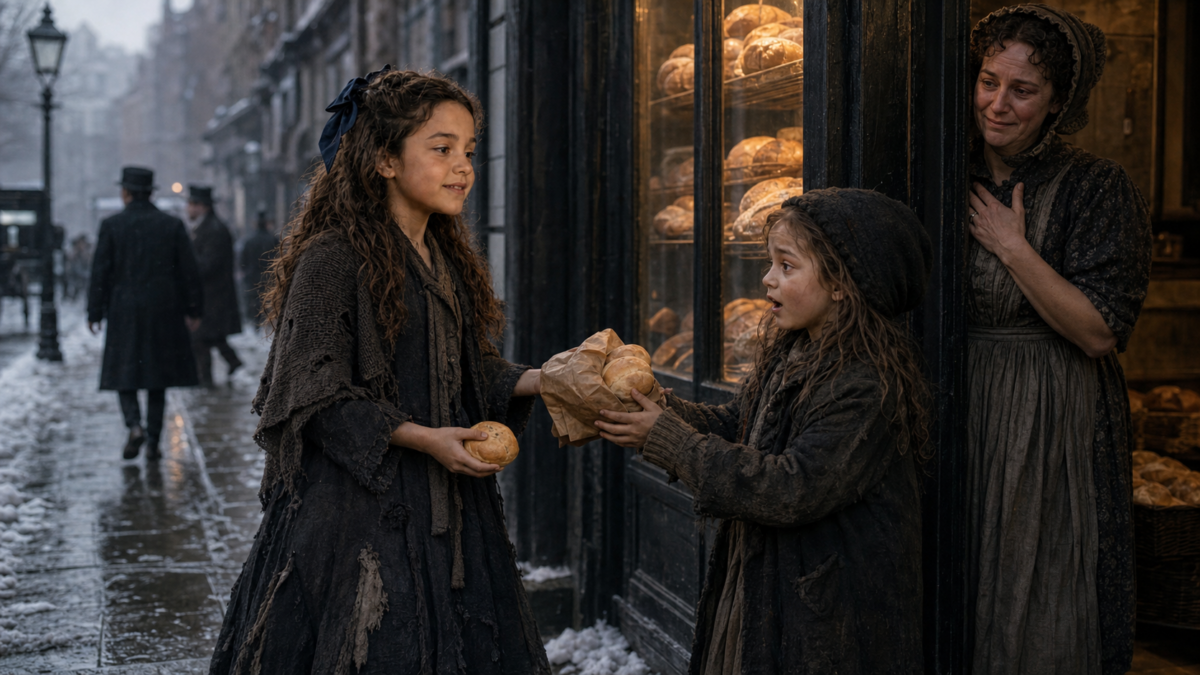
And it was a baker’s shop, and a cheerful, stout, motherly woman with rosy cheeks was putting into the window a tray of delicious newly baked hot buns.
それはパン屋だった。そして血色のよい頬をした、陽気でふくよかな母親のような女性が、焼きたての温かくおいしそうな菓子パンを載せた盆を窓に並べていた。
Fresh from the oven–large, plump, shiny buns, with currants in them.
オーブンから出たばかりの、大きく、ふっくらとして、つやつやした、干しぶどう入りの菓子パンだった。
It almost made Sara feel faint for a few seconds.
それは数秒間、サラをほとんど気が遠くなるような気持ちにさせた。
The shock, and the sight of the buns, and the delightful odors of warm bread floating up through the baker’s cellar window.
その衝撃、菓子パンの光景、そしてパン屋の地下室の窓から漂ってくる温かいパンのすばらしい香りのせいだった。
She knew she need not hesitate to use the little piece of money.
彼女は、その小さなお金を使うことをためらう必要はないとわかっていた。
It had evidently been lying in the mud for some time.
それは明らかに、しばらく泥の中に落ちていたものだった。
And its owner was completely lost in the stream of passing people who crowded and jostled each other all day long.
そしてその持ち主は、一日中互いに混み合い押し合う通行人の流れの中に、完全に消えてしまっていた。
“But I’ll go and ask the baker woman if she has lost anything,” she said to herself, rather faintly.
「でも、パン屋の女の人に何かなくしていないか聞いてみよう」と、彼女はかなり弱々しく自分に言った。
So she crossed the pavement and put her wet foot on the step.
それで彼女は歩道を渡り、濡れた足を店の段に置いた。
As she did so she saw something that made her stop.
その時、彼女は何かを見て立ち止まった。
It was a little figure more forlorn even than herself.
それは、彼女自身よりさらにみじめな小さな姿だった。
A little figure which was not much more than a bundle of rags, from which small, bare, red muddy feet peeped out.
それは、ほとんどぼろ布の束のような小さな姿で、そこから小さな、裸の、泥で赤くなった足がのぞいていた。
Only because the rags with which their owner was trying to cover them were not long enough.
足が見えていたのは、その子が足を覆おうとしているぼろ布が十分に長くなかったからだった。
Above the rags appeared a shock head of tangled hair, and a dirty face with big, hollow, hungry eyes.
ぼろ布の上には、もつれた髪のぼさぼさ頭と、大きくくぼんだ飢えた目を持つ汚れた顔が見えていた。
Sara knew they were hungry eyes the moment she saw them, and she felt a sudden sympathy.
サラはその目を見た瞬間、それが飢えた目だとわかり、突然同情を感じた。
“This,” she said to herself, with a little sigh, “is one of the populace–and she is hungrier than I am.”
「この子は」と彼女は小さくため息をつきながら自分に言った。「民衆の一人なのね。そして私よりお腹をすかせているわ」
The child–this “one of the populace”–stared up at Sara, and shuffled herself aside a little, so as to give her room to pass.
その子、この「民衆の一人」は、サラを見上げ、彼女が通れるように少し身をずらした。
She was used to being made to give room to everybody.
その子は、誰にでも場所を譲らされることに慣れていた。
She knew that if a policeman chanced to see her he would tell her to “move on.”
警官がたまたま自分を見れば、「立ち去れ」と言われることを知っていた。
Sara clutched her little fourpenny piece and hesitated for a few seconds.
サラは小さな四ペンス銀貨を握りしめ、数秒ためらった。
Then she spoke to her.
それから彼女はその子に話しかけた。
“Are you hungry?” she asked.
「お腹がすいているの?」と彼女は尋ねた。
The child shuffled herself and her rags a little more.
その子は、自分の体とぼろ布をもう少しずらした。
“Ain’t I jist?” she said in a hoarse voice.
「すいてるなんてもんじゃないよ」と彼女はしわがれ声で言った。
“Jist ain’t I?”
「本当にすいてるよ」
“Haven’t you had any dinner?” said Sara.
「夕食は食べていないの?」とサラは言った。
“No dinner,” more hoarsely still and with more shuffling.
「夕食なんてないよ」と、さらにしわがれた声で、さらに身をもぞもぞさせながら言った。
“Nor yet no bre’fast–nor yet no supper. No nothin’.”
「朝ごはんもないし、晩ごはんもない。何もないよ」
“Since when?” asked Sara.
「いつから?」とサラは尋ねた。
“Dunno. Never got nothin’ today–nowhere. I’ve axed an’ axed.”
「わかんない。今日はどこでも何ももらってない。頼んで、頼んだんだ」
Just to look at her made Sara more hungry and faint.
その子を見るだけで、サラはますます空腹になり、気が遠くなるようだった。
But those queer little thoughts were at work in her brain, and she was talking to herself, though she was sick at heart.
しかし、あの奇妙な小さな考えが彼女の頭の中で働いていて、胸が痛みながらも、彼女は自分に語りかけていた。
“If I’m a princess,” she was saying, “if I’m a princess–when they were poor and driven from their thrones–they always shared–with the populace.”
「もし私が王女なら」と彼女は言っていた。「もし私が王女なら、王女たちは貧しくなり、王座から追われた時でも、いつも民衆と分け合ったわ」
“If they met one poorer and hungrier than themselves.”
「自分たちより貧しく、お腹をすかせた人に出会ったなら」
“They always shared.”
「いつも分け合ったの」
“Buns are a penny each.”
「菓子パンは一つ一ペニー」
“If it had been sixpence I could have eaten six.”
「もし六ペンスだったら、六つ食べられたのに」
“It won’t be enough for either of us.”
「これではどちらにとっても十分ではないわ」
“But it will be better than nothing.”
「でも、何もないよりはましよ」
“Wait a minute,” she said to the beggar child.
「少し待っていて」と彼女は物乞いの子に言った。
She went into the shop.
彼女は店の中へ入った。
It was warm and smelled deliciously.
そこは暖かく、おいしそうな匂いがしていた。
The woman was just going to put some more hot buns into the window.
女の人は、ちょうどさらに温かい菓子パンを窓に並べようとしていた。
“If you please,” said Sara, “have you lost fourpence–a silver fourpence?”
「すみません」とサラは言った。「四ペンスをなくしませんでしたか。銀の四ペンスです」
And she held the forlorn little piece of money out to her.
そして彼女は、そのみすぼらしい小さなお金を女の人に差し出した。
The woman looked at it and then at her–at her intense little face and draggled, once fine clothes.
女の人はそれを見て、それからサラを見た。真剣な小さな顔と、かつては上等だったが今は雨に濡れてだらりとした服を見た。
“Bless us, no,” she answered.
「まあ、いいえ」と彼女は答えた。
“Did you find it?”
「それを拾ったの?」
“Yes,” said Sara. “In the gutter.”
「はい」とサラは言った。「側溝で」
“Keep it, then,” said the woman.
「それなら持っておきなさい」と女の人は言った。
“It may have been there for a week, and goodness knows who lost it.”
「一週間そこにあったかもしれないし、誰が落としたのかなんて神さまにしかわからないわ」
“YOU could never find out.”
「あなたには絶対に見つけられないでしょう」
“I know that,” said Sara, “but I thought I would ask you.”
「それはわかっています」とサラは言った。「でも、あなたに聞いてみようと思ったのです」
“Not many would,” said the woman, looking puzzled and interested and good-natured all at once.
「そんなことをする人は多くないわ」と女の人は、困惑し、興味を持ち、親切そうな表情を同時に浮かべて言った。
“Do you want to buy something?” she added, as she saw Sara glance at the buns.
「何か買いたいの?」と、サラが菓子パンをちらりと見たのを見て、彼女は付け加えた。
“Four buns, if you please,” said Sara.
「菓子パンを四つお願いします」とサラは言った。
“Those at a penny each.”
「一つ一ペニーのものを」
The woman went to the window and put some in a paper bag.
女の人は窓辺へ行き、いくつかを紙袋に入れた。
Sara noticed that she put in six.
サラは、彼女が六つ入れたことに気づいた。
“I said four, if you please,” she explained.
「四つと言ったのですが」と彼女は説明した。
“I have only fourpence.”
「私は四ペンスしか持っていません」
“I’ll throw in two for makeweight,” said the woman with her good-natured look.
「二つはおまけに入れておくわ」と女の人は親切そうな表情で言った。
“I dare say you can eat them sometime. Aren’t you hungry?”
「きっといつか食べられるでしょう。お腹がすいているんじゃないの?」
A mist rose before Sara’s eyes.
サラの目の前に涙の霧が立ちこめた。
“Yes,” she answered.
「はい」と彼女は答えた。
“I am very hungry, and I am much obliged to you for your kindness.”
「とてもお腹がすいています。そして、ご親切に本当に感謝しています」
And–she was going to add–“there is a child outside who is hungrier than I am.”
そして、「外に、私よりお腹をすかせた子がいるのです」と言いかけた。
But just at that moment two or three customers came in at once, and each one seemed in a hurry.
しかしちょうどその時、二、三人の客が一度に入ってきて、みんな急いでいるようだった。
So she could only thank the woman again and go out.
そのため、彼女はもう一度女の人に礼を言い、外へ出ることしかできなかった。
The beggar girl was still huddled up in the corner of the step.
物乞いの少女は、まだ階段の隅にうずくまっていた。
She looked frightful in her wet and dirty rags.
濡れて汚れたぼろ布をまとった彼女は、ひどい姿に見えた。
She was staring straight before her with a stupid look of suffering.
彼女は苦しみでぼんやりした表情を浮かべ、まっすぐ前を見つめていた。
And Sara saw her suddenly draw the back of her roughened black hand across her eyes to rub away the tears.
そしてサラは、彼女が突然、荒れた黒い手の甲を目に当てて涙をぬぐうのを見た。
Which seemed to have surprised her by forcing their way from under her lids.
その涙は、まぶたの下から無理やり流れ出て、彼女自身を驚かせたようだった。
She was muttering to herself.
彼女は自分に向かってぶつぶつ言っていた。
Sara opened the paper bag and took out one of the hot buns, which had already warmed her own cold hands a little.
サラは紙袋を開け、温かい菓子パンを一つ取り出した。それはすでに彼女の冷たい手を少し暖めていた。
“See,” she said, putting the bun in the ragged lap, “this is nice and hot.”
「見て」と彼女は言い、その菓子パンをぼろぼろの膝の上に置いた。「これは温かくておいしいわ」
“Eat it, and you will not feel so hungry.”
「食べなさい。そうすれば、そんなにお腹がすいている感じはしなくなるわ」
The child started and stared up at her, as if such sudden, amazing good luck almost frightened her.
その子はびくっとしてサラを見上げた。突然の驚くべき幸運に、ほとんど怖がっているようだった。
Then she snatched up the bun and began to cram it into her mouth with great wolfish bites.
それから彼女は菓子パンをひったくり、狼のように大きくかぶりついて、口に詰め込み始めた。
“Oh, my! Oh, my!” Sara heard her say hoarsely, in wild delight.
「ああ、まあ! ああ、まあ!」と、彼女が荒々しい喜びの中でしわがれ声で言うのをサラは聞いた。
“OH my!”
「ああ、まあ!」
Sara took out three more buns and put them down.
サラはさらに三つの菓子パンを取り出し、置いた。
The sound in the hoarse, ravenous voice was awful.
そのしわがれた飢えきった声にこもる響きは、恐ろしいものだった。
“She is hungrier than I am,” she said to herself.
「この子は私よりお腹をすかせている」とサラは自分に言った。
“She’s starving.”
「この子は飢えているのだわ」
But her hand trembled when she put down the fourth bun.
しかし、四つ目の菓子パンを置く時、彼女の手は震えた。
“I’m not starving,” she said–and she put down the fifth.
「私は飢えてはいないわ」と彼女は言った。そして五つ目を置いた。
The little ravening London savage was still snatching and devouring when she turned away.
彼女が立ち去る時、小さなむさぼるようなロンドンの野生児は、まだひったくって食べ続けていた。
She was too ravenous to give any thanks, even if she had ever been taught politeness–which she had not.
彼女はあまりにも飢えていて、たとえ礼儀を教わったことがあったとしても、お礼を言うことはできなかっただろう。もっとも、彼女は礼儀など教わっていなかった。
She was only a poor little wild animal.
彼女はただの、かわいそうな小さな野生の動物だった。
“Good-bye,” said Sara.
「さようなら」とサラは言った。
When she reached the other side of the street she looked back.
通りの反対側に着くと、彼女は振り返った。
The child had a bun in each hand and had stopped in the middle of a bite to watch her.
その子は両手に一つずつ菓子パンを持ち、ひと口かじる途中で止まり、彼女を見ていた。
Sara gave her a little nod.
サラはその子に小さくうなずいた。
And the child, after another stare–a curious lingering stare–jerked her shaggy head in response.
するとその子は、もう一度じっと見つめた後、奇妙に長く残る視線を向けてから、ぼさぼさの頭をぴくりと動かして応えた。
And until Sara was out of sight she did not take another bite or even finish the one she had begun.
そしてサラが見えなくなるまで、彼女はもうひと口も食べず、かじりかけのものを食べ終えることさえしなかった。
At that moment the baker-woman looked out of her shop window.
その時、パン屋の女の人が店の窓から外をのぞいた。
“Well, I never!” she exclaimed.
「まあ、なんてこと!」と彼女は叫んだ。
“If that young un hasn’t given her buns to a beggar child!”
「あの子、自分の菓子パンを物乞いの子にあげているじゃないの!」
“It wasn’t because she didn’t want them, either.”
「しかも、自分が欲しくなかったからじゃないわ」
“Well, well, she looked hungry enough.”
「まあまあ、あの子だって十分お腹がすいているように見えたのに」
“I’d give something to know what she did it for.”
「どうしてそんなことをしたのか、ぜひ知りたいものだわ」
She stood behind her window for a few moments and pondered.
彼女はしばらく窓の後ろに立ち、じっと考えた。
Then her curiosity got the better of her.
それから好奇心が彼女に勝った。
She went to the door and spoke to the beggar child.
彼女はドアへ行き、物乞いの子に話しかけた。
“Who gave you those buns?” she asked her.
「その菓子パンは誰がくれたの?」と彼女は尋ねた。
The child nodded her head toward Sara’s vanishing figure.
その子は、消えていくサラの姿の方へ頭をうなずかせた。
“What did she say?” inquired the woman.
「あの子は何と言ったの?」と女の人は尋ねた。
“Axed me if I was ‘ungry,” replied the hoarse voice.
「腹がへってるかって聞いた」と、しわがれ声が答えた。
“What did you say?”
「あなたは何て答えたの?」
“Said I was jist.”
「本当にへってるって言った」
“And then she came in and got the buns, and gave them to you, did she?”
「それであの子は中へ入って菓子パンを買って、あなたにくれたのね?」
The child nodded.
その子はうなずいた。
“How many?”
「いくつ?」
“Five.”
「五つ」
The woman thought it over.
女の人はそれについて考えた。
“Left just one for herself,” she said in a low voice.
「自分には一つだけ残したのね」と彼女は低い声で言った。
“And she could have eaten the whole six–I saw it in her eyes.”
「あの子なら六つ全部食べられたはずなのに。目を見ればわかったわ」
She looked after the little draggled far-away figure and felt more disturbed in her usually comfortable mind than she had felt for many a day.
彼女は濡れてだらしなく遠ざかっていく小さな姿を見送り、いつもは落ち着いている心が、ここ何日も感じたことがないほど揺さぶられるのを感じた。
“I wish she hadn’t gone so quick,” she said.
「あんなに早く行ってしまわなければよかったのに」と彼女は言った。
“I’m blest if she shouldn’t have had a dozen.”
「あの子には一ダースあげるべきだったわ」
Then she turned to the child.
それから彼女はその子の方を向いた。
“Are you hungry yet?” she said.
「まだお腹がすいている?」と彼女は言った。
“I’m allus hungry,” was the answer, “but ‘t ain’t as bad as it was.”
「いつも腹はへってるよ」と答えた。「でもさっきほどひどくはない」
“Come in here,” said the woman, and she held open the shop door.
「ここへ入りなさい」と女の人は言い、店のドアを開けておいた。
The child got up and shuffled in.
その子は立ち上がり、足を引きずるように中へ入った。
To be invited into a warm place full of bread seemed an incredible thing.
パンでいっぱいの暖かい場所へ招き入れられることは、信じられないことのように思えた。
She did not know what was going to happen.
彼女には何が起こるのかわからなかった。
She did not care, even.
気にしてさえいなかった。
“Get yourself warm,” said the woman, pointing to a fire in the tiny back room.
「体を暖めなさい」と女の人は、小さな奥の部屋の火を指さして言った。
“And look here; when you are hard up for a bit of bread, you can come in here and ask for it.”
「それから、いいこと。パンの一切れにも困る時は、ここへ来て頼めばいいわ」
“I’m blest if I won’t give it to you for that young one’s sake.”
「あの子のために、私はあなたにパンをあげずにはいられないわ」
Sara found some comfort in her remaining bun.
サラは残った一つの菓子パンに、いくらかの慰めを見いだした。
At all events, it was very hot, and it was better than nothing.
ともかく、それはとても温かく、何もないよりはましだった。
As she walked along she broke off small pieces and ate them slowly to make them last longer.
歩きながら彼女は小さくちぎり、長くもたせるためにゆっくり食べた。
“Suppose it was a magic bun,” she said, “and a bite was as much as a whole dinner.”
「もしこれが魔法の菓子パンだったら」と彼女は言った。「ひと口が夕食一回分と同じくらいだったら」
“I should be overeating myself if I went on like this.”
「こんなふうに食べ続けたら、私は食べ過ぎになってしまうわ」
It was dark when she reached the square where the Select Seminary was situated.
寄宿学校のある広場に着いた時には、あたりは暗くなっていた。
The lights in the houses were all lighted.
家々の明かりはすべて灯っていた。
The blinds were not yet drawn in the windows of the room where she nearly always caught glimpses of members of the Large Family.
彼女がいつも大きな家族の人々をちらりと見る部屋の窓では、まだブラインドが下ろされていなかった。
Frequently at this hour she could see the gentleman she called Mr. Montmorency sitting in a big chair.
この時間にはしばしば、彼女がモンモレンシー氏と呼んでいる紳士が、大きな椅子に座っているのを見ることができた。
With a small swarm round him, talking, laughing, perching on the arms of his seat or on his knees or leaning against them.
彼の周りには小さな群れがいて、話したり笑ったり、椅子の肘掛けや膝の上に座ったり、それにもたれたりしていた。
This evening the swarm was about him, but he was not seated.
この夕方も、その群れは彼の周りにいたが、彼は座っていなかった。
On the contrary, there was a good deal of excitement going on.
それどころか、かなりの興奮が起こっていた。
It was evident that a journey was to be taken, and it was Mr. Montmorency who was to take it.
旅に出ることは明らかで、その旅をするのはモンモレンシー氏だった。
A brougham stood before the door, and a big portmanteau had been strapped upon it.
玄関の前には一台の馬車が止まっており、その上には大きな旅行かばんが縛りつけられていた。
The children were dancing about, chattering and hanging on to their father.
子どもたちは踊るように動き回り、おしゃべりをし、父親にまとわりついていた。
The pretty rosy mother was standing near him, talking as if she was asking final questions.
血色のよい美しい母親は彼の近くに立ち、最後の質問をしているかのように話していた。
Sara paused a moment to see the little ones lifted up and kissed and the bigger ones bent over and kissed also.
サラはしばらく立ち止まり、小さな子どもたちが抱き上げられてキスされ、大きな子どもたちも身をかがめてもらってキスされるのを見た。
“I wonder if he will stay away long,” she thought.
「あの方は長く留守にするのかしら」と彼女は思った。
“The portmanteau is rather big.”
「旅行かばんがかなり大きいわ」
“Oh, dear, how they will miss him!”
「ああ、みんなはどんなにあの方を恋しく思うことかしら!」
“I shall miss him myself–even though he doesn’t know I am alive.”
「私自身も寂しく思うでしょう。あの方は私が生きていることさえ知らないけれど」
When the door opened she moved away–remembering the sixpence.
ドアが開くと、彼女は六ペンスのことを思い出して、そこから離れた。
But she saw the traveler come out and stand against the background of the warmly-lighted hall, the older children still hovering about him.
しかし彼女は、旅人が出てきて、暖かく灯された玄関ホールを背景に立ち、年上の子どもたちがまだ彼の周りにいるのを見た。
“Will Moscow be covered with snow?” said the little girl Janet.
「モスクワは雪で覆われているの?」と小さなジャネットが言った。
“Will there be ice everywhere?”
「どこも氷だらけなの?」
“Shall you drive in a drosky?” cried another.
「ドロシュキーに乗るの?」と別の子が叫んだ。
“Shall you see the Czar?”
「皇帝に会うの?」
“I will write and tell you all about it,” he answered, laughing.
「手紙を書いて、全部教えてあげるよ」と彼は笑いながら答えた。
“And I will send you pictures of muzhiks and things.”
「それに、ロシア農民などの絵も送ってあげよう」
“Run into the house. It is a hideous damp night.”
「家の中へ入りなさい。今夜はひどく湿っているから」
“I would rather stay with you than go to Moscow.”
「モスクワへ行くより、君たちと一緒にいたいくらいだよ」
“Good night! Good night, duckies! God bless you!”
「おやすみ! おやすみ、かわいい子たち! 神さまの祝福がありますように!」
And he ran down the steps and jumped into the brougham.
そして彼は階段を駆け下り、馬車に飛び乗った。
“If you find the little girl, give her our love,” shouted Guy Clarence, jumping up and down on the door mat.
「その小さな女の子を見つけたら、僕たちの愛を伝えてね」と、ガイ・クラレンスは玄関マットの上で飛び跳ねながら叫んだ。
Then they went in and shut the door.
それから彼らは中へ入り、ドアを閉めた。
“Did you see,” said Janet to Nora, as they went back to the room–“the little-girl-who-is-not-a-beggar was passing?”
「見た?」とジャネットは部屋へ戻りながらノラに言った。「物乞いではない小さな女の子が通っていたわ」
“She looked all cold and wet, and I saw her turn her head over her shoulder and look at us.”
「あの子はすっかり寒そうで濡れていて、肩越しに振り返って私たちを見るのを見たわ」
“Mamma says her clothes always look as if they had been given her by someone who was quite rich.”
「ママは、あの子の服はいつも、とても裕福な誰かからもらったものみたいに見えるって言っているわ」
“Someone who only let her have them because they were too shabby to wear.”
「着るにはあまりにみすぼらしくなったから、あの子にあげただけの誰かからね」
“The people at the school always send her out on errands on the horridest days and nights there are.”
「学校の人たちは、いつもいちばんひどい昼や夜に、あの子を使いに出すのよ」
Sara crossed the square to Miss Minchin’s area steps, feeling faint and shaky.
サラは気が遠くなり、震えるような思いで、広場を横切ってミンチン先生の家の地下階段へ向かった。
“I wonder who the little girl is,” she thought–“the little girl he is going to look for.”
「その小さな女の子って誰なのかしら」と彼女は思った。「あの方が探しに行く小さな女の子って」
And she went down the area steps, lugging her basket and finding it very heavy indeed.
そして彼女は地下階段を下りていった。かごを重そうに引きずりながら、それが本当にとても重いと感じていた。
As the father of the Large Family drove quickly on his way to the station to take the train which was to carry him to Moscow.
その頃、大きな家族の父親は、モスクワへ向かう列車に乗るため、駅へ向かって馬車で急いでいた。
Where he was to make his best efforts to search for the lost little daughter of Captain Crewe.
そこで彼は、クルー大尉の行方不明の小さな娘を探すために、できる限りの努力をすることになっていた。