
CHAPTER XII のポイント
第12章では、セーラの屋根裏部屋のすぐ向こう側にある隣家の様子が、よりはっきり描かれていきます。病身の紳士とラムダスたちの暮らし、そしてセーラの部屋との近さが、物語の中で重要な意味を持ち始めます。
この章の読みどころは、壁一枚を隔てた二つの世界の対比です。片方には暖かさや食べ物があり、もう片方には寒さと空腹があります。しかしその距離の近さこそが、セーラの運命を少しずつ動かしていく伏線になっています。
この章の英語学習ポイントを開く
- wall:壁。セーラの屋根裏部屋と隣家を隔てる、物語上重要な境界を示す語。
- comfort:快適さ、慰め。隣家の暖かさとセーラの貧しさを対比するうえで大切な語。
- contrast:対比、違い。二つの生活空間の差を読むために役立つ語。
- misery:みじめさ、苦しみ。セーラの現在の境遇を表す感情の強い語。
- secretly:ひそかに、こっそりと。隣家とのつながりが静かに進んでいく雰囲気を表す語。
12 The Other Side of the Wall
『A Little Princess』第12章「The Other Side of the Wall」を、英語多読用に読みやすく整えています。形容詞・副詞・熟語・心理描写・場面描写を中心に、やや多めに色分けしています。
When one lives in a row of houses, it is interesting to think of the things which are being done and said on the other side of the wall of the very rooms one is living in.
長屋のように家が並んでいる場所に住んでいると、自分が暮らしている部屋のまさに壁の向こう側で、どんなことが行われ、どんなことが話されているのかを考えるのは面白いものだ。
Sara was fond of amusing herself by trying to imagine the things hidden by the wall which divided the Select Seminary from the Indian gentleman’s house.
サラは、寄宿学校とインドの紳士の家を隔てる壁の向こうに隠れているものを想像して、自分を楽しませるのが好きだった。
She knew that the schoolroom was next to the Indian gentleman’s study, and she hoped that the wall was thick so that the noise made sometimes after lesson hours would not disturb him.
教室がインドの紳士の書斎の隣にあることを彼女は知っていた。そして授業の後に時々立つ騒音が彼の邪魔をしないよう、壁が厚ければよいと思っていた。
“I am growing quite fond of him,” she said to Ermengarde; “I should not like him to be disturbed.”
「私はあの方のことがかなり好きになってきたの」と彼女はアーメンガードに言った。「邪魔されたらいやだわ」
“I have adopted him for a friend.”
「私はあの方を友だちとして心の中で引き取ったの」
“You can do that with people you never speak to at all.”
「一度も話したことのない人に対しても、そういうことはできるのよ」
“You can just watch them, and think about them and be sorry for them, until they seem almost like relations.”
「ただその人を見て、その人のことを考え、その人を気の毒に思っているうちに、ほとんど親戚のように思えてくるの」
“I’m quite anxious sometimes when I see the doctor call twice a day.”
「お医者さまが一日に二度も訪ねてくるのを見ると、時々とても心配になるの」
“I have very few relations,” said Ermengarde, reflectively, “and I’m very glad of it.”
「私には親戚がとても少ないの」とアーメンガードは考え込むように言った。「そして、そのことをとてもありがたく思っているわ」
“I don’t like those I have.”
「いる親戚のことは好きじゃないの」
“My two aunts are always saying, ‘Dear me, Ermengarde! You are very fat. You shouldn’t eat sweets.'”
「二人のおばはいつも、『まあ、アーメンガード! あなたはとても太っているわ。甘いものを食べてはいけません』と言うの」
“And my uncle is always asking me things like, ‘When did Edward the Third ascend the throne?’ and, ‘Who died of a surfeit of lampreys?'”
「それに叔父はいつも、『エドワード三世が王位についたのはいつか』とか、『ヤツメウナギを食べすぎて死んだのは誰か』みたいなことを聞くの」
Sara laughed.
サラは笑った。
“People you never speak to can’t ask you questions like that,” she said.
「一度も話さない人なら、そんな質問はしてこないわ」と彼女は言った。
“And I’m sure the Indian gentleman wouldn’t even if he was quite intimate with you.”
「それに、たとえあのインドの紳士があなたととても親しくなっても、そんなことは絶対に聞かないと思うわ」
“I am fond of him.”
「私はあの方が好きなの」
She had become fond of the Large Family because they looked happy; but she had become fond of the Indian gentleman because he looked unhappy.
彼女が大きな家族を好きになったのは、彼らが幸せそうに見えたからだった。しかしインドの紳士を好きになったのは、彼が不幸そうに見えたからだった。
He had evidently not fully recovered from some very severe illness.
彼は明らかに、何か非常に重い病気から完全には回復していなかった。
In the kitchen–where, of course, the servants, through some mysterious means, knew everything–there was much discussion of his case.
台所では、もちろん使用人たちが何か不思議な手段ですべてを知っている場所だが、彼の事情について多くの話が交わされていた。
He was not an Indian gentleman really, but an Englishman who had lived in India.
彼は本当はインド人の紳士ではなく、インドに住んでいたイギリス人だった。
He had met with great misfortunes which had for a time so imperilled his whole fortune that he had thought himself ruined and disgraced forever.
彼は大きな不運に見舞われ、一時は全財産が危険にさらされたため、自分は永遠に破滅し、不名誉を受けたのだと思った。
The shock had been so great that he had almost died of brain fever.
その衝撃はあまりにも大きく、彼は脳炎でほとんど死にかけた。
And ever since he had been shattered in health, though his fortunes had changed and all his possessions had been restored to him.
それ以来、財産状況は変わり、すべての所有物が戻ってきたにもかかわらず、彼の健康は打ち砕かれたままだった。
His trouble and peril had been connected with mines.
彼の苦しみと危機は、鉱山に関係していた。
“And mines with diamonds in ‘em!” said the cook.
「しかもダイヤモンドの入った鉱山だってさ!」と料理人は言った。
“No savin’s of mine never goes into no mines–particular diamond ones”–with a side glance at Sara.
「私の貯金なんか、絶対に鉱山には入れないよ。特にダイヤモンド鉱山なんかにはね」――そう言って、彼女はサラを横目で見た。
“We all know somethin’ of THEM.”
「それがどういうものか、私たちはみんな少しは知ってるからね」
“He felt as my papa felt,” Sara thought.
「あの方は、私のパパが感じたのと同じように感じたのだわ」とサラは思った。
“He was ill as my papa was; but he did not die.”
「彼は私のパパと同じように病気になった。でも、死ななかったのね」
So her heart was more drawn to him than before.
そのため、彼女の心はいっそう彼に引き寄せられた。
When she was sent out at night she used sometimes to feel quite glad, because there was always a chance that the curtains of the house next door might not yet be closed.
夜に使いに出されると、彼女は時々とても嬉しく感じた。隣の家のカーテンがまだ閉まっていない可能性がいつもあったからだ。
And she could look into the warm room and see her adopted friend.
そして暖かそうな部屋をのぞき込み、心の中で友だちにしたその人を見ることができたからだった。
When no one was about she used sometimes to stop, and, holding to the iron railings, wish him good night as if he could hear her.
誰もいない時、彼女は時々立ち止まり、鉄の柵につかまって、まるで彼に聞こえるかのように「おやすみなさい」と心の中で言うのだった。
“Perhaps you can FEEL if you can’t hear,” was her fancy.
「聞こえなくても、感じることはできるかもしれないわ」と彼女は空想した。
“Perhaps kind thoughts reach people somehow, even through windows and doors and walls.”
「親切な思いは、窓や扉や壁を通ってでも、何らかの形で人に届くのかもしれない」
“Perhaps you feel a little warm and comforted, and don’t know why, when I am standing here in the cold and hoping you will get well and happy again.”
「私がここで寒さの中に立ち、あなたが元気になってまた幸せになりますようにと願っている時、あなたは理由もわからず少し暖かく慰められた気持ちになるのかもしれない」
“I am so sorry for you,” she would whisper in an intense little voice.
「あなたが本当にお気の毒です」と彼女は強い感情のこもった小さな声でささやくのだった。
“I wish you had a ‘Little Missus’ who could pet you as I used to pet papa when he had a headache.”
「あなたにも、パパが頭痛の時に私がしてあげたように、かわいがってくれる『リトル・ミサス』がいたらいいのに」
“I should like to be your ‘Little Missus’ myself, poor dear!”
「かわいそうなあなたの『リトル・ミサス』に、私自身がなってあげたいくらいだわ!」
“Good night–good night. God bless you!”
「おやすみなさい。おやすみなさい。神さまがあなたを祝福してくださいますように!」
She would go away, feeling quite comforted and a little warmer herself.
そうすると彼女は、自分自身もかなり慰められ、少し暖かくなったように感じながら立ち去るのだった。
Her sympathy was so strong that it seemed as if it MUST reach him somehow as he sat alone in his armchair by the fire.
彼女の同情はとても強かったので、暖炉のそばの肘掛け椅子に一人で座っている彼に、何らかの形で必ず届くに違いないように思えた。
Nearly always in a great dressing gown, and nearly always with his forehead resting in his hand as he gazed hopelessly into the fire.
彼はほとんどいつも大きなガウンを着ており、ほとんどいつも額を手に預け、絶望したように火を見つめていた。
He looked to Sara like a man who had a trouble on his mind still, not merely like one whose troubles lay all in the past.
サラには彼が、苦しみがすべて過去にある人ではなく、今なお心に悩みを抱えている人のように見えた。
“He always seems as if he were thinking of something that hurts him NOW,” she said to herself.
「あの方はいつも、今も自分を苦しめている何かを考えているように見える」と彼女は自分に言った。
“But he has got his money back and he will get over his brain fever in time, so he ought not to look like that.”
「でも、お金は戻ってきたし、脳炎もそのうち治るはずなのだから、あんな顔をしているはずはないのに」
“I wonder if there is something else.”
「ほかに何かあるのかしら」
If there was something else–something even servants did not hear of–she could not help believing that the father of the Large Family knew it.
もしほかに何かあるなら、使用人たちでさえ聞いていない何かがあるなら、大きな家族の父親はそれを知っているに違いないと、彼女は思わずにはいられなかった。
The gentleman she called Mr. Montmorency.
彼女がモンモレンシー氏と呼んでいる紳士である。
Mr. Montmorency went to see him often, and Mrs. Montmorency and all the little Montmorencys went, too, though less often.
モンモレンシー氏はよく彼を訪ね、モンモレンシー夫人や小さなモンモレンシーたちも、それほど頻繁ではないが訪ねていた。
He seemed particularly fond of the two elder little girls–the Janet and Nora who had been so alarmed when their small brother Donald had given Sara his sixpence.
彼は特に年上の二人の女の子をかわいがっているようだった。弟のドナルドがサラに六ペンスをあげた時、とても心配していたジャネットとノラである。
He had, in fact, a very tender place in his heart for all children, and particularly for little girls.
実際、彼の心の中にはすべての子どもたち、特に小さな女の子たちに対する、とても優しい部分があった。
Janet and Nora were as fond of him as he was of them, and looked forward with the greatest pleasure to the afternoons when they were allowed to cross the square.
ジャネットとノラも、彼が彼女たちを好きなのと同じくらい彼のことが好きで、広場を渡ることを許される午後を、最大の楽しみとして待ち望んでいた。
And make their well-behaved little visits to him.
そして、彼のもとへ行儀のよい小さな訪問をするのだった。
They were extremely decorous little visits because he was an invalid.
彼は病人だったので、それは非常に礼儀正しい小さな訪問だった。
“He is a poor thing,” said Janet, “and he says we cheer him up.”
「あの方はかわいそうなの」とジャネットは言った。「それに、私たちが元気づけているって言ってくれるの」
“We try to cheer him up very quietly.”
「私たちは、とても静かにあの方を元気づけようとしているの」
Janet was the head of the family, and kept the rest of it in order.
ジャネットはその家族のまとめ役で、ほかの子どもたちをきちんと従わせていた。
It was she who decided when it was discreet to ask the Indian gentleman to tell stories about India.
インドの紳士にインドの話をしてほしいと頼んでもよい時を判断するのは、彼女だった。
And it was she who saw when he was tired and it was the time to steal quietly away and tell Ram Dass to go to him.
そして、彼が疲れたことに気づき、そっと立ち去ってラム・ダスに彼のところへ行くよう伝える時間だと判断するのも、彼女だった。
They were very fond of Ram Dass.
彼女たちはラム・ダスのことがとても好きだった。
He could have told any number of stories if he had been able to speak anything but Hindustani.
もし彼がヒンドゥスターニー語以外の言葉を話せたなら、いくらでも物語を語れたことだろう。
The Indian gentleman’s real name was Mr. Carrisford, and Janet told Mr. Carrisford about the encounter with the little-girl-who-was-not-a-beggar.
インドの紳士の本当の名前はカリスフォード氏で、ジャネットはカリスフォード氏に、「物乞いではない小さな女の子」と出会った話をした。
He was very much interested, and all the more so when he heard from Ram Dass of the adventure of the monkey on the roof.
彼は非常に興味を持った。そしてラム・ダスから屋根の上での猿の冒険について聞くと、さらにいっそう興味を持った。
Ram Dass made for him a very clear picture of the attic and its desolateness.
ラム・ダスは彼に、屋根裏部屋とその荒涼とした様子を非常にはっきり描いて聞かせた。
Of the bare floor and broken plaster, the rusty, empty grate, and the hard, narrow bed.
むき出しの床、壊れたしっくい、錆びた空の暖炉格子、硬く狭いベッドについてである。
“Carmichael,” he said to the father of the Large Family, after he had heard this description, “I wonder how many of the attics in this square are like that one.”
その描写を聞いた後、彼は大きな家族の父親に言った。「カーマイケル、この広場の屋根裏部屋のうち、あの部屋のようなものがどれほどあるのだろう」
“And how many wretched little servant girls sleep on such beds, while I toss on my down pillows, loaded and harassed by wealth that is, most of it–not mine.”
「そして、どれほど多くのみじめな小さな女中たちが、あんなベッドで眠っているのだろう。私は羽毛の枕の上で寝返りを打ちながら、その大部分が自分のものではない富に押しつぶされ、苦しめられているというのに」
“My dear fellow,” Mr. Carmichael answered cheerily, “the sooner you cease tormenting yourself the better it will be for you.”
「君」とカーマイケル氏は陽気に答えた。「自分を苦しめるのをやめるのが早ければ早いほど、君のためになるよ」
“If you possessed all the wealth of all the Indies, you could not set right all the discomforts in the world.”
「たとえ君がインド全土の富をすべて持っていたとしても、世界中の不幸をすべて正すことはできない」
“And if you began to refurnish all the attics in this square, there would still remain all the attics in all the other squares and streets to put in order.”
「そして、この広場の屋根裏部屋をすべて整え始めたとしても、ほかのすべての広場や通りにある屋根裏部屋が、まだ整えられずに残ることになる」
“And there you are!”
「つまり、そういうことなんだよ!」
Mr. Carrisford sat and bit his nails as he looked into the glowing bed of coals in the grate.
カリスフォード氏は座ったまま、暖炉格子の中で赤く燃える炭床を見つめながら爪を噛んだ。
“Do you suppose,” he said slowly, after a pause–“do you think it is possible that the other child–the child I never cease thinking of, I believe–could be–could POSSIBLY be reduced to any such condition as the poor little soul next door?”
「君は思うかね」と彼はしばらく黙った後、ゆっくりと言った。「私が考えずにはいられない、あのもう一人の子どもが、隣のかわいそうな小さな魂のような境遇にまで落ちている可能性が、あると思うかね」
Mr. Carmichael looked at him uneasily.
カーマイケル氏は不安そうに彼を見た。
He knew that the worst thing the man could do for himself, for his reason and his health, was to begin to think in the particular way of this particular subject.
彼は、この男が自分自身のためにも、理性のためにも、健康のためにも、最もしてはいけないことが、この特定の問題について特定の考え方で考え始めることだと知っていた。
“If the child at Madame Pascal’s school in Paris was the one you are in search of,” he answered soothingly, “she would seem to be in the hands of people who can afford to take care of her.”
「もしパリのマダム・パスカルの学校にいた子どもが、君の探している子だったのなら」と彼はなだめるように答えた。「その子は、面倒を見る余裕のある人々の手に渡ったように思える」
“They adopted her because she had been the favorite companion of their little daughter who died.”
「彼らがその子を養女にしたのは、亡くなった小さな娘のお気に入りの遊び相手だったからだ」
“They had no other children, and Madame Pascal said that they were extremely well-to-do Russians.”
「彼らにはほかに子どもがいなかったし、マダム・パスカルは、彼らが非常に裕福なロシア人だと言っていた」
“And the wretched woman actually did not know where they had taken her!” exclaimed Mr. Carrisford.
「それなのに、あのひどい女は、その子がどこへ連れて行かれたのか本当に知らなかったのだ!」とカリスフォード氏は叫んだ。
Mr. Carmichael shrugged his shoulders.
カーマイケル氏は肩をすくめた。
“She was a shrewd, worldly Frenchwoman, and was evidently only too glad to get the child so comfortably off her hands when the father’s death left her totally unprovided for.”
「彼女は抜け目なく世俗的なフランス人女性だった。父親の死によって、その子のための費用がまったくなくなった時、都合よく手放せたことを明らかに喜んでいたのだろう」
“Women of her type do not trouble themselves about the futures of children who might prove burdens.”
「彼女のようなタイプの女性は、重荷になるかもしれない子どもたちの将来を気にしたりはしない」
“The adopted parents apparently disappeared and left no trace.”
「養父母はどうやら姿を消し、何の手がかりも残さなかったようだ」
“But you say ‘IF the child was the one I am in search of. You say ‘if.'”
「しかし君は『もしその子が私の探している子なら』と言う。『もし』と言うのだ」
“We are not sure. There was a difference in the name.”
「確かではない。名前に違いがあった」
“Madame Pascal pronounced it as if it were Carew instead of Crewe–but that might be merely a matter of pronunciation.”
「マダム・パスカルはそれをクルーではなくケアリューのように発音した。しかし、それは単に発音の問題かもしれない」
“The circumstances were curiously similar.”
「状況は奇妙なほどよく似ていた」
“An English officer in India had placed his motherless little girl at the school.”
「インドにいたイギリス人将校が、母親のいない小さな娘をその学校に預けた」
“He had died suddenly after losing his fortune.”
「その父親は財産を失った後、突然死んだ」
Mr. Carmichael paused a moment, as if a new thought had occurred to him.
カーマイケル氏は、何か新しい考えが浮かんだかのように、しばらく言葉を止めた。
“Are you SURE the child was left at a school in Paris? Are you sure it was Paris?”
「その子がパリの学校に預けられたというのは、本当に確かなのか。パリだったと確信しているのか」
“My dear fellow,” broke forth Carrisford, with restless bitterness, “I am SURE of nothing.”
「君」とカリスフォードは落ち着かない苦々しさで口を開いた。「私は何一つ確信していない」
“I never saw either the child or her mother.”
「私はその子どもにも、その母親にも会ったことがない」
“Ralph Crewe and I loved each other as boys, but we had not met since our school days, until we met in India.”
「ラルフ・クルーと私は少年時代に互いを大切に思っていたが、学校時代以来、インドで再会するまで会っていなかった」
“I was absorbed in the magnificent promise of the mines.”
「私は鉱山の壮大な見込みに夢中になっていた」
“He became absorbed, too.”
「彼もまた夢中になった」
“The whole thing was so huge and glittering that we half lost our heads.”
「その事業全体があまりにも巨大で輝かしかったため、私たちは半ば正気を失っていた」
“When we met we scarcely spoke of anything else.”
「会えば、ほとんどそれ以外のことは話さなかった」
“I only knew that the child had been sent to school somewhere.”
「私が知っていたのは、その子がどこかの学校へ送られたということだけだった」
“I do not even remember, now, HOW I knew it.”
「今となっては、それをどうやって知ったのかさえ覚えていない」
He was beginning to be excited.
彼は興奮し始めていた。
He always became excited when his still weakened brain was stirred by memories of the catastrophes of the past.
まだ弱ったままの頭が、過去の破局の記憶によってかき乱されると、彼はいつも興奮するのだった。
Mr. Carmichael watched him anxiously.
カーマイケル氏は心配そうに彼を見守った。
It was necessary to ask some questions, but they must be put quietly and with caution.
いくつか質問をする必要はあったが、それは静かに、慎重に行わなければならなかった。
“But you had reason to think the school WAS in Paris?”
「しかし、その学校がパリにあったと思う理由はあったのだね」
“Yes,” was the answer, “because her mother was a Frenchwoman, and I had heard that she wished her child to be educated in Paris.”
「あった」と彼は答えた。「彼女の母親がフランス人で、その子をパリで教育したがっていると聞いていたからだ」
“It seemed only likely that she would be there.”
「そこにいる可能性が高いと思えた」
“Yes,” Mr. Carmichael said, “it seems more than probable.”
「そうだね」とカーマイケル氏は言った。「それは十分ありそうに思える」
The Indian gentleman leaned forward and struck the table with a long, wasted hand.
インドの紳士は身を乗り出し、長く痩せ衰えた手でテーブルを打った。
“Carmichael,” he said, “I MUST find her.”
「カーマイケル」と彼は言った。「私はその子を見つけなければならない」
“If she is alive, she is somewhere.”
「もし生きているなら、どこかにいるはずだ」
“If she is friendless and penniless, it is through my fault.”
「もしその子が友もなく無一文なら、それは私のせいなのだ」
“How is a man to get back his nerve with a thing like that on his mind?”
「そんなことを心に抱えたまま、どうして人は気力を取り戻せるというのか」
“This sudden change of luck at the mines has made realities of all our most fantastic dreams, and poor Crewe’s child may be begging in the street!”
「鉱山で突然運が向いたことで、私たちの最も途方もない夢はすべて現実になった。なのに、かわいそうなクルーの子どもは通りで物乞いをしているかもしれないのだ!」
“No, no,” said Carmichael. “Try to be calm.”
「いや、いや」とカーマイケル氏は言った。「落ち着くようにしなさい」
“Console yourself with the fact that when she is found you have a fortune to hand over to her.”
「その子が見つかった時、君には渡してやれる財産がある。その事実で自分を慰めなさい」
“Why was I not man enough to stand my ground when things looked black?” Carrisford groaned in petulant misery.
「なぜ事態が暗く見えた時、私は踏みとどまれるだけの男でなかったのだろう」とカリスフォードは苛立った惨めさの中でうめいた。
“I believe I should have stood my ground if I had not been responsible for other people’s money as well as my own.”
「自分の金だけでなく、他人の金にも責任を負っていなければ、私は踏みとどまれたはずだと思う」
“Poor Crewe had put into the scheme every penny that he owned.”
「かわいそうなクルーは、自分の持つ金を一ペニー残らずその計画に注ぎ込んでいた」
“He trusted me–he LOVED me.”
「彼は私を信じていた。私を愛していたのだ」
“And he died thinking I had ruined him–I–Tom Carrisford, who played cricket at Eton with him.”
「そして彼は、私が彼を破滅させたと思いながら死んだのだ。私、イートン校で彼とクリケットをしたトム・カリスフォードが」
“What a villain he must have thought me!”
「彼は私をどれほど悪人だと思ったことだろう!」
“Don’t reproach yourself so bitterly.”
「そんなにひどく自分を責めてはいけない」
“I don’t reproach myself because the speculation threatened to fail–I reproach myself for losing my courage.”
「投機が失敗しそうになったことで自分を責めているのではない。勇気を失ったことで自分を責めているのだ」
“I ran away like a swindler and a thief, because I could not face my best friend and tell him I had ruined him and his child.”
「私は詐欺師や泥棒のように逃げ出した。親友に向き合って、君と君の子どもを破滅させたと告げることができなかったからだ」
The good-hearted father of the Large Family put his hand on his shoulder comfortingly.
心の優しい大きな家族の父親は、慰めるように彼の肩に手を置いた。
“You ran away because your brain had given way under the strain of mental torture,” he said.
「君が逃げたのは、精神的な拷問の重圧で、頭が耐えきれなくなっていたからだ」と彼は言った。
“You were half delirious already.”
「君はすでに半ば錯乱していた」
“If you had not been you would have stayed and fought it out.”
「そうでなければ、君は残って最後まで戦ったはずだ」
“You were in a hospital, strapped down in bed, raving with brain fever, two days after you left the place.”
「その場所を去って二日後には、君は病院でベッドに縛りつけられ、脳炎でうわごとを言っていた」
“Remember that.”
「そのことを思い出しなさい」
Carrisford dropped his forehead in his hands.
カリスフォードは額を両手に落とした。
“Good God! Yes,” he said.
「神よ! そうだ」と彼は言った。
“I was driven mad with dread and horror.”
「私は恐怖と戦慄で気が狂いそうになっていた」
“I had not slept for weeks.”
「何週間も眠っていなかった」
“The night I staggered out of my house all the air seemed full of hideous things mocking and mouthing at me.”
「私が家からよろめき出た夜、空気全体が、私をあざけり、口をゆがめる恐ろしいものたちで満ちているように思えた」
“That is explanation enough in itself,” said Mr. Carmichael.
「それだけで十分な説明になる」とカーマイケル氏は言った。
“How could a man on the verge of brain fever judge sanely!”
「脳炎の寸前にある人間が、どうして正気で判断できるというのか!」
Carrisford shook his drooping head.
カリスフォードは垂れた頭を振った。
“And when I returned to consciousness poor Crewe was dead–and buried.”
「そして私が意識を取り戻した時、かわいそうなクルーは死に、埋葬されていた」
“And I seemed to remember nothing.”
「そして私は何も覚えていないようだった」
“I did not remember the child for months and months.”
「私は何か月も何か月も、その子どものことを思い出さなかった」
“Even when I began to recall her existence everything seemed in a sort of haze.”
「その子の存在を思い出し始めた時でさえ、すべてが一種のもやの中にあるようだった」
He stopped a moment and rubbed his forehead.
彼はしばらく言葉を止め、額をこすった。
“It sometimes seems so now when I try to remember.”
「思い出そうとすると、今でも時々そう感じる」
“Surely I must sometime have heard Crewe speak of the school she was sent to.”
「きっと私はいつか、クルーがその子を送った学校について話すのを聞いたはずなのだ」
“Don’t you think so?”
「そう思わないかね?」
“He might not have spoken of it definitely.”
「彼はそれについて、はっきりとは話さなかったのかもしれない」
“You never seem even to have heard her real name.”
「君はその子の本当の名前さえ聞いていなかったようだからね」
“He used to call her by an odd pet name he had invented.”
「彼は自分で作った奇妙な愛称でその子を呼んでいた」
“He called her his ‘Little Missus.'”
「彼はその子を自分の『リトル・ミサス』と呼んでいた」
“But the wretched mines drove everything else out of our heads.”
「だが、あの忌まわしい鉱山が、ほかのすべてを私たちの頭から追い出してしまった」
“We talked of nothing else.”
「私たちはそれ以外何も話さなかった」
“If he spoke of the school, I forgot–I forgot.”
「もし彼が学校のことを話したとしても、私は忘れてしまった。忘れてしまったのだ」
“And now I shall never remember.”
「そして今となっては、もう二度と思い出せないだろう」
“Come, come,” said Carmichael.
「まあ、まあ」とカーマイケル氏は言った。
“We shall find her yet.”
「まだその子は見つかるよ」
“We will continue to search for Madame Pascal’s good-natured Russians.”
「マダム・パスカルの言う親切なロシア人たちを探し続けよう」
“She seemed to have a vague idea that they lived in Moscow.”
「彼女は、彼らがモスクワに住んでいるというぼんやりした考えを持っていたようだ」
“We will take that as a clue.”
「それを手がかりにしよう」
“I will go to Moscow.”
「私がモスクワへ行こう」
“If I were able to travel, I would go with you,” said Carrisford.
「もし旅ができる体なら、私も君と一緒に行くのだが」とカリスフォードは言った。
“But I can only sit here wrapped in furs and stare at the fire.”
「しかし私はここに座って毛皮にくるまり、火を見つめることしかできない」
“And when I look into it I seem to see Crewe’s gay young face gazing back at me.”
「そして火を見つめると、クルーの陽気な若い顔がこちらを見返しているように思えるのだ」
“He looks as if he were asking me a question.”
「彼は私に何か問いかけているように見える」
“Sometimes I dream of him at night, and he always stands before me and asks the same question in words.”
「時々、夜に彼の夢を見る。彼はいつも私の前に立ち、同じ問いを言葉で尋ねるのだ」
“Can you guess what he says, Carmichael?”
「彼が何と言うかわかるか、カーマイケル」
Mr. Carmichael answered him in a rather low voice.
カーマイケル氏は、やや低い声で彼に答えた。
“Not exactly,” he said.
「正確にはわからない」と彼は言った。
“He always says, ‘Tom, old man–Tom–where is the Little Missus?'”
「彼はいつもこう言うのだ。『トム、親友よ、トム、リトル・ミサスはどこだ?』と」
He caught at Carmichael’s hand and clung to it.
彼はカーマイケルの手をつかみ、それにすがりついた。
“I must be able to answer him–I must!” he said.
「私は彼に答えられなければならない。どうしてもだ!」と彼は言った。
“Help me to find her. Help me.”
「その子を見つけるのを助けてくれ。助けてくれ」
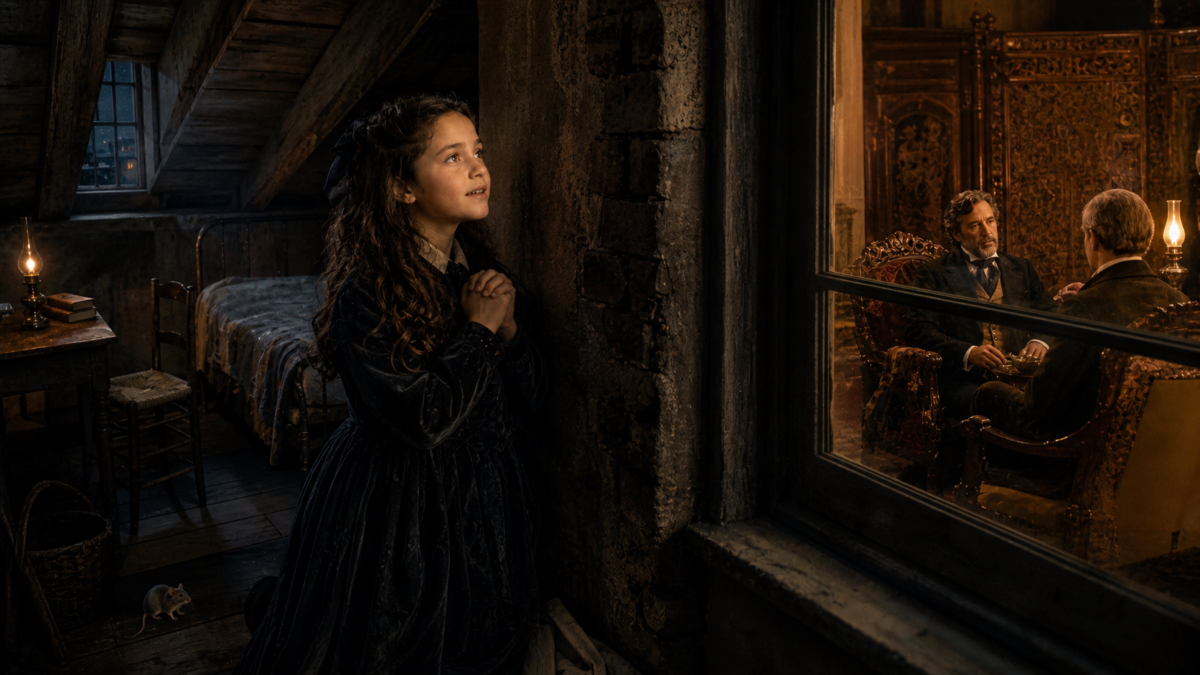
On the other side of the wall Sara was sitting in her garret talking to Melchisedec, who had come out for his evening meal.
壁の反対側では、サラが屋根裏部屋に座り、夕食を取りに出てきたメルキセデクに話しかけていた。
“It has been hard to be a princess today, Melchisedec,” she said.
「今日は王女でいるのがつらかったわ、メルキセデク」と彼女は言った。
“It has been harder than usual.”
「いつもよりつらかったの」
“It gets harder as the weather grows colder and the streets get more sloppy.”
「天気が寒くなり、通りがもっとぬかるんでくると、ますますつらくなるの」
“When Lavinia laughed at my muddy skirt as I passed her in the hall, I thought of something to say all in a flash–and I only just stopped myself in time.”
「廊下でラヴィニアの前を通った時、彼女が私の泥だらけのスカートを笑ったの。私は一瞬で言い返す言葉を思いついたけれど、ぎりぎりで自分を止めたの」
“You can’t sneer back at people like that–if you are a princess.”
「あんな人たちに冷笑で返すことはできないわ。王女ならね」
“But you have to bite your tongue to hold yourself in.”
「でも、自分を抑えるには舌を噛まなければならないの」
“I bit mine.”
「私は自分の舌を噛んだわ」
“It was a cold afternoon, Melchisedec.”
「寒い午後だったわ、メルキセデク」
“And it’s a cold night.”
「そして今夜も寒いわ」
Quite suddenly she put her black head down in her arms, as she often did when she was alone.
突然、彼女は一人でいる時によくするように、黒い頭を腕の中に伏せた。
“Oh, papa,” she whispered, “what a long time it seems since I was your ‘Little Missus’!”
「ああ、パパ」と彼女はささやいた。「私がパパの『リトル・ミサス』だった頃から、なんて長い時間がたったように思えるの!」
This was what happened that day on both sides of the wall.
これが、その日、壁の両側で起こったことだった。