
CHAPTER II のポイント
第2章では、セーラがミンチン先生の学校で初めて授業を受け、フランス語の時間に周囲を驚かせます。先生たちはセーラをまだ普通の新入生として見ていますが、彼女がすでに高い語学力を持っていることが明らかになります。
この章の読みどころは、セーラの知性と品のよさが自然に示されるところです。同時に、ミンチン先生の見栄や思い込み、学校の中の序列意識も浮かび上がり、セーラがこの場所でどのように見られ、扱われていくのかを予感させます。
この章の英語学習ポイントを開く
- French:フランス語。この章の中心となる授業で、セーラの能力を示す重要語。
- lesson:授業、課題。学校生活が本格的に始まる場面でよく出る基本語。
- ignorant:無知な、知らない。相手を見下すような判断や思い込みを読む手がかりになる語。
- astonished:驚いた。セーラの返答によって周囲が受ける衝撃を表す重要な感情語。
- polite:礼儀正しい。セーラの話し方や態度の上品さを理解するために大切な語。
2 A French Lesson
『A Little Princess』第2章「A French Lesson」を、英語多読用に読みやすく整えています。形容詞・副詞・熟語・心理描写・場面描写を中心に、やや多めに色分けしています。
表示設定
When Sara entered the schoolroom the next morning everybody looked at her with wide, interested eyes.
翌朝、サラが教室に入ると、みんなが大きく見開いた興味深そうな目で彼女を見た。
By that time every pupil–from Lavinia Herbert, who was nearly thirteen and felt quite grown up, to Lottie Legh, who was only just four and the baby of the school—had heard a great deal about her.
その時までには、ほぼ十三歳で自分はすっかり大人だと思っているラヴィニア・ハーバートから、まだ四歳になったばかりで学校で一番幼いロッティ・リーまで、すべての生徒がサラについて多くのことを聞いていた。
They knew very certainly that she was Miss Minchin’s show pupil and was considered a credit to the establishment.
彼女がミンチン先生の看板生徒であり、学校の名誉になる存在だと考えられていることを、彼女たちははっきり知っていた。
One or two of them had even caught a glimpse of her French maid, Mariette, who had arrived the evening before.
そのうち一、二人は、前の晩に到着したサラのフランス人メイド、マリエットをちらりと見さえしていた。
Lavinia had managed to pass Sara’s room when the door was open, and had seen Mariette opening a box which had arrived late from some shop.
ラヴィニアは、ドアが開いている時にサラの部屋の前をなんとか通りかかり、どこかの店から遅れて届いた箱をマリエットが開けているのを見ていた。
“It was full of petticoats with lace frills on them–frills and frills,” she whispered to her friend Jessie as she bent over her geography.
「それ、レースのひだ飾りがついたペチコートでいっぱいだったのよ。ひだ、ひだ、またひだって感じ」と、彼女は地理の本に身をかがめながら、友だちのジェシーにささやいた。
“I saw her shaking them out. I heard Miss Minchin say to Miss Amelia that her clothes were so grand that they were ridiculous for a child.”
「マリエットがそれを振って広げているのを見たの。ミンチン先生がアメリア先生に、あの子の服は子どもには豪華すぎてばかげているって言っているのを聞いたわ」
“My mamma says that children should be dressed simply. She has got one of those petticoats on now. I saw it when she sat down.”
「私のママは、子どもは質素な服を着るべきだって言っているわ。あの子、今そのペチコートの一つを着ているのよ。座った時に見えたの」
“She has silk stockings on!” whispered Jessie, bending over her geography also. “And what little feet! I never saw such little feet.”
「絹の靴下をはいているわ!」とジェシーも地理の本に身をかがめながらささやいた。「それに、なんて小さな足なの! あんな小さな足、見たことがないわ」
“Oh,” sniffed Lavinia, spitefully, “that is the way her slippers are made.”
「ふん」とラヴィニアは意地悪く鼻を鳴らした。「あれは靴の作りがそうなっているだけよ」
“My mamma says that even big feet can be made to look small if you have a clever shoemaker. I don’t think she is pretty at all. Her eyes are such a queer color.”
「私のママは、腕のいい靴職人がいれば、大きな足だって小さく見せられるって言っているわ。私はあの子が少しもかわいいとは思わない。目の色が妙すぎるもの」
“She isn’t pretty as other pretty people are,” said Jessie, stealing a glance across the room; “but she makes you want to look at her again.”
「ほかのきれいな人たちみたいにきれいなわけじゃないわ」とジェシーは部屋の向こうをこっそりちらりと見ながら言った。「でも、もう一度見たくなるのよ」
“She has tremendously long eyelashes, but her eyes are almost green.”
「あの子、とてつもなく長いまつげをしているけれど、目はほとんど緑色だわ」
Sara was sitting quietly in her seat, waiting to be told what to do. She had been placed near Miss Minchin’s desk.
サラは自分の席に静かに座り、何をすればよいか言われるのを待っていた。彼女はミンチン先生の机の近くに座らされていた。
She was not abashed at all by the many pairs of eyes watching her.
多くの目が自分を見ていても、彼女は少しも気後れしていなかった。
She was interested and looked back quietly at the children who looked at her.
彼女は興味を持ち、自分を見ている子どもたちを静かに見返していた。
She wondered what they were thinking of, and if they liked Miss Minchin, and if they cared for their lessons, and if any of them had a papa at all like her own.
彼女は、みんなが何を考えているのか、ミンチン先生のことが好きなのか、授業に関心があるのか、そしてその中に自分の父親のようなパパを持っている子がいるのかを不思議に思った。
She had had a long talk with Emily about her papa that morning.
その朝、彼女はエミリーと自分のパパについて長い話をしていた。
“He is on the sea now, Emily,” she had said. “We must be very great friends to each other and tell each other things.”
「パパは今、海の上にいるのよ、エミリー」と彼女は言っていた。「私たちはお互いにとても大切な友だちになって、いろいろなことを話し合わなければならないの」
“Emily, look at me. You have the nicest eyes I ever saw–but I wish you could speak.”
「エミリー、私を見て。あなたは私が今まで見た中で一番すてきな目をしているわ。でも、話せたらいいのに」
She was a child full of imaginings and whimsical thoughts, and one of her fancies was that there would be a great deal of comfort in even pretending that Emily was alive and really heard and understood.
彼女は空想や気まぐれで風変わりな考えに満ちた子どもだった。そして彼女の空想の一つは、エミリーが生きていて、本当に聞き、理解しているふりをするだけでも、大きな慰めになるだろうというものだった。
After Mariette had dressed her in her dark-blue schoolroom frock and tied her hair with a dark-blue ribbon, she went to Emily, who sat in a chair of her own, and gave her a book.
マリエットが彼女に濃い青の教室用ドレスを着せ、濃い青のリボンで髪を結んだあと、サラは自分専用の椅子に座っているエミリーのところへ行き、本を渡した。
“You can read that while I am downstairs,” she said; and, seeing Mariette looking at her curiously, she spoke to her with a serious little face.
「私が下にいる間、これを読んでいてね」と彼女は言った。そして、マリエットが不思議そうに自分を見ているのを見ると、サラは真剣な小さな顔で彼女に話しかけた。
“What I believe about dolls,” she said, “is that they can do things they will not let us know about.”
「私が人形について信じていることはね」と彼女は言った。「人形たちは、私たちに知らせないだけで、いろいろなことができるということなの」
“Perhaps, really, Emily can read and talk and walk, but she will only do it when people are out of the room.”
「もしかすると、本当はエミリーは読んだり、話したり、歩いたりできるのかもしれない。でも、人が部屋の外にいる時だけそうするのよ」
“That is her secret. You see, if people knew that dolls could do things, they would make them work.”
「それが彼女の秘密なの。だって、人形たちがいろいろなことをできると人間が知ったら、人形たちを働かせるでしょう」
“So, perhaps, they have promised each other to keep it a secret.”
「だから、たぶん人形たちはお互いに、それを秘密にしておこうと約束しているのよ」
“If you stay in the room, Emily will just sit there and stare; but if you go out, she will begin to read, perhaps, or go and look out of the window.”
「あなたが部屋にいれば、エミリーはただそこに座ってじっと見ているだけ。でも、あなたが外へ出たら、たぶん読み始めたり、窓の外を見に行ったりするの」
“Then if she heard either of us coming, she would just run back and jump into her chair and pretend she had been there all the time.”
「それで、私たちのどちらかが来る音を聞いたら、さっと戻って椅子に飛び乗って、ずっとそこにいたふりをするのよ」
“Comme elle est drole!” Mariette said to herself, and when she went downstairs she told the head housemaid about it.
「なんておもしろい子なの!」とマリエットは心の中で言い、階下へ行くと、そのことを上級女中に話した。
But she had already begun to like this odd little girl who had such an intelligent small face and such perfect manners.
しかしマリエットは、知的な小さな顔と完璧な礼儀作法を持つ、この風変わりな小さな女の子をすでに好きになり始めていた。
She had taken care of children before who were not so polite.
彼女は以前にも子どもの世話をしたことがあったが、その子どもたちはこんなに礼儀正しくはなかった。
Sara was a very fine little person, and had a gentle, appreciative way of saying, “If you please, Mariette,” “Thank you, Mariette,” which was very charming.
サラはとても立派な小さな人物で、「お願いします、マリエット」「ありがとう、マリエット」と言う時の、やさしく感謝を示す言い方がとても魅力的だった。
Mariette told the head housemaid that she thanked her as if she was thanking a lady.
マリエットは上級女中に、サラはまるで相手が一人の淑女であるかのように礼を言うのだと話した。
“Elle a l’air d’une princesse, cette petite,” she said. Indeed, she was very much pleased with her new little mistress and liked her place greatly.
「あの小さな子は、お姫さまのように見えるわ」と彼女は言った。実際、マリエットは新しい小さな主人をとても気に入り、自分の勤め先を大いに気に入っていた。
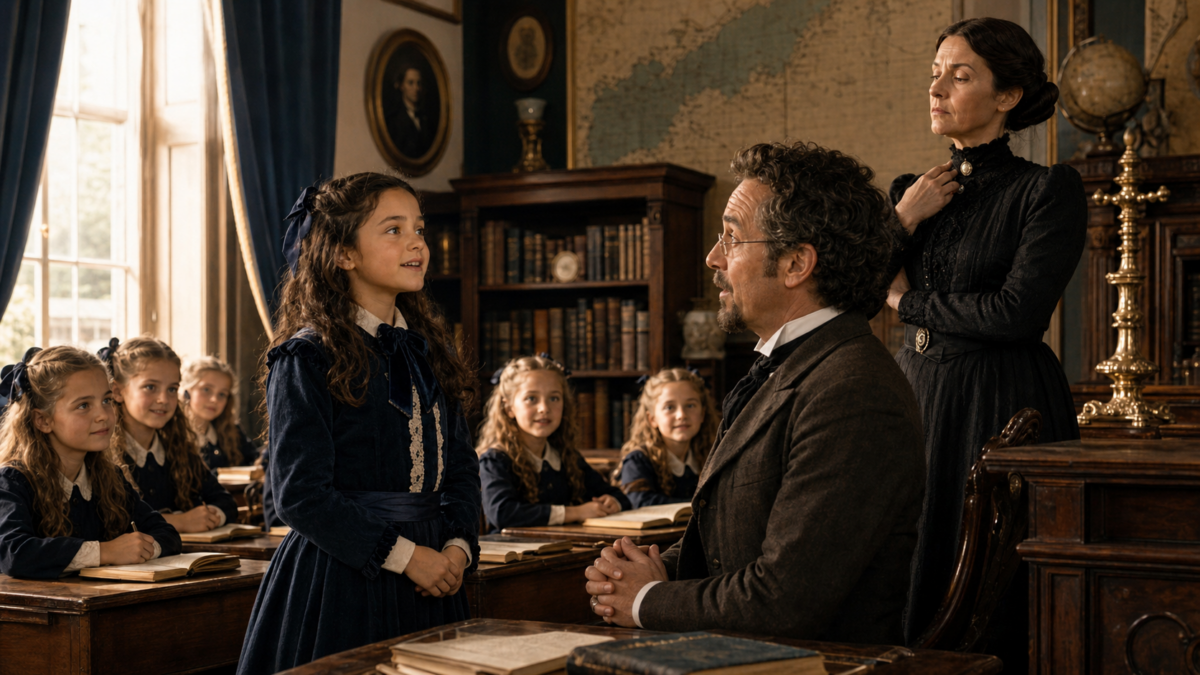
After Sara had sat in her seat in the schoolroom for a few minutes, being looked at by the pupils, Miss Minchin rapped in a dignified manner upon her desk.
サラが教室の席に座って数分間、生徒たちに見つめられていると、ミンチン先生は威厳のある態度で机を軽く叩いた。
“Young ladies,” she said, “I wish to introduce you to your new companion.”
「皆さん」と彼女は言った。「新しいお仲間を紹介したいと思います」
All the little girls rose in their places, and Sara rose also.
小さな女の子たちは全員その場で立ち上がり、サラも立ち上がった。
“I shall expect you all to be very agreeable to Miss Crewe; she has just come to us from a great distance—in fact, from India.”
「皆さんには、クルーさんにとても感じよく接してくれることを期待しています。この方は遠いところから、実際にはインドから来たばかりなのです」
“As soon as lessons are over you must make each other’s acquaintance.”
「授業が終わったら、皆さんはお互いに知り合いにならなければなりません」
The pupils bowed ceremoniously, and Sara made a little curtsy, and then they sat down and looked at each other again.
生徒たちは儀式ばってお辞儀をし、サラは小さな会釈をした。それから彼女たちは座り、また互いに見つめ合った。
“Sara,” said Miss Minchin in her schoolroom manner, “come here to me.”
「サラ」とミンチン先生は教室での口調で言った。「こちらへ来なさい」
She had taken a book from the desk and was turning over its leaves. Sara went to her politely.
彼女は机から一冊の本を取り、ページをめくっていた。サラは礼儀正しく彼女のところへ行った。
“As your papa has engaged a French maid for you,” she began, “I conclude that he wishes you to make a special study of the French language.”
「あなたのお父さまはあなたのためにフランス人のメイドを雇われたのですから」と彼女は話し始めた。「あなたにフランス語を特別に学ばせたいとお望みなのだと私は考えます」
Sara felt a little awkward.
サラは少し気まずく感じた。
“I think he engaged her,” she said, “because he–he thought I would like her, Miss Minchin.”
「パパが彼女を雇ったのは」とサラは言った。「私が彼女を気に入ると思ったからだと思います、ミンチン先生」
“I am afraid,” said Miss Minchin, with a slightly sour smile, “that you have been a very spoiled little girl and always imagine that things are done because you like them.”
「残念ながら」とミンチン先生は少し酸っぱい笑みを浮かべて言った。「あなたはとても甘やかされた小さな女の子で、物事はいつも自分が好むから行われるのだと思い込んでいるようですね」
“My impression is that your papa wished you to learn French.”
「私の考えでは、あなたのお父さまはあなたにフランス語を学ばせたいと思っておられたのです」
If Sara had been older or less punctilious about being quite polite to people, she could have explained herself in a very few words.
もしサラがもっと年上だったか、人に対して完全に礼儀正しくあろうとすることにそれほど細かくなかったなら、彼女はほんの数語で自分のことを説明できただろう。
But, as it was, she felt a flush rising on her cheeks.
しかし実際には、彼女は頬に赤みがのぼってくるのを感じた。
Miss Minchin was a very severe and imposing person, and she seemed so absolutely sure that Sara knew nothing whatever of French that she felt as if it would be almost rude to correct her.
ミンチン先生はとても厳しく威圧的な人物であり、サラがフランス語をまったく知らないと完全に確信しているようだった。そのためサラは、彼女を訂正するのはほとんど失礼にあたるように感じた。
The truth was that Sara could not remember the time when she had not seemed to know French.
実のところ、サラは自分がフランス語を知らなかったように思える時期を思い出すことができなかった。
Her father had often spoken it to her when she had been a baby.
父は、彼女が赤ん坊だった頃から、よくフランス語で話しかけていた。
Her mother had been a French woman, and Captain Crewe had loved her language, so it happened that Sara had always heard and been familiar with it.
母はフランス人女性であり、クルー大尉は彼女の言葉を愛していた。そのため、サラはいつもフランス語を聞き、それに慣れ親しんでいたのだった。
“I–I have never really learned French, but–but–” she began, trying shyly to make herself clear.
「わ、私は本当にフランス語を習ったことはありません。でも、でも……」と彼女は、自分の言いたいことをはっきり伝えようとして、恥ずかしそうに話し始めた。
One of Miss Minchin’s chief secret annoyances was that she did not speak French herself, and was desirous of concealing the irritating fact.
ミンチン先生の大きな密かな悩みの一つは、彼女自身がフランス語を話せないことだった。そして彼女は、そのいらだたしい事実を隠したがっていた。
She, therefore, had no intention of discussing the matter and laying herself open to innocent questioning by a new little pupil.
そのため彼女は、この問題について話し合い、新しい小さな生徒から無邪気な質問を受ける危険に自分をさらすつもりはまったくなかった。
“That is enough,” she said with polite tartness.
「それで十分です」と彼女は礼儀正しいが刺々しい調子で言った。
“If you have not learned, you must begin at once. The French master, Monsieur Dufarge, will be here in a few minutes.”
「習ったことがないのなら、すぐに始めなければなりません。フランス語の先生、デュファルジュ先生が数分後にいらっしゃいます」
“Take this book and look at it until he arrives.”
「この本を持って、先生が到着するまで見ていなさい」
Sara’s cheeks felt warm. She went back to her seat and opened the book.
サラの頬は熱く感じられた。彼女は席に戻り、本を開いた。
She looked at the first page with a grave face. She knew it would be rude to smile, and she was very determined not to be rude.
彼女は真面目な顔で最初のページを見た。笑うのは失礼だとわかっていたし、失礼にならないようにしようと固く決意していた。
But it was very odd to find herself expected to study a page which told her that “le pere” meant “the father,” and “la mere” meant “the mother.”
しかし、「le pere」は「父」を意味し、「la mere」は「母」を意味すると教えるページを、自分が勉強することを期待されているのは、とても奇妙だった。
Miss Minchin glanced toward her scrutinizingly.
ミンチン先生は、じろじろ観察するように彼女の方をちらりと見た。
“You look rather cross, Sara,” she said. “I am sorry you do not like the idea of learning French.”
「あなたは少し不機嫌そうですね、サラ」と彼女は言った。「フランス語を学ぶという考えが気に入らないようで残念です」
“I am very fond of it,” answered Sara, thinking she would try again; “but–“
「私はフランス語がとても好きです」とサラは、もう一度説明してみようと思いながら答えた。「でも……」
“You must not say ‘but’ when you are told to do things,” said Miss Minchin. “Look at your book again.”
「何かをするように言われた時に、『でも』と言ってはいけません」とミンチン先生は言った。「もう一度本を見なさい」
And Sara did so, and did not smile, even when she found that “le fils” meant “the son,” and “le frere” meant “the brother.”
サラはその通りにし、「le fils」は「息子」、「le frere」は「兄弟」という意味だとわかっても、笑わなかった。
“When Monsieur Dufarge comes,” she thought, “I can make him understand.”
「デュファルジュ先生が来たら」と彼女は思った。「わかってもらえるわ」
Monsieur Dufarge arrived very shortly afterward.
デュファルジュ先生は、その後まもなく到着した。
He was a very nice, intelligent, middle-aged Frenchman, and he looked interested when his eyes fell upon Sara trying politely to seem absorbed in her little book of phrases.
彼はとても感じのよい、知的な中年のフランス人だった。そして、小さな会話集に夢中になっているよう礼儀正しく見せようとしているサラに目を留めると、興味深そうな顔をした。
“Is this a new pupil for me, madame?” he said to Miss Minchin. “I hope that is my good fortune.”
「こちらが私の新しい生徒ですか、マダム?」と彼はミンチン先生に言った。「それが私の幸運であることを願います」
“Her papa–Captain Crewe–is very anxious that she should begin the language. But I am afraid she has a childish prejudice against it.”
「この子のお父さま、クルー大尉は、この子がその言語を始めることを強く望んでおられます。けれど残念ながら、この子はそれに対して子どもっぽい偏見を持っているようです」
“She does not seem to wish to learn,” said Miss Minchin.
「学びたがっていないようなのです」とミンチン先生は言った。
“I am sorry of that, mademoiselle,” he said kindly to Sara. “Perhaps, when we begin to study together, I may show you that it is a charming tongue.”
「それは残念ですね、お嬢さん」と彼はサラに親切に言った。「たぶん一緒に勉強を始めれば、それが魅力的な言語であることをお見せできるでしょう」
Little Sara rose in her seat. She was beginning to feel rather desperate, as if she were almost in disgrace.
小さなサラは席で立ち上がった。彼女は、自分がほとんど叱られているかのように感じ、かなり追い詰められた気持ちになり始めていた。
She looked up into Monsieur Dufarge’s face with her big, green-gray eyes, and they were quite innocently appealing.
彼女は大きな緑がかった灰色の目でデュファルジュ先生の顔を見上げた。その目は、まったく無邪気に訴えるようだった。
She knew that he would understand as soon as she spoke.
彼女は、自分が話し始めればすぐに彼が理解してくれるとわかっていた。
She began to explain quite simply in pretty and fluent French.
彼女は、きれいで流暢なフランス語で、とても簡単に説明し始めた。
Madame had not understood. She had not learned French exactly–not out of books–but her papa and other people had always spoken it to her, and she had read it and written it as she had read and written English.
マダムは理解していなかったのだ。サラは正確にはフランス語を習ったわけではなかった。本で学んだわけではない。しかし、パパやほかの人々がいつも彼女にフランス語で話しかけていたし、彼女は英語を読んだり書いたりするのと同じように、フランス語を読んだり書いたりしていた。
Her papa loved it, and she loved it because he did. Her dear mamma, who had died when she was born, had been French.
パパがフランス語を愛していたので、彼女もそれを愛していた。彼女が生まれた時に亡くなった大切なママは、フランス人だった。
She would be glad to learn anything monsieur would teach her, but what she had tried to explain to madame was that she already knew the words in this book–and she held out the little book of phrases.
彼女は、先生が教えてくれることなら何でも喜んで学ぶつもりだった。しかし、マダムに説明しようとしていたのは、この本の中の単語はすでに知っているということだった。そして彼女はその小さな会話集を差し出した。
When she began to speak Miss Minchin started quite violently and sat staring at her over her eyeglasses, almost indignantly, until she had finished.
サラが話し始めると、ミンチン先生はひどくぎょっとし、サラが話し終えるまで、眼鏡越しに、ほとんど憤慨したように彼女をじっと見つめて座っていた。
Monsieur Dufarge began to smile, and his smile was one of great pleasure.
デュファルジュ先生は微笑み始めた。その微笑みは大きな喜びを表すものだった。
To hear this pretty childish voice speaking his own language so simply and charmingly made him feel almost as if he were in his native land–which in dark, foggy days in London sometimes seemed worlds away.
このかわいらしい子どもの声が、自分の言葉をこんなに素直に、魅力的に話すのを聞くと、彼はまるで故郷にいるかのような気持ちになった。暗く霧の深いロンドンの日々には、その故郷は時に別世界のように遠く感じられた。
When she had finished, he took the phrase book from her, with a look almost affectionate. But he spoke to Miss Minchin.
彼女が話し終えると、彼はほとんど愛情のこもった表情で会話集を受け取った。しかし彼が話しかけたのはミンチン先生だった。
“Ah, madame,” he said, “there is not much I can teach her. She has not LEARNED French; she is French. Her accent is exquisite.”
「ああ、マダム」と彼は言った。「私がこの子に教えられることはあまりありません。この子はフランス語を習ったのではありません。フランス語そのものなのです。彼女の発音はこの上なく美しい」
“You ought to have told me,” exclaimed Miss Minchin, much mortified, turning to Sara.
「あなたは私に言うべきでした」と、ミンチン先生は大いに屈辱を感じながら、サラの方を向いて叫ぶように言った。
“I–I tried,” said Sara. “I–I suppose I did not begin right.”
「わ、私は言おうとしました」とサラは言った。「た、たぶん私の話し始め方がよくなかったのだと思います」
Miss Minchin knew she had tried, and that it had not been her fault that she was not allowed to explain.
ミンチン先生は、サラが説明しようとしていたこと、そして説明させてもらえなかったのはサラのせいではなかったことを知っていた。
And when she saw that the pupils had been listening and that Lavinia and Jessie were giggling behind their French grammars, she felt infuriated.
そして、生徒たちが聞いていたこと、ラヴィニアとジェシーがフランス語文法書の陰でくすくす笑っていたことを見ると、彼女は激怒した。
“Silence, young ladies!” she said severely, rapping upon the desk. “Silence at once!”
「静かに、皆さん!」彼女は机を叩きながら厳しく言った。「今すぐ静かに!」
And she began from that minute to feel rather a grudge against her show pupil.
そしてその瞬間から、彼女は自分の看板生徒に対して、いくらか恨みを抱き始めた。