
『白痴』のカラフル対訳について
カラフル対訳で紹介している『白痴』は、パブリックドメインの作品を出典としています。
このサイトで使われている作品は、ロシアの文豪フョードル・ドストエフスキーによる小説 The Idiot を出典としています。 英文は Eva M. Martin による英訳版をもとにしています。 原文は、著作権の切れた名作などの全文を電子化し、インターネット上で公開している Project Gutenberg(プロジェクト・グーテンベルク)、 朗読音声は LibriVox(リブリヴォックス/朗読図書館) の公開音声を出典としています。
原文はProject Gutenberg、音声はLibriVoxで公開されているパブリックドメイン作品を出典としています。
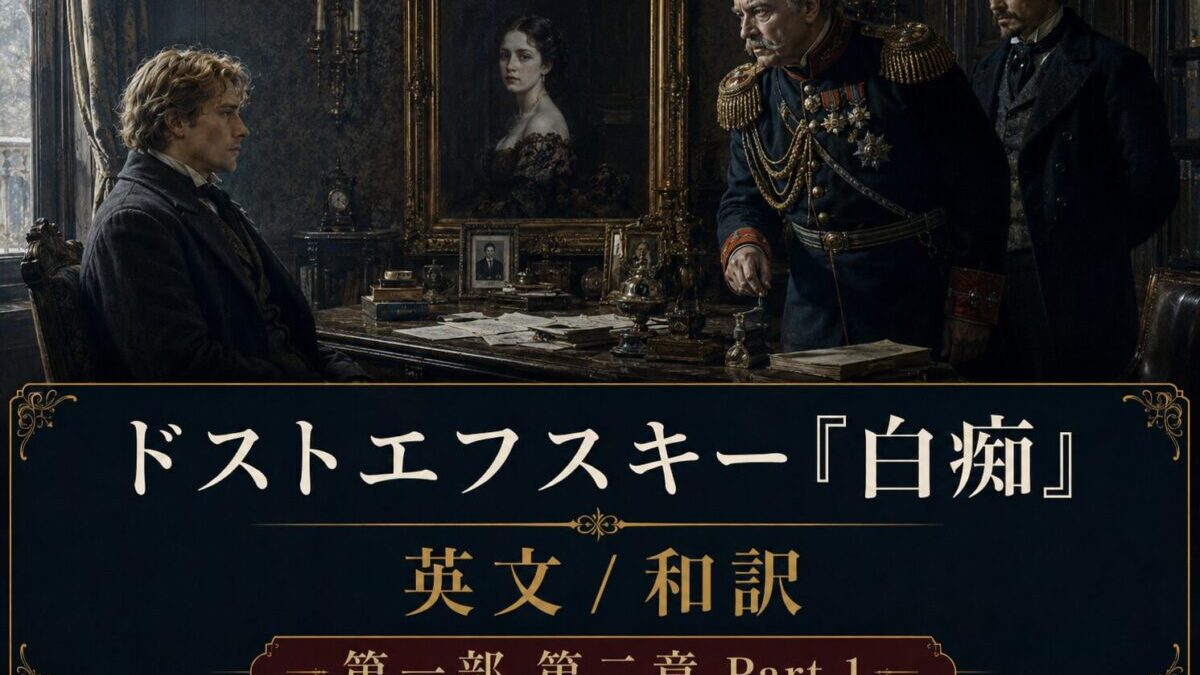
“`『白痴』英文/和訳 PART I CHAPTER II エパンチン将軍家へ
『The Idiot』PART I CHAPTER II を、英語学習用に「英文→和訳」の順で読みやすく整理し、重要語句を多めに色分けしています。上部の操作パネルで、和訳・色分け・ミニ訳・カテゴリ別ハイライトを切り替えられます。
General Epanchin lived in his own house near the Litaynaya. Besides this large residence—five-sixths of which was let in flats and lodgings—the general was owner of another enormous house in the Sadovaya bringing in even more rent than the first. Besides these houses he had a delightful little estate just out of town, and some sort of factory in another part of the city.
エパンチン将軍は、リタイナヤの近くにある自分の家に住んでいた。この大きな邸宅は五分の四以上がアパートや下宿として貸されていたが、将軍はそれとは別に、サドヴァヤにもさらに多くの家賃を生む巨大な家を所有していた。そのほか、町外れにはすばらしい小さな地所があり、市内の別の地区には何かしらの工場も持っていた。
General Epanchin, as everyone knew, had a good deal to do with certain government monopolies; he was also a voice, and an important one, in many rich public companies of various descriptions; in fact, he enjoyed the reputation of being a well-to-do man of busy habits, many ties, and affluent means.
エパンチン将軍は、誰もが知っているように、いくつかの政府の独占事業に大いに関わっていた。また、さまざまな種類の裕福な公共会社でも、重要な発言力を持つ人物だった。実際、彼は多忙で、縁故が多く、資力に富む裕福な人物として評判を得ていた。
He had made himself indispensable in several quarters, amongst others in his department of the government; and yet it was a known fact that Fedor Ivanovitch Epanchin was a man of no education whatever, and had absolutely risen from the ranks.
彼はいくつもの方面で、なかでも政府の自分の部門において不可欠な人物となっていた。しかし一方で、フョードル・イワノヴィッチ・エパンチンはまったく教育を受けていない人物であり、完全に下層から成り上がったのだということも、よく知られた事実だった。
This last fact could, of course, reflect nothing but credit upon the general; and yet, though unquestionably a sagacious man, he had his own little weaknesses—very excusable ones,—one of which was a dislike to any allusion to the above circumstance. He was undoubtedly clever.
もちろん、この最後の事実は将軍にとって名誉以外の何ものでもなかった。とはいえ、彼は疑いなく抜け目のない人物でありながら、彼なりの小さな弱点を持っていた。それは十分に許される類の弱点だったが、その一つが、自分の成り上がりに関するほのめかしを嫌うことだった。彼は疑いなく賢かった。
For instance, he made a point of never asserting himself when he would gain more by keeping in the background; and in consequence many exalted personages valued him principally for his humility and simplicity, and because “he knew his place.” And yet if these good people could only have had a peep into the mind of this excellent fellow who “knew his place” so well! The fact is that, in spite of his knowledge of the world and his really remarkable abilities, he always liked to appear to be carrying out other people’s ideas rather than his own.
たとえば彼は、前面に出るよりも背景に退いていたほうが得をするときには、決して自己主張しないよう心がけていた。そのため、多くの高位の人物たちは、彼の謙遜や簡素さ、そして「身の程を知っている」ことを主に評価していた。だが、もしその善良な人々が、この「身の程を知っている」すばらしい男の心の中を少しでものぞけたなら、どうだっただろう。実際のところ彼は、世慣れしており、実に目覚ましい能力を持っていたにもかかわらず、いつも自分の考えではなく他人の考えを実行しているように見せることを好んでいた。
And also, his luck seldom failed him, even at cards, for which he had a passion that he did not attempt to conceal. He played for high stakes, and moved, altogether, in very varied society.
また、彼の運はめったに彼を見放さなかった。カード遊びにおいてさえそうだった。彼はカードに情熱を持っており、それを隠そうともしなかった。彼は大金を賭け、全体として非常に多様な社交界を渡り歩いていた。
As to age, General Epanchin was in the very prime of life; that is, about fifty-five years of age,—the flowering time of existence, when real enjoyment of life begins. His healthy appearance, good colour, sound, though discoloured teeth, sturdy figure, preoccupied air during business hours, and jolly good humour during his game at cards in the evening, all bore witness to his success in life, and combined to make existence a bed of roses to his excellency.
年齢について言えば、エパンチン将軍はまさに人生の盛りにあった。つまり五十五歳ほどであり、本当の人生の楽しみが始まる、存在の花盛りの時期だった。健康そうな外見、よい顔色、変色してはいるが丈夫な歯、がっしりした体格、仕事中の忙しげな様子、そして夜のカード遊びでの陽気な上機嫌。そうしたすべてが、彼の人生の成功を物語り、閣下にとっての生活を安楽なものにしていた。
The general was lord of a flourishing family, consisting of his wife and three grown-up daughters. He had married young, while still a lieutenant, his wife being a girl of about his own age, who possessed neither beauty nor education, and who brought him no more than fifty souls of landed property, which little estate served, however, as a nest-egg for far more important accumulations.
将軍は、妻と三人の成人した娘から成る繁栄した家庭の主だった。彼はまだ中尉だったころに若くして結婚した。妻は彼と同じくらいの年齢の娘で、美貌も教育も持っておらず、彼にもたらしたものは五十人の農奴を含む地所だけだった。しかし、その小さな地所は、後にずっと重要な財産を蓄えるための元手となった。
The general never regretted his early marriage, or regarded it as a foolish youthful escapade; and he so respected and feared his wife that he was very near loving her. Mrs. Epanchin came of the princely stock of Muishkin, which if not brilliant, was, at all events, a decidedly ancient family; and she was extremely proud of her descent.
将軍は早婚を一度も後悔したことがなく、それを若気の愚かな冒険だと考えたこともなかった。そして彼は妻を非常に尊敬し、恐れていたので、ほとんど愛しているに近かった。エパンチン夫人はムイシュキン家という公爵家の血筋を引いていた。その家は華やかではないにしても、いずれにせよ確かに古い家柄であり、彼女は自分の出自を非常に誇りにしていた。
With a few exceptions, the worthy couple had lived through their long union very happily. While still young the wife had been able to make important friends among the aristocracy, partly by virtue of her family descent, and partly by her own exertions; while, in after life, thanks to their wealth and to the position of her husband in the service, she took her place among the higher circles as by right.
わずかな例外を除けば、この立派な夫婦は長い結婚生活を非常に幸福に過ごしてきた。妻は若いころ、家柄のおかげもあり、自分自身の努力もあって、貴族社会に重要な友人を作ることができた。そして後年には、彼らの富と夫の官職上の地位のおかげで、上流社会の中に当然のように自分の場所を占めるようになった。
During these last few years all three of the general’s daughters—Alexandra, Adelaida, and Aglaya—had grown up and matured. Of course they were only Epanchins, but their mother’s family was noble; they might expect considerable fortunes; their father had hopes of attaining to very high rank indeed in his country’s service—all of which was satisfactory. All three of the girls were decidedly pretty, even the eldest, Alexandra, who was just twenty-five years old.
ここ数年の間に、将軍の三人の娘、アレクサンドラ、アデライダ、アグラーヤはみな成長し、成熟していた。もちろん彼女たちはエパンチン家の娘にすぎなかったが、母方の家柄は高貴だった。かなりの財産も期待でき、父親は祖国の官職で非常に高い位に達する望みを持っていた。こうしたことはすべて満足すべきものだった。三人の娘はいずれも明らかに美しく、二十五歳になったばかりの長女アレクサンドラでさえそうだった。
The middle daughter was now twenty-three, while the youngest, Aglaya, was twenty. This youngest girl was absolutely a beauty, and had begun of late to attract considerable attention in society. But this was not all, for every one of the three was clever, well educated, and accomplished.
次女は二十三歳、末娘のアグラーヤは二十歳だった。この末娘はまったくの美人で、最近では社交界でかなりの注目を集め始めていた。しかしそれだけではなかった。三人はいずれも賢く、よく教育され、教養を備えていた。
It was a matter of general knowledge that the three girls were very fond of one another, and supported each other in every way; it was even said that the two elder ones had made certain sacrifices for the sake of the idol of the household, Aglaya. In society they not only disliked asserting themselves, but were actually retiring. Certainly no one could blame them for being too arrogant or haughty, and yet everybody was well aware that they were proud and quite understood their own value.
三人の娘が互いにとても仲がよく、あらゆる面で支え合っていることは広く知られていた。二人の姉たちは、一家の偶像であるアグラーヤのために、ある種の犠牲を払ったことさえあると言われていた。社交界では、彼女たちは自己主張を嫌うだけでなく、実際に控えめだった。確かに、彼女たちが傲慢すぎるとか高慢すぎると非難する者はいなかったが、それでも誰もが、彼女たちが誇り高く、自分たちの価値をよく理解していることを知っていた。
The eldest was musical, while the second was a clever artist, which fact she had concealed until lately. In a word, the world spoke well of the girls; but they were not without their enemies, and occasionally people talked with horror of the number of books they had read.
長女は音楽の才があり、次女は巧みな画家だったが、その事実を最近まで隠していた。要するに、世間は娘たちを好意的に語っていた。しかし彼女たちに敵がいないわけではなく、ときには、彼女たちが読んだ本の多さについて恐ろしげに語る人々もいた。
They were in no hurry to marry. They liked good society, but were not too keen about it. All this was the more remarkable, because everyone was well aware of the hopes and aims of their parents.
彼女たちは結婚を急いでいなかった。上流社会は好きだったが、それに熱中しすぎているわけではなかった。このことは、両親の期待と目的を誰もがよく知っていたため、なおさら注目すべきものだった。
It was about eleven o’clock in the forenoon when the prince rang the bell at General Epanchin’s door. The general lived on the first floor or flat of the house, as modest a lodging as his position permitted. A liveried servant opened the door, and the prince was obliged to enter into long explanations with this gentleman, who, from the first glance, looked at him and his bundle with grave suspicion.
午前十一時ごろ、公爵はエパンチン将軍の家の呼び鈴を鳴らした。将軍はその家の一階、つまり自分の地位が許す範囲で控えめな住まいに住んでいた。制服を着た召使いが戸を開けたが、公爵はその男に長々と説明しなければならなかった。その男は最初の一目から、公爵とその包みを重い疑いの目で見ていた。
At last, however, on the repeated positive assurance that he really was Prince Muishkin, and must absolutely see the general on business, the bewildered domestic showed him into a little ante-chamber leading to a waiting-room that adjoined the general’s study, there handing him over to another servant, whose duty it was to be in this ante-chamber all the morning, and announce visitors to the general.
しかしついに、公爵が本当にムイシュキン公爵であり、用件があってどうしても将軍に会わねばならないのだと何度もはっきり保証すると、困惑した召使いは彼を小さな控えの間へ案内した。そこは将軍の書斎に隣接する待合室へ通じており、そこで彼は別の召使いに引き渡された。その召使いは午前中ずっとこの控えの間にいて、来客を将軍に取り次ぐ役目を持っていた。
This second individual wore a dress coat, and was some forty years of age; he was the general’s special study servant, and well aware of his own importance.
この二人目の人物は燕尾服を着ており、四十歳ほどだった。彼は将軍の書斎付きの特別な召使いであり、自分の重要性をよく心得ていた。
“Wait in the next room, please; and leave your bundle here,” said the door-keeper, as he sat down comfortably in his own easy-chair in the ante-chamber. He looked at the prince in severe surprise as the latter settled himself in another chair alongside, with his bundle on his knees.
「隣の部屋でお待ちください。それから包みはこちらに置いてください」と戸番は言い、自分の安楽椅子にゆったりと腰を下ろした。公爵が包みを膝に乗せたまま、その隣の椅子に腰を落ち着けると、彼は厳しい驚きの目で公爵を見た。
“If you don’t mind, I would rather sit here with you,” said the prince; “I should prefer it to sitting in there.”
「差し支えなければ、私はあなたとここに座っていたいのです」と公爵は言った。「あちらに座るより、そのほうがよいのです」
“Oh, but you can’t stay here. You are a visitor—a guest, so to speak. Is it the general himself you wish to see?”
「いや、しかしここにいるわけにはいきません。あなたは訪問客、つまりお客様です。将軍ご本人にお会いになりたいのですか?」
The man evidently could not take in the idea of such a shabby-looking visitor, and had decided to ask once more.
その男は、そんなみすぼらしい見た目の訪問客というものをどうしても理解できなかったらしく、もう一度尋ねることにしたのだった。
“Yes—I have business—” began the prince.
「はい、用件がありまして……」と公爵は言いかけた。
“I do not ask you what your business may be, all I have to do is to announce you; and unless the secretary comes in here I cannot do that.”
「ご用件が何かを伺っているのではありません。私のすることは、あなたを取り次ぐことだけです。そして秘書がこちらへ来なければ、それもできません」
The man’s suspicions seemed to increase more and more. The prince was too unlike the usual run of daily visitors; and although the general certainly did receive, on business, all sorts and conditions of men, yet in spite of this fact the servant felt great doubts on the subject of this particular visitor. The presence of the secretary as an intermediary was, he judged, essential in this case.
男の疑いはますます強まっているようだった。公爵は、日々やってくる普通の訪問客とはあまりにも違っていた。確かに将軍は用件があればあらゆる種類の人々を引見したが、それでもこの特定の訪問客については、召使いは大きな疑念を抱いていた。この場合、秘書が仲介者としていることが不可欠だと彼は判断したのである。
“Surely you—are from abroad?” he inquired at last, in a confused sort of way. He had begun his sentence intending to say, “Surely you are not Prince Muishkin, are you?”
「たしかあなたは……外国からおいでで?」と彼はついに、困惑したような調子で尋ねた。彼は本当は「まさかあなたがムイシュキン公爵ではないでしょうね」と言いかけていたのだった。
“Yes, straight from the train! Did not you intend to say, ‘Surely you are not Prince Muishkin?’ just now, but refrained out of politeness?”
「はい、列車からまっすぐ来ました! 今あなたは『まさかあなたがムイシュキン公爵ではないでしょうね』と言おうとして、礼儀から控えたのではありませんか?」
“H’m!” grunted the astonished servant.
「ふむ!」と驚いた召使いはうなった。
“I assure you I am not deceiving you; you shall not have to answer for me. As to my being dressed like this, and carrying a bundle, there’s nothing surprising in that—the fact is, my circumstances are not particularly rosy at this moment.”
「私はあなたをだましているのではありません。あなたが私のことで責任を負う必要もありません。こんな格好をして包みを持っていることについては、少しも驚くことではないのです。実は、今の私の境遇は特に順調ではありませんから」
“H’m!—no, I’m not afraid of that, you see; I have to announce you, that’s all. The secretary will be out directly—that is, unless you—yes, that’s the rub—unless you—come, you must allow me to ask you—you’ve not come to beg, have you?”
「ふむ! いや、その点を心配しているわけではありません。私はあなたを取り次がなければならない、それだけです。秘書はすぐに出てくるでしょう。つまり、もしあなたが……そう、そこが問題なのですが……失礼ながら伺わせてください。あなたは物乞いに来たのではありませんね?」
“Oh dear no, you can be perfectly easy on that score. I have quite another matter on hand.”
「まさか、とんでもありません。その点については完全に安心してくださって結構です。私はまったく別の用件を持っているのです」
“You must excuse my asking, you know. Your appearance led me to think—but just wait for the secretary; the general is busy now, but the secretary is sure to come out.”
「尋ねたことはお許しください。あなたの見た目が私にそう思わせたものですから……ともかく秘書をお待ちください。将軍はいま忙しいですが、秘書はきっと出てきます」
“Oh—well, look here, if I have some time to wait, would you mind telling me, is there any place about where I could have a smoke? I have my pipe and tobacco with me.”
「ああ、では、もし少し待つ時間があるのなら、どこかこのあたりに一服できる場所があるか教えていただけませんか。私はパイプと煙草を持っているのです」
“Smoke?” said the man, in shocked but disdainful surprise, blinking his eyes at the prince as though he could not believe his senses. “No, sir, you cannot smoke here, and I wonder you are not ashamed of the very suggestion. Ha, ha! a cool idea that, I declare!”
「一服ですって?」と男は、衝撃と軽蔑が入り混じった驚きで言い、公爵を見ながら、まるで自分の耳を疑うようにまばたきした。「いいえ、ここで煙草を吸うことはできません。そんなことを言い出すこと自体、恥ずかしくないのかと不思議に思います。はは! なんともずうずうしい考えですな!」
“Oh, I didn’t mean in this room! I know I can’t smoke here, of course. I’d adjourn to some other room, wherever you like to show me to. You see, I’m used to smoking a good deal, and now I haven’t had a puff for three hours; however, just as you like.”
「ああ、この部屋で吸うという意味ではありません。もちろん、ここで吸えないことは分かっています。あなたが案内してくださるなら、どこか別の部屋へ移ります。私はかなり煙草を吸う習慣がありまして、もう三時間も一吸いもしていないのです。もっとも、あなたのお好きなようにしてください」
“Now how on earth am I to announce a man like that?” muttered the servant. “In the first place, you’ve no right in here at all; you ought to be in the waiting-room, because you’re a sort of visitor—a guest, in fact—and I shall catch it for this. Look here, do you intend to take up your abode with us?” he added, glancing once more at the prince’s bundle, which evidently gave him no peace.
「さて、こんな人をいったいどうやって取り次いだらよいのか」と召使いはつぶやいた。「そもそも、あなたはここにいる権利などありません。あなたは訪問客、つまりお客様なのですから、待合室にいるべきなのです。私はこのことで叱られますよ。ところで、あなたはこの家に住みつくつもりですか?」と彼は付け加え、明らかに気になって仕方がないらしい公爵の包みに、もう一度目をやった。
“No, I don’t think so. I don’t think I should stay even if they were to invite me. I’ve simply come to make their acquaintance, and nothing more.”
「いいえ、そうは思いません。たとえ招かれたとしても、泊まることはないと思います。ただ知り合いになるために来ただけで、それ以上のことではありません」
“Make their acquaintance?” asked the man, in amazement, and with redoubled suspicion. “Then why did you say you had business with the general?”
「知り合いになるためですって?」と男は驚き、さらに疑いを強めて尋ねた。「では、なぜ将軍に用件があるなどと言ったのです?」
“Oh well, very little business. There is one little matter—some advice I am going to ask him for; but my principal object is simply to introduce myself, because I am Prince Muishkin, and Madame Epanchin is the last of her branch of the house, and besides herself and me there are no other Muishkins left.”
「ええ、ほんの少しの用件です。一つだけ小さな問題があり、助言をお願いしようと思っているのです。しかし主な目的は、ただ自己紹介をすることです。私はムイシュキン公爵で、エパンチン夫人はこの家系の最後の一人です。そして彼女と私のほかには、もうムイシュキン家の者は残っていませんから」
“What—you’re a relation then, are you?” asked the servant, so bewildered that he began to feel quite alarmed.
「何ですって、ではあなたは親戚なのですか?」と召使いは尋ねた。彼はあまりにも当惑して、すっかり不安になり始めていた。
“Well, hardly so. If you stretch a point, we are relations, of course, but so distant that one cannot really take cognizance of it. I once wrote to your mistress from abroad, but she did not reply. However, I have thought it right to make acquaintance with her on my arrival. I am telling you all this in order to ease your mind, for I see you are still far from comfortable on my account. All you have to do is to announce me as Prince Muishkin, and the object of my visit will be plain enough.
「まあ、ほとんどそうではありません。無理に考えれば、もちろん親戚ではありますが、実際には親戚と認めるほどではないくらい遠い関係です。私は以前、外国から奥様に手紙を書いたことがありますが、返事はありませんでした。それでも、到着したら彼女と知り合うのが正しいと思ったのです。こうしてすべてお話ししているのは、あなたを安心させるためです。あなたがまだ私のことで落ち着かない様子だと分かりますから。あなたはただ、私をムイシュキン公爵として取り次げばよいのです。そうすれば私の訪問の目的は十分明らかになるでしょう」
If I am received—very good; if not, well, very good again. But they are sure to receive me, I should think; Madame Epanchin will naturally be curious to see the only remaining representative of her family. She values her Muishkin descent very highly, if I am rightly informed.”
「もし迎え入れられれば、それで結構です。もしそうでなくても、やはり結構です。しかし私の考えでは、きっと迎え入れてくださるでしょう。エパンチン夫人は当然、自分の家系に残った唯一の代表者を見たいと思うはずです。私の聞いているところが正しければ、彼女はムイシュキン家の血筋を非常に重んじていますから」
The prince’s conversation was artless and confiding to a degree, and the servant could not help feeling that as from visitor to common serving-man this state of things was highly improper.
公爵の話しぶりは非常に無邪気で打ち解けたものだった。そのため召使いは、訪問客が普通の召使いに対してこのような態度を取るのは、きわめて不適切だと感じずにはいられなかった。
His conclusion was that one of two things must be the explanation—either that this was a begging impostor, or that the prince, if prince he were, was simply a fool, without the slightest ambition; for a sensible prince with any ambition would certainly not wait about in ante-rooms with servants, and talk of his own private affairs like this. In either case, how was he to announce this singular visitor?
彼の結論は、説明は二つのうち一つだというものだった。この男は物乞いの詐欺師であるか、あるいは、もし本当に公爵だとしても、ほんの少しの野心もない単なる愚か者であるかのどちらかだった。野心を持つまともな公爵なら、召使いと一緒に控えの間で待ちながら、自分の私事をこんなふうに話すはずがないからだ。いずれにせよ、この奇妙な訪問客をどう取り次げばよいのだろうか。
“I really think I must request you to step into the next room!” he said, with all the insistence he could muster.
「やはり隣の部屋へお移りいただくよう、お願いしなければならないと思います!」と彼は、できる限り強い調子で言った。
“Why? If I had been sitting there now, I should not have had the opportunity of making these personal explanations. I see you are still uneasy about me and keep eyeing my cloak and bundle. Don’t you think you might go in yourself now, without waiting for the secretary to come out?”
「なぜですか。もし私が今あちらに座っていたら、こうした個人的な説明をする機会はなかったでしょう。あなたがまだ私について不安で、私の外套と包みをじろじろ見ているのが分かります。秘書が出てくるのを待たずに、あなた自身がもう中へ行ってくださってもよいのではありませんか」
“No, no! I can’t announce a visitor like yourself without the secretary. Besides the general said he was not to be disturbed—he is with the Colonel C—. Gavrila Ardalionovitch goes in without announcing.”
「いいえ、いいえ! あなたのような訪問客を秘書なしで取り次ぐことはできません。それに将軍は邪魔をしてはならないと言っておられます。いまはC大佐と一緒です。ガヴリラ・アルダリオノヴィッチなら、取り次ぎなしで入りますが」
“Who may that be? a clerk?”
「それはどなたですか。事務員ですか?」
“What? Gavrila Ardalionovitch? Oh no; he belongs to one of the companies. Look here, at all events put your bundle down, here.”
「何ですって? ガヴリラ・アルダリオノヴィッチが? いいえ、彼は会社の一つに属している方です。とにかく、その包みをここに置いてください」
“Yes, I will if I may; and—can I take off my cloak?”
「はい、よろしければそうします。それから、外套を脱いでもよいでしょうか」
“Of course; you can’t go in there with it on, anyhow.”
「もちろんです。いずれにせよ、それを着たまま中へは入れませんから」
The prince rose and took off his mantle, revealing a neat enough morning costume—a little worn, but well made. He wore a steel watch chain and from this chain there hung a silver Geneva watch. Fool the prince might be, still, the general’s servant felt that it was not correct for him to continue to converse thus with a visitor, in spite of the fact that the prince pleased him somehow.
公爵は立ち上がってマントを脱いだ。すると、少しくたびれてはいるが仕立てのよい、まずまずきちんとした朝の服装が現れた。彼は鋼の時計鎖を身につけ、その鎖には銀のジュネーブ時計が下がっていた。公爵が愚か者かもしれないとしても、将軍の召使いは、このように訪問客と会話を続けるのは適切ではないと感じた。もっとも、公爵のことはなぜか気に入っていたのだが。
“And what time of day does the lady receive?” the latter asked, reseating himself in his old place.
「それで、奥様は一日のうち何時ごろに面会されるのですか」と公爵は、元の場所に座り直しながら尋ねた。
“Oh, that’s not in my province! I believe she receives at any time; it depends upon the visitors. The dressmaker goes in at eleven. Gavrila Ardalionovitch is allowed much earlier than other people, too; he is even admitted to early lunch now and then.”
「ああ、それは私の担当ではありません! 奥様はいつでもお会いになると思います。訪問客によります。仕立屋は十一時に入ります。ガヴリラ・アルダリオノヴィッチはほかの人よりずっと早く入ることも許されています。時には早めの昼食に招かれることさえあります」
“It is much warmer in the rooms here than it is abroad at this season,” observed the prince; “but it is much warmer there out of doors. As for the houses—a Russian can’t live in them in the winter until he gets accustomed to them.”
「この季節、こちらの部屋の中は外国よりずっと暖かいですね」と公爵は言った。「でも向こうでは、屋外はこちらよりずっと暖かいのです。家について言えば、ロシア人でも冬には慣れるまであちらの家に住めません」
“Don’t they heat them at all?”
「まったく暖房しないのですか?」
“Well, they do heat them a little; but the houses and stoves are so different to ours.”
「ええ、少しは暖房します。でも家もストーブも、こちらのものとはまったく違うのです」
“H’m! were you long away?”
「ふむ! 長く離れていたのですか?」
“Four years! and I was in the same place nearly all the time,—in one village.”
「四年です! そしてほとんどずっと同じ場所、一つの村にいました」
“You must have forgotten Russia, hadn’t you?”
「ロシアのことを忘れてしまったでしょう?」
“Yes, indeed I had—a good deal; and, would you believe it, I often wonder at myself for not having forgotten how to speak Russian? Even now, as I talk to you, I keep saying to myself ‘how well I am speaking it.’ Perhaps that is partly why I am so talkative this morning. I assure you, ever since yesterday evening I have had the strongest desire to go on and on talking Russian.”
「はい、確かにかなり忘れていました。それに、信じていただけるか分かりませんが、ロシア語の話し方を忘れていないことに、私はしばしば自分で驚くのです。今こうしてあなたと話しながらも、『自分はなんてうまく話しているのだろう』と心の中で言い続けています。今朝こんなにおしゃべりなのは、おそらくそのせいもあるでしょう。昨日の夕方以来、私はロシア語をいつまでも話し続けたいという非常に強い欲求を抱いているのです」
“H’m! yes; did you live in Petersburg in former years?”
「ふむ、そうですか。以前はペテルブルクに住んでいたのですか?」
This good flunkey, in spite of his conscientious scruples, really could not resist continuing such a very genteel and agreeable conversation.
この善良な従僕は、良心的なためらいを抱きながらも、実に上品で心地よいこの会話を続けずにはいられなかった。
“In Petersburg? Oh no! hardly at all, and now they say so much is changed in the place that even those who did know it well are obliged to relearn what they knew. They talk a good deal about the new law courts, and changes there, don’t they?”
「ペテルブルクにですか。いいえ、ほとんどありません。それに今では、この町はあまりにも変わってしまい、よく知っていた人でさえ知識を学び直さなければならないと言われています。新しい裁判所や、そこでの変化についてよく話されていますね」
“H’m! yes, that’s true enough. Well now, how is the law over there, do they administer it more justly than here?”
「ふむ、ええ、それはまったくその通りです。では、向こうの法律はどうですか。こちらより公正に運用されていますか?」
“Oh, I don’t know about that! I’ve heard much that is good about our legal administration, too. There is no capital punishment here for one thing.”
「ああ、それについては分かりません。こちらの司法制度についても、よいことをたくさん聞いています。何より、こちらには死刑がありませんから」
“Is there over there?”
「向こうにはあるのですか?」
“Yes—I saw an execution in France—at Lyons. Schneider took me over with him to see it.”
「はい。私はフランスのリヨンで処刑を見ました。シュナイダーが私を連れて行って見せたのです」
“What, did they hang the fellow?”
「何です、そいつを絞首刑にしたのですか?」
“No, they cut off people’s heads in France.”
「いいえ、フランスでは人の首を切るのです」
“What did the fellow do?—yell?”
「その男はどうしました。叫びましたか?」
“Oh no—it’s the work of an instant. They put a man inside a frame and a sort of broad knife falls by machinery—they call the thing a guillotine—it falls with fearful force and weight—the head springs off so quickly that you can’t wink your eye in between. But all the preparations are so dreadful. When they announce the sentence, you know, and prepare the criminal and tie his hands, and cart him off to the scaffold—that’s the fearful part of the business.
「いいえ、それは一瞬のことです。人を枠の中に入れると、機械仕掛けで一種の幅広い刃が落ちてきます。それをギロチンと呼ぶのです。刃は恐ろしい力と重さで落ち、頭はまばたきする間もないほど素早く飛びます。しかし、すべての準備があまりにも恐ろしいのです。判決を告げ、罪人の身支度をさせ、手を縛り、処刑台へ運んでいく。そこがこの出来事の恐ろしい部分なのです」
The people all crowd round—even women—though they don’t at all approve of women looking on.”
「人々はみな周りに群がります。女性までいます。もっとも、女性が見物することはまったくよいとは思われていませんが」
“No, it’s not a thing for women.”
「ええ、それは女性の見るものではありません」
“Of course not—of course not!—bah! The criminal was a fine intelligent fearless man; Le Gros was his name; and I may tell you—believe it or not, as you like—that when that man stepped upon the scaffold he cried, he did indeed,—he was as white as a bit of paper. Isn’t it a dreadful idea that he should have cried—cried! Whoever heard of a grown man crying from fear—not a child, but a man who never had cried before—a grown man of forty-five years.
「もちろん違います、もちろんです! まったく! その罪人は立派で、知的で、恐れを知らない男でした。名前はル・グロといいました。信じるかどうかはあなた次第ですが、彼が処刑台に上がったとき、彼は泣いたのです。本当に泣いたのです。紙のように真っ白でした。彼が泣いた、泣いたというのは、なんと恐ろしい考えではありませんか。恐怖で大人の男が泣くなど、誰が聞いたことがあるでしょう。子供ではなく、これまで泣いたことのない男、四十五歳の大人の男がです」
Imagine what must have been going on in that man’s mind at such a moment; what dreadful convulsions his whole spirit must have endured; it is an outrage on the soul that’s what it is. Because it is said ‘thou shalt not kill,’ is he to be killed because he murdered some one else? No, it is not right, it’s an impossible theory. I assure you, I saw the sight a month ago and it’s dancing before my eyes to this moment. I dream of it, often.”
「その瞬間、その男の心の中で何が起きていたか想像してみてください。彼の精神全体が、どれほど恐ろしいけいれんに耐えたに違いないか。それは魂への侮辱です、まさにそうです。『汝殺すなかれ』と言われているのに、誰かを殺したからといって、その男も殺されるべきなのでしょうか。いいえ、それは正しくありません。不可能な理屈です。私は一か月前にその光景を見ましたが、今この瞬間まで目の前にちらついています。私はよくその夢を見るのです」
The prince had grown animated as he spoke, and a tinge of colour suffused his pale face, though his way of talking was as quiet as ever. The servant followed his words with sympathetic interest. Clearly he was not at all anxious to bring the conversation to an end. Who knows? Perhaps he too was a man of imagination and with some capacity for thought.
公爵は話すうちに熱を帯び、いつもと同じ静かな話しぶりではあったが、青白い顔にはかすかな赤みが差した。召使いは共感的な関心をもって彼の言葉に聞き入っていた。明らかに彼は、会話を終わらせたいとはまったく思っていなかった。誰に分かるだろう。おそらく彼もまた、想像力を持ち、少しは考える力を持った人物だったのかもしれない。
“Well, at all events it is a good thing that there’s no pain when the poor fellow’s head flies off,” he remarked.
「まあ、とにかく、その哀れな男の首が飛ぶときに痛みがないのは、よいことですね」と彼は言った。
“Do you know, though,” cried the prince warmly, “you made that remark now, and everyone says the same thing, and the machine is designed with the purpose of avoiding pain, this guillotine I mean; but a thought came into my head then: what if it be a bad plan after all? You may laugh at my idea, perhaps—but I could not help its occurring to me all the same.
「でも、分かりますか」と公爵は熱を込めて叫んだ。「今あなたはそう言いましたし、誰もが同じことを言います。この機械、つまりギロチンは痛みを避ける目的で設計されています。しかしそのとき、ある考えが私の頭に浮かんだのです。結局、それは悪い方法なのではないか、と。あなたは私の考えを笑うかもしれません。それでも、私にはそう思わずにはいられなかったのです」
Now with the rack and tortures and so on—you suffer terrible pain of course; but then your torture is bodily pain only, although no doubt you have plenty of that, until you die.
「拷問台や拷問などの場合は、もちろん恐ろしい痛みを受けます。しかしその苦痛は、死ぬまでの間、肉体の痛みにすぎません。もちろん、それだけでも十分すぎるほどでしょうが」
But here I should imagine the most terrible part of the whole punishment is, not the bodily pain at all—but the certain knowledge that in an hour,—then in ten minutes, then in half a minute, then now—this very instant—your soul must quit your body and that you will no longer be a man—and that this is certain, certain! That’s the point—the certainty of it. Just that instant when you place your head on the block and hear the iron grate over your head—then—that quarter of a second is the most awful of all.
「しかしこの場合、刑罰全体の中で最も恐ろしい部分は、肉体の痛みではまったくないと思うのです。一時間後、次には十分後、次には三十秒後、そして今、この瞬間に、自分の魂が肉体を離れ、自分がもはや人間ではなくなるということ、そしてそれが確実であるということを知っていることです。そこが要点なのです、その確実さです。首を台に置き、頭上で鉄がきしむ音を聞く、まさにその瞬間、その四分の一秒こそが、何よりも恐ろしいのです」
“This is not my own fantastical opinion—many people have thought the same; but I feel it so deeply that I’ll tell you what I think. I believe that to execute a man for murder is to punish him immeasurably more dreadfully than is equivalent to his crime. A murder by sentence is far more dreadful than a murder committed by a criminal. The man who is attacked by robbers at night, in a dark wood, or anywhere, undoubtedly hopes and hopes that he may yet escape until the very moment of his death.
「これは私だけの空想的な意見ではありません。多くの人が同じことを考えています。しかし私はそれをとても深く感じているので、自分の考えをお話しします。殺人を犯した者を処刑することは、その罪に相応する以上に、計り知れないほど恐ろしく罰することだと思います。判決による殺人は、犯罪者による殺人よりはるかに恐ろしいのです。夜、暗い森の中やどこかで強盗に襲われた人は、死のまさにその瞬間まで、自分はまだ逃げられるかもしれないと、きっと希望し続けます」
There are plenty of instances of a man running away, or imploring for mercy—at all events hoping on in some degree—even after his throat was cut. But in the case of an execution, that last hope—having which it is so immeasurably less dreadful to die,—is taken away from the wretch and certainty substituted in its place! There is his sentence, and with it that terrible certainty that he cannot possibly escape death—which, I consider, must be the most dreadful anguish in the world.
「喉を切られたあとでさえ、逃げようとしたり、慈悲を乞うたり、少なくとも何らかの希望を抱き続けたりした例はたくさんあります。しかし処刑の場合には、死ぬ恐怖を計り知れないほど和らげるその最後の希望が、哀れな者から奪い去られ、その代わりに確実さが置かれるのです。そこには判決があり、それとともに、自分は絶対に死から逃れられないという恐ろしい確実さがあります。私はそれこそが、この世で最も恐ろしい苦悶に違いないと思うのです」
You may place a soldier before a cannon’s mouth in battle, and fire upon him—and he will still hope. But read to that same soldier his death-sentence, and he will either go mad or burst into tears.
「戦場で兵士を大砲の前に立たせ、そこへ砲撃しても、彼はまだ希望を持つでしょう。しかし同じ兵士に死刑判決を読み上げれば、彼は発狂するか、泣き出すかのどちらかです」
Who dares to say that any man can suffer this without going mad? No, no! it is an abuse, a shame, it is unnecessary—why should such a thing exist? Doubtless there may be men who have been sentenced, who have suffered this mental anguish for a while and then have been reprieved; perhaps such men may have been able to relate their feelings afterwards. Our Lord Christ spoke of this anguish and dread. No! no! no! No man should be treated so, no man, no man!”
「誰が、こんなことに耐えて発狂せずにいられる人間がいるなどと言えるでしょう。いいえ、いいえ! それは濫用であり、恥であり、不要なものです。なぜそんなものが存在するのでしょう。もちろん、判決を受け、この精神的苦悶をしばらく味わったあとで恩赦された人々もいるかもしれません。そういう人々は、その後で自分の感情を語ることができたかもしれません。私たちの主キリストは、この苦悶と恐怖について語られました。いいえ、いいえ、いいえ! 人はそのように扱われるべきではありません。誰も、誰も、誰もです!」
The servant, though of course he could not have expressed all this as the prince did, still clearly entered into it and was greatly conciliated, as was evident from the increased amiability of his expression. “If you are really very anxious for a smoke,” he remarked, “I think it might possibly be managed, if you are very quick about it. You see they might come out and inquire for you, and you wouldn’t be on the spot.
召使いは、もちろん公爵のようにこれらすべてを表現することはできなかったが、それでも明らかに話を理解し、大いに心を和らげられていた。それは、彼の表情に愛想のよさが増したことからも明らかだった。「もし本当に煙草を吸いたくて仕方ないのなら」と彼は言った。「急いで済ませるなら、何とかなるかもしれません。というのも、あちらの方々が出てきてあなたをお探しになるかもしれず、そのときあなたがここにいないことになりますから」
You see that door there? Go in there and you’ll find a little room on the right; you can smoke there, only open the window, because I ought not to allow it really, and—.” But there was no time, after all.
「あそこにある扉が見えますね。そこへ入ると右手に小さな部屋があります。そこで吸ってかまいません。ただし窓を開けてください。本当は許してはいけないことなのですから。それに……」しかし結局、その時間はなかった。
A young fellow entered the ante-room at this moment, with a bundle of papers in his hand. The footman hastened to help him take off his overcoat. The new arrival glanced at the prince out of the corners of his eyes.
その瞬間、一人の若者が書類の束を手に控えの間へ入ってきた。従僕は急いで彼が外套を脱ぐのを手伝った。新しく来た男は、公爵を横目でちらりと見た。
“This gentleman declares, Gavrila Ardalionovitch,” began the man, confidentially and almost familiarly, “that he is Prince Muishkin and a relative of Madame Epanchin’s. He has just arrived from abroad, with nothing but a bundle by way of luggage—.”
「ガヴリラ・アルダリオノヴィッチ」と男は、内密に、ほとんど親しげな口調で話し始めた。「こちらの紳士は、自分はムイシュキン公爵で、エパンチン夫人の親戚だとおっしゃっています。外国から着いたばかりで、荷物といえば包み一つだけで……」
The prince did not hear the rest, because at this point the servant continued his communication in a whisper.
公爵はその続きを聞かなかった。召使いはその時点から、ささやき声で話を続けたからである。
Gavrila Ardalionovitch listened attentively, and gazed at the prince with great curiosity. At last he motioned the man aside and stepped hurriedly towards the prince.
ガヴリラ・アルダリオノヴィッチは注意深く耳を傾け、大きな好奇心をもって公爵を見つめた。ついに彼は男に脇へ行くよう合図し、急いで公爵のほうへ歩み寄った。
“Are you Prince Muishkin?” he asked, with the greatest courtesy and amiability.
「あなたがムイシュキン公爵ですか」と彼は、この上ない礼儀正しさと愛想のよさで尋ねた。
He was a remarkably handsome young fellow of some twenty-eight summers, fair and of middle height; he wore a small beard, and his face was most intelligent. Yet his smile, in spite of its sweetness, was a little thin, if I may so call it, and showed his teeth too evenly; his gaze though decidedly good-humoured and ingenuous, was a trifle too inquisitive and intent to be altogether agreeable.
彼は二十八歳ほどの非常に美しい若者で、色白で中背だった。短いあごひげを生やし、その顔はきわめて知的だった。しかし、その微笑みは甘さを持っているにもかかわらず、いわば少し薄っぺらく、歯をあまりにも整然と見せていた。その視線は明らかに人のよさそうで率直ではあったが、いくらか詮索好きで、じっとしすぎており、完全に心地よいものとは言えなかった。
“Probably when he is alone he looks quite different, and hardly smiles at all!” thought the prince.
「おそらく一人でいるときにはまったく違って見え、ほとんど笑わないのだろう」と公爵は思った。
He explained about himself in a few words, very much the same as he had told the footman and Rogojin beforehand.
彼は自分のことを簡単に説明した。その内容は、先ほど従僕やロゴージンに話したこととほとんど同じだった。
Gavrila Ardalionovitch meanwhile seemed to be trying to recall something.
その間、ガヴリラ・アルダリオノヴィッチは何かを思い出そうとしているようだった。
“Was it not you, then, who sent a letter a year or less ago—from Switzerland, I think it was—to Elizabetha Prokofievna (Mrs. Epanchin)?”
「では、一年ほど前、いや一年足らず前だったでしょうか、スイスからリザヴェータ・プロコフィエヴナ、つまりエパンチン夫人へ手紙を送ったのはあなたではありませんか」
“It was.”
「そうです」
“Oh, then, of course they will remember who you are. You wish to see the general? I’ll tell him at once—he will be free in a minute; but you—you had better wait in the ante-chamber,—hadn’t you? Why is he here?” he added, severely, to the man.
「ああ、それならもちろん、あなたがどなたか覚えているでしょう。将軍にお会いになりたいのですね。すぐにお伝えします。まもなくお手すきになるはずです。しかしあなたは……控えの間で待ったほうがよいでしょうね。なぜこの方はここにいるのです?」と彼は、男に厳しく付け加えた。
“I tell you, sir, he wished it himself!”
「申し上げますが、この方ご自身がそう望まれたのです!」
At this moment the study door opened, and a military man, with a portfolio under his arm, came out talking loudly, and after bidding good-bye to someone inside, took his departure.
その瞬間、書斎の扉が開き、書類入れを小脇に抱えた軍人が、大声で話しながら出てきた。そして中にいる誰かに別れを告げると、そのまま立ち去った。
“You there, Gania?” cried a voice from the study, “come in here, will you?”
「そこにいるのか、ガーニャ?」と書斎から声がした。「こちらへ入ってくれないか」
Gavrila Ardalionovitch nodded to the prince and entered the room hastily.
ガヴリラ・アルダリオノヴィッチは公爵にうなずき、急いで部屋に入った。
A couple of minutes later the door opened again and the affable voice of Gania cried:
数分後、扉が再び開き、ガーニャの愛想のよい声が呼んだ。
“Come in please, prince!”
「どうぞお入りください、公爵!」