
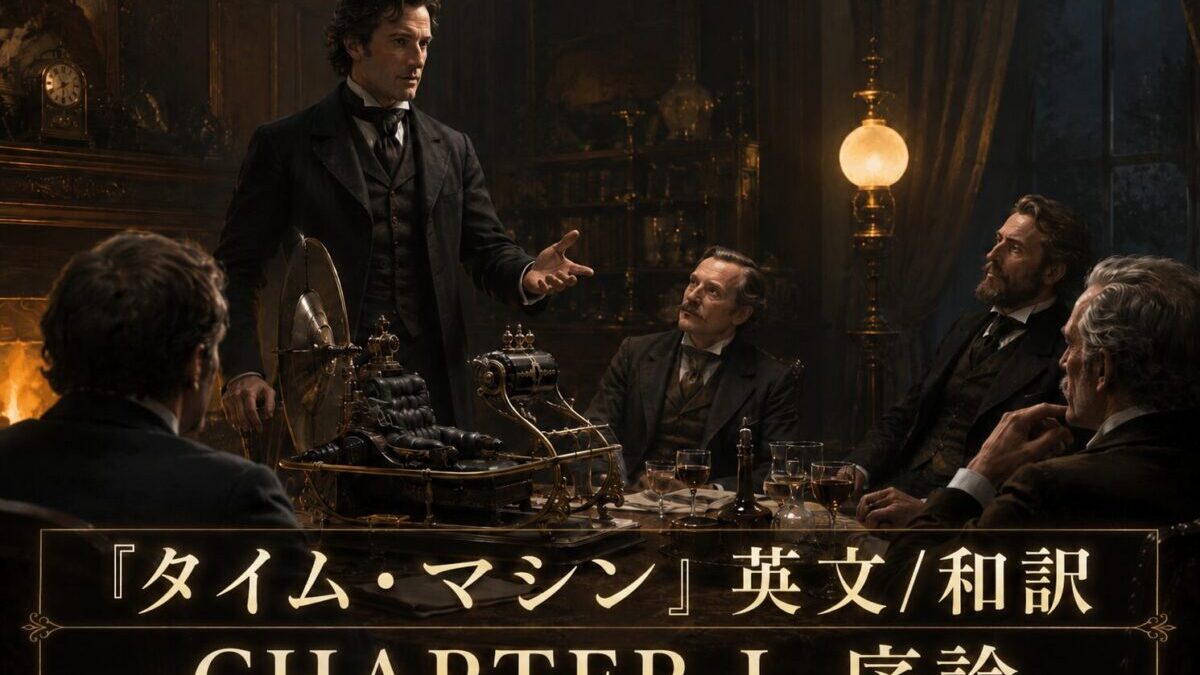
CHAPTER I のポイント
第1章では、時間旅行者が食後の客たちを前に、時間とは空間と同じような「第四の次元」であるという考えを語り始めます。長さ・幅・厚みだけでは現実の物体は成り立たず、そこには必ず「持続する時間」が必要だという議論が展開されます。
物語はまだ冒険に入らず、まず科学的な会話と知的な緊張感で読者を引き込みます。時間を移動できるのかという問いが、この先に登場するタイム・マシンの理論的な土台となり、SFらしい不思議さと説得力を同時に作っています。
この章の英語学習ポイントを開く
- expounding:説明している。時間旅行者が難しい理論を語り始める場面を示す重要語。
- recondite:難解な、奥深い。この章全体の科学的・哲学的な雰囲気を表す語。
- paradox:逆説。一見矛盾して見える考えを通して、時間旅行の発想へ読者を導く語。
- dimension:次元。時間を第四の次元として考える、この章の中心概念。
- duration:持続、継続時間。物体が現実に存在するには時間的な広がりが必要だという議論で重要。
『タイム・マシン』のカラフル対訳について
カラフル対訳で紹介しているH. G. Wells『タイム・マシン』は、パブリックドメインの作品を出典としています。
このサイトで使われている原文は、著作権の切れた名作などの全文を電子化し、インターネット上で公開している Project Gutenberg(プロジェクト・グーテンベルク)、 および朗読音声を公開している LibriVox(リブリヴォックス/朗読図書館) の作品を出典としています。
『タイム・マシン』は、時間旅行という発想を通して、人類の未来、文明の進歩、社会の分裂、そして遠い未来の地球の姿を描いた古典的SF作品です。 カラフル対訳では、英文を読みやすくするために、重要語句や表現を色分けしながら紹介しています。
原文はProject Gutenberg、音声はLibriVoxで公開されているパブリックドメイン作品を出典としています。 本ページでは、英語学習用に英文・和訳・重要表現の色分けを加えた形で紹介しています。
『タイム・マシン』英文/和訳 CHAPTER I Introduction 序論
H. G. Wells『The Time Machine』第1章「Introduction」を、英語を読みながら意味を直感的につかめるように、重要語句を多めに色分けした英文・和訳形式に整えています。
The Time Traveller (for so it will be convenient to speak of him) was expounding a recondite matter to us.
時間旅行者――そう呼ぶのが都合がよいので、彼をそう呼ぶことにする――は、私たちに難解な問題を説明していた。
His pale grey eyes shone and twinkled, and his usually pale face was flushed and animated.
彼の淡い灰色の目は輝き、きらめいていた。そして、ふだんは青白い顔も紅潮し、生き生きとしていた。
The fire burnt brightly, and the soft radiance of the incandescent lights in the lilies of silver caught the bubbles that flashed and passed in our glasses.
火は明るく燃え、銀の百合の形をした白熱灯の柔らかな光が、私たちのグラスの中で弾けては消えていく泡を照らしていた。
Our chairs, being his patents, embraced and caressed us rather than submitted to be sat upon.
私たちの椅子は、彼の特許品で、ただ座られるものというより、私たちを包み込み、やさしく受け止めるようなものだった。
And there was that luxurious after-dinner atmosphere, when thought runs gracefully free of the trammels of precision.
そこには、食後特有のぜいたくな空気があった。厳密さの束縛から思考が優雅に解き放たれる、あの雰囲気である。
And he put it to us in this way—marking the points with a lean forefinger—as we sat and lazily admired his earnestness over this new paradox and his fecundity.
そして彼は、細い人差し指で要点を示しながら、次のように語った。私たちは腰を下ろしたまま、この新しい逆説に対する彼の真剣さと豊かな発想力に、気だるく感心していた。
“You must follow me carefully. I shall have to controvert one or two ideas that are almost universally accepted.
「どうか注意深く聞いてください。私は、ほとんど誰もが受け入れている一つか二つの考えに、反論しなければなりません。
The geometry, for instance, they taught you at school is founded on a misconception.”
たとえば、学校で教わった幾何学は、誤解の上に成り立っているのです」
“Is not that rather a large thing to expect us to begin upon?” said Filby, an argumentative person with red hair.
「それは、いきなり私たちに求めるには、少し大きすぎる話ではありませんか」と、赤毛で議論好きのフィルビーが言った。
“I do not mean to ask you to accept anything without reasonable ground for it.
「私は、合理的な根拠なしに何かを受け入れてほしいと言っているのではありません。
You will soon admit as much as I need from you.
あなたがたはまもなく、私に必要な範囲のことは認めてくれるでしょう。
You know of course that a mathematical line, a line of thickness nil, has no real existence.
もちろん、数学上の線、つまり厚みがゼロの線には、現実の存在がないことはご存じですね。
They taught you that? Neither has a mathematical plane. These things are mere abstractions.”
そう教わりましたね? 数学上の平面にも、同じく現実の存在はありません。これらは単なる抽象物なのです」
“That is all right,” said the Psychologist.
「それはよろしい」と心理学者が言った。
“Nor, having only length, breadth, and thickness, can a cube have a real existence.”
「また、長さ、幅、厚みだけしか持たない立方体も、現実には存在できません」
“There I object,” said Filby. “Of course a solid body may exist. All real things—”
「そこには異議があります」とフィルビーが言った。「もちろん、立体は存在し得るでしょう。現実のものはすべて――」
“So most people think. But wait a moment. Can an instantaneous cube exist?”
「たいていの人はそう考えます。しかし、少し待ってください。瞬間だけ存在する立方体というものは存在できるでしょうか」
“Don’t follow you,” said Filby.
「おっしゃる意味がわかりません」とフィルビーが言った。
“Can a cube that does not last for any time at all, have a real existence?”
「まったく時間的に持続しない立方体が、現実に存在できるでしょうか」
Filby became pensive.
フィルビーは考え込んだ。
“Clearly,” the Time Traveller proceeded, “any real body must have extension in four directions: it must have Length, Breadth, Thickness, and—Duration.
「明らかに」と時間旅行者は続けた。「現実の物体は、四つの方向に広がりを持たなければなりません。すなわち、長さ、幅、厚み、そして――持続時間です。
But through a natural infirmity of the flesh, which I will explain to you in a moment, we incline to overlook this fact.
しかし、肉体に備わった自然な弱さのために――それはすぐ説明しますが――私たちはこの事実を見落としがちなのです。
There are really four dimensions, three which we call the three planes of Space, and a fourth, Time.
実際には四つの次元があります。そのうち三つは、私たちが空間の三つの面と呼ぶものです。そして四つ目が、時間です。
There is, however, a tendency to draw an unreal distinction between the former three dimensions and the latter.
しかし、人は前者の三つの次元と後者の時間とのあいだに、実在しない区別を引いてしまう傾向があります。
Because it happens that our consciousness moves intermittently in one direction along the latter from the beginning to the end of our lives.”
それは、私たちの意識が人生の始まりから終わりまで、時間という後者の次元に沿って、一方向へ断続的に動いているからにすぎません」
“That,” said a very young man, making spasmodic efforts to relight his cigar over the lamp; “that . . . very clear indeed.”
「それは」と、とても若い男がランプの上で葉巻に火をつけ直そうとぎこちなく努力しながら言った。「それは……実に明快ですね」
“Now, it is very remarkable that this is so extensively overlooked,” continued the Time Traveller, with a slight accession of cheerfulness.
「さて、これほどまでに広く見落とされているというのは、実に注目すべきことです」と時間旅行者は、少し陽気さを増して続けた。
“Really this is what is meant by the Fourth Dimension, though some people who talk about the Fourth Dimension do not know they mean it.
「実際、これこそが第四次元という言葉の意味なのです。もっとも、第四次元について語る人の中には、自分が何を意味しているのかわかっていない人もいますが。
It is only another way of looking at Time. There is no difference between Time and any of the three dimensions of Space except that our consciousness moves along it.
それは時間を別の見方で見たものにすぎません。時間と空間の三つの次元とのあいだに違いはありません。ただ、私たちの意識がその上を進んでいるという点だけが違うのです。
But some foolish people have got hold of the wrong side of that idea.
しかし、愚かな人々の中には、その考えの間違った側だけをつかんでしまった者もいます。
You have all heard what they have to say about this Fourth Dimension?”
この第四次元について彼らが何を言っているか、皆さんもお聞きになったことがあるでしょう」
“I have not,” said the Provincial Mayor.
「私はありません」と地方市長が言った。
“It is simply this. That Space, as our mathematicians have it, is spoken of as having three dimensions, which one may call Length, Breadth, and Thickness.
「それは簡単に言えばこうです。数学者たちの考える空間は、三つの次元を持つものとして語られます。つまり、長さ、幅、厚みです。
And is always definable by reference to three planes, each at right angles to the others.
そして空間は、互いに直角に交わる三つの平面を基準にして、常に定義できるものとされます。
But some philosophical people have been asking why three dimensions particularly—why not another direction at right angles to the other three?
しかし、哲学的な人々の中には、なぜ特に三つの次元なのか、なぜ他の三つに直角なもう一つの方向があってはいけないのか、と問い始めた者がいます。
And have even tried to construct a Four-Dimensional geometry.
そして、四次元幾何学を構築しようとさえしたのです。
Professor Simon Newcomb was expounding this to the New York Mathematical Society only a month or so ago.
サイモン・ニューカム教授は、ほんの一か月ほど前に、ニューヨーク数学協会でこのことを説明していました。
You know how on a flat surface, which has only two dimensions, we can represent a figure of a three-dimensional solid.
二つの次元しか持たない平面の上に、三次元の立体の図を表すことができるのはご存じでしょう。
And similarly they think that by models of three dimensions they could represent one of four—if they could master the perspective of the thing. See?”
それと同じように、もしその見方を理解できれば、三次元の模型によって四次元のものを表せると彼らは考えているのです。わかりますか」
“I think so,” murmured the Provincial Mayor; and, knitting his brows, he lapsed into an introspective state.
「わかったように思います」と地方市長はつぶやいた。そして眉を寄せ、内省的な状態に陥った。
His lips moving as one who repeats mystic words. “Yes, I think I see it now,” he said after some time, brightening in a quite transitory manner.
彼の唇は、神秘的な言葉を繰り返す人のように動いていた。「ええ、今はわかったように思います」と、しばらくして彼は言い、ごく一時的に表情を明るくした。
“Well, I do not mind telling you I have been at work upon this geometry of Four Dimensions for some time.
「さて、申し上げてもかまいませんが、私はしばらくのあいだ、この四次元の幾何学に取り組んできました。
Some of my results are curious. For instance, here is a portrait of a man at eight years old, another at fifteen, another at seventeen, another at twenty-three, and so on.
その成果の中には、興味深いものもあります。たとえば、ここに一人の男の八歳の肖像、十五歳の肖像、十七歳の肖像、二十三歳の肖像、という具合にあるとします。
All these are evidently sections, as it were, Three-Dimensional representations of his Four-Dimensioned being, which is a fixed and unalterable thing.
これらはすべて、言ってみれば、彼の四次元的な存在の断面、つまり三次元的な表現なのです。その四次元的存在は、固定され、変えることのできないものです。
“Scientific people,” proceeded the Time Traveller, after the pause required for the proper assimilation of this, “know very well that Time is only a kind of Space.
「科学に携わる人々は」と、この考えを十分に理解させるための間を置いてから、時間旅行者は続けた。「時間が一種の空間にすぎないことをよく知っています。
Here is a popular scientific diagram, a weather record. This line I trace with my finger shows the movement of the barometer.
ここに一般的な科学図表、つまり気象記録があるとします。私が指でたどるこの線は、気圧計の動きを示しています。
Yesterday it was so high, yesterday night it fell, then this morning it rose again, and so gently upward to here.
昨日はこれほど高く、昨夜は下がり、そして今朝また上がり、そこからゆるやかにここまで上昇しました。
Surely the mercury did not trace this line in any of the dimensions of Space generally recognised?
確かに、水銀は一般に認められている空間のどの次元においても、この線を描いたわけではありません。
But certainly it traced such a line, and that line, therefore, we must conclude, was along the Time-Dimension.”
しかし、それがそのような線を描いたことは確かです。したがって、その線は時間次元に沿ったものだったと結論しなければなりません」
“But,” said the Medical Man, staring hard at a coal in the fire, “if Time is really only a fourth dimension of Space, why is it, and why has it always been, regarded as something different?
「しかし」と医師は、火の中の石炭をじっと見つめながら言った。「もし時間が本当に空間の第四の次元にすぎないのなら、なぜそれは、そしてなぜこれまでずっと、それとは別のものと見なされてきたのでしょうか。
And why cannot we move in Time as we move about in the other dimensions of Space?”
そして、なぜ私たちは空間の他の次元を動き回るように、時間の中を移動できないのでしょうか」
The Time Traveller smiled. “Are you so sure we can move freely in Space?
時間旅行者は微笑んだ。「私たちが空間を自由に動けると、それほど確信していますか。
Right and left we can go, backward and forward freely enough, and men always have done so.
右へも左へも行けますし、前へも後ろへもかなり自由に動けます。人間はいつもそうしてきました。
I admit we move freely in two dimensions. But how about up and down? Gravitation limits us there.”
二つの次元では自由に動けると認めましょう。しかし、上下はどうでしょう。そこでは重力が私たちを制限しています」
“Not exactly,” said the Medical Man. “There are balloons.”
「正確にはそうではありません」と医師が言った。「気球があります」
“But before the balloons, save for spasmodic jumping and the inequalities of the surface, man had no freedom of vertical movement.”
「しかし気球以前には、ぎこちなく跳ぶことや、地表のでこぼこを除けば、人間には垂直方向の移動の自由はありませんでした」
“Still they could move a little up and down,” said the Medical Man.
「それでも少しは上下に動けたでしょう」と医師が言った。
“Easier, far easier down than up.”
「下へ行くほうが、上へ行くよりはるかに簡単です」
“And you cannot move at all in Time, you cannot get away from the present moment.”
「そして時間の中ではまったく動けません。現在の瞬間から逃れることはできないのです」
“My dear sir, that is just where you are wrong. That is just where the whole world has gone wrong.
「いや、それこそがあなたの間違っているところです。世界中が間違ってきたのも、まさにそこなのです。
We are always getting away from the present moment.
私たちは常に、現在の瞬間から離れていっているのです。
Our mental existences, which are immaterial and have no dimensions, are passing along the Time-Dimension with a uniform velocity from the cradle to the grave.
私たちの精神的存在は、非物質的で次元を持たないものですが、ゆりかごから墓場まで、一定の速度で時間次元に沿って進んでいます。
Just as we should travel down if we began our existence fifty miles above the earth’s surface.”
それは、もし私たちが地表から五十マイル上空で存在を始めたなら、下へ向かって進むであろうのと同じことです」
“But the great difficulty is this,” interrupted the Psychologist. “You can move about in all directions of Space, but you cannot move about in Time.”
「しかし、大きな問題はここです」と心理学者が口を挟んだ。「空間のあらゆる方向には動けますが、時間の中を動き回ることはできません」
“That is the germ of my great discovery. But you are wrong to say that we cannot move about in Time.
「それこそが、私の大発見の萌芽なのです。しかし、私たちは時間の中を動き回れないと言うのは間違いです。
For instance, if I am recalling an incident very vividly I go back to the instant of its occurrence.
たとえば、ある出来事を非常に生き生きと思い出すとき、私はその出来事が起こった瞬間へ戻っています。
I become absent-minded, as you say. I jump back for a moment.
あなたがたの言うように、私はぼんやりする。つまり、私は一瞬だけ戻っているのです。
Of course we have no means of staying back for any length of Time, any more than a savage or an animal has of staying six feet above the ground.
もちろん、私たちには一定の時間だけ過去に留まる手段はありません。未開人や動物が地上六フィートの高さに留まり続ける手段を持たないのと同じです。
But a civilised man is better off than the savage in this respect.
しかし、この点では、文明人は未開人よりも恵まれています。
He can go up against gravitation in a balloon, and why should he not hope that ultimately he may be able to stop or accelerate his drift along the Time-Dimension, or even turn about and travel the other way?”
文明人は気球に乗って重力に逆らって上昇できます。ならば、時間次元に沿った自分の流れを止めたり、加速したり、さらには向きを変えて反対方向へ旅したりできるようになると期待してはいけない理由があるでしょうか」
“Oh, this,” began Filby, “is all—”
「いや、これは」とフィルビーが言いかけた。「まったく――」
“Why not?” said the Time Traveller.
「なぜです」と時間旅行者が言った。
“It’s against reason,” said Filby.
「理性に反しています」とフィルビーが言った。
“What reason?” said the Time Traveller.
「何の理性ですか」と時間旅行者が言った。
“You can show black is white by argument,” said Filby, “but you will never convince me.”
「議論によって黒を白だと示すことはできるでしょう」とフィルビーは言った。「しかし、私を納得させることは決してできません」
“Possibly not,” said the Time Traveller. “But now you begin to see the object of my investigations into the geometry of Four Dimensions.
「おそらく無理でしょう」と時間旅行者は言った。「しかし、これであなたがたにも、私が四次元の幾何学を研究している目的が見え始めたはずです。
Long ago I had a vague inkling of a machine—”
ずっと以前から、私はある機械についてぼんやりとした予感を持っていました――」
“To travel through Time!” exclaimed the Very Young Man.
「時間を旅するための!」と、とても若い男が叫んだ。
“That shall travel indifferently in any direction of Space and Time, as the driver determines.”
「操縦者が決めるままに、空間と時間のどの方向へも同じように旅する機械です」
Filby contented himself with laughter.
フィルビーは、ただ笑うことで満足した。
“But I have experimental verification,” said the Time Traveller.
「しかし、私には実験による証明があります」と時間旅行者が言った。
“It would be remarkably convenient for the historian,” the Psychologist suggested.
「それは歴史家にとって、非常に便利でしょうね」と心理学者が言った。
“One might travel back and verify the accepted account of the Battle of Hastings, for instance!”
「たとえば、過去に戻ってヘイスティングズの戦いについて一般に受け入れられている説明を検証できるかもしれません」
“Don’t you think you would attract attention?” said the Medical Man. “Our ancestors had no great tolerance for anachronisms.”
「人目を引くとは思いませんか」と医師が言った。「私たちの祖先は、時代錯誤に対してあまり寛容ではありませんでしたから」
“One might get one’s Greek from the very lips of Homer and Plato,” the Very Young Man thought.
「ホメロスやプラトンの口から直接ギリシア語を学べるかもしれません」と、とても若い男は考えた。
“In which case they would certainly plough you for the Little-go. The German scholars have improved Greek so much.”
「その場合、彼らはきっとあなたをリトルゴー試験で落とすでしょう。ドイツの学者たちがギリシア語をずいぶん改良してしまいましたからね」
“Then there is the future,” said the Very Young Man. “Just think! One might invest all one’s money, leave it to accumulate at interest, and hurry on ahead!”
「それに未来があります」と、とても若い男が言った。「考えてみてください。全財産を投資して、利子で増えるままにしておき、それから未来へ急いで行けばいいのです!」
“To discover a society,” said I, “erected on a strictly communistic basis.”
「そして、厳格な共産主義的基盤の上に築かれた社会を発見するわけですね」と私は言った。
“Of all the wild extravagant theories!” began the Psychologist.
「なんという途方もない理論だ!」と心理学者が言い始めた。
“Yes, so it seemed to me, and so I never talked of it until—”
「ええ、私にもそう思えました。だから私は、これまでそれについて話したことがなかったのです。――ただし」
“Experimental verification!” cried I. “You are going to verify that?”
「実験による証明ですって!」と私は叫んだ。「それを証明しようというのですか」
“The experiment!” cried Filby, who was getting brain-weary.
「実験だ!」と、頭が疲れてきたフィルビーが叫んだ。
“Let’s see your experiment anyhow,” said the Psychologist, “though it’s all humbug, you know.”
「とにかく、その実験を見せてもらいましょう」と心理学者は言った。「もちろん、全部でたらめでしょうけれど」
The Time Traveller smiled round at us.
時間旅行者は、私たちを見回して微笑んだ。
Then, still smiling faintly, and with his hands deep in his trousers pockets, he walked slowly out of the room.
それから、なおかすかに微笑みながら、ズボンのポケットに深く手を入れ、彼はゆっくりと部屋を出ていった。
And we heard his slippers shuffling down the long passage to his laboratory.
そして、彼のスリッパが長い廊下をすり足で進み、実験室へ向かう音が聞こえた。
The Psychologist looked at us. “I wonder what he’s got?”
心理学者は私たちを見た。「彼は何を持っているのでしょうね」
“Some sleight-of-hand trick or other,” said the Medical Man.
「何か手品の類でしょう」と医師が言った。
And Filby tried to tell us about a conjuror he had seen at Burslem, but before he had finished his preface the Time Traveller came back, and Filby’s anecdote collapsed.
そしてフィルビーは、バースレムで見た手品師の話をしようとしたが、その前置きが終わる前に時間旅行者が戻ってきたため、フィルビーの逸話はそこで崩れてしまった。