
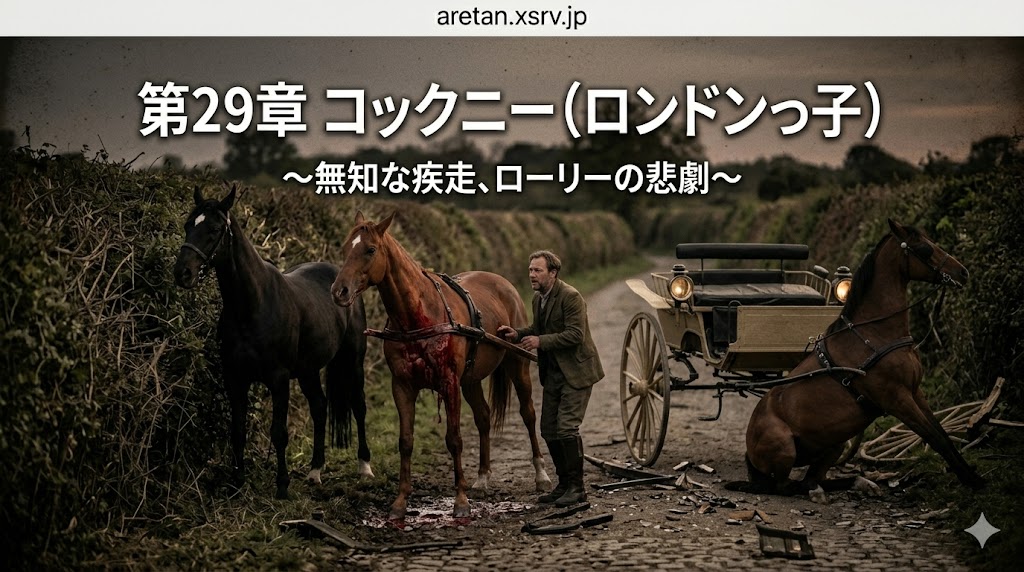
CHAPTER XXIX:コックニー のポイント
第29章では、ブラック・ビューティーが馬の扱いに慣れていない都会育ちの客たちに使われます。彼らは馬車を借りて楽しもうとしますが、手綱の扱いも馬の疲れ具合もよくわからず、ブラック・ビューティーに余計な負担をかけてしまいます。
読みどころは、悪意がなくても、無知と軽い気持ちが馬を苦しめるという点です。貸し馬として働くブラック・ビューティーは、使う人間を選べない立場にあり、人間の知識不足や無責任さがそのまま動物の苦痛につながる現実が描かれます。
この章の英語学習ポイントを開く
- Cockney:ロンドン下町の人、都会育ちの人。この章では、馬の扱いに不慣れな客を示す語として重要です。
- reins:手綱。馬を正しく導けるかどうかが、ブラック・ビューティーの負担に直結します。
- ignorant:無知な、知らない。悪意ではなく知識不足が馬を苦しめるという主題を表します。
- hire:借りる、雇う。貸し馬として一時的な客に使われる立場を理解するための語です。
- roughly:乱暴に、雑に。慣れない人間の扱いが馬に与える不快さや危険を表します。
カラフル対訳で紹介している作品について
カラフル対訳で紹介している作品は、すべてパブリックドメインの作品です。
このサイトで使われている作品は、著作権の切れた名作などの全文を電子化し、インターネット上で公開している Project Gutenberg(プロジェクト・グーテンベルク)、 および朗読音声を公開している LibriVox(リブリヴォックス/朗読図書館) の作品を出典としています。
原文はProject Gutenberg、音声はLibriVoxで公開されているパブリックドメイン作品を出典としています。
『黒馬物語』Chapter XXIX: Cockneys
『黒馬物語』第29章「町育ちの人たち」を、英単語の意味が直感的に入るように色分けしながら、英文と日本語訳をセットで読める形式に整えています。
表示切替
カテゴリ別ハイライト
Then there is the steam-engine style of driving.
それから、蒸気機関車式の運転というものがあります。
These drivers were mostly people from towns, who never had a horse of their own and generally traveled by rail.
こうした御者たちはたいてい町の人で、自分の馬を持ったことがなく、普段は鉄道で移動している人たちでした。
They always seemed to think that a horse was something like a steam-engine, only smaller.
彼らはいつも、馬とは蒸気機関車のようなもので、ただ少し小さいだけだと思っているようでした。
At any rate, they think that if only they pay for it a horse is bound to go just as far and just as fast and with just as heavy a load as they please.
いずれにしても彼らは、料金さえ払えば、馬は自分たちの望むだけ遠くへ、望むだけ速く、望むだけ重い荷を引いて当然だと思っているのです。
And be the roads heavy and muddy, or dry and good; be they stony or smooth, uphill or downhill, it is all the same.
道が重くぬかるんでいようと、乾いてよい道であろうと、石だらけであろうと滑らかであろうと、上り坂であろうと下り坂であろうと、彼らにとってはすべて同じです。
On, on, on, one must go, at the same pace, with no relief and no consideration.
進め、進め、進め。同じ速さで進まなければならず、休みも思いやりもありません。
These people never think of getting out to walk up a steep hill.
こうした人たちは、急な坂を上るときに降りて歩くことなど決して考えません。
Oh, no, they have paid to ride, and ride they will!
いいえ、彼らは乗るためにお金を払ったのだから、乗るのです。
The horse? Oh, he’s used to it!
馬ですって? ああ、馬は慣れているのだ、というわけです。
What were horses made for, if not to drag people uphill?
馬は、人を坂の上まで引っ張るためでなければ、何のために作られたというのでしょうか。
Walk! A good joke indeed!
歩くですって! まったく冗談でしょう、というわけです。
And so the whip is plied and the rein is chucked.
こうしてむちは振るわれ、手綱は乱暴に引かれます。
And often a rough, scolding voice cries out, “Go along, you lazy beast!”
そしてしばしば、荒々しく叱りつける声が「進め、この怠けた獣め!」と叫びます。
And then another slash of the whip, when all the time we are doing our very best to get along.
そしてまたむちの一撃です。私たちはずっと、進むために全力を尽くしているというのに。
Uncomplaining and obedient, though often sorely harassed and down-hearted.
私たちは不満を言わず従順ですが、しばしばひどく苦しめられ、落ち込んでいるのです。
This steam-engine style of driving wears us up faster than any other kind.
この蒸気機関車式の運転は、ほかのどんな運転よりも早く私たちを消耗させます。
I would far rather go twenty miles with a good considerate driver than I would go ten with some of these.
私は、このような御者と十マイル行くよりも、思いやりのある良い御者と二十マイル行くほうがずっとよいと思います。
It would take less out of me.
そのほうが私の消耗は少ないのです。
Another thing, they scarcely ever put on the brake, however steep the downhill may be.
もう一つ、彼らは下り坂がどれほど急であっても、ほとんどブレーキをかけません。
And thus bad accidents sometimes happen.
そのため、ひどい事故が起こることがあります。
Or if they do put it on, they often forget to take it off at the bottom of the hill.
あるいは、たとえブレーキをかけたとしても、坂の下でそれを外すのをよく忘れます。
And more than once I have had to pull halfway up the next hill, with one of the wheels held by the brake.
そして私は何度も、車輪の一つがブレーキで押さえられたまま、次の坂を半分ほど引かなければならないことがありました。
Before my driver chose to think about it; and that is a terrible strain on a horse.
御者がようやくそのことを考えるまでです。そしてそれは馬にとってひどい負担です。
Then these cockneys, instead of starting at an easy pace, as a gentleman would do, generally set off at full speed from the very stable-yard.
また、こうした町育ちの人たちは、紳士ならするように楽な速度で出発するのではなく、たいてい馬小屋の中庭から全速力で走り出します。
And when they want to stop, they first whip us, and then pull up so suddenly that we are nearly thrown on our haunches.
そして止まりたいときには、まず私たちをむちで打ち、それから急に止めるので、私たちはほとんど尻もちをつきそうになります。
And our mouths jagged with the bit—they call that pulling up with a dash.
そして私たちの口ははみで傷つけられます。彼らはそれを「勢いよく止める」と呼ぶのです。
And when they turn a corner they do it as sharply as if there were no right side or wrong side of the road.
そして角を曲がるときには、道に正しい側も悪い側もないかのように、急に曲がります。
I well remember one spring evening I and Rory had been out for the day.
ある春の夕方のことを、私はよく覚えています。私とローリーは一日中外に出ていました。
Rory was the horse that mostly went with me when a pair was ordered, and a good honest fellow he was.
ローリーは、二頭立てが求められたときに、たいてい私と一緒に行く馬でした。そして彼は正直なよい仲間でした。
We had our own driver, and as he was always considerate and gentle with us, we had a very pleasant day.
私たちには自分たちの御者がいて、彼はいつも私たちに思いやりがあり優しかったので、とても楽しい一日でした。
We were coming home at a good smart pace, about twilight.
私たちは夕暮れごろ、きびきびしたよい速度で家へ帰っていました。
Our road turned sharp to the left.
私たちの道は左へ急に曲がっていました。
But as we were close to the hedge on our own side, and there was plenty of room to pass, our driver did not pull us in.
しかし私たちは自分たちの側の生け垣近くにおり、通る余地が十分あったため、御者は私たちを引き寄せませんでした。
As we neared the corner I heard a horse and two wheels coming rapidly down the hill toward us.
私たちが角に近づくと、馬と二輪馬車が丘を下って急速にこちらへ向かってくる音が聞こえました。
The hedge was high, and I could see nothing, but the next moment we were upon each other.
生け垣は高く、私は何も見えませんでした。しかし次の瞬間、私たちはぶつかりそうになっていました。
Happily for me, I was on the side next the hedge.
幸い私にとって、私は生け垣に近い側にいました。
Rory was on the left side of the pole, and had not even a shaft to protect him.
ローリーは馬車のながえの左側におり、彼を守る車のながえさえありませんでした。
The man who was driving was making straight for the corner, and when he came in sight of us he had no time to pull over to his own side.
相手の御者は角へまっすぐ向かっており、私たちが見えたときには、自分の側へ寄せる時間がありませんでした。
The whole shock came upon Rory.
衝撃はすべてローリーにかかりました。
The gig shaft ran right into the chest, making him stagger back with a cry that I shall never forget.
二輪馬車のながえが彼の胸にまともに突き刺さり、彼は私が決して忘れられない叫び声を上げて、よろめいて後退しました。
The other horse was thrown upon his haunches and one shaft broken.
相手の馬は尻もちをつくように倒され、ながえの一本が折れました。
It turned out that it was a horse from our own stables, with the high-wheeled gig that the young men were so fond of.
それは、若者たちがとても気に入っていた車輪の高い二輪馬車で、私たちの馬小屋の馬だったことがわかりました。
The driver was one of those random, ignorant fellows, who don’t even know which is their own side of the road, or, if they know, don’t care.
その御者は、道のどちらが自分の側かさえ知らない、あるいは知っていても気にしない、いい加減で無知な者の一人でした。
And there was poor Rory with his flesh torn open and bleeding, and the blood streaming down.
そしてかわいそうなローリーは肉が裂けて開き、血を流し、その血が流れ落ちていました。
They said if it had been a little more to one side it would have killed him.
もしそれがもう少し横にずれていたら、彼は死んでいただろうと言われました。
And a good thing for him, poor fellow, if it had.
そして、かわいそうに、もしそうなっていたなら、そのほうが彼にとってよかったかもしれません。
As it was, it was a long time before the wound healed, and then he was sold for coal-carting.
実際には、傷が治るまで長い時間がかかり、その後、彼は石炭運搬用に売られました。
And what that is, up and down those steep hills, only horses know.
それが何を意味するのか、あの急な丘を上り下りすることがどれほど大変なのかは、馬にしかわかりません。
Some of the sights I saw there, where a horse had to come downhill with a heavily loaded two-wheel cart behind him, on which no brake could be placed, make me sad even now to think of.
そこで私が見た光景の中には、ブレーキをつけられない重く積まれた二輪荷車を背後に引いて、馬が下り坂を下らなければならないものがあり、今思い出しても悲しくなります。
After Rory was disabled I often went in the carriage with a mare named Peggy, who stood in the next stall to mine.
ローリーが働けない状態になったあと、私は隣の馬房にいたペギーという名の雌馬とよく馬車に入りました。
She was a strong, well-made animal, of a bright dun color, beautifully dappled, and with a dark-brown mane and tail.
彼女は強く、体格のよい馬で、明るい薄茶色をしており、美しい斑点模様があり、たてがみと尾は濃い茶色でした。
There was no high breeding about her, but she was very pretty and remarkably sweet-tempered and willing.
彼女に高貴な血統はありませんでしたが、とてもかわいらしく、驚くほど気立てが優しく、進んで働く馬でした。
Still, there was an anxious look about her eye, by which I knew that she had some trouble.
それでも、彼女の目には不安げな表情があり、それによって私は彼女に何か悩みがあることを知りました。
The first time we went out together I thought she had a very odd pace.
初めて一緒に出かけたとき、私は彼女の歩き方がとても奇妙だと思いました。
She seemed to go partly a trot, partly a canter, three or four paces, and then a little jump forward.
彼女は一部は速歩、一部は駆け足のように三、四歩進み、それから少し前へ跳ねるように見えました。
It was very unpleasant for any horse who pulled with her, and made me quite fidgety.
彼女と一緒に引く馬にとって、それはとても不快なもので、私もかなりそわそわしました。
When we got home I asked her what made her go in that odd, awkward way.
家に戻ると、私は彼女に、なぜそんな奇妙でぎこちない歩き方をするのか尋ねました。
“Ah,” she said in a troubled manner, “I know my paces are very bad, but what can I do?”
「ああ」と彼女は悩んだ様子で言いました。「自分の歩き方がとても悪いことはわかっているわ。でも、どうすればいいの?」
“It really is not my fault; it is just because my legs are so short.”
「それは本当に私の責任ではないの。私の脚がとても短いからなのよ」
“I stand nearly as high as you, but your legs are a good three inches longer above your knee than mine.”
「私はあなたとほとんど同じくらいの高さだけれど、あなたの脚は膝の上の部分が私よりたっぷり三インチ長いの」
“And of course you can take a much longer step and go much faster.”
「だから当然、あなたはずっと長い歩幅で進めるし、ずっと速く行けるのよ」
“You see I did not make myself. I wish I could have done so; I would have had long legs then.”
「私が自分で自分を作ったわけではないでしょう。もし自分で作れたならよかったのに。そうしたら長い脚にしたのに」
“All my troubles come from my short legs,” said Peggy, in a desponding tone.
「私の悩みはすべて短い脚から来るの」とペギーは落胆した調子で言いました。
“But how is it,” I said, “when you are so strong and good-tempered and willing?”
「でも、あなたはそんなに強く、気立てもよく、進んで働くのに、どうしてなの」と私は言いました。
“Why, you see,” said she, “men will go so fast, and if one can’t keep up to other horses it is nothing but whip, whip, whip, all the time.”
「だってね」と彼女は言いました。「人間はとても速く行きたがるの。そしてほかの馬についていけないと、ずっと、むち、むち、むちなのよ」
“And so I have had to keep up as I could, and have got into this ugly shuffling pace.”
「だから私は、できるだけついていかなければならず、この醜い足を引きずるような歩き方になってしまったの」
“It was not always so; when I lived with my first master I always went a good regular trot.”
「いつもこうだったわけではないの。最初の主人のもとにいたときは、私はいつも良い規則正しい速歩で進んでいたわ」
“But then he was not in such a hurry.”
「でも、その人はそんなに急いではいなかったの」
“He was a young clergyman in the country, and a good, kind master he was.”
「彼は田舎の若い聖職者で、とても良い、親切な主人だったわ」
“He had two churches a good way apart, and a great deal of work, but he never scolded or whipped me for not going faster.”
「彼はかなり離れた二つの教会を担当していて、仕事もたくさんあったけれど、もっと速く行けないからといって私を叱ったり、むち打ったりすることは決してなかったわ」
“He was very fond of me.”
「彼は私をとてもかわいがってくれたの」
“I only wish I was with him now; but he had to leave and go to a large town, and then I was sold to a farmer.”
「今も彼のところにいられたらよかったのに。でも彼は大きな町へ行かなければならなくなり、私は農夫に売られたの」
“Some farmers, you know, are capital masters; but I think this one was a low sort of man.”
「農夫の中にはすばらしい主人もいるでしょう。でもその人は、低俗な男だったと思うわ」
“He cared nothing about good horses or good driving; he only cared for going fast.”
「彼は良い馬のことも、良い運転のことも何も気にしなかった。ただ速く行くことだけを気にしていたの」
“I went as fast as I could, but that would not do, and he was always whipping.”
「私はできるだけ速く進んだけれど、それでは足りず、彼はいつもむちを打っていたわ」
“So I got into this way of making a spring forward to keep up.”
「だから私は、ついていくために跳ねるように前へ出る、この歩き方になってしまったの」
“On market nights he used to stay very late at the inn, and then drive home at a gallop.”
「市のある夜には、彼は宿屋にとても遅くまでいて、それから全速力で家へ帰ったものよ」
“One dark night he was galloping home as usual, when all of a sudden the wheel came against some great heavy thing in the road, and turned the gig over in a minute.”
「ある暗い夜、彼がいつものように駆け足で家へ帰っていると、突然、車輪が道にあった大きく重いものにぶつかり、二輪馬車はあっという間にひっくり返ったの」
“He was thrown out and his arm broken, and some of his ribs, I think.”
「彼は投げ出されて腕を折り、たぶん肋骨も何本か折ったと思うわ」
“At any rate, it was the end of my living with him, and I was not sorry.”
「いずれにしても、それで私が彼のもとで暮らすのは終わったの。私は少しも残念ではなかったわ」
“But you see it will be the same everywhere for me, if men must go so fast. I wish my legs were longer!”
「でもわかるでしょう。人間がそんなに速く行かなければならないなら、私にはどこへ行っても同じことなの。脚がもっと長ければよかったのに!」
Poor Peggy! I was very sorry for her, and I could not comfort her.
かわいそうなペギー! 私は彼女をとても気の毒に思いましたが、慰めることはできませんでした。
For I knew how hard it was upon slow-paced horses to be put with fast ones.
なぜなら、歩みの遅い馬が速い馬と組まされることがどれほどつらいか、私は知っていたからです。
All the whipping comes to their share, and they can’t help it.
むち打ちはすべて彼らのところへ来ます。そして彼らにはどうしようもないのです。
She was often used in the phaeton, and was very much liked by some of the ladies, because she was so gentle.
彼女はよく四輪軽馬車に使われ、たいへんおとなしかったので、何人かの婦人たちにとても好かれていました。
And some time after this she was sold to two ladies who drove themselves, and wanted a safe, good horse.
そしてしばらくして、彼女は自分たちで馬車を運転する二人の婦人に売られました。彼女たちは安全で良い馬を欲しがっていたのです。
I met her several times out in the country, going a good steady pace, and looking as gay and contented as a horse could be.
私は田舎で何度か彼女に会いました。彼女は安定したよい速度で進み、馬としてあり得るかぎり陽気で満足そうに見えました。
I was very glad to see her, for she deserved a good place.
私は彼女に会えてとてもうれしく思いました。彼女は良い場所にふさわしい馬だったからです。
After she left us another horse came in her stead.
彼女が私たちのもとを去ったあと、別の馬が彼女の代わりに来ました。
He was young, and had a bad name for shying and starting, by which he had lost a good place.
彼は若く、物に驚いたり急に動いたりするという悪い評判があり、そのために良い場所を失っていました。
I asked him what made him shy.
私は彼に、なぜ物に驚くのか尋ねました。
“Well, I hardly know,” he said.
「うーん、よくわからないんだ」と彼は言いました。
“I was timid when I was young, and was a good deal frightened several times.”
「僕は若いころ臆病で、何度かかなり怖い思いをしたんだ」
“And if I saw anything strange I used to turn and look at it.”
「そして何か見慣れないものを見ると、向きを変えてそれを見ていたんだ」
“You see, with our blinkers one can’t see or understand what a thing is unless one looks round.”
「わかるだろう。目隠しをつけていると、振り向いて見ないかぎり、それが何なのか見えないし理解できないんだ」
“And then my master always gave me a whipping, which of course made me start on, and did not make me less afraid.”
「すると主人はいつも僕をむち打った。もちろんそれで僕は飛び出したけれど、怖くなくなるわけではなかった」
“I think if he would have let me just look at things quietly, and see that there was nothing to hurt me, it would have been all right.”
「もし主人が、僕にただ静かにそれを見させて、害を与えるものではないとわからせてくれていたら、大丈夫だったと思う」
“And I should have got used to them.”
「そして僕はそれらに慣れていったはずなんだ」
“One day an old gentleman was riding with him, and a large piece of white paper or rag blew across just on one side of me.”
「ある日、年配の紳士が主人と一緒に乗っていたとき、大きな白い紙かぼろ布が、僕のすぐ横を吹き抜けたんだ」
“I shied and started forward.”
「僕は驚いて、前へ飛び出した」
“My master as usual whipped me smartly, but the old man cried out, ‘You’re wrong! you’re wrong!’”
「主人はいつものように僕を鋭くむち打った。でもその老人は叫んだ。『それは間違っている! 間違っている!』と」
“‘You should never whip a horse for shying; he shies because he is frightened, and you only frighten him more and make the habit worse.’”
「『馬が物に驚いたからといって、決してむち打ってはいけない。馬は怖いから驚くのだ。むち打てばさらに怖がらせ、その癖を悪くするだけだ』」
“So I suppose all men don’t do so.”
「だから、すべての人間がそうするわけではないのだと思う」
“I am sure I don’t want to shy for the sake of it.”
「僕は、好きで物に驚きたいわけではないんだ」
“But how should one know what is dangerous and what is not, if one is never allowed to get used to anything?”
「でも、何にも慣れることを許されなければ、何が危険で何が危険でないか、どうやって知ればいいのだろう」
“I am never afraid of what I know.”
「僕は、知っているものを怖がることは決してない」
“Now I was brought up in a park where there were deer; of course I knew them as well as I did a sheep or a cow.”
「僕は鹿のいる公園で育ったんだ。だから当然、羊や牛と同じくらい鹿のことを知っていた」
“But they are not common, and I know many sensible horses who are frightened at them.”
「でも鹿はどこにでもいるものではないから、鹿を怖がる分別ある馬もたくさん知っている」
“And who kick up quite a shindy before they will pass a paddock where there are deer.”
「そして鹿のいる囲い地を通り過ぎる前に、かなり大騒ぎする馬たちもいるんだ」
I knew what my companion said was true, and I wished that every young horse had as good masters as Farmer Grey and Squire Gordon.
私はその仲間の言ったことが本当だとわかりました。そして、すべての若い馬がグレイ農場主やゴードン氏のような良い主人を持てたらよいのにと思いました。
Of course we sometimes came in for good driving here.
もちろん、ここでも時には良い運転に出会うことがありました。
I remember one morning I was put into the light gig, and taken to a house in Pulteney Street.
ある朝、私は軽い二輪馬車につながれ、パルトニー通りの家へ連れて行かれたことを覚えています。
Two gentlemen came out; the taller of them came round to my head.
二人の紳士が出てきました。そのうち背の高いほうが、私の頭のところへ回ってきました。
He looked at the bit and bridle, and just shifted the collar with his hand, to see if it fitted comfortably.
彼ははみと手綱を見て、首輪が快適に合っているか確かめるために、手で少し位置を直しました。
“Do you consider this horse wants a curb?” he said to the hostler.
「この馬にくつわ鎖が必要だと思いますか」と彼は馬丁に言いました。
“Well,” said the man, “I should say he would go just as well without.”
「そうですね」と男は言いました。「なくても同じようによく進むと思います」
“He has an uncommon good mouth, and though he has a fine spirit he has no vice.”
「この馬の口は非常に良いですし、立派な気性はありますが、悪癖はありません」
“But we generally find people like the curb.”
「ただ、たいていの人はくつわ鎖を好むのです」
“I don’t like it,” said the gentleman.
「私はそれが好きではありません」と紳士は言いました。
“Be so good as to take it off, and put the rein in at the cheek.”
「どうかそれを外して、手綱を頬革のところに通してください」
“An easy mouth is a great thing on a long journey, is it not, old fellow?” he said, patting my neck.
「長い旅では扱いやすい口というのは大事なものだよな、相棒」と彼は私の首をなでながら言いました。
Then he took the reins, and they both got up.
それから彼は手綱を取り、二人とも乗り込みました。
I can remember now how quietly he turned me round.
私は今でも、彼がどれほど静かに私の向きを変えたかを覚えています。
And then with a light feel of the rein, and drawing the whip gently across my back, we were off.
それから軽い手綱の感触と、背中をそっと横切るむちの合図で、私たちは出発しました。
I arched my neck and set off at my best pace.
私は首を弓なりにし、最高の歩調で出発しました。
I found I had some one behind me who knew how a good horse ought to be driven.
私は、自分の後ろに、良い馬をどのように運転すべきか知っている人がいることに気づきました。
It seemed like old times again, and made me feel quite gay.
それは昔のよい時代が戻ってきたようで、私はとても陽気な気分になりました。
This gentleman took a great liking to me.
この紳士は私をたいへん気に入りました。
And after trying me several times with the saddle he prevailed upon my master to sell me to a friend of his, who wanted a safe, pleasant horse for riding.
そして、何度か鞍をつけて私を試したあと、彼は私の主人を説得して、安全で感じのよい乗用馬を欲しがっている友人に私を売らせました。
And so it came to pass that in the summer I was sold to Mr. Barry.
こうして夏に、私はバリー氏に売られることになりました。