
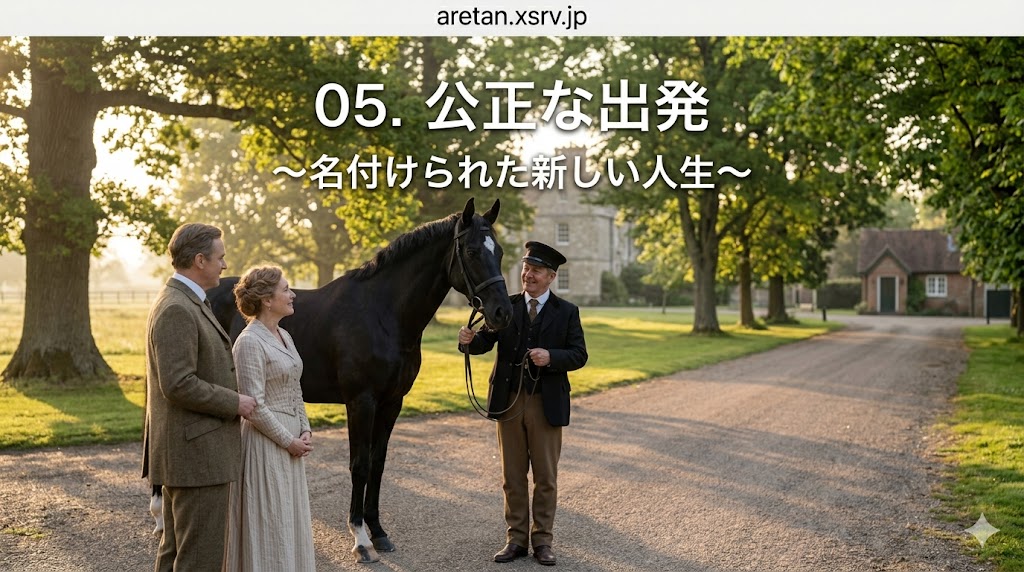
CHAPTER V:順調なスタート のポイント
第5章では、ブラック・ビューティーがバートウィックパークでの仕事に慣れ、新しい主人や馬丁たちのもとで落ち着いた日々を送り始めます。馬車を引く仕事や厩舎での暮らしを通して、彼は自分の役目を少しずつ理解していきます。
読みどころは、よい主人、よい馬丁、よい環境がそろったとき、馬がどれほど安心して力を発揮できるかが描かれる点です。この章は、後に訪れる厳しい扱いとの対比にもなり、ブラック・ビューティーにとって「幸せな働き方」の基準を示す章になっています。
この章の英語学習ポイントを開く
- fair start:順調な出発、公平な始まり。新しい生活がよい形で始まることを示す章題の中心表現です。
- carriage:馬車。ブラック・ビューティーの仕事を理解するうえで欠かせない語です。
- harness:馬具、馬車用の装具。働く馬としての役目と結びつく重要な道具です。
- steady:落ち着いた、安定した。信頼できる馬として成長していく様子を表すのに重要です。
- kind treatment:親切な扱い。馬の性格や働きぶりが、人間の接し方に左右されるというテーマを示します。
カラフル対訳で紹介している作品について
カラフル対訳で紹介している作品は、すべてパブリックドメインの作品です。
このサイトで使われている作品は、著作権の切れた名作などの全文を電子化し、インターネット上で公開している Project Gutenberg(プロジェクト・グーテンベルク)、 および朗読音声を公開している LibriVox(リブリヴォックス/朗読図書館) の作品を出典としています。
原文はProject Gutenberg、音声はLibriVoxで公開されているパブリックドメイン作品を出典としています。
『黒馬物語』Chapter V: A Fair Start
『黒馬物語』第5章を、英単語の意味が直感的に入るように色分けしながら、英文と日本語訳をセットで読める形式に整えています。
ボタンで和訳・色分け・日本語ミニ訳を切り替えられます。カテゴリを選ぶと、学習したい種類の表現だけを目立たせられます。
The name of the coachman was John Manly; he had a wife and one little child, and they lived in the coachman’s cottage, very near the stables.
御者の名前はジョン・マンリーでした。彼には妻と小さな子どもが一人いて、彼らは馬小屋のすぐ近くにある御者用の小屋に住んでいました。
The next morning he took me into the yard and gave me a good grooming.
翌朝、ジョンは私を庭へ連れていき、丁寧に手入れをしてくれました。
And just as I was going into my box, with my coat soft and bright, the squire came in to look at me, and seemed pleased.
そして、毛並みが柔らかく輝いた状態で私が馬房に入ろうとしていたちょうどその時、地主が私を見に入ってきて、満足しているようでした。
“John,” he said, “I meant to have tried the new horse this morning, but I have other business.”
「ジョン」と彼は言いました。「今朝、新しい馬を試してみるつもりだったが、ほかに用事がある」
“You may as well take him around after breakfast; go by the common and the Highwood, and back by the watermill and the river.”
「朝食のあとで、おまえが彼を一回りさせるとよい。共有地とハイウッドを通り、水車小屋と川のそばを通って戻ってきなさい」
“That will show his paces.”
「そうすれば、この馬の走りぶりがわかるだろう」
“I will, sir,” said John.
「承知しました」とジョンは言いました。
After breakfast he came and fitted me with a bridle.
朝食のあと、ジョンはやって来て、私に手綱をつけました。
He was very particular in letting out and taking in the straps, to fit my head comfortably.
彼は革ひもを緩めたり締めたりして、私の頭に心地よく合うように、とても細かく気を配ってくれました。
Then he brought a saddle, but it was not broad enough for my back.
それから彼は鞍を持ってきましたが、それは私の背には十分な幅がありませんでした。
He saw it in a minute and went for another, which fitted nicely.
彼はすぐにそれに気づき、別の鞍を取りに行きました。その鞍はぴったり合いました。
He rode me first slowly, then a trot, then a canter.
彼はまず私をゆっくり乗り、次に速歩、そして駆け足で走らせました。
And when we were on the common he gave me a light touch with his whip, and we had a splendid gallop.
そして共有地に出ると、彼はむちで軽く合図を送り、私たちはすばらしい疾走をしました。
“Ho, ho! my boy,” he said, as he pulled me up, “you would like to follow the hounds, I think.”
「ほう、ほう、坊や」と彼は私を引き止めながら言いました。「おまえは猟犬を追って走りたいのだろうな」
As we came back through the park we met the Squire and Mrs. Gordon walking; they stopped, and John jumped off.
公園を通って戻ってくると、歩いている地主とゴードン夫人に会いました。二人は立ち止まり、ジョンは馬から飛び降りました。
“Well, John, how does he go?”
「さて、ジョン、この馬の走りはどうだね」
“First-rate, sir,” answered John; “he is as fleet as a deer, and has a fine spirit too.”
「第一級です、旦那さま」とジョンは答えました。「この馬は鹿のように速く、気性も立派です」
“But the lightest touch of the rein will guide him.”
「それでいて、手綱をほんの軽く触れるだけで導くことができます」
“Down at the end of the common we met one of those traveling carts hung all over with baskets, rugs, and such like.”
「共有地の端のほうで、かごや敷物などをあちこちにぶら下げた旅の荷車に出会いました」
“You know, sir, many horses will not pass those carts quietly.”
「ご存じの通り、多くの馬はああいう荷車のそばを落ち着いて通れません」
“He just took a good look at it, and then went on as quiet and pleasant as could be.”
「この馬はただそれをよく見ただけで、その後はこの上なく静かで穏やかに進みました」
“They were shooting rabbits near the Highwood, and a gun went off close by.”
「ハイウッドの近くではウサギを撃っていて、すぐそばで銃が鳴りました」
“He pulled up a little and looked, but did not stir a step to right or left.”
「この馬は少し止まって見ましたが、右にも左にも一歩も動きませんでした」
“I just held the rein steady and did not hurry him.”
「私はただ手綱を一定に保ち、彼を急がせませんでした」
“And it’s my opinion he has not been frightened or ill-used while he was young.”
「私の考えでは、この馬は若いころに怖がらされたり、ひどく扱われたりしていません」
“That’s well,” said the squire, “I will try him myself to-morrow.”
「それはよいことだ」と地主は言いました。「明日は私自身が試してみよう」
The next day I was brought up for my master.
翌日、私は主人のために連れてこられました。
I remembered my mother’s counsel and my good old master’s, and I tried to do exactly what he wanted me to do.
私は母の忠告と、以前の良い主人の言葉を思い出し、彼が望むことを正確にしようと努めました。
I found he was a very good rider, and thoughtful for his horse too.
彼はとても上手な乗り手であり、馬に対しても思いやりのある人だとわかりました。
When he came home the lady was at the hall door as he rode up.
彼が家へ戻ってきたとき、馬で玄関に近づくと、夫人が屋敷の扉のところにいました。
“Well, my dear,” she said, “how do you like him?”
「ねえ、あなた」と夫人は言いました。「その馬はどうですか」
“He is exactly what John said,” he replied; “a pleasanter creature I never wish to mount.”
「ジョンの言った通りだ」と彼は答えました。「これ以上気持ちよく乗れる生き物を望むことはないね」
“What shall we call him?”
「この馬を何と呼ぼうか」
“Would you like Ebony?” said she; “he is as black as ebony.”
「エボニーはどうでしょう」と夫人は言いました。「この馬は黒檀のように黒いですから」
“No, not Ebony.”
「いや、エボニーではないな」
“Will you call him Blackbird, like your uncle’s old horse?”
「では、おじさまの昔の馬のように、ブラックバードと呼びますか」
“No, he is far handsomer than old Blackbird ever was.”
「いや、この馬は昔のブラックバードよりもはるかに美しい」
“Yes,” she said, “he is really quite a beauty, and he has such a sweet, good-tempered face, and such a fine, intelligent eye.”
「ええ」と夫人は言いました。「本当にとても美しい馬ですし、とても優しく気立てのよい顔をしています。それに立派で知的な目をしています」
“What do you say to calling him Black Beauty?”
「ブラック・ビューティと呼ぶのはどうでしょう」
“Black Beauty—why, yes, I think that is a very good name.”
「ブラック・ビューティ――なるほど、それはとてもよい名前だと思う」
“If you like it shall be his name;” and so it was.
「君が気に入ったなら、それをこの馬の名前にしよう」こうして、それが私の名前になりました。
When John went into the stable he told James that master and mistress had chosen a good, sensible English name for me, that meant something.
ジョンが馬小屋へ入ると、主人と奥さまが私に、意味のある、良くて分別のある英語の名前を選んだとジェームズに話しました。
Not like Marengo, or Pegasus, or Abdallah.
マレンゴやペガサスやアブダラのような名前ではない、というのです。
They both laughed, and James said, “If it was not for bringing back the past, I should have named him Rob Roy.”
二人は笑いました。そしてジェームズは言いました。「過去を思い出させるのでなければ、僕ならロブ・ロイと名づけたでしょう」
“For I never saw two horses more alike.”
「これほどよく似た二頭の馬を見たことがありませんから」
“That’s no wonder,” said John; “didn’t you know that Farmer Grey’s old Duchess was the mother of them both?”
「それも当然だ」とジョンは言いました。「グレイ農場主の年老いたダッチェスが、その二頭の母親だと知らなかったのか」
I had never heard that before; and so poor Rob Roy who was killed at that hunt was my brother!
私はそれをそれまで一度も聞いたことがありませんでした。そうすると、あの狩りで殺されたかわいそうなロブ・ロイは、私の兄弟だったのです。
I did not wonder that my mother was so troubled.
母があれほど心を痛めていたのも、不思議ではありませんでした。
It seems that horses have no relations; at least they never know each other after they are sold.
馬には家族というものがないようです。少なくとも、売られたあとには互いを知ることができません。
John seemed very proud of me; he used to make my mane and tail almost as smooth as a lady’s hair.
ジョンは私をとても誇りに思っているようでした。彼はよく私のたてがみと尾を、女性の髪のようになめらかにしてくれました。
And he would talk to me a great deal; of course I did not understand all he said.
そして彼は私にたくさん話しかけてくれました。もちろん、私は彼の言うことをすべて理解したわけではありません。
But I learned more and more to know what he meant, and what he wanted me to do.
しかし私は、彼が何を意味しているのか、そして私に何をしてほしいのかを、だんだん理解するようになりました。
I grew very fond of him, he was so gentle and kind.
私は彼のことが大好きになりました。彼はとても穏やかで親切だったからです。
He seemed to know just how a horse feels, and when he cleaned me he knew the tender places and the ticklish places.
彼は馬がどう感じるのかをよく知っているようでした。私を手入れするときにも、敏感な場所やくすぐったい場所をわかっていました。
When he brushed my head he went as carefully over my eyes as if they were his own, and never stirred up any ill-temper.
彼が私の頭をブラシでとかすときには、自分の目であるかのように私の目の周りを慎重に扱い、決して私の機嫌を損ねることはありませんでした。
James Howard, the stable boy, was just as gentle and pleasant in his way, so I thought myself well off.
馬小屋の少年ジェームズ・ハワードも、彼なりに同じくらい穏やかで感じがよかったので、私は自分が恵まれていると思いました。
There was another man who helped in the yard, but he had very little to do with Ginger and me.
庭仕事を手伝う別の男もいましたが、彼はジンジャーや私とはほとんど関わりがありませんでした。
A few days after this I had to go out with Ginger in the carriage.
その数日後、私はジンジャーと一緒に馬車を引いて出かけることになりました。
I wondered how we should get on together; but except laying her ears back when I was led up to her, she behaved very well.
私たちがうまくやっていけるだろうかと思いました。しかし、私が彼女のそばへ連れてこられたときに彼女が耳を後ろに伏せたことを除けば、彼女はとても行儀よくしていました。
She did her work honestly, and did her full share.
彼女は誠実に仕事をし、自分の分担を十分に果たしました。
And I never wish to have a better partner in double harness.
そして私は、二頭立て馬具で彼女以上によい相棒を望むことはありません。
When we came to a hill, instead of slackening her pace, she would throw her weight right into the collar, and pull away straight up.
丘に差しかかると、彼女は速度を落とすどころか、首輪に体重をしっかりかけて、まっすぐ上へ引いていきました。
We had both the same sort of courage at our work, and John had oftener to hold us in than to urge us forward.
私たちは仕事において同じ種類の勇気を持っていました。ジョンは、私たちを前へ促すよりも、抑えることのほうが多かったのです。
He never had to use the whip with either of us.
彼は私たちのどちらにも、むちを使う必要がありませんでした。
Then our paces were much the same, and I found it very easy to keep step with her when trotting.
また、私たちの歩調はよく似ていたので、速歩のときに彼女と歩調を合わせるのはとても簡単でした。
Which made it pleasant, and master always liked it when we kept step well, and so did John.
そのため気持ちよく走ることができました。私たちがうまく歩調を合わせると、主人はいつも喜び、ジョンも同じように喜びました。
After we had been out two or three times together we grew quite friendly and sociable, which made me feel very much at home.
二、三回一緒に出かけたあと、私たちはすっかり親しく、打ち解けるようになり、そのおかげで私はとてもくつろいだ気持ちになりました。
As for Merrylegs, he and I soon became great friends.
メリーレッグスについて言えば、彼と私はすぐに大の友だちになりました。
He was such a cheerful, plucky, good-tempered little fellow that he was a favorite with every one.
彼はとても陽気で、勇敢で、気立てのよい小さな馬だったので、みんなのお気に入りでした。
And especially with Miss Jessie and Flora, who used to ride him about in the orchard, and have fine games with him and their little dog Frisky.
特にジェシー嬢とフローラ嬢に気に入られていて、彼女たちはよく果樹園で彼に乗り、小さな犬フリスキーと一緒に楽しく遊んでいました。
Our master had two other horses that stood in another stable.
私たちの主人は、別の馬小屋に二頭のほかの馬を持っていました。
One was Justice, a roan cob, used for riding or for the luggage cart.
一頭はジャスティスという、葦毛混じりの小型馬で、乗馬用や荷物用の荷車に使われていました。
The other was an old brown hunter, named Sir Oliver.
もう一頭は、サー・オリヴァーという名の年老いた茶色の狩猟馬でした。
He was past work now, but was a great favorite with the master, who gave him the run of the park.
彼はもう仕事を引退していましたが、主人のお気に入りで、主人は彼に公園を自由に走り回らせていました。
He sometimes did a little light carting on the estate, or carried one of the young ladies when they rode out with their father.
彼は時々、屋敷で軽い荷車仕事をしたり、若いお嬢さまたちが父親と乗馬に出かけるときに、その一人を乗せたりしていました。
For he was very gentle and could be trusted with a child as well as Merrylegs.
彼はとても穏やかで、メリーレッグスと同じように、子どもを任せても安心できる馬だったからです。
The cob was a strong, well-made, good-tempered horse.
その小型馬は、強く、体格がよく、気立てのよい馬でした。
And we sometimes had a little chat in the paddock, but of course I could not be so intimate with him as with Ginger, who stood in the same stable.
私たちは時々、放牧場で少しおしゃべりをしました。しかしもちろん、同じ馬小屋にいるジンジャーほど、彼と親しくなることはできませんでした。