
『白痴』のカラフル対訳について
カラフル対訳で紹介している『白痴』は、パブリックドメインの作品を出典としています。
このサイトで使われている作品は、ロシアの文豪フョードル・ドストエフスキーによる小説 The Idiot を出典としています。 英文は Eva M. Martin による英訳版をもとにしています。 原文は、著作権の切れた名作などの全文を電子化し、インターネット上で公開している Project Gutenberg(プロジェクト・グーテンベルク)、 朗読音声は LibriVox(リブリヴォックス/朗読図書館) の公開音声を出典としています。
原文はProject Gutenberg、音声はLibriVoxで公開されているパブリックドメイン作品を出典としています。
“`『白痴』英文/和訳 PART IV CHAPTER IV
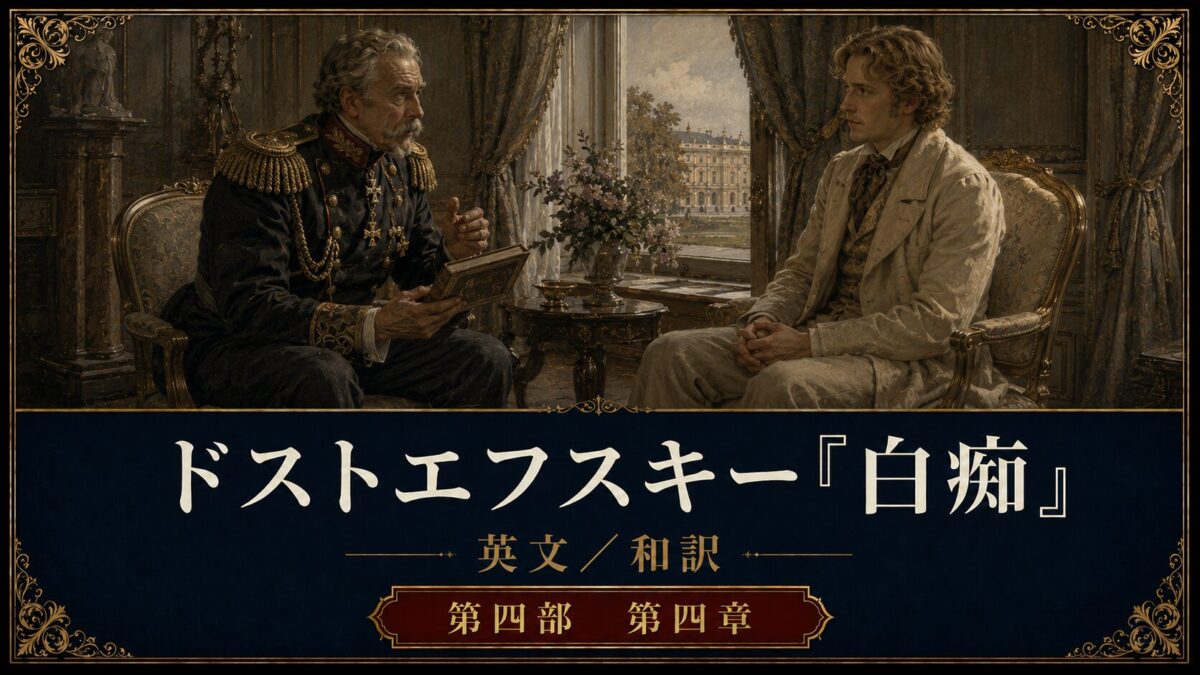
Fyodor Dostoyevsky『The Idiot』PART IV CHAPTER IV です。イヴォルギン将軍が公爵を訪ね、ナポレオンとの荒唐無稽な思い出を語り、最後にはコーリャの腕の中で発作を起こす場面までを、英文・和訳ペアで整理しています。
On scrutinizing him, the prince soon saw that the general was quite a different man from what he had been the day before.
彼をじっと観察すると、公爵はすぐに、将軍が前日とはまったく別人のようであることに気づいた。
He looked like one who had come to some momentous resolve.
彼は、何か重大な決意に達した人間のように見えた。
His calmness, however, was more apparent than real.
しかし、その落ち着きは本物というより、見かけだけのものだった。
He was courteous, but there was a suggestion of injured innocence in his manner.
彼は礼儀正しかったが、その態度には、傷つけられた無実を訴えるようなところがあった。
“I’ve brought your book back,” he began, indicating a book lying on the table.
「お借りした本を返しに来ました」と彼は、テーブルの上に置かれた本を示しながら話し始めた。
“Much obliged to you for lending it to me.”
「貸していただいて、たいへん感謝しております」
“Ah, yes. Well, did you read it, general? It’s curious, isn’t it?” said the prince, delighted to be able to open up conversation upon an outside subject.
「ああ、そうでした。では、読まれましたか、将軍? 面白いでしょう?」と公爵は言った。別の話題で会話を始められることを喜んでいたのである。
“Curious enough, yes, but crude, and of course dreadful nonsense; probably the man lies in every other sentence.”
「確かに面白いことは面白い。しかし粗雑で、もちろんひどい戯言です。おそらくその男は、一文おきに嘘をついているのでしょう」
The general spoke with considerable confidence, and dragged his words out with a conceited drawl.
将軍はかなり自信ありげに話し、気取ったように言葉を引き伸ばした。
“Oh, but it’s only the simple tale of an old soldier who saw the French enter Moscow.”
「ああ、しかしそれは、フランス軍がモスクワへ入るのを見た老兵の素朴な話にすぎませんよ」
“Some of his remarks were wonderfully interesting.”
「彼の言葉のいくつかは、驚くほど興味深いものでした」
“Remarks of an eye-witness are always valuable, whoever he be, don’t you think so?”
「目撃者の言葉は、その人が誰であれ、いつも貴重なものです。そう思いませんか?」
“Had I been the publisher I should not have printed it.”
「私が出版者なら、それを印刷しなかったでしょう」
“As to the evidence of eye-witnesses, in these days people prefer impudent lies to the stories of men of worth and long service.”
「目撃者の証言について言えば、今日の人々は、価値ある人物や長く勤めた人物の話よりも、厚かましい嘘のほうを好むのです」
“I know of some notes of the year 1812, which—I have determined, prince, to leave this house, Mr. Lebedeff’s house.”
「私は一八一二年のある記録を知っていますが――私は決心しました、公爵。この家、レベジェフ氏の家を出ることにしたのです」
The general looked significantly at his host.
将軍は意味ありげに主人を見た。
“Of course you have your own lodging at Pavlofsk at—at your daughter’s house,” began the prince, quite at a loss what to say.
「もちろん、あなたにはパヴロフスクにご自分の住まいが――娘さんのお宅にありますね」と公爵は、何と言えばよいかまったく分からずに言い始めた。
He suddenly recollected that the general had come for advice on a most important matter, affecting his destiny.
彼は突然、将軍が自分の運命に関わる非常に重要な件について助言を求めに来たことを思い出した。
“At my wife’s; in other words, at my own place, my daughter’s house.”
「妻の家です。言い換えれば、私自身の住まいであり、娘の家です」
“I beg your pardon, I—”
「失礼しました、私は――」
“I leave Lebedeff’s house, my dear prince, because I have quarrelled with this person.”
「私はレベジェフの家を出るのです、親愛なる公爵。なぜなら私はこの人物と喧嘩したからです」
“I broke with him last night, and am very sorry that I did not do so before.”
「私は昨夜、彼と絶交しました。もっと前にそうしなかったことを、たいへん残念に思っています」
“I expect respect, prince, even from those to whom I give my heart, so to speak.”
「私は敬意を期待しているのです、公爵。たとえ、いわば私が心を与えた相手からであってもです」
“Prince, I have often given away my heart, and am nearly always deceived.”
「公爵、私はしばしば自分の心を与えてきました。そしてほとんどいつも欺かれてきたのです」
“This person was quite unworthy of the gift.”
「この人物は、その贈り物にまったく値しませんでした」
“There is much that might be improved in him,” said the prince, moderately.
「彼には改善できるところが多くあります」と公爵は控えめに言った。
“But he has some qualities which—though amid them one cannot but discern a cunning nature—reveal what is often a diverting intellect.”
「しかし彼にはいくつかの長所があります。もちろん、その中に狡猾な性質を見ないわけにはいきませんが、それでもしばしば愉快な知性を示しています」
The prince’s tone was so natural and respectful that the general could not possibly suspect him of any insincerity.
公爵の口調はあまりに自然で敬意に満ちていたので、将軍は彼に不誠実さがあるなどとは到底疑えなかった。
“Oh, that he possesses good traits, I was the first to show, when I very nearly made him a present of my friendship.”
「ああ、彼に良いところがあることは、私が真っ先に示しました。私がほとんど自分の友情を彼に贈り物として与えかけた時のことです」
“I am not dependent upon his hospitality, and upon his house; I have my own family.”
「私は彼のもてなしにも、彼の家にも依存していません。私には自分の家族があるのです」
“I do not attempt to justify my own weakness.”
「私は自分の弱さを正当化しようとは思いません」
“I have drunk with this man, and perhaps I deplore the fact now, but I did not take him up for the sake of drink alone.”
「私はこの男と酒を飲みました。そして今ではその事実を嘆いているのかもしれません。しかし私は、酒のためだけに彼と親しくなったのではありません」
“Excuse the crudeness of the expression, prince; I did not make friends with him for that alone.”
「表現の粗野さはお許しください、公爵。私はそれだけのために彼と友達になったのではありません」
“I was attracted by his good qualities.”
「私は彼の良い性質に惹かれたのです」
“But when the fellow declares that he was a child in 1812, and had his left leg cut off, and buried in the Vagarkoff cemetery, in Moscow, such a cock-and-bull story amounts to disrespect, my dear sir, to—to impudent exaggeration.”
「しかしあの男が、一八一二年には子どもで、左脚を切り落とされ、それをモスクワのヴァガルコフ墓地に埋めたなどと言い張る時、そのような荒唐無稽な話は、親愛なる君、不敬に当たります。つまり、厚かましい誇張なのです」
“Oh, he was very likely joking; he said it for fun.”
「ああ、おそらく冗談だったのでしょう。面白がって言ったのです」
“I quite understand you.”
「あなたの言うことはよく分かります」
“You mean that an innocent lie for the sake of a good joke is harmless, and does not offend the human heart.”
「あなたは、良い冗談のための悪意のない嘘なら無害であり、人の心を傷つけないと言いたいのでしょう」
“Some people lie, if you like to put it so, out of pure friendship, in order to amuse their fellows.”
「そう言いたければ、純粋な友情から、仲間を楽しませるために嘘をつく人もいます」
“But when a man makes use of extravagance in order to show his disrespect and to make clear how the intimacy bores him, it is time for a man of honour to break off the said intimacy.”
「しかし、人が不敬を示し、その親密さに退屈していることをはっきりさせるために突飛な誇張を用いる時、名誉ある人間はその親密さを断つべき時なのです」
“And to teach the offender his place.”
「そして相手に身の程を教えるべきなのです」
The general flushed with indignation as he spoke.
将軍は話しながら、憤りで顔を赤くした。
“Oh, but Lebedeff cannot have been in Moscow in 1812.”
「ああ、しかしレベジェフが一八一二年にモスクワにいたはずはありません」
“He is much too young; it is all nonsense.”
「彼は若すぎます。すべて戯言です」
“Very well, but even if we admit that he was alive in 1812, can one believe that a French chasseur pointed a cannon at him for a lark, and shot his left leg off?”
「よろしい。しかし仮に彼が一八一二年に生きていたとしても、フランスの猟兵が戯れに彼へ大砲を向け、左脚を吹き飛ばしたなどと信じられますか?」
“He says he picked his own leg up and took it away and buried it in the cemetery.”
「彼は自分の脚を拾い上げ、それを持って行って墓地に埋めたと言うのです」
“He swore he had a stone put up over it with the inscription: ‘Here lies the leg of Collegiate Secretary Lebedeff.’”
「彼は、その上に石碑を建て、『ここに参事官レベジェフの脚眠る』という碑文を刻ませたと誓いました」
“And on the other side, ‘Rest, beloved ashes, till the morn of joy.’”
「そして反対側には、『愛しき灰よ、喜びの朝まで安らかに眠れ』と刻まれているというのです」
“And that he has a service read over it every year, which is simply sacrilege, and goes to Moscow once a year on purpose.”
「そして毎年そのために祈祷を上げさせていると言うのです。それはまったくの冒涜です。しかもそのために毎年モスクワへ行くというのです」
“He invites me to Moscow in order to prove his assertion, and show me his leg’s tomb, and the very cannon that shot him.”
「彼は自分の主張を証明するために私をモスクワへ招き、脚の墓と、自分を撃ったその大砲を見せると言うのです」
“He says it’s the eleventh from the gate of the Kremlin, an old-fashioned falconet taken from the French afterwards.”
「それはクレムリンの門から十一番目のもので、後にフランス軍から奪った古式の小型砲だと言うのです」
“And, meanwhile both his legs are still on his body,” said the prince, laughing.
「しかもその間、彼の脚は二本ともまだ体についているわけですね」と公爵は笑いながら言った。
“I assure you, it is only an innocent joke, and you need not be angry about it.”
「本当に、それはただの悪意のない冗談です。怒る必要はありません」
“Excuse me—wait a minute—he says that the leg we see is a wooden one, made by Tchernosvitoff.”
「失礼、少しお待ちください。彼は、私たちが見ている脚はチェルノスヴィトフ製の木の脚だと言うのです」
“They do say one can dance with those!”
「そういう脚なら踊ることもできるそうですね!」
“Quite so, quite so; and he swears that his wife never found out that one of his legs was wooden all the while they were married.”
「まったくその通り、まったくその通りです。そして彼は、結婚していたあいだずっと、片脚が木製だったことに妻は気づかなかったと誓うのです」
“When I showed him the ridiculousness of all this, he said, ‘Well, if you were one of Napoleon’s pages in 1812, you might let me bury my leg in the Moscow cemetery.’”
「私がこのすべての馬鹿馬鹿しさを示すと、彼はこう言ったのです。『では、あなたが一八一二年にナポレオンの小姓だったのなら、私に脚をモスクワの墓地へ埋めるくらい許してもよいでしょう』と」
“Why, did you say—” began the prince, and paused in confusion.
「え、あなたはそう言ったのですか――」と公爵は言いかけ、困惑して口をつぐんだ。
The general gazed at his host disdainfully.
将軍は主人を軽蔑するように見つめた。
“Oh, go on,” he said, “finish your sentence, by all means.”
「ああ、どうぞ続けてください」と彼は言った。「ぜひその文を最後まで言ってください」
“Say how odd it appears to you that a man fallen to such a depth of humiliation as I, can ever have been the actual eye-witness of great events.”
「私のようにこれほど深い屈辱に落ちた男が、かつて偉大な出来事の実際の目撃者であったなど、あなたにはいかに奇妙に見えるか、そう言ってください」
“Go on, I don’t mind! Has he found time to tell you scandal about me?”
「どうぞ続けてください、私は気にしません! 彼は私についての醜聞をあなたに話す時間を見つけたのですか?」
“No, I’ve heard nothing of this from Lebedeff, if you mean Lebedeff.”
「いいえ、レベジェフのことを言っているのなら、私は彼からこの件について何も聞いていません」
“H’m; I thought differently.”
「ふむ、私は違うと思っていました」
“You see, we were talking over this period of history.”
「ご存じの通り、私たちはこの歴史の時期について話していたのです」
“I was criticizing a current report of something which then happened, and having been myself an eye-witness of the occurrence—you are smiling, prince—you are looking at my face as if—”
「私は当時起こったある事柄についての通説を批判していました。そして私自身がその出来事の目撃者であったので――あなたは微笑んでいますね、公爵。あなたは私の顔をまるで――」
“Oh no! not at all—I—”
「ああ、いいえ! まったくそんなことは――私は――」
“I am rather young-looking, I know; but I am actually older than I appear to be.”
「私は少し若く見えることは知っています。しかし実際には、見かけより年を取っているのです」
“I was ten or eleven in the year 1812.”
「一八一二年には、私は十歳か十一歳でした」
“I don’t know my age exactly, but it has always been a weakness of mine to make it out less than it really is.”
「正確な年齢は分かりませんが、実際より若く言ってしまうのは、昔からの私の弱点なのです」
“I assure you, general, I do not in the least doubt your statement.”
「保証します、将軍。私はあなたのお話を少しも疑っていません」
“One of our living autobiographers states that when he was a small baby in Moscow in 1812 the French soldiers fed him with bread.”
「現存するある自伝作者は、一八一二年にモスクワでまだ小さな赤ん坊だった時、フランス兵にパンを食べさせてもらったと述べています」
“Well, there you see!” said the general, condescendingly.
「ほら、ご覧なさい!」と将軍は恩着せがましく言った。
“There is nothing whatever unusual about my tale.”
「私の話には、少しも変わったところなどありません」
“Truth very often appears to be impossible.”
「真実は、しばしば不可能に見えるものなのです」
“I was a page—it sounds strange, I dare say.”
「私は小姓でした。奇妙に聞こえることは、認めます」
“Had I been fifteen years old I should probably have been terribly frightened when the French arrived, as my mother was.”
「もし私が十五歳だったなら、フランス軍が来た時、母と同じようにひどく怖がったでしょう」
“She had been too slow about clearing out of Moscow.”
「母はモスクワから退去するのが遅すぎたのです」
“But as I was only just ten I was not in the least alarmed, and rushed through the crowd to the very door of the palace when Napoleon alighted from his horse.”
「しかし私はまだ十歳だったので、少しも怖くありませんでした。そしてナポレオンが馬から降りた時、群衆をかき分けて宮殿の扉のすぐそばまで駆け寄ったのです」
“Undoubtedly, at ten years old you would not have felt the sense of fear, as you say,” blurted out the prince.
「確かに、十歳ならおっしゃる通り恐怖を感じなかったでしょう」と公爵は思わず口にした。
He was horribly uncomfortable in the sensation that he was just about to blush.
彼は、今にも赤面しそうな感覚にひどく居心地の悪さを感じていた。
“Of course; and it all happened so easily and naturally.”
「もちろんです。そしてすべてはとても容易に、自然に起こりました」
“And yet, were a novelist to describe the episode, he would put in all kinds of impossible and incredible details.”
「それでも、もし小説家がその出来事を描くなら、あらゆる種類の不可能で信じがたい細部を入れるでしょう」
“Oh,” cried the prince, “I have often thought that!”
「ああ」と公爵は叫んだ。「私もよくそう思っていました!」
“Why, I know of a murder, for the sake of a watch.”
「実際、私は時計のために起きた殺人事件を知っています」
“It’s in all the papers now.”
「それは今、あらゆる新聞に載っています」
“But if some writer had invented it, all the critics would have jumped down his throat and said the thing was too improbable for anything.”
「しかし、もしどこかの作家がそれを創作したなら、すべての批評家がその作家に食ってかかり、そんなことはあまりにもあり得ないと言ったでしょう」
“And yet you read it in the paper, and you can’t help thinking that out of these strange disclosures is to be gained the full knowledge of Russian life and character.”
「それでも新聞で読むと、こうした奇妙な暴露の中から、ロシアの生活と性格についての完全な知識が得られるのだと考えずにはいられません」
“You said that well, general; it is so true,” concluded the prince, warmly.
「あなたはうまくおっしゃいました、将軍。本当にその通りです」と公爵は温かく結んだ。
He was delighted to have found a refuge from the fiery blushes which had covered his face.
彼は、自分の顔を覆っていた燃えるような赤面から逃れる場所を見つけられて喜んだ。
“Yes, it’s quite true, isn’t it?” cried the general, his eyes sparkling with gratification.
「そうです、本当にその通りでしょう?」と将軍は満足で目を輝かせながら叫んだ。
“A small boy, a child, would naturally realize no danger.”
「小さな男の子、子どもなら、当然危険を理解しません」
“He would shove his way through the crowds to see the shine and glitter of the uniforms.”
「制服の輝きやきらめきを見るために、群衆を押し分けて進むでしょう」
“And especially the great man of whom everyone was speaking, for at that time all the world had been talking of no one but this man for some years past.”
「そして特に、誰もが語っていた偉大な人物を見るためです。当時、世界中は数年来、この男のことしか話していませんでした」
“The world was full of his name; I—so to speak—drew it in with my mother’s milk.”
「世界は彼の名で満ちていました。私は、いわば母乳とともにその名を吸い込んだのです」
“Napoleon, passing a couple of paces from me, caught sight of me accidentally.”
「ナポレオンは、私の二、三歩そばを通り過ぎる時、偶然私に目を留めました」
“I was very well dressed, and being all alone, in that crowd, as you will easily imagine…”
「私はたいへん立派な服装をしており、その群衆の中で一人きりだったのですから、ご想像の通り……」
“Oh, of course! Naturally the sight impressed him, and proved to him that not all the aristocracy had left Moscow.”
「ああ、もちろんです! 当然その光景は彼に印象を与え、すべての貴族がモスクワを去ったわけではないことを示したのでしょう」
“That at least some nobles and their children had remained behind.”
「少なくとも、一部の貴族とその子どもたちは残っていたということですね」
“Just so! just so! He wanted to win over the aristocracy!”
「まさにその通り! その通りです! 彼は貴族階級を味方につけたかったのです!」
“When his eagle eye fell on me, mine probably flashed back in response.”
「彼の鷲のような目が私に注がれた時、私の目もそれに応えて輝いたことでしょう」
“‘Voilà un garçon bien éveillé! Qui est ton père?’”
「『なんと目の覚めた少年だ! お前の父は誰だ?』」
“I immediately replied, almost panting with excitement, ‘A general, who died on the battle-fields of his country!’”
「私は興奮でほとんど息を切らしながら、すぐに答えました。『祖国の戦場で亡くなった将軍です!』」
“‘Le fils d’un boyard et d’un brave, pardessus le marché. J’aime les boyards. M’aimes-tu, petit?’”
「『貴族の息子で、しかも勇士の息子か。私は貴族が好きだ。小さな子よ、お前は私を愛しているか?』」
“To this keen question I replied as keenly, ‘The Russian heart can recognize a great man even in the bitter enemy of his country.’”
「この鋭い問いに対して、私も鋭く答えました。『ロシア人の心は、祖国の激しい敵の中にも偉大な人物を認めることができます』」
“At least, I don’t remember the exact words, you know, but the idea was as I say.”
「少なくとも、正確な言葉は覚えていませんが、考えとしては今言った通りでした」
“Napoleon was struck; he thought a minute and then said to his suite: ‘I like that boy’s pride.’”
「ナポレオンは衝撃を受けました。少し考え、それから従者たちに言いました。『私はあの少年の誇りが好きだ』と」
“‘If all Russians think like this child, then—’ he didn’t finish, but went on and entered the palace.”
「『もしすべてのロシア人がこの子どものように考えるなら――』彼は最後まで言わず、そのまま進んで宮殿へ入りました」
“I instantly mixed with his suite, and followed him.”
「私はすぐに彼の従者たちに紛れ込み、彼について行きました」
“I was already in high favour.”
「私はすでに非常に気に入られていたのです」
“I remember when he came into the first hall, the emperor stopped before a portrait of the Empress Katherine.”
「彼が最初の広間へ入った時のことを覚えています。皇帝はエカテリーナ女帝の肖像画の前で立ち止まりました」
“And after a thoughtful glance remarked, ‘That was a great woman,’ and passed on.”
「そして物思いに沈んだ一瞥の後、『あれは偉大な女性だった』と言い、そのまま通り過ぎました」
“Well, in a couple of days I was known all over the palace and the Kremlin as ‘le petit boyard.’”
「さて、二、三日のうちに、私は宮殿中、クレムリン中で『小さな貴族』として知られるようになりました」
“I only went home to sleep.”
「私は眠るためだけに家へ帰りました」
“They were nearly out of their minds about me at home.”
「家の者たちは、私のことでほとんど気が狂いそうになっていました」
“A couple of days after this, Napoleon’s page, De Bazancour, died.”
「その二、三日後、ナポレオンの小姓ド・バザンクールが亡くなりました」
“He had not been able to stand the trials of the campaign.”
「彼は遠征の試練に耐えられなかったのです」
“Napoleon remembered me; I was taken away without explanation.”
「ナポレオンは私のことを覚えていました。私は説明もなく連れて行かれました」
“The dead page’s uniform was tried on me, and when I was taken before the emperor, dressed in it, he nodded his head to me.”
「亡くなった小姓の制服が私に試着され、それを着た私が皇帝の前に連れて行かれると、彼は私にうなずきました」
“And I was told that I was appointed to the vacant post of page.”
「そして私は、空席になった小姓の職に任命されたと告げられました」
“Well, I was glad enough, for I had long felt the greatest sympathy for this man.”
「さて、私は十分に嬉しく思いました。なぜなら私は長いあいだ、この人物に最大の共感を抱いていたからです」
“And then the pretty uniform and all that—only a child, you know—and so on.”
「それに、美しい制服や何やらもありました。ご存じの通り、私はただの子どもでしたから」
“It was a dark green dress coat with gold buttons—red facings, white trousers, and a white silk waistcoat.”
「それは金ボタンのついた濃緑色の礼服で、赤い折り返し、白いズボン、白い絹のチョッキでした」
“Silk stockings, shoes with buckles, and top-boots if I were riding out with his majesty or with the suite.”
「絹の靴下、留め金つきの靴、そして陛下や従者たちと騎乗で出かける時には長靴も履きました」
“Though the position of all of us at that time was not particularly brilliant, and the poverty was dreadful all round, yet the etiquette at court was strictly preserved.”
「当時の私たち全員の状況は特に華やかなものではなく、周囲の貧困はひどいものでしたが、それでも宮廷の儀礼は厳格に守られていました」
“And the more strictly in proportion to the growth of the forebodings of disaster.”
「そして災厄の不吉な予感が強まるにつれて、儀礼はますます厳格になったのです」
“Quite so, quite so, of course!” murmured the poor prince, who didn’t know where to look.
「まったくその通りです、もちろんです!」と哀れな公爵は、どこを見ればよいか分からずにつぶやいた。
“Your memoirs would be most interesting.”
「あなたの回想録は、きっとたいへん興味深いものになるでしょう」
The general was, of course, repeating what he had told Lebedeff the night before.
もちろん将軍は、前夜レベジェフに語ったことを繰り返していたのである。
Thus he brought it out glibly enough, but here he looked suspiciously at the prince out of the corners of his eyes.
そのため、彼はかなりすらすらと語ったが、ここで目の端から疑わしげに公爵を見た。
“My memoirs!” he began, with redoubled pride and dignity.
「私の回想録ですと!」と彼は、倍増した誇りと威厳をもって話し始めた。
“Write my memoirs? The idea has not tempted me.”
「私の回想録を書くですと? その考えに誘惑されたことはありません」
“And yet, if you please, my memoirs have long been written, but they shall not see the light until dust returns to dust.”
「それでも、よろしければ申し上げますが、私の回想録はずっと前に書かれています。しかし塵が塵に帰るまでは、日の目を見ることはありません」
“Then, I doubt not, they will be translated into all languages.”
「その時には、疑いなく、それはすべての言語に翻訳されるでしょう」
“Not of course on account of their actual literary merit, but because of the great events of which I was the actual witness.”
「もちろん、実際の文学的価値のためではありません。私が実際に目撃した偉大な出来事のためです」
“Though but a child at the time.”
「もっとも、その時私はまだ子どもでしたが」
“As a child, I was able to penetrate into the secrecy of the great man’s private room.”
「子どもでありながら、私はその偉人の私室の秘密に入り込むことができたのです」
“At nights I have heard the groans and wailings of this ‘giant in distress.’”
「夜には、この『苦悩する巨人』のうめき声や嘆き声を聞いたこともあります」
“He could feel no shame in weeping before such a mere child as I was.”
「私のようなただの子どもの前で泣くことに、彼は何の恥も感じませんでした」
“Though I understood even then that the reason for his suffering was the silence of the Emperor Alexander.”
「もっとも、私はその時でさえ、彼の苦しみの理由がアレクサンドル皇帝の沈黙であることを理解していました」
“Yes, of course; he had written letters to the latter with proposals of peace, had he not?” put in the prince.
「ええ、もちろんです。彼は和平提案の手紙を相手に書いていたのでしょう?」と公爵が口を挟んだ。
“We did not know the details of his proposals, but he wrote letter after letter, all day and every day.”
「私たちは彼の提案の詳細は知りませんでしたが、彼は毎日一日中、次から次へと手紙を書いていました」
“He was dreadfully agitated.”
「彼はひどく動揺していました」
“Sometimes at night I would throw myself upon his breast with tears.”
「夜には時々、私は涙を流しながら彼の胸に身を投げました」
“Oh, how I loved that man!”
「ああ、私はどれほどその人を愛していたことでしょう!」
“‘Ask forgiveness, Oh, ask forgiveness of the Emperor Alexander!’ I would cry.”
「『許しを乞うてください、ああ、アレクサンドル皇帝に許しを乞うてください!』と私は叫んだものです」
“I should have said, of course, ‘Make peace with Alexander,’ but as a child I expressed my idea in the naive way recorded.”
「もちろん本来なら『アレクサンドルと和平を結んでください』と言うべきでしたが、子どもだった私は、記録されているような無邪気な言い方で自分の考えを表したのです」
“‘Oh, my child,’ he would say, ‘Oh, my child, I am ready to kiss Alexander’s feet.’”
「『ああ、わが子よ』と彼は言うのでした。『ああ、わが子よ、私はアレクサンドルの足に口づけする用意もある』」
“‘But I hate and abominate the King of Prussia and the Austrian Emperor, and—and—but you know nothing of politics, my child.’”
「『しかし私はプロイセン王とオーストリア皇帝を憎み、忌み嫌っている。そして――そして――だが、お前は政治のことなど何も知らないのだ、わが子よ』」
“He would pull up, remembering whom he was speaking to, but his eyes would sparkle for a long while after this.”
「彼は自分が誰に話しているかを思い出し、言葉を止めるのですが、その後もしばらくのあいだ目を輝かせていました」
“Well now, if I were to describe all this, and I have seen greater events than these, all these critical gentlemen of the press and political parties—Oh, no thanks!”
「さて、もし私がこのすべてを描くなら、しかも私はこれ以上に偉大な出来事も見ているのですが、新聞や政党の批評家先生方は――ああ、まっぴらです!」
“I’m their very humble servant, but no thanks!”
「私は彼らのたいへん卑しい僕ですが、結構です!」
“Quite so—parties—you are very right,” said the prince.
「まったくその通りです。政党ですね。あなたは本当に正しい」と公爵は言った。
“I was reading a book about Napoleon and the Waterloo campaign only the other day, by Charasse.”
「私はつい先日、シャラスのナポレオンとワーテルロー戦役についての本を読んでいました」
“In which the author does not attempt to conceal his joy at Napoleon’s discomfiture at every page.”
「そこでは著者が、ナポレオンの敗北への喜びを各ページで隠そうともしていません」
“Well now, I don’t like that; it smells of ‘party,’ you know.”
「私はそういうのが好きではありません。ご存じの通り、『党派』の匂いがしますから」
“You are quite right.”
「あなたはまったく正しいです」
“And were you much occupied with your service under Napoleon?”
「それで、ナポレオンのもとでのお勤めはかなり忙しかったのですか?」
The general was in ecstasies, for the prince’s remarks, made, as they evidently were, in all seriousness and simplicity, quite dissipated the last relics of his suspicion.
将軍は有頂天になった。公爵の言葉は、明らかにまったく真面目で素朴なものだったため、彼の疑いの最後の残りをすっかり消し去ったのである。
“I know Charasse’s book! Oh! I was so angry with his work!”
「私はシャラスの本を知っています! ああ! 私は彼の著作にひどく腹を立てました!」
“I wrote to him and said—I forget what, at this moment.”
「私は彼に手紙を書いて、こう言いました――今は何と言ったか忘れましたが」
“You ask whether I was very busy under the Emperor? Oh no!”
「皇帝のもとで私はとても忙しかったのかとお尋ねですか? ああ、いいえ!」
“I was called ‘page,’ but hardly took my duty seriously.”
「私は『小姓』と呼ばれていましたが、自分の職務をほとんど真剣には受け取っていませんでした」
“Besides, Napoleon very soon lost hope of conciliating the Russians, and he would have forgotten all about me had he not loved me.”
「それに、ナポレオンはすぐにロシア人を懐柔する望みを失いましたし、もし私を愛していなければ、彼は私のことなどすっかり忘れていたでしょう」
“For personal reasons—I don’t mind saying so now.”
「個人的な理由からです。今ならそう言ってもかまいません」
“My heart was greatly drawn to him, too.”
「私の心もまた、彼に強く引き寄せられていました」
“My duties were light.”
「私の任務は軽いものでした」
“I merely had to be at the palace occasionally to escort the Emperor out riding, and that was about all.”
「私は時々宮殿にいて、皇帝が騎乗で出かける時に付き添えばよかっただけです。それがほとんどすべてでした」
“I rode very fairly well.”
「私はかなり上手に馬に乗れました」
“He used to have a ride before dinner, and his suite on those occasions were generally Davoust, myself, and Roustan.”
「彼は夕食前によく騎乗しました。その時の随行者は、たいていダヴー、私、そしてルスタンでした」
“Constant?” said the prince, suddenly, and quite involuntarily.
「コンスタンでは?」と公爵は突然、まったく思わず言った。
“No; Constant was away then, taking a letter to the Empress Josephine.”
「いいえ。コンスタンはその時不在で、ジョゼフィーヌ皇后へ手紙を届けに行っていました」
“Instead of him there were always a couple of orderlies—and that was all.”
「彼の代わりに、いつも二人ほどの伝令兵がいました。それだけです」
“Excepting, of course, the generals and marshals whom Napoleon always took with him for the inspection of various localities, and for the sake of consultation generally.”
「もちろん、ナポレオンがさまざまな場所の視察や一般的な相談のためにいつも連れていた将軍や元帥たちは別ですが」
“I remember there was one—Davoust—nearly always with him—a big man with spectacles.”
「一人覚えています。ダヴーです。彼はほとんどいつも皇帝と一緒にいて、眼鏡をかけた大柄な男でした」
“They used to argue and quarrel sometimes.”
「二人は時々議論したり、口論したりしていました」
“Once they were in the Emperor’s study together—just those two and myself—I was unobserved—and they argued.”
「ある時、彼らは皇帝の書斎に一緒にいました。その二人と私だけでした。私は気づかれていませんでした。そして彼らは議論していました」
“And the Emperor seemed to be agreeing to something under protest.”
「皇帝は何かに不承不承同意しているように見えました」
“Suddenly his eye fell on me and an idea seemed to flash across him.”
「突然、彼の目が私に止まり、ある考えが彼の中をひらめいたようでした」
“‘Child,’ he said, abruptly. ‘If I were to recognize the Russian orthodox religion and emancipate the serfs, do you think Russia would come over to me?’”
「『子よ』と彼は突然言いました。『もし私がロシア正教を承認し、農奴を解放したなら、ロシアは私の側につくだろうか?』」
“‘Never!’ I cried, indignantly.”
「『決して!』と私は憤然として叫びました」
“The Emperor was much struck.”
「皇帝はたいへん驚きました」
“‘In the flashing eyes of this patriotic child I read and accept the fiat of the Russian people.’”
「『この愛国的な子どもの輝く目の中に、私はロシア人民の命令を読み取り、それを受け入れる』」
“‘Enough, Davoust, it is mere phantasy on our part. Come, let’s hear your other project.’”
「『もうよい、ダヴー。それは我々の空想にすぎない。さあ、君のもう一つの計画を聞こう』」
“Yes, but that was a great idea,” said the prince, clearly interested.
「ええ、しかしそれは偉大な考えでしたね」と公爵は、明らかに興味を示して言った。
“You ascribe it to Davoust, do you?”
「それをダヴーに帰するのですか?」
“Well, at all events, they were consulting together at the time.”
「まあ、とにかく、その時彼らは相談していたのです」
“Of course it was the idea of an eagle, and must have originated with Napoleon.”
「もちろんそれは鷲のような人物の考えであり、ナポレオンから生まれたに違いありません」
“But the other project was good too—it was the ‘Conseil du lion!’ as Napoleon called it.”
「しかしもう一つの計画も良いものでした。ナポレオンが『獅子の会議』と呼んだものです」
“This project consisted in a proposal to occupy the Kremlin with the whole army.”
「この計画は、全軍でクレムリンを占拠するという提案でした」
“To arm and fortify it scientifically, to kill as many horses as could be got, and salt their flesh, and spend the winter there.”
「それを科学的に武装し要塞化し、手に入る限りの馬を殺して肉を塩漬けにし、そこで冬を越すというものです」
“And in spring to fight their way out.”
「そして春になったら戦いながら脱出するのです」
“Napoleon liked the idea—it attracted him.”
「ナポレオンはその考えを気に入りました。彼はそれに惹かれたのです」
“We rode round the Kremlin walls every day, and Napoleon used to give orders where they were to be patched, where built up, where pulled down and so on.”
「私たちは毎日クレムリンの城壁を馬で回り、ナポレオンはどこを修復すべきか、どこを築き上げるべきか、どこを壊すべきかなどを命じていました」
“All was decided at last.”
「ついにすべてが決定されました」
“They were alone together—those two and myself.”
「彼らは二人きりでした。つまり、その二人と私だけでした」
“Napoleon was walking up and down with folded arms.”
「ナポレオンは腕を組んで行ったり来たりしていました」
“I could not take my eyes off his face—my heart beat loudly and painfully.”
「私は彼の顔から目を離せませんでした。私の心臓は激しく、苦しいほど鳴っていました」
“‘I’m off,’ said Davoust.”
「『私は行く』とダヴーが言いました」
“‘Where to?’ asked Napoleon.”
「『どこへ?』とナポレオンが尋ねました」
“‘To salt horse-flesh,’ said Davoust.”
「『馬肉を塩漬けにしに』とダヴーは言いました」
“Napoleon shuddered—his fate was being decided.”
「ナポレオンは身震いしました。彼の運命が決まりつつあったのです」
“‘Child,’ he addressed me suddenly, ‘what do you think of our plan?’”
「『子よ』と彼は突然私に呼びかけました。『我々の計画をどう思う?』」
“Of course he only applied to me as a sort of toss-up, you know.”
「もちろん彼は、いわば成り行きで私に尋ねただけでした」
“I turned to Davoust and addressed my reply to him.”
「私はダヴーのほうを向き、彼に向かって答えました」
“I said, as though inspired: ‘Escape, general! Go home!’”
「私は霊感を受けたかのように言いました。『逃げてください、将軍! 故郷へ帰ってください!』」
“The project was abandoned; Davoust shrugged his shoulders and went out, whispering to himself—‘Bah, il devient superstitieux!’”
「その計画は放棄されました。ダヴーは肩をすくめて出て行き、『ふん、彼は迷信深くなっている』と独り言を言っていました」
“Next morning the order to retreat was given.”
「翌朝、退却命令が出されました」
“All this is most interesting,” said the prince, very softly.
「それは本当に興味深いことです」と公爵はとても静かに言った。
“If it really was so—that is, I mean—” he hastened to correct himself.
「もしそれが本当にそうだったなら――つまり、私が言いたいのは――」と彼は慌てて言い直した。
“Oh, my dear prince,” cried the general, who was now so intoxicated with his own narrative that he probably could not have pulled up at the most patent indiscretion.
「ああ、親愛なる公爵」と将軍は叫んだ。彼は今や自分の物語に酔いしれており、たとえ最も明白な軽率さに突き当たっても、おそらく止まれなかっただろう。
“You say, ‘if it really was so!’ There was more—much more, I assure you!”
「あなたは『もし本当にそうだったなら』と言われる! もっとありました。はるかにもっとあったのです。保証します!」
“These are merely a few little political acts.”
「これはほんのいくつかの小さな政治的出来事にすぎません」
“I tell you I was the eye-witness of the nightly sorrow and groanings of the great man, and of that no one can speak but myself.”
「私はあの偉大な人物の夜ごとの悲しみとうめきの目撃者だったのです。そしてそれについて語れるのは私だけなのです」
“Towards the end he wept no more, though he continued to emit an occasional groan.”
「終わりのころには、彼はもう泣かなくなりました。もっとも、時折うめき声を漏らし続けてはいましたが」
“But his face grew more overcast day by day, as though Eternity were wrapping its gloomy mantle about him.”
「しかし彼の顔は日ごとに曇りを増し、まるで永遠が暗い外套を彼に巻きつけているかのようでした」
“Occasionally we passed whole hours of silence together at night, Roustan snoring in the next room—that fellow slept like a pig.”
「時折、私たちは夜に何時間も一緒に沈黙して過ごしました。隣の部屋ではルスタンがいびきをかいていました。あの男は豚のように眠るのです」
“‘But he’s loyal to me and my dynasty,’ said Napoleon of him.”
「『しかし彼は私と私の王朝に忠実だ』とナポレオンは彼について言いました」
“Sometimes it was very painful to me, and once he caught me with tears in my eyes.”
「時には私にはとてもつらいことでした。そしてある時、彼は私の目に涙が浮かんでいるのを見つけました」
“He looked at me kindly.”
「彼は優しく私を見ました」
“‘You are sorry for me,’ he said, ‘you, my child, and perhaps one other child—my son, the King of Rome—may grieve for me.’”
「『お前は私を哀れんでいるのだな』と彼は言いました。『お前、わが子よ。そしておそらくもう一人の子、私の息子、ローマ王だけが私のために悲しんでくれるのだろう』」
“‘All the rest hate me; and my brothers are the first to betray me in misfortune.’”
「『ほかの者は皆、私を憎んでいる。そして私の兄弟たちは、不幸の中で真っ先に私を裏切るのだ』」
“I sobbed and threw myself into his arms.”
「私はすすり泣き、彼の腕の中へ身を投げました」
“He could not resist me—he burst into tears, and our tears mingled as we folded each other in a close embrace.”
「彼は私を拒むことができませんでした。彼は突然泣き出し、私たちが固く抱き合う中で、互いの涙が混じり合いました」
“‘Write, oh, write a letter to the Empress Josephine!’ I cried, sobbing.”
「『書いてください、ああ、ジョゼフィーヌ皇后へ手紙を書いてください!』と私はすすり泣きながら叫びました」
“Napoleon started, reflected, and said, ‘You remind me of a third heart which loves me.’”
「ナポレオンははっとし、考え込み、そして言いました。『お前は、私を愛する三つ目の心を思い出させる』と」
“‘Thank you, my friend;’ and then and there he sat down and wrote that letter to Josephine, with which Constant was sent off next day.”
「『ありがとう、わが友よ』そしてその場で彼は腰を下ろし、ジョゼフィーヌへのその手紙を書きました。その手紙を持って、翌日コンスタンが送り出されたのです」
“You did a good action,” said the prince, “for in the midst of his angry feelings you insinuated a kind thought into his heart.”
「あなたは良いことをしました」と公爵は言った。「彼の怒りの感情のただ中で、あなたは優しい思いを彼の心にそっと吹き込んだのですから」
“Just so, prince, just so. How well you bring out that fact! Because your own heart is good!” cried the ecstatic old gentleman.
「その通りです、公爵、その通りです。あなたはその事実をなんとうまく引き出してくださるのでしょう! それはあなた自身の心が善良だからです!」と恍惚とした老紳士は叫んだ。
And, strangely enough, real tears glistened in his eyes.
そして奇妙なことに、彼の目には本物の涙がきらめいていた。
“Yes, prince, it was a wonderful spectacle.”
「ええ、公爵、それは素晴らしい光景でした」
“And, do you know, I all but went off to Paris, and should assuredly have shared his solitary exile with him.”
「そして、ご存じですか、私はほとんどパリへ行くところでした。そして間違いなく、彼の孤独な流刑をともにしたことでしょう」
“But, alas, our destinies were otherwise ordered!”
「しかし、ああ、私たちの運命は別のように定められていたのです!」
“We parted, he to his island, where I am sure he thought of the weeping child who had embraced him so affectionately at parting in Moscow.”
「私たちは別れました。彼は自分の島へ向かいました。そこできっと、モスクワで別れ際にあれほど愛情深く彼を抱きしめた泣く子どものことを思ったに違いありません」
“And I was sent off to the cadet corps, where I found nothing but roughness and harsh discipline.”
「そして私は士官学校へ送られ、そこで見つけたものは粗暴さと厳しい規律だけでした」
“Alas, my happy days were done!”
「ああ、私の幸福な日々は終わったのです!」
“‘I do not wish to deprive your mother of you, and, therefore, I will not ask you to go with me,’ he said, the morning of his departure.”
「『私はお前の母からお前を奪いたくはない。だから私と一緒に来てくれとは頼まない』と、出発の朝、彼は言いました」
“‘But I should like to do something for you.’”
「『しかし、お前のために何かをしてやりたい』」
“He was mounting his horse as he spoke.”
「彼はそう言いながら馬に乗ろうとしていました」
“‘Write something in my sister’s album for me,’ I said rather timidly, for he was in a state of great dejection at the moment.”
「『妹のアルバムに何か書いてください』と私はかなりおずおずと言いました。というのも、その時彼はひどく落胆していたからです」
“He turned, called for a pen, took the album.”
「彼は振り向き、ペンを求め、アルバムを取りました」
“‘How old is your sister?’ he asked, holding the pen in his hand.”
「『お前の妹はいくつだ?』と彼はペンを手に持ちながら尋ねました」
“‘Three years old,’ I said.”
「『三歳です』と私は言いました」
“‘Ah, petite fille alors!’ and he wrote in the album:
「『ああ、それでは小さな女の子だね!』と言い、彼はアルバムに書きました。
“‘Ne mentez jamais! NAPOLÉON (votre ami sincère).’”
「『決して嘘をついてはならない! ナポレオン、あなたの誠実な友』」
“Such advice, and at such a moment, you must allow, prince, was—”
「そのような助言を、あのような瞬間に与えたことは、公爵、認めていただきたいのですが――」
“Yes, quite so; very remarkable.”
「ええ、まったくその通りです。非常に注目すべきことです」
“This page of the album, framed in gold, hung on the wall of my sister’s drawing-room all her life, in the most conspicuous place, till the day of her death.”
「そのアルバムのページは金の額に入れられ、妹が亡くなる日まで、生涯ずっと応接間の壁の最も目立つ場所に掛けられていました」
“Where it is now, I really don’t know.”
「今それがどこにあるのかは、本当に分かりません」
“Heavens! it’s two o’clock! How I have kept you, prince!”
「なんと! もう二時です! 私はなんとあなたを引き止めてしまったことでしょう、公爵!」
“It is really most unpardonable of me.”
「これは本当に許しがたいことです」
The general rose.
将軍は立ち上がった。
“Oh, not in the least,” said the prince.
「ああ、少しもそんなことはありません」と公爵は言った。
“On the contrary, I have been so much interested, I’m really very much obliged to you.”
「むしろ、私はたいへん興味深く聞いていました。本当に感謝しています」
“Prince,” said the general, pressing his hand, and looking at him with flashing eyes.
「公爵」と将軍は彼の手を握り、輝く目で彼を見ながら言った。
And an expression as though he were under the influence of a sudden thought which had come upon him with stunning force.
その表情は、突然の考えが圧倒的な力で彼に襲いかかったかのようだった。
“Prince, you are so kind, so simple-minded, that sometimes I really feel sorry for you!”
「公爵、あなたはあまりにも親切で、あまりにも純真なので、時々本当にあなたが気の毒になります!」
“I gaze at you with a feeling of real affection.”
「私は本物の愛情をもってあなたを見つめています」
“Oh, Heaven bless you! May your life blossom and fructify in love.”
「ああ、天があなたを祝福しますように! あなたの人生が愛の中で花開き、実を結びますように」
“Mine is over. Forgive me, forgive me!”
「私の人生は終わりました。許してください、許してください!」
He left the room quickly, covering his face with his hands.
彼は両手で顔を覆い、急いで部屋を出て行った。
The prince could not doubt the sincerity of his agitation.
公爵は、彼の動揺の誠実さを疑うことができなかった。
He understood, too, that the old man had left the room intoxicated with his own success.
また彼は、老人が自分の成功に酔いしれて部屋を出て行ったことも理解していた。
The general belonged to that class of liars, who, in spite of their transports of lying, invariably suspect that they are not believed.
将軍は、嘘をつく熱狂にもかかわらず、自分が信じられていないのではないかと必ず疑う種類の嘘つきに属していた。
On this occasion, when he recovered from his exaltation, he would probably suspect Muishkin of pitying him, and feel insulted.
この場合も、彼が高揚から覚めた時、ムイシュキンが自分を哀れんでいるのではないかと疑い、侮辱されたと感じるだろう。
“Have I been acting rightly in allowing him to develop such vast resources of imagination?” the prince asked himself.
「彼にあれほど膨大な想像力を展開させておいたのは、正しいことだったのだろうか」と公爵は自問した。
But his answer was a fit of violent laughter which lasted ten whole minutes.
しかしその答えは、まるまる十分間続いた激しい笑いの発作だった。
He tried to reproach himself for the laughing fit.
彼はその笑いの発作について、自分を責めようとした。
But eventually concluded that he needn’t do so, since in spite of it he was truly sorry for the old man.
しかし結局、そうする必要はないと結論した。なぜなら、それにもかかわらず彼は本当に老人を気の毒に思っていたからである。
The same evening he received a strange letter, short but decided.
同じ晩、彼は奇妙な手紙を受け取った。短いが、決然とした手紙だった。
The general informed him that they must part for ever.
将軍は彼に、二人は永遠に別れなければならないと知らせてきた。
That he was grateful, but that even from him he could not accept “signs of sympathy which were humiliating to the dignity of a man already miserable enough.”
彼は感謝しているが、たとえ公爵からであっても、「すでに十分に惨めな男の尊厳を辱めるような同情のしるし」は受け入れられないというのだった。
When the prince heard that the old man had gone to Nina Alexandrovna, though, he felt almost easy on his account.
しかし老人がニーナ・アレクサンドロヴナのもとへ行ったと聞いた時、公爵は彼のことについてほとんど安心した。
We have seen, however, that the general paid a visit to Lizabetha Prokofievna and caused trouble there.
しかし、私たちはすでに見た通り、将軍はリザヴェータ・プロコフィエヴナを訪ね、そこで騒動を起こした。
The final upshot being that he frightened Mrs. Epanchin, and angered her by bitter hints as to his son Gania.
最終的な成り行きとして、彼はエパンチン夫人を怖がらせ、息子ガーニャについての辛辣なほのめかしで彼女を怒らせたのである。
He had been turned out in disgrace, eventually.
彼は結局、不名誉のうちに追い出された。
And this was the cause of his bad night and quarrelsome day.
そしてこれが、彼のひどい夜と喧嘩腰の一日の原因だった。
Which ended in his sudden departure into the street in a condition approaching insanity, as recorded before.
それは前に記したように、狂気に近い状態で突然通りへ出て行くことで終わった。
Colia did not understand the position.
コーリャはその状況を理解していなかった。
He tried severity with his father, as they stood in the street after the latter had cursed the household.
父が家に呪いをかけた後、二人が通りに立っている時、彼は父に対して厳しく接しようとした。
Hoping to bring him round that way.
そうすれば父を正気に戻せると思ったのである。
“Well, where are we to go to now, father?” he asked.
「さて、これからどこへ行くの、父さん?」と彼は尋ねた。
“You don’t want to go to the prince’s; you have quarrelled with Lebedeff; you have no money; I never have any.”
「公爵のところへは行きたくないんでしょう。レベジェフとは喧嘩したし、お金もない。僕だっていつも持っていない」
“And here we are in the middle of the road, in a nice sort of mess.”
「そして僕たちは道の真ん中にいる。実に困った状況だよ」
“Better to be of a mess than in a mess!”
「混乱の中にいるより、混乱そのものの一部であるほうがましだ!」
“I remember making a joke something like that at the mess in eighteen hundred and forty—forty—I forget.”
「私は一八四十――四十何年か忘れたが、士官食堂でそんなような冗談を言ったのを覚えている」
“‘Where is my youth, where is my golden youth?’ Who was it said that, Colia?”
「『私の青春はどこへ行った、私の黄金の青春はどこへ行った?』それを言ったのは誰だったかな、コーリャ?」
“It was Gogol, in Dead Souls, father,” cried Colia, glancing at him in some alarm.
「それはゴーゴリだよ、『死せる魂』の中の言葉だよ、父さん」とコーリャは、不安そうに彼をちらりと見ながら叫んだ。
“‘Dead Souls,’ yes, of course, dead.”
「『死せる魂』、そうだ、もちろん、死んでいる」
“When I die, Colia, you must engrave on my tomb:
「私が死んだら、コーリャ、私の墓にこう刻んでくれ。
“‘Here lies a Dead Soul, Shame pursues me.’”
「『ここに死せる魂眠る、恥が私を追い続ける』」
“Who said that, Colia?”
「それを言ったのは誰だ、コーリャ?」
“I don’t know, father.”
「分からないよ、父さん」
“There was no Eropegoff? Eroshka Eropegoff?” he cried, suddenly, stopping in the road in a frenzy.
「エロペゴフはいなかっただと? エロシュカ・エロペゴフが?」と彼は突然叫び、狂乱の中で道に立ち止まった。
“No Eropegoff! And my own son to say it!”
「エロペゴフがいないだと! それを私の息子が言うのか!」
“Eropegoff was in the place of a brother to me for eleven months.”
「エロペゴフは十一か月間、私にとって兄弟同然だったのだ」
“I fought a duel for him.”
「私は彼のために決闘した」
“He was married afterwards, and then killed on the field of battle.”
「彼はその後結婚し、それから戦場で殺された」
“The bullet struck the cross on my breast and glanced off straight into his temple.”
「弾丸は私の胸の十字架に当たり、そこからそれて、まっすぐ彼のこめかみに入ったのだ」
“‘I’ll never forget you,’ he cried, and expired.”
「『君を決して忘れない』と彼は叫び、息絶えた」
“I served my country well and honestly, Colia, but shame, shame has pursued me!”
「私は祖国によく、そして誠実に仕えた、コーリャ。しかし恥が、恥が私を追い続けてきたのだ!」
“You and Nina will come to my grave, Colia; poor Nina, I always used to call her Nina in the old days, and how she loved….”
「お前とニーナは私の墓に来てくれるだろう、コーリャ。哀れなニーナ、私は昔いつも彼女をニーナと呼んでいた。そして彼女はどれほど愛していたことか……」
“Nina, Nina, oh, Nina.”
「ニーナ、ニーナ、ああ、ニーナ」
“What have I ever done to deserve your forgiveness and long-suffering?”
「私はいったい何をして、あなたの許しと長い忍耐に値したというのか?」
“Oh, Colia, your mother has an angelic spirit, an angelic spirit, Colia!”
「ああ、コーリャ、お前の母は天使のような心を持っている。天使のような心だ、コーリャ!」
“I know that, father.”
「それは分かっているよ、父さん」
“Look here, dear old father, come back home! Let’s go back to mother.”
「ねえ、親愛なる父さん、家へ戻ろう! 母さんのところへ戻ろう」
“Look, she ran after us when we came out.”
「ほら、僕たちが出てきた時、母さんは追いかけてきたんだよ」
“What have you stopped her for, just as though you didn’t take in what I said?”
「なぜ母さんを止めたの? まるで僕の言ったことが分からなかったみたいに」
“Why are you crying, father?”
「なぜ泣いているの、父さん?」
Poor Colia cried himself, and kissed the old man’s hands.
哀れなコーリャ自身も泣き出し、老人の手に口づけした。
“You kiss my hands, mine?”
「お前が私の手に口づけするのか、私の手に?」
“Yes, yes, yours, yours! What is there to surprise anyone in that?”
「そうだよ、そう、父さんの手だよ! それの何に驚くことがあるの?」
“Come, come, you mustn’t go on like this, crying in the middle of the road; and you a general too, a military man!”
「さあ、さあ、こんなふうに道の真ん中で泣き続けてはいけないよ。しかも父さんは将軍で、軍人じゃないか!」
“Come, let’s go back.”
「さあ、戻ろう」
“God bless you, dear boy, for being respectful to a disgraced man.”
「神がお前を祝福してくださいますように、親愛なる少年よ。恥を受けた男に敬意を示してくれるのだから」
“Yes, to a poor disgraced old fellow, your father.”
「そう、哀れで恥を受けた老人、お前の父にだ」
“You shall have such a son yourself; le roi de Rome.”
「お前自身もそのような息子を持つだろう。ローマ王だ」
“Oh, curses on this house!”
「ああ、この家に呪いあれ!」
“Come, come, what does all this mean?” cried Colia beside himself at last.
「さあ、さあ、これはいったいどういうことなの?」とコーリャはついに我を忘れて叫んだ。
“What is it? What has happened to you?”
「何なの? 父さんに何が起きたの?」
“Why don’t you wish to come back home? Why have you gone out of your mind, like this?”
「なぜ家に戻りたがらないの? なぜこんなふうに気が変になってしまったの?」
“I’ll explain it, I’ll explain all to you.”
「説明する、すべてお前に説明する」
“Don’t shout! You shall hear. Le roi de Rome.”
「叫ぶな! 聞かせてやる。ローマ王だ」
“Oh, I am sad, I am melancholy!”
「ああ、私は悲しい、私は憂鬱だ!」
“‘Nurse, where is your tomb?’”
「『乳母よ、お前の墓はどこにある?』」
“Who said that, Colia?”
「それを言ったのは誰だ、コーリャ?」
“I don’t know, I don’t know who said it.”
「分からないよ、誰が言ったのか分からない」
“Come home at once; come on!”
「すぐに家へ帰ろう。さあ!」
“I’ll punch Gania’s head myself, if you like—only come.”
「望むなら、僕がガーニャの頭を殴ってやるよ。だから来て」
“Oh, where are you off to again?”
「ああ、またどこへ行くの?」
The general was dragging him away towards the door of a house nearby.
将軍は、近くの家の扉のほうへ彼を引っ張っていた。
He sat down on the step, still holding Colia by the hand.
彼は段に腰を下ろし、まだコーリャの手を握っていた。
“Bend down—bend down your ear.”
「かがめ――耳をかがめろ」
“I’ll tell you all—disgrace—bend down, I’ll tell you in your ear.”
「すべて話してやる――恥辱だ――かがめ、耳元で話してやる」
“What are you dreaming of?” said poor, frightened Colia, stooping down towards the old man, all the same.
「何を夢見ているの?」と、哀れにも怯えたコーリャは言った。それでも彼は老人のほうへ身をかがめた。
“Le roi de Rome,” whispered the general, trembling all over.
「ローマ王」と将軍は全身を震わせながらささやいた。
“What? What do you mean? What roi de Rome?”
「何? どういう意味? 何のローマ王?」
“I—I,” the general continued to whisper, clinging more and more tightly to the boy’s shoulder.
「私は――私は」と将軍は、少年の肩にますます強くしがみつきながら、ささやき続けた。
“I—wish—to tell you—all—Maria—Maria Petrovna—Su—Su—Su…….”
「私は――お前に――すべてを話したい――マリヤ――マリヤ・ペトロヴナ――ス――ス――ス……」
Colia broke loose, seized his father by the shoulders, and stared into his eyes with frenzied gaze.
コーリャは身を振りほどき、父の肩をつかみ、狂ったような目で彼の目をのぞき込んだ。
The old man had grown livid—his lips were shaking, convulsions were passing over his features.
老人は土気色になっていた。唇は震え、顔には痙攣が走っていた。
Suddenly he leant over and began to sink slowly into Colia’s arms.
突然、彼は体を傾け、ゆっくりとコーリャの腕の中へ沈み始めた。
“He’s got a stroke!” cried Colia, loudly, realizing what was the matter at last.
「脳卒中だ!」とコーリャは、ついに何が起きたのかを悟って大声で叫んだ。