
カラフル対訳で紹介している作品について
カラフル対訳で紹介している作品は、すべてパブリックドメインの作品です。
このサイトで使われている作品は、著作権の切れた名作などの全文を電子化し、インターネット上で公開している Project Gutenberg(プロジェクト・グーテンベルク)、 および朗読音声を公開している LibriVox(リブリヴォックス/朗読図書館) の作品を出典としています。
原文はProject Gutenberg、音声はLibriVoxで公開されているパブリックドメイン作品を出典としています。
PART FOUR
THE SECOND CHAPTER
THE FIDGIT’S STORY
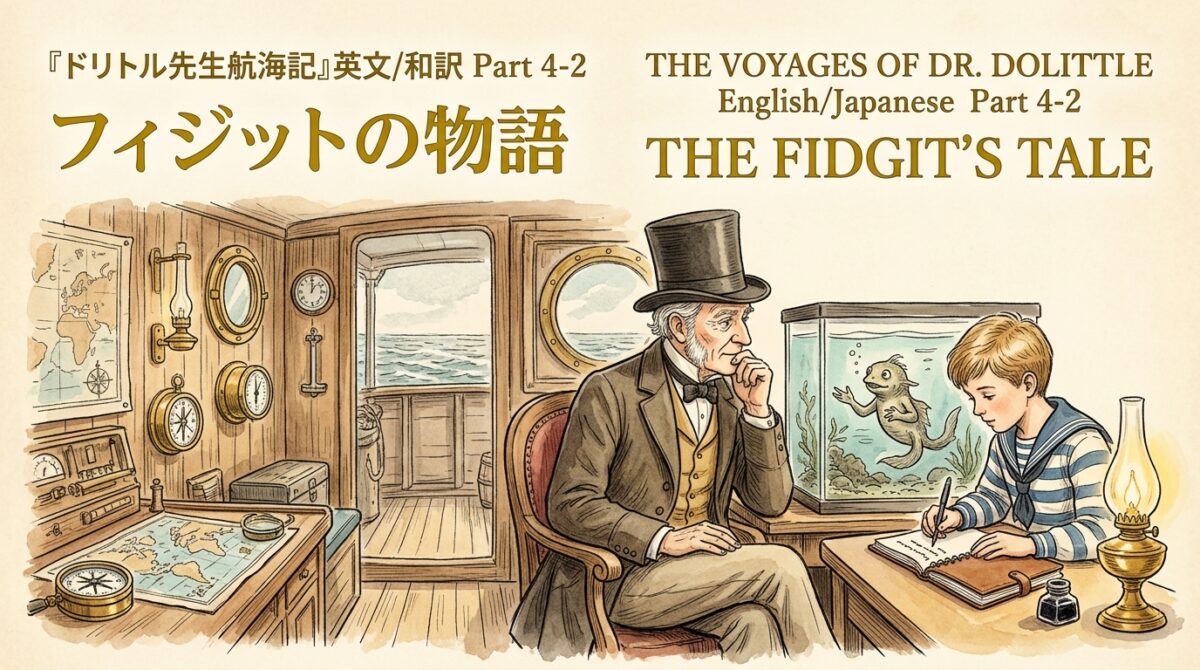
シルバー・フィジットの言葉を解読しようとするドリトル先生は、夜通し研究を続けます。やがて先生はその言葉の「鍵」をつかみ、フィジット自身の壮大な身の上話を聞き取ります。太平洋で生まれた小魚が、クジラやドッグフィッシュから逃げ、水族館に捕らえられ、妹クリッパとともに自由を取り戻すまでの物語です。後半では、深海、巨大なガラスの海カタツムリ、コロンブスの日誌など、物語が一気に深海探検へ向かって広がっていきます。
表示設定
WELL, now that he was started once more upon his old hobby of the shellfish languages, there was no stopping the Doctor.
さて、先生が昔からの趣味である貝類の言葉に再び取りかかると、もう先生を止めることはできなかった。
He worked right through the night.
先生は夜通し働き続けた。
A little after midnight I fell asleep in a chair.
真夜中を少し過ぎたころ、私は椅子で眠り込んだ。
About two in the morning Bumpo fell asleep at the wheel.
午前二時ごろには、バンポが舵輪のところで眠り込んだ。
And for five hours the Curlew was allowed to drift where she liked.
そして五時間もの間、カーリュー号は好きなところへ漂流するままになっていた。
But still John Dolittle worked on, trying his hardest to understand the fidgit’s language, struggling to make the fidgit understand him.
それでもジョン・ドリトルは働き続け、フィジットの言葉を理解しようと全力を尽くし、またフィジットに自分の言葉を理解させようと苦闘していた。
When I woke up it was broad daylight again.
私が目を覚ますと、外はまたすっかり明るい昼間になっていた。
The Doctor was still standing at the listening-tank, looking as tired as an owl and dreadfully wet.
先生はまだ聞き取り水槽の前に立っていて、フクロウのように疲れ、ひどく濡れていた。
But on his face there was a proud and happy smile.
しかしその顔には、誇らしげで幸せそうな笑みが浮かんでいた。
“Stubbins,” he said as soon as he saw me stir, “I’ve done it.”
「スタビンズ」と先生は、私が身じろぎするのを見るなり言った。「やったぞ」
“I’ve got the key to the fidgit’s language.”
「フィジットの言葉の鍵をつかんだんだ」
“It’s a frightfully difficult language—quite different from anything I ever heard.”
「それはものすごく難しい言葉だ。私がこれまで聞いたどんなものともまったく違う」
“The only thing it reminds me of—slightly—is ancient Hebrew.”
「少しだけ思い出させるものがあるとすれば、それは古代ヘブライ語だ」
“It isn’t shellfish; but it’s a big step towards it.”
「それは貝類の言葉ではない。だが、それへ向かう大きな一歩だ」
“Now, the next thing, I want you to take a pencil and a fresh notebook and write down everything I say.”
「さて次に、君には鉛筆と新しいノートを持って、私が言うことをすべて書き取ってほしい」
“The fidgit has promised to tell me the story of his life.”
「フィジットは、自分の一生の物語を私に話すと約束してくれた」
“I will translate it into English and you put it down in the book. Are you ready?”
「私がそれを英語に訳すから、君はそれを本に書き留めるんだ。準備はいいかい?」
Once more the Doctor lowered his ear beneath the level of the water.
もう一度、先生は耳を水面の下へ下げた。
And as he began to speak, I started to write.
そして先生が話し始めると、私は書き始めた。
And this is the story that the fidgit told us.
これが、フィジットが私たちに語った物語である。
“I was born in the Pacific Ocean, close to the coast of Chile.”
「私はチリの海岸近く、太平洋で生まれました」
“I was one of a family of two-thousand five-hundred and ten.”
「私は二千五百十匹の家族の一員でした」
“Soon after our mother and father left us, we youngsters got scattered.”
「母と父が私たちを離れてまもなく、若い私たちは散り散りになってしまいました」
“The family was broken up—by a herd of whales who chased us.”
「私たちを追いかけてきたクジラの群れによって、家族はばらばらにされたのです」
“I and my sister, Clippa, she was my favorite sister, had a very narrow escape for our lives.”
「私と妹のクリッパ、彼女は私のいちばん好きな妹でしたが、私たちは命からがら逃げ延びました」
“As a rule, whales are not very hard to get away from if you are good at dodging—if you’ve only got a quick swerve.”
「普通、身をかわすのがうまく、すばやい急旋回ができれば、クジラから逃げるのはそれほど難しくありません」
“But this one that came after Clippa and myself was a very mean whale.”
「しかし、クリッパと私を追ってきたその一頭は、とても意地の悪いクジラでした」
“Every time he lost us under a stone or something he’d come back and hunt and hunt till he routed us out into the open again.”
「私たちが石の下などに隠れて彼をまいたと思っても、彼は戻ってきて、何度も探し回り、私たちをまた開けたところへ追い出すまでやめませんでした」
“I never saw such a nasty, persevering brute.”
「あれほどいやで、しつこい獣を見たことがありません」
“Well, we shook him at last—though not before he had worried us for hundreds of miles northward, up the west coast of South America.”
「ともかく、私たちはついに彼を振り切りました。もっともその前に、彼は南アメリカ西岸を北へ何百マイルも私たちを追い回したのですが」
“But luck was against us that day.”
「しかしその日は運が悪かったのです」
“While we were resting and trying to get our breath, another family of fidgits came rushing by.”
「私たちが休んで息を整えようとしていると、別のフィジットの家族が突進するように通り過ぎていきました」
“They were shouting, ‘Come on! Swim for your lives! The dog-fish are coming!’”
「彼らは『早く来い! 命がけで泳げ! ドッグフィッシュが来るぞ!』と叫んでいました」
“Now dog-fish are particularly fond of fidgits.”
「ドッグフィッシュは、特にフィジットが大好きです」
“We are, you might say, their favorite food.”
「言ってみれば、私たちは彼らの大好物なのです」
“And for that reason we always keep away from deep, muddy waters.”
「そのため、私たちはいつも深く濁った水を避けています」
“What’s more, dog-fish are not easy to escape from; they are terribly fast and clever hunters.”
「そのうえ、ドッグフィッシュから逃げるのは簡単ではありません。彼らは恐ろしく速く、賢い狩人なのです」
“So up we had to jump and on again.”
「だから私たちはすぐに飛び起きて、また泳ぎ続けなければなりませんでした」
“After we had gone a few more hundred miles we looked back and saw that the dog-fish were gaining on us.”
「さらに数百マイル進んだあと、振り返ると、ドッグフィッシュたちが私たちに追いついてきているのが見えました」
“So we turned into a harbor.”
「そこで私たちは港へ入っていきました」
“It happened to be one on the west coast of the United States.”
「それはたまたま、アメリカ合衆国の西海岸にある港でした」
“Here we guessed, and hoped, the dog-fish would not be likely to follow us.”
「ここならドッグフィッシュはついてこないだろうと、私たちは推測し、願いました」
“As it happened, they didn’t even see us turn in, but dashed on northward and we never saw them again.”
「実際には、彼らは私たちが曲がって入ったことにさえ気づかず、北へ突っ走っていき、それ以来二度と見ませんでした」
“I hope they froze to death in the Arctic Seas.”
「彼らが北極海で凍え死んでいればよいのですが」
“But, as I said, luck was against us that day.”
「しかし、先ほど言ったように、その日は運が悪かったのです」
“While I and my sister were cruising gently round the ships anchored in the harbor looking for orange-peels, a great delicacy with us—Swoop! Bang!—we were caught in a net.”
「私と妹が、港に停泊している船の周りをゆっくり泳ぎながら、私たちにとって大ごちそうであるオレンジの皮を探していると――サッ! バン!――私たちは網に捕まってしまいました」
“We struggled for all we were worth; but it was no use.”
「私たちは全力でもがきました。しかし無駄でした」
“The net was small-meshed and strongly made.”
「その網は目が細かく、頑丈に作られていました」
“Kicking and flipping we were hauled up the side of the ship and dumped down on the deck.”
「蹴ったりひれをばたつかせたりしながら、私たちは船の側面へ引き上げられ、甲板に放り出されました」
“There we lay, high and dry in a blazing noon-day sun.”
「そこで私たちは、真昼の照りつける太陽の下、完全に水から出た状態で横たわっていました」
“Here a couple of old men in whiskers and spectacles leant over us, making strange sounds.”
「そこへ、ほおひげと眼鏡の年老いた男たち二人が、奇妙な音を立てながら私たちの上に身をかがめました」
“Some codling had got caught in the net the same time as we were.”
「私たちと同時に、何匹かの小ダラも網にかかっていました」
“These the old men threw back into the sea; but us they seemed to think very precious.”
「年寄りたちはそれらを海へ投げ返しました。しかし私たちのことは、とても貴重だと思ったようでした」
“They put us carefully into a large jar.”
「彼らは私たちを大きな瓶に注意深く入れました」
“And after they had taken us on shore they went to a big house and changed us from the jar into glass boxes full of water.”
「そして私たちを岸へ運んだあと、大きな建物へ行き、瓶から水で満たされたガラス箱へ移しました」
“This house was on the edge of the harbor; and a small stream of sea-water was made to flow through the glass tank so we could breathe properly.”
「その建物は港の縁にあり、私たちがきちんと呼吸できるように、少量の海水がガラス水槽の中を流れるようになっていました」
“Of course we had never lived inside glass walls before.”
「もちろん、私たちはそれまでガラスの壁の中で暮らしたことなどありませんでした」
“And at first we kept on trying to swim through them and got our noses awfully sore bumping the glass at full speed.”
「最初のうちは、そこを泳いで通り抜けようとし続け、全速力でガラスにぶつかったため、鼻がひどく痛くなりました」
“Then followed weeks and weeks of weary idleness.”
「それから、何週間も何週間も、退屈で何もすることのない日々が続きました」
“They treated us well, so far as they knew how.”
「彼らは、知っている範囲では私たちをよく扱ってくれました」
“The old fellows in spectacles came and looked at us proudly twice a day.”
「眼鏡をかけた年寄りたちは一日に二度やってきて、誇らしげに私たちを眺めました」
“And they saw that we had the proper food to eat, the right amount of light and that the water was not too hot or too cold.”
「そして、私たちに適切な食べ物があり、光の量がちょうどよく、水が熱すぎたり冷たすぎたりしないように気を配ってくれました」
“But oh, the dullness of that life!”
「しかし、ああ、その生活の退屈さといったら!」
“It seemed we were a kind of a show.”
「どうやら私たちは、一種の見世物だったようです」
“At a certain hour every morning the big doors of the house were thrown open.”
「毎朝決まった時間になると、その建物の大きな扉が開け放たれました」
“And everybody in the city who had nothing special to do came in and looked at us.”
「そして町中の、特にすることのない人々が入ってきて、私たちを見ました」
“There were other tanks filled with different kinds of fishes all round the walls of the big room.”
「大きな部屋の壁の周りには、さまざまな種類の魚で満たされたほかの水槽もありました」
“And the crowds would go from tank to tank, looking in at us through the glass—with their mouths open, like half-witted flounders.”
「群衆は水槽から水槽へ移動し、口を開けたまま、まぬけなヒラメのようにガラス越しに私たちをのぞき込むのでした」
“We got so sick of it that we used to open our mouths back at them.”
「私たちはそれにうんざりして、こちらも彼らに向かって口を開け返すようになりました」
“And this they seemed to think highly comical.”
「すると彼らは、それを非常にこっけいだと思ったようでした」
“One day my sister said to me, ‘Think you, Brother, that these strange creatures who have captured us can talk?’”
「ある日、妹が私に言いました。『兄さん、私たちを捕らえたこの奇妙な生き物たちは、話せると思う?』」
“‘Surely,’ said I, ‘have you not noticed that some talk with the lips only, some with the whole face, and yet others discourse with the hands?’”
「『もちろんだ』と私は言いました。『唇だけで話す者もいれば、顔全体で話す者もいて、さらに手で語る者もいることに気づかなかったのかい?』」
“‘When they come quite close to the glass you can hear them. Listen!’”
「『彼らがガラスのすぐ近くまで来ると、声が聞こえる。聞いてごらん!』」
“At that moment a female, larger than the rest, pressed her nose up against the glass.”
「その瞬間、ほかの者より大きな雌、つまり女の人が、鼻をガラスに押しつけました」
“She pointed at me and said to her young behind her, ‘Oh, look, here’s a queer one!’”
「彼女は私を指さし、後ろにいる子どもに『あら見て、変なのがいるわ!』と言いました」
“And then we noticed that they nearly always said this when they looked in.”
「それから私たちは、彼らがのぞき込むときには、ほとんどいつもこれを言うことに気づきました」
“And for a long time we thought that such was the whole extent of the language, this being a people of but few ideas.”
「そして長い間、私たちはそれが彼らの言葉のすべてだと思っていました。たいして多くの考えを持たない種族なのだろうと思ったのです」
“To help pass away the weary hours we learned it by heart, ‘Oh, look, here’s a queer one!’”
「退屈な時間をつぶすために、私たちはそれを暗記しました。『あら見て、変なのがいるわ!』と」
“But we never got to know what it meant.”
「しかし、それが何を意味するのかは結局わかりませんでした」
“Other phrases, however, we did get the meaning of; and we even learned to read a little in man-talk.”
「ただし、ほかの言い回しについては意味がわかるようになりましたし、人間語を少し読むことまで覚えました」
“Many big signs there were, set up upon the walls.”
「壁には大きな掲示がたくさん立てられていました」
“And when we saw that the keepers stopped the people from spitting and smoking, pointed to these signs angrily and read them out loud, we knew then that these writings signified, No Smoking and Don’t Spit.”
「そして係員たちが人々につばを吐くことや喫煙をやめさせ、怒ってその掲示を指さし、大声で読み上げるのを見て、私たちはそれらの文字が『禁煙』と『つばを吐くな』を意味するのだと知りました」
“Then in the evenings, after the crowd had gone, the same aged male with one leg of wood, swept up the peanut-shells with a broom every night.”
「そして夕方、群衆が去ったあと、木の脚を一本持つ同じ年老いた男が、毎晩ほうきでピーナッツの殻を掃き集めていました」
“And while he was so doing he always whistled the same tune to himself.”
「そしてその作業をしながら、彼はいつも同じ曲を口笛で吹いていました」
“This melody we rather liked; and we learned that too by heart—thinking it was part of the language.”
「私たちはその旋律がかなり気に入り、それも暗記しました。それが言葉の一部だと思ったからです」
“Thus a whole year went by in this dismal place.”
「こうして、この陰気な場所で丸一年が過ぎました」
“Some days new fishes were brought in to the other tanks; and other days old fishes were taken out.”
「ある日には新しい魚がほかの水槽へ運び込まれ、また別の日には古い魚が取り出されました」
“At first we had hoped we would only be kept here for a while.”
「最初、私たちはここに置かれるのはしばらくの間だけだろうと期待していました」
“And that after we had been looked at sufficiently we would be returned to freedom and the sea.”
「そして十分に見られたあとには、自由と海へ返してもらえるだろうと思っていたのです」
“But as month after month went by, and we were left undisturbed, our hearts grew heavy within our prison-walls of glass.”
「しかし月が過ぎても月が過ぎても、私たちはそのまま放っておかれ、ガラスの牢獄の壁の中で心は重くなっていきました」
“And we spoke to one another less and less.”
「そして私たちは、互いに話すこともだんだん少なくなりました」
“One day, when the crowd was thickest in the big room, a woman with a red face fainted from the heat.”
「ある日、大きな部屋に群衆が最も密集していたとき、赤い顔をした女性が暑さで気絶しました」
“I watched through the glass and saw that the rest of the people got highly excited.”
「私はガラス越しに見ていましたが、ほかの人々がひどく興奮するのが見えました」
“Though to me it did not seem to be a matter of very great importance.”
「もっとも、私にはそれがそれほど重大なことには思えませんでした」
“They threw cold water on her and carried her out into the open air.”
「彼らは彼女に冷たい水をかけ、屋外へ運び出しました」
“This made me think mightily; and presently a great idea burst upon me.”
「これを見て私は大いに考えました。そしてやがて、すばらしい考えが突然ひらめいたのです」
“‘Sister,’ I said, turning to poor Clippa who was sulking at the bottom of our prison.”
「『妹よ』と私は、私たちの牢獄の底ですねていたかわいそうなクリッパのほうを向いて言いました」
“She was trying to hide behind a stone from the stupid gaze of the children who thronged about our tank.”
「彼女は、水槽の周りに群がる子どもたちの愚かな凝視から逃れるために、石の後ろに隠れようとしていました」
“‘Supposing that we pretended we were sick: do you think they would take us also from this stuffy house?’”
「『もし僕たちが病気のふりをしたら、彼らは僕たちもこの息苦しい建物から連れ出すと思うかい?』」
“‘Brother,’ said she wearily, ‘that they might do.’”
「『兄さん』と彼女は疲れたように言いました。『それはするかもしれないわ』」
“‘But most likely they would throw us on a rubbish-heap, where we would die in the hot sun.’”
「『でも、たぶん私たちをごみ捨て場に投げ捨てるでしょう。そこで私たちは熱い太陽の下で死ぬのよ』」
“‘But,’ said I, ‘why should they go abroad to seek a rubbish-heap, when the harbor is so close?’”
「『でも』と私は言いました。『港がこんなに近いのに、なぜわざわざ外へごみ捨て場を探しに行く必要があるんだい?』」
“‘While we were being brought here I saw men throwing their rubbish into the water.’”
「『ここへ運ばれてくる途中で、人間たちがごみを水の中へ投げ込んでいるのを見たんだ』」
“‘If they would only throw us also there, we could quickly reach the sea.’”
「『もし私たちもそこへ投げ込んでくれさえすれば、すぐに海へたどり着ける』」
“‘The Sea!’ murmured poor Clippa with a far-away look in her eyes.”
「『海!』と、かわいそうなクリッパは遠くを見るような目でつぶやきました」
“She had fine eyes, had my sister, Clippa.”
「私の妹クリッパは、美しい目をしていました」
“‘How like a dream it sounds—the Sea!’”
「『夢のように聞こえるわ。海!』」
“‘Oh brother, will we ever swim in it again, think you?’”
「『ああ兄さん、私たちはもう一度そこを泳げると思う?』」
“‘Every night as I lie awake on the floor of this evil-smelling dungeon, I hear its hearty voice ringing in my ears.’”
「『毎晩、この悪臭のする地下牢の床で眠れずに横たわっていると、海の力強い声が耳に響くの』」
“‘How I have longed for it!’”
「『どれほど海に恋い焦がれてきたことか!』」
“‘Just to feel it once again, the nice, big, wholesome homeliness of it all!’”
「『もう一度だけ感じたいの。あの大きくて、心地よくて、健やかで、親しみ深い海そのものを!』」
“‘To jump from the crest of an Atlantic wave, laughing in the trade wind’s spindrift, down into the blue-green swirling trough!’”
「『大西洋の波頭から、貿易風のしぶきの中で笑いながら、青緑色の渦巻く波の谷へ飛び込みたい!』」
“‘To chase the shrimps on a summer evening, when the sky is red and the light’s all pink within the foam!’”
「『空が赤く、泡の中の光がすべて桃色になる夏の夕方に、エビを追いかけたい!』」
“‘To lie on the top, in the doldrums’ noonday calm, and warm your tummy in the tropic sun!’”
「『無風帯の真昼の静けさの中、水面に横たわり、熱帯の太陽でお腹を温めたい!』」
“‘To wander hand in hand once more through the giant seaweed forests of the Indian Ocean, seeking the delicious eggs of the pop-pop!’”
「『もう一度手を取り合って、インド洋の巨大な海藻の森をさまよい、おいしいポップポップの卵を探したい!』」
“‘To play hide-and-seek among the castles of the coral towns with their pearl and jasper windows spangling the floor of the Spanish Main!’”
「『真珠と碧玉の窓がスペイン領海の海底をきらめかせる、サンゴの町の城のあいだで、かくれんぼをしたい!』」
“‘To picnic in the anemone-meadows, dim blue and lilac-gray, that lie in the lowlands beyond the South Sea Garden!’”
「『南海の庭園の向こうの低地に広がる、淡い青とライラック色のイソギンチャクの草原でピクニックしたい!』」
“‘To throw somersaults on the springy sponge-beds of the Mexican Gulf!’”
「『メキシコ湾の弾力ある海綿の床で宙返りをしたい!』」
“‘To poke about among the dead ships and see what wonders and adventures lie inside!’”
「『沈没船のあいだをあれこれ探り、中にどんな驚きや冒険があるのか見てみたい!』」
“‘And then, on winter nights when the Northeaster whips the water into froth, to swoop down and down to get away from the cold.’”
「『そして冬の夜、北東風が水を泡立てるとき、寒さから逃れるためにどこまでも急降下したい』」
“‘Down to where the water’s warm and dark, down and still down, till we spy the twinkle of the fire-eels far below.’”
「『水が暖かく暗いところへ、下へ、さらに下へ。はるか下で火ウナギのきらめきが見えるまで』」
“‘Where our friends and cousins sit chatting round the Council Grotto—chatting, Brother, over the news and gossip of the Sea!… Oh—’”
「『そこでは友人やいとこたちが会議の洞窟の周りに座って、おしゃべりしているの。海のニュースやうわさ話をね、兄さん!……ああ――』」
“And then she broke down completely, sniffling.”
「そして彼女は完全に泣き崩れ、すすり泣きました」
“‘Stop it!’ I said. ‘You make me homesick.’”
「『やめてくれ!』と私は言いました。『僕まで故郷が恋しくなる』」
“‘Look here: let’s pretend we’re sick—or better still, let’s pretend we’re dead; and see what happens.’”
「『いいかい。病気のふりをしよう。いや、それより死んだふりをしよう。そして何が起こるか見てみよう』」
“‘If they throw us on a rubbish-heap and we fry in the sun, we’ll not be much worse off than we are here in this smelly prison.’”
「『ごみ捨て場に投げられて太陽で焼け死んでも、この臭い牢獄にいる今と大して変わらないだろう』」
“‘What do you say? Will you risk it?’”
「『どう思う? 危険を冒してみるかい?』」
“‘I will,’ she said—‘and gladly.’”
「『やるわ』と彼女は言いました。『喜んで』」
“So next morning two fidgits were found by the keeper floating on the top of the water in their tank, stiff and dead.”
「そこで翌朝、二匹のフィジットが、水槽の水面に硬直して死んだように浮かんでいるのを係員が見つけました」
“We gave a mighty good imitation of dead fish—although I say it myself.”
「自分で言うのも何ですが、私たちは死んだ魚のまねを実にうまくやりました」
“The keeper ran and got the old gentlemen with spectacles and whiskers.”
「係員は走っていき、眼鏡とほおひげの老紳士たちを呼んできました」
“They threw up their hands in horror when they saw us.”
「私たちを見ると、彼らは恐怖で両手を上げました」
“Lifting us carefully out of the water they laid us on wet cloths.”
「彼らは私たちを水から注意深く持ち上げ、濡れた布の上に置きました」
“That was the hardest part of all.”
「それが何よりもいちばんつらい部分でした」
“If you’re a fish and get taken out of the water you have to keep opening and shutting your mouth to breathe at all.”
「魚が水から出されると、少しでも呼吸するためには口を開けたり閉じたりし続けなければなりません」
“And even that you can’t keep up for long.”
「しかもそれさえ、長くは続けられません」
“And all this time we had to stay stiff as sticks and breathe silently through half-closed lips.”
「その間ずっと、私たちは棒のように硬直したまま、半ば閉じた唇から静かに息をしなければなりませんでした」
“Well, the old fellows poked us and felt us and pinched us till I thought they’d never be done.”
「さて、その老人たちは私たちをつついたり、触ったり、つねったりし続け、いつまでも終わらないのではないかと思うほどでした」
“Then, when their backs were turned a moment, a wretched cat got up on the table and nearly ate us.”
「それから、彼らが一瞬背を向けたとき、いやな猫がテーブルに上がってきて、私たちを食べそうになりました」
“Luckily the old men turned round in time and shooed her away.”
「幸い、老人たちは間に合うように振り向き、猫を追い払いました」
“You may be sure though that we took a couple of good gulps of air while they weren’t looking.”
「しかし彼らが見ていない間に、私たちがしっかり何度か空気を吸い込んだことは確かです」
“And that was the only thing that saved us from choking.”
「それだけが、私たちを窒息から救ったのです」
“I wanted to whisper to Clippa to be brave and stick it out.”
「私はクリッパに、勇気を出して持ちこたえるようささやきたかった」
“But I couldn’t even do that; because, as you know, most kinds of fish-talk cannot be heard—not even a shout—unless you’re under water.”
「しかしそれさえできませんでした。ご存じのように、たいていの魚の言葉は、水中にいなければ、叫び声でさえ聞こえないからです」
“Then, just as we were about to give it up and let on that we were alive, one of the old men shook his head sadly.”
「そして、私たちがあきらめて、生きていることをばらそうとしたそのとき、老人の一人が悲しげに首を振りました」
“He lifted us up and carried us out of the building.”
「彼は私たちを持ち上げ、建物の外へ運び出しました」
“‘Now for it!’ I thought to myself.”
「『いよいよだ!』と私は心の中で思いました」
“‘We’ll soon know our fate: liberty or the garbage-can.’”
「『もうすぐ私たちの運命がわかる。自由か、ごみ箱か』」
“Outside, to our unspeakable horror, he made straight for a large ash-barrel which stood against the wall on the other side of a yard.”
「外に出ると、言葉にできないほど恐ろしいことに、彼は庭の向こう側の壁際に立っている大きな灰捨て樽へまっすぐ向かいました」
“Most happily for us, however, while he was crossing this yard a very dirty man with a wagon and horses drove up and took the ash-barrel away.”
「しかし私たちにとって非常に幸運なことに、彼がその庭を横切っている間に、馬車を連れたとても汚い男がやってきて、その灰捨て樽を持っていきました」
“I suppose it was his property.”
「たぶんそれはその男の持ち物だったのでしょう」
“Then the old man looked around for some other place to throw us.”
「すると老人は、私たちを捨てる別の場所を探して周りを見回しました」
“He seemed about to cast us upon the ground.”
「彼は私たちを地面に投げ捨てようとしているようでした」
“But he evidently thought that this would make the yard untidy and he desisted.”
「しかし、それでは庭が散らかると思ったらしく、彼は思いとどまりました」
“The suspense was terrible.”
「その宙ぶらりんの不安は恐ろしいものでした」
“He moved outside the yard-gate and my heart sank once more as I saw that he now intended to throw us in the gutter of the roadway.”
「彼が庭の門の外へ出ると、今度は私たちを道路わきの溝へ投げ捨てるつもりだとわかり、私の心は再び沈みました」
“But fortune was indeed with us that day.”
「しかし、その日は本当に幸運が私たちの味方でした」
“A large man in blue clothes and silver buttons stopped him in the nick of time.”
「青い服と銀のボタンを身につけた大きな男が、ぎりぎり間に合って彼を止めたのです」
“Evidently, from the way the large man lectured and waved a short thick stick, it was against the rules of the town to throw dead fish in the streets.”
「その大男が説教し、短く太い棒を振っている様子からすると、死んだ魚を通りに捨てることは町の規則に反するようでした」
“At last, to our unutterable joy, the old man turned and moved off with us towards the harbor.”
「ついに、私たちの言い表せない喜びのうちに、老人は向きを変え、私たちを持って港へ向かいました」
“He walked so slowly, muttering to himself all the way and watching the man in blue out of the corner of his eye, that I wanted to bite his finger to make him hurry up.”
「彼は道中ずっとぶつぶつ独り言を言い、青服の男を横目で見ながらあまりにゆっくり歩いたので、私は彼の指を噛んで急がせたいほどでした」
“Both Clippa and I were actually at our last gasp.”
「クリッパも私も、実際に息も絶え絶えでした」
“Finally he reached the sea-wall and giving us one last sad look he dropped us into the waters of the harbor.”
「ついに彼は海壁に着き、私たちに最後の悲しげな視線を向けると、港の水の中へ落としました」
“Never had we realized anything like the thrill of that moment, as we felt the salt wetness close over our heads.”
「塩辛い水が頭の上を覆うのを感じたその瞬間ほどの胸の高鳴りを、私たちは一度も経験したことがありませんでした」
“With one flick of our tails we came to life again.”
「尾を一振りすると、私たちは再び生き返りました」
“The old man was so surprised that he fell right into the water, almost on top of us.”
「老人はとても驚いて、水の中へ落ちてしまいました。ほとんど私たちの真上にです」
“From this he was rescued by a sailor with a boat-hook.”
「彼はボートフックを持った船乗りに救助されました」
“And the last we saw of him, the man in blue was dragging him away by the coat-collar, lecturing him again.”
「私たちが最後に見たとき、青服の男がまた説教しながら、彼の上着の襟をつかんで引きずっていくところでした」
“Apparently it was also against the rules of the town to throw dead fish into the harbor.”
「どうやら、死んだ魚を港へ投げ込むことも町の規則に反していたようです」
“But we?—What time or thought had we for his troubles?”
「しかし私たちは? 彼の困りごとを気にする時間も考えもありませんでした」
“We were free!”
「私たちは自由だったのです!」
“In lightning leaps, in curving spurts, in crazy zig-zags—whooping, shrieking with delight, we sped for home and the open sea!”
「稲妻のように跳び、曲線を描いて突進し、狂ったようにジグザグに泳ぎながら、歓声を上げ、喜びで叫び、私たちは故郷と大海原を目指して突き進みました!」
“That is all of my story.”
「これが私の物語のすべてです」
“And I will now, as I promised last night, try to answer any questions you may ask about the sea.”
「そして今から、昨夜お約束した通り、海についてあなたがお尋ねになるどんな質問にも答えるよう努めます」
“On condition that I am set at liberty as soon as you have done.”
「ただし、質問が終わったらすぐに私を自由にしてくださるという条件で」
The Doctor: “Is there any part of the sea deeper than that known as the Nero Deep—I mean the one near the Island of Guam?”
先生:「ネロ海淵として知られている場所よりも深い海の部分はありますか。グアム島の近くにある、あの海淵のことです」
The Fidgit: “Why, certainly. There’s one much deeper than that near the mouth of the Amazon River.”
フィジット:「ええ、もちろんです。アマゾン川の河口近くに、それよりずっと深い場所があります」
“But it’s small and hard to find. We call it ‘The Deep Hole.’”
「しかしそれは小さく、見つけるのが難しい場所です。私たちはそれを『深い穴』と呼んでいます」
“And there’s another in the Antarctic Sea.”
「それから南極海にも、もう一つあります」
The Doctor: “Can you talk any shellfish language yourself?”
先生:「あなた自身は、貝類の言葉を何か話せますか」
The Fidgit: “No, not a word. We regular fishes don’t have anything to do with the shellfish.”
フィジット:「いいえ、一語も話せません。私たち普通の魚は、貝類とは関わりを持ちません」
“We consider them a low class.”
「私たちは彼らを下等なものだと考えています」
The Doctor: “But when you’re near them, can you hear the sound they make talking?”
先生:「しかし彼らの近くにいると、彼らが話す音は聞こえますか」
“I mean without necessarily understanding what they say?”
「つまり、言っている内容を必ずしも理解できなくても、音として聞こえるかということです」
The Fidgit: “Only with the very largest ones.”
フィジット:「ごく大きなものの場合だけです」
“Shellfish have such weak small voices it is almost impossible for any but their own kind to hear them.”
「貝類の声はとても弱く小さいので、彼ら自身の仲間以外が聞くのはほとんど不可能です」
“But with the bigger ones it is different.”
「しかし大きなものの場合は違います」
“They make a sad, booming noise, rather like an iron pipe being knocked with a stone.”
「彼らは悲しげで低く響く音を出します。石で鉄の管を叩いたような音に少し似ています」
“Only not nearly so loud of course.”
「もちろん、それほど大きな音ではありませんが」
The Doctor: “I am most anxious to get down to the bottom of the sea—to study many things.”
先生:「私は海底へ下りて、多くのことを研究したいと強く願っています」
“But we land animals, as you no doubt know, are unable to breathe under water.”
「しかしご存じの通り、私たち陸の動物は水中で呼吸できません」
“Have you any ideas that might help me?”
「私の助けになりそうな考えはありませんか」
The Fidgit: “I think that for both your difficulties the best thing for you to do would be to try and get hold of the Great Glass Sea Snail.”
フィジット:「その二つの困難の両方に対して、あなたがすべき最善のことは、巨大なガラスの海カタツムリを何とか見つけることだと思います」
The Doctor: “Er—who, or what, is the Great Glass Sea Snail?”
先生:「ええと、その巨大なガラスの海カタツムリとは、誰、あるいは何なのですか」
The Fidgit: “He is an enormous salt-water snail, one of the winkle family, but as large as a big house.”
フィジット:「それは巨大な海水のカタツムリで、タマキビの仲間ですが、大きな家ほどの大きさがあります」
“He talks quite loudly—when he speaks, but this is not often.”
「彼は話すときにはかなり大きな声で話します。ただし、あまり頻繁には話しません」
“He can go to any part of the ocean, at all depths because he doesn’t have to be afraid of any creature in the sea.”
「彼は海のどの場所へも、どんな深さへも行くことができます。海のどんな生き物も恐れる必要がないからです」
“His shell is made of transparent mother-o’-pearl so that you can see through it; but it’s thick and strong.”
「彼の殻は透明な真珠母でできているので、中を透かして見ることができます。しかしそれは厚くて丈夫です」
“When he is out of his shell and he carries it empty on his back, there is room in it for a wagon and a pair of horses.”
「彼が殻の外に出て、空の殻を背負っているとき、その中には馬車一台と二頭の馬が入る余地があります」
“He has been seen carrying his food in it when traveling.”
「旅をするときに、その殻の中に食べ物を入れて運んでいる姿を見られたこともあります」
The Doctor: “I feel that that is just the creature I have been looking for.”
先生:「まさに私が探していた生き物だと感じます」
“He could take me and my assistant inside his shell and we could explore the deepest depths in safety.”
「彼なら私と助手を殻の中に入れて、安全に最深部を探検させてくれるでしょう」
“Do you think you could get him for me?”
「私のために彼を連れてくることはできると思いますか」
The Fidgit: “Alas! no. I would willingly if I could; but he is hardly ever seen by ordinary fish.”
フィジット:「残念ながら、いいえ。できるなら喜んでしたいのですが、普通の魚が彼を見ることはほとんどありません」
“He lives at the bottom of the Deep Hole, and seldom comes out.”
「彼は深い穴の底に住んでおり、めったに外へ出てきません」
“And into the Deep Hole, the lower waters of which are muddy, fishes such as we are afraid to go.”
「そして深い穴は、下層の水が濁っているため、私たちのような魚は恐ろしくて行けません」
The Doctor: “Dear me! That’s a terrible disappointment.”
先生:「おやおや! それはひどく残念です」
“Are there many of this kind of snail in the sea?”
「この種類のカタツムリは、海にたくさんいるのですか」
The Fidgit: “Oh no. He is the only one in existence, since his second wife died long, long ago.”
フィジット:「いいえ。ずっと昔に二番目の妻が死んで以来、彼は現存する唯一の存在です」
“He is the last of the Giant Shellfish.”
「彼は巨大貝類の最後の一体なのです」
“He belongs to past ages when the whales were land-animals and all that.”
「彼は、クジラが陸上動物だったような過去の時代に属する存在です」
“They say he is over seventy thousand years old.”
「彼は七万歳を超えていると言われています」
The Doctor: “Good Gracious, what wonderful things he could tell me!”
先生:「なんということだ。彼ならどれほどすばらしいことを私に語ってくれるでしょう!」
“I do wish I could meet him.”
「ぜひ彼に会いたいものです」
The Fidgit: “Were there any more questions you wished to ask me?”
フィジット:「ほかにお尋ねになりたいことはありますか」
“This water in your tank is getting quite warm and sickly.”
「あなたの水槽の水は、かなり温かく、気分が悪くなるようになってきました」
“I’d like to be put back into the sea as soon as you can spare me.”
「できるだけ早く、私を海へ戻していただきたいのです」
The Doctor: “Just one more thing: when Christopher Columbus crossed the Atlantic in 1492, he threw overboard two copies of his diary sealed up in barrels.”
先生:「あと一つだけ。クリストファー・コロンブスが1492年に大西洋を横断したとき、彼は樽に封じた日誌の写しを二つ船外へ投げました」
“One of them was never found. It must have sunk.”
「そのうち一つは見つかっていません。沈んだに違いありません」
“I would like to get it for my library. Do you happen to know where it is?”
「私はそれを自分の図書館のために手に入れたいのです。偶然にも、それがどこにあるか知っていますか」
The Fidgit: “Yes, I do. That too is in the Deep Hole.”
フィジット:「はい、知っています。それも深い穴の中にあります」
“When the barrel sank the currents drifted it northwards down what we call the Orinoco Slope.”
「その樽が沈んだとき、海流がそれを北へ流し、私たちがオリノコ斜面と呼ぶところを下らせました」
“Till it finally disappeared into the Deep Hole.”
「そして最終的に、それは深い穴の中へ消えていきました」
“If it was any other part of the sea I’d try and get it for you; but not there.”
「それが海のほかの場所なら、あなたのために取ってこようとするでしょう。しかしそこはだめです」
The Doctor: “Well, that is all, I think.”
先生:「では、質問はこれで全部だと思います」
“I hate to put you back into the sea, because I know that as soon as I do, I’ll think of a hundred other questions I wanted to ask you.”
「あなたを海へ戻すのは惜しいです。戻した途端に、聞きたかった質問を百も思いつくに違いないからです」
“But I must keep my promise.”
「しかし私は約束を守らなければなりません」
“Would you care for anything before you go?—it seems a cold day—some cracker-crumbs or something?”
「行く前に何かいりますか。今日は寒いようですし、クラッカーのくずか何かはどうでしょう」
The Fidgit: “No, I won’t stop. All I want just at present is fresh sea-water.”
フィジット:「いいえ、私は留まりません。今ほしいのは新鮮な海水だけです」
The Doctor: “I cannot thank you enough for all the information you have given me.”
先生:「あなたが私にくださったすべての情報には、どれほど感謝してもしきれません」
“You have been very helpful and patient.”
「あなたはとても役に立ち、辛抱強くいてくれました」
The Fidgit: “Pray do not mention it.”
フィジット:「どうかお気になさらないでください」
“It has been a real pleasure to be of assistance to the great John Dolittle.”
「偉大なジョン・ドリトルのお役に立てたことは、本当の喜びでした」
“You are, as of course you know, already quite famous among the better class of fishes.”
「もちろんご存じでしょうが、あなたはすでに、上流の魚たちのあいだではかなり有名です」
“Goodbye!—and good luck to you, to your ship and to all your plans!”
「さようなら! あなたと、あなたの船と、あなたのすべての計画に幸運がありますように!」
The Doctor carried the listening-tank to a port-hole, opened it and emptied the tank into the sea.
先生は聞き取り水槽を舷窓まで運び、それを開けて、水槽の中身を海へ空けた。
“Good-bye!” he murmured as a faint splash reached us from without.
外からかすかな水音が聞こえると、先生は「さようなら!」とつぶやいた。
I dropped my pencil on the table and leaned back with a sigh.
私は鉛筆を机の上に落とし、ため息をついて背もたれに寄りかかった。
My fingers were so stiff with writers’ cramp that I felt as though I should never be able to open my hand again.
私の指は書き物によるけいれんでひどくこわばり、もう二度と手を開けられないような気がした。
But I, at least, had had a night’s sleep.
しかし少なくとも、私は一晩眠っていた。
As for the poor Doctor, he was so weary that he had hardly put the tank back upon the table and dropped into a chair, when his eyes closed and he began to snore.
かわいそうな先生のほうは疲れ果てていて、水槽を机の上に戻し、椅子にどさりと座るやいなや、目を閉じていびきをかき始めた。
In the passage outside Polynesia scratched angrily at the door.
外の通路では、ポリネシアが怒って扉を引っかいていた。
I rose and let her in.
私は立ち上がって、彼女を中へ入れた。
“A nice state of affairs!” she stormed.
「なんて立派な事態だこと!」と彼女は怒鳴った。
“What sort of a ship is this?”
「これはいったいどんな船なんだい?」
“There’s that colored man upstairs asleep under the wheel; the Doctor asleep down here; and you making pot-hooks in a copybook with a pencil!”
「上ではあの黒人が舵輪の下で眠っているし、先生はここで眠っているし、君は鉛筆でノートに字の練習みたいなものを書いている!」
“Expect the ship to steer herself to Brazil?”
「船が自分でブラジルまで操縦してくれるとでも思っているのかい?」
“We’re just drifting around the sea like an empty bottle.”
「私たちは空き瓶みたいに海を漂っているだけじゃないか」
“And a week behind time as it is.”
「しかも今の時点で一週間も予定より遅れているんだよ」
“What’s happened to you all?”
「君たちはみんなどうしてしまったんだい?」
She was so angry that her voice rose to a scream.
彼女はあまりに怒っていたので、声は金切り声にまで高まった。
But it would have taken more than that to wake the Doctor.
しかし、それくらいでは先生を起こすことはできなかっただろう。
I put the note-book carefully in a drawer and went on deck to take the wheel.
私はノートを注意深く引き出しにしまい、舵を取るために甲板へ上がった。