
カラフル対訳で紹介している作品について
カラフル対訳で紹介している作品は、すべてパブリックドメインの作品です。
このサイトで使われている作品は、著作権の切れた名作などの全文を電子化し、インターネット上で公開している Project Gutenberg(プロジェクト・グーテンベルク)、 および朗読音声を公開している LibriVox(リブリヴォックス/朗読図書館) の作品を出典としています。
原文はProject Gutenberg、音声はLibriVoxで公開されているパブリックドメイン作品を出典としています。
PART FOUR
THE THIRD CHAPTER
BAD WEATHER
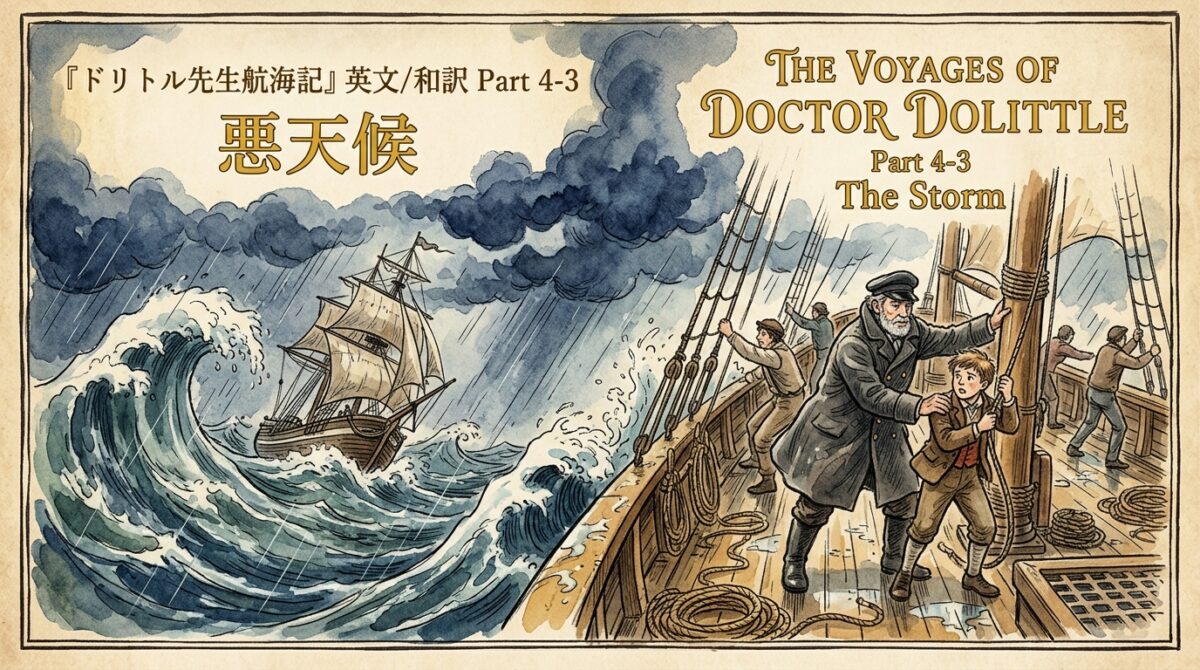
カーリュー号はブラジルを目前にしながら、風が弱まり、航海が思うように進まなくなります。ドリトル先生は六分儀や地図を使って何度も位置を確認しますが、やがて風向きが不安定になり、ポリネシアが嵐の接近を知らせます。穏やかだった海は一変し、カーリュー号は激しい暴風雨に襲われます。風・嵐・海の表情・船の危機に関する重要表現を多めに色分けしています。
表示設定
AS soon as I had the Curlew swung round upon her course again I noticed something peculiar.
カーリュー号を再び進路に向け直すとすぐ、私は何か奇妙なことに気づいた。
We were not going as fast as we had been.
私たちは以前ほど速く進んでいなかった。
Our favorable wind had almost entirely disappeared.
私たちに都合のよかった風は、ほとんど完全に消えてしまっていた。
This, at first, we did not worry about, thinking that at any moment it might spring up again.
最初のうち、私たちはこれを心配しなかった。いつまた風が起こるかもしれないと思っていたからだ。
But the whole day went by; then two days; then a week,—ten days, and the wind grew no stronger.
しかし丸一日が過ぎ、二日が過ぎ、一週間が過ぎ、十日が過ぎても、風は強くならなかった。
The Curlew just dawdled along at the speed of a toddling babe.
カーリュー号は、よちよち歩きの赤ん坊のような速さで、ただのろのろ進むだけだった。
I now saw that the Doctor was becoming uneasy.
そのころ私は、先生が不安になり始めているのに気づいた。
He kept getting out his sextant, an instrument which tells you what part of the ocean you are in, and making calculations.
先生は六分儀を何度も取り出していた。それは海のどのあたりにいるかを知るための道具で、先生は計算をしていた。
He was forever looking at his maps and measuring distances on them.
先生はいつも地図を見て、そこに距離を測っていた。
The far edge of the sea, all around us, he examined with his telescope a hundred times a day.
私たちの周囲に広がる海の遠い端を、先生は一日に百回も望遠鏡で調べていた。
“But Doctor,” I said when I found him one afternoon mumbling to himself about the misty appearance of the sky.
ある午後、先生が空の霧がかった様子についてぶつぶつ独り言を言っているのを見つけたとき、私は言った。「でも先生」
“It wouldn’t matter so much, would it, if we did take a little longer over the trip?”
「旅に少し時間がかかったとしても、それほど問題ではないのではありませんか」
“We’ve got plenty to eat on board now; and the Purple Bird-of-Paradise will know that we have been delayed by something that we couldn’t help.”
「今は船に食べ物がたくさんありますし、紫の極楽鳥も、私たちがどうしようもない事情で遅れているのだとわかってくれるでしょう」
“Yes, I suppose so,” he said thoughtfully.
「うん、そうだろうね」と先生は考え深く言った。
“But I hate to keep her waiting.”
「しかし彼女を待たせるのは嫌なんだ」
“At this season of the year she generally goes to the Peruvian mountains—for her health.”
「一年のこの時期、彼女はたいてい健康のためにペルーの山々へ行くんだ」
“And besides, the good weather she prophesied is likely to end any day now and delay us still further.”
「それに、彼女が予言したよい天気も、もういつ終わってもおかしくなく、私たちをさらに遅らせるかもしれない」
“If we could only keep moving at even a fair speed, I wouldn’t mind.”
「たとえかなりの速さでも動き続けられるなら、私は気にしないのだが」
“It’s this hanging around, almost dead still, that gets me restless.”
「ほとんど完全に止まったまま、ぐずぐず留まっていることが、私を落ち着かなくさせるんだ」
“Ah, here comes a wind—Not very strong—but maybe it’ll grow.”
「ああ、風が来た。あまり強くはないが、もしかすると強まるかもしれない」
A gentle breeze from the Northeast came singing through the ropes.
北東からの穏やかなそよ風が、ロープの間を歌うように吹き抜けてきた。
And we smiled up hopefully at the Curlew’s leaning masts.
そして私たちは、傾いたカーリュー号のマストを希望を持って見上げて微笑んだ。
“We’ve only got another hundred and fifty miles to make, to sight the coast of Brazil,” said the Doctor.
「ブラジルの海岸が見えるまで、あと百五十マイル進むだけだ」と先生は言った。
“If that wind would just stay with us, steady, for a full day we’d see land.”
「あの風が一日中安定して私たちと一緒にいてくれさえすれば、陸が見えるだろう」
But suddenly the wind changed, swung to the East, then back to the Northeast—then to the North.
しかし突然、風は変わり、東へ回り、それから北東へ戻り、次に北へ回った。
It came in fitful gusts, as though it hadn’t made up its mind which way to blow.
それは、どちらへ吹くべきか決めかねているかのように、断続的な突風となって吹いてきた。
And I was kept busy at the wheel, swinging the Curlew this way and that to keep the right side of it.
そして私は舵輪のところで忙しく働かされ、カーリュー号をあちらこちらへ向けて、風を正しい側から受けるようにしていた。
Presently we heard Polynesia, who was in the rigging keeping a look-out for land or passing ships, screech down to us.
やがて、索具の中で陸や通り過ぎる船を見張っていたポリネシアが、私たちに向かって金切り声で叫ぶのが聞こえた。
“Bad weather coming.”
「悪天候が来るよ」
“That jumpy wind is an ugly sign.”
「あの落ち着きのない風は、不吉な兆しだ」
“And look!—over there in the East—see that black line, low down?”
「それに見てごらん! 東のあそこ、低いところに黒い線が見えるかい?」
“If that isn’t a storm I’m a land-lubber.”
「あれが嵐でないなら、私は陸者だよ」
“The gales round here are fierce, when they do blow—tear your canvas out like paper.”
「このあたりの強風は、いったん吹くと猛烈だよ。帆布なんか紙のように引き裂いてしまう」
“You take the wheel, Doctor: it’ll need a strong arm if it’s a real storm.”
「先生、舵を取ってください。本物の嵐なら、強い腕が必要になる」
“I’ll go wake Bumpo and Chee-Chee.”
「私はバンポとチーチーを起こしに行く」
“This looks bad to me.”
「これはまずそうに見えるよ」
“We’d best get all the sail down right away, till we see how strong she’s going to blow.”
「どれほど強く吹くかを見るまで、すぐに帆を全部下ろしたほうがいい」
Indeed the whole sky was now beginning to take on a very threatening look.
実際、空全体が今や非常に不穏な様子を帯び始めていた。
The black line to the eastward grew blacker as it came nearer and nearer.
東の黒い線は、近づくにつれてますます黒くなっていった。
A low, rumbly, whispering noise went moaning over the sea.
低く、ゴロゴロと、ささやくような音が、海の上をうめくように流れていった。
The water which had been so blue and smiling turned to a ruffled ugly gray.
あれほど青く、ほほえむようだった海は、波立った不気味な灰色へ変わった。
And across the darkening sky, shreds of cloud swept like tattered witches flying from the storm.
そして暗くなる空を横切って、雲の切れ端が、嵐から逃げるぼろぼろの魔女のように流れていった。
I must confess I was frightened.
私はおびえていたと告白しなければならない。
You see I had only so far seen the sea in friendly moods.
というのも、それまで私は海の友好的な表情しか見たことがなかったからだ。
Sometimes quiet and lazy; sometimes laughing, venturesome and reckless.
あるときは静かでのんびりし、またあるときは笑っているようで、冒険好きで、向こう見ずだった。
Sometimes brooding and poetic, when moonbeams turned her ripples into silver threads.
またあるときは、月の光がそのさざ波を銀の糸に変えると、物思いに沈み、詩的だった。
And dreaming snowy night-clouds piled up fairy-castles in the sky.
そして夢見るような雪白の夜雲が、空に妖精の城を積み上げていた。
But as yet I had not known, or even guessed at, the terrible strength of the Sea’s wild anger.
しかしその時まで、私は海の荒々しい怒りの恐ろしい力を知らず、想像したことさえなかった。
When that storm finally struck us we leaned right over flatly on our side.
その嵐がついに私たちを襲ったとき、船は横倒しになるほど大きく傾いた。
It was as though some invisible giant had slapped the poor Curlew on the cheek.
まるで目に見えない巨人が、かわいそうなカーリュー号の頬を平手打ちしたかのようだった。
After that things happened so thick and fast that I haven’t a very clear idea of how our shipwreck came about.
その後は物事があまりに次々と起こったので、私たちの難破がどう起こったのか、はっきりとは覚えていない。
What with the wind that stopped your breath, the driving, blinding water, the deafening noise and the rest, everything became confused.
息を止めるほどの風、吹きつけて目をくらませる水、耳をつんざく音、その他もろもろのせいで、すべてが混乱してしまった。
I remember seeing the sails, which we were now trying to roll up upon the deck, torn out of our hands by the wind.
私たちが甲板の上で巻き上げようとしていた帆が、風によって私たちの手から引きちぎられたのを覚えている。
They went overboard like a penny balloon—very nearly carrying Chee-Chee with them.
それらは安物の風船のように船外へ飛んでいき、チーチーまで連れていきそうになった。
And I have a dim recollection of Polynesia screeching somewhere for one of us to go downstairs and close the port-holes.
また、ポリネシアがどこかで、誰かが下へ行って舷窓を閉めろと金切り声で叫んでいた、ぼんやりとした記憶もある。
In spite of our masts being bare of sail we were now scudding along to the southward at a great pace.
マストに帆がないにもかかわらず、私たちは今、ものすごい速さで南へ疾走していた。
But every once in a while huge gray-black waves would arise from under the ship’s side like nightmare monsters.
しかし、ときどき巨大な灰黒色の波が、悪夢の怪物のように船の横から持ち上がった。
They would swell and climb, then crash down upon us, pressing us into the sea.
それらは膨れ上がり、せり上がり、それから私たちの上に崩れ落ち、船を海へ押し込んだ。
And the poor Curlew would come to a standstill, half under water, like a gasping, drowning pig.
そしてかわいそうなカーリュー号は半ば水に沈み、あえぎながら溺れかけた豚のように、止まってしまうのだった。
While I was clambering along towards the wheel to see the Doctor, I was clinging like a leech with hands and legs to the rails.
先生の様子を見るために舵輪へ向かってよじ登るように進んでいたとき、私は手足で手すりにヒルのようにしがみついていた。
I did this lest I be blown overboard.
船外へ吹き飛ばされないように、そうしていたのだ。
One of these tremendous seas tore loose my hold.
そのものすごい波の一つが、私のつかんでいた手を引きはがした。
It filled my throat with water and swept me like a cork the full length of the deck.
波は私の喉を水でいっぱいにし、私をコルクのように甲板の端から端まで押し流した。
My head struck a door with an awful bang.
私の頭は、ものすごい音を立てて扉にぶつかった。
And then I fainted.
そして私は気を失った。