
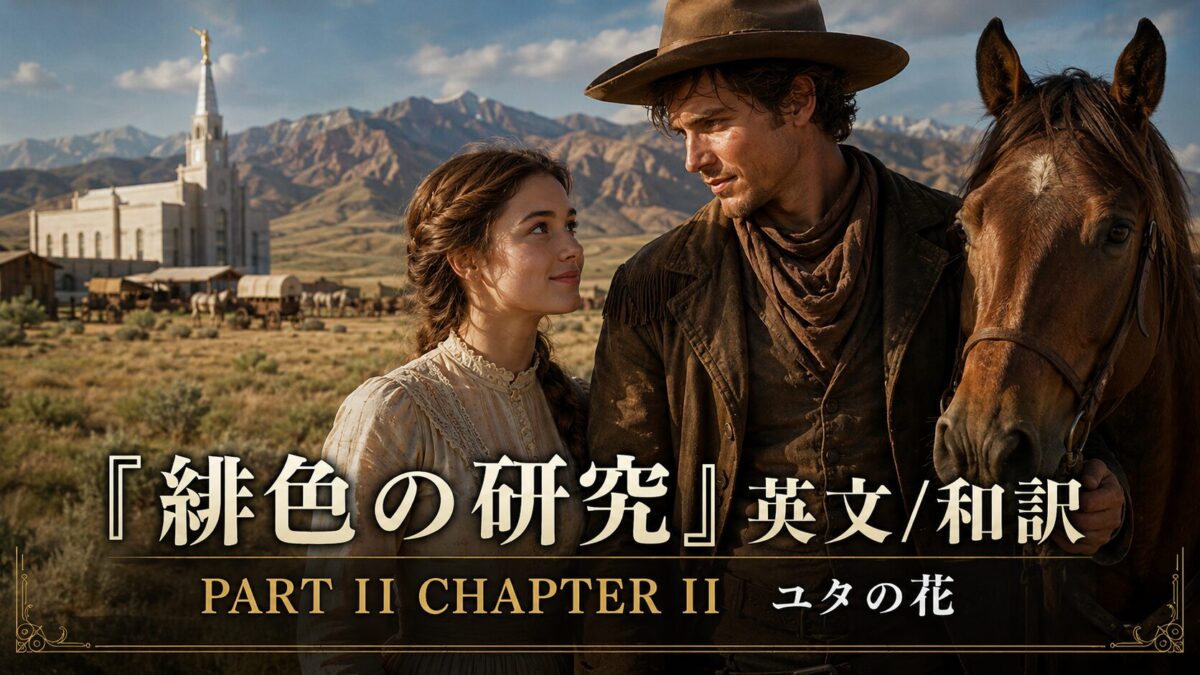
PART II CHAPTER II のポイント
第II部第2章では、ジョン・フェリアーとルーシーがモルモン共同体の中で年月を重ね、フェリアーは豊かな農場主となり、ルーシーは美しい娘へと成長します。やがてルーシーは、勇敢な青年ジェファーソン・ホープと出会い、二人の間に強い愛情が芽生えます。
この章の読みどころは、ロンドンの殺人事件の背後にある「愛」と「過去の約束」が見え始めるところです。ルーシーとホープの純粋な関係は明るく描かれますが、その幸福が共同体の掟や権力と衝突していく予感が、次章への不穏な伏線になっています。
この章の英語学習ポイントを開く
- settlement:入植地、定住地。モルモン共同体が築いた町や生活の広がりを読むうえで重要です。
- prosperous:繁栄した、裕福な。フェリアーが荒野から成功を得ていく様子を表す語です。
- maiden:若い娘、乙女。成長したルーシーの美しさを描く古風な表現として押さえておきたい語です。
- hunter:猟師、狩人。ジェファーソン・ホープのたくましい人物像を示す語です。
- affection:愛情、好意。ルーシーとホープの関係が深まっていく場面を理解するための重要語です。
緋色の研究 対訳学習コントロールパネル
『緋色の研究』英文/和訳 PART II CHAPTER II
THE FLOWER OF UTAH / ユタの花
『緋色の研究』英文/和訳 PART II CHAPTER II ユタの花
コナン・ドイル『緋色の研究』第2部第2章を、英語の重要語句が直感的に入るように色分けした多読用の英文/和訳記事です。ジョン・フェリアーとルーシーはモルモンの一団とともにユタへ到着し、やがてルーシーは「ユタの花」と呼ばれる美しい娘へと成長していきます。
This is not the place to commemorate the trials and privations endured by the immigrant Mormons before they came to their final haven.
ここは、移民のモルモン教徒たちが最終的な安住の地にたどり着くまでに耐えた試練や困窮を詳しく記す場ではない。
From the shores of the Mississippi to the western slopes of the Rocky Mountains they had struggled on with a constancy almost unparalleled in history.
ミシシッピ川の岸からロッキー山脈の西斜面まで、彼らは歴史上ほとんど比類ない不屈さで苦闘しながら進んできた。
The savage man, and the savage beast, hunger, thirst, fatigue, and disease—every impediment which Nature could place in the way had all been overcome with Anglo-Saxon tenacity.
野蛮な人間、野生の獣、飢え、渇き、疲労、病気——自然が道に置き得るあらゆる障害を、彼らはアングロサクソン的な粘り強さで乗り越えてきた。
Yet the long journey and the accumulated terrors had shaken the hearts of the stoutest among them.
しかし、長い旅と積み重なった恐怖は、彼らの中で最も勇敢な者たちの心さえ揺さぶっていた。
There was not one who did not sink upon his knees in heartfelt prayer when they saw the broad valley of Utah bathed in the sunlight beneath them.
眼下に、太陽の光を浴びた広大なユタの谷を見たとき、心からの祈りを捧げてひざまずかない者は一人もいなかった。
And they learned from the lips of their leader that this was the promised land, and that these virgin acres were to be theirs for evermore.
そして指導者の口から、こここそが約束の地であり、この未開の土地は永遠に彼らのものとなるのだと知らされたのである。
Young speedily proved himself to be a skilful administrator as well as a resolute chief.
ヤングはすぐに、自分が断固たる首長であるだけでなく、有能な行政家でもあることを証明した。
Maps were drawn and charts prepared, in which the future city was sketched out.
地図が描かれ、図面が作られ、そこには未来の都市の姿が描き出された。
All around farms were apportioned and allotted in proportion to the standing of each individual.
周囲の農地は、それぞれの人物の地位に応じて配分され、割り当てられた。
The tradesman was put to his trade and the artisan to his calling.
商人は商売に、職人はその職に就かされた。
In the town streets and squares sprang up, as if by magic.
町には通りや広場が、まるで魔法のように生まれた。
In the country there was draining and hedging, planting and clearing.
田園では、排水整備や生け垣作り、植え付けや開墾が行われた。
Until the next summer saw the whole country golden with the wheat crop.
そして翌年の夏には、国中が小麦の実りで黄金色に輝くまでになった。
Everything prospered in the strange settlement.
この奇妙な入植地では、すべてが繁栄した。
Above all, the great temple which they had erected in the centre of the city grew ever taller and larger.
何よりも、彼らが町の中心に建てた大神殿は、ますます高く、ますます大きくなっていった。
From the first blush of dawn until the closing of the twilight, the clatter of the hammer and the rasp of the saw was never absent.
夜明けの最初の赤みから夕暮れが閉じるまで、金づちの音とのこぎりのきしみが絶えることはなかった。
It was the monument which the immigrants erected to Him who had led them safe through many dangers.
それは、多くの危険を通って彼らを無事に導いた神へ、移民たちが建てた記念碑であった。
The two castaways, John Ferrier and the little girl who had shared his fortunes and had been adopted as his daughter, accompanied the Mormons to the end of their great pilgrimage.
二人の遭難者、ジョン・フェリアーと、彼と運命を共にして養女となった小さな少女は、モルモン教徒たちの大いなる巡礼の終わりまで同行した。
Little Lucy Ferrier was borne along pleasantly enough in Elder Stangerson’s waggon.
小さなルーシー・フェリアーは、スタンガソン長老の幌馬車の中で、なかなか快適に運ばれていった。
It was a retreat which she shared with the Mormon’s three wives and with his son, a headstrong forward boy of twelve.
そこは、モルモン教徒である彼の三人の妻と、強情で出しゃばりな十二歳の息子と共にする避難場所であった。
Having rallied, with the elasticity of childhood, from the shock caused by her mother’s death, she soon became a pet with the women.
母の死による衝撃から、子どもらしい回復力で立ち直ると、彼女はすぐに女たちの可愛がる存在になった。
And she reconciled herself to this new life in her moving canvas-covered home.
そして幌で覆われた動く家での新しい生活にも、しだいになじんでいった。
In the meantime Ferrier, having recovered from his privations, distinguished himself as a useful guide and an indefatigable hunter.
その間、フェリアーは困窮から回復し、有能な案内人であり、疲れを知らない猟師として頭角を現した。
So rapidly did he gain the esteem of his new companions, that when they reached the end of their wanderings, it was unanimously agreed that he should be provided with a large and fertile tract of land.
彼は新しい仲間たちの尊敬を非常に早く得たため、彼らが放浪の終わりに到達したとき、彼に広く肥沃な土地を与えることが満場一致で決められた。
It was as large and as fertile as any of the settlers possessed, with the exception of Young himself and of the four principal Elders.
それは、ヤング自身と四人の主要な長老を除けば、どの入植者の土地にも劣らない広さと肥沃さを持っていた。
On the farm thus acquired John Ferrier built himself a substantial log-house.
こうして手に入れた農場に、ジョン・フェリアーは頑丈な丸太小屋を建てた。
It received so many additions in succeeding years that it grew into a roomy villa.
その後の年月で多くの増築が行われ、それは広々とした邸宅へと成長した。
He was a man of a practical turn of mind, keen in his dealings and skilful with his hands.
彼は実際的な気質の人物で、取引には鋭く、手先も器用だった。
His iron constitution enabled him to work morning and evening at improving and tilling his lands.
鉄のような体質のおかげで、彼は朝から晩まで土地を改良し、耕すことができた。
Hence it came about that his farm and all that belonged to him prospered exceedingly.
その結果、彼の農場と彼の所有物すべては非常に繁栄した。
In three years he was better off than his neighbours, in six he was well-to-do, in nine he was rich.
三年で彼は近隣の者たちより暮らし向きがよくなり、六年で裕福になり、九年で金持ちになった。
And in twelve there were not half a dozen men in the whole of Salt Lake City who could compare with him.
そして十二年後には、ソルトレイクシティ全体で彼に匹敵する者は、半ダースもいなかった。
From the great inland sea to the distant Wahsatch Mountains there was no name better known than that of John Ferrier.
大きな内陸の湖から遠くのワサッチ山脈に至るまで、ジョン・フェリアーほどよく知られた名はなかった。
There was one way and only one in which he offended the susceptibilities of his co-religionists.
ただ一つだけ、彼が同じ信仰を持つ者たちの感情を傷つける点があった。
No argument or persuasion could ever induce him to set up a female establishment after the manner of his companions.
どんな議論や説得も、彼に仲間たちのような「女性の家庭」を持たせることはできなかった。
He never gave reasons for this persistent refusal, but contented himself by resolutely and inflexibly adhering to his determination.
彼はこの頑固な拒否の理由を決して語らず、ただ断固として、曲げることなく自分の決意を守った。
There were some who accused him of lukewarmness in his adopted religion.
中には、彼が受け入れた宗教に対して熱心でないと非難する者もいた。
Others put it down to greed of wealth and reluctance to incur expense.
また別の者たちは、それを富への貪欲さと、費用を負担したくない気持ちのせいだと考えた。
Others, again, spoke of some early love affair, and of a fair-haired girl who had pined away on the shores of the Atlantic.
さらに別の者たちは、若いころの恋愛や、大西洋の岸辺でやつれて死んだ金髪の娘の話をした。
Whatever the reason, Ferrier remained strictly celibate.
理由が何であれ、フェリアーは厳格に独身を貫いた。
In every other respect he conformed to the religion of the young settlement, and gained the name of being an orthodox and straight-walking man.
それ以外のあらゆる点では、彼は若い入植地の宗教に従い、正統でまっすぐな人物という評判を得ていた。
Lucy Ferrier grew up within the log-house, and assisted her adopted father in all his undertakings.
ルーシー・フェリアーは丸太小屋の中で成長し、養父のあらゆる仕事を手伝った。
The keen air of the mountains and the balsamic odour of the pine trees took the place of nurse and mother to the young girl.
山の鋭い空気と、松の木の芳香は、その少女にとって乳母と母親の代わりとなった。
As year succeeded to year she grew taller and stronger, her cheek more ruddy, and her step more elastic.
年を追うごとに、彼女は背が高く、強くなり、頬はより赤みを帯び、足取りはより弾むようになった。
Many a wayfarer upon the high road which ran by Ferrier’s farm felt long-forgotten thoughts revive in their mind.
フェリアーの農場のそばを通る街道の旅人たちは、彼女を見ると、長く忘れていた思いが心によみがえるのを感じた。
They watched her lithe girlish figure tripping through the wheatfields.
彼らは、彼女のしなやかな少女の姿が小麦畑を軽やかに歩くのを見つめた。
Or they met her mounted upon her father’s mustang, managing it with all the ease and grace of a true child of the West.
あるいは、父のムスタングにまたがり、本物の西部の子らしい気軽さと優雅さで馬を操る彼女に出会った。
So the bud blossomed into a flower.
こうして、つぼみは花へと開いた。
And the year which saw her father the richest of the farmers left her as fair a specimen of American girlhood as could be found in the whole Pacific slope.
父が農民の中で最も裕福になったその年、彼女は太平洋斜面全体を探しても見つからないほど美しい、アメリカ娘の見本となっていた。
It was not the father, however, who first discovered that the child had developed into the woman.
しかし、その子どもが女性へと成長したことに最初に気づいたのは、父親ではなかった。
It seldom is in such cases.
こういう場合、父親が最初に気づくことはめったにない。
That mysterious change is too subtle and too gradual to be measured by dates.
その神秘的な変化は、あまりにも微妙で、あまりにもゆっくりしているため、日付で測ることはできない。
Least of all does the maiden herself know it until the tone of a voice or the touch of a hand sets her heart thrilling within her.
少女自身こそ、声の調子や手の触れ方が心を震わせるまで、それに最も気づかないものだ。
Then she learns, with a mixture of pride and fear, that a new and larger nature has awoken within her.
そのとき彼女は、誇りと恐れの入り混じった気持ちで、自分の中に新しく大きな本性が目覚めたことを知るのである。
There are few who cannot recall that day and remember the one little incident which heralded the dawn of a new life.
新しい人生の夜明けを告げた、その小さな出来事を思い出せない者はほとんどいないだろう。
In the case of Lucy Ferrier the occasion was serious enough in itself, apart from its future influence on her destiny and that of many besides.
ルーシー・フェリアーの場合、その出来事は、それが彼女や多くの人々の運命に及ぼす将来の影響を別にしても、それ自体で十分に重大なものだった。
It was a warm June morning, and the Latter Day Saints were as busy as the bees whose hive they have chosen for their emblem.
それは暖かな六月の朝で、末日聖徒たちは、自分たちの象徴に選んだ蜂の巣の蜂のように忙しかった。
In the fields and in the streets rose the same hum of human industry.
畑でも通りでも、人間の労働のざわめきが同じように立ちのぼっていた。
Down the dusty high roads defiled long streams of heavily-laden mules, all heading to the west.
ほこりっぽい街道を、重い荷を背負ったラバの長い列が、西へ向かって進んでいた。
For the gold fever had broken out in California, and the Overland Route lay through the City of the Elect.
というのも、カリフォルニアで金熱が起こり、陸路は選ばれし者たちの都を通っていたからである。
There, too, were droves of sheep and bullocks coming in from the outlying pasture lands.
そこにはまた、周辺の牧草地からやって来る羊や雄牛の群れもあった。
And trains of tired immigrants, men and horses equally weary of their interminable journey.
さらに、疲れ切った移民の列もあった。人も馬も、果てしない旅に等しく疲れ果てていた。
Through all this motley assemblage, threading her way with the skill of an accomplished rider, there galloped Lucy Ferrier.
この雑多な集まりの中を、熟練した騎手の技で縫うように進みながら、ルーシー・フェリアーが馬を走らせていた。
Her fair face was flushed with the exercise and her long chestnut hair floated out behind her.
その美しい顔は運動で上気し、長い栗色の髪は後ろになびいていた。
She had a commission from her father in the City.
彼女は父から町での用事を頼まれていた。
And she was dashing in, as she had done many a time before, with all the fearlessness of youth.
そしてこれまで何度もそうしてきたように、若さゆえの大胆さで町へ駆け込んでいった。
She thought only of her task and how it was to be performed.
彼女はただ、自分の用事と、それをどう果たすかだけを考えていた。
The travel-stained adventurers gazed after her in astonishment.
旅に汚れた冒険者たちは、驚いて彼女の後ろ姿を見つめた。
Even the unemotional Indians, journeying in with their peltries, relaxed their accustomed stoicism.
毛皮を持って旅してきた無感情なインディアンたちでさえ、いつもの平然さをゆるめた。
They marvelled at the beauty of the pale-faced maiden.
彼らはその白い顔の乙女の美しさに驚嘆した。
She had reached the outskirts of the city when she found the road blocked by a great drove of cattle.
彼女が町外れに達したとき、道は大きな牛の群れにふさがれていた。
They were driven by a half-dozen wild-looking herdsmen from the plains.
その牛たちは、平原から来た半ダースほどの荒々しい様子の牧人たちに追われていた。
In her impatience she endeavoured to pass this obstacle by pushing her horse into what appeared to be a gap.
焦った彼女は、隙間に見える場所へ馬を押し入れて、この障害を通り抜けようとした。
Scarcely had she got fairly into it, however, before the beasts closed in behind her.
しかし、彼女がそこへ入り込むやいなや、獣たちは彼女の後ろで密集した。
She found herself completely imbedded in the moving stream of fierce-eyed, long-horned bullocks.
彼女は、鋭い目をした長い角の雄牛たちの動く流れの中に、完全に埋もれてしまった。
Accustomed as she was to deal with cattle, she was not alarmed at her situation.
牛を扱うことには慣れていたので、彼女は自分の状況に動揺しなかった。
But she took advantage of every opportunity to urge her horse on in the hopes of pushing her way through the cavalcade.
それでも、彼女は機会を見つけるたびに馬を進ませ、牛の隊列を押し分けて抜けようとした。
Unfortunately the horns of one of the creatures, either by accident or design, came in violent contact with the flank of the mustang.
不幸にも、一頭の角が、偶然か意図的かはともかく、ムスタングの脇腹に激しく触れた。
And it excited it to madness.
それによって、馬は狂ったように興奮した。
In an instant it reared up upon its hind legs with a snort of rage.
一瞬のうちに、馬は怒りの鼻息を鳴らしながら後ろ脚で立ち上がった。
It pranced and tossed in a way that would have unseated any but a most skilful rider.
馬は跳ね回り、身を揺らした。それは、最も巧みな騎手でなければ振り落とされるほどだった。
The situation was full of peril.
状況は危険に満ちていた。
Every plunge of the excited horse brought it against the horns again, and goaded it to fresh madness.
興奮した馬が跳ねるたびに、再び角にぶつかり、それが馬をさらに狂気へと駆り立てた。
It was all that the girl could do to keep herself in the saddle.
少女にできるのは、何とか鞍にしがみついていることだけだった。
Yet a slip would mean a terrible death under the hoofs of the unwieldy and terrified animals.
しかし一度でも滑り落ちれば、重く不器用で怯えた動物たちのひづめの下で、恐ろしい死を迎えることを意味していた。
Unaccustomed to sudden emergencies, her head began to swim, and her grip upon the bridle to relax.
突然の非常事態に慣れていなかったため、彼女の頭はくらくらし始め、手綱を握る力もゆるんできた。
Choked by the rising cloud of dust and by the steam from the struggling creatures, she might have abandoned her efforts in despair.
立ちのぼる砂ぼこりと、もがく動物たちの熱気に息を詰まらせ、彼女は絶望して努力をあきらめていたかもしれない。
But for a kindly voice at her elbow which assured her of assistance.
もしそのとき、彼女のそばで助けを約束する親切な声が聞こえなかったならば。
At the same moment a sinewy brown hand caught the frightened horse by the curb.
同時に、筋張った茶色の手が、怯えた馬のくつわをつかんだ。
And, forcing a way through the drove, soon brought her to the outskirts.
そして牛の群れの中を無理に道を開き、すぐに彼女を外れへ連れ出した。
“You’re not hurt, I hope, miss,” said her preserver, respectfully.
「お怪我はありませんか、お嬢さん」と、彼女を救った男は丁寧に言った。
She looked up at his dark, fierce face, and laughed saucily.
彼女はその浅黒く荒々しい顔を見上げ、小生意気に笑った。
“I’m awful frightened,” she said, naively.
「ものすごく怖かったわ」と彼女は無邪気に言った。
“Whoever would have thought that Poncho would have been so scared by a lot of cows?”
「ポンチョが、牛の群れなんかにあんなに怯えるなんて、誰が思ったでしょうね?」
“Thank God you kept your seat,” the other said earnestly.
「あなたが鞍に残っていてくれて、本当に神に感謝します」と相手は真剣に言った。
He was a tall, savage-looking young fellow, mounted on a powerful roan horse.
彼は背の高い、荒々しい風貌の若者で、力強い栗毛馬に乗っていた。
He was clad in the rough dress of a hunter, with a long rifle slung over his shoulders.
彼は猟師の粗末な服をまとい、長いライフルを肩に掛けていた。
“I guess you are the daughter of John Ferrier,” he remarked.
「あなたはジョン・フェリアーの娘さんですね」と彼は言った。
“I saw you ride down from his house.”
「あの家から馬で下りてくるのを見ました」
“When you see him, ask him if he remembers the Jefferson Hopes of St. Louis.”
「彼に会ったら、セントルイスのジェファーソン・ホープ一家を覚えているか聞いてください」
“If he’s the same Ferrier, my father and he were pretty thick.”
「彼が同じフェリアーなら、私の父と彼はかなり親しかったはずです」
“Hadn’t you better come and ask yourself?” she asked, demurely.
「ご自分で来て尋ねた方がよくありませんか?」と彼女は慎み深く尋ねた。
The young fellow seemed pleased at the suggestion, and his dark eyes sparkled with pleasure.
その提案に若者は喜んだようで、黒い目が喜びに輝いた。
“I’ll do so,” he said.
「そうします」と彼は言った。
“We’ve been in the mountains for two months, and are not over and above in visiting condition.”
「私たちは二か月も山にいたので、訪問にふさわしい身なりとはあまり言えませんが」
“He must take us as he finds us.”
「彼には、ありのままの私たちを受け入れてもらうしかありません」
“He has a good deal to thank you for, and so have I,” she answered.
「父はあなたに大いに感謝するでしょう。私もそうです」と彼女は答えた。
“He’s awful fond of me. If those cows had jumped on me he’d have never got over it.”
「父は私をとても大事にしているの。あの牛たちに踏まれていたら、父は立ち直れなかったでしょうね」
“Neither would I,” said her companion.
「私も立ち直れなかったでしょう」と相手は言った。
“You! Well, I don’t see that it would make much matter to you, anyhow.”
「あなたが? でも、どちらにしても、あなたにはあまり関係ないように思うけれど」
“You ain’t even a friend of ours.”
「あなたは、まだ私たちの友だちでさえないもの」
The young hunter’s dark face grew so gloomy over this remark that Lucy Ferrier laughed aloud.
この言葉を聞いて若い猟師の浅黒い顔があまりにも陰気になったので、ルーシー・フェリアーは声を出して笑った。
“There, I didn’t mean that,” she said.
「まあ、そんな意味じゃないの」と彼女は言った。
“Of course, you are a friend now. You must come and see us.”
「もちろん、あなたはもう友だちよ。ぜひ私たちに会いに来てください」
“Now I must push along, or father won’t trust me with his business any more.”
「でももう急がないと。父がもう用事を任せてくれなくなるわ」
“Good-bye!”
「さようなら!」
“Good-bye,” he answered, raising his broad sombrero, and bending over her little hand.
「さようなら」と彼は答え、広いつばのソンブレロを上げ、彼女の小さな手に身をかがめた。
She wheeled her mustang round, gave it a cut with her riding-whip, and darted away down the broad road in a rolling cloud of dust.
彼女はムスタングの向きを変え、乗馬鞭で一打ちすると、巻き上がる砂ぼこりの中を広い道へ矢のように去っていった。
Young Jefferson Hope rode on with his companions, gloomy and taciturn.
若いジェファーソン・ホープは、陰気で無口なまま仲間たちと馬を進めた。
He and they had been among the Nevada Mountains prospecting for silver.
彼と仲間たちは、ネバダ山脈で銀を探鉱していた。
They were returning to Salt Lake City in the hope of raising capital enough to work some lodes which they had discovered.
彼らは、発見したいくつかの鉱脈を採掘するための資金を集めようと、ソルトレイクシティへ戻るところだった。
He had been as keen as any of them upon the business until this sudden incident had drawn his thoughts into another channel.
この突然の出来事が彼の思考を別の方向へ向けるまでは、彼も仲間たちと同じくらいその事業に熱心だった。
The sight of the fair young girl, as frank and wholesome as the Sierra breezes, had stirred his volcanic, untamed heart to its very depths.
シエラのそよ風のように率直で健やかな美しい少女の姿は、彼の火山のような、飼いならされていない心の奥底を揺さぶった。
When she had vanished from his sight, he realized that a crisis had come in his life.
彼女の姿が見えなくなると、彼は自分の人生に転機が訪れたことを悟った。
Neither silver speculations nor any other questions could ever be of such importance to him as this new and all-absorbing one.
銀の投機も、ほかのどんな問題も、この新しく、すべてを飲み込む問題ほど彼にとって重要ではありえなかった。
The love which had sprung up in his heart was not the sudden, changeable fancy of a boy.
彼の心に芽生えた愛は、少年の突然で移ろいやすい気まぐれではなかった。
It was rather the wild, fierce passion of a man of strong will and imperious temper.
それはむしろ、強い意志と支配的な気性を持つ男の、荒々しく激しい情熱だった。
He had been accustomed to succeed in all that he undertook.
彼は、自分が取り組むことすべてで成功することに慣れていた。
He swore in his heart that he would not fail in this if human effort and human perseverance could render him successful.
人間の努力と忍耐によって成功できるものなら、この恋で失敗することはないと、彼は心に誓った。
He called on John Ferrier that night, and many times again, until his face was a familiar one at the farm-house.
彼はその夜ジョン・フェリアーを訪ね、その後も何度も訪ねた。やがて彼の顔は農家で見慣れたものになった。
John, cooped up in the valley and absorbed in his work, had had little chance of learning the news of the outside world during the last twelve years.
谷に閉じ込められ、仕事に没頭していたジョンは、この十二年間、外の世界のニュースを知る機会がほとんどなかった。
All this Jefferson Hope was able to tell him, and in a style which interested Lucy as well as her father.
ジェファーソン・ホープはそうした話をすべて彼に語ることができ、その語り口は父だけでなくルーシーにも興味を抱かせた。
He had been a pioneer in California, and could narrate many a strange tale of fortunes made and fortunes lost in those wild, halcyon days.
彼はカリフォルニアの開拓者であり、あの荒々しくも幸福な日々に、財産を築いた話や失った話を数多く語ることができた。
He had been a scout too, and a trapper, a silver explorer, and a ranchman.
彼は斥候でもあり、罠猟師でもあり、銀鉱探しでもあり、牧場主でもあった。
Wherever stirring adventures were to be had, Jefferson Hope had been there in search of them.
胸躍る冒険があるところならどこへでも、ジェファーソン・ホープはそれを求めて出かけていた。
He soon became a favourite with the old farmer, who spoke eloquently of his virtues.
彼はすぐに老農夫のお気に入りとなり、老農夫は彼の美点を雄弁に語った。
On such occasions, Lucy was silent.
そういうとき、ルーシーは黙っていた。
But her blushing cheek and her bright, happy eyes showed only too clearly that her young heart was no longer her own.
しかし、赤らむ頬と明るく幸せそうな目は、彼女の若い心がもはや自分のものではないことを、あまりにもはっきり示していた。
Her honest father may not have observed these symptoms.
正直な父親は、こうした兆候に気づかなかったかもしれない。
But they were assuredly not thrown away upon the man who had won her affections.
しかし、彼女の愛情を勝ち取った男にとって、それらは決して見逃されるものではなかった。
It was a summer evening when he came galloping down the road and pulled up at the gate.
ある夏の夕方、彼は道を馬で駆け下り、門のところで馬を止めた。
She was at the doorway, and came down to meet him.
彼女は戸口にいて、彼を迎えるために下りてきた。
He threw the bridle over the fence and strode up the pathway.
彼は手綱を柵に投げかけ、小道を大股で進んだ。
“I am off, Lucy,” he said, taking her two hands in his, and gazing tenderly down into her face.
「行ってくるよ、ルーシー」と彼は言い、彼女の両手を取り、優しくその顔を見下ろした。
“I won’t ask you to come with me now, but will you be ready to come when I am here again?”
「今すぐ一緒に来てほしいとは言わない。でも、私がまた戻ってきたとき、一緒に来る準備をしていてくれるかい?」
“And when will that be?” she asked, blushing and laughing.
「それはいつになるの?」と彼女は赤くなって笑いながら尋ねた。
“A couple of months at the outside.”
「長くても二か月だ」
“I will come and claim you then, my darling.”
「そのとき、君を迎えに来るよ、愛しい人」
“There’s no one who can stand between us.”
「私たちの間に立ちはだかれる者など誰もいない」
“And how about father?” she asked.
「父はどうなの?」と彼女は尋ねた。
“He has given his consent, provided we get these mines working all right.”
「鉱山がうまく動くようになれば、彼は同意してくれている」
“I have no fear on that head.”
「その点については心配していない」
“Oh, well; of course, if you and father have arranged it all, there’s no more to be said,” she whispered.
「まあ、それなら。あなたと父が全部決めているなら、もう何も言うことはないわ」と彼女はささやいた。
Her cheek was against his broad breast.
彼女の頬は、彼の広い胸に寄せられていた。
“Thank God!” he said, hoarsely, stooping and kissing her.
「神に感謝する!」と彼はかすれた声で言い、身をかがめて彼女にキスした。
“It is settled, then.”
「では、決まりだ」
“The longer I stay, the harder it will be to go.”
「長くいればいるほど、去るのがつらくなる」
“They are waiting for me at the cañon.”
「仲間たちが峡谷で私を待っている」
“Good-bye, my own darling—good-bye.”
「さようなら、私の愛しい人——さようなら」
“In two months you shall see me.”
「二か月後には、君は私に会える」
He tore himself from her as he spoke.
そう言うと、彼は彼女から身を引き離した。
And, flinging himself upon his horse, galloped furiously away.
そして馬に飛び乗ると、激しく馬を走らせて去っていった。
He never even looked round, as though afraid that his resolution might fail him if he took one glance at what he was leaving.
彼は一度も振り返らなかった。置いていくものを一目でも見れば、自分の決意が揺らぐことを恐れているかのようだった。
She stood at the gate, gazing after him until he vanished from her sight.
彼女は門のところに立ち、彼の姿が見えなくなるまで見送っていた。
Then she walked back into the house, the happiest girl in all Utah.
それから彼女は家へ戻った。ユタ中で最も幸せな娘として。