
CHAPTER II「二十万フランの懸賞金」中 のポイント
ルパンは、暗号の信号とレプスタン男爵夫人失踪事件との関係を語りながら、信号の発信源を追ってラヴェルヌーの部屋へ向かいます。そこで彼は、病気とされていたラヴェルヌーがすでに殺されていることを発見し、さらにハーグローヴという人物へ手がかりを広げていきます。
この章では、光の暗号が単なる謎解きから殺人事件へと一気に深まります。医師を名乗る謎の老人、逃げたハーグローヴ、レプスタン邸へ向かうルパンなど、次々に危険な要素が重なり、ルパン自身も命を賭けた勝負に踏み込むことになります。
この章の英語学習ポイントを開く
- victimized:被害に遭った、だまされた。レプスタン男爵が妻に金品を奪われたという事件の前提を示す重要語です。
- vanished:姿を消した。男爵夫人の失踪を表し、追跡劇と謎の中心になる語です。
- portress:女性の門番、管理人。ラヴェルヌーの部屋へ入る場面で、建物の状況を説明する人物を表します。
- corpse:死体。ラヴェルヌーの死が明らかになる場面で、事件が殺人へ変わったことを示す語です。
- intuition:直感。ルパンが論理だけでなく直感を頼りに事件へ迫る姿勢を表す重要表現です。
アルセーヌ・ルパン「二十万フランの懸賞金」中
ルパンが暗号の発信源を追い、ラヴェルヌーの死、ハーグローヴの行動、レプスタン男爵をめぐる疑惑へと迫っていく中盤です。事件の手がかり、推理の進行、不穏な描写を多めに色分けしています。
He put his arm through mine, as we went down the stairs, and said:
階段を降りながら、彼は私の腕に自分の腕を絡めて言った。
“I know what everybody knows. Baron Repstein, the company-promoter and racing-man, whose colt Etna won the Derby and the Grand Prix this year, has been victimized by his wife.”
「僕は誰もが知っていることを知っている。会社発起人であり競馬家でもあるレプスタン男爵は、今年ダービーとグランプリを制した牡馬エトナの持ち主だが、妻にひどい目に遭わされた」
“The wife, who was well known for her fair hair, her dress and her extravagance, ran away a fortnight ago.”
「金髪と衣装と浪費で有名だったその妻は、二週間前に逃げ出した」
“She took with her a sum of three million francs, stolen from her husband, and quite a collection of diamonds, pearls and jewellery.”
「彼女は夫から盗んだ三百万フランと、ダイヤモンド、真珠、宝石類を大量に持ち去った」
“Those jewels had been placed in her hands by the Princesse de Berny, and she was supposed to buy them.”
「その宝石はベルニー公妃が彼女に預けていたもので、彼女が買い取ることになっていた」
“For two weeks the police have been pursuing the baroness across France and the continent.”
「この二週間、警察はフランス中、さらには大陸中で男爵夫人を追跡している」
“It is an easy job, as she scatters gold and jewels wherever she goes.”
「それは簡単な仕事だ。彼女は行く先々で金や宝石をばらまいているからだ」
“They think they have her every moment. Two days ago, our champion detective, the egregious Ganimard, arrested a visitor at a big hotel in Belgium.”
「警察は、今にも彼女を捕まえられると思っている。二日前には、我らが名探偵、あの悪名高きガニマールが、ベルギーの大ホテルで一人の宿泊客を逮捕した」
“The most positive evidence seemed to be heaped up against her.”
「その女に対しては、最も確実な証拠が山ほど積み上げられているように見えた」
“On enquiry, the lady turned out to be a notorious chorus-girl called Nelly Darbal.”
「調べてみると、その女性はネリー・ダルバルという有名な踊り子だった」
“As for the baroness, she has vanished.”
「男爵夫人の方は、姿を消してしまった」
“The baron, on his side, has offered a reward of two hundred thousand francs to whosoever finds his wife.”
「一方、男爵は、妻を見つけた者に二十万フランの懸賞金を出すと申し出ている」
“The money is in the hands of a solicitor.”
「その金は弁護士の手に預けられている」
“Moreover, he has sold his racing-stud, his house on the Boulevard Haussmann and his country-seat of Roquencourt in one lump.”
「そのうえ彼は、競走馬の牧場、オスマン大通りの邸宅、ロカンクールの田舎屋敷をまとめて売り払った」
“So that he may indemnify the Princesse de Berny for her loss.”
「ベルニー公妃の損害を補償するためだ」
“And the proceeds of the sale,” I added, “are to be paid over at once.”
「そして売却代金は」と私は付け加えた。「すぐに支払われることになっている」
“The papers say that the princess will have her money to-morrow.”
「新聞によれば、公妃は明日には金を受け取ることになっている」
“Only, frankly, I fail to see the connection between this story, which you have told very well, and the puzzling sentence….”
「ただ正直に言って、君がうまく話してくれたこの話と、あの謎めいた文との関連が私には見えない……」
Lupin did not condescend to reply.
ルパンは答える気にもならないという様子だった。
We had been walking down the street in which I live and had passed some four or five houses.
私たちは私の住む通りを歩き、四、五軒の家を過ぎていた。
Then he stepped off the pavement and began to examine a block of flats, not of the latest construction.
そのとき彼は歩道を外れ、最新式ではない集合住宅を調べ始めた。
It looked as if it contained a large number of tenants.
そこには多くの借家人が住んでいるように見えた。
“According to my calculations,” he said, “this is where the signals came from, probably from that open window.”
「僕の計算によれば」と彼は言った。「信号はここから来た。おそらくあの開いた窓からだ」
“On the third floor?”
「三階か?」
“Yes.”
「そうだ」
He went to the portress and asked her:
彼は門番女のところへ行き、尋ねた。
“Does one of your tenants happen to be acquainted with Baron Repstein?”
「こちらの借家人の中に、レプスタン男爵と知り合いの方はいませんか?」
“Why, of course!” replied the woman.
「もちろんですとも!」と女は答えた。
“We have M. Lavernoux here, such a nice gentleman; he is the baron’s secretary and agent.”
「ここにはラヴェルヌーさんがいますよ。とても感じのよい紳士で、男爵の秘書兼代理人です」
“I look after his flat.”
「私はその方の部屋の世話をしています」
“And can we see him?”
「会えますか?」
“See him?… The poor gentleman is very ill.”
「会う?……お気の毒に、その方は重い病気です」
“Ill?”
「病気?」
“He’s been ill a fortnight … ever since the trouble with the baroness….”
「二週間前から病気です……男爵夫人の騒ぎがあってからずっと……」
“He came home the next day with a temperature and took to his bed.”
「翌日、熱を出して帰ってきて、そのまま寝込んでしまいました」
“But he gets up, surely?”
「しかし、起きることはあるのでしょう?」
“Ah, that I can’t say!”
「ああ、それは何とも言えません!」
“How do you mean, you can’t say?”
「何とも言えないとは、どういう意味です?」
“No, his doctor won’t let any one into his room. He took my key from me.”
「ええ、お医者様が誰も部屋に入れさせないのです。私の鍵も取り上げてしまいました」
“Who did?”
「誰が?」
“The doctor. He comes and sees to his wants, two or three times a day.”
「お医者様です。一日に二、三度やって来て、必要な世話をしています」
“He left the house only twenty minutes ago … an old gentleman with a grey beard and spectacles….”
「その方はほんの二十分前に出ていきました……灰色のあごひげに眼鏡をかけた老紳士で……」
“Walks quite bent…. But where are you going sir?”
「ずいぶん腰を曲げて歩きます……でも、どちらへ行かれるんですか、旦那様?」
“I’m going up, show me the way,” said Lupin, with his foot on the stairs.
「上へ行く。案内してくれ」とルパンは階段に足をかけながら言った。
“It’s the third floor, isn’t it, on the left?”
「三階の左側だね?」
“But I mustn’t!” moaned the portress, running after him.
「でも、いけません!」と門番女は嘆きながら彼の後を追った。
“Besides, I haven’t the key … the doctor….”
「それに鍵もありません……お医者様が……」
They climbed the three flights, one behind the other.
彼らは一列になって三階分の階段を上った。
On the landing, Lupin took a tool from his pocket and, disregarding the woman’s protests, inserted it in the lock.
踊り場でルパンはポケットから道具を取り出し、女の抗議を無視して鍵穴に差し込んだ。
The door yielded almost immediately. We went in.
扉はほとんどすぐに開いた。私たちは中へ入った。
At the back of a small dark room we saw a streak of light filtering through a door that had been left ajar.
小さな暗い部屋の奥に、半開きの扉から漏れる一筋の光が見えた。
Lupin ran across the room and, on reaching the threshold, gave a cry:
ルパンは部屋を横切って走り、敷居に着くと叫んだ。
“Too late! Oh, hang it all!”
「遅かった! ああ、なんてことだ!」
The portress fell on her knees, as though fainting.
門番女は、気絶するかのように膝をついた。
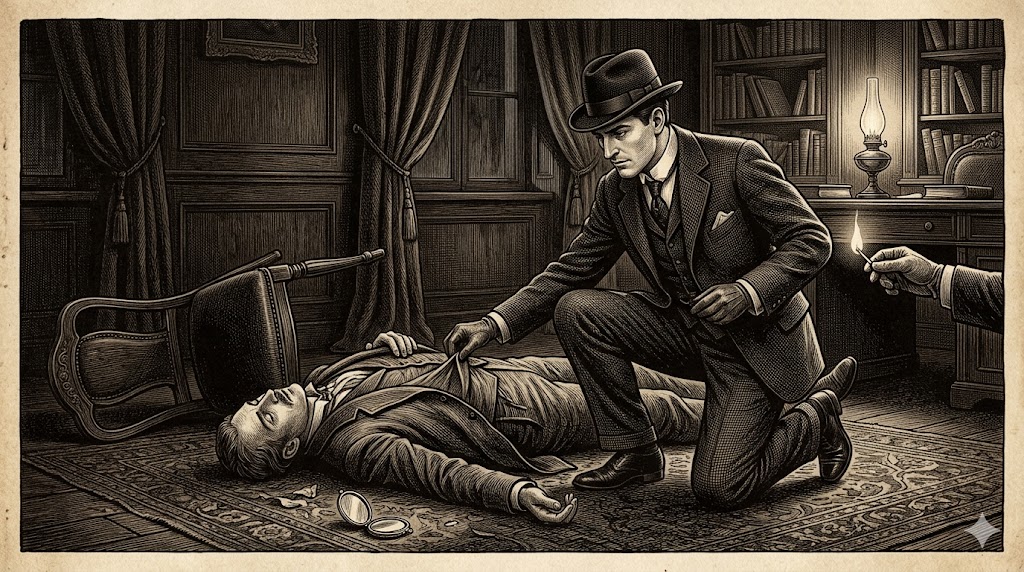
I entered the bedroom, in my turn, and saw a man lying half-dressed on the carpet.
私も寝室に入った。そして、半ば服を着た男が絨毯の上に倒れているのを見た。
His legs were drawn up under him, his arms contorted and his face quite white.
彼の脚は体の下に引き寄せられ、腕はねじ曲がり、顔は真っ白だった。
It was an emaciated, fleshless face, with the eyes still staring in terror.
それはやせ衰え、肉の落ちた顔だった。目はなお恐怖に見開かれていた。
The mouth was twisted into a hideous grin.
口はぞっとするような笑いにねじれていた。
“He’s dead,” said Lupin, after a rapid examination.
「死んでいる」とルパンは素早く調べたあとで言った。
“But why?” I exclaimed. “There’s not a trace of blood!”
「しかし、なぜだ?」と私は叫んだ。「血の跡がまったくない!」
“Yes, yes, there is,” replied Lupin, pointing to two or three drops that showed on the chest, through the open shirt.
「いや、ある、あるよ」とルパンは答え、開いたシャツの間から胸に見える二、三滴の血を指した。
“Look, they must have taken him by the throat with one hand and pricked him to the heart with the other.”
「見たまえ。片手で喉をつかみ、もう一方の手で心臓を刺したに違いない」
“I say, ‘pricked,’ because really the wound can’t be seen.”
「刺した、と言ったのは、実際には傷口が見えないからだ」
“It suggests a hole made by a very long needle.”
「とても長い針で開けられた穴のように思える」
He looked on the floor, all round the corpse.
彼は死体の周囲の床を見回した。
There was nothing to attract his attention, except a little pocket-mirror.
彼の注意を引くものは、小さな手鏡以外には何もなかった。
It was the little mirror with which M. Lavernoux had amused himself by making the sunbeams dance through space.
それは、ラヴェルヌー氏が太陽の光を空間に踊らせていた小さな鏡だった。
But, suddenly, as the portress was breaking into lamentations and calling for help, Lupin flung himself on her and shook her.
だが突然、門番女が嘆き出して助けを呼ぼうとすると、ルパンは彼女に飛びかかり、揺さぶった。
“Stop that!… Listen to me … you can call out later…. Listen to me and answer me. It is most important.”
「やめるんだ!……僕の話を聞け……叫ぶのは後でいい……僕の話を聞いて答えろ。これは非常に重要だ」
“M. Lavernoux had a friend living in this street, had he not?”
「ラヴェルヌー氏には、この通りに住む友人がいたね?」
“On the same side, to the right? An intimate friend?”
「同じ側の右手に。親しい友人が?」
“Yes.”
「はい」
“A friend whom he used to meet at the cafe in the evening and with whom he exchanged the illustrated papers?”
「夕方にカフェで会い、絵入り新聞を交換していた友人だね?」
“Yes.”
「はい」
“Was the friend an Englishman?”
「その友人はイギリス人だったか?」
“Yes.”
「はい」
“What’s his name?”
「名前は?」
“Mr. Hargrove.”
「ハーグローヴさんです」
“Where does he live?”
「どこに住んでいる?」
“At No. 92 in this street.”
「この通りの九十二番地です」
“One word more: had that old doctor been attending him long?”
「もう一つだけ。その老医師は長く彼を診ていたのか?」
“No. I did not know him. He came on the evening when M. Lavernoux was taken ill.”
「いいえ。私は知りませんでした。ラヴェルヌーさんが病気になった晩に来たのです」
Without another word, Lupin dragged me away once more.
ルパンはそれ以上何も言わず、また私を引きずるように連れ出した。
He ran down the stairs and, once in the street, turned to the right, which took us past my flat again.
彼は階段を駆け下り、通りに出ると右へ曲がった。その方向に進むと、また私の住まいの前を通ることになった。
Four doors further, he stopped at No. 92, a small, low-storied house.
四軒先で、彼は九十二番地の前に止まった。そこは小さな低層の家だった。
The ground-floor was occupied by the proprietor of a dram-shop.
一階には酒場の主人が入っていた。
He stood smoking in his doorway, next to the entrance-passage.
彼は入口通路の隣の戸口に立って煙草を吸っていた。
Lupin asked if Mr. Hargrove was at home.
ルパンはハーグローヴ氏が在宅かどうか尋ねた。
“Mr. Hargrove went out about half-an-hour ago,” said the publican.
「ハーグローヴさんは三十分ほど前に出ていきました」と酒場の主人が言った。
“He seemed very much excited and took a taxi-cab, a thing he doesn’t often do.”
「ひどく興奮しているようで、タクシーに乗っていきました。あの人がそんなことをするのは珍しいんです」
“And you don’t know….”
「それで、どこへ行ったかは……」
“Where he was going? Well, there’s no secret about it. He shouted it loud enough!”
「どこへ行ったかですか? それなら秘密でも何でもありませんよ。大声で言っていましたからね!」
“‘Prefecture of Police’ is what he said to the driver….”
「運転手に『警視庁へ』と言っていました……」
Lupin was himself just hailing a taxi, when he changed his mind.
ルパン自身もタクシーを呼び止めようとしたが、ふと思い直した。
I heard him mutter: “What’s the good? He’s got too much start of us….”
彼がつぶやくのが聞こえた。「何の役に立つ? 彼はもう先に行きすぎている……」
He asked if any one called after Mr. Hargrove had gone.
彼は、ハーグローヴ氏が出たあとで誰か訪ねて来たかを尋ねた。
“Yes, an old gentleman with a grey beard and spectacles.”
「はい、灰色のあごひげに眼鏡をかけた老紳士が来ました」
“He went up to Mr. Hargrove’s, rang the bell, and went away again.”
「ハーグローヴさんの部屋まで上がって、ベルを鳴らして、それからまた帰っていきました」
“I am much obliged,” said Lupin, touching his hat.
「どうもありがとう」とルパンは帽子に手をやって言った。
He walked away slowly without speaking to me, wearing a thoughtful air.
彼は私に何も言わず、考え込んだ様子でゆっくり歩き去った。
There was no doubt that the problem struck him as very difficult.
その問題が彼にとって非常に難しいものに思えたことは疑いなかった。
He saw none too clearly in the darkness through which he seemed to be moving with such certainty.
彼は自信ありげに進んでいるように見えながらも、その暗闇の中をまだはっきり見通してはいないようだった。
He himself, for that matter, confessed to me:
実際、彼自身も私にこう打ち明けた。
“These are cases that require much more intuition than reflection.”
「こういう事件は、熟考よりも直感をずっと必要とする」
“But this one, I may tell you, is well worth taking pains about.”
「だがこれは、苦労して取り組むだけの価値がある事件だと言っておこう」
We had now reached the boulevards.
私たちは大通りに着いていた。
Lupin entered a public reading-room and spent a long time consulting the last fortnight’s newspapers.
ルパンは公衆閲覧室に入り、この二週間分の新聞を長い時間かけて調べた。
Now and again, he mumbled: “Yes … yes … of course … it’s only a guess, but it explains everything….”
時折、彼はつぶやいた。「そうだ……そうだ……もちろん……ただの推測だが、すべてを説明している……」
“Well, a guess that answers every question is not far from being the truth….”
「すべての疑問に答える推測は、真実からそう遠くない……」
It was now dark.
もう暗くなっていた。
We dined at a little restaurant and I noticed that Lupin’s face became gradually more animated.
私たちは小さなレストランで食事をした。私は、ルパンの顔が次第に生き生きとしてくるのに気づいた。
His gestures were more decided. He recovered his spirits, his liveliness.
彼の身振りはよりきっぱりしたものになっていた。彼は元気と活気を取り戻していた。
When we left, he made me take a walk along the Boulevard Haussmann, towards Baron Repstein’s house.
店を出ると、彼は私をオスマン大通りに沿って、レプスタン男爵の家の方へ歩かせた。
He was the real Lupin of the great occasions, the Lupin who had made up his mind to go in and win.
彼はまさに大勝負に臨む本物のルパンだった。乗り込んで勝つと決めたルパンだった。
We slackened our pace just short of the Rue de Courcelles.
私たちはクールセル通りの少し手前で歩みを緩めた。
Baron Repstein lived on the left-hand side, between this street and the Faubourg Saint-Honore.
レプスタン男爵は、この通りとフォーブール・サントノレの間、左手側に住んでいた。
It was a three-storied private house of which we could see the front, decorated with columns and caryatides.
それは三階建ての邸宅で、正面には柱と女人像柱の装飾が見えた。
“Stop!” said Lupin, suddenly.
「止まれ!」とルパンが突然言った。
“What is it?”
「どうした?」
“Another proof to confirm my supposition….”
「僕の仮説を裏づける、もう一つの証拠だ……」
“What proof? I see nothing.”
「どんな証拠だ? 私には何も見えない」
“I do…. That’s enough….”
「僕には見える……それで十分だ……」
He turned up the collar of his coat, lowered the brim of his soft hat and said:
彼はコートの襟を立て、柔らかな帽子のつばを下げて言った。
“By Jove, it’ll be a stiff fight! Go to bed, my friend.”
「まったく、厳しい戦いになりそうだ! 友よ、君は寝たまえ」
“I’ll tell you about my expedition to-morrow … if it doesn’t cost me my life.”
「明日、この遠征の話をしてやる……命を落とさなければね」
“What are you talking about?”
「何を言っているんだ?」
“Oh, I know what I’m saying! I’m risking a lot.”
「ああ、自分が何を言っているかはわかっている! 僕は多くを危険にさらす」
“First of all, getting arrested, which isn’t much. Next, getting killed, which is worse.”
「まず逮捕されること。それは大したことじゃない。次に殺されること。そちらはもっと悪い」
“But there’s a third thing I’m risking, which is getting hold of two millions….”
「だが、もう一つ危険にさらしているものがある。二百万を手に入れることだ……」
“And, once I possess a capital of two millions, I’ll show people what I can do!”
「そして二百万の資本を持ったら、僕が何をできるか世間に見せてやる!」
“Good-night, old chap, and, if you never see me again….”
「おやすみ、友よ。もし二度と僕に会えなかったら……」
He spouted Musset’s lines:
彼はミュッセの詩句を朗々と口にした。
“Plant a willow by my grave, The weeping willow that I love….”
「わが墓のそばに柳を植えよ、私の愛するしだれ柳を……」
I walked away.
私は歩き去った。
Three minutes later, Lupin rang at the door of the Hotel Repstein.
三分後、ルパンはレプスタン邸の扉のベルを鳴らしていた。