
『白痴』のカラフル対訳について
カラフル対訳で紹介している『白痴』は、パブリックドメインの作品を出典としています。
このサイトで使われている作品は、ロシアの文豪フョードル・ドストエフスキーによる小説 The Idiot を出典としています。 英文は Eva M. Martin による英訳版をもとにしています。 原文は、著作権の切れた名作などの全文を電子化し、インターネット上で公開している Project Gutenberg(プロジェクト・グーテンベルク)、 朗読音声は LibriVox(リブリヴォックス/朗読図書館) の公開音声を出典としています。
原文はProject Gutenberg、音声はLibriVoxで公開されているパブリックドメイン作品を出典としています。
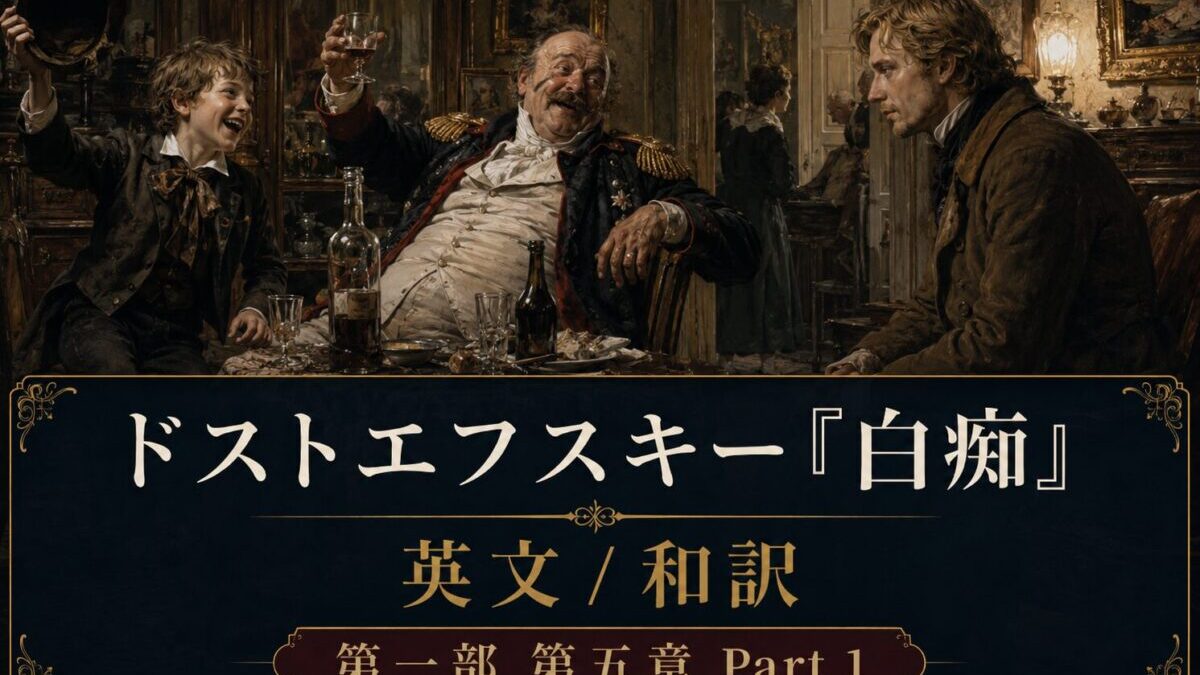
“`『白痴』英文/和訳 PART I CHAPTER V ロバの話と処刑台の記憶
『The Idiot』PART I CHAPTER V を、英語学習用に「英文→和訳」の順で読みやすく整理し、重要語句を多めに色分けしています。上部の操作パネルで、和訳・色分け・ミニ訳・カテゴリ別ハイライトを切り替えられます。
Mrs. General Epanchin was a proud woman by nature. What must her feelings have been when she heard that Prince Muishkin, the last of his and her line, had arrived in beggar’s guise, a wretched idiot, a recipient of charity—all of which details the general gave out for greater effect!
エパンチン将軍夫人は、生まれつき誇り高い女性だった。ムイシュキン公爵、つまり彼と彼女の家系に残った最後の人物が、乞食同然の姿で到着し、惨めな白痴で、施しを受ける身であると聞いたとき、彼女はどんな気持ちだっただろう。しかも将軍は、効果を高めるために、そうした細部をすべて大げさに伝えたのだった。
He was anxious to steal her interest at the first swoop, so as to distract her thoughts from other matters nearer home.
彼は、妻の関心を一挙に奪い、家庭内のもっと身近な別の問題から彼女の考えをそらしたかったのである。
Mrs. Epanchin was in the habit of holding herself very straight, and staring before her, without speaking, in moments of excitement.
エパンチン夫人は、興奮したときには、いつも体をまっすぐに保ち、口をきかずに前方を見つめる癖があった。
She was a fine woman of the same age as her husband, with a slightly hooked nose, a high, narrow forehead, thick hair turning a little grey, and a sallow complexion. Her eyes were grey and wore a very curious expression at times. She believed them to be most effective—a belief that nothing could alter.
彼女は夫と同じ年ごろの立派な女性で、やや鉤鼻、高く狭い額、少し灰色がかってきた豊かな髪、そして黄みがかった顔色をしていた。目は灰色で、ときおり非常に奇妙な表情を帯びた。彼女はその目が非常に効果的だと信じており、その信念は何ものによっても変えられなかった。
“What, receive him! Now, at once?” asked Mrs. Epanchin, gazing vaguely at her husband as he stood fidgeting before her.
「何ですって、彼を迎えるのですか。今、すぐに?」とエパンチン夫人は、目の前でそわそわ立っている夫をぼんやり見つめながら尋ねた。
“Oh, dear me, I assure you there is no need to stand on ceremony with him,” the general explained hastily. “He is quite a child, not to say a pathetic-looking creature. He has fits of some sort, and has just arrived from Switzerland, straight from the station, dressed like a German and without a farthing in his pocket.
「いや、まったく、彼に対して儀礼ばる必要はありません」と将軍は急いで説明した。「彼はまるで子どもです。哀れな姿の生き物と言ってもよいくらいです。何か発作のようなものがあり、スイスから到着したばかりで、駅からまっすぐ来ました。ドイツ人のような格好をして、ポケットには一文もありません。」
I gave him twenty-five roubles to go on with, and am going to find him some easy place in one of the government offices. I should like you to ply him well with the victuals, my dears, for I should think he must be very hungry.”
「私は当面の資金として二十五ルーブルを渡しましたし、官庁の一つで簡単な職を見つけてやるつもりです。だから、君たちには彼に食べ物をたっぷり出してやってほしい。彼はとても腹をすかせているに違いありませんから。」
“You astonish me,” said the lady, gazing as before. “Fits, and hungry too! What sort of fits?”
「驚かせる人ですね」と夫人は、先ほどと同じように見つめながら言った。「発作で、そのうえ腹をすかせているのですか。どんな発作なのです?」
“Oh, they don’t come on frequently, besides, he’s a regular child, though he seems to be fairly educated. I should like you, if possible, my dears,” the general added, making slowly for the door, “to put him through his paces a bit, and see what he is good for.”
「いや、発作は頻繁に起こるわけではありません。それに、彼はまるで子どもです。もっとも、かなり教育は受けているようですが。できれば、君たちに彼を少し試して、何に向いているのか見てもらいたいのです」と将軍は扉のほうへゆっくり向かいながら付け加えた。
“I think you should be kind to him; it is a good deed, you know—however, just as you like, of course—but he is a sort of relation, remember, and I thought it might interest you to see the young fellow, seeing that this is so.”
「彼には親切にしてやるべきだと思います。善い行いですからね。もちろん、君たちの好きなようにしてよいのですが。それでも、彼は一種の親戚であることを忘れないでください。だから、この若者を見ることは、君たちの興味を引くかもしれないと思ったのです。」
“Oh, of course, mamma, if we needn’t stand on ceremony with him, we must give the poor fellow something to eat after his journey; especially as he has not the least idea where to go to,” said Alexandra, the eldest of the girls.
「ええ、もちろんです、お母さま。彼に儀礼ばる必要がないのなら、そのかわいそうな方に旅のあとで何か食べさせてあげなければなりません。特に、どこへ行けばよいのかまったく分からないのですから」と、長女のアレクサンドラが言った。
“Besides, he’s quite a child; we can entertain him with a little hide-and-seek, in case of need,” said Adelaida.
「それに、彼はまるで子どもなのでしょう。必要なら、少しかくれんぼでもして楽しませてあげられますわ」とアデライダが言った。
“Hide-and-seek? What do you mean?” inquired Mrs. Epanchin.
「かくれんぼですって。どういう意味ですか」とエパンチン夫人が尋ねた。
“Oh, do stop pretending, mamma,” cried Aglaya, in vexation. “Send him up, father; mother allows.”
「ああ、お母さま、とぼけるのはやめてください」とアグラーヤはいらだって叫んだ。「お父さま、彼を上げてください。お母さまは許しています。」
The general rang the bell and gave orders that the prince should be shown in.
将軍は呼び鈴を鳴らし、公爵を案内するよう命じた。
“Only on condition that he has a napkin under his chin at lunch, then,” said Mrs. Epanchin, “and let Fedor, or Mavra, stand behind him while he eats. Is he quiet when he has these fits? He doesn’t show violence, does he?”
「では、昼食のときに顎の下にナプキンをつけるという条件でね」とエパンチン夫人は言った。「それから食べている間は、フョードルかマヴラを後ろに立たせなさい。発作のとき、彼はおとなしいのですか。暴れたりはしないでしょうね。」
“On the contrary, he seems to be very well brought up. His manners are excellent—but here he is himself. Here you are, prince—let me introduce you, the last of the Muishkins, a relative of your own, my dear, or at least of the same name. Receive him kindly, please.”
「それどころか、彼はとても育ちがよいようです。礼儀作法は立派です。ああ、ちょうど本人が来ました。こちらです、公爵。紹介しましょう。ムイシュキン家最後の人で、君の親戚です、少なくとも同じ家名の人物です。どうか親切に迎えてやってください。」
“They’ll bring in lunch directly, prince; you must stop and have some, but you must excuse me. I’m in a hurry, I must be off—”
「すぐに昼食が運ばれてきます、公爵。ぜひ残って少し召し上がってください。ただし、私は失礼しなければなりません。急いでいるので、行かねば……」
“We all know where you must be off to!” said Mrs. Epanchin, in a meaning voice.
「あなたがどこへ行かなければならないのか、私たちはみな知っていますよ」とエパンチン夫人は意味ありげな声で言った。
“Yes, yes—I must hurry away, I’m late! Look here, dears, let him write you something in your albums; you’ve no idea what a wonderful caligraphist he is, wonderful talent! He has just written out ‘Abbot Pafnute signed this’ for me. Well, au revoir!”
「はい、はい、急いで行かなければならない、遅れているのです。そうだ、君たち、彼にアルバムへ何か書いてもらいなさい。彼がどれほどすばらしい能書家か、君たちは知らないでしょう。すばらしい才能です。たった今、私のために『修道院長パフヌーティ、これに署名す』と書いてくれました。では、また会いましょう!」
“Stop a minute; where are you off to? Who is this abbot?” cried Mrs. Epanchin to her retreating husband in a tone of excited annoyance.
「ちょっと待ちなさい。どこへ行くのです。その修道院長とは誰なのです」とエパンチン夫人は、逃げるように退いていく夫に、興奮したいらだちの調子で叫んだ。
“Yes, my dear, it was an old abbot of that name—I must be off to see the count, he’s waiting for me, I’m late—Good-bye! Au revoir, prince!”—and the general bolted at full speed.
「そうです、君、その名の古い修道院長です。私は伯爵に会いに行かねばなりません。待たせています。遅れているのです。さようなら! また会いましょう、公爵!」こう言って、将軍は全速力で逃げ出した。
“Oh, yes—I know what count you’re going to see!” remarked his wife in a cutting manner, as she turned her angry eyes on the prince. “Now then, what’s all this about?—What abbot—Who’s Pafnute?” she added, brusquely.
「ああ、ええ、あなたがどの伯爵に会いに行くのか、私は知っていますよ」と妻は痛烈に言い、怒った目を公爵へ向けた。「さて、これはいったいどういうことですか。その修道院長とは何です。パフヌーティとは誰なのです」と、彼女はぶっきらぼうに付け加えた。
“Mamma!” said Alexandra, shocked at her rudeness.
「お母さま!」とアレクサンドラは、母の無作法に驚いて言った。
Aglaya stamped her foot.
アグラーヤは足を踏み鳴らした。
“Nonsense! Let me alone!” said the angry mother. “Now then, prince, sit down here, no, nearer, come nearer the light! I want to have a good look at you. So, now then, who is this abbot?”
「ばかげたことを。放っておきなさい」と怒った母は言った。「さて、公爵、ここに座りなさい。いや、もっと近く、明かりの近くへ来てください。あなたをよく見たいのです。さあ、その修道院長とは誰なのです。」
“Abbot Pafnute,” said our friend, seriously and with deference.
「修道院長パフヌーティです」と、我らが友人は真面目に、敬意をこめて言った。
“Pafnute, yes. And who was he?”
「パフヌーティ、そうです。それで、彼は何者だったのですか。」
Mrs. Epanchin put these questions hastily and brusquely, and when the prince answered she nodded her head sagely at each word he said.
エパンチン夫人は、これらの質問をせわしなく、ぶっきらぼうに発した。そして公爵が答えると、彼の言葉一つ一つに、いかにも分かっているというふうにうなずいた。
“The Abbot Pafnute lived in the fourteenth century,” began the prince; “he was in charge of one of the monasteries on the Volga, about where our present Kostroma government lies. He went to Oreol and helped in the great matters then going on in the religious world; he signed an edict there, and I have seen a print of his signature; it struck me, so I copied it.
「修道院長パフヌーティは十四世紀に生きていました」と公爵は話し始めた。「彼はヴォルガ川沿いの、現在のコストロマ県あたりにある修道院の一つを管理していました。彼はオリョールへ行き、当時宗教界で起きていた大きな問題に関わりました。そこで勅令に署名したのですが、私はその署名の印刷を見たことがあります。それが強い印象を与えたので、私は写したのです。」
When the general asked me, in his study, to write something for him, to show my handwriting, I wrote ‘The Abbot Pafnute signed this,’ in the exact handwriting of the abbot. The general liked it very much, and that’s why he recalled it just now.”
「将軍が書斎で、私の筆跡を見るために何か書いてほしいとおっしゃったので、私はその修道院長の筆跡を正確にまねて、『修道院長パフヌーティ、これに署名す』と書きました。将軍はそれをたいへん気に入ったので、今それを思い出されたのです。」
“Aglaya, make a note of ‘Pafnute,’ or we shall forget him. H’m! and where is this signature?”
「アグラーヤ、『パフヌーティ』と書き留めておきなさい。忘れてしまいますから。ふむ、それでその署名はどこにあるのです。」
“I think it was left on the general’s table.”
「将軍の机の上に置いてきたと思います。」
“Let it be sent for at once!”
「すぐに取りに行かせなさい。」
“Oh, I’ll write you a new one in half a minute,” said the prince, “if you like!”
「ああ、お望みなら、半分の一分で新しいものを書きます」と公爵は言った。
“Of course, mamma!” said Alexandra. “But let’s have lunch now, we are all hungry!”
「もちろんです、お母さま」とアレクサンドラは言った。「でも、まず昼食にしましょう。みんなお腹がすいています。」
“Yes; come along, prince,” said the mother, “are you very hungry?”
「そうですね。さあ来なさい、公爵」と母は言った。「とてもお腹がすいていますか。」
“Yes; I must say that I am pretty hungry, thanks very much.”
「はい。正直に申しますと、かなりお腹がすいています。どうもありがとうございます。」
“H’m! I like to see that you know your manners; and you are by no means such a person as the general thought fit to describe you. Come along; you sit here, opposite to me,” she continued, “I wish to be able to see your face.”
「ふむ。あなたが礼儀を心得ているのはよいことです。それに、将軍が説明したような人物では決してありませんね。さあ来なさい。あなたはここ、私の向かいに座りなさい」と彼女は続けた。「あなたの顔が見えるようにしたいのです。」
“Alexandra, Adelaida, look after the prince! He doesn’t seem so very ill, does he? I don’t think he requires a napkin under his chin, after all; are you accustomed to having one on, prince?”
「アレクサンドラ、アデライダ、公爵の世話をしてあげなさい。彼はそれほど病気らしくは見えませんね。結局、顎の下にナプキンはいらないようです。公爵、あなたはナプキンをつけることに慣れているのですか。」
“Formerly, when I was seven years old or so. I believe I wore one; but now I usually hold my napkin on my knee when I eat.”
「昔、七歳くらいのころには、つけていたと思います。でも今は、食事のときにはたいていナプキンを膝の上に置きます。」
“Of course, of course! And about your fits?”
「もちろん、もちろんです。それで、あなたの発作については?」
“Fits?” asked the prince, slightly surprised. “I very seldom have fits nowadays. I don’t know how it may be here, though; they say the climate may be bad for me.”
「発作ですか」と公爵は少し驚いて尋ねた。「近ごろはめったに発作はありません。ただ、ここではどうなるか分かりません。気候が私にはよくないかもしれないと言われていますから。」
“He talks very well, you know!” said Mrs. Epanchin, who still continued to nod at each word the prince spoke. “I really did not expect it at all; in fact, I suppose it was all stuff and nonsense on the general’s part, as usual. Eat away, prince, and tell me where you were born, and where you were brought up. I wish to know all about you, you interest me very much!”
「この方はとても上手に話しますね」とエパンチン夫人は言い、公爵の言葉ごとにうなずき続けた。「本当にまったく予想していませんでした。実際のところ、いつものように将軍の話は全部ばかげた誇張だったのでしょう。さあ、食べなさい、公爵。そして、どこで生まれ、どこで育ったのか話してください。あなたのことを全部知りたいのです。あなたは私にとても興味を抱かせます。」
The prince expressed his thanks once more, and eating heartily the while, recommenced the narrative of his life in Switzerland, all of which we have heard before.
公爵はもう一度感謝を述べ、しっかり食べながら、スイスでの自分の生活の話を再び始めた。その内容は、私たちがすでに聞いたものであった。
Mrs. Epanchin became more and more pleased with her guest; the girls, too, listened with considerable attention. In talking over the question of relationship it turned out that the prince was very well up in the matter and knew his pedigree off by heart.
エパンチン夫人は、この客をますます気に入っていった。娘たちもまた、かなり注意深く耳を傾けていた。親戚関係の問題を話し合ううち、公爵はその件に非常に詳しく、自分の家系を暗記していることが分かった。
It was found that scarcely any connection existed between himself and Mrs. Epanchin, but the talk, and the opportunity of conversing about her family tree, gratified the latter exceedingly, and she rose from the table in great good humour.
彼とエパンチン夫人の間には、ほとんど何のつながりもないことが分かった。しかし、その会話と、自分の家系について話す機会は、彼女をたいへん満足させ、彼女は非常に上機嫌で食卓から立ち上がった。
“Let’s all go to my boudoir,” she said, “and they shall bring some coffee in there. That’s the room where we all assemble and busy ourselves as we like best,” she explained.
「みんなで私の私室へ行きましょう」と彼女は言った。「そこへコーヒーを持ってこさせます。あの部屋は、私たちが皆集まって、それぞれ好きなことをする場所なのです」と彼女は説明した。
“Alexandra, my eldest, here, plays the piano, or reads or sews; Adelaida paints landscapes and portraits (but never finishes any); and Aglaya sits and does nothing. I don’t work too much, either. Here we are, now; sit down, prince, near the fire and talk to us. I want to hear you relate something.
「ここにいる長女のアレクサンドラはピアノを弾くか、本を読むか、縫い物をします。アデライダは風景画や肖像画を描きますが、どれも完成させません。アグラーヤは座って何もしません。私もあまり働きません。さあ着きました。公爵、暖炉の近くに座って、私たちに話をしてください。あなたに何か語ってもらいたいのです。」
I wish to make sure of you first and then tell my old friend, Princess Bielokonski, about you. I wish you to know all the good people and to interest them. Now then, begin!”
「まずあなたがどういう人か確かめ、それから古い友人のビエロコンスキー公爵夫人にあなたのことを話したいのです。あなたには、立派な人々をみな知ってもらい、彼らの興味を引いてもらいたい。さあ、始めてください。」
“Mamma, it’s rather a strange order, that!” said Adelaida, who was fussing among her paints and paint-brushes at the easel.
「お母さま、それはかなり奇妙な命令ですわ」とアデライダが言った。彼女はイーゼルのそばで絵具や絵筆の間をせわしなく動いていた。
Aglaya and Alexandra had settled themselves with folded hands on a sofa, evidently meaning to be listeners. The prince felt that the general attention was concentrated upon himself.
アグラーヤとアレクサンドラは、手を組んでソファに腰を落ち着け、明らかに聞き役になるつもりだった。公爵は、全員の注意が自分に集中しているのを感じた。
“I should refuse to say a word if I were ordered to tell a story like that!” observed Aglaya.
「そんなふうに話をしろと命じられたら、私なら一言も話すのを拒みます」とアグラーヤが言った。
“Why? what’s there strange about it? He has a tongue. Why shouldn’t he tell us something? I want to judge whether he is a good story-teller; anything you like, prince—how you liked Switzerland, what was your first impression, anything.”
「なぜです。何が奇妙なのです。彼には舌があります。何か話してもらって何が悪いのです。私は彼が話し上手かどうか判断したいのです。公爵、何でも好きなことを。スイスをどう思ったか、最初の印象はどうだったか、何でもよいのです。」
“You’ll see, he’ll begin directly and tell us all about it beautifully.”
「見ていなさい。彼はすぐに話し始め、すばらしく語ってくれます。」
“The impression was forcible—” the prince began.
「その印象は強烈でした……」と公爵は話し始めた。
“There, you see, girls,” said the impatient lady, “he has begun, you see.”
「ほら、見なさい、娘たち」とせっかちな夫人は言った。「彼は始めましたよ、ほら。」
“Well, then, let him talk, mamma,” said Alexandra. “This prince is a great humbug and by no means an idiot,” she whispered to Aglaya.
「それなら、話させてあげましょう、お母さま」とアレクサンドラは言った。「この公爵はかなりの食わせ者で、決して白痴ではないわ」と彼女はアグラーヤにささやいた。
“Oh, I saw that at once,” replied the latter. “I don’t think it at all nice of him to play a part. What does he wish to gain by it, I wonder?”
「ああ、それはすぐに分かったわ」と後者は答えた。「彼が役を演じているのは、少しも感じがよくないと思うわ。それで何を得ようとしているのかしら。」
“My first impression was a very strong one,” repeated the prince. “When they took me away from Russia, I remember I passed through many German towns and looked out of the windows, but did not trouble so much as to ask questions about them. This was after a long series of fits.”
「私の最初の印象は非常に強いものでした」と公爵は繰り返した。「ロシアから連れ出されたとき、私は多くのドイツの町を通り過ぎ、窓の外を眺めたことを覚えています。しかし、それについて質問しようとさえしませんでした。それは長い発作の連続の後でした。」
“I always used to fall into a sort of torpid condition after such a series, and lost my memory almost entirely; and though I was not altogether without reason at such times, yet I had no logical power of thought.”
「そうした発作の連続の後には、私はいつも一種の無気力状態に陥り、記憶をほとんど完全に失いました。そういうときでも理性がまったくなかったわけではありませんが、論理的に考える力はありませんでした。」
“This would continue for three or four days, and then I would recover myself again. I remember my melancholy was intolerable; I felt inclined to cry; I sat and wondered and wondered uncomfortably; the consciousness that everything was strange weighed terribly upon me.”
「それは三日か四日続き、それから私はまた自分を取り戻しました。憂鬱は耐えがたいほどだったのを覚えています。泣きたい気持ちになり、座ったまま不快に、ただ不思議に思い続けました。すべてが見知らぬものだという意識が、ひどく重くのしかかりました。」
“I could understand that it was all foreign and strange. I recollect I awoke from this state for the first time at Basle, one evening; the bray of a donkey aroused me, a donkey in the town market. I saw the donkey and was extremely pleased with it, and from that moment my head seemed to clear.”
「それがすべて外国のもので、見知らぬものだということは理解できました。私は、ある夕方、バーゼルで初めてその状態から目覚めたことを覚えています。町の市場にいたロバの鳴き声が私を目覚めさせたのです。私はそのロバを見て、非常にうれしくなりました。そしてその瞬間から、頭が晴れたように思えたのです。」
“A donkey? How strange! Yet it is not strange. Anyone of us might fall in love with a donkey! It happened in mythological times,” said Madame Epanchin, looking wrathfully at her daughters, who had begun to laugh. “Go on, prince.”
「ロバですって。なんて奇妙な。でも奇妙ではありませんね。私たちの誰でもロバを好きになるかもしれません。神話時代にもそういうことはありました」とエパンチン夫人は、笑い始めた娘たちを怒ったように見ながら言った。「続けてください、公爵。」
“Since that evening I have been specially fond of donkeys. I began to ask questions about them, for I had never seen one before; and I at once came to the conclusion that this must be one of the most useful of animals—strong, willing, patient, cheap.”
「その夕方以来、私は特にロバが好きになりました。私はロバについて質問し始めました。というのも、それまで一度も見たことがなかったからです。そしてすぐに、これは最も役に立つ動物の一つに違いないという結論に達しました。強く、進んで働き、忍耐強く、安いのです。」
“And, thanks to this donkey, I began to like the whole country I was travelling through; and my melancholy passed away.”
「そしてこのロバのおかげで、私は旅をしていたその国全体を好きになり始めました。私の憂鬱は消え去ったのです。」
“All this is very strange and interesting,” said Mrs. Epanchin. “Now let’s leave the donkey and go on to other matters. What are you laughing at, Aglaya? and you too, Adelaida? The prince told us his experiences very cleverly; he saw the donkey himself, and what have you ever seen? You have never been abroad.”
「これはどれも非常に奇妙で興味深いことです」とエパンチン夫人は言った。「さて、ロバのことは置いて、ほかの話へ進みましょう。アグラーヤ、何を笑っているのです。アデライダ、あなたもです。公爵は自分の経験をたいへん巧みに話してくれました。彼は自分でロバを見たのです。あなたたちはいったい何を見たことがあるのです。外国へ行ったこともないではありませんか。」
“I have seen a donkey though, mamma!” said Aglaya.
「でも、私はロバを見たことがありますわ、お母さま」とアグラーヤが言った。
“And I’ve heard one!” said Adelaida. All three of the girls laughed out loud, and the prince laughed with them.
「私は鳴き声を聞いたことがありますわ」とアデライダが言った。三人の娘は大声で笑い、公爵も彼女たちと一緒に笑った。
“Well, it’s too bad of you,” said mamma. “You must forgive them, prince; they are good girls. I am very fond of them, though I often have to be scolding them; they are all as silly and mad as march hares.”
「まあ、あなたたちは本当に困った子たちです」と母は言った。「公爵、この子たちを許してやってください。よい娘たちなのです。私はこの子たちをとても愛しています。しょっちゅう叱らなければなりませんけれど。みんな三月の野ウサギのように愚かで気まぐれなのです。」
“Oh, why shouldn’t they laugh?” said the prince. “I shouldn’t have let the chance go by in their place, I know. But I stick up for the donkey, all the same; he’s a patient, good-natured fellow.”
「ああ、笑ってもよいではありませんか」と公爵は言った。「私が彼女たちの立場だったら、その機会を逃さなかったでしょう。それでも、私はロバを弁護します。ロバは忍耐強く、気立てのよい仲間です。」
“Are you a patient man, prince? I ask out of curiosity,” said Mrs. Epanchin.
「公爵、あなたは忍耐強い人ですか。好奇心から尋ねているのです」とエパンチン夫人が言った。
All laughed again.
みな再び笑った。
“Oh, that wretched donkey again, I see!” cried the lady. “I assure you, prince, I was not guilty of the least—”
「ああ、またあの哀れなロバですね」と夫人は叫んだ。「公爵、私はほんの少しも……」
“Insinuation? Oh! I assure you, I take your word for it.” And the prince continued laughing merrily.
「当てこすりですか。ああ、もちろん、あなたのお言葉を信じます」と公爵は言い、楽しそうに笑い続けた。
“I must say it’s very nice of you to laugh. I see you really are a kind-hearted fellow,” said Mrs. Epanchin.
「あなたが笑うのは、とてもよいことですね。あなたは本当に心の優しい人なのだと分かります」とエパンチン夫人は言った。
“I’m not always kind, though.”
「でも、私はいつも優しいわけではありません。」
“I am kind myself, and always kind too, if you please!” she retorted, unexpectedly; “and that is my chief fault, for one ought not to be always kind. I am often angry with these girls and their father; but the worst of it is, I am always kindest when I am cross.”
「私は自分では優しいつもりですし、しかもいつも優しいのですよ」と彼女は思いがけず言い返した。「それが私の一番の欠点です。人はいつも優しくあるべきではありません。私はこの娘たちや父親にしばしば腹を立てます。でも最悪なのは、私が怒っているときほど、いちばん優しくなることです。」
“I was very angry just before you came, and Aglaya there read me a lesson—thanks, Aglaya, dear—come and kiss me—there—that’s enough,” she added, as Aglaya came forward and kissed her lips and then her hand. “Now then, go on, prince. Perhaps you can think of something more exciting than about the donkey, eh?”
「あなたが来る直前、私はとても怒っていました。そしてそこにいるアグラーヤが私に説教したのです。ありがとう、アグラーヤ、かわいい子。こちらへ来てキスしなさい。はい、それで十分です」と彼女は付け加えた。アグラーヤは進み出て、母の唇に、次に手にキスした。「さあ、公爵、続けてください。ロバよりももっと刺激的なことを思いつけるかもしれませんね。」
“I must say, again, I can’t understand how you can expect anyone to tell you stories straight away, so,” said Adelaida. “I know I never could!”
「やはり、そんなふうに急に話をしてくれと人に期待できるのが、私には理解できませんわ」とアデライダが言った。「少なくとも私は絶対にできません。」
“Yes, but the prince can, because he is clever—cleverer than you are by ten or twenty times, if you like. There, that’s so, prince; and seriously, let’s drop the donkey now—what else did you see abroad, besides the donkey?”
「ええ、でも公爵にはできます。彼は賢いからです。望むなら、あなたより十倍も二十倍も賢いのです。そうでしょう、公爵。さて真面目に、ロバの話はもうやめましょう。ロバのほかに、外国で何を見ましたか。」
“Yes, but the prince told us about the donkey very cleverly, all the same,” said Alexandra. “I have always been most interested to hear how people go mad and get well again, and that sort of thing. Especially when it happens suddenly.”
「でも、公爵はロバのことを、とても巧みに話してくれましたわ」とアレクサンドラは言った。「人がどのように気が狂い、またどうやって回復するのか、そういう話を聞くのは、私はいつもとても興味があります。特に、それが突然起こる場合には。」
“Quite so, quite so!” cried Mrs. Epanchin, delighted. “I see you can be sensible now and then, Alexandra. You were speaking of Switzerland, prince?”
「まったくその通りです、まったく!」とエパンチン夫人は喜んで叫んだ。「アレクサンドラ、あなたも時には分別あることを言えるのですね。公爵、あなたはスイスの話をしていたのですね。」
“Yes. We came to Lucerne, and I was taken out in a boat. I felt how lovely it was, but the loveliness weighed upon me somehow or other, and made me feel melancholy.”
「はい。私たちはルツェルンへ着き、私はボートに乗せられました。それがどれほど美しいかは感じましたが、その美しさがどういうわけか私に重くのしかかり、憂鬱な気分にさせたのです。」
“Why?” asked Alexandra.
「なぜですか」とアレクサンドラが尋ねた。
“I don’t know; I always feel like that when I look at the beauties of nature for the first time; but then, I was ill at that time, of course!”
「分かりません。自然の美しさを初めて見るとき、私はいつもそう感じます。もっとも、そのころは病気だったのですが。」
“Oh, but I should like to see it!” said Adelaida; “and I don’t know when we shall ever go abroad. I’ve been two years looking out for a good subject for a picture. I’ve done all I know. ‘The North and South I know by heart,’ as our poet observes. Do help me to a subject, prince.”
「ああ、でも私はそれを見てみたいですわ」とアデライダが言った。「私たちがいつ外国へ行けるかも分かりません。私は二年間、絵のよい題材を探しています。できることは全部やりました。詩人が言うように、『北も南も暗記している』のです。公爵、どうか題材を考えるのを手伝ってください。」
“Oh, but I know nothing about painting. It seems to me one only has to look, and paint what one sees.”
「ああ、私は絵については何も知りません。ただ見て、見たものを描けばよいように思えます。」
“But I don’t know how to see!”
「でも私は、どう見ればよいのか分からないのです。」
“Nonsense, what rubbish you talk!” the mother struck in. “Not know how to see! Open your eyes and look! If you can’t see here, you won’t see abroad either. Tell us what you saw yourself, prince!”
「ばかげています。なんというくだらないことを言うのです」と母が割り込んだ。「どう見ればよいか分からないですって。目を開けて見なさい。ここで見えないなら、外国でも見えません。公爵、あなた自身が見たものを話してください。」
“Yes, that’s better,” said Adelaida; “the prince learned to see abroad.”
「ええ、そのほうがよいですわ」とアデライダは言った。「公爵は外国で見ることを学んだのです。」
“Oh, I hardly know! You see, I only went to restore my health. I don’t know whether I learned to see, exactly. I was very happy, however, nearly all the time.”
「ああ、どうでしょう。私は健康を回復するために行っただけです。正確に言って、見ることを学んだかどうかは分かりません。でも、ほとんどいつも、とても幸福でした。」
“Happy! you can be happy?” cried Aglaya. “Then how can you say you did not learn to see? I should think you could teach us to see!”
「幸福ですって。あなたは幸福になれるのですか」とアグラーヤが叫んだ。「それなら、見ることを学ばなかったなどと、どうして言えるのです。むしろ、私たちに見ることを教えられるはずですわ。」
“Oh! do teach us,” laughed Adelaida.
「ああ、ぜひ教えてください」とアデライダは笑った。
“Oh! I can’t do that,” said the prince, laughing too. “I lived almost all the while in one little Swiss village; what can I teach you? At first I was only just not absolutely dull; then my health began to improve—then every day became dearer and more precious to me.”
「ああ、それはできません」と公爵も笑いながら言った。「私はほとんどずっと、スイスの小さな村に住んでいたのです。何を教えられるでしょう。最初は、ただ完全にぼんやりしているわけではないという程度でした。それから健康がよくなり始め、毎日が私にとってますます大切で貴重なものになっていきました。」
“And the longer I stayed, the dearer became the time to me; so much so that I could not help observing it; but why this was so, it would be difficult to say.”
「長く滞在すればするほど、時間はいっそう大切になりました。そう感じずにはいられないほどでした。しかし、なぜそうだったのかを言うのは難しいでしょう。」
“So that you didn’t care to go away anywhere else?”
「つまり、ほかの場所へ行きたいとは思わなかったのですね。」
“Well, at first I did; I was restless; I didn’t know however I should manage to support life—you know there are such moments, especially in solitude.”
「ええ、最初は思いました。私は落ち着きませんでした。どうやって生きていけばよいのか分かりませんでした。そういう瞬間があるでしょう、特に孤独の中では。」
“There was a waterfall near us, such a lovely thin streak of water, like a thread but white and moving. It fell from a great height, but it looked quite low, and it was half a mile away, though it did not seem fifty paces. I loved to listen to it at night, but it was then that I became so restless.”
「私たちの近くには滝がありました。糸のように細く、美しい白い水の筋で、動いていました。それは非常に高いところから落ちていたのですが、とても低く見えました。半マイルも離れていたのに、五十歩もないように思えました。夜にその音を聞くのが好きでしたが、その時こそ、私はひどく落ち着かなくなったのです。」
“Sometimes I went and climbed the mountain and stood there in the midst of the tall pines, all alone in the terrible silence, with our little village in the distance, and the sky so blue, and the sun so bright, and an old ruined castle on the mountain-side, far away.”
「ときどき私は山に登り、高い松の木々の真ん中に立ちました。遠くに私たちの小さな村があり、空はとても青く、太陽はとても明るく、山腹の遠くには古い廃城がありました。私はその恐ろしい静けさの中に、たった一人で立っていたのです。」
“I used to watch the line where earth and sky met, and longed to go and seek there the key of all mysteries, thinking that I might find there a new life, perhaps some great city where life should be grander and richer—and then it struck me that life may be grand enough even in a prison.”
「私は大地と空が交わる線をよく眺め、そこへ行ってすべての謎の鍵を探したいと切望しました。そこには新しい生活があるかもしれない、人生がもっと壮大で豊かな大都市があるかもしれないと思ったのです。そしてそのとき、人生は牢獄の中でさえ十分に壮大であり得るのだと思いつきました。」
“I read that last most praiseworthy thought in my manual, when I was twelve years old,” said Aglaya.
「その最後のたいへん称賛すべき考えは、私が十二歳のときに読本で読みましたわ」とアグラーヤが言った。
“All this is pure philosophy,” said Adelaida. “You are a philosopher, prince, and have come here to instruct us in your views.”
「これはすべて純粋な哲学ですわ」とアデライダが言った。「公爵、あなたは哲学者で、自分の見解を私たちに教えるためにここへ来たのです。」
“Perhaps you are right,” said the prince, smiling. “I think I am a philosopher, perhaps, and who knows, perhaps I do wish to teach my views of things to those I meet with?”
「たぶんあなたの言う通りかもしれません」と公爵は微笑んで言った。「私は哲学者なのかもしれません。誰に分かるでしょう。出会う人たちに自分の物の見方を教えたいと思っているのかもしれません。」
“Your philosophy is rather like that of an old woman we know, who is rich and yet does nothing but try how little she can spend. She talks of nothing but money all day. Your great philosophical idea of a grand life in a prison and your four happy years in that Swiss village are like this, rather,” said Aglaya.
「あなたの哲学は、私たちの知っている、金持ちなのに少しでもお金を使わないようにすることばかり考えている老婦人の哲学に少し似ていますわ。その人は一日中お金の話しかしません。牢獄の中の壮大な人生というあなたの偉大な哲学的考えと、スイスの村での四年間の幸福は、むしろそれに似ています」とアグラーヤは言った。
“As to life in a prison, of course there may be two opinions,” said the prince. “I once heard the story of a man who lived twelve years in a prison—I heard it from the man himself. He was one of the persons under treatment with my professor; he had fits, and attacks of melancholy, then he would weep, and once he tried to commit suicide.”
「牢獄での人生については、もちろん二つの意見があり得ます」と公爵は言った。「私は以前、十二年間牢獄で暮らした人の話を聞いたことがあります。その人自身から聞いたのです。彼は私の教授のもとで治療を受けていた人の一人でした。発作があり、憂鬱の発作もあり、その後泣き出し、一度は自殺しようとしたこともありました。」
“His life in prison was sad enough; his only acquaintances were spiders and a tree that grew outside his grating—but I think I had better tell you of another man I met last year. There was a very strange feature in this case, strange because of its extremely rare occurrence.”
「彼の牢獄生活は十分に悲しいものでした。彼の唯一の知り合いは、蜘蛛と、格子の外に生えていた一本の木だけでした。しかし、私は去年会った別の人の話をしたほうがよいと思います。この場合には非常に奇妙な特徴がありました。それはきわめてまれにしか起こらないために奇妙なのです。」
“This man had once been brought to the scaffold in company with several others, and had had the sentence of death by shooting passed upon him for some political crime.”
「その人は、かつてほかの数人と一緒に処刑台へ連れて行かれ、ある政治犯として銃殺刑の判決を受けたことがありました。」
“Twenty minutes later he had been reprieved and some other punishment substituted; but the interval between the two sentences, twenty minutes, or at least a quarter of an hour, had been passed in the certainty that within a few minutes he must die.”
「二十分後、彼は恩赦され、別の刑罰に替えられました。しかし二つの判決の間の時間、二十分、少なくとも十五分ほどは、数分以内に自分は死ななければならないという確信の中で過ごされたのです。」
“I was very anxious to hear him speak of his impressions during that dreadful time, and I several times inquired of him as to what he thought and felt. He remembered everything with the most accurate and extraordinary distinctness, and declared that he would never forget a single iota of the experience.”
「私は、その恐ろしい時間に彼がどんな印象を抱いたのか、ぜひ聞きたいと思い、彼が何を考え、何を感じたのかを何度か尋ねました。彼はすべてをきわめて正確に、異常なほどはっきりと覚えており、その経験のほんの一点さえ決して忘れないと言いました。」
“About twenty paces from the scaffold, where he had stood to hear the sentence, were three posts, fixed in the ground, to which to fasten the criminals. The first three criminals were taken to the posts, dressed in long white tunics, with white caps drawn over their faces, so that they could not see the rifles pointed at them.”
「彼が判決を聞くために立っていた場所から二十歩ほどのところに、罪人を縛りつけるための三本の柱が地面に固定されていました。最初の三人の罪人は柱へ連れて行かれ、長い白い上着を着せられ、白い帽子を顔にかぶせられました。自分に向けられた銃が見えないようにするためです。」
“Then a group of soldiers took their stand opposite to each post. My friend was the eighth on the list, and therefore he would have been among the third lot to go up. A priest went about among them with a cross: and there was about five minutes of time left for him to live.”
「それから兵士の一団がそれぞれの柱の正面に立ちました。私の友人はリストの八番目だったので、三組目として進むはずでした。司祭が十字架を持って彼らの間を回っていました。彼に残された時間は、およそ五分でした。」
“He said that those five minutes seemed to him to be a most interminable period, an enormous wealth of time; he seemed to be living, in these minutes, so many lives that there was no need as yet to think of that last moment.”
「彼は、その五分が果てしない時間、途方もない時間の富のように思えたと言いました。その数分のうちに、彼はいくつもの人生を生きているように思えたため、まだ最後の瞬間について考える必要などないように感じられたのです。」
“So that he made several arrangements, dividing up the time into portions—one for saying farewell to his companions, two minutes for that; then a couple more for thinking over his own life and career and all about himself; and another minute for a last look around.”
「そこで彼はいくつかの段取りを立て、時間をいくつかの部分に分けました。一つは仲間に別れを告げるためで、それに二分。次の二分ほどは、自分の人生や経歴、自分自身のすべてについて考えるため。そしてさらに一分は、最後に周囲を見回すためです。」
“He remembered having divided his time like this quite well. While saying good-bye to his friends he recollected asking one of them some very usual everyday question, and being much interested in the answer.”
「彼は、自分がこのように時間を分けたことを非常によく覚えていました。友人たちに別れを告げる間、彼はそのうちの一人に、ごく普通の日常的な質問をし、その答えにたいへん興味を持ったことを覚えていました。」
“Then having bade farewell, he embarked upon those two minutes which he had allotted to looking into himself; he knew beforehand what he was going to think about.”
「それから別れを告げ終えると、彼は自分の内面を見るために割り当てた二分間に入りました。彼は何について考えるつもりか、あらかじめ分かっていました。」
“He wished to put it to himself as quickly and clearly as possible, that here was he, a living, thinking man, and that in three minutes he would be nobody; or if somebody or something, then what and where? He thought he would decide this question once for all in these last three minutes.”
「彼は、できるだけ素早く明確に自分自身に問いかけようとしました。ここにいる自分は、生きて思考する人間である。しかし三分後には、自分は誰でもなくなる。もし何者か、何かになるとすれば、それは何で、どこにいるのか。この最後の三分で、その問題にきっぱり決着をつけようと思ったのです。」
“A little way off there stood a church, and its gilded spire glittered in the sun. He remembered staring stubbornly at this spire, and at the rays of light sparkling from it.”
「少し離れたところに教会が立っており、その金色の尖塔が太陽の中できらめいていました。彼は、その尖塔と、そこから輝く光線を頑固に見つめていたことを覚えていました。」
“He could not tear his eyes from these rays of light; he got the idea that these rays were his new nature, and that in three minutes he would become one of them, amalgamated somehow with them.”
「彼はそれらの光線から目を離すことができませんでした。そして、その光線こそが自分の新しい本性であり、三分後には自分もその一つとなり、何らかの形でそれらと融合するのだという考えを抱きました。」
“The repugnance to what must ensue almost immediately, and the uncertainty, were dreadful, he said; but worst of all was the idea, ‘What should I do if I were not to die now? What if I were to return to life again? What an eternity of days, and all mine!’”
「彼は、ほとんどすぐに起こらなければならないことへの強い嫌悪と、不確かさが恐ろしかったと言いました。しかし何より恐ろしかったのは、『もし今死なないとしたら、自分は何をするだろう。もし再び生へ戻るとしたらどうだろう。どれほど永遠のような日々が、すべて自分のものになるだろう』という考えでした。」
“‘How I should grudge and count up every minute of it, so as to waste not a single instant!’ He said that this thought weighed so upon him and became such a terrible burden upon his brain that he could not bear it, and wished they would shoot him quickly and have done with it.”
「『一瞬たりとも無駄にしないように、その一分一分をどれほど惜しみ、数え上げることだろう』。彼は、この考えがあまりにも重くのしかかり、頭の中で恐ろしい負担となったため、それに耐えられず、早く撃ってすべてを終わらせてほしいと思ったと言いました。」
The prince paused and all waited, expecting him to go on again and finish the story.
公爵は言葉を止めた。皆は、彼がまた続けて話を終えるのを待っていた。
“Is that all?” asked Aglaya.
「それだけですか」とアグラーヤが尋ねた。
“All? Yes,” said the prince, emerging from a momentary reverie.
「それだけですか。はい」と公爵は、つかの間の物思いから我に返って言った。
“And why did you tell us this?”
「それで、なぜその話を私たちにしたのですか。」
“Oh, I happened to recall it, that’s all! It fitted into the conversation—”
「ああ、たまたま思い出しただけです。それだけです。会話に合っていたので……」
“You probably wish to deduce, prince,” said Alexandra, “that moments of time cannot be reckoned by money value, and that sometimes five minutes are worth priceless treasures.”
「公爵、あなたはおそらく、時間の瞬間はお金の価値では測れず、ときには五分が値段のつけられない宝にも値するという結論を導き出したいのでしょう」とアレクサンドラは言った。
“All this is very praiseworthy; but may I ask about this friend of yours, who told you the terrible experience of his life? He was reprieved, you say; in other words, they did restore to him that ‘eternity of days.’ What did he do with these riches of time? Did he keep careful account of his minutes?”
「それはすべてたいへん称賛に値します。しかし、その人生の恐ろしい経験を話してくれたあなたの友人について尋ねてもよいでしょうか。彼は恩赦されたとおっしゃいましたね。つまり、彼らは彼にその『永遠の日々』を返したわけです。その時間の富を、彼はどう使ったのですか。一分一分を注意深く数えましたか。」
“Oh no, he didn’t! I asked him myself. He said that he had not lived a bit as he had intended, and had wasted many, and many a minute.”
「いいえ、そうではありませんでした。私自身が彼に尋ねました。彼は、自分が意図したようには少しも生きなかったし、多くの、多くの時間を無駄にしたと言っていました。」
“Very well, then there’s an experiment, and the thing is proved; one cannot live and count each moment; say what you like, but one cannot.”
「では、それで実験結果が出たわけです。そして証明されました。人は一瞬一瞬を数えながら生きることはできません。何と言おうと、できないのです。」
“That is true,” said the prince, “I have thought so myself. And yet, why shouldn’t one do it?”
「それは本当です」と公爵は言った。「私もそう考えたことがあります。それでも、なぜそうしてはいけないのでしょう。」
“You think, then, that you could live more wisely than other people?” said Aglaya.
「では、あなたはほかの人より賢く生きられると思っているのですね」とアグラーヤが言った。
“I have had that idea.”
「そう考えたことはあります。」
“And you have it still?”
「今でもそう考えていますか。」
“Yes—I have it still,” the prince replied.
「はい、今でもそう考えています」と公爵は答えた。
He had contemplated Aglaya until now, with a pleasant though rather timid smile, but as the last words fell from his lips he began to laugh, and looked at her merrily.
彼は今まで、愉快ではあるが少し臆病な微笑みを浮かべてアグラーヤを見つめていた。しかし最後の言葉を口にすると、彼は笑い始め、楽しげに彼女を見た。
“You are not very modest!” said she.
「あなたはあまり謙虚ではありませんね」と彼女は言った。
“But how brave you are!” said he. “You are laughing, and I—that man’s tale impressed me so much, that I dreamt of it afterwards; yes, I dreamt of those five minutes…”
「でも、あなたはなんて勇敢なのでしょう」と彼は言った。「あなたは笑っています。でも私は、その人の話にあまりにも強い印象を受けて、その後夢に見たのです。ええ、その五分の夢を見たのです……」
He looked at his listeners again with that same serious, searching expression.
彼は再び、同じ真剣で探るような表情で聞き手たちを見た。
“You are not angry with me?” he asked suddenly, and with a kind of nervous hurry, although he looked them straight in the face.
「私に腹を立ててはいませんか」と彼は突然、ある種の神経質な急ぎを帯びて尋ねた。もっとも、彼は彼女たちの顔をまっすぐ見ていた。
“Why should we be angry?” they cried.
「どうして怒る必要があるのですか」と彼女たちは叫んだ。
“Only because I seem to be giving you a lecture, all the time!”
「ただ、私はずっとあなた方に説教しているように見えるからです。」
At this they laughed heartily.
これを聞いて彼女たちは心から笑った。
“Please don’t be angry with me,” continued the prince. “I know very well that I have seen less of life than other people, and have less knowledge of it. I must appear to speak strangely sometimes…”
「どうか私に腹を立てないでください」と公爵は続けた。「私は、自分がほかの人より人生をあまり見ておらず、それについての知識も少ないことをよく知っています。ときどき、奇妙な話し方をしているように見えるでしょう……」
He said the last words nervously.
彼は最後の言葉を神経質に言った。
“You say you have been happy, and that proves you have lived, not less, but more than other people. Why make all these excuses?” interrupted Aglaya in a mocking tone of voice.
「あなたは幸福だったと言います。それは、あなたがほかの人より少なくではなく、むしろ多く生きたことを証明しています。なぜそんな言い訳をするのです」とアグラーヤがからかう調子で遮った。
“Besides, you need not mind about lecturing us; you have nothing to boast of. With your quietism, one could live happily for a hundred years at least.”
「それに、私たちに説教することを気にする必要はありません。あなたには誇るものなど何もありませんから。あなたのその静観主義なら、少なくとも百年は幸福に生きられるでしょう。」
“One might show you the execution of a felon, or show you one’s little finger. You could draw a moral from either, and be quite satisfied. That sort of existence is easy enough.”
「あなたには重罪人の処刑を見せてもよいし、小指を見せてもよいでしょう。あなたはどちらからでも教訓を引き出し、すっかり満足するでしょう。そういう存在の仕方は、十分に簡単です。」
“I can’t understand why you always fly into a temper,” said Mrs. Epanchin, who had been listening to the conversation and examining the faces of the speakers in turn. “I do not understand what you mean. What has your little finger to do with it?”
「あなたがなぜいつもかっとなるのか、私には分かりません」とエパンチン夫人は言った。彼女は会話を聞きながら、話し手たちの顔を順に見ていた。「あなたの言っている意味が分かりません。小指がそれと何の関係があるのですか。」
“The prince talks well, though he is not amusing. He began all right, but now he seems sad.”
「公爵は面白くはありませんが、話は上手です。最初はよかったのに、今は悲しそうに見えます。」
“Never mind, mamma! Prince, I wish you had seen an execution,” said Aglaya. “I should like to ask you a question about that, if you had.”
「気にしないで、お母さま。公爵、あなたが処刑を見たことがあればよかったのに」とアグラーヤが言った。「もし見たことがあるなら、それについて質問したいのです。」
“I have seen an execution,” said the prince.
「私は処刑を見たことがあります」と公爵は言った。
“You have!” cried Aglaya. “I might have guessed it. That’s a fitting crown to the rest of the story. If you have seen an execution, how can you say you lived happily all the while?”
「あるのですか」とアグラーヤは叫んだ。「そうだと思えばよかったですわ。それはこれまでの話にふさわしい締めくくりです。処刑を見たことがあるのなら、どうしてその間ずっと幸福に暮らしていたなどと言えるのです。」
“But is there capital punishment where you were?” asked Adelaida.
「でも、あなたのいたところには死刑があるのですか」とアデライダが尋ねた。
“I saw it at Lyons. Schneider took us there, and as soon as we arrived we came in for that.”
「リヨンで見ました。シュナイダーが私たちをそこへ連れて行き、到着するとすぐに、ちょうどそれに出くわしたのです。」
“Well, and did you like it very much? Was it very edifying and instructive?” asked Aglaya.
「それで、それはとても気に入りましたか。たいへん教化的でためになりましたか」とアグラーヤが尋ねた。
“No, I didn’t like it at all, and was ill after seeing it; but I confess I stared as though my eyes were fixed to the sight. I could not tear them away.”
「いいえ、まったく気に入りませんでした。それを見た後、体調も悪くなりました。しかし正直に言うと、目がその光景に固定されたように見つめてしまいました。目を離すことができなかったのです。」
“I, too, should have been unable to tear my eyes away,” said Aglaya.
「私もきっと目を離せなかったでしょう」とアグラーヤが言った。
“They do not at all approve of women going to see an execution there. The women who do go are condemned for it afterwards in the newspapers.”
「あちらでは、女性が処刑を見に行くことはまったくよしとされていません。見に行った女性は、後で新聞で非難されます。」
“That is, by contending that it is not a sight for women they admit that it is a sight for men. I congratulate them on the deduction. I suppose you quite agree with them, prince?”
「つまり、それは女性の見るものではないと主張することで、それが男性の見るものだと認めているわけですね。その推論にはお祝い申し上げます。公爵、あなたは彼らにまったく同意なさるのでしょうね。」
“Tell us about the execution,” put in Adelaida.
「その処刑について話してください」とアデライダが口を挟んだ。
“I would much rather not, just now,” said the prince, a little disturbed and frowning slightly.
「今は、できれば話したくありません」と公爵は少し動揺し、わずかに眉をひそめながら言った。
“You don’t seem to want to tell us,” said Aglaya, with a mocking air.
「私たちには話したくないようですね」とアグラーヤはからかうような態度で言った。
“No,—the thing is, I was telling all about the execution a little while ago, and—”
「いいえ、実は少し前に、その処刑についてすべて話していたので……」
“Whom did you tell about it?”
「誰に話したのですか。」
“The man-servant, while I was waiting to see the general.”
「将軍に会うのを待っている間に、召使いの男にです。」
“Our man-servant?” exclaimed several voices at once.
「うちの召使いに?」といくつもの声が同時に叫んだ。
“Yes, the one who waits in the entrance hall, a greyish, red-faced man—”
「はい。玄関広間で待っている、灰色がかった髪で赤ら顔の男です……」
“The prince is clearly a democrat,” remarked Aglaya.
「公爵は明らかに民主主義者ですわ」とアグラーヤが言った。
“Well, if you could tell Aleksey about it, surely you can tell us too.”
「では、アレクセイに話せたのなら、私たちにも話せるはずです。」
“I do so want to hear about it,” repeated Adelaida.
「私は本当にそれを聞きたいのです」とアデライダは繰り返した。
“Just now, I confess,” began the prince, with more animation, “when you asked me for a subject for a picture, I confess I had serious thoughts of giving you one. I thought of asking you to draw the face of a criminal, one minute before the fall of the guillotine.”
「実を言うと、つい先ほど」と公爵は少し活気を帯びて話し始めた。「あなたが絵の題材を求めたとき、私は真剣に一つ題材を差し上げようかと思いました。ギロチンが落ちる一分前、罪人がまだ処刑台の上に立ち、首を台に置く準備をしている、その顔を描いてもらおうと思ったのです。」
“What, his face? only his face?” asked Adelaida. “That would be a strange subject indeed. And what sort of a picture would that make?”
「何ですって、その顔を? 顔だけを?」とアデライダが尋ねた。「それは本当に奇妙な題材ですわ。それでどんな絵になるのでしょう。」
“Oh, why not?” the prince insisted, with some warmth. “When I was in Basle I saw a picture very much in that style—I should like to tell you about it; I will some time or other; it struck me very forcibly.”
「ああ、なぜいけないのでしょう」と公爵は少し熱を込めて主張した。「バーゼルにいたとき、私はそれに非常に近い様式の絵を見ました。そのこともお話ししたいと思います。いつか話しましょう。それは私に非常に強い印象を与えました。」
“Oh, you shall tell us about the Basle picture another time; now we must have all about the execution,” said Adelaida. “Tell us about that face as it appeared to your imagination—how should it be drawn?—just the face alone, do you mean?”
「バーゼルの絵については、また別の時に話していただきます。今は処刑について全部聞かなければなりません」とアデライダは言った。「あなたの想像の中に現れたその顔について話してください。どう描けばよいのですか。顔だけという意味ですか。」
“It was just a minute before the execution,” began the prince, readily, carried away by the recollection and evidently forgetting everything else in a moment; “just at the instant when he stepped off the ladder on to the scaffold.”
「それは処刑の一分前でした」と公爵はすぐに話し始めた。記憶に引き込まれ、一瞬にしてほかのすべてを忘れたようだった。「彼が梯子から処刑台へ踏み出した、まさにその瞬間です。」
“He happened to look in my direction: I saw his eyes and understood all, at once—but how am I to describe it? I do so wish you or somebody else could draw it, you, if possible. I thought at the time what a picture it would make.”
「彼は偶然、私のほうを見ました。私は彼の目を見て、すぐにすべてを理解しました。しかし、どう描写すればよいのでしょう。あなたか、誰かほかの人が、それを描けたらどれほどよいかと思います。できればあなたに。そのとき私は、これはどんな絵になるだろうと思ったのです。」
“You must imagine all that went before, of course, all—all. He had lived in the prison for some time and had not expected that the execution would take place for at least a week yet—he had counted on all the formalities and so on taking time.”
「もちろん、その前に起こったすべてを想像しなければなりません。全部です。彼はしばらく牢獄で暮らしており、少なくともあと一週間は処刑が行われないと思っていました。手続きなどに時間がかかると当てにしていたのです。」
“But it so happened that his papers had been got ready quickly. At five o’clock in the morning he was asleep—it was October, and at five in the morning it was cold and dark. The governor of the prison comes in on tip-toe and touches the sleeping man’s shoulder gently.”
「しかし、たまたま彼の書類はすぐに準備されました。朝の五時、彼は眠っていました。十月のことで、朝五時は寒く暗かったのです。監獄の長が忍び足で入り、眠っている男の肩にそっと触れました。」
“He starts up. ‘What is it?’ he says. ‘The execution is fixed for ten o’clock.’ He was only just awake, and would not believe at first, but began to argue that his papers would not be out for a week, and so on.”
「彼は飛び起きます。『何ですか』と彼は言います。『処刑は十時に決まりました』。彼はまだ目覚めたばかりで、最初は信じようとせず、書類は一週間は出ないはずだ、などと反論し始めました。」
“When he was wide awake and realized the truth, he became very silent and argued no more—so they say; but after a bit he said: ‘It comes very hard on one so suddenly’ and then he was silent again and said nothing.”
「彼が完全に目覚め、真実を悟ると、非常に静かになり、もう反論しなかったそうです。しかし少ししてから、『こんなに突然では、ひどくつらい』と言い、それからまた黙って何も言わなくなりました。」
“The three or four hours went by, of course, in necessary preparations—the priest, breakfast, coffee, meat, and some wine they gave him; doesn’t it seem ridiculous? And yet I believe these people give them a good breakfast out of pure kindness of heart, and believe that they are doing a good action.”
「三時間か四時間は、もちろん必要な準備で過ぎました。司祭、朝食、コーヒー、肉、それに少しのワインが与えられました。ばかげているように思えませんか。それでも、彼らは純粋な親切心からよい朝食を出しており、自分たちは善いことをしていると信じているのだと思います。」
“Then he is dressed, and then begins the procession through the town to the scaffold. I think he, too, must feel that he has an age to live still while they cart him along.”
「それから彼は服を着せられ、町を通って処刑台へ向かう行列が始まります。彼もまた、荷車で運ばれている間、まだ一生分の時間が残っているように感じたに違いないと思います。」
“Probably he thought, on the way, ‘Oh, I have a long, long time yet. Three streets of life yet! When we’ve passed this street there’ll be that other one; and then that one where the baker’s shop is on the right; and when shall we get there? It’s ages, ages!’”
「おそらく彼は途中でこう思ったでしょう。『ああ、まだ長い長い時間がある。まだ三つの通り分の人生がある。この通りを過ぎれば、あの別の通りがある。それから右側にパン屋のある通りがある。いつ着くのだろう。永遠のようだ、永遠のようだ』と。」
“Around him are crowds shouting, yelling—ten thousand faces, twenty thousand eyes. All this has to be endured, and especially the thought: ‘Here are ten thousand men, and not one of them is going to be executed, and yet I am to die.’ Well, all that is preparatory.”
「彼の周りには群衆が叫び、わめいています。一万の顔、二万の目。そのすべてに耐えなければなりません。特に、『ここには一万人の人間がいるのに、その中の誰一人処刑されるわけではない。それなのに、私は死ぬのだ』という考えに耐えなければならないのです。まあ、そこまではすべて準備にすぎません。」
“At the scaffold there is a ladder, and just there he burst into tears—and this was a strong man, and a terribly wicked one, they say! There was a priest with him the whole time, talking; even in the cart as they drove along, he talked and talked.”
「処刑台には梯子があり、まさにその場所で彼は泣き出しました。彼は強い男で、しかも恐ろしく邪悪な男だったというのにです。司祭はずっと彼と一緒にいて話していました。荷車で運ばれている間でさえ、話し続けていました。」
“Probably the other heard nothing; he would begin to listen now and then, and at the third word or so he had forgotten all about it.”
「おそらく相手は何も聞いていなかったでしょう。時々聞こうとし始めても、三語目くらいにはもうすべて忘れてしまっていたのです。」
“At last he began to mount the steps; his legs were tied, so that he had to take very small steps. The priest, who seemed to be a wise man, had stopped talking now, and only held the cross for the wretched fellow to kiss.”
「ついに彼は階段を上り始めました。足を縛られていたので、ごく小さな歩幅で進まなければなりませんでした。賢い人物らしい司祭は、もう話すのをやめ、ただその哀れな男が口づけするための十字架を差し出していました。」
“At the foot of the ladder he had been pale enough; but when he set foot on the scaffold at the top, his face suddenly became the colour of paper, positively like white notepaper.”
「梯子の下にいたときにも彼は十分に青白かったのですが、上の処刑台へ足を踏み出したとき、その顔は突然紙の色になりました。本当に白い便箋のようでした。」
“His legs must have become suddenly feeble and helpless, and he felt a choking in his throat—you know the sudden feeling one has in moments of terrible fear, when one does not lose one’s wits, but is absolutely powerless to move?”
「彼の足は突然弱く無力になったに違いありません。そして喉が詰まるように感じたでしょう。恐ろしい恐怖の瞬間に、人が正気を失うわけではないのに、まったく動けなくなる、あの突然の感覚をご存じでしょうか。」
“If some dreadful thing were suddenly to happen; if a house were just about to fall on one;—don’t you know how one would long to sit down and shut one’s eyes and wait, and wait?”
「もし何か恐ろしいことが突然起ころうとしていたら、家がまさに自分の上に崩れ落ちようとしていたら、人は座り込み、目を閉じて、ただ待ち、待ち続けたいと思うでしょう。そういう感覚をご存じではありませんか。」
“Well, when this terrible feeling came over him, the priest quickly pressed the cross to his lips, without a word—a little silver cross it was—and he kept on pressing it to the man’s lips every second.”
「さて、この恐ろしい感覚が彼を襲ったとき、司祭は言葉もなく、すぐに十字架を彼の唇に押し当てました。それは小さな銀の十字架でした。そして司祭は毎秒のように、それを男の唇に押し当て続けました。」
“And whenever the cross touched his lips, the eyes would open for a moment, and the legs moved once, and he kissed the cross greedily, hurriedly—just as though he were anxious to catch hold of something in case of its being useful to him afterwards.”
「そして十字架が唇に触れるたびに、彼の目は一瞬開き、足が一度動き、彼は十字架に貪るように、急いで口づけしました。まるで、後で役に立つかもしれない何かをつかみ取ろうとしているかのようでした。」
“Though he could hardly have had any connected religious thoughts at the time. And so up to the very block.”
「もっとも、そのとき彼にまとまった宗教的思考などあったはずはほとんどありません。そうして、まさに台のところまで進んだのです。」
“How strange that criminals seldom swoon at such a moment! On the contrary, the brain is especially active, and works incessantly—probably hard, hard, hard—like an engine at full pressure.”
「罪人がそのような瞬間にめったに気絶しないというのは、なんと奇妙なことでしょう。むしろ逆に、脳は特に活発になり、絶え間なく働きます。おそらく激しく、激しく、激しく、全圧で動く機関のように働くのです。」
“I imagine that various thoughts must beat loud and fast through his head—all unfinished ones, and strange, funny thoughts, very likely!—like this, for instance: ‘That man is looking at me, and he has a wart on his forehead! and the executioner has burst one of his buttons, and the lowest one is all rusty!’”
「いろいろな考えが彼の頭の中で大きく速く打ち鳴らしていたに違いないと想像します。すべて未完成の考えで、しかも奇妙で滑稽な考えだったかもしれません。たとえば、『あの男が私を見ている。額にいぼがある。処刑人のボタンが一つ取れかかっている。一番下のボタンはすっかり錆びている』というように。」
“And meanwhile he notices and remembers everything. There is one point that cannot be forgotten, round which everything else dances and turns about; and because of this point he cannot faint.”
「そしてその間、彼はすべてに気づき、すべてを覚えています。忘れることのできない一点があり、その周りをほかのすべてが踊り、回っています。そしてその一点のために、彼は気絶できないのです。」
“And this lasts until the very final quarter of a second, when the wretched neck is on the block and the victim listens and waits and knows—that’s the point, he knows that he is just now about to die, and listens for the rasp of the iron over his head.”
「それは、最後の四分の一秒まで続きます。哀れな首が台の上に置かれ、犠牲者が聞き、待ち、そして知っている瞬間までです。そこが要点です。彼は、まさに今、自分が死のうとしていることを知っており、頭上の鉄のきしる音に耳を澄ましているのです。」
“If I lay there, I should certainly listen for that grating sound, and hear it, too! There would probably be but the tenth part of an instant left to hear it in, but one would certainly hear it.”
「もし私がそこに横たわっていたら、私は間違いなくそのきしる音を聞こうとし、実際に聞くでしょう。それを聞くために残された時間は、おそらく一瞬の十分の一しかないでしょうが、それでも確かに聞くはずです。」
“And imagine, some people declare that when the head flies off it is conscious of having flown off! Just imagine what a thing to realize! Fancy if consciousness were to last for even five seconds!”
「しかも想像してください。首が飛んだとき、その首は飛んだことを意識しているのだと主張する人々がいるのです。そんなことを悟るとは、どれほどのことでしょう。もし意識が五秒でも続くとしたら、想像してみてください。」
“Draw the scaffold so that only the top step of the ladder comes in clearly. The criminal must be just stepping on to it, his face as white as note-paper. The priest is holding the cross to his blue lips, and the criminal kisses it, and knows and sees and understands everything.”
「処刑台は、梯子の一番上の段だけがはっきり見えるように描いてください。罪人はちょうどそこへ足を踏み出そうとしていて、その顔は便箋のように白い。司祭は彼の青い唇に十字架を差し出し、罪人はそれに口づけし、すべてを知り、見て、理解しているのです。」
“The cross and the head—there’s your picture; the priest and the executioner, with his two assistants, and a few heads and eyes below. Those might come in as subordinate accessories—a sort of mist. There’s a picture for you.” The prince paused, and looked around.
「十字架と頭部、それがあなたの絵です。司祭と処刑人、その二人の助手、そして下にいくつかの頭と目。それらは従属的な要素として、一種の霧のように入ってもよいでしょう。それがあなたの絵です。」公爵は言葉を止め、周囲を見回した。
“Certainly that isn’t much like quietism,” murmured Alexandra, half to herself.
「確かに、それはあまり静観主義らしくありませんね」とアレクサンドラは半ば独り言のようにつぶやいた。
“Now tell us about your love affairs,” said Adelaida, after a moment’s pause.
「では、今度はあなたの恋愛について話してください」と、しばらく間を置いてアデライダが言った。
The prince gazed at her in amazement.
公爵は驚いて彼女を見つめた。
“You know,” Adelaida continued, “you owe us a description of the Basle picture; but first I wish to hear how you fell in love. Don’t deny the fact, for you did, of course. Besides, you stop philosophizing when you are telling about anything.”
「ご存じでしょう」とアデライダは続けた。「あなたはバーゼルの絵について説明する義務があります。でもその前に、あなたがどのように恋に落ちたのか聞きたいのです。その事実を否定しないでください。もちろん、恋に落ちたのでしょう。それに、あなたは何かを語っているときには哲学をやめますから。」
“Why are you ashamed of your stories the moment after you have told them?” asked Aglaya, suddenly.
「なぜあなたは、自分の話を語った直後に恥ずかしがるのですか」とアグラーヤが突然尋ねた。
“How silly you are!” said Mrs. Epanchin, looking indignantly towards the last speaker.
「なんてばかなことを言うのです」とエパンチン夫人は、最後に話した娘のほうを憤慨して見ながら言った。
“Yes, that wasn’t a clever remark,” said Alexandra.
「ええ、それは賢い発言ではありませんでした」とアレクサンドラが言った。
“Don’t listen to her, prince,” said Mrs. Epanchin; “she says that sort of thing out of mischief. Don’t think anything of their nonsense, it means nothing. They love to chaff, but they like you. I can see it in their faces—I know their faces.”
「公爵、彼女の言うことを聞いてはいけません」とエパンチン夫人は言った。「彼女はいたずら心からそういうことを言うのです。この子たちのくだらない話を気にしてはいけません。意味はありません。彼女たちはからかうのが好きですが、あなたを気に入っています。その顔を見れば分かります。私はこの子たちの顔を知っています。」
“I know their faces, too,” said the prince, with a peculiar stress on the words.
「私も彼女たちの顔を知っています」と公爵は、その言葉に独特の強調を置いて言った。
“How so?” asked Adelaida, with curiosity.
「どういう意味ですか」とアデライダは好奇心をもって尋ねた。
“What do you know about our faces?” exclaimed the other two, in chorus.
「私たちの顔について、あなたは何を知っているのですか」と、ほかの二人が声をそろえて叫んだ。
But the prince was silent and serious. All awaited his reply.
しかし公爵は沈黙し、真剣な顔をしていた。皆が彼の返答を待った。
“I’ll tell you afterwards,” he said quietly.
「あとでお話しします」と彼は静かに言った。
“Ah, you want to arouse our curiosity!” said Aglaya. “And how terribly solemn you are about it!”
「ああ、あなたは私たちの好奇心をかき立てたいのですね」とアグラーヤは言った。「しかも、そのことでなんて厳粛なのです。」
“Very well,” interrupted Adelaida, “then if you can read faces so well, you must have been in love. Come now; I’ve guessed—let’s have the secret!”
「よろしい」とアデライダが割り込んだ。「それなら、もしあなたがそんなに顔を読むのが上手なら、あなたは恋をしたことがあるはずです。さあ、私は当てました。秘密を聞かせてください。」
“I have not been in love,” said the prince, as quietly and seriously as before. “I have been happy in another way.”
「私は恋をしたことはありません」と公爵は、先ほどと同じように静かに、真剣に言った。「私は別の形で幸福だったのです。」
“How, how?”
「どんなふうに、どんなふうにですか。」
“Well, I’ll tell you,” said the prince, apparently in a deep reverie.
「では、お話ししましょう」と公爵は言った。彼は深い物思いに沈んでいるようだった。