
カラフル対訳で紹介している作品について
カラフル対訳で紹介している作品は、すべてパブリックドメインの作品です。
このサイトで使われている作品は、著作権の切れた名作などの全文を電子化し、インターネット上で公開している Project Gutenberg(プロジェクト・グーテンベルク)、 および朗読音声を公開している LibriVox(リブリヴォックス/朗読図書館) の作品を出典としています。
原文はProject Gutenberg、音声はLibriVoxで公開されているパブリックドメイン作品を出典としています。
THE ELEVENTH CHAPTER
BLIND TRAVEL
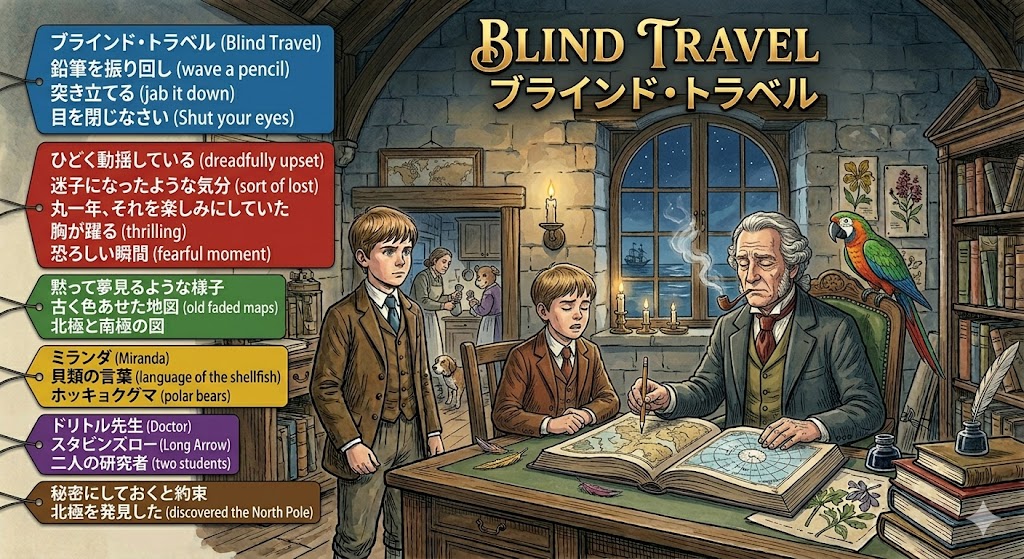
ロング・アロー失踪の知らせに落ち込むドリトル先生が、次の航海先を決めるために「ブラインド・トラベル」という遊びを始める章です。目を閉じて地図帳を開き、鉛筆が指した場所へ必ず行くという、冒険心あふれる決め方が描かれます。地図・航海・迷い・北極の秘密に関する重要表現を多めに色分けしています。
表示設定
THIS news about Long Arrow made us all very sad.
ロング・アローについてのこの知らせは、私たち全員をとても悲しませた。
And I could see from the silent dreamy way the Doctor took his tea that he was dreadfully upset.
そして先生がお茶を飲む、黙って夢見るような様子から、先生がひどく動揺していることが私にはわかった。
Every once in a while he would stop eating altogether and sit staring at the spots on the kitchen table-cloth.
時折、先生は食べるのをすっかりやめて、台所のテーブルクロスのしみをじっと見つめて座っていた。
As though his thoughts were far away.
まるで先生の心が遠くへ行ってしまっているかのようだった。
Till Dab-Dab, who was watching to see that he got a good meal, would cough or rattle the pots in the sink.
すると、先生がちゃんと食事を取るか見張っていたダブダブが、咳払いをしたり、流しの鍋をガチャガチャ鳴らしたりするのだった。
I did my best to cheer him up by reminding him of all he had done for Luke and his wife that afternoon.
私はその日の午後、先生がルークとその妻のためにしたことを思い出させて、先生を元気づけようと精いっぱい努めた。
And when that didn’t seem to work, I went on talking about our preparations for the voyage.
それでも効果がなさそうだったので、私は私たちの航海準備について話し続けた。
“But you see, Stubbins,” said he as we rose from the table and Dab-Dab and Chee-Chee began to clear away, “I don’t know where to go now.”
「だがね、スタビンズ」と、私たちが食卓を立ち、ダブダブとチーチーが片づけを始めたとき先生は言った。「今はどこへ行けばよいのかわからないんだ」
“I feel sort of lost since Miranda brought me this news.”
「ミランダがこの知らせを持ってきてから、私は何か迷子になったような気分なんだ」
“On this voyage I had planned going to see Long Arrow.”
「この航海では、ロング・アローに会いに行くつもりだった」
“I had been looking forward to it for a whole year.”
「私は丸一年、それを楽しみにしていたんだ」
“I felt he might help me in learning the language of the shellfish—and perhaps in finding some way of getting to the bottom of the sea.”
「彼なら貝類の言葉を学ぶ助けになってくれるかもしれないし、海の底へ行く方法を見つける助けにもなるかもしれないと思っていた」
“But now?—He’s gone! And all his great knowledge has gone with him.”
「だが今はどうだ? 彼はいなくなってしまった! そして彼の偉大な知識も、彼とともに消えてしまった」
Then he seemed to fall a-dreaming again.
それから先生は、また夢想にふけってしまったようだった。
“Just to think of it!” he murmured.
「考えてもみたまえ!」と先生はつぶやいた。
“Long Arrow and I, two students—Although I’d never met him, I felt as though I knew him quite well.”
「ロング・アローと私、二人の研究者だ。私は彼に会ったことはなかったが、まるで彼をよく知っているように感じていた」
“For, in his way—without any schooling—he has, all his life, been trying to do the very things which I have tried to do in mine.”
「というのも、彼は彼なりのやり方で、学校教育を受けずに、私が人生で試みてきたこととまさに同じことを、生涯ずっと試みてきたからだ」
“And now he’s gone!—A whole world lay between us—And only a bird knew us both!”
「そして今、彼はいなくなってしまった! 私たちの間には世界が丸ごと横たわっていた。そして、私たち二人を知っていたのは一羽の鳥だけだったのだ!」
We went back into the study, where Jip brought the Doctor his slippers and his pipe.
私たちは書斎へ戻った。そこではジップが先生のスリッパとパイプを持ってきた。
And after the pipe was lit and the smoke began to fill the room the old man seemed to cheer up a little.
そしてパイプに火がつき、煙が部屋を満たし始めると、先生は少し元気を取り戻したようだった。
“But you will go on some voyage, Doctor, won’t you?” I asked—“even if you can’t go to find Long Arrow.”
「でも先生、何かの航海には行くのですよね?」と私は尋ねた。「たとえロング・アローを探しに行けないとしても」
He looked up sharply into my face; and I suppose he saw how anxious I was.
先生は私の顔を鋭く見上げた。そしておそらく、私がどれほど心配しているかに気づいたのだろう。
Because he suddenly smiled his old, boyish smile and said,
なぜなら先生は突然、いつもの少年のような笑みを浮かべて、こう言ったからだ。
“Yes, Stubbins. Don’t worry. We’ll go.”
「ああ、スタビンズ。心配しなくていい。私たちは行くよ」
“We mustn’t stop working and learning, even if poor Long Arrow has disappeared.”
「かわいそうなロング・アローが姿を消してしまったとしても、私たちは働くこと、学ぶことをやめてはいけない」
“But where to go: that’s the question. Where shall we go?”
「だが、どこへ行くか。それが問題だ。私たちはどこへ行こうか?」
There were so many places that I wanted to go that I couldn’t make up my mind right away.
行きたい場所があまりにも多かったので、私はすぐには決めることができなかった。
And while I was still thinking, the Doctor sat up in his chair and said,
そして私がまだ考えているうちに、先生は椅子の上で身を起こして言った。
“I tell you what we’ll do, Stubbins: it’s a game I used to play when I was young—before Sarah came to live with me.”
「こうしよう、スタビンズ。これは私が若いころ、サラが私と暮らし始める前によくやっていた遊びだ」
“I used to call it Blind Travel.”
「私はそれを『ブラインド・トラベル』と呼んでいた」
“Whenever I wanted to go on a voyage, and I couldn’t make up my mind where to go, I would take the atlas and open it with my eyes shut.”
「航海に出たいけれど、どこへ行くか決められないときはいつも、私は地図帳を手に取り、目を閉じて開いたものだ」
“Next, I’d wave a pencil, still without looking, and stick it down on whatever page had fallen open.”
「次に、まだ見ないまま鉛筆を振り回し、開いたページのどこかに突き立てる」
“Then I’d open my eyes and look.”
「それから目を開けて見るんだ」
“It’s a very exciting game, is Blind Travel.”
「ブラインド・トラベルというのは、とてもわくわくする遊びなんだ」
“Because you have to swear, before you begin, that you will go to the place the pencil touches, come what may.”
「なぜなら始める前に、鉛筆が触れた場所へ、何があろうとも行くと誓わなければならないからだ」
“Shall we play it?”
「やってみるかい?」
“Oh, let’s!” I almost yelled.
「ええ、やりましょう!」と私はほとんど叫んだ。
“How thrilling! I hope it’s China—or Borneo—or Bagdad.”
「なんて胸が躍るんでしょう! 中国か、ボルネオか、バグダッドだといいなあ」
And in a moment I had scrambled up the bookcase, dragged the big atlas from the top shelf and laid it on the table before the Doctor.
そしてすぐに私は本棚によじ登り、一番上の棚から大きな地図帳を引きずり下ろして、先生の前のテーブルに置いた。
I knew every page in that atlas by heart.
私はその地図帳のすべてのページを暗記していた。
How many days and nights I had lingered over its old faded maps.
私はその古く色あせた地図を、何日も何晩も長く眺めたものだった。
following the blue rivers from the mountains to the sea.
青い川を山から海までたどりながら。
wondering what the little towns really looked like, and how wide were the sprawling lakes!
小さな町は実際にはどんな姿なのだろう、広がる湖はどれほど広いのだろうと想像しながら。
I had had a lot of fun with that atlas, traveling, in my mind, all over the world.
私はその地図帳でたくさん楽しんだ。心の中で世界中を旅していたのだ。
I can see it now: the first page had no map; it just told you that it was printed in Edinburgh in 1808.
今でもそれが目に浮かぶ。最初のページには地図はなく、一八〇八年にエディンバラで印刷されたことが書かれているだけだった。
And a whole lot more about the book.
その本について、ほかにもたくさんのことが書かれていた。
The next page was the Solar System, showing the sun and planets, the stars and the moon.
次のページは太陽系で、太陽と惑星、星々と月が示されていた。
The third page was the chart of the North and South Poles.
三ページ目は北極と南極の図だった。
Then came the hemispheres, the oceans, the continents and the countries.
それから半球、海洋、大陸、そして国々が続いた。
As the Doctor began sharpening his pencil a thought came to me.
先生が鉛筆を削り始めたとき、ある考えが私に浮かんだ。
“What if the pencil falls upon the North Pole,” I asked, “will we have to go there?”
「もし鉛筆が北極に当たったらどうなるのですか?」と私は尋ねた。「そこへ行かなければならないのですか?」
“No. The rules of the game say you don’t have to go any place you’ve been to before.”
「いや。この遊びの規則では、前に行ったことのある場所へは行かなくてもよいことになっている」
“You are allowed another try.”
「もう一度やり直すことが許されるんだ」
“I’ve been to the North Pole,” he ended quietly, “so we shan’t have to go there.”
「私は北極へ行ったことがある」と先生は静かに言って締めくくった。「だから、そこへ行く必要はない」
I could hardly speak with astonishment.
私は驚きのあまり、ほとんど口がきけなかった。
“You’ve been to the North pole!” I managed to gasp out at last.
「先生は北極へ行ったことがあるのですか!」と私はついに、あえぎながら何とか言った。
“But I thought it was still undiscovered.”
「でも、北極はまだ発見されていないと思っていました」
“The map shows all the places explorers have reached to, trying to get there.”
「地図には、探検家たちがそこへ到達しようとして進んだ場所が全部示されています」
“Why isn’t your name down if you discovered it?”
「もし先生が発見したのなら、なぜ先生の名前が載っていないのですか?」
“I promised to keep it a secret.”
「私はそれを秘密にしておくと約束したんだ」
“And you must promise me never to tell any one.”
「そして君も、誰にも話さないと私に約束しなければならない」
“Yes, I discovered the North Pole in April, 1809.”
「そう、私は一八〇九年四月に北極を発見した」
“But shortly after I got there the polar bears came to me in a body.”
「だが私がそこに着いてまもなく、ホッキョクグマたちが一団となって私のところへ来た」
“And told me there was a great deal of coal there, buried beneath the snow.”
「そして、雪の下にたくさんの石炭が埋まっていると私に教えてくれた」
“They knew, they said, that human beings would do anything, and go anywhere, to get coal.”
「彼らが言うには、人間は石炭を手に入れるためなら何でもし、どこへでも行くことを知っていたのだ」
“So would I please keep it a secret.”
「だから、どうかそれを秘密にしてほしいということだった」
“Because once people began coming up there to start coal-mines, their beautiful white country would be spoiled.”
「なぜなら、人々が炭鉱を始めるためにそこへ来るようになれば、彼らの美しい白い国が台無しにされてしまうからだ」
“And there was nowhere else in the world cold enough for polar bears to be comfortable.”
「それに、ホッキョクグマが快適に過ごせるほど寒い場所は、世界のほかのどこにもなかった」
“So of course I had to promise them I would.”
「だからもちろん、私は彼らにそうすると約束しなければならなかった」
“Ah, well, it will be discovered again some day, by somebody else.”
「まあ、いつか誰か別の人によって再び発見されるだろう」
“But I want the polar bears to have their play-ground to themselves as long as possible.”
「だが私は、ホッキョクグマたちができるだけ長く自分たちだけの遊び場を持っていてほしいんだ」
“And I daresay it will be a good while yet—for it certainly is a fiendish place to get to.”
「そして、まだかなり時間がかかるだろうと思う。なにしろ、そこへ行くのは確かにひどく困難だからね」
“Well now, are we ready?—Good! Take the pencil and stand here close to the table.”
「さて、準備はいいかい? よし! 鉛筆を持って、ここ、テーブルの近くに立ちなさい」
“When the book falls open, wave the pencil round three times and jab it down.”
「本が開いたら、鉛筆を三回ぐるぐる回して、それを突き刺すんだ」
“Ready?—All right. Shut your eyes.”
「いいかい? よし。目を閉じなさい」
It was a tense and fearful moment—but very thrilling.
それは張りつめた、恐ろしい瞬間だった。しかし、とてもわくわくする瞬間でもあった。
We both had our eyes shut tight.
私たちは二人とも、目をぎゅっと閉じていた。
I heard the atlas fall open with a bang.
私は地図帳がバタンという音を立てて開くのを聞いた。
I wondered what page it was: England or Asia.
それがどのページなのだろうと私は思った。イングランドだろうか、それともアジアだろうか。
If it should be the map of Asia, so much would depend on where that pencil would land.
もしそれがアジアの地図なら、その鉛筆がどこに落ちるかで、非常に多くのことが決まるのだった。
I waved three times in a circle.
私は円を描くように三回振った。
I began to lower my hand.
私は手を下ろし始めた。
The pencil-point touched the page.
鉛筆の先がページに触れた。
“All right,” I called out, “it’s done.”
「よし」と私は声を上げた。「終わりました」