
カラフル対訳で紹介している作品について
カラフル対訳で紹介している作品は、すべてパブリックドメインの作品です。
このサイトで使われている作品は、著作権の切れた名作などの全文を電子化し、インターネット上で公開している Project Gutenberg(プロジェクト・グーテンベルク)、 および朗読音声を公開している LibriVox(リブリヴォックス/朗読図書館) の作品を出典としています。
原文はProject Gutenberg、音声はLibriVoxで公開されているパブリックドメイン作品を出典としています。
THE FOURTH CHAPTER
THE WIFF-WAFF
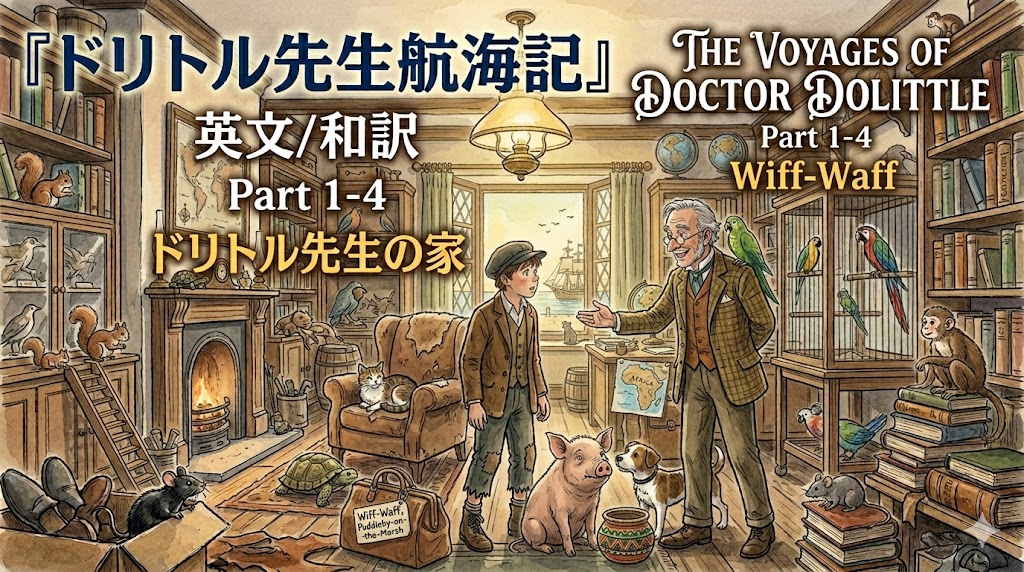
ドリトル先生の家の中で、トミーが動物たちや不思議な生き物「ウィフワフ」に出会う場面です。家の描写、料理、動物の言葉、貝類の言語研究など、物語の魅力が広がる重要表現を多めに色分けしています。
表示設定
WHEN at last I could look around me I found that the hall was indeed simply full of animals.
ようやくあたりを見回せるようになると、玄関ホールは本当に動物たちでいっぱいだった。
It seemed to me that almost every kind of creature from the countryside must be there: a pigeon, a white rat, an owl, a badger, a jackdaw.
田舎にいるほとんどあらゆる種類の生き物がそこにいるように思えた。ハト、白ネズミ、フクロウ、アナグマ、コクマルガラス。
There was even a small pig, just in from the rainy garden, carefully wiping his feet on the mat.
雨の庭から入ってきたばかりの小さな豚までいて、玄関マットで念入りに足を拭いていた。
The light from the candle glistened on his wet pink back.
ろうそくの光が、その濡れたピンク色の背中にきらめいていた。
The Doctor took the candlestick from the duck and turned to me.
先生はアヒルからろうそく立てを受け取り、私のほうを向いた。
“Look here,” he said: “you must get those wet clothes off—by the way, what is your name?”
「いいかい」と先生は言った。「その濡れた服を脱がなければいけない。ところで、君の名前は?」
“Tommy Stubbins,” I said.
「トミー・スタビンズです」と私は言った。
“Oh, are you the son of Jacob Stubbins, the shoemaker?”
「おお、君は靴職人のジェイコブ・スタビンズの息子かい?」
“Yes,” I said.
「はい」と私は言った。
“Excellent bootmaker, your father,” said the Doctor.
「君のお父さんはすばらしい靴職人だ」と先生は言った。
“You see these?” and he held up his right foot to show me the enormous boots he was wearing.
「これが見えるかい?」と言って、先生は自分が履いている巨大な長靴を見せるために右足を上げた。
“Your father made me those boots four years ago, and I’ve been wearing them ever since—perfectly wonderful boots.”
「君のお父さんが四年前にこの長靴を作ってくれてね。それ以来ずっと履いているんだ。実にすばらしい長靴だよ」
“Well now, look here, Stubbins. You’ve got to change those wet things—and quick.”
「さて、いいかい、スタビンズ。その濡れた服を着替えなければいけない。しかも急いでだ」
“Wait a moment till I get some more candles lit, and then we’ll go upstairs and find some dry clothes.”
「もう少しろうそくをつけるまで少し待ちなさい。それから二階へ行って乾いた服を探そう」
“You’ll have to wear an old suit of mine till we can get yours dry again by the kitchen-fire.”
「君の服が台所の火で乾くまでは、私の古い服を着ることになるね」
So presently when more candles had been lighted round different parts of the house, we went upstairs.
やがて家のあちこちにさらにろうそくが灯されると、私たちは二階へ上がった。
When we had come into a bedroom the Doctor opened a big wardrobe and took out two suits of old clothes.
寝室に入ると、先生は大きな衣装だんすを開け、古い服を二組取り出した。
These we put on. Then we carried our wet ones down to the kitchen and started a fire in the big chimney.
私たちはそれを着た。それから濡れた服を台所へ運び、大きな煙突のある暖炉に火を起こした。
The coat of the Doctor’s which I was wearing was so large for me that I kept treading on my own coat-tails.
私が着ていた先生の上着はあまりにも大きかったので、自分の上着の裾を何度も踏んでしまった。
This happened while I was helping to fetch the wood up from the cellar.
それは、地下室から薪を運び上げるのを手伝っているときのことだった。
But very soon we had a huge big fire blazing up the chimney and we hung our wet clothes around on chairs.
けれどもすぐに、大きな火が煙突へ向かって燃え上がり、私たちは濡れた服を椅子のまわりに掛けた。
“Now let’s cook some supper,” said the Doctor.—“You’ll stay and have supper with me, Stubbins, of course?”
「さあ、夕食を作ろう」と先生は言った。「もちろん、スタビンズ、君はここに残って私と夕食を食べるだろう?」
Already I was beginning to be very fond of this funny little man who called me “Stubbins,” instead of “Tommy” or “little lad.”
私はもう、このおかしな小さな男のことがとても好きになり始めていた。先生は私を「トミー」や「小さな坊や」ではなく、「スタビンズ」と呼んでくれた。
I did so hate to be called “little lad”!
私は「小さな坊や」と呼ばれるのが本当に嫌だったのだ!
This man seemed to begin right away treating me as though I were a grown-up friend of his.
先生はすぐに、まるで私を大人の友人であるかのように扱い始めてくれた。
And when he asked me to stop and have supper with him I felt terribly proud and happy.
だから、先生が私に残って一緒に夕食を食べないかと尋ねたとき、私はものすごく誇らしく、幸せな気持ちになった。
But I suddenly remembered that I had not told my mother that I would be out late.
けれども私は突然、遅くなることを母に伝えていないことを思い出した。
So very sadly I answered, “Thank you very much. I would like to stay, but I am afraid that my mother will begin to worry and wonder where I am if I don’t get back.”
そこで私はとても悲しい気持ちで答えた。「ありがとうございます。残りたいのですが、帰らないと母が心配して、私がどこにいるのか不思議に思うと思います」
“Oh, but my dear Stubbins,” said the Doctor, throwing another log of wood on the fire, “your clothes aren’t dry yet.”
「おやおや、親愛なるスタビンズ」と先生は、もう一本の薪を火にくべながら言った。「君の服はまだ乾いていないよ」
“You’ll have to wait for them, won’t you? By the time they are ready to put on we will have supper cooked and eaten.”
「乾くまで待たなければならないだろう? 着られるころには、夕食も作って食べ終わっているよ」
“Did you see where I put my bag?”
「私がかばんをどこに置いたか見なかったかい?」
“I think it is still in the hall,” I said. “I’ll go and see.”
「まだ玄関ホールにあると思います」と私は言った。「見てきます」
I found the bag near the front door. It was made of black leather and looked very, very old.
私は玄関の近くでかばんを見つけた。それは黒い革でできていて、とても、とても古そうだった。
One of its latches was broken and it was tied up round the middle with a piece of string.
留め金の一つは壊れていて、真ん中を一本のひもで縛ってあった。
“Thank you,” said the Doctor when I brought it to him.
私がそれを持っていくと、先生は「ありがとう」と言った。
“Was that bag all the luggage you had for your voyage?” I asked.
「航海に持っていった荷物は、そのかばんだけだったのですか?」と私は尋ねた。
“Yes,” said the Doctor, as he undid the piece of string. “I don’t believe in a lot of baggage.”
「そうだよ」と先生は、ひもをほどきながら言った。「私はたくさんの荷物を持つのは好きではないんだ」
“It’s such a nuisance. Life’s too short to fuss with it.”
「荷物というのは実に厄介なものだからね。人生は短すぎて、そんなものにかかずらっていられない」
“And it isn’t really necessary, you know—Where did I put those sausages?”
「それに、実際そんなに必要なものでもないんだよ。ところで、ソーセージをどこに入れたかな?」
The Doctor was feeling about inside the bag.
先生はかばんの中を手探りしていた。
First he brought out a loaf of new bread.
最初に先生は、焼きたてのパンを一つ取り出した。
Next came a glass jar with a curious metal top to it.
次に、奇妙な金属のふたがついたガラス瓶が出てきた。
He held this up to the light very carefully before he set it down upon the table.
先生はそれをテーブルに置く前に、とても注意深く明かりにかざした。
And I could see that there was some strange little water-creature swimming about inside.
すると私は、その中に不思議な小さな水の生き物が泳ぎ回っているのを見ることができた。
At last the Doctor brought out a pound of sausages.
最後に先生は、一ポンドのソーセージを取り出した。
“Now,” he said, “all we want is a frying-pan.”
「さて」と先生は言った。「あとはフライパンだけだね」
We went into the scullery and there we found some pots and pans hanging against the wall.
私たちは流し場へ行き、壁に鍋やフライパンがいくつも掛かっているのを見つけた。
The Doctor took down the frying-pan. It was quite rusty on the inside.
先生はフライパンを下ろした。その内側はかなりさびていた。
“Dear me, just look at that!” said he. “That’s the worst of being away so long.”
「おやおや、これを見てごらん!」と先生は言った。「長く留守にしていると、こういうところが困るんだ」
“The animals are very good and keep the house wonderfully clean as far as they can.”
「動物たちはとてもよくやってくれて、できる限り家を見事にきれいに保ってくれている」
“Dab-Dab is a perfect marvel as a housekeeper.”
「ダブダブは家政係としては本当に驚くべき存在だよ」
“But some things of course they can’t manage. Never mind, we’ll soon clean it up.”
「だがもちろん、動物たちにはどうにもできないこともある。気にしなくていい、すぐにきれいにしよう」
“You’ll find some silver-sand down there, under the sink, Stubbins. Just hand it up to me, will you?”
「スタビンズ、流しの下に磨き砂があるはずだ。こちらへ渡してくれるかい?」
In a few moments we had the pan all shiny and bright and the sausages were put over the kitchen-fire.
しばらくすると、フライパンはすっかりぴかぴかになり、ソーセージは台所の火にかけられた。
A beautiful frying smell went all through the house.
おいしそうな焼ける香りが家中に広がった。
While the Doctor was busy at the cooking I went and took another look at the funny little creature swimming about in the glass jar.
先生が料理で忙しくしているあいだ、私はガラス瓶の中で泳ぎ回っているおかしな小さな生き物をもう一度見に行った。
“What is this animal?” I asked.
「これは何という動物ですか?」と私は尋ねた。
“Oh that,” said the Doctor, turning round—“that’s a Wiff-Waff.”
「ああ、それかい」と先生は振り返って言った。「それはウィフワフだよ」
“Its full name is hippocampus pippitopitus. But the natives just call it a Wiff-Waff.”
「正式な名前は hippocampus pippitopitus だ。だが土地の人々は、ただウィフワフと呼んでいる」
“On account of the way it waves its tail, swimming, I imagine.”
「泳ぐときに尾を振る様子から、そう呼ばれるのだと思うよ」
“That’s what I went on this last voyage for, to get that.”
「今回の航海は、それを手に入れるためだったんだ」
“You see I’m very busy just now trying to learn the language of the shellfish.”
「私は今、貝類の言葉を覚えようとして、とても忙しいんだよ」
“They have languages, of that I feel sure.”
「彼らには確かに言葉がある。私はそう確信している」
“I can talk a little shark language and porpoise dialect myself.”
「私自身、サメの言葉とネズミイルカの方言なら少し話せる」
“But what I particularly want to learn now is shellfish.”
「だが今とくに覚えたいのは、貝類の言葉なんだ」
“Why?” I asked.
「なぜですか?」と私は尋ねた。
“Well, you see, some of the shellfish are the oldest kind of animals in the world that we know of.”
「つまりね、貝類の中には、私たちが知る限り世界で最も古い種類の動物がいるんだ」
“We find their shells in the rocks—turned to stone—thousands of years old.”
「岩の中から彼らの殻が見つかる。石になっていて、何千年も前のものなんだ」
“So I feel quite sure that if I could only get to talk their language, I should be able to learn a whole lot about what the world was like ages and ages and ages ago.”
「だから、もし彼らの言葉を話せるようになれば、大昔の世界がどんなものだったのか、たくさん学べるはずだと私は確信しているんだ」
“You see?”
「わかるかい?」
“But couldn’t some of the other animals tell you as well?”
「でも、ほかの動物たちでも教えてくれるのではありませんか?」
“I don’t think so,” said the Doctor, prodding the sausages with a fork.
「そうは思わないね」と先生は、フォークでソーセージをつつきながら言った。
“To be sure, the monkeys I knew in Africa some time ago were very helpful in telling me about bygone days.”
「たしかに、以前アフリカで知り合ったサルたちは、昔のことを教えてくれる点でとても役に立った」
“But they only went back a thousand years or so.”
「だが、彼らがさかのぼれるのはせいぜい千年ほどだった」
“No, I am certain that the oldest history in the world is to be had from the shellfish—and from them only.”
「いや、世界で最も古い歴史は貝類から得られる。しかも貝類からだけだと、私は確信している」
“You see most of the other animals that were alive in those very ancient times have now become extinct.”
「というのも、その非常に古い時代に生きていたほかの動物たちの多くは、今では絶滅してしまっているからだ」
“Have you learned any shellfish language yet?” I asked.
「もう貝類の言葉は何か覚えたのですか?」と私は尋ねた。
“No. I’ve only just begun.”
「いや。まだ始めたばかりだよ」
“I wanted this particular kind of a pipe-fish because he is half a shellfish and half an ordinary fish.”
「私はこの特別な種類のヨウジウオが欲しかったんだ。これは半分は貝類で、半分は普通の魚だからね」
“I went all the way to the Eastern Mediterranean after him.”
「それを求めて、私ははるばる東地中海まで行ったんだ」
“But I’m very much afraid he isn’t going to be a great deal of help to me.”
「だが残念ながら、彼は私にとってそれほど大きな助けにはならなそうだ」
“To tell you the truth, I’m rather disappointed in his appearance.”
「正直に言うと、その見た目には少しがっかりしているんだ」
“He doesn’t look very intelligent, does he?”
「あまり賢そうには見えないだろう?」
“No, he doesn’t,” I agreed.
「はい、そうは見えません」と私は同意した。
“Ah,” said the Doctor. “The sausages are done to a turn. Come along—hold your plate near and let me give you some.”
「ああ」と先生は言った。「ソーセージがちょうどよく焼けた。さあ、皿を近くに持ってきなさい。少しよそってあげよう」
Then we sat down at the kitchen-table and started a hearty meal.
それから私たちは台所のテーブルに座り、たっぷりとした食事を始めた。
It was a wonderful kitchen, that.
それは本当にすばらしい台所だった。
I had many meals there afterwards and I found it a better place to eat in than the grandest dining-room in the world.
私はその後そこで何度も食事をしたが、世界で最も豪華な食堂よりも、そこは食事をするのにずっとよい場所だと思った。
It was so cozy and home-like and warm.
そこはとても居心地がよく、家庭的で、暖かかった。
It was so handy for the food too.
食べ物を扱うにも、とても便利だった。
You took it right off the fire, hot, and put it on the table and ate it.
火から熱々のまま取り、テーブルに置いて、そのまま食べることができた。
And you could watch your toast toasting at the fender and see it didn’t burn while you drank your soup.
スープを飲みながら、暖炉の囲いのところでトーストが焼けていくのを眺め、焦げないように見ていることもできた。
And if you had forgotten to put the salt on the table, you didn’t have to get up and go into another room to fetch it.
それに、塩をテーブルに出すのを忘れていても、わざわざ立ち上がって別の部屋へ取りに行く必要はなかった。
You just reached round and took the big wooden box off the dresser behind you.
ただ後ろに手を伸ばして、食器棚から大きな木箱を取ればよかったのだ。
Then the fireplace—the biggest fireplace you ever saw—was like a room in itself.
それから暖炉は、これまで見たこともないほど大きな暖炉で、それ自体が一つの部屋のようだった。
You could get right inside it even when the logs were burning and sit on the wide seats either side.
丸太が燃えているときでさえ、その中へ入り、左右の広い腰掛けに座ることができた。
There you could roast chestnuts after the meal was over—or listen to the kettle singing, or tell stories, or look at picture-books by the light of the fire.
食事が終わったあと、そこで栗を焼いたり、やかんの歌う音を聞いたり、物語を話したり、火の明かりで絵本を見たりできた。
It was a marvelous kitchen.
それは本当にすばらしい台所だった。
It was like the Doctor, comfortable, sensible, friendly and solid.
それはまるで先生のように、心地よく、実際的で、親しみやすく、しっかりしていた。
While we were gobbling away, the door suddenly opened.
私たちががつがつ食べていると、突然扉が開いた。
In marched the duck, Dab-Dab, and the dog, Jip, dragging sheets and pillow-cases behind them over the clean tiled floor.
アヒルのダブダブと犬のジップが、清潔なタイル張りの床の上を、シーツや枕カバーを後ろに引きずりながら入ってきた。
The Doctor, seeing how surprised I was, explained:
先生は、私がどれほど驚いているかを見て、説明してくれた。
“They’re just going to air the bedding for me in front of the fire.”
「あの子たちは、火の前で私の寝具に風を通してくれるところなんだ」
“Dab-Dab is a perfect treasure of a housekeeper; she never forgets anything.”
「ダブダブは家政係としては本当に宝物のような存在だ。彼女は何一つ忘れない」
“I had a sister once who used to keep house for me—poor, dear Sarah! I wonder how she’s getting on.”
「昔、私には家のことをしてくれる妹がいた。かわいそうな、愛しいサラ! 今どうしているだろうね」
“I haven’t seen her in many years. But she wasn’t nearly as good as Dab-Dab. Have another sausage?”
「もう何年も会っていない。だが彼女もダブダブほど上手ではなかった。ソーセージをもう一本どうだい?」
The Doctor turned and said a few words to the dog and duck in some strange talk and signs.
先生は振り向き、犬とアヒルに向かって、何やら不思議な言葉と合図でいくつか話した。
They seemed to understand him perfectly.
彼らは先生の言うことを完全に理解しているようだった。
“Can you talk in squirrel language?” I asked.
「リスの言葉で話せますか?」と私は尋ねた。
“Oh yes. That’s quite an easy language,” said the Doctor.
「ああ、もちろん。あれはかなり簡単な言葉だよ」と先生は言った。
“You could learn that yourself without a great deal of trouble. But why do you ask?”
「君でもたいした苦労なく覚えられるだろう。だが、どうしてそんなことを聞くんだい?」
“Because I have a sick squirrel at home,” I said.
「家に病気のリスがいるからです」と私は言った。
“I took it away from a hawk. But two of its legs are badly hurt and I wanted very much to have you see it, if you would.”
「タカから助けたのです。でも二本の脚がひどく傷ついていて、もしよければ先生に見ていただきたいとずっと思っていました」
“Shall I bring it to-morrow?”
「明日連れてきましょうか?」
“Well, if its leg is badly broken I think I had better see it to-night.”
「そうだね、もし脚がひどく折れているなら、今夜見たほうがよさそうだ」
“It may be too late to do much; but I’ll come home with you and take a look at it.”
「もう多くのことをするには手遅れかもしれない。だが君の家まで一緒に行って見てみよう」
So presently we felt the clothes by the fire and mine were found to be quite dry.
そこでしばらくして、私たちは火のそばの服に触れてみた。私の服はすっかり乾いていた。
I took them upstairs to the bedroom and changed.
私はそれを二階の寝室へ持っていき、着替えた。
And when I came down the Doctor was all ready waiting for me with his little black bag full of medicines and bandages.
私が下へ降りてくると、先生は薬や包帯を詰めた小さな黒いかばんを持ち、すっかり準備を整えて待っていた。
“Come along,” he said. “The rain has stopped now.”
「さあ行こう」と先生は言った。「雨はもうやんだよ」
Outside it had grown bright again and the evening sky was all red with the setting sun.
外はまた明るくなっており、夕方の空は沈む太陽で一面赤く染まっていた。
And thrushes were singing in the garden as we opened the gate to go down on to the road.
私たちが門を開けて道へ下りようとすると、庭ではツグミが歌っていた。