
『白痴』のカラフル対訳について
カラフル対訳で紹介している『白痴』は、パブリックドメインの作品を出典としています。
このサイトで使われている作品は、ロシアの文豪フョードル・ドストエフスキーによる小説 The Idiot を出典としています。 英文は Eva M. Martin による英訳版をもとにしています。 原文は、著作権の切れた名作などの全文を電子化し、インターネット上で公開している Project Gutenberg(プロジェクト・グーテンベルク)、 朗読音声は LibriVox(リブリヴォックス/朗読図書館) の公開音声を出典としています。
原文はProject Gutenberg、音声はLibriVoxで公開されているパブリックドメイン作品を出典としています。
“`『白痴』英文/和訳 PART IV CHAPTER I
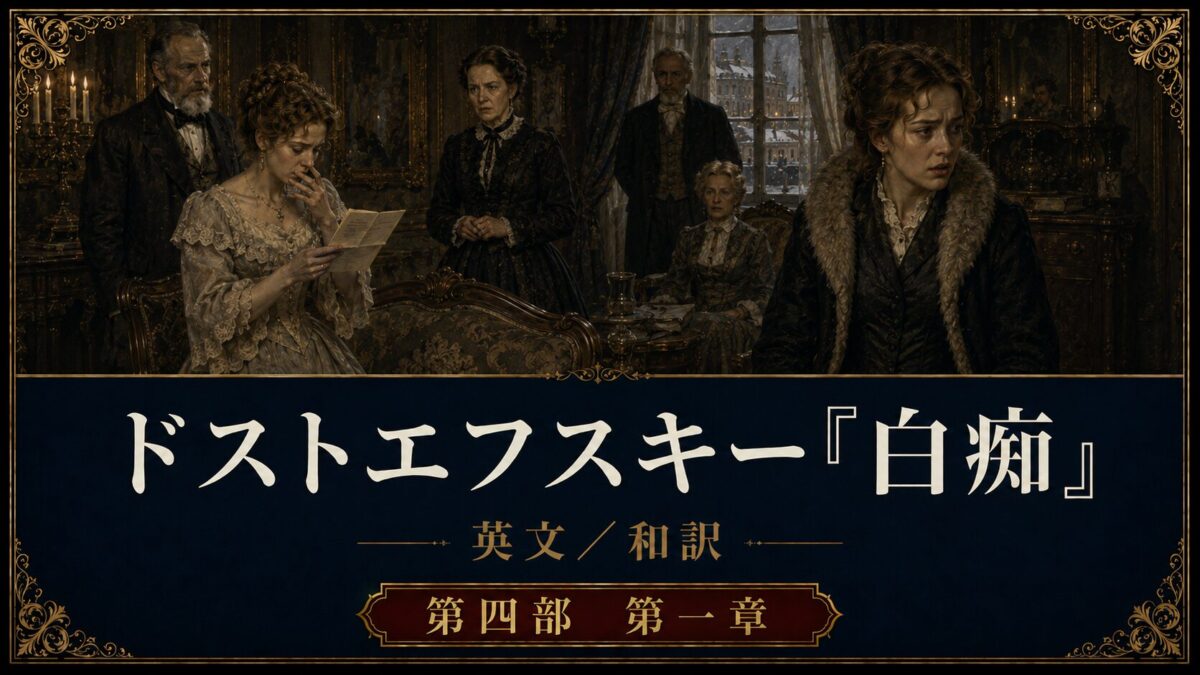
Fyodor Dostoyevsky『The Idiot』PART IV CHAPTER I です。第四部の冒頭として、「平凡な人々」についての考察から、ガーニャ、ワーリャ、プチーツィン一家の内情、そしてイヴォルギン将軍の騒動へつながる場面を、英文・和訳ペアで整理しています。
A week had elapsed since the rendezvous of our two friends on the green bench in the park.
公園の緑のベンチで二人の友人が会ってから、一週間が経過していた。
One fine morning at about half-past ten o’clock, Varvara Ardalionovna, otherwise Mrs. Ptitsin, returned home in a state of considerable mental depression.
ある晴れた朝、十時半ごろ、ワルワーラ・アルダリオノヴナ、すなわちプチーツィン夫人は、かなり精神的に落ち込んだ状態で家に戻ってきた。
She had been out to visit a friend.
彼女は友人を訪ねて外出していたのだった。
There are certain people of whom it is difficult to say anything which will at once throw them into relief.
世の中には、その人をすぐにくっきり浮かび上がらせるようなことを言うのが難しい人々がいる。
In other words, it is difficult to describe them graphically in their typical characteristics.
言い換えれば、その典型的な特徴を、生き生きと描写することが難しいのである。
These are they who are generally known as “commonplace people,” and this class comprises, of course, the immense majority of mankind.
そういう人々は一般に「平凡な人々」と呼ばれ、もちろんこの階級は人類の圧倒的大多数を含んでいる。
Authors, as a rule, attempt to select and portray types rarely met with in their entirety.
作家は普通、完全な形ではめったに出会えないような典型的人物を選び出し、描こうとする。
But these types are nevertheless more real than real life itself.
しかし、そうした典型的人物は、それでも現実の生活そのものよりも現実的なのである。
“Podkoleosin” was perhaps an exaggeration, but he was by no means a non-existent character.
「ポドコリョーシン」はおそらく誇張ではあったが、決して存在しない人物ではなかった。
On the contrary, how many intelligent people, after hearing of this Podkoleosin from Gogol, immediately began to find that scores of their friends were exactly like him!
それどころか、ゴーゴリからこのポドコリョーシンを知ったあと、どれほど多くの知的な人々が、自分の友人の何十人もがまさに彼にそっくりだと気づき始めたことだろう。
They knew, perhaps, before Gogol told them, that their friends were like Podkoleosin, but they did not know what name to give them.
彼らはおそらく、ゴーゴリに教えられる前から、自分の友人たちがポドコリョーシンのようだと分かっていた。しかし、その人々にどんな名を与えればよいのかを知らなかったのである。
In real life, young fellows seldom jump out of the window just before their weddings.
現実の生活では、若い男たちが結婚式の直前に窓から飛び降りることはめったにない。
Such a feat, not to speak of its other aspects, must be a decidedly unpleasant mode of escape.
そのような行為は、ほかの面はともかくとして、明らかに不快な逃げ方であるに違いない。
And yet there are plenty of bridegrooms, intelligent fellows too, who would be ready to confess themselves Podkoleosins in the depths of their consciousness, just before marriage.
それでも、結婚直前の意識の奥底では、自分をポドコリョーシンだと認めてもよいような花婿はたくさんいる。しかも知的な男たちの中にもいるのである。
Nor does every husband feel bound to repeat at every step, “Tu l’as voulu, Georges Dandin!” like another typical personage.
また、別の典型的人物のように、すべての夫が一歩ごとに「お前が望んだのだ、ジョルジュ・ダンダン!」と繰り返さねばならないと感じているわけでもない。
And yet how many millions and billions of Georges Dandins there are in real life who feel inclined to utter this soul-drawn cry after their honeymoon, if not the day after the wedding!
それでも現実の生活には、結婚式の翌日とまではいかなくとも、新婚旅行のあとにこの魂から絞り出される叫びを発したくなるジョルジュ・ダンダンが、何百万、何十億といることだろう。
Therefore, without entering into any more serious examination of the question, I will content myself with remarking that in real life typical characters are “watered down,” so to speak.
したがって、この問題をこれ以上真剣に考察することはせず、現実の生活では典型的人物は、いわば「薄められている」と述べるだけで満足しておこう。
All these Dandins and Podkoleosins actually exist among us every day, but in a diluted form.
これらのダンダンやポドコリョーシンたちは、薄められた形ではあるが、実際に毎日私たちの中に存在しているのである。
I will just add, however, that Georges Dandin might have existed exactly as Molière presented him, and probably does exist now and then, though rarely.
ただし、モリエールが描いたそのままのジョルジュ・ダンダンも存在し得たし、おそらくまれには今でも存在している、とだけ付け加えておこう。
And so I will end this scientific examination, which is beginning to look like a newspaper criticism.
こうして、新聞批評じみてきたこの「科学的考察」は終わりにすることにしよう。
But for all this, the question remains,—what are the novelists to do with commonplace people?
しかし、それでも問題は残る。小説家は平凡な人々をどう扱えばよいのだろうか。
How are they to be presented to the reader in such a form as to be in the least degree interesting?
彼らを読者に対して、少しでも興味深い形で示すにはどうすればよいのだろうか。
They cannot be left out altogether, for commonplace people meet one at every turn of life.
彼らを完全に省くことはできない。平凡な人々は人生のあらゆる場面で出会うものだからである。
And to leave them out would be to destroy the whole reality and probability of the story.
そして彼らを省けば、物語全体の現実性と蓋然性を壊すことになる。
To fill a novel with typical characters only, or with merely strange and uncommon people, would render the book unreal and improbable.
小説を典型的人物だけで、あるいはただ奇妙で珍しい人々だけで満たせば、その本は非現実的であり得なさそうなものになってしまう。
And it would very likely destroy the interest.
そして、おそらく興味も失わせてしまうだろう。
In my opinion, the duty of the novelist is to seek out points of interest and instruction even in the characters of commonplace people.
私の考えでは、小説家の務めは、平凡な人々の性格の中にも興味と教訓のある点を探し出すことにある。
For instance, when the whole essence of an ordinary person’s nature lies in his perpetual and unchangeable commonplaceness.
たとえば、ある普通の人間の本質全体が、永続的で変わることのない平凡さの中にある場合である。
And when, in spite of all his endeavours to do something out of the common, this person ends, eventually, by remaining in his unbroken line of routine—.
そして、何か普通とは違うことをしようとどれほど努力しても、その人物が結局は途切れることのない日常の線の中にとどまってしまう場合である――。
I think such an individual really does become a type of his own.
私は、そういう個人は本当にそれ自体で一つの典型になるのだと思う。
A type of commonplaceness which will not, for the world, if it can help it, be contented.
それは、できることならどうしても満足しようとしない平凡さの典型である。
But it strains and yearns to be something original and independent, without the slightest possibility of being so.
しかし、それは独創的で独立した何かになろうともがき、渇望する。そうなれる可能性など少しもないにもかかわらず。
To this class of commonplace people belong several characters in this novel.
この小説に登場する何人かの人物は、この平凡な人々の階級に属している。
Characters which—I admit—I have not drawn very vividly up to now for my reader’s benefit.
それらの人物は、認めるが、読者のためにこれまであまり鮮明には描いてこなかった人物たちである。
Such were, for instance, Varvara Ardalionovna Ptitsin, her husband, and her brother, Gania.
たとえば、ワルワーラ・アルダリオノヴナ・プチーツィナ、その夫、そしてその兄ガーニャがそうだった。
There is nothing so annoying as to be fairly rich, of a fairly good family, pleasing presence, average education, to be “not stupid,” kind-hearted, and yet to have no talent at all.
そこそこ裕福で、そこそこ良い家柄で、感じのよい外見を持ち、平均的な教育を受け、「愚かではなく」、心も優しいのに、才能がまったくないということほど厄介なものはない。
No originality, not a single idea of one’s own—to be, in fact, “just like everyone else.”
独創性もなく、自分自身の考えが一つもない。つまり、実際には「皆と同じ」であるということだ。
Of such people there are countless numbers in this world—far more even than appear.
この世にはそういう人々が数え切れないほどいる。見た目以上にずっと多いのである。
They can be divided into two classes as all men can—that is, those of limited intellect, and those who are much cleverer.
彼らは、すべての人間と同じように二つの階級に分けられる。すなわち、知性の限られた者と、ずっと賢い者である。
The former of these classes is the happier.
この二つの階級のうち、前者のほうが幸福である。
To a commonplace man of limited intellect, for instance, nothing is simpler than to imagine himself an original character.
たとえば、知性の限られた平凡な人間にとって、自分を独創的な人物だと思い込むことほど簡単なことはない。
And to revel in that belief without the slightest misgiving.
そして、その信念を少しの不安もなく楽しむことも簡単なのである。
Many of our young women have thought fit to cut their hair short, put on blue spectacles, and call themselves Nihilists.
多くの若い女性たちは、髪を短く切り、青い眼鏡をかけ、自分をニヒリストと呼ぶのがよいと考えた。
By doing this they have been able to persuade themselves, without further trouble, that they have acquired new convictions of their own.
そうすることで、彼女たちはそれ以上苦労することなく、自分自身の新しい信念を得たのだと自分に信じ込ませることができたのである。
Some men have but felt some little qualm of kindness towards their fellow-men.
ある者たちは、同胞に対してほんのわずかな親切心の痛みを感じただけである。
And the fact has been quite enough to persuade them that they stand alone in the van of enlightenment.
そしてその事実だけで、自分たちこそ啓蒙の最前線にただ一人立っているのだと信じ込むには十分だった。
And that no one has such humanitarian feelings as they.
そして、自分たちほど人道的感情を持つ者はいないと信じるにも十分だった。
Others have but to read an idea of somebody else’s, and they can immediately assimilate it and believe that it was a child of their own brain.
また別の者たちは、誰か他人の思想を読むだけで、それをすぐに取り込み、それが自分の頭から生まれた子だと信じることができる。
The “impudence of ignorance,” if I may use the expression, is developed to a wonderful extent in such cases.
こうした場合には、あえてこの表現を使うなら、「無知の厚かましさ」が驚くほど発達するのである。
Unlikely as it appears, it is met with at every turn.
ありそうにないように見えても、それは至るところで見られる。
This confidence of a stupid man in his own talents has been wonderfully depicted by Gogol in the amazing character of Pirogoff.
愚かな人間が自分の才能を信じ込むこの自信は、ゴーゴリがピロゴフという驚くべき人物の中に見事に描いている。
Pirogoff has not the slightest doubt of his own genius—nay, of his superiority of genius—so certain is he of it that he never questions it.
ピロゴフは自分の天才について、いや、自分の天才の優越性について、少しも疑わない。あまりにも確信しているので、それを疑問にさえしないのである。
How many Pirogoffs have there not been among our writers—scholars, propagandists?
私たちの作家、学者、宣伝家たちの中に、ピロゴフはいったいどれほどいたことだろう。
I say “have been,” but indeed there are plenty of them at this very day.
私は「いた」と言ったが、実際には今日この瞬間にも、彼らはたくさんいるのである。
Our friend, Gania, belonged to the other class—to the “much cleverer” persons.
私たちの友人ガーニャは、もう一方の階級、つまり「ずっと賢い」人々のほうに属していた。
Though he was from head to foot permeated and saturated with the longing to be original.
もっとも、彼は頭からつま先まで、独創的でありたいという渇望に染み込んでいた。
This class, as I have said above, is far less happy.
この階級は、先に述べたように、はるかに不幸である。
For the “clever commonplace” person, though he may possibly imagine himself a man of genius and originality, none the less has within his heart the deathless worm of suspicion and doubt.
なぜなら、「賢い平凡人」は、たとえ自分を天才で独創的な人物だと思い込むことができても、それでも心の中には死ぬことのない疑いと不安の虫を抱えているからである。
And this doubt sometimes brings a clever man to despair.
そしてこの疑いは、ときに賢い人間を絶望へと追いやる。
As a rule, however, nothing tragic happens; his liver becomes a little damaged in the course of time, nothing more serious.
しかし普通は、悲劇的なことは何も起こらない。時がたつにつれて肝臓が少し悪くなるだけで、それ以上深刻なことはない。
Such men do not give up their aspirations after originality without a severe struggle.
そういう人々は、激しい苦闘なしには独創性への願望を捨てない。
There have been men who, though good fellows in themselves, and even benefactors to humanity, have sunk to the level of base criminals for the sake of originality.
それ自体は善良な人物であり、人類の恩人でさえあったのに、独創性のために卑しい犯罪者の水準まで堕ちた人々もいたのである。
Gania was a beginner, as it were, upon this road.
ガーニャは、いわばこの道の初心者だった。
A deep and unchangeable consciousness of his own lack of talent, combined with a vast longing to be able to persuade himself that he was original, had rankled in his heart, even from childhood.
自分に才能がないという深く変わらない意識と、自分は独創的なのだと自分に信じ込ませたいという大きな渇望が結びつき、子どものころから彼の心の中でうずいていた。
He seemed to have been born with overwrought nerves.
彼は張りつめた神経を持って生まれてきたようだった。
And in his passionate desire to excel, he was often led to the brink of some rash step.
そして抜きん出たいという激しい欲望の中で、彼はしばしば何か無謀な行動の瀬戸際へ導かれた。
Yet, having resolved upon such a step, when the moment arrived, he invariably proved too sensible to take it.
しかし、そのような行動を決意しても、その瞬間が来ると、彼は決まってそれを実行するにはあまりにも分別があることを示した。
He was ready, in the same way, to do a base action in order to obtain his wished-for object.
同じように、彼は望む目的を得るためなら卑しい行為をする覚悟もあった。
And yet, when the moment came to do it, he found that he was too honest for any great baseness.
それでも、それを実行する瞬間が来ると、自分は大きな下劣さに踏み込むには正直すぎると気づくのだった。
Not that he objected to acts of petty meanness—he was always ready for them.
もっとも、つまらない卑劣さの行為を嫌がったわけではない。そういうことなら、彼はいつでもする用意があった。
He looked with hate and loathing on the poverty and downfall of his family.
彼は自分の家族の貧困と没落を、憎しみと嫌悪をもって見ていた。
And treated his mother with haughty contempt, although he knew that his whole future depended on her character and reputation.
そして、自分の将来全体が母の人柄と評判にかかっていることを知りながら、母を高慢な軽蔑で扱った。
Aglaya had simply frightened him.
アグラーヤはただ彼を怖がらせただけだった。
Yet he did not give up all thoughts of her, though he never seriously hoped that she would condescend to him.
それでも彼は彼女のことを完全には諦めなかった。もっとも、彼女が自分のところまで身をかがめてくれると本気で望んだことはなかったが。
At the time of his “adventure” with Nastasia Philipovna he had come to the conclusion that money was his only hope.
ナスターシャ・フィリッポヴナとの「冒険」の時、彼は金こそが自分の唯一の希望だという結論に達していた。
Money should do all for him.
金が彼のためにすべてを成し遂げてくれるはずだった。
At the moment when he lost Aglaya, and after the scene with Nastasia, he had felt so low in his own eyes that he actually brought the money back to the prince.
アグラーヤを失い、ナスターシャとの場面の後、自分の目にあまりにも卑しく映ったため、彼は実際に金を公爵へ返しに行った。
Of this returning of the money given to him by a madwoman who had received it from a madman, he had often repented since.
狂人から受け取った金を狂女から与えられ、それを返したことについて、彼はその後しばしば後悔した。
Though he never ceased to be proud of his action.
もっとも、その行為を誇りに思うことをやめることもなかった。
During the short time that Muishkin remained in Petersburg Gania had had time to come to hate him for his sympathy.
ムイシュキンがペテルブルグにとどまっていた短いあいだに、ガーニャはその同情のゆえに彼を憎むようになっていた。
Though the prince told him that it was “not everyone who would have acted so nobly” as to return the money.
公爵は、金を返すほど「高潔に振る舞える人は誰でもいるわけではない」と彼に言ったのだが。
He had long pondered, too, over his relations with Aglaya.
彼はまた、アグラーヤとの関係についても長いあいだ考え込んでいた。
And had persuaded himself that with such a strange, childish, innocent character as hers, things might have ended very differently.
そして、彼女のように奇妙で子どもっぽく無垢な性格なら、事態はまったく違った結末を迎えたかもしれないと自分に信じ込ませていた。
Remorse then seized him; he threw up his post, and buried himself in self-torment and reproach.
すると後悔が彼を捕らえた。彼は職を投げ出し、自責と自己苦悩の中に身を埋めた。
He lived at Ptitsin’s, and openly showed contempt for the latter, though he always listened to his advice.
彼はプチーツィンの家に住み、彼に対して公然と軽蔑を示していたが、それでもいつも彼の助言には耳を傾けていた。
And was sensible enough to ask for it when he wanted it.
そして必要な時には助言を求めるだけの分別もあった。
Gavrila Ardalionovitch was angry with Ptitsin because the latter did not care to become a Rothschild.
ガヴリラ・アルダリオノヴィチは、プチーツィンがロスチャイルドになる気がないことに腹を立てていた。
“If you are to be a Jew,” he said, “do it properly—squeeze people right and left, show some character; be the King of the Jews while you are about it.”
「ユダヤ人になるなら」と彼は言った。「ちゃんとやれ。あちこちから人を搾り取って、少しは根性を見せろ。やるならユダヤ人の王になれ」
Ptitsin was quiet and not easily offended—he only laughed.
プチーツィンは静かで、めったに気分を害することはなかった。彼はただ笑うだけだった。
But on one occasion he explained seriously to Gania that he was no Jew, that he did nothing dishonest, and that he could not help the market price of money.
しかしある時、彼はガーニャに真面目に説明した。自分はユダヤ人ではなく、不正なことは何もしておらず、金の市場価格は自分にはどうしようもないのだ、と。
Thanks to his accurate habits, he had already a good footing and was respected, and his business was flourishing.
正確な習慣のおかげで、彼はすでに確かな地位を得て尊敬され、商売も繁盛していた。
“I shan’t ever be a Rothschild, and there is no reason why I should,” he added, smiling.
「私は決してロスチャイルドにはならないでしょうし、なる理由もありません」と彼は微笑みながら付け加えた。
“But I shall have a house in the Liteynaya, perhaps two, and that will be enough for me.”
「しかしリテイナヤ通りに家を一軒、おそらく二軒は持つでしょう。それで私には十分です」
“Who knows but what I may have three!” he concluded to himself.
「三軒持つことだってあるかもしれない!」と彼は心の中で結論づけた。
But this dream, cherished inwardly, he never confided to a soul.
しかし彼は、心の中で大切にしているこの夢を、誰にも打ち明けなかった。
Nature loves and favours such people.
自然はそういう人々を愛し、ひいきする。
Ptitsin will certainly have his reward, not three houses, but four.
プチーツィンは必ず報いを受けるだろう。三軒ではなく、四軒の家を得るだろう。
Precisely because from childhood up he had realized that he would never be a Rothschild.
まさに、子どものころから自分は決してロスチャイルドにはならないと悟っていたからである。
That will be the limit of Ptitsin’s fortune, and, come what may, he will never have more than four houses.
それがプチーツィンの財産の限界であり、何があっても彼は四軒以上の家を持つことはないだろう。
Varvara Ardalionovna was not like her brother.
ワルワーラ・アルダリオノヴナは兄とは違っていた。
She too had passionate desires, but they were persistent rather than impetuous.
彼女にも激しい欲望はあったが、それは衝動的というより持続的なものだった。
Her plans were as wise as her methods of carrying them out.
彼女の計画は、それを実行する方法と同じくらい賢明だった。
No doubt she also belonged to the category of ordinary people who dream of being original.
疑いなく、彼女もまた、独創的であることを夢見る普通の人々の範疇に属していた。
But she soon discovered that she had not a grain of true originality, and she did not let it trouble her too much.
しかし彼女はすぐに、自分には真の独創性など一粒もないことに気づき、それをあまり気にしなかった。
Perhaps a certain kind of pride came to her help.
おそらく、ある種の誇りが彼女を助けたのである。
She made her first concession to the demands of practical life with great resolution when she consented to marry Ptitsin.
彼女がプチーツィンとの結婚に同意した時、それは実生活の要求に対する最初の譲歩であり、彼女はそれを大きな決断力をもって行った。
However, when she married she did not say to herself, “Never mind a mean action if it leads to the end in view,” as her brother would certainly have said in such a case.
しかし結婚する時、彼女は兄ならそういう場合に必ず言ったであろう「目的に達するなら卑しい行為など気にするな」と自分に言い聞かせたわけではなかった。
It is quite probable that he may have said it when he expressed his elder-brotherly satisfaction at her decision.
もっとも、兄として彼女の決断に満足を示した時、彼はそう言った可能性が高い。
Far from this; Varvara Ardalionovna did not marry until she felt convinced that her future husband was unassuming, agreeable, almost cultured.
しかし実際はそうではなかった。ワルワーラ・アルダリオノヴナは、未来の夫が控えめで、感じがよく、ほとんど教養ある人物だと確信するまで結婚しなかった。
And that nothing on earth would tempt him to a really dishonourable deed.
そして、この世の何ものも彼を本当に不名誉な行為へ誘うことはないと確信したのである。
As to small meannesses, such trifles did not trouble her.
小さな卑劣さについては、そんな些細なことは彼女を悩ませなかった。
Indeed, who is free from them? It is absurd to expect the ideal!
実際、そうしたものから自由な人間などいるだろうか。理想を期待するのは馬鹿げている。
Besides, she knew that her marriage would provide a refuge for all her family.
それに、彼女は自分の結婚が家族全員に避難所を与えることを知っていた。
Seeing Gania unhappy, she was anxious to help him, in spite of their former disputes and misunderstandings.
ガーニャが不幸なのを見て、彼女は以前の争いや誤解にもかかわらず、彼を助けたいと強く思っていた。
Ptitsin, in a friendly way, would press his brother-in-law to enter the army.
プチーツィンは親しげに、義兄弟に軍隊へ入るよう勧めることがあった。
“You know,” he said sometimes, jokingly, “you despise generals and generaldom.”
「君はね」と彼は時々冗談めかして言った。「将軍や将軍職を軽蔑しているだろう」
“But you will see that ‘they’ will all end by being generals in their turn. You will see it if you live long enough!”
「しかし見ていれば分かるが、『彼ら』は結局みんな順番に将軍になるものだ。十分長生きすれば、それが分かるよ!」
“But why should they suppose that I despise generals?” Gania thought sarcastically to himself.
「しかし、なぜ彼らは私が将軍を軽蔑しているなどと思うのだろう」とガーニャは皮肉っぽく心の中で考えた。
To serve her brother’s interests, Varvara Ardalionovna was constantly at the Epanchins’ house.
兄の利益に仕えるため、ワルワーラ・アルダリオノヴナはしょっちゅうエパンチン家に出入りしていた。
This was helped by the fact that in childhood she and Gania had played with General Ivan Fedorovitch’s daughters.
その助けとなったのは、子どものころ彼女とガーニャがイワン・フョードロヴィチ将軍の娘たちと一緒に遊んでいたという事実だった。
It would have been inconsistent with her character if in these visits she had been pursuing a chimera.
もし彼女がこれらの訪問で空想を追っていたのなら、それは彼女の性格に合わなかっただろう。
Her project was not chimerical at all; she was building on a firm basis—on her knowledge of the character of the Epanchin family, especially Aglaya, whom she studied closely.
彼女の計画はまったく空想的ではなかった。彼女は確かな基礎、つまりエパンチン家の性格、とりわけ彼女が綿密に観察していたアグラーヤの性格についての知識の上に築いていた。
All Varvara’s efforts were directed towards bringing Aglaya and Gania together.
ワルワーラの努力はすべて、アグラーヤとガーニャを結びつけることに向けられていた。
Perhaps she achieved some result; perhaps, also, she made the mistake of depending too much upon her brother.
おそらく彼女はいくらかの成果を上げたのだろう。だが同時に、兄に頼りすぎるという誤りも犯したのかもしれない。
And expecting more from him than he would ever be capable of giving.
そして彼が到底与えられないほどのものを、彼に期待しすぎたのかもしれない。
However this may be, her manoeuvres were skilful enough.
いずれにせよ、彼女の工作は十分に巧みだった。
For weeks at a time she would never mention Gania.
何週間ものあいだ、彼女はガーニャのことを一切口にしないこともあった。
Her attitude was modest but dignified, and she was always extremely truthful and sincere.
彼女の態度は控えめだが威厳があり、いつも非常に正直で誠実だった。
Examining the depths of her conscience, she found nothing to reproach herself with.
良心の奥底を調べても、彼女は自分を責めるべきものを何も見つけなかった。
And this still further strengthened her in her designs.
そしてそれが、彼女の計画への意志をさらに強めた。
But Varvara Ardalionovna sometimes remarked that she felt spiteful.
しかしワルワーラ・アルダリオノヴナは時々、自分には意地悪な気持ちがあると感じることもあった。
That there was a good deal of vanity in her, perhaps even of wounded vanity.
自分の中にはかなりの虚栄心、ひょっとすると傷ついた虚栄心さえあるのかもしれない、と感じていた。
She noticed this at certain times more than at others, and especially after her visits to the Epanchins.
彼女はこれを、ある時にはほかの時よりも強く感じた。特にエパンチン家を訪問した後にそうだった。
Today, as I have said, she returned from their house with a heavy feeling of dejection.
今日、すでに述べたように、彼女は重い落胆の気持ちを抱えて彼らの家から戻ってきた。
There was a sensation of bitterness, a sort of mocking contempt, mingled with it.
そこには苦々しさの感覚、ある種の嘲るような軽蔑が混じっていた。
Arrived at her own house, Varia heard a considerable commotion going on in the upper storey.
自分の家に着くと、ワーリャは上の階でかなりの騒ぎが起きているのを聞いた。
And distinguished the voices of her father and brother.
そして父と兄の声を聞き分けた。
On entering the salon she found Gania pacing up and down at frantic speed, pale with rage and almost tearing his hair.
サロンに入ると、彼女はガーニャが怒りで青ざめ、ほとんど髪をかきむしりながら、狂ったような速さで行ったり来たりしているのを見つけた。
She frowned, and subsided on to the sofa with a tired air, without taking the trouble to remove her hat.
彼女は眉をひそめ、帽子を脱ぐ手間もかけず、疲れた様子でソファに腰を沈めた。
She very well knew that if she kept quiet and asked her brother nothing about his reason for tearing up and down the room, his wrath would fall upon her head.
彼女はよく知っていた。黙っていて、兄が部屋を走り回っている理由を尋ねなければ、彼の怒りは自分の頭に降りかかるだろうと。
So she hastened to put the question:
そこで彼女は急いで質問した。
“The old story, eh?”
「いつもの話なの?」
“Old story? No! Heaven knows what’s up now—I don’t!”
「いつもの話? 違う! 今度は何が起きているのか、神のみぞ知るだ。僕には分からない!」
“Father has simply gone mad; mother’s in floods of tears.”
「父は完全に気が狂った。母は涙の洪水だ」
“Upon my word, Varia, I must kick him out of the house; or else go myself,” he added.
「本当に、ワーリャ、僕は父を家から追い出すしかない。さもなければ僕が出ていく」と彼は付け加えた。
Probably he remembered that he could not well turn people out of a house which was not his own.
おそらく彼は、自分のものではない家から人を追い出すわけにはいかないことを思い出したのだろう。
“You must make allowances,” murmured Varia.
「大目に見てあげなければ」とワーリャはつぶやいた。
“Make allowances? For whom? Him—the old blackguard?”
「大目に見る? 誰を? あの老いぼれ悪党をか?」
“No, no, Varia—that won’t do! It won’t do, I tell you!”
「だめだ、だめだ、ワーリャ、それは通らない! 通らないと言っているんだ!」
“And look at the swagger of the man!”
「それに、あの男の威張りぶりを見てみろ!」
“He’s all to blame himself, and yet he puts on so much ‘side’ that you’d think—my word!”
「悪いのはすべて本人なのに、あれほどもったいぶっている。まったく、見ていると――いやはや!」
“‘It’s too much trouble to go through the gate, you must break the fence for me!’ That’s the sort of air he puts on.”
「『門を通るのは面倒だから、私のために柵を壊せ!』というような態度なんだ」
“But what’s the matter with you, Varia? What a curious expression you have!”
「だが、君はどうしたんだ、ワーリャ? 変な顔をしているぞ!」
“I’m all right,” said Varia, in a tone that sounded as though she were all wrong.
「私は大丈夫よ」とワーリャは言ったが、その声はまるでまったく大丈夫ではないように響いた。
Gania looked more intently at her.
ガーニャは彼女をさらにじっと見た。
“You’ve been there?” he asked, suddenly.
「あそこへ行ってきたのか?」と彼は突然尋ねた。
“Yes.”
「ええ」
“Did you find out anything?”
「何か分かったか?」
“Nothing unexpected. I discovered that it’s all true.”
「予想外のことは何もないわ。すべて本当だと分かっただけ」
“My husband was wiser than either of us. Just as he suspected from the beginning, so it has fallen out.”
「私の夫は私たち二人より賢かったのよ。彼が最初から疑っていた通りになったの」
“Where is he?”
「彼はどこだ?」
“Out. Well—what has happened?—go on.”
「外出中だ。で、何があった? 続けろ」
“The prince is formally engaged to her—that’s settled.”
「公爵は正式に彼女と婚約しているの。それは決まったことよ」
“The elder sisters told me about it. Aglaya has agreed.”
「姉たちが私に話してくれたわ。アグラーヤは同意したのよ」
“They don’t attempt to conceal it any longer; you know how mysterious and secret they have all been up to now.”
「もう隠そうともしていないわ。これまでみんながどれほど謎めいて秘密めかしていたか、あなたも知っているでしょう」
“Adelaida’s wedding is put off again, so that both can be married on one day.”
「アデライーダの結婚式はまた延期されて、二人が同じ日に結婚できるようにするそうよ」
“Isn’t that delightfully romantic? Somebody ought to write a poem on it.”
「なんて楽しくロマンチックなのかしら。誰かがそれで詩を書くべきね」
“Sit down and write an ode instead of tearing up and down like that.”
「そんなふうに行ったり来たりしないで、座って頌歌でも書きなさい」
“This evening Princess Bielokonski is to arrive; she comes just in time—they have a party tonight.”
「今晩、ビエロコンスキー公爵夫人が到着するの。ちょうどよい時に来るわ。今夜はパーティーがあるのよ」
“He is to be presented to old Bielokonski, though I believe he knows her already.”
「彼は老ビエロコンスキー夫人に紹介されることになっているわ。もっとも、彼はすでに彼女を知っていると思うけれど」
“Probably the engagement will be openly announced.”
「おそらく婚約が公に発表されるでしょう」
“They are only afraid that he may knock something down, or trip over something when he comes into the room.”
「彼が部屋に入ってきたとき、何かを倒したり、何かにつまずいたりするのではないかと、それだけを心配しているの」
“It would be just like him.”
「いかにも彼らしいでしょう」
Gania listened attentively, but to his sister’s astonishment he was by no means so impressed by this news as she had expected.
ガーニャは注意深く聞いていたが、妹の驚いたことに、彼は彼女が予想していたほどこの知らせに心を動かされてはいなかった。
She thought it should have been so important to him.
彼女は、それは彼にとって非常に重要な知らせであるはずだと思っていた。
“Well, it was clear enough all along,” he said, after a moment’s reflection.
「まあ、最初から十分にはっきりしていたことだ」と彼はしばらく考えたあとで言った。
“So that’s the end,” he added, with a disagreeable smile.
「つまり、これで終わりというわけだ」と彼は不快な笑みを浮かべて付け加えた。
He continued to walk up and down the room, but much slower than before, and glanced slyly into his sister’s face.
彼は部屋を行ったり来たりし続けたが、以前よりずっとゆっくりになり、妹の顔をずるそうにちらりと見た。
“It’s a good thing that you take it philosophically, at all events,” said Varia.
「とにかく、あなたがそれを達観して受け止めているのはよいことね」とワーリャは言った。
“I’m really very glad of it.”
「本当にうれしいわ」
“Yes, it’s off our hands—off yours, I should say.”
「ああ、僕たちの手から離れた。いや、君たちの手から、と言うべきかな」
“I think I have served you faithfully. I never even asked you what happiness you expected to find with Aglaya.”
「私はあなたに忠実に尽くしてきたと思うわ。あなたがアグラーヤとどんな幸福を見つけるつもりだったのかさえ、一度も尋ねなかったもの」
“Did I ever expect to find happiness with Aglaya?”
「僕がアグラーヤと幸福を見つけるつもりだったことなどあるか?」
“Come, come, don’t overdo your philosophy. Of course you did.”
「まあまあ、そんなに達観をやりすぎないで。もちろん期待していたでしょう」
“Now it’s all over, and a good thing, too; pair of fools that we have been!”
「今ではすべて終わったし、それでよかったのよ。私たちは本当に馬鹿な二人だったわ!」
“I confess I have never been able to look at it seriously.”
「正直に言うと、私はそれを本気で考えることができなかったの」
“I busied myself in it for your sake, thinking that there was no knowing what might happen with a funny girl like that to deal with.”
「あなたのためにそれに関わっていたのよ。あんな変わった娘が相手なら、何が起こるか分からないと思ってね」
“There were ninety to one chances against it.”
「成功する見込みは九十対一でなかったわ」
“To this moment I can’t make out why you wished for it.”
「今でも、なぜあなたがそれを望んだのか私には分からないわ」
“H’m! now, I suppose, you and your husband will never weary of egging me on to work again.”
「ふむ! では今度は、君と君の夫がまた僕に働け働けとけしかけるのに飽きないわけだな」
“You’ll begin your lectures about perseverance and strength of will, and all that. I know it all by heart,” said Gania, laughing.
「忍耐だの意志の力だの、そういう説教を始めるんだろう。全部暗記しているよ」とガーニャは笑いながら言った。
“He’s got some new idea in his head,” thought Varia.
「彼の頭には何か新しい考えがあるのだわ」とワーリャは思った。
“Are they pleased over there—the parents?” asked Gania, suddenly.
「あちらでは喜んでいるのか、両親は?」とガーニャは突然尋ねた。
“N-no, I don’t think they are. You can judge for yourself.”
「い、いいえ、そうは思わないわ。自分で判断できるでしょう」
“I think the general is pleased enough; her mother is a little uneasy.”
「将軍はそれなりに喜んでいると思う。でも彼女の母親は少し不安そうね」
“She always loathed the idea of the prince as a husband; everybody knows that.”
「彼女は夫としての公爵という考えをいつも嫌っていたわ。誰でも知っていることよ」
“Of course, naturally. The bridegroom is an impossible and ridiculous one.”
「もちろん、当然だ。花婿としてはあり得ないし、滑稽な男だからな」
“I mean, has she given her formal consent?”
「つまり、彼女は正式に同意したのか?」
“She has not said ‘no,’ up to now, and that’s all.”
「今のところ『いいえ』とは言っていない。それだけよ」
“It was sure to be so with her. You know what she is like.”
「彼女ならきっとそうなるはずだったわ。彼女がどんな人か、あなたも知っているでしょう」
“You know how absurdly shy she is.”
「彼女がどれほど馬鹿げたほど恥ずかしがり屋か、知っているでしょう」
“You remember how she used to hide in a cupboard as a child, so as to avoid seeing visitors, for hours at a time.”
「子どものころ、客に会わないように何時間も戸棚に隠れていたことを覚えているでしょう」
“She is just the same now.”
「今も彼女はまったく同じなのよ」
“But, do you know, I think there is something serious in the matter, even from her side; I feel it, somehow.”
「でもね、彼女の側にも何か真剣なものがあるように思うの。なぜかそう感じるのよ」
“She laughs at the prince, they say, from morn to night in order to hide her real feelings.”
「彼女は本当の気持ちを隠すために、朝から晩まで公爵を笑っているそうよ」
“But you may be sure she finds occasion to say something or other to him on the sly.”
「でもきっと、彼女はこっそり彼に何かを言う機会を見つけているはずよ」
“For he himself is in a state of radiant happiness.”
「というのも、彼自身は輝くような幸福の状態にあるのだから」
“He walks in the clouds; they say he is extremely funny just now; I heard it from themselves.”
「彼は雲の上を歩いているようなものよ。今の彼はとてもおかしいそうよ。本人たちから聞いたの」
“They seemed to be laughing at me in their sleeves—those elder girls—I don’t know why.”
「あの姉たちは、私を陰で笑っているように見えたわ。なぜかは分からないけれど」
Gania had begun to frown, and probably Varia added this last sentence in order to probe his thought.
ガーニャは眉をひそめ始めていた。おそらくワーリャは彼の考えを探るために、最後の一文を付け加えたのだろう。
However, at this moment, the noise began again upstairs.
しかしこの瞬間、上の階でまた騒ぎが始まった。
“I’ll turn him out!” shouted Gania, glad of the opportunity of venting his vexation.
「追い出してやる!」とガーニャは、自分の苛立ちをぶつける機会を得て喜びながら叫んだ。
“I shall just turn him out—we can’t have this.”
「今すぐ追い出してやる。こんなことは許しておけない」
“Yes, and then he’ll go about the place and disgrace us as he did yesterday.”
「そうね、そして彼はまた昨日のように、あちこち歩き回って私たちに恥をかかせるでしょうね」
“How ‘as he did yesterday’? What do you mean? What did he do yesterday?” asked Gania, in alarm.
「『昨日のように』とはどういうことだ? 何のことだ? 昨日、父は何をしたんだ?」とガーニャは不安になって尋ねた。
“Why, goodness me, don’t you know?” Varia stopped short.
「まあ、あなた知らないの?」ワーリャはそこで言葉を切った。
“What? You don’t mean to say that he went there yesterday!” cried Gania, flushing red with shame and anger.
「何だって? まさか父が昨日あそこへ行ったと言うんじゃないだろうな!」とガーニャは羞恥と怒りで真っ赤になって叫んだ。
“Good heavens, Varia! Speak! You have just been there. Was he there or not, quick?”
「何てことだ、ワーリャ! 話せ! 君は今あそこへ行ってきたんだろう。父はそこに行ったのか、行かなかったのか、早く!」
And Gania rushed for the door.
そしてガーニャは扉へ駆け出した。
Varia followed and caught him by both hands.
ワーリャは追いかけ、両手で彼をつかんだ。
“What are you doing? Where are you going to?”
「何をするの? どこへ行くつもり?」
“You can’t let him go now; if you do he’ll go and do something worse.”
「今彼を行かせてはだめよ。行かせたら、もっとひどいことをするわ」
“What did he do there? What did he say?”
「父はそこで何をしたんだ? 何を言ったんだ?」
“They couldn’t tell me themselves; they couldn’t make head or tail of it.”
「あちらの人たちも私に説明できなかったの。何が何だかさっぱり分からなかったのよ」
“But he frightened them all.”
「でも彼はみんなを怖がらせたわ」
“He came to see the general, who was not at home; so he asked for Lizabetha Prokofievna.”
「将軍に会いに行ったけれど、将軍は留守だった。それでリザヴェータ・プロコフィエヴナを呼んでもらったの」
“First of all, he begged her for some place, or situation, for work of some kind.”
「まず彼は、何か働き口や職のようなものを彼女に頼んだの」
“And then he began to complain about us, about me and my husband, and you, especially you; he said a lot of things.”
「それから私たちのこと、私と夫のこと、そしてあなたのこと、特にあなたのことを不平として話し始めたの。たくさんのことを言ったわ」
“Oh! couldn’t you find out?” muttered Gania, trembling hysterically.
「ああ! もっと分からなかったのか?」とガーニャはヒステリックに震えながらつぶやいた。
“No—nothing more than that. Why, they couldn’t understand him themselves; and very likely didn’t tell me all.”
「いいえ、それ以上は何も。だって、彼ら自身が彼の言うことを理解できなかったのよ。それに、おそらく全部は私に話していないわ」
Gania seized his head with both hands and tottered to the window.
ガーニャは両手で頭を抱え、よろめくように窓のほうへ行った。
Varia sat down at the other window.
ワーリャは別の窓辺に座った。
“Funny girl, Aglaya,” she observed, after a pause.
「変わった娘ね、アグラーヤは」と彼女は少し間を置いて言った。
“When she left me she said, ‘Give my special and personal respects to your parents; I shall certainly find an opportunity to see your father one day.’”
「私と別れる時、彼女はこう言ったの。『あなたのご両親に、私から特別に、個人的な敬意を伝えてください。いつか必ずあなたのお父様にお会いする機会を見つけます』って」
“And so serious over it. She’s a strange creature.”
「しかも、とても真剣だったのよ。奇妙な人ね」
“Wasn’t she joking? She was speaking sarcastically!”
「冗談だったんじゃないのか? 皮肉で言ったんだろう!」
“Not a bit of it; that’s just the strange part of it.”
「少しも違うわ。そこがまさに奇妙なところなの」
“Does she know about father, do you think—or not?”
「彼女は父のことを知っていると思うか? それとも知らないのか?」
“That they do not know about it in the house is quite certain, the rest of them, I mean.”
「あの家の人たちがそれを知らないのは確かよ。つまり、ほかの人たちはね」
“But you have given me an idea. Aglaya perhaps knows.”
「でも、あなたのおかげで一つ思いついたわ。アグラーヤは知っているのかもしれない」
“She alone, though, if anyone; for the sisters were as astonished as I was to hear her speak so seriously.”
「知っているとすれば彼女だけよ。だって姉たちは、彼女があんなに真剣に話すのを聞いて、私と同じくらい驚いていたもの」
“If she knows, the prince must have told her.”
「もし彼女が知っているなら、公爵が話したに違いないわ」
“Oh! it’s not a great matter to guess who told her.”
「ああ! 誰が話したかを推測するのは難しいことじゃない」
“A thief! A thief in our family, and the head of the family, too!”
「泥棒だ! 家族の中に泥棒がいる、しかも家長が泥棒だ!」
“Oh! nonsense!” cried Varia, angrily.
「ああ、馬鹿げているわ!」とワーリャは怒って叫んだ。
“That was nothing but a drunkard’s tale. Nonsense!”
「あれはただ酔っぱらいの作り話よ。馬鹿げているわ!」
“Why, who invented the whole thing—Lebedeff and the prince—a pretty pair! Both were probably drunk.”
「だいたい、誰がその話を作ったのよ。レベジェフと公爵でしょう。たいした二人組ね! 二人ともおそらく酔っていたのよ」
“Father is a drunkard and a thief; I am a beggar, and the husband of my sister is a usurer,” continued Gania, bitterly.
「父は酔っぱらいで泥棒、僕は乞食、妹の夫は高利貸しだ」とガーニャは苦々しく続けた。
“There was a pretty list of advantages with which to enchant the heart of Aglaya.”
「アグラーヤの心を魅了するには、実に見事な長所の一覧だ」
“That same husband of your sister, the usurer—”
「その、あなたの妹の夫である高利貸しが――」
“Feeds me? Go on. Don’t stand on ceremony, pray.”
「僕を養っていると言いたいのか? 続けろ。どうか遠慮はしないでくれ」
“Don’t lose your temper. You are just like a schoolboy.”
「怒らないで。あなたはまるで学生みたいよ」
“You think that all this sort of thing would harm you in Aglaya’s eyes, do you?”
「こういうことがすべて、アグラーヤの目にあなたを悪く映すと思っているのね?」
“You little know her character.”
「あなたは彼女の性格をまるで分かっていないわ」
“She is capable of refusing the most brilliant party, and running away and starving in a garret with some wretched student.”
「彼女は最も華やかな縁談を断り、どこかのみじめな学生と駆け落ちして屋根裏部屋で飢えることだってできる娘よ」
“That’s the sort of girl she is.”
「彼女はそういう娘なの」
“You never could or did understand how interesting you would have seemed in her eyes if you had come firmly and proudly through our misfortunes.”
「もしあなたが私たちの不幸を堂々と誇り高く乗り越えてきたなら、彼女の目にどれほど興味深く映ったか、あなたには今までもこれからも分からないでしょうね」
“The prince has simply caught her with hook and line.”
「公爵はただ、釣り針と糸で彼女を釣り上げただけよ」
“Firstly, because he never thought of fishing for her, and secondly, because he is an idiot in the eyes of most people.”
「第一に、彼は彼女を釣ろうなどとは考えもしなかったから。第二に、彼は多くの人の目には白痴だから」
“It’s quite enough for her that by accepting him she puts her family out and annoys them all round—that’s what she likes.”
「彼を受け入れることで家族を困らせ、みんなをいら立たせられる。それだけで彼女には十分なのよ。それが彼女の好きなことなの」
“You don’t understand these things.”
「あなたにはこういうことが分からないのよ」
“We shall see whether I understand or no!” said Gania, enigmatically.
「僕が分かっているかどうか、そのうち分かるさ!」とガーニャは謎めいて言った。
“But I shouldn’t like her to know all about father, all the same.”
「だが、それでも彼女に父のことを全部知られたくはない」
“I thought the prince would manage to hold his tongue about this, at least.”
「少なくともこのことについては、公爵は黙っていられると思っていた」
“He prevented Lebedeff spreading the news—he wouldn’t even tell me all when I asked him—”
「彼はレベジェフがその噂を広めるのを止めた。僕が尋ねても、すべてを話そうとはしなかった――」
“Then you must see that he is not responsible.”
「なら、彼に責任がないことは分かるでしょう」
“What does it matter to you now, in any case? What are you hoping for still?”
「いずれにしても、今となってはあなたに何の関係があるの? まだ何を望んでいるの?」
“If you have a hope left, it is that your suffering air may soften her heart towards you.”
「もしまだ望みがあるとすれば、あなたの苦しげな様子が彼女の心をあなたへ向けて和らげるかもしれない、ということだけね」
“Oh, she would funk a scandal like anyone else. You are all tarred with one brush!”
「ああ、彼女だってほかの人間と同じように醜聞を怖がるさ。君たちはみんな同じ穴のむじなだ!」
“What! Aglaya would have funked? You are a chicken-hearted fellow, Gania!” said Varia, looking at her brother with contempt.
「何ですって! アグラーヤが怖がるですって? あなたは臆病者ね、ガーニャ!」とワーリャは兄を軽蔑して見ながら言った。
“Not one of us is worth much.”
「私たちの中に大した価値のある者など一人もいないわ」
“Aglaya may be a wild sort of a girl, but she is far nobler than any of us, a thousand times nobler!”
「アグラーヤは荒っぽいところのある娘かもしれない。でも彼女は私たちの誰よりもずっと高貴よ。千倍も高貴だわ!」
“Well—come! there’s nothing to get cross about,” said Gania.
「まあ、まあ! 怒ることはないだろう」とガーニャは言った。
“All I’m afraid of is—mother. I’m afraid this scandal about father may come to her ears; perhaps it has already. I am dreadfully afraid.”
「私が恐れているのは――母よ。父についてのこの醜聞が母の耳に入るのではないかと怖いの。もう入っているかもしれない。私はひどく怖いのよ」
“It undoubtedly has already!” observed Gania.
「間違いなく、もう入っているさ!」とガーニャは言った。
Varia had risen from her place and had started to go upstairs to her mother.
ワーリャは席を立ち、母のいる上の階へ行こうとしていた。
But at this observation of Gania’s she turned and gazed at him attentively.
しかしガーニャのこの言葉を聞くと、彼女は振り向き、彼を注意深く見つめた。
“Who could have told her?”
「誰が母に話したというの?」
“Hippolyte, probably. He would think it the most delightful amusement in the world to tell her of it the instant he moved over here.”
「おそらくイッポリートだ。ここへ移ってきた瞬間にそれを母に話すことを、この世で最も楽しい遊びだと思っただろう」
“I haven’t a doubt of it.”
「僕はそうに違いないと思っている」
“But how could he know anything of it? Tell me that.”
「でも、彼がどうしてそのことを知り得たの? それを教えて」
“Lebedeff and the prince determined to tell no one—even Colia knows nothing.”
「レベジェフと公爵は誰にも話さないと決めたのよ。コーリャでさえ何も知らないわ」
“What, Hippolyte? He found it out himself, of course.”
「何、イッポリートが? もちろん自分で嗅ぎつけたんだ」
“Why, you have no idea what a cunning little animal he is; dirty little gossip!”
「あいつがどれほど狡猾な小動物か、君には分からないんだ。汚らしい小さな噂好きめ!」
“He has the most extraordinary nose for smelling out other people’s secrets, or anything approaching to scandal.”
「他人の秘密や、醜聞に近いものを嗅ぎ出すことにかけては、あいつは並外れた鼻を持っている」
“Believe it or not, but I’m pretty sure he has got round Aglaya.”
「信じようと信じまいと、あいつはアグラーヤにも取り入ったと僕はかなり確信している」
“If he hasn’t, he soon will.”
「まだでなければ、すぐにそうするだろう」
“Rogojin is intimate with him, too.”
「ロゴージンもあいつと親しい」
“How the prince doesn’t notice it, I can’t understand.”
「どうして公爵がそれに気づかないのか、僕には分からない」
“The little wretch considers me his enemy now and does his best to catch me tripping.”
「あの小悪党は今や僕を敵だと思っていて、僕の失敗をつかまえようと全力を尽くしている」
“What on earth does it matter to him, when he’s dying?”
「死にかけているというのに、そんなことがあいつに何の関係があるというんだ?」
“However, you’ll see; I shall catch him tripping yet, and not he me.”
「だが見ていろ。僕があいつの失敗をつかまえるのであって、あいつが僕をつかまえるのではない」
“Why did you get him over here, if you hate him so?”
「そんなに彼を憎んでいるなら、なぜここへ連れてきたの?」
“And is it really worth your while to try to score off him?”
「それに、彼に仕返ししようとするだけの価値が本当にあるの?」
“Why, it was yourself who advised me to bring him over!”
「だって、あいつを連れてくるように僕に勧めたのは君自身じゃないか!」
“I thought he might be useful.”
「彼が役に立つかもしれないと思ったのよ」
“You know he is in love with Aglaya himself, now, and has written to her.”
「知っているでしょう、彼自身、今はアグラーヤに恋していて、彼女に手紙を書いているのよ」
“He has even written to Lizabetha Prokofievna!”
「リザヴェータ・プロコフィエヴナにまで手紙を書いているのよ!」
“Oh! he’s not dangerous there!” cried Gania, laughing angrily.
「ああ! その点では危険じゃない!」とガーニャは怒りながら笑って叫んだ。
“However, I believe there is something of that sort in the air; he is very likely to be in love, for he is a mere boy.”
「とはいえ、そういう気配があるのは確かだと思う。彼はただの少年だから、恋をしていてもおかしくない」
“But he won’t write anonymous letters to the old lady; that would be too audacious a thing for him to attempt.”
「しかし、あの老婦人に匿名の手紙を書くことはないだろう。そんなことは彼には大胆すぎる」
“But I dare swear the very first thing he did was to show me up to Aglaya as a base deceiver and intriguer.”
「だが、彼が真っ先にしたのは、僕を卑しい嘘つきで陰謀家としてアグラーヤに見せることだったと誓ってもいい」
“I confess I was fool enough to attempt something through him at first.”
「正直に言えば、最初は彼を通じて何かしようとするほど僕は愚かだった」
“I thought he would throw himself into my service out of revengeful feelings towards the prince, the sly little beast!”
「公爵に対する復讐心から、あのずる賢い小獣は僕に身を投じて働くだろうと思っていたんだ!」
“But I know him better now.”
「だが今では、彼のことがもっとよく分かっている」
“As for the theft, he may have heard of it from the widow in Petersburg.”
「盗みのことについては、彼はペテルブルグの未亡人から聞いたのかもしれない」
“For if the old man committed himself to such an act, he can have done it for no other object but to give the money to her.”
「というのも、もし老いぼれがそんな行為をしたのなら、その目的は彼女に金を渡すこと以外にはありえないからだ」
“Hippolyte said to me, without any prelude, that the general had promised the widow four hundred roubles.”
「イッポリートは前置きもなく、将軍が未亡人に四百ルーブルを約束したと僕に言った」
“Of course I understood, and the little wretch looked at me with a nasty sort of satisfaction.”
「もちろん僕には分かった。そしてあの小悪党は、嫌な満足を浮かべて僕を見た」
“I know him; you may depend upon it he went and told mother too, for the pleasure of wounding her.”
「僕はあいつを知っている。間違いない、あいつは母にも話した。母を傷つける楽しみのためにね」
“And why doesn’t he die, I should like to know?”
「それに、あいつはなぜ死なないんだ、ぜひ知りたいものだね」
“He undertook to die within three weeks, and here he is getting fatter.”
「三週間以内に死ぬと請け合ったくせに、今では太ってきている」
“His cough is better, too. It was only yesterday that he said that was the second day he hadn’t coughed blood.”
「咳もよくなっている。血を吐かなかったのは昨日で二日目だと、昨日言っていたばかりだ」
“Well, turn him out!”
「では、追い出しなさい!」
“I don’t hate, I despise him,” said Gania, grandly.
「憎んではいない、軽蔑しているんだ」とガーニャは大げさに言った。
“Well, I do hate him, if you like!” he added, with a sudden access of rage.
「いや、望むなら、憎んでいると言ってもいい!」と彼は突然怒りを爆発させて付け加えた。
“And I’ll tell him so to his face, even when he’s dying!”
「死にかけている時でさえ、面と向かってそう言ってやる!」
“If you had but read his confession—good Lord! what refinement of impudence!”
「もし君があいつの告白を読んでいたら――まったく! なんという洗練された厚かましさだ!」
“Oh, but I’d have liked to whip him then and there, like a schoolboy, just to see how surprised he would have been!”
「ああ、その場で学生のように鞭打ってやりたかったよ。あいつがどれほど驚くかを見るためだけに!」
“Now he hates everybody because he—Oh, I say, what on earth are they doing there!”
「今ではあいつは、自分が――ああ、何だ、いったいあそこで何をしているんだ!」
“Listen to that noise! I really can’t stand this any longer.”
「あの騒ぎを聞いてみろ! もう本当に我慢できない」
“Ptitsin!” he cried, as the latter entered the room, “what in the name of goodness are we coming to? Listen to that—”
「プチーツィン!」と彼は、プチーツィンが部屋に入ってくると叫んだ。「いったい僕たちはどうなってしまうんだ? あれを聞いてみろ――」
But the noise came rapidly nearer.
しかし騒ぎは急速に近づいてきた。
The door burst open, and old General Ivolgin, raging, furious, purple-faced, and trembling with anger, rushed in.
扉が勢いよく開き、老イヴォルギン将軍が、激怒し、怒り狂い、紫色の顔をして、怒りで震えながら飛び込んできた。
He was followed by Nina Alexandrovna, Colia, and behind the rest, Hippolyte.
その後にニーナ・アレクサンドロヴナ、コーリャ、そして最後にイッポリートが続いていた。