
『白痴』のカラフル対訳について
カラフル対訳で紹介している『白痴』は、パブリックドメインの作品を出典としています。
このサイトで使われている作品は、ロシアの文豪フョードル・ドストエフスキーによる小説 The Idiot を出典としています。 英文は Eva M. Martin による英訳版をもとにしています。 原文は、著作権の切れた名作などの全文を電子化し、インターネット上で公開している Project Gutenberg(プロジェクト・グーテンベルク)、 朗読音声は LibriVox(リブリヴォックス/朗読図書館) の公開音声を出典としています。
原文はProject Gutenberg、音声はLibriVoxで公開されているパブリックドメイン作品を出典としています。
“`『白痴』英文/和訳 PART IV CHAPTER VII
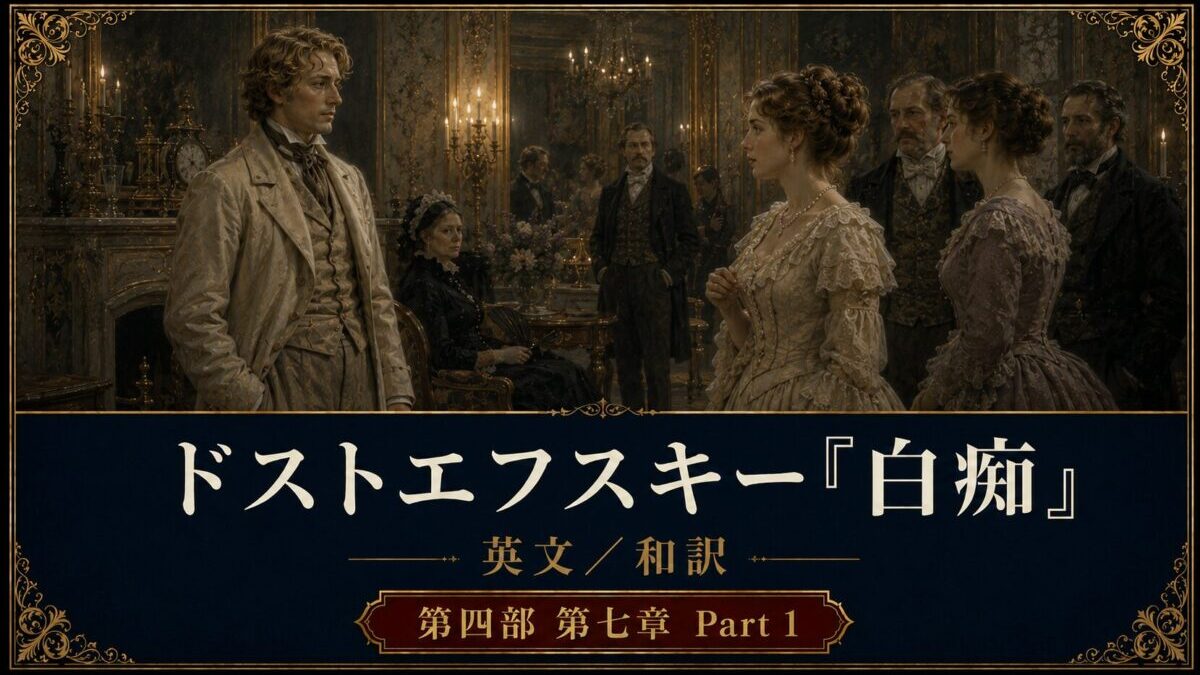
Fyodor Dostoyevsky『The Idiot』PART IV CHAPTER VII です。公爵がパヴリチェフの親族と出会い、恩人の過去をめぐる衝撃から宗教・ロシア社会・未来への希望について熱を帯びて語り、ついに中国の花瓶を壊し、発作に倒れる場面までを、英文・和訳ペアで整理しています。
While he feasted his eyes upon Aglaya, as she talked merrily with Evgenie and Prince N., suddenly the old anglomaniac, who was talking to the dignitary in another corner of the room, apparently telling him a story about something or other—suddenly this gentleman pronounced the name of “Nicolai Andreevitch Pavlicheff” aloud.
アグラーヤがエヴゲーニーやN公爵と陽気に話しているのを、公爵が目で楽しんでいると、部屋の別の隅で高官と話していた老いた英国かぶれの紳士が、何かの話をしていたらしく、突然「ニコライ・アンドレーエヴィチ・パヴリチェフ」という名を大声で口にした。
The prince quickly turned towards him, and listened.
公爵はすばやくそちらを向き、耳を傾けた。
The conversation had been on the subject of land, and the present disorders, and there must have been something amusing said, for the old man had begun to laugh at his companion’s heated expressions.
会話は土地と現在の混乱についてのものだった。何か面白いことが言われたに違いない。老人は相手の熱を帯びた言葉に笑い始めていたからである。
The latter was describing in eloquent words how, in consequence of recent legislation, he was obliged to sell a beautiful estate in the N. province, not because he wanted ready money—in fact, he was obliged to sell it at half its value.
その相手は、最近の法律の結果として、N県にある美しい領地を売らざるを得なくなったことを雄弁に語っていた。現金が欲しかったからではなく、実際には半値で売らざるを得なかったのだ。
“To avoid another lawsuit about the Pavlicheff estate, I ran away,” he said.
「パヴリチェフの領地をめぐるもう一つの訴訟を避けるために、私は逃げ出したのです」と彼は言った。
“With a few more inheritances of that kind I should soon be ruined!”
「ああいう遺産があといくつかあれば、私はすぐに破産してしまうでしょう!」
At this point General Epanchin, noticing how interested Muishkin had become in the conversation, said to him, in a low tone:
この時、エパンチン将軍はムイシュキンがその会話に強く関心を示していることに気づき、低い声で彼に言った。
“That gentleman—Ivan Petrovitch—is a relation of your late friend, Mr. Pavlicheff.”
「あの紳士、イワン・ペトロヴィチは、亡くなった君の友人、パヴリチェフ氏の親戚だ」
“You wanted to find some of his relations, did you not?”
「君は彼の親族を探したいと思っていたのではなかったかな?」
The general, who had been talking to his chief up to this moment, had observed the prince’s solitude and silence, and was anxious to draw him into the conversation.
将軍はこの時まで上司と話していたが、公爵が一人で黙っていることに気づき、彼を会話に引き入れたいと思っていた。
And so introduce him again to the notice of some of the important personages.
そうして、何人かの重要人物たちに再び彼を注目させようとしたのである。
“Lef Nicolaievitch was a ward of Nicolai Andreevitch Pavlicheff, after the death of his own parents,” he remarked, meeting Ivan Petrovitch’s eye.
「レフ・ニコラエヴィチは、両親の死後、ニコライ・アンドレーエヴィチ・パヴリチェフの被後見人だったのです」と彼はイワン・ペトロヴィチの目を見ながら言った。
“Very happy to meet him, I’m sure,” remarked the latter.
「お目にかかれて大変うれしく思います」と相手は言った。
“I remember Lef Nicolaievitch well.”
「レフ・ニコラエヴィチのことはよく覚えています」
“When General Epanchin introduced us just now, I recognized you at once, prince.”
「先ほどエパンチン将軍が紹介してくださった時、公爵、私はすぐにあなたが分かりました」
“You are very little changed, though I saw you last as a child of some ten or eleven years old.”
「最後にあなたを見たのは十歳か十一歳くらいの子どもの時でしたが、あなたはほとんど変わっていません」
“There was something in your features, I suppose, that—”
「あなたの顔立ちに何か、たぶん――」
“You saw me as a child!” exclaimed the prince, with surprise.
「子どもの頃の私をご覧になったのですか!」と公爵は驚いて叫んだ。
“Oh! yes, long ago,” continued Ivan Petrovitch, “while you were living with my cousin at Zlatoverhoff.”
「ああ、ええ、ずっと昔のことです」とイワン・ペトロヴィチは続けた。「あなたがズラトヴェルホフで私の従姉妹と一緒に暮らしていた頃です」
“You don’t remember me? No, I dare say you don’t; you had some malady at the time, I remember.”
「私を覚えていませんか? ええ、たぶん覚えていないでしょう。その時あなたは病気でした、覚えています」
“It was so serious that I was surprised—”
「それが非常に重かったので、私は驚いたほどで――」
“No; I remember nothing!” said the prince.
「いいえ、何も覚えていません!」と公爵は言った。
A few more words of explanation followed, words which were spoken without the smallest excitement by his companion, but which evoked the greatest agitation in the prince.
それからさらに少し説明が続いた。相手は少しも興奮せずに話していたが、その言葉は公爵に非常に大きな動揺を引き起こした。
And it was discovered that two old ladies to whose care the prince had been left by Pavlicheff, and who lived at Zlatoverhoff, were also relations of Ivan Petrovitch.
そして、パヴリチェフが公爵を預けた二人の老婦人、ズラトヴェルホフに住んでいたその二人も、イワン・ペトロヴィチの親族であることが分かった。
The latter had no idea and could give no information as to why Pavlicheff had taken so great an interest in the little prince, his ward.
イワン・ペトロヴィチには、パヴリチェフがなぜ被後見人である幼い公爵にそれほど深い関心を寄せたのか、何の心当たりもなく、情報も与えられなかった。
“In point of fact I don’t think I thought much about it,” said the old fellow.
「実際のところ、私はそのことをあまり考えもしなかったと思います」と老人は言った。
He seemed to have a wonderfully good memory, however, for he told the prince all about the two old ladies, Pavlicheff’s cousins, who had taken care of him.
しかし彼は驚くほど記憶がよいようだった。公爵の世話をしていたパヴリチェフの従姉妹である二人の老婦人について、詳しく話してくれたからである。
And whom, he declared, he had taken to task for being too severe with the prince as a small sickly boy—the elder sister, at least; the younger had been kind, he recollected.
そして彼は、幼く病弱だった公爵に厳しすぎるとして彼女たちを叱ったことがあると言った。少なくとも姉のほうはそうで、妹のほうは親切だったと彼は記憶していた。
They both now lived in another province, on a small estate left to them by Pavlicheff.
二人は今、別の県にある、パヴリチェフが残した小さな領地で暮らしていた。
The prince listened to all this with eyes sparkling with emotion and delight.
公爵は、感動と喜びで目を輝かせながら、そのすべてに耳を傾けた。
He declared with unusual warmth that he would never forgive himself for having travelled about in the central provinces during these last six months without having hunted up his two old friends.
彼は、ここ半年ほど中央諸県を旅していながら、この二人の昔の友人を探し出さなかったことを、自分は決して許せないと、いつになく熱を込めて言った。
He declared, further, that he had intended to go every day, but had always been prevented by circumstances.
さらに彼は、毎日行こうと思っていたのに、いつも事情に妨げられていたのだと言った。
But that now he would promise himself the pleasure—however far it was, he would find them out.
しかし今度こそ、その喜びを自分に約束する、どれほど遠くても彼女たちを探し出す、と言った。
And so Ivan Petrovitch really knew Natalia Nikitishna!—what a saintly nature was hers!—and Martha Nikitishna!
ではイワン・ペトロヴィチは本当にナターリヤ・ニキーチシナを知っていたのだ! 彼女はなんと聖女のような性質の人だったことか! そしてマルファ・ニキーチシナも!
Ivan Petrovitch must excuse him, but really he was not quite fair on dear old Martha.
イワン・ペトロヴィチには許してもらわなければならないが、実のところ、彼は親愛なる老マルファに対して少し公平ではなかった。
She was severe, perhaps; but then what else could she be with such a little idiot as he was then?
彼女は厳しかったかもしれない。しかし、当時の彼のような小さな白痴に対して、ほかにどうあり得ただろうか。
He really was an idiot then, Ivan Petrovitch must know, though he might not believe it.
その頃の自分は本当に白痴だったのだ。信じないかもしれないが、イワン・ペトロヴィチには知っておいてほしい、と彼は言った。
So he had really seen him there! Good heavens! And was he really and truly and actually a cousin of Pavlicheff’s?
それでは彼は本当にそこで自分を見たのだ! なんということだ! そして彼は本当に、まぎれもなく、実際にパヴリチェフの従兄弟なのだろうか。
“I assure you of it,” laughed Ivan Petrovitch, gazing amusedly at the prince.
「保証しますよ」とイワン・ペトロヴィチは、公爵を面白そうに見つめながら笑った。
“Oh! I didn’t say it because I doubt the fact, you know.”
「ああ! その事実を疑っているから言ったのではありません」
“How could I doubt such a thing?”
「どうしてそんなことを疑えましょうか」
“I made the remark because—because Nicolai Andreevitch Pavlicheff was such a splendid man, don’t you see!”
「私がそう言ったのは――ニコライ・アンドレーエヴィチ・パヴリチェフがあまりに素晴らしい人だったからなのです、お分かりでしょう!」
“Such a high-souled man, he really was, I assure you.”
「本当に高潔な人でした。保証します」
The prince did not exactly pant for breath, but he “seemed almost to choke out of pure simplicity and goodness of heart,” as Adelaida expressed it, on talking the party over with her fiancé, the Prince S., next morning.
公爵は息を切らしていたわけではなかったが、翌朝アデライーダが婚約者のS公爵とその夜会について話した時に表現したように、「純粋な単純さと心の善良さのために、ほとんど喉を詰まらせているように見えた」。
“But, my goodness me,” laughed Ivan Petrovitch, “why can’t I be cousin to even a splendid man?”
「しかし、いやはや」とイワン・ペトロヴィチは笑った。「私が素晴らしい人物の従兄弟であってはいけませんか?」
“Oh, dear!” cried the prince, confused, trying to hurry his words out, and growing more and more eager every moment.
「ああ、なんということでしょう!」と公爵は混乱して叫び、言葉を急いで出そうとしながら、刻々とますます熱を帯びていった。
“I’ve gone and said another stupid thing.”
「また愚かなことを言ってしまいました」
“I don’t know what to say. I—I didn’t mean that, you know—I—I—he really was such a splendid man, wasn’t he?”
「何と言えばいいのか分かりません。私は――私はそういう意味で言ったのではありません。私は――私は――彼は本当に素晴らしい人でしたね?」
The prince trembled all over.
公爵は全身を震わせていた。
Why was he so agitated? Why had he flown into such transports of delight without any apparent reason?
なぜ彼はそれほど動揺していたのだろうか。なぜ明らかな理由もなく、そんな歓喜の高まりへと飛び込んだのだろうか。
He had far outshot the measure of joy and emotion consistent with the occasion.
彼はその場にふさわしい喜びと感情の程度を、はるかに超えてしまっていた。
Why this was it would be difficult to say.
なぜそうなったのかを言うのは難しいだろう。
He seemed to feel warmly and deeply grateful to someone for something or other—perhaps to Ivan Petrovitch; but likely enough to all the guests, individually, and collectively.
彼は何かについて、誰かに温かく深い感謝を感じているようだった。おそらくイワン・ペトロヴィチに、あるいはそれ以上に、客たち一人一人に、そして全員に対してである。
He was much too happy.
彼はあまりにも幸福だった。
Ivan Petrovitch began to stare at him with some surprise; the dignitary, too, looked at him with considerable attention.
イワン・ペトロヴィチは少し驚いて彼を見つめ始めた。高官もまた、かなり注意深く彼を見た。
Princess Bielokonski glared at him angrily, and compressed her lips.
ビエロコンスキー公爵夫人は怒ったように彼を睨み、唇を引き結んだ。
Prince N., Evgenie, Prince S., and the girls, all broke off their own conversations and listened.
N公爵、エヴゲーニー、S公爵、そして娘たちは皆、それぞれの会話を中断して耳を傾けた。
Aglaya seemed a little startled; as for Lizabetha Prokofievna, her heart sank within her.
アグラーヤは少し驚いたようだった。リザヴェータ・プロコフィエヴナに至っては、胸が沈む思いだった。
This was odd of Lizabetha Prokofievna and her daughters.
これはリザヴェータ・プロコフィエヴナと娘たちにとって、奇妙なことだった。
They had themselves decided that it would be better if the prince did not talk all the evening.
彼女たちは、公爵がその晩ずっと話さないほうがよいと自分たちで決めていたのだ。
Yet seeing him sitting silent and alone, but perfectly happy, they had been on the point of exerting themselves to draw him into one of the groups of talkers around the room.
それなのに、彼が黙って一人で座りながらも完全に幸福そうにしているのを見ると、彼女たちは、部屋のあちこちにいる談話の輪の一つへ彼を引き入れようと努力しかけていた。
Now that he was in the midst of a talk they became more than ever anxious and perturbed.
ところが今、彼が会話の真っただ中にいると、彼女たちはこれまで以上に不安になり、動揺した。
“That he was a splendid man is perfectly true; you are quite right,” repeated Ivan Petrovitch, but seriously this time.
「彼が素晴らしい人物だったことはまったく本当です。あなたはまったく正しい」とイワン・ペトロヴィチは繰り返した。ただし今度は真面目に言った。
“He was a fine and a worthy fellow—worthy, one may say, of the highest respect,” he added, more and more seriously at each pause.
「彼は立派で価値ある人物でした。最高の敬意に値する人物だったと言ってよいでしょう」と彼は付け加え、言葉を区切るごとにますます真剣になっていった。
“And it is agreeable to see, on your part, such—”
「そしてあなたの側に、そのような――が見られるのは喜ばしいことです」
“Wasn’t it this same Pavlicheff about whom there was a strange story in connection with some abbot?” remarked the old dignitary.
「ある修道院長に関して奇妙な話があったのは、この同じパヴリチェフではなかったかな」と老高官が言った。
“I don’t remember who the abbot was, but I remember at one time everybody was talking about it.”
「その修道院長が誰だったかは覚えていないが、一時は誰もがその話をしていたことは覚えている」
“Yes—Abbot Gurot, a Jesuit,” said Ivan Petrovitch.
「ええ、グロ修道院長、イエズス会士です」とイワン・ペトロヴィチは言った。
“Yes, that’s the sort of thing our best men are apt to do.”
「ええ、我々の最良の人々というのは、そういうことをしがちなものです」
“A man of rank, too, and rich—a man who, if he had continued to serve, might have done anything.”
「身分もあり、裕福でもある人物でした。もし官職を続けていたなら、何でもできたはずの人物です」
“And then to throw up the service and everything else in order to go over to Roman Catholicism and turn Jesuit—openly, too—almost triumphantly.”
「それなのに官職も何もかも投げ捨てて、ローマ・カトリックへ改宗し、イエズス会士になったのです。しかも公然と、ほとんど勝ち誇るように」
“By Jove! it was positively a mercy that he died when he did—it was indeed—everyone said so at the time.”
「まったく! あの時彼が死んだのは、まさに慈悲でした。本当にそうです。当時は誰もがそう言っていました」
The prince was beside himself.
公爵は我を忘れた。
“Pavlicheff?—Pavlicheff turned Roman Catholic? Impossible!” he cried, in horror.
「パヴリチェフが? パヴリチェフがローマ・カトリックになった? あり得ません!」と彼は恐怖に駆られて叫んだ。
“H’m! impossible is rather a strong word,” said Ivan Petrovitch.
「ふむ! あり得ない、というのは少し強い言い方ですね」とイワン・ペトロヴィチは言った。
“You must allow, my dear prince… However, of course you value the memory of the deceased so very highly.”
「認めていただかなければなりません、親愛なる公爵……もっとも、もちろんあなたは故人の思い出を非常に高く評価しておられる」
“And he certainly was the kindest of men; to which fact, by the way, I ascribe, more than to anything else, the success of the abbot in influencing his religious convictions.”
「そして彼が本当に最も親切な人物だったことは確かです。ちなみに、修道院長が彼の宗教的信念に影響を与えることに成功したのは、何よりもその事実によるものだと私は考えています」
“But you may ask me, if you please, how much trouble and worry I, personally, had over that business, and especially with this same Gurot!”
「しかしよろしければ、あの件で、特にそのグロという人物のことで、私自身がどれほど苦労し心配したか、お尋ねになってもよいのです!」
“Would you believe it,” he continued, addressing the dignitary, “they actually tried to put in a claim under the deceased’s will.”
「信じられますか」と彼は高官に向かって続けた。「彼らは実際に、故人の遺言に基づいて請求を出そうとしたのです」
“And I had to resort to the very strongest measures in order to bring them to their senses?”
「そして彼らに正気を取り戻させるために、私は最も強力な手段に訴えなければなりませんでした」
“I assure you they knew their cue, did these gentlemen—wonderful!”
「保証しますが、あの紳士たちは自分たちの役どころをよく分かっていました。見事なものでした!」
“Thank goodness all this was in Moscow, and I got the Court, you know, to help me, and we soon brought them to their senses.”
「ありがたいことに、これはすべてモスクワでのことでした。ご存じの通り、私は裁判所に助けてもらい、すぐに彼らを正気に戻しました」
“You wouldn’t believe how you have pained and astonished me,” cried the prince.
「あなたがどれほど私を苦しめ、驚かせたか、信じられないでしょう」と公爵は叫んだ。
“Very sorry; but in point of fact, you know, it was all nonsense and would have ended in smoke, as usual—I’m sure of that.”
「大変申し訳ない。しかし実際のところ、あれはすべて戯言で、いつものように煙となって終わったはずです。私はそう確信しています」
“Last year,”—he turned to the old man again,—“Countess K. joined some Roman Convent abroad.”
「昨年」と彼はまた老人のほうを向いた。「K伯爵夫人が外国でローマの修道院に入りました」
“Our people never seem to be able to offer any resistance so soon as they get into the hands of these—intriguers—especially abroad.”
「我々の人々は、こういう陰謀家たちの手にかかると、特に外国では、まったく抵抗できないようです」
“That is all thanks to our lassitude, I think,” replied the old man, with authority.
「それはすべて我々の無気力のせいだと思う」と老人は権威ある口調で答えた。
“And then their way of preaching; they have a skilful manner of doing it!”
「それに彼らの説教の仕方だ。実に巧妙なやり方を心得ている!」
“And they know how to startle one, too.”
「しかも彼らは人を驚かせる方法も知っている」
“I got quite a fright myself in ’32, in Vienna, I assure you; but I didn’t cave in to them, I ran away instead, ha, ha!”
「私自身も三二年にウィーンでかなり驚かされた。保証するよ。しかし私は彼らに屈しなかった。代わりに逃げ出したのだ、はは!」
“Come, come, I’ve always heard that you ran away with the beautiful Countess Levitsky that time—throwing up everything in order to do it—and not from the Jesuits at all,” said Princess Bielokonski, suddenly.
「まあまあ、その時あなたは美しいレヴィツキー伯爵夫人と駆け落ちするために、何もかも投げ出したのだと私はずっと聞いていましたよ。イエズス会から逃げたのではなくて」とビエロコンスキー公爵夫人が突然言った。
“Well, yes—but we call it from the Jesuits, you know; it comes to the same thing,” laughed the old fellow, delighted with the pleasant recollection.
「まあ、そうです。しかし我々はそれをイエズス会から逃げたと言っているのです。結局同じことですからね」と老人は楽しい思い出に喜びながら笑った。
“You seem to be very religious,” he continued, kindly, addressing the prince, “which is a thing one meets so seldom nowadays among young people.”
「あなたはたいへん信仰深いようですね」と彼は親切に公爵へ向かって続けた。「今の若者の間では、そういう人にはめったに会いません」
The prince was listening open-mouthed, and still in a condition of excited agitation.
公爵は口を開けたまま聞いており、まだ興奮した動揺の状態にあった。
The old man was evidently interested in him, and anxious to study him more closely.
老人は明らかに彼に興味を持ち、もっと詳しく彼を観察したがっていた。
“Pavlicheff was a man of bright intellect and a good Christian, a sincere Christian,” said the prince, suddenly.
「パヴリチェフは明晰な知性を持ち、善良なキリスト教徒、誠実なキリスト教徒でした」と公爵は突然言った。
“How could he possibly embrace a faith which is unchristian?”
「彼がどうして非キリスト教的な信仰を受け入れることなどあり得るでしょうか?」
“Roman Catholicism is, so to speak, simply the same thing as unchristianity,” he added with flashing eyes, which seemed to take in everybody in the room.
「ローマ・カトリックとは、いわば非キリスト教そのものです」と彼は付け加えた。その目は燃えるように輝き、部屋の全員を見渡しているようだった。
“Come, that’s a little too strong, isn’t it?” murmured the old man, glancing at General Epanchin in surprise.
「それは少し言い過ぎではないかな」と老人は驚いてエパンチン将軍をちらりと見ながらつぶやいた。
“How do you make out that the Roman Catholic religion is unchristian? What is it, then?” asked Ivan Petrovitch, turning to the prince.
「ローマ・カトリックが非キリスト教だと、どうして分かるのですか。ではそれは何なのです?」とイワン・ペトロヴィチは公爵のほうを向いて尋ねた。
“It is not a Christian religion, in the first place,” said the latter, in extreme agitation, quite out of proportion to the necessity of the moment.
「第一に、それはキリスト教ではありません」と公爵は、その場の必要性にまったく見合わないほど極度に動揺して言った。
“And in the second place, Roman Catholicism is, in my opinion, worse than Atheism itself.”
「第二に、私の考えでは、ローマ・カトリックは無神論そのものよりも悪いのです」
“Yes—that is my opinion. Atheism only preaches a negation, but Romanism goes further; it preaches a disfigured, distorted Christ—it preaches Anti-Christ—I assure you, I swear it!”
「ええ、それが私の意見です。無神論はただ否定を説くだけですが、ローマ主義はさらに進みます。それは歪められたキリストを説きます。反キリストを説くのです。保証します、誓います!」
“This is my own personal conviction, and it has long distressed me.”
「これは私自身の個人的な確信であり、長いあいだ私を苦しめてきました」
“The Roman Catholic believes that the Church on earth cannot stand without universal temporal Power.”
「ローマ・カトリックは、地上の教会は普遍的な世俗権力なしには立ち得ないと信じています」
“He cries ‘non possumus!’”
「彼は『ノン・ポッスムス』と叫ぶのです!」
“In my opinion the Roman Catholic religion is not a faith at all, but simply a continuation of the Roman Empire, and everything is subordinated to this idea—beginning with faith.”
「私の考えでは、ローマ・カトリックは信仰などではなく、単にローマ帝国の継続であり、信仰をはじめとして、すべてがこの考えに従属しているのです」
“The Pope has seized territories and an earthly throne, and has held them with the sword.”
「教皇は領土と地上の王座を奪い、それを剣によって保持してきました」
“And so the thing has gone on, only that to the sword they have added lying, intrigue, deceit, fanaticism, superstition, swindling.”
「そしてそうして事は続いてきました。ただ剣に加えて、彼らは嘘、陰謀、欺瞞、狂信、迷信、詐欺を付け加えたのです」
“They have played fast and loose with the most sacred and sincere feelings of men.”
「彼らは人間の最も神聖で誠実な感情を、もてあそんできました」
“They have exchanged everything—everything for money, for base earthly power!”
「彼らはすべてを、すべてを金と卑しい地上的権力のために交換してしまったのです!」
“And is this not the teaching of Anti-Christ?”
「そしてこれは反キリストの教えではないでしょうか?」
“How could the upshot of all this be other than Atheism?”
「このすべての結末が無神論以外の何になり得るでしょうか?」
“Atheism is the child of Roman Catholicism—it proceeded from these Romans themselves, though perhaps they would not believe it.”
「無神論はローマ・カトリックの子どもです。おそらく彼ら自身は信じないでしょうが、それはこのローマ人たち自身から生まれたのです」
“It grew and fattened on hatred of its parents; it is the progeny of their lies and spiritual feebleness.”
「それは親への憎しみを糧に育ち太りました。それは彼らの嘘と精神的弱さの子孫なのです」
“Atheism! In our country it is only among the upper classes that you find unbelievers; men who have lost the root or spirit of their faith.”
「無神論! 我が国で不信仰者を見いだすのは、上流階級の中だけです。信仰の根や精神を失った人々です」
“But abroad whole masses of the people are beginning to profess unbelief—at first because of the darkness and lies by which they were surrounded.”
「しかし外国では、民衆の大群全体が不信仰を公言し始めています。最初は、彼らを取り囲んでいた暗闇と嘘のためでした」
“But now out of fanaticism, out of loathing for the Church and Christianity!”
「しかし今では、狂信から、教会とキリスト教への嫌悪からそうしているのです!」
The prince paused to get breath.
公爵は息を整えるために言葉を止めた。
He had spoken with extraordinary rapidity, and was very pale.
彼は並外れた速さで話しており、顔はひどく青ざめていた。
All present interchanged glances, but at last the old dignitary burst out laughing frankly.
居合わせた者たちは皆、視線を交わしたが、ついに老高官が率直に笑い出した。
Prince N. took out his eye-glass to have a good look at the speaker.
N公爵は、その話し手をよく見るために片眼鏡を取り出した。
The German poet came out of his corner and crept nearer to the table, with a spiteful smile.
ドイツ系の詩人は隅から出てきて、意地悪な笑みを浮かべながらテーブルの近くへ忍び寄った。
“You exaggerate the matter very much,” said Ivan Petrovitch, with rather a bored air.
「あなたはその問題を大いに誇張しています」とイワン・ペトロヴィチはやや退屈そうに言った。
“There are, in the foreign Churches, many representatives of their faith who are worthy of respect and esteem.”
「外国の教会にも、尊敬と敬意に値する信仰の代表者はたくさんいます」
“Oh, but I did not speak of individual representatives.”
「ああ、しかし私は個々の代表者について話したのではありません」
“I was merely talking about Roman Catholicism, and its essence—of Rome itself.”
「私はただ、ローマ・カトリックとその本質、つまりローマそのものについて話していたのです」
“A Church can never entirely disappear; I never hinted at that!”
「教会が完全に消滅することは決してありません。私はそんなことをほのめかしたことはありません!」
“Agreed that all this may be true; but we need not discuss a subject which belongs to the domain of theology.”
「それらすべてが真実かもしれないことは認めましょう。しかし神学の領域に属する問題を議論する必要はありません」
“Oh, no; oh, no! Not to theology alone, I assure you!”
「ああ、違います、違います! 神学だけに属するものではありません。保証します!」
“Why, Socialism is the progeny of Romanism and of the Romanistic spirit.”
「なぜなら、社会主義はローマ主義とローマ主義的精神の子孫だからです」
“It and its brother Atheism proceed from Despair in opposition to Catholicism.”
「それとその兄弟である無神論は、カトリックへの反発としての絶望から生じたものです」
“It seeks to replace in itself the moral power of religion, in order to appease the spiritual thirst of parched humanity and save it; not by Christ, but by force.”
「それは、渇いた人類の精神的渇望をなだめ救うために、宗教の道徳的力を自分自身で置き換えようとします。キリストによってではなく、力によってです」
“‘Don’t dare to believe in God, don’t dare to possess any individuality, any property! Fraternité ou la Mort; two million heads.’”
「『神を信じるな、いかなる個性も財産も持つな! 友愛か死か、二百万の首を!』」
“‘By their works ye shall know them’—we are told.”
「『その行いによって彼らを知るであろう』と、私たちは教えられています」
“And we must not suppose that all this is harmless and without danger to ourselves.”
「そして、これらすべてが無害で、私たちにとって危険ではないなどと思ってはなりません」
“Oh, no; we must resist, and quickly, quickly!”
「ああ、違います。私たちは抵抗しなければなりません。しかも早く、早く!」
“We must let our Christ shine forth upon the Western nations, our Christ whom we have preserved intact, and whom they have never known.”
「私たちは西方の諸国に、私たちのキリストを輝かせなければなりません。私たちが無傷で守ってきた、彼らが一度も知らなかったキリストをです」
“Not as slaves, allowing ourselves to be caught by the hooks of the Jesuits, but carrying our Russian civilization to them, we must stand before them.”
「イエズス会の釣り針に引っかかる奴隷としてではなく、私たちのロシア文明を彼らのもとへ携えて、私たちは彼らの前に立たなければなりません」
“Not letting it be said among us that their preaching is ‘skilful,’ as someone expressed it just now.”
「彼らの説教は『巧妙だ』などと、今誰かが言ったようなことを、私たちの間で言わせてはならないのです」
“But excuse me, excuse me,” cried Ivan Petrovitch considerably disturbed, and looking around uneasily.
「しかし失礼、失礼」とイワン・ペトロヴィチはかなり動揺し、不安げにあたりを見回しながら叫んだ。
“Your ideas are, of course, most praiseworthy, and in the highest degree patriotic; but you exaggerate the matter terribly.”
「あなたの考えは、もちろん非常に称賛すべきもので、最高度に愛国的です。しかしあなたはその問題を恐ろしく誇張しています」
“It would be better if we dropped the subject.”
「この話題はやめたほうがよいでしょう」
“No, sir, I do not exaggerate, I understate the matter, if anything, undoubtedly understate it.”
「いいえ、私は誇張していません。むしろ控えめに言っているのです。疑いなく控えめに言っています」
“Simply because I cannot express myself as I should like, but—”
「ただ、私が自分の望むように表現できないからであって、しかし――」
“Allow me!”
「失礼!」
The prince was silent.
公爵は黙った。
He sat straight up in his chair and gazed fervently at Ivan Petrovitch.
彼は椅子の上で背筋を伸ばし、イワン・ペトロヴィチを熱烈に見つめた。
“It seems to me that you have been too painfully impressed by the news of what happened to your good benefactor,” said the old dignitary, kindly, and with the utmost calmness of demeanour.
「あなたは、善良な恩人に起こったことを聞いて、あまりにも痛ましい印象を受けすぎているように思えます」と老高官は親切に、そしてこの上なく落ち着いた態度で言った。
“You are excitable, perhaps as the result of your solitary life.”
「あなたは興奮しやすいのでしょう。おそらく孤独な生活の結果です」
“If you would make up your mind to live more among your fellows in society, I trust, I am sure, that the world would be glad to welcome you, as a remarkable young man.”
「もしあなたがもっと仲間たちのいる社会の中で生きようと決心するなら、私は信じています、確信しています。世間はあなたを注目すべき青年として喜んで迎えるでしょう」
“And you would soon find yourself able to look at things more calmly.”
「そしてあなたはすぐに、物事をもっと落ち着いて見ることができるようになるでしょう」
“You would see that all these things are much simpler than you think.”
「これらのことはすべて、あなたが思っているよりずっと単純だと分かるでしょう」
“And, besides, these rare cases come about, in my opinion, from ennui and from satiety.”
「それに、こうしたまれな例は、私の考えでは、倦怠と飽満から生じるのです」
“Exactly, exactly! That is a true thought!” cried the prince.
「その通り、その通りです! それは真実の考えです!」と公爵は叫んだ。
“From ennui, from our ennui but not from satiety!”
「倦怠からです、私たちの倦怠からです。しかし飽満からではありません!」
“Oh, no, you are wrong there! Say from thirst if you like; the thirst of fever!”
「ああ、違います。そこは間違っています! 言うなら渇きからです。熱病の渇きです!」
“And please do not suppose that this is so small a matter that we may have a laugh at it and dismiss it.”
「そして、これは笑って片づけてよいほど小さな問題だとは思わないでください」
“We must be able to foresee our disasters and arm against them.”
「私たちは自分たちの災厄を予見し、それに備えなければなりません」
“We Russians no sooner arrive at the brink of the water, and realize that we are really at the brink, than we are so delighted with the outlook that in we plunge and swim to the farthest point we can see.”
「私たちロシア人は、水辺にたどり着き、本当に水辺にいると悟るやいなや、その眺めに喜びすぎて、すぐに飛び込み、見える限り最も遠くまで泳いでしまうのです」
“Why is this? You say you are surprised at Pavlicheff’s action; you ascribe it to madness, to kindness of heart, and what not, but it is not so.”
「なぜそうなのでしょう? あなたはパヴリチェフの行動に驚いたと言い、それを狂気や心の優しさなどのせいにします。しかしそうではありません」
“Our Russian intensity not only astonishes ourselves; all Europe wonders at our conduct in such cases!”
「私たちロシア人の激しさは、自分たち自身を驚かせるだけではありません。ヨーロッパ全体が、そうした場合の私たちの行動に驚くのです!」
“For, if one of us goes over to Roman Catholicism, he is sure to become a Jesuit at once, and a rabid one into the bargain.”
「なぜなら、私たちの一人がローマ・カトリックへ移ると、必ずすぐにイエズス会士になり、しかも狂信的なイエズス会士になるからです」
“If one of us becomes an Atheist, he must needs begin to insist on the prohibition of faith in God by force, that is, by the sword.”
「私たちの一人が無神論者になると、必ず力によって、つまり剣によって、神への信仰を禁止することを主張し始めます」
“Why is this? Why does he then exceed all bounds at once?”
「なぜそうなのでしょう? なぜ彼はその時、すぐにあらゆる限度を超えてしまうのでしょう?」
“Because he has found land at last, the fatherland that he sought in vain before.”
「それは、ついに陸地を見つけたからです。以前は空しく探し求めていた祖国を見つけたからです」
“And, because his soul is rejoiced to find it, he throws himself upon it and kisses it!”
「そしてそれを見つけて魂が喜ぶからこそ、彼はそこに身を投げ出し、口づけするのです!」
“Oh, it is not from vanity alone, it is not from feelings of vanity that Russians become Atheists and Jesuits!”
「ああ、ロシア人が無神論者やイエズス会士になるのは、虚栄だけからではありません。虚栄心からだけではないのです!」
“But from spiritual thirst, from anguish of longing for higher things, for dry firm land, for foothold on a fatherland which they never believed in because they never knew it.”
「それは精神的な渇きから、より高いものへの憧れの苦悶から、乾いた確かな土地への、足を置く祖国への渇望からなのです。彼らはそれを知らなかったために、信じたこともなかったのです」
“It is easier for a Russian to become an Atheist, than for any other nationality in the world.”
「ロシア人が無神論者になるのは、世界のどの民族よりも容易です」
“And not only does a Russian ‘become an Atheist,’ but he actually believes in Atheism, just as though he had found a new faith, not perceiving that he has pinned his faith to a negation.”
「しかもロシア人は単に『無神論者になる』だけではありません。まるで新しい信仰を見つけたかのように、実際に無神論を信じるのです。自分の信仰を否定に留めていることに気づかずに」
“Such is our anguish of thirst!”
「これが私たちの渇望の苦しみなのです!」
“‘Whoso has no country has no God.’ That is not my own expression; it is the expression of a merchant, one of the Old Believers, whom I once met while travelling.”
「『祖国なき者に神なし』。これは私自身の言葉ではありません。かつて旅の途中で出会った古儀式派の商人の言葉です」
“He did not say exactly these words. I think his expression was: ‘Whoso forsakes his country forsakes his God.’”
「彼が正確にこの言葉を言ったわけではありません。たしか彼の表現は、『祖国を捨てる者は神を捨てる』だったと思います」
“But let these thirsty Russian souls find, like Columbus’ discoverers, a new world.”
「しかし、これら渇いたロシアの魂に、コロンブスの発見者たちのように、新世界を見つけさせてください」
“Let them find the Russian world, let them search and discover all the gold and treasure that lies hid in the bosom of their own land!”
「彼らにロシアの世界を見つけさせてください。自分たちの土地の懐に隠されたすべての黄金と宝を探し、発見させてください!」
“Show them the restitution of lost humanity, in the future, by Russian thought alone, and by means of the God and of the Christ of our Russian faith.”
「失われた人間性の回復が、未来において、ロシアの思想だけによって、そして私たちロシアの信仰の神とキリストによって実現されることを、彼らに示してください」
“And you will see how mighty and just and wise and good a giant will rise up before the eyes of the astonished and frightened world.”
「そうすれば、驚き恐れる世界の目の前に、どれほど力強く、公正で、賢く、善良な巨人が立ち上がるかを見るでしょう」
“Astonished because they expect nothing but the sword from us, because they think they will get nothing out of us but barbarism.”
「彼らが驚くのは、私たちから剣以外のものを何も期待しておらず、私たちからは野蛮以外に何も得られないと思っているからです」
“This has been the case up to now, and the longer matters go on as they are now proceeding, the more clear will be the truth of what I say; and I—”
「今まではそうでした。そして物事が今のまま進めば進むほど、私の言うことの真実はますます明らかになるでしょう。そして私は――」
But at this moment something happened which put a most unexpected end to the orator’s speech.
しかしその瞬間、演説者の話に最も予期しない終止符を打つ出来事が起こった。
All this heated tirade, this outflow of passionate words and ecstatic ideas which seemed to hustle and tumble over each other as they fell from his lips, bore evidence of some unusually disturbed mental condition.
この熱を帯びた長広舌、彼の唇からこぼれ落ちる時に互いに押し合い、転がり合うように見えた情熱的な言葉と恍惚とした思想の奔流は、何か異常に乱れた精神状態の証拠を示していた。
In the young fellow who had “boiled over” in such a remarkable manner, without any apparent reason.
明らかな理由もなく、これほど驚くべき形で「沸騰して」しまったこの青年の中にである。
Of those who were present, such as knew the prince listened to his outburst in a state of alarm, some with a feeling of mortification.
居合わせた者のうち、公爵を知る者たちは、彼の爆発を不安の中で聞き、ある者は屈辱感を抱いて聞いた。
It was so unlike his usual timid self-constraint; so inconsistent with his usual taste and tact, and with his instinctive feeling for the higher proprieties.
それは彼のいつもの臆病な自制とはあまりに違い、彼のいつもの趣味や機転、そしてより高い礼節への本能的な感覚とはまったく一致しなかった。
They could not understand the origin of the outburst; it could not be simply the news of Pavlicheff’s perversion.
彼らにはその爆発の原因が理解できなかった。それは単にパヴリチェフの改宗の知らせだけではあり得なかった。
By the ladies the prince was regarded as little better than a lunatic, and Princess Bielokonski admitted afterwards that “in another minute she would have bolted.”
婦人たちには、公爵はほとんど狂人同然に見えた。ビエロコンスキー公爵夫人は後になって、「あと一分あれば逃げ出していた」と認めた。
The two old gentlemen looked quite alarmed.
二人の老紳士はひどく不安そうに見えた。
The old general, Epanchin’s chief, sat and glared at the prince in severe displeasure.
エパンチンの上司である老将軍は座ったまま、厳しい不快感をもって公爵を睨みつけていた。
The colonel sat immovable.
大佐は身動きもせずに座っていた。
Even the German poet grew a little pale, though he wore his usual artificial smile as he looked around to see what the others would do.
ドイツ系の詩人でさえ少し青ざめたが、いつもの作り笑いを浮かべたまま、ほかの人々がどうするかを見回していた。
In point of fact it is quite possible that the matter would have ended in a very commonplace and natural way in a few minutes.
実際のところ、あと数分もすれば、その事態はごくありふれた自然な形で終わっていた可能性が高い。
The undoubtedly astonished, but now more collected, General Epanchin had several times endeavoured to interrupt the prince.
疑いなく驚いていたが、今ではいくらか落ち着きを取り戻したエパンチン将軍は、公爵の話を何度か遮ろうとしていた。
And not having succeeded he was now preparing to take firmer and more vigorous measures to attain his end.
それがうまくいかなかったので、今度は目的を果たすために、より断固とした、より力強い手段を取ろうとしていた。
In another minute or two he would probably have made up his mind to lead the prince quietly out of the room, on the plea of his being ill.
あと一、二分もすれば、彼はおそらく、公爵が病気だという口実で、静かに部屋から連れ出す決心をしていただろう。
And it was more than likely that the general was right in his belief that the prince was actually ill.
そして、公爵が実際に病気だという将軍の考えは、おそらく正しかった。
But it so happened that destiny had something different in store.
しかし運命は、別のものを用意していたのである。
At the beginning of the evening, when the prince first came into the room, he had sat down as far as possible from the Chinese vase which Aglaya had spoken of the day before.
その晩の初め、公爵が初めて部屋に入った時、彼は前日にアグラーヤが話していた中国の花瓶からできるだけ遠く離れて座っていた。
Will it be believed that, after Aglaya’s alarming words, an ineradicable conviction had taken possession of his mind that, however he might try to avoid this vase next day, he must certainly break it?
信じられるだろうか。アグラーヤの警告めいた言葉の後、翌日どれほどその花瓶を避けようとしても、自分は必ずそれを壊してしまうという消しがたい確信が、彼の心を占めていたのである。
But so it was.
しかし実際、そうだった。
During the evening other impressions began to awaken in his mind, as we have seen, and he forgot his presentiment.
その晩の間に、すでに見たように、ほかの印象が彼の心に目覚め始め、彼はその予感を忘れていた。
But when Pavlicheff was mentioned and the general introduced him to Ivan Petrovitch, he had changed his place, and went over nearer to the table.
しかしパヴリチェフの名が出て、将軍が彼をイワン・ペトロヴィチに紹介した時、彼は場所を変え、テーブルの近くへ移っていた。
When, it so happened, he took the chair nearest to the beautiful vase, which stood on a pedestal behind him, just about on a level with his elbow.
そして偶然にも、彼は美しい花瓶に最も近い椅子に座っていた。その花瓶は彼の背後の台座の上にあり、ちょうど肘の高さほどだった。
As he spoke his last words he had risen suddenly from his seat with a wave of his arm, and there was a general cry of horror.
最後の言葉を話しながら、彼は腕を振って突然席から立ち上がった。その時、全員から恐怖の叫びが上がった。
The huge vase swayed backwards and forwards.
巨大な花瓶は前後に揺れた。
It seemed to be uncertain whether or no to topple over on to the head of one of the old men.
それは老人の一人の頭の上へ倒れるかどうか、迷っているように見えた。
But eventually determined to go the other way, and came crashing over towards the German poet, who darted out of the way in terror.
しかし結局、反対側へ倒れることに決めたように、ドイツ系の詩人のほうへ激しく倒れかかった。彼は恐怖に駆られて飛び退いた。
The crash, the cry, the sight of the fragments of valuable china covering the carpet, the alarm of the company—what all this meant to the poor prince it would be difficult to convey to the mind of the reader.
その衝撃音、叫び声、高価な磁器の破片が絨毯を覆う光景、一同の狼狽。これらすべてが哀れな公爵にとって何を意味したかを、読者の心に伝えるのは難しいだろう。
Or for him to imagine.
あるいは、読者が想像するのも難しいだろう。
But one very curious fact was that all the shame and vexation and mortification which he felt over the accident were less powerful than the deep impression of the almost supernatural truth of his premonition.
しかし非常に奇妙な事実が一つあった。その事故について彼が感じたすべての恥、苛立ち、屈辱は、自分の予感がほとんど超自然的な真実だったという深い印象よりも弱かったのである。
He stood still in alarm—in almost superstitious alarm, for a moment.
彼は驚きの中で、ほとんど迷信的な恐怖の中で、しばらく立ち尽くした。
Then all mists seemed to clear away from his eyes; he was conscious of nothing but light and joy and ecstasy.
すると、目の前の霧がすべて晴れたように思えた。彼が意識したのは、光と喜びと恍惚だけだった。
His breath came and went; but the moment passed.
彼の呼吸は激しく出入りした。しかしその瞬間は過ぎた。
Thank God it was not that!
ありがたいことに、それではなかったのだ!
He drew a long breath and looked around.
彼は長く息を吸い、あたりを見回した。
For some minutes he did not seem to comprehend the excitement around him.
数分のあいだ、彼は周囲の騒ぎを理解していないように見えた。
That is, he comprehended it and saw everything, but he stood aside, as it were, like someone invisible in a fairy tale.
つまり、彼はそれを理解し、すべてを見てはいたのだが、いわばおとぎ話の中の透明人間のように、脇に立っていたのである。
As though he had nothing to do with what was going on, though it pleased him to take an interest in it.
まるで起こっていることに自分は何の関係もないかのようだった。もっとも、それに関心を持つことは彼にとって楽しかった。
He saw them gather up the broken bits of china.
彼は人々が割れた磁器の破片を集めているのを見た。
He heard the loud talking of the guests and observed how pale Aglaya looked, and how very strangely she was gazing at him.
彼は客たちの大きな話し声を聞き、アグラーヤがどれほど青ざめているか、そして彼女がどれほど奇妙に自分を見つめているかを見た。
There was no hatred in her expression, and no anger whatever.
彼女の表情には憎しみも、怒りもまったくなかった。
It was full of alarm for him, and sympathy and affection, while she looked around at the others with flashing, angry eyes.
それは彼を案じる不安、同情、愛情に満ちていた。一方で、彼女は周囲の人々を怒りに輝く目で見回していた。
His heart filled with a sweet pain as he gazed at her.
彼女を見つめるうちに、彼の心は甘い痛みで満たされた。
At length he observed, to his amazement, that all had taken their seats again, and were laughing and talking as though nothing had happened.
やがて彼は驚いたことに、皆がまた席に戻り、何もなかったかのように笑い、話していることに気づいた。
Another minute and the laughter grew louder—they were laughing at him, at his dumb stupor—laughing kindly and merrily.
さらに一分すると笑い声は大きくなった。彼らは彼を、彼の呆然とした沈黙を笑っていた。しかし親切に、陽気に笑っていた。
Several of them spoke to him, and spoke so kindly and cordially, especially Lizabetha Prokofievna.
何人かが彼に声をかけたが、その言葉は非常に親切で心のこもったものだった。とりわけリザヴェータ・プロコフィエヴナがそうだった。
She was saying the kindest possible things to him.
彼女は彼に、これ以上ないほど親切な言葉をかけていた。
Suddenly he became aware that General Epanchin was tapping him on the shoulder.
突然、彼はエパンチン将軍が自分の肩を叩いていることに気づいた。
Ivan Petrovitch was laughing too, but still more kind and sympathizing was the old dignitary.
イワン・ペトロヴィチも笑っていたが、それ以上に親切で同情的だったのは老高官だった。
He took the prince by the hand and pressed it warmly.
彼は公爵の手を取り、温かく握った。
Then he patted it, and quietly urged him to recollect himself—speaking to him exactly as he would have spoken to a little frightened child.
それからその手を軽く叩き、静かに彼に気を取り戻すよう促した。その話し方は、まるで怯えた小さな子どもに話しかける時とまったく同じだった。
Which pleased the prince wonderfully; and next seated him beside himself.
それが公爵を非常に喜ばせた。そして次に、彼を自分のそばに座らせた。
The prince gazed into his face with pleasure, but still seemed to have no power to speak.
公爵は喜びをもって彼の顔を見つめたが、まだ話す力はないようだった。
His breath failed him.
彼は息が続かなかった。
The old man’s face pleased him greatly.
老人の顔は彼を大いに喜ばせた。
“Do you really forgive me?” he said at last.
「本当に私を許してくださるのですか?」と彼はついに言った。
“And—and Lizabetha Prokofievna too?”
「それに――それに、リザヴェータ・プロコフィエヴナも?」
The laugh increased, tears came into the prince’s eyes, he could not believe in all this kindness—he was enchanted.
笑い声はさらに大きくなり、公爵の目には涙が浮かんだ。彼はこのすべての親切を信じられず、魅了されていた。
“The vase certainly was a very beautiful one. I remember it here for fifteen years—yes, quite that!” remarked Ivan Petrovitch.
「その花瓶は確かにたいへん美しいものでした。私は十五年前からここにあったのを覚えています。ええ、まさにそれくらいです!」とイワン・ペトロヴィチは言った。
“Oh, what a dreadful calamity! A wretched vase smashed, and a man half dead with remorse about it,” said Lizabetha Prokofievna, loudly.
「ああ、なんという恐ろしい災難でしょう! みじめな花瓶が壊れて、それで人が後悔のあまり半死半生になるなんて」とリザヴェータ・プロコフィエヴナは大きな声で言った。
“What made you so dreadfully startled, Lef Nicolaievitch?” she added, a little timidly.
「何があなたをそんなに恐ろしく驚かせたのですか、レフ・ニコラエヴィチ?」と彼女は少しおずおずと付け加えた。
“Come, my dear boy! cheer up.”
「さあ、親愛なる坊や! 元気を出しなさい」
“You really alarm me, taking the accident so to heart.”
「その事故をそんなに気に病むなんて、本当に私を不安にさせます」
“Do you forgive me all—all, besides the vase, I mean?” said the prince, rising from his seat once more.
「すべてを――花瓶のこと以外も、すべてを許してくださいますか?」と公爵は言い、もう一度席から立ち上がった。
But the old gentleman caught his hand and drew him down again—he seemed unwilling to let him go.
しかし老紳士が彼の手をつかみ、再び引き下ろした。彼を離したくないようだった。
“C’est très-curieux et c’est très-sérieux,” he whispered across the table to Ivan Petrovitch, rather loudly.
「これは非常に興味深く、非常に重大です」と彼はテーブル越しに、かなり大きな声でイワン・ペトロヴィチにささやいた。
Probably the prince heard him.
おそらく公爵にも聞こえたのだろう。
“So that I have not offended any of you?”
「つまり私は、皆さんの誰も怒らせてはいないのですね?」
“You will not believe how happy I am to be able to think so.”
「そう思えることがどれほど私を幸福にするか、皆さんには信じられないでしょう」
“It is as it should be.”
「それでよいのです」
“As if I could offend anyone here! I should offend you again by even suggesting such a thing.”
「ここにいる誰かを私が怒らせることなどできるでしょうか! そんなことを考えるだけで、私はまた皆さんを怒らせてしまうでしょう」
“Calm yourself, my dear fellow. You are exaggerating again,” said the old dignitary.
「落ち着きなさい、親愛なる君。あなたはまた誇張しています」と老高官は言った。
“You really have no occasion to be so grateful to us.”
「私たちにそれほど感謝する必要は本当にありません」
“It is a feeling which does you great credit, but an exaggeration, for all that.”
「それはあなたに大きな名誉を与える感情ですが、それでも誇張です」
“I am not exactly thanking you, I am only feeling a growing admiration for you—it makes me happy to look at you.”
「私は正確には感謝しているのではありません。ただ皆さんへの敬慕が増しているのを感じているのです。皆さんを見ると幸福になるのです」
“I dare say I am speaking very foolishly, but I must speak—I must explain, if it be out of nothing better than self-respect.”
「私はきっと非常に愚かなことを話しているのでしょう。しかし話さなければなりません。たとえ自尊心以外の理由が何もないとしても、説明しなければなりません」
All he said and did was abrupt, confused, feverish.
彼の言葉や振る舞いはすべて、唐突で、混乱し、熱に浮かされたようだった。
Very likely the words he spoke, as often as not, were not those he wished to say.
おそらく彼が口にした言葉は、しばしば本当に言いたかった言葉ではなかった。
He seemed to inquire whether he might speak.
彼は話してもよいか尋ねているようだった。
His eyes lighted on Princess Bielokonski.
彼の目はビエロコンスキー公爵夫人に留まった。
“All right, my friend, talk away, talk away!” she remarked.
「よろしい、友よ、話しなさい、話しなさい!」と彼女は言った。
“Only don’t lose your breath; you were in such a hurry when you began, and look what you’ve come to now!”
「ただし息を切らさないように。あなたは話し始めた時あんなに急いでいて、今ではこんなことになっているのですから!」
“Don’t be afraid of speaking—all these ladies and gentlemen have seen far stranger people than yourself.”
「話すことを怖がらないで。ここにいる紳士淑女たちは、あなたよりずっと奇妙な人々を見てきています」
“You don’t astonish them. You are nothing out-of-the-way remarkable, you know.”
「あなたは彼らを驚かせません。あなたは特別に変わった存在ではありませんよ」
“You’ve done nothing but break a vase, and give us all a fright.”
「あなたは花瓶を壊して、私たち全員を驚かせただけです」
The prince listened, smiling.
公爵は微笑みながら聞いていた。
“Wasn’t it you,” he said, suddenly turning to the old gentleman, “who saved the student Porkunoff and a clerk called Shoabrin from being sent to Siberia, two or three months since?”
「二、三か月前に、学生ポルクノフとショアブリンという書記がシベリア送りになるのを救ったのは、あなたではありませんでしたか」と彼は突然老紳士のほうを向いて言った。
The old dignitary blushed a little, and murmured that the prince had better not excite himself further.
老高官は少し赤くなり、公爵はこれ以上興奮しないほうがよいとつぶやいた。
“And I have heard of you,” continued the prince, addressing Ivan Petrovitch.
「そしてあなたについても聞いたことがあります」と公爵はイワン・ペトロヴィチに向かって続けた。
“That when some of your villagers were burned out you gave them wood to build up their houses again, though they were no longer your serfs and had behaved badly towards you.”
「あなたの村人たちの何人かが火事で焼け出された時、彼らはもうあなたの農奴ではなく、あなたに対して悪い態度を取っていたにもかかわらず、あなたは彼らが家を建て直すための木材を与えたそうですね」
“Oh, come, come! You are exaggerating,” said Ivan Petrovitch, beaming with satisfaction, all the same.
「いやいや、あなたは誇張しています」とイワン・ペトロヴィチは言ったが、それでも満足げに顔を輝かせていた。
He was right, however, in this instance, for the report had reached the prince’s ears in an incorrect form.
しかしこの場合、彼は正しかった。その話は誤った形で公爵の耳に届いていたからである。
“And you, princess,” he went on, addressing Princess Bielokonski.
「そしてあなたです、公爵夫人」と彼はビエロコンスキー公爵夫人に向かって続けた。
“Was it not you who received me in Moscow, six months since, as kindly as though I had been your own son, in response to a letter from Lizabetha Prokofievna?”
「半年前、リザヴェータ・プロコフィエヴナの手紙に応じて、まるで私があなた自身の息子であるかのように、モスクワで私を親切に迎えてくださったのは、あなたではありませんでしたか?」
“And gave me one piece of advice, again as to your own son, which I shall never forget? Do you remember?”
「そしてやはり自分の息子にするように、私に一つ忠告をくださった。私はそれを決して忘れません。覚えていらっしゃいますか?」
“What are you making such a fuss about?” said the old lady, with annoyance.
「何をそんなに大騒ぎしているのです?」と老婦人は不機嫌に言った。
“You are a good fellow, but very silly.”
「あなたはよい人ですが、とても愚かです」
“One gives you a halfpenny, and you are as grateful as though one had saved your life.”
「半ペニーを与えただけで、命を救われたかのように感謝するのですから」
“You think this is praiseworthy on your part, but it is not—it is not, indeed.”
「あなたはそれが称賛すべきことだと思っているのでしょうが、そうではありません。本当にそうではありません」
She seemed to be very angry, but suddenly burst out laughing, quite good-humouredly.
彼女はひどく怒っているように見えたが、突然、とても機嫌よく笑い出した。
Lizabetha Prokofievna’s face brightened up, too; so did that of General Epanchin.
リザヴェータ・プロコフィエヴナの顔も明るくなった。エパンチン将軍の顔も同じだった。
“I told you Lef Nicolaievitch was a man—a man—if only he would not be in such a hurry, as the princess remarked,” said the latter, with delight.
「私は言ったでしょう、レフ・ニコラエヴィチは男だ、立派な男だと。ただ、公爵夫人が言ったように、あんなに急がなければよいのだが」と将軍は喜んで言った。
Aglaya alone seemed sad and depressed; her face was flushed, perhaps with indignation.
アグラーヤだけが悲しげで沈んでいるように見えた。彼女の顔は、おそらく憤りで赤くなっていた。
“He really is very charming,” whispered the old dignitary to Ivan Petrovitch.
「彼は本当にとても魅力的だ」と老高官はイワン・ペトロヴィチにささやいた。
“I came into this room with anguish in my heart,” continued the prince, with ever-growing agitation, speaking quicker and quicker, and with increasing strangeness.
「私は心に苦悩を抱えてこの部屋に入りました」と公爵は続けた。彼の動揺はますます高まり、言葉はますます速くなり、奇妙さも増していった。
“I—I was afraid of you all, and afraid of myself.”
「私は――私は皆さんが怖かったのです。そして自分自身が怖かったのです」
“I was most afraid of myself.”
「私が最も怖かったのは自分自身でした」
“When I returned to Petersburg, I promised myself to make a point of seeing our greatest men, and members of our oldest families—the old families like my own.”
「ペテルブルグに戻った時、私は我が国の偉大な人々や、最も古い家柄の人々、私自身の家のような古い家柄の人々に必ず会おうと自分に約束しました」
“I am now among princes like myself, am I not?”
「今、私は自分と同じ公爵たちの中にいるのですね?」
“I wished to know you, and it was necessary, very, very necessary.”
「私は皆さんを知りたいと思いました。そしてそれは必要でした。非常に、非常に必要でした」
“I had always heard so much that was evil said of you all—more evil than good.”
「私はいつも、皆さんについて悪いことをたくさん聞いてきました。良いことよりも悪いことを多くです」
“As to how small and petty were your interests, how absurd your habits, how shallow your education, and so on.”
「皆さんの関心がどれほど小さく卑小で、習慣がどれほど馬鹿げていて、教育がどれほど浅いか、といったことです」
“There is so much written and said about you!”
「皆さんについては、実に多くのことが書かれ、語られています!」
“I came here today with anxious curiosity; I wished to see for myself and form my own convictions.”
「私は今日、不安な好奇心を抱いてここへ来ました。自分の目で見て、自分の確信を形づくりたかったのです」
“As to whether it were true that the whole of this upper stratum of Russian society is worthless, has outlived its time, has existed too long, and is only fit to die.”
「ロシア社会のこの上層全体が無価値で、時代遅れで、あまりに長く存在しすぎ、ただ死ぬのにふさわしいだけだというのが本当かどうかをです」
“And yet is dying with petty, spiteful warring against that which is destined to supersede it and take its place—hindering the Coming Men, and knowing not that itself is in a dying condition.”
「しかもそれに取って代わる運命にあるものに対して、卑小で意地悪な戦いをしながら死につつあり、来るべき人々を妨げ、自分自身が死にかけていることを知らないというのが本当かどうかをです」
“I did not fully believe in this view even before, for there never was such a class among us—excepting perhaps at court, by accident—or by uniform.”
「私は以前から、この見方を完全には信じていませんでした。なぜなら、我々の間にはそのような階級は存在しなかったからです。たまたま宮廷に、あるいは制服によって存在したことはあったかもしれませんが」
“But now there is not even that, is there? It has vanished, has it not?”
「しかし今では、それさえも存在しないのではありませんか? 消えてしまったのではありませんか?」
“No, not a bit of it,” said Ivan Petrovitch, with a sarcastic laugh.
「いいえ、少しもそうではありません」とイワン・ペトロヴィチは皮肉な笑いを浮かべて言った。
“Good Lord, he’s off again!” said Princess Bielokonski, impatiently.
「まったく、また始まった!」とビエロコンスキー公爵夫人は苛立って言った。
“Laissez-le dire! He is trembling all over,” said the old man, in a warning whisper.
「話させておきなさい! 彼は全身震えている」と老人は警告するようにささやいた。
The prince certainly was beside himself.
公爵は確かに我を忘れていた。
“Well? What have I seen?” he continued.
「では、私は何を見たのでしょう?」と彼は続けた。
“I have seen men of graceful simplicity of intellect.”
「私は知性に優雅な単純さを持つ人々を見ました」
“I have seen an old man who is not above speaking kindly and even listening to a boy like myself.”
「私は、私のような少年に親切に話しかけ、耳を傾けることさえ軽んじない老人を見ました」
“I see before me persons who can understand, who can forgive—kind, good Russian hearts.”
「私は目の前に、理解でき、許すことのできる人々を見ています。親切で善良なロシアの心です」
“Hearts almost as kind and cordial as I met abroad.”
「私が外国で出会ったものとほとんど同じくらい親切で心のこもった心です」
“Imagine how delighted I must have been, and how surprised!”
「私がどれほど喜び、どれほど驚いたか想像してみてください!」
“Oh, let me express this feeling!”
「ああ、この感情を表現させてください!」
“I have so often heard, and I have even believed, that in society there was nothing but empty forms, and that reality had vanished.”
「私は社交界には空虚な形式しかなく、現実は消えてしまったのだと、何度も聞き、さらには信じさえしていました」
“But I now see for myself that this can never be the case here, among us—it may be the order elsewhere, but not in Russia.”
「しかし今、私は自分の目で見ています。ここ、私たちの間では決してそうではありません。ほかの場所ではそうかもしれませんが、ロシアでは違います」
“Surely you are not all Jesuits and deceivers!”
「皆さんが皆イエズス会士や欺瞞者であるはずがありません!」
“I heard Prince N.’s story just now. Was it not simple-minded, spontaneous humour?”
「私は先ほどN公爵の話を聞きました。あれは素朴で自然なユーモアではありませんでしたか?」
“Could such words come from the lips of a man who is dead?—a man whose heart and talents are dried up?”
「あのような言葉が、死んだ人間の唇から出るでしょうか。心も才能も干からびた人間から出るでしょうか?」
“Could dead men and women have treated me so kindly as you have all been treating me to-day?”
「死んだ男女が、今日皆さんが私にしてくださったように、これほど親切に私を扱うことができるでしょうか?」
“Is there not material for the future in all this—for hope?”
「このすべての中に、未来のための材料、希望のための材料があるのではありませんか?」
“Can such people fail to understand? Can such men fall away from reality?”
「このような人々が理解できないことがあるでしょうか。このような人々が現実から離れてしまうことがあるでしょうか?」
“Once more let us beg you to be calm, my dear boy.”
「もう一度お願いします、落ち着きなさい、親愛なる坊や」
“We’ll talk of all this another time—I shall do so with the greatest pleasure, for one,” said the old dignitary, with a smile.
「このことはまた別の時に話しましょう。少なくとも私は喜んでそうします」と老高官は微笑んで言った。
Ivan Petrovitch grunted and twisted round in his chair.
イワン・ペトロヴィチはうなり、椅子の上で身をよじった。
General Epanchin moved nervously.
エパンチン将軍は神経質に身じろぎした。
The latter’s chief had started a conversation with the wife of the dignitary, and took no notice whatever of the prince.
将軍の上司は高官の妻と会話を始めており、公爵にはまったく注意を払わなかった。
But the old lady very often glanced at him, and listened to what he was saying.
しかしその老婦人はしばしば彼をちらりと見て、彼の言うことに耳を傾けていた。
“No, I had better speak,” continued the prince, with a new outburst of feverish emotion.
「いいえ、私は話したほうがよいのです」と公爵は、新たに熱に浮かされた感情を爆発させて続けた。
And turning towards the old man with an air of confidential trustfulness.
そして、打ち明けるような信頼の様子で老人のほうを向いた。
“Yesterday, Aglaya Ivanovna forbade me to talk, and even specified the particular subjects I must not touch upon.”
「昨日、アグラーヤ・イワノヴナは私に話すことを禁じ、触れてはならない特定の話題まで指定しました」
“She knows well enough that I am odd when I get upon these matters.”
「私がこういう問題になると奇妙になることを、彼女は十分に知っているのです」
“I am nearly twenty-seven years old, and yet I know I am little better than a child.”
「私はもうすぐ二十七歳ですが、それでも自分が子どもとほとんど変わらないことを知っています」
“I have no right to express my ideas, and said so long ago.”
「私は自分の考えを表現する権利がないのです。ずっと前にそう言いました」
“Only in Moscow, with Rogojin, did I ever speak absolutely freely!”
「モスクワでロゴージンと一緒にいた時だけ、私は完全に自由に話しました!」
“He and I read Pushkin together—all his works.”
「彼と私は一緒にプーシキンを読みました。彼の全作品をです」
“Rogojin knew nothing of Pushkin, had not even heard his name.”
「ロゴージンはプーシキンのことを何も知らず、その名前さえ聞いたことがありませんでした」
“I am always afraid of spoiling a great Thought or Idea by my absurd manner.”
「私はいつも、自分の馬鹿げた話し方で偉大な思想や理念を台無しにすることを恐れています」
“I have no eloquence, I know. I always make the wrong gestures—inappropriate gestures.”
「私は雄弁ではありません。それは分かっています。私はいつも間違った身ぶり、不適切な身ぶりをしてしまいます」
“And therefore I degrade the Thought, and raise a laugh instead of doing my subject justice.”
「そのため私は思想を貶め、主題を正当に扱う代わりに笑いを引き起こしてしまうのです」
“I have no sense of proportion either, and that is the chief thing.”
「私には釣り合いの感覚もありません。そしてそれが一番重要なことなのです」
“I know it would be much better if I were always to sit still and say nothing.”
「私は、いつもじっと座って何も言わないほうがずっとよいことを知っています」
“When I do so, I appear to be quite a sensible sort of a person, and what’s more, I think about things.”
「そうしていると、私はかなり分別のある人間に見えますし、そのうえ物事について考えることもできます」
“But now I must speak; it is better that I should.”
「しかし今は話さなければなりません。そのほうがよいのです」
“I began to speak because you looked so kindly at me; you have such a beautiful face.”
「私が話し始めたのは、あなたがあまりに親切に私を見てくださったからです。あなたは本当に美しい顔をしています」
“I promised Aglaya Ivanovna yesterday that I would not speak all the evening.”
「私は昨日、アグラーヤ・イワノヴナに、一晩中話さないと約束しました」
“Really?” said the old man, smiling.
「本当に?」と老人は微笑んで言った。
“But, at times, I can’t help thinking that I am wrong in feeling so about it, you know.”
「しかし時々、そう感じること自体が間違っているのではないかと思わずにはいられません」
“Sincerity is more important than elocution, isn’t it?”
「誠実さは雄弁術よりも重要ですよね?」
“Sometimes.”
「時にはね」
“I want to explain all to you—everything—everything!”
「私はあなたにすべてを説明したいのです。すべてを、すべてを!」
“I know you think me Utopian, don’t you—an idealist?”
「あなたは私を空想家だと思っているのでしょう。理想主義者だと?」
“Oh, no! I’m not, indeed—my ideas are all so simple.”
「ああ、違います! 本当に違います。私の考えはすべて非常に単純です」
“You don’t believe me? You are smiling.”
「信じていませんね? あなたは微笑んでいます」
“Do you know, I am sometimes very wicked—for I lose my faith?”
「ご存じですか、私は時々ひどく悪い人間になります。信仰を失うからです」
“This evening as I came here, I thought to myself, ‘What shall I talk about?’”
「今晩ここへ来る時、私は自分にこう思いました。『何を話せばよいのだろう?』」
“‘How am I to begin, so that they may be able to understand partially, at all events?’”
「『少なくとも一部だけでも理解してもらえるように、どう始めればよいのだろう?』と」
“How afraid I was—dreadfully afraid!”
「私はどれほど怖かったことか。本当に恐ろしく怖かったのです!」
“And yet, how could I be afraid—was it not shameful of me?”
「それなのに、どうして私は怖がることができたのでしょう。恥ずべきことではありませんか?」
“Was I afraid of finding a bottomless abyss of empty selfishness?”
「私は空虚な利己心の底なしの深淵を見つけることを恐れていたのでしょうか?」
“Ah! that’s why I am so happy at this moment, because I find there is no bottomless abyss at all—but good, healthy material, full of life.”
「ああ! だからこそ私は今この瞬間、これほど幸福なのです。そこには底なしの深淵などまったくなく、生命に満ちた善良で健全な素材があると分かったからです」
“It is not such a very dreadful circumstance that we are odd people, is it?”
「私たちが奇妙な人間であることは、それほど恐ろしい事情ではありませんよね?」
“For we really are odd, you know—careless, reckless, easily wearied of anything.”
「実際、私たちは奇妙なのです。不注意で、無鉄砲で、どんなことにもすぐ飽きてしまう」
“We don’t look thoroughly into matters—don’t care to understand things.”
「私たちは物事を徹底して見ようとせず、物事を理解することにも関心を持ちません」
“We are all like this—you and I, and all of them!”
「私たちは皆そうなのです。あなたも私も、そしてあの人たちも皆です!」
“Why, here are you, now—you are not a bit angry with me for calling you ‘odd,’ are you?”
「だって、今ここにあなたがいるでしょう。私があなたを『奇妙だ』と言っても、あなたは少しも怒っていませんよね?」
“And, if so, surely there is good material in you?”
「もしそうなら、あなたの中には確かに善い素材があるのではありませんか?」
“Do you know, I sometimes think it is a good thing to be odd.”
「ご存じですか、私は時々、奇妙であることは良いことなのではないかと思うのです」
“We can forgive one another more easily, and be more humble.”
「私たちは互いをより容易に許すことができ、より謙虚になれるからです」
“No one can begin by being perfect—there is much one cannot understand in life at first.”
「誰も最初から完全で始めることはできません。人生には、最初は理解できないことがたくさんあります」
“In order to attain to perfection, one must begin by failing to understand much.”
「完全に到達するためには、多くのことを理解できないところから始めなければなりません」
“And if we take in knowledge too quickly, we very likely are not taking it in at all.”
「そしてもし私たちが知識をあまりに早く取り込むなら、実はまったく取り込んでいない可能性が高いのです」
“I say all this to you—you who by this time understand so much—and doubtless have failed to understand so much, also.”
「私はこれをあなたに言っています。あなたは今では非常に多くを理解しており、そして疑いなく、非常に多くを理解できずにもきた方です」
“I am not afraid of you any longer.”
「私はもうあなたを恐れていません」
“You are not angry that a mere boy should say such words to you, are you?”
「ただの少年があなたにこんなことを言っても、あなたは怒りませんよね?」
“Of course not! You know how to forget and to forgive.”
「もちろんです! あなたは忘れ、許す方法を知っています」
“You are laughing, Ivan Petrovitch?”
「笑っていらっしゃいますね、イワン・ペトロヴィチ?」
“You think I am a champion of other classes of people—that I am their advocate, a democrat, and an orator of Equality?”
「あなたは、私が別の階級の人々の擁護者だ、彼らの代弁者で、民主主義者で、平等の演説家だと思っているのでしょうか?」
The prince laughed hysterically; he had several times burst into these little, short nervous laughs.
公爵はヒステリックに笑った。彼はこれまでにも何度か、こうした小さく短い神経質な笑いを爆発させていた。
“Oh, no—it is for you, for myself, and for all of us together, that I am alarmed.”
「ああ、違います。私が心配しているのは、あなたのため、自分のため、そして私たち全員のためなのです」
“I am a prince of an old family myself, and I am sitting among my peers.”
「私自身も古い家柄の公爵であり、今は自分と同じ身分の人々の中に座っています」
“And I am talking like this in the hope of saving us all.”
「そして私は、私たち全員を救いたいという希望の中で、このように話しているのです」
“In the hope that our class will not disappear altogether—into the darkness—unguessing its danger—blaming everything around it, and losing ground every day.”
「私たちの階級が完全に消えてしまわないように、闇の中へ消え、自分の危険に気づかず、周囲のすべてを責め、日ごとに足場を失っていくことがないように、そう願っているのです」
“Why should we disappear and give place to others, when we may still, if we choose, remain in the front rank and lead the battle?”
「私たちは、望みさえすればまだ前列に残り、戦いを導くことができるのに、なぜ消え去り、ほかの者に場所を譲らなければならないのでしょうか?」
“Let us be servants, that we may become lords in due season!”
「時が来て主人となるために、私たちは僕となりましょう!」
He tried to get upon his feet again, but the old man still restrained him, gazing at him with increasing perturbation as he went on.
彼は再び立ち上がろうとしたが、老人はなおも彼を制し、彼が話し続けるにつれて、ますます動揺した様子で彼を見つめていた。
“Listen—I know it is best not to speak! It is best simply to give a good example—simply to begin the work.”
「聞いてください。話さないのが最善だと私は知っています! ただ良い手本を示すのが最善です。ただ仕事を始めることです」
“I have done this—I have begun, and—and—oh! can anyone be unhappy, really?”
「私はそれをしました。私は始めました。そして――そして――ああ! 本当に誰かが不幸であり得るのでしょうか?」
“Oh! what does grief matter—what does misfortune matter, if one knows how to be happy?”
「ああ! 幸せになる方法を知っているなら、悲しみが何だというのでしょう。不幸が何だというのでしょう」
“Do you know, I cannot understand how anyone can pass by a green tree, and not feel happy only to look at it!”
「ご存じですか、緑の木のそばを通り過ぎて、それを見るだけで幸福を感じない人がいることを、私は理解できません!」
“How anyone can talk to a man and not feel happy in loving him!”
「人と話して、その人を愛することに幸福を感じない人がいることも理解できません!」
“Oh, it is my own fault that I cannot express myself well enough!”
「ああ、自分を十分うまく表現できないのは、私自身のせいです!」
“But there are lovely things at every step I take—things which even the most miserable man must recognize as beautiful.”
「しかし私が一歩進むごとに、美しいものがあります。最も惨めな人間でさえ、美しいと認めざるを得ないものがあります」
“Look at a little child—look at God’s day dawn—look at the grass growing—look at the eyes that love you, as they gaze back into your eyes!”
「小さな子どもを見てください。神の日が明けるのを見てください。草が伸びるのを見てください。あなたを愛する目が、あなたの目を見返すのを見てください!」
He had risen, and was speaking standing up.
彼は立ち上がり、立ったまま話していた。
The old gentleman was looking at him now in unconcealed alarm.
老紳士は今、隠しきれない不安をもって彼を見ていた。
Lizabetha Prokofievna wrung her hands.
リザヴェータ・プロコフィエヴナは両手をもみしだいた。
“Oh, my God!” she cried.
「ああ、神さま!」と彼女は叫んだ。
She had guessed the state of the case before anyone else.
彼女は誰よりも先に事態の状態を察していた。
Aglaya rushed quickly up to him, and was just in time to receive him in her arms.
アグラーヤはすばやく彼のもとへ駆け寄り、ちょうど間に合って彼を腕に受け止めた。
And to hear with dread and horror that awful, wild cry as he fell writhing to the ground.
そして彼が身をよじりながら床に倒れる時、あの恐ろしく野性的な叫びを、恐怖と戦慄の中で聞いた。
There he lay on the carpet, and someone quickly placed a cushion under his head.
彼は絨毯の上に横たわり、誰かがすばやく彼の頭の下にクッションを置いた。
No one had expected this.
誰もこれを予想していなかった。
In a quarter of an hour or so Prince N. and Evgenie Pavlovitch and the old dignitary were hard at work endeavouring to restore the harmony of the evening.
十五分ほどすると、N公爵、エヴゲーニー・パヴロヴィチ、老高官は、その晩の調和を取り戻そうと懸命に努めていた。
But it was of no avail, and very soon after the guests separated and went their ways.
しかしそれは何の役にも立たず、その後まもなく客たちは別れて、それぞれ帰っていった。
A great deal of sympathy was expressed; a considerable amount of advice was volunteered.
多くの同情が表明され、かなりの量の助言が自発的に与えられた。
Ivan Petrovitch expressed his opinion that the young man was “a Slavophile, or something of that sort”; but that it was not a dangerous development.
イワン・ペトロヴィチは、その青年は「スラヴ派か何かそういうもの」だろうが、それは危険な進展ではないという意見を述べた。
The old dignitary said nothing.
老高官は何も言わなかった。
True enough, most of the guests, next day and the day after, were not in very good humour.
実際、客の多くは翌日とその翌日、あまり機嫌がよくなかった。
Ivan Petrovitch was a little offended, but not seriously so.
イワン・ペトロヴィチは少し気を悪くしていたが、深刻なほどではなかった。
General Epanchin’s chief was rather cool towards him for some while after the occurrence.
エパンチン将軍の上司は、その出来事の後しばらく、彼に対してやや冷淡だった。
The old dignitary, as patron of the family, took the opportunity of murmuring some kind of admonition to the general.
老高官は、一家の後援者として、この機会を利用し、将軍に何らかの戒めをつぶやいた。
And added, in flattering terms, that he was most interested in Aglaya’s future.
そしてお世辞めいた言い方で、アグラーヤの将来に非常に関心を持っていると付け加えた。
He was a man who really did possess a kind heart.
彼は本当に親切な心を持った人物だった。
Although his interest in the prince, in the earlier part of the evening, was due, among other reasons, to the latter’s connection with Nastasia Philipovna, according to popular report.
もっとも、その晩の前半に彼が公爵に興味を持ったのは、ほかの理由の中でも、世間の噂によれば、公爵がナスターシャ・フィリッポヴナと関係しているためだった。
He had heard a good deal of this story here and there, and was greatly interested in it.
彼はあちこちでこの話をかなり聞いており、それに大いに興味を持っていた。
So much so that he longed to ask further questions about it.
そのため、それについてさらに質問したくてたまらないほどだった。
Princess Bielokonski, as she drove away on this eventful evening, took occasion to say to Lizabetha Prokofievna:
ビエロコンスキー公爵夫人は、この重大な夜に馬車で去りながら、リザヴェータ・プロコフィエヴナにこう言う機会を得た。
“Well—he’s a good match—and a bad one; and if you want my opinion, more bad than good.”
「まあ、彼は良い縁組でもあり、悪い縁組でもあります。私の意見を望むなら、良いより悪いほうが多いですね」
“You can see for yourself the man is an invalid.”
「あなたにも分かるでしょう。あの男は病人です」
Lizabetha therefore decided that the prince was impossible as a husband for Aglaya.
そのためリザヴェータは、公爵はアグラーヤの夫として不可能だと決めた。
And during the ensuing night she made a vow that never while she lived should he marry Aglaya.
そしてその夜のうちに、彼女は生きている限り彼がアグラーヤと結婚することは決してない、と誓った。
With this resolve firmly impressed upon her mind, she awoke next day.
この決意を心にしっかり刻み込んだまま、彼女は翌日目覚めた。
But during the morning, after her early lunch, she fell into a condition of remarkable inconsistency.
しかしその日の朝、早い昼食の後、彼女は驚くべき矛盾の状態に陥った。
In reply to a very guarded question of her sisters’, Aglaya had answered coldly, but exceedingly haughtily:
姉たちの非常に慎重な質問に対して、アグラーヤは冷たく、しかし非常に尊大に答えた。
“I have never given him my word at all, nor have I ever counted him as my future husband—never in my life.”
「私は彼に何の約束もしていませんし、彼を将来の夫だと思ったこともありません。生まれて一度もありません」
“He is just as little to me as all the rest.”
「彼はほかの人たちと同じくらい、私にとって何でもない人です」
Lizabetha Prokofievna suddenly flared up.
リザヴェータ・プロコフィエヴナは突然激怒した。
“I did not expect that of you, Aglaya,” she said.
「あなたがそんなことを言うとは思いませんでした、アグラーヤ」と彼女は言った。
“He is an impossible husband for you,—I know it; and thank God that we agree upon that point.”
「彼があなたの夫として不可能であることは分かっています。そしてその点で私たちの意見が一致していることを神に感謝します」
“But I did not expect to hear such words from you.”
「しかし、あなたからそんな言葉を聞くとは思いませんでした」
“I thought I should hear a very different tone from you.”
「あなたからは、まったく違う調子の言葉を聞くものと思っていました」
“I would have turned out everyone who was in the room last night and kept him,—that’s the sort of man he is, in my opinion!”
「私なら昨夜あの部屋にいた人を全員追い出して、彼だけを残したでしょう。私の考えでは、彼はそういう人なのです!」
Here she suddenly paused, afraid of what she had just said.
ここで彼女は、自分がたった今言ったことを恐れて、突然口をつぐんだ。
But she little knew how unfair she was to her daughter at that moment.
しかし彼女は、その瞬間、自分が娘に対してどれほど不公平であったかを少しも知らなかった。
It was all settled in Aglaya’s mind.
アグラーヤの心の中では、すべてがすでに決まっていた。
She was only waiting for the hour that would bring the matter to a final climax.
彼女はただ、その問題を最終的な頂点へ運ぶ時を待っているだけだった。
And every hint, every careless probing of her wound, did but further lacerate her heart.
そしてあらゆるほのめかし、彼女の傷を不用意につつくあらゆる行為は、ただ彼女の心をさらに引き裂くだけだった。