
『ハムレット』のカラフル対訳について
カラフル対訳で紹介しているシェイクスピア『ハムレット』は、パブリックドメインの作品を出典としています。
このサイトで使われている作品は、著作権の切れた名作などの全文を電子化し、インターネット上で公開している Project Gutenberg(プロジェクト・グーテンベルク)、 および朗読音声を公開している LibriVox(リブリヴォックス/朗読図書館) の作品を出典としています。
原文はProject Gutenberg、音声はLibriVoxで公開されているパブリックドメイン作品を出典としています。
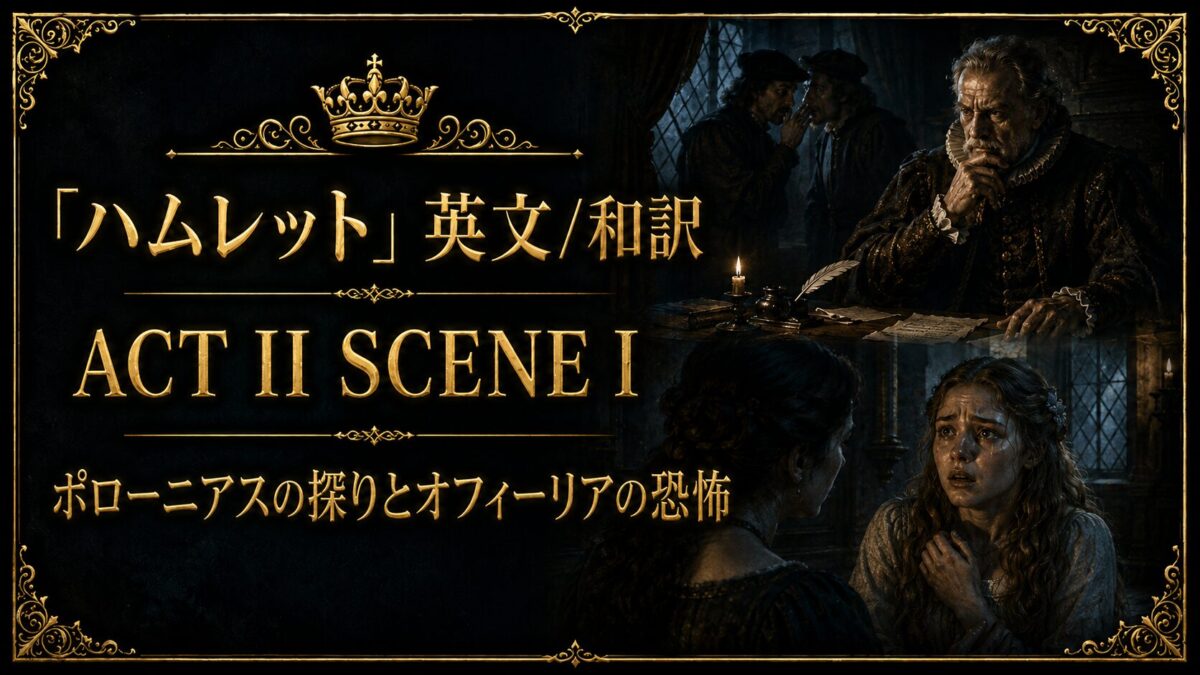
“`『ハムレット』英文/和訳 ACT II SCENE I ポローニアスの探りとオフィーリアの恐怖
『Hamlet』ACT II SCENE I を、英語学習用に「英文→和訳」の順で読みやすく整理し、重要語句を多めに色分けしています。上部の操作パネルで、和訳・色分け・ミニ訳・カテゴリ別ハイライトを切り替えられます。
ACT II. SCENE I. A room in Polonius’s house. Enter Polonius and Reynaldo.
第二幕 第一場。ポローニアスの家の一室。ポローニアスとレイナルドーが登場する。
POLONIUS
Give him this money and these notes, Reynaldo.
この金と手紙をあの子に渡してくれ、レイナルドー。
REYNALDO
I will, my lord.
承知しました、旦那様。
POLONIUS
You shall do marvellous wisely, good Reynaldo, before you visit him, to make inquiry of his behaviour.
よいか、レイナルドー。あの子を訪ねる前に、その行状を調べておけば、実に賢いやり方というものだ。
REYNALDO
My lord, I did intend it.
旦那様、私もそのつもりでおりました。
POLONIUS
Marry, well said; very well said. Look you, sir, Enquire me first what Danskers are in Paris; and how, and who, what means, and where they keep, what company, at what expense.
うむ、よく言った。実によく言った。まずパリにいるデンマーク人たちについて尋ねるのだ。どう暮らしているか、誰がいるか、どんな資力があるか、どこに滞在しているか、どんな仲間とつき合い、どれほど金を使っているかをな。
POLONIUS
And finding by this encompassment and drift of question, that they do know my son, come you more nearer than your particular demands will touch it.
そうした遠回しな質問の流れで、相手がわが息子を知っていると分かったなら、直接尋ねるよりも、さらに近くまで探りを入れるのだ。
POLONIUS
Take you as ’twere some distant knowledge of him, as thus, ‘I know his father and his friends, and in part him’—do you mark this, Reynaldo?
たとえば、あの子について少しだけ知っているように装うのだ。「彼の父親や友人を知っていますし、本人のことも少しは」――分かるか、レイナルドー。
REYNALDO
Ay, very well, my lord.
はい、よく分かります、旦那様。
POLONIUS
‘And in part him, but,’ you may say, ‘not well; but if’t be he I mean, he’s very wild; Addicted so and so;’ and there put on him what forgeries you please.
「本人も少しは知っていますが、よくは知りません。もし私の思っている人なら、かなり奔放で、あれこれ悪い癖があるようです」と言えばよい。そこで好きな作り話を少しばかり着せるのだ。
POLONIUS
Marry, none so rank as may dishonour him; take heed of that; but, sir, such wanton, wild, and usual slips as are companions noted and most known to youth and liberty.
ただし、あの子の名誉を傷つけるほどひどいものはいけない。そこは注意せよ。若さと自由につきものの、気ままで若気の、よくある過ちにしておくのだ。
REYNALDO
As gaming, my lord?
たとえば賭博でございますか、旦那様。
POLONIUS
Ay, or drinking, fencing, swearing, Quarrelling, drabbing. You may go so far.
そうだ。あるいは飲酒、剣術、悪口、口論、女遊び。そこまでは言ってよい。
REYNALDO
My lord, that would dishonour him.
旦那様、それではご子息の名誉を傷つけてしまいます。
POLONIUS
Faith no, as you may season it in the charge. You must not put another scandal on him, that he is open to incontinency; that’s not my meaning.
いや、言い方を加減すればよい。あの子が本当に放縦だというような別の醜聞を押しつけてはいけない。私が言っているのはそういうことではない。
POLONIUS
But breathe his faults so quaintly that they may seem the taints of liberty; the flash and outbreak of a fiery mind, a savageness in unreclaimed blood.
ただ、あの子の欠点を巧みにほのめかし、それが自由な若者につきものの汚れ、激しい心の閃きと爆発、まだ抑えられていない血の荒々しさに見えるようにするのだ。
REYNALDO
But my good lord—
ですが、旦那様――
POLONIUS
Wherefore should you do this?
なぜそんなことをするのか、というのだな。
REYNALDO
Ay, my lord, I would know that.
はい、旦那様。それを知りたいのでございます。
POLONIUS
Marry, sir, here’s my drift, and I believe it is a fetch of warrant.
よろしい、私の狙いはこうだ。これは正当な策だと思っている。
POLONIUS
You laying these slight sullies on my son, as ’twere a thing a little soil’d i’ th’ working, mark you, your party in converse, him you would sound, having ever seen in the prenominate crimes the youth you breathe of guilty, be assur’d he closes with you in this consequence.
お前が、わが息子に軽い汚点を置く。作業中に少し汚れた品のようにだ。そうすると、お前が探ろうとしている会話相手が、前に挙げたような悪さの中でその若者を見かけたことがあれば、必ず話に乗ってくる。
POLONIUS
‘Good sir,’ or so; or ‘friend,’ or ‘gentleman’—according to the phrase or the addition of man and country.
「よい方ですな」とか、「友よ」とか、「紳士」とか、その人や国の言い方に合わせてな。
REYNALDO
Very good, my lord.
よく分かります、旦那様。
POLONIUS
And then, sir, does he this,—He does—What was I about to say? By the mass, I was about to say something. Where did I leave?
そうすると相手はこうする――いや、するのだ――私は何を言おうとしていたのだったか。まったく、何かを言いかけていたのだ。どこまで話したかな。
REYNALDO
At ‘closes in the consequence.’ At ‘friend or so,’ and ‘gentleman.’
「話に乗ってくる」のところです。「友よ」とか「紳士」とかのところでございます。
POLONIUS
At ‘closes in the consequence’ ay, marry! He closes with you thus: ‘I know the gentleman, I saw him yesterday, or t’other day, or then, or then, with such and such.’
そう、「話に乗ってくる」のところだ。相手はこう言う。「その紳士なら知っています。昨日見ました、いや一昨日だったか、いやその前だったか、誰それと一緒にいました」とな。
POLONIUS
‘And, as you say, there was he gaming, there o’ertook in’s rouse, there falling out at tennis’: or perchance, ‘I saw him enter such a house of sale’—Videlicet, a brothel, or so forth.
「おっしゃる通り、そこで彼は賭博をしていました。あそこで酔っていました。テニス場で口論していました」とか、あるいは「彼がそういう売り物の家に入るのを見ました」――つまり娼館のような場所だ――などと言うかもしれない。
POLONIUS
See you now; your bait of falsehood takes this carp of truth; and thus do we of wisdom and of reach, with windlasses, and with assays of bias, by indirections find directions out.
分かるか。嘘の餌で、真実という鯉を釣り上げるのだ。こうして知恵と遠回しの技を使い、回り道や斜めからの試みによって、間接的に真の方向を見つけ出すのだ。
POLONIUS
So by my former lecture and advice shall you my son. You have me, have you not?
だから、今の私の教えと助言に従って、わが息子を探るのだ。分かったな。
REYNALDO
My lord, I have.
はい、旦那様、分かりました。
POLONIUS
God b’ wi’ you, fare you well.
神が共にあらんことを。では行ってよい。
REYNALDO
Good my lord.
はい、旦那様。
POLONIUS
Observe his inclination in yourself.
自分でも、あの子の傾向をよく観察するのだ。
REYNALDO
I shall, my lord.
そういたします、旦那様。
POLONIUS
And let him ply his music.
それから、あの子には音楽も続けさせておけ。
REYNALDO
Well, my lord.
かしこまりました、旦那様。
POLONIUS
Farewell.
さらば。
Exit Reynaldo. Enter Ophelia.
レイナルドー退場。オフィーリアが登場する。
POLONIUS
How now, Ophelia, what’s the matter?
どうした、オフィーリア。何事だ。
OPHELIA
Alas, my lord, I have been so affrighted.
ああ、お父様。私はひどく怯えてしまいました。
POLONIUS
With what, in the name of God?
いったい何にだ、神の名にかけて。
OPHELIA
My lord, as I was sewing in my chamber, Lord Hamlet, with his doublet all unbrac’d, no hat upon his head, his stockings foul’d, Ungart’red, and down-gyved to his ankle, Pale as his shirt, his knees knocking each other, and with a look so piteous in purport as if he had been loosed out of hell to speak of horrors, he comes before me.
お父様、私が部屋で縫い物をしていると、ハムレット様が現れました。上着はすっかりはだけ、頭には帽子もなく、靴下は汚れ、ガーターもなく、足首まで垂れ下がっていました。顔はシャツのように青白く、膝は震え、まるで恐ろしいことを語るために地獄から解き放たれた者のような、痛ましい表情をして、私の前に現れたのです。
POLONIUS
Mad for thy love?
お前への恋で狂ったのか。
OPHELIA
My lord, I do not know, but truly I do fear it.
お父様、私には分かりません。でも本当に、そうではないかと恐れています。
POLONIUS
What said he?
彼は何と言ったのだ。
OPHELIA
He took me by the wrist and held me hard; then goes he to the length of all his arm; and with his other hand thus o’er his brow, he falls to such perusal of my face as he would draw it.
ハムレット様は私の手首を取り、強く握りました。それから腕をいっぱいに伸ばした距離まで離れ、もう片方の手を額にかざして、まるで私の顔を描こうとするかのように、じっと見つめ始めたのです。
OPHELIA
Long stay’d he so. At last,—a little shaking of mine arm, and thrice his head thus waving up and down, he rais’d a sigh so piteous and profound as it did seem to shatter all his bulk and end his being.
彼は長い間そのままでした。やがて、私の腕を少し震わせ、頭を三度上下に振り、あまりにも痛ましく深いため息をつきました。それは、彼の体全体を砕き、命そのものを終わらせてしまうかのようでした。
OPHELIA
That done, he lets me go, and with his head over his shoulder turn’d he seem’d to find his way without his eyes, for out o’ doors he went without their help, and to the last bended their light on me.
それが終わると、彼は私を放しました。そして肩越しに顔をこちらへ向けたまま、目を使わずに道を見つけているようでした。外へ出るまで、目の助けを借りないように歩き、それでも最後まで、その目の光を私に向けていたのです。
POLONIUS
Come, go with me. I will go seek the King. This is the very ecstasy of love, whose violent property fordoes itself, and leads the will to desperate undertakings.
来なさい、一緒に行くのだ。王を探しに行こう。これはまさしく恋の狂乱だ。その激しい性質は自らを破壊し、意志を絶望的な行動へ導くのだ。
POLONIUS
As oft as any passion under heaven that does afflict our natures. I am sorry,—What, have you given him any hard words of late?
人間の性質を苦しめるどんな激情にも劣らない。すまなかった――ところで、最近あの方に何か厳しい言葉をかけたか。
OPHELIA
No, my good lord; but as you did command, I did repel his letters and denied his access to me.
いいえ、お父様。ただ、お父様がお命じになった通り、私はハムレット様の手紙を拒み、私に会うことも断りました。
POLONIUS
That hath made him mad. I am sorry that with better heed and judgement I had not quoted him.
それが彼を狂わせたのだ。もっと注意深く、もっとよい判断で彼を見ていなかったことが悔やまれる。
POLONIUS
I fear’d he did but trifle, and meant to wreck thee. But beshrew my jealousy! It seems it is as proper to our age to cast beyond ourselves in our opinions as it is common for the younger sort to lack discretion.
私は、彼がただお前をもてあそび、破滅させようとしているのだと恐れていた。だが、私の疑り深さなど呪われてしまえ。若者に分別が欠けがちであるように、年寄りには自分の考えを越えて考えすぎる癖があるらしい。
POLONIUS
Come, go we to the King. This must be known, which, being kept close, might move more grief to hide than hate to utter love.
来なさい、王のもとへ行こう。このことは知らせなければならない。隠しておけば、愛を口に出すことで生じる憎しみよりも、隠すことで生じる悲しみの方が大きくなるかもしれない。
Exeunt.
二人は退場する。
原文:William Shakespeare, Hamlet, Project Gutenberg eBook #1524. 日本語訳と語句色分けは英語学習用に整理したものです。