
カラフル対訳で紹介している作品について
カラフル対訳で紹介している作品は、すべてパブリックドメインの作品です。
このサイトで使われている作品は、著作権の切れた名作などの全文を電子化し、インターネット上で公開している Project Gutenberg(プロジェクト・グーテンベルク)、 および朗読音声を公開している LibriVox(リブリヴォックス/朗読図書館) の作品を出典としています。
原文はProject Gutenberg、音声はLibriVoxで公開されているパブリックドメイン作品を出典としています。
THE TENTH CHAPTER
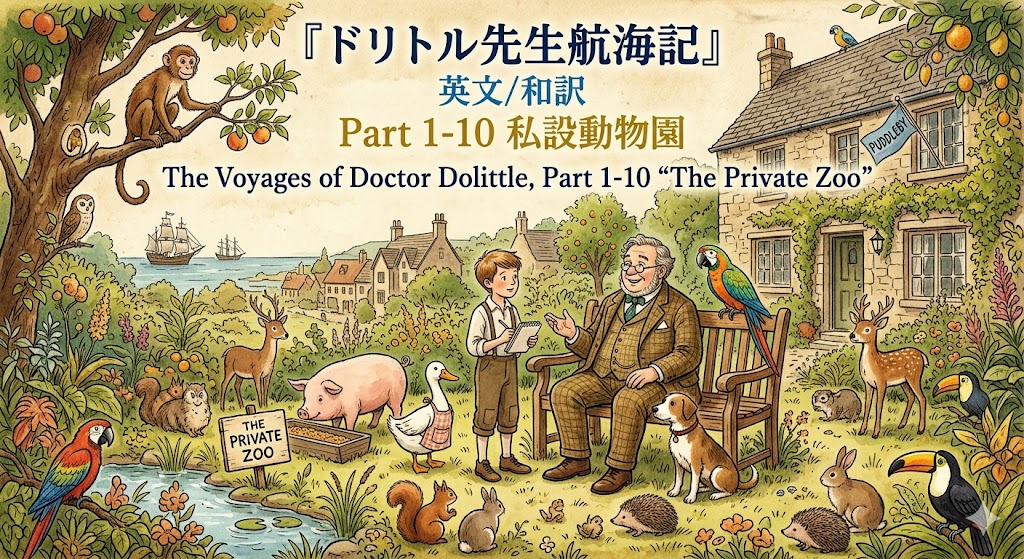
THE PRIVATE ZOO
ドリトル先生がトミーを私設動物園へ案内する場面です。檻のない動物園、双頭の動物プッシュミ・プルユー、ライオンやトラを閉じ込めることへの先生の強い考え、そして蝶の家や水族館へ続く流れを、重要表現多めに色分けしています。
表示設定
I DID not think there could be anything left in that garden which we had not seen.
私は、その庭に、私たちがまだ見ていないものなど残っているはずがないと思っていた。
But the Doctor took me by the arm and started off down a little narrow path.
しかし先生は私の腕を取り、小さな細い小道を進み始めた。
After many windings and twistings and turnings we found ourselves before a small door in a high stone wall.
何度もくねくね曲がり、ねじれ、折れ曲がったあと、私たちは高い石壁にある小さな扉の前に立っていた。
The Doctor pushed it open.
先生はその扉を押し開けた。
Inside was still another garden.
中には、さらに別の庭があった。
I had expected to find cages with animals inside them.
私は中に動物の入った檻があるものと思っていた。
But there were none to be seen.
しかし、檻は一つも見当たらなかった。
Instead there were little stone houses here and there all over the garden; and each house had a window and a door.
その代わり、庭のあちこちに小さな石の家があり、それぞれの家には窓と扉がついていた。
As we walked in, many of these doors opened and animals came running out to us, evidently expecting food.
私たちが入っていくと、それらの扉の多くが開き、動物たちが食べ物を期待しているらしく、私たちのところへ走って出てきた。
“Haven’t the doors any locks on them?” I asked the Doctor.
「扉には鍵がついていないのですか?」と私は先生に尋ねた。
“Oh yes,” he said, “every door has a lock.”
「いや、ついているよ」と先生は言った。「どの扉にも鍵はある」
“But in my zoo the doors open from the inside, not from the out.”
「ただし私の動物園では、扉は外側からではなく、内側から開くんだ」
“The locks are only there so the animals can go and shut themselves in any time they want to get away from the annoyance of other animals or from people who might come here.”
「鍵があるのは、ほかの動物やここへ来る人間にうるさくされるのを避けたいとき、動物たちが自分で中に入り、内側から閉じこもれるようにするためなんだ」
“Every animal in this zoo stays here because he likes it, not because he is made to.”
「この動物園のすべての動物は、ここにいたいからいるのであって、無理やりいさせられているわけではない」
“They all look very happy and clean,” I said.
「みんなとても幸せそうで、清潔に見えます」と私は言った。
“Would you mind telling me the names of some of them?”
「何匹かの名前を教えていただけませんか?」
“Certainly. Well now: that funny-looking thing with plates on his back, nosing under the brick over there, is a South American armadillo.”
「もちろんだ。さて、あそこにいる、背中に板のようなものがあり、レンガの下を鼻で探っている変わった見た目の動物は、南アメリカのアルマジロだ」
“The little chap talking to him is a Canadian woodchuck.”
「そのアルマジロに話しかけている小さなやつは、カナダのウッドチャックだよ」
“They both live in those holes you see at the foot of the wall.”
「彼らはどちらも、あの壁の下に見える穴の中に住んでいる」
“The two little beasts doing antics in the pond are a pair of Russian minks.”
「池の中でふざけた動きをしている二匹の小さな獣は、ロシアのミンクのつがいだ」
“And that reminds me: I must go and get them some herrings from the town before noon—it is early-closing to-day.”
「そうだ、それで思い出した。正午までに町へ行って、あの子たちにニシンを買ってこなければならない。今日は店が早く閉まる日なんだ」
“That animal just stepping out of his house is an antelope, one of the smaller South African kinds.”
「ちょうど家から出てきたあの動物はアンテロープで、南アフリカ産の小型の種類の一つだ」
“Now let us move to the other side of those bushes there and I will show you some more.”
「さあ、あそこの茂みの向こう側へ行こう。もっと見せてあげるよ」
“Are those deer over there?” I asked.
「あそこにいるのはシカですか?」と私は尋ねた。
“Deer!” said the Doctor. “Where do you mean?”
「シカだって!」と先生は言った。「どこのことだい?」
“Over there,” I said, pointing—“nibbling the grass border of the bed. There are two of them.”
「あそこです」と私は指さして言った。「花壇の縁の草をかじっています。二匹います」
“Oh, that,” said the Doctor with a smile. “That isn’t two animals: that’s one animal with two heads—the only two-headed animal in the world.”
「ああ、あれか」と先生は微笑んで言った。「あれは二匹の動物ではない。一匹の動物に頭が二つあるんだ。世界でただ一匹の双頭の動物だよ」
“It’s called the ‘pushmi-pullyu.’ I brought him from Africa.”
「あれは『プッシュミ・プルユー』と呼ばれている。アフリカから連れてきたんだ」
“He’s very tame—acts as a kind of night-watchman for my zoo.”
「とても人になれていて、私の動物園の夜警のような役目をしている」
“He only sleeps with one head at a time, you see—very handy—the other head stays awake all night.”
「彼は一度に片方の頭だけで眠るんだ。とても便利だよ。もう一方の頭は一晩中起きているからね」
“Have you any lions or tigers?” I asked as we moved on.
「ライオンやトラはいますか?」と、歩きながら私は尋ねた。
“No,” said the Doctor. “It wouldn’t be possible to keep them here—and I wouldn’t keep them even if I could.”
「いないよ」と先生は言った。「ここで飼うことはできないし、たとえできたとしても私は飼わないだろう」
“If I had my way, Stubbins, there wouldn’t be a single lion or tiger in captivity anywhere in the world.”
「もし私の思い通りになるなら、スタビンズ、世界中のどこにも、捕らわれたライオンやトラは一頭もいなくなるだろう」
“They never take to it. They’re never happy. They never settle down.”
「彼らは決してそれに慣れない。決して幸せにならない。決して落ち着かない」
“They are always thinking of the big countries they have left behind.”
「彼らはいつも、自分たちが後にしてきた広い国々のことを考えているんだ」
“You can see it in their eyes, dreaming—dreaming always of the great open spaces where they were born.”
「彼らの目を見ればそれがわかる。彼らは夢見ている。自分たちが生まれた広大な開けた土地を、いつも夢見ているんだ」
“Dreaming of the deep, dark jungles where their mothers first taught them how to scent and track the deer.”
「母親が初めてシカのにおいをかぎ、跡を追う方法を教えてくれた、深く暗い密林を夢見ているんだ」
“And what are they given in exchange for all this?” asked the Doctor, stopping in his walk and growing all red and angry.
「そして、そのすべての代わりに何を与えられるというのだ?」と先生は歩みを止め、顔を赤くして怒りながら尋ねた。
“What are they given in exchange for the glory of an African sunrise?”
「アフリカの日の出の栄光の代わりに、彼らは何を与えられるというのか?」
“For the twilight breeze whispering through the palms?”
「ヤシの木の間をささやく夕暮れの風の代わりに?」
“For the green shade of the matted, tangled vines?”
「もつれ絡み合ったツタの緑の陰の代わりに?」
“For the cool, big-starred nights of the desert?”
「大きな星に満ちた、涼しい砂漠の夜の代わりに?」
“For the patter of the waterfall after a hard day’s hunt?”
「厳しい一日の狩りのあとに聞く、滝の水音の代わりに?」
“What, I ask you, are they given in exchange for these?”
「これらの代わりに、いったい何が彼らに与えられるというのか?」
“Why, a bare cage with iron bars; an ugly piece of dead meat thrust in to them once a day.”
「鉄格子のあるむき出しの檻だ。日に一度、醜い死んだ肉片を押し込まれるだけだ」
“And a crowd of fools to come and stare at them with open mouths!”
「そして、口を開けた愚か者たちの群れがやって来て、彼らをじろじろ眺めるのだ!」
“No, Stubbins. Lions and tigers, the Big Hunters, should never, never be seen in zoos.”
「だめだ、スタビンズ。ライオンやトラ、大いなる狩人たちは、決して、決して動物園にいるべきではない」
The Doctor seemed to have grown terribly serious—almost sad.
先生はひどく真剣になったようだった。ほとんど悲しげにさえ見えた。
But suddenly his manner changed again and he took me by the arm with his same old cheerful smile.
しかし突然、先生の態度はまた変わり、いつもの陽気な笑顔で私の腕を取った。
“But we haven’t seen the butterfly-houses yet—nor the aquariums.”
「だが、まだ蝶の家を見ていないね。水族館もまだだ」
“Come along. I am very proud of my butterfly-houses.”
「さあ行こう。私は自分の蝶の家をとても誇りに思っているんだ」
Off we went again and came presently into a hedged enclosure.
私たちはまた歩き出し、やがて生け垣で囲まれた場所に入った。
Here I saw several big huts made of fine wire netting, like cages.
そこには、細かい金網で作られた大きな小屋がいくつかあり、檻のように見えた。
Inside the netting all sorts of beautiful flowers were growing in the sun, with butterflies skimming over them.
金網の内側には、あらゆる美しい花が日差しの中で咲いており、その上を蝶たちがひらひら飛んでいた。
The Doctor pointed to the end of one of the huts where little boxes with holes in them stood in a row.
先生は、小さな穴のあいた箱が一列に並んでいる小屋の端を指さした。
“Those are the hatching-boxes,” said he.
「あれは羽化箱だよ」と先生は言った。
“There I put the different kinds of caterpillars.”
「あそこにいろいろな種類の毛虫を入れておくんだ」
“And as soon as they turn into butterflies and moths they come out into these flower-gardens to feed.”
「そして蝶や蛾になるとすぐ、この花の庭へ出てきて食事をする」
“Do butterflies have a language?” I asked.
「蝶にも言葉があるのですか?」と私は尋ねた。
“Oh I fancy they have,” said the Doctor—“and the beetles too.”
「ああ、あると思うよ」と先生は言った。「甲虫にもね」
“But so far I haven’t succeeded in learning much about insect languages.”
「だが今のところ、昆虫の言葉について多くを学ぶことには成功していない」
“I have been too busy lately trying to master the shellfish-talk.”
「最近は貝類の言葉を習得しようとして、忙しすぎたんだ」
“I mean to take it up though.”
「だが、いずれは取りかかるつもりだよ」
At that moment Polynesia joined us and said, “Doctor, there are two guinea-pigs at the back door.”
そのときポリネシアが私たちのところへ来て言った。「先生、裏口にモルモットが二匹います」
“They say they have run away from the boy who kept them because they didn’t get the right stuff to eat.”
「飼っていた男の子が正しい食べ物をくれなかったので、逃げ出してきたと言っています」
“They want to know if you will take them in.”
「先生が受け入れてくれるかどうか知りたがっています」
“All right,” said the Doctor.
「いいとも」と先生は言った。
“Show them the way to the zoo. Give them the house on the left, near the gate—the one the black fox had.”
「動物園への道を案内してあげなさい。門の近く、左側の家を使わせてあげるんだ。黒ギツネが使っていた家だよ」
“Tell them what the rules are and give them a square meal.”
「規則を教えて、たっぷりした食事を出してあげなさい」
“Now, Stubbins, we will go on to the aquariums.”
「さて、スタビンズ、私たちは水族館へ進もう」
“And first of all I must show you my big, glass, sea-water tank where I keep the shellfish.”
「そして何より先に、貝類を飼っている大きなガラスの海水水槽を見せてあげなければならない」