
カラフル対訳で紹介している作品について
カラフル対訳で紹介している作品は、すべてパブリックドメインの作品です。
このサイトで使われている作品は、著作権の切れた名作などの全文を電子化し、インターネット上で公開している Project Gutenberg(プロジェクト・グーテンベルク)、 および朗読音声を公開している LibriVox(リブリヴォックス/朗読図書館) の作品を出典としています。
原文はProject Gutenberg、音声はLibriVoxで公開されているパブリックドメイン作品を出典としています。
THE SECOND CHAPTER
I HEAR OF THE GREAT NATURALIST
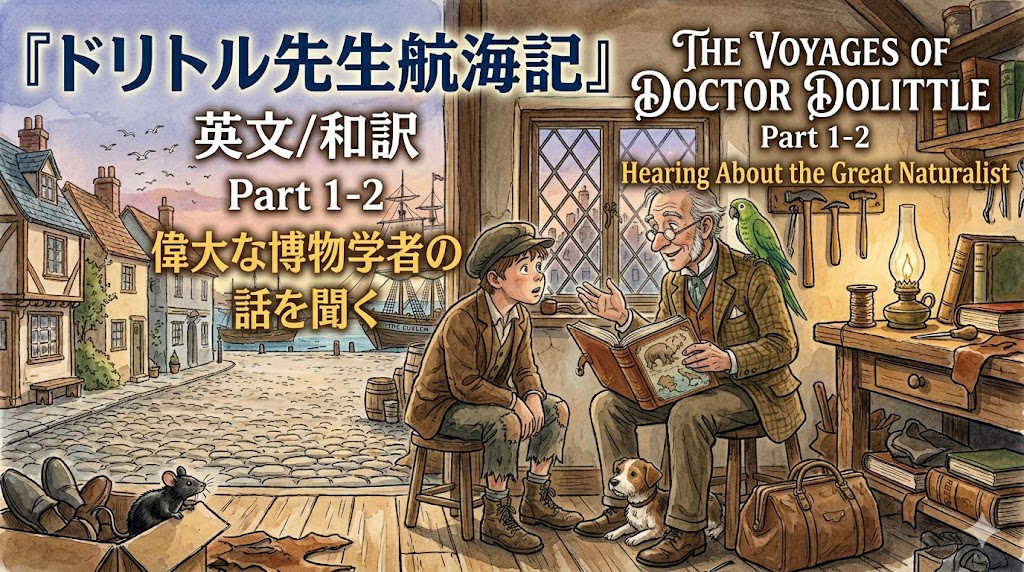
トミーが傷ついたリスを助けようとして、初めて「ドリトル先生」という偉大な博物学者の名を聞く場面です。自然・動物・人物紹介・重要表現を多めに色分けしています。
表示設定
ONE early morning in the Springtime, when I was wandering among the hills at the back of the town, I happened to come upon a hawk with a squirrel in its claws.
春のある早朝、町の裏手の丘を歩き回っていたとき、私は爪にリスをつかんだタカに偶然出くわした。
It was standing on a rock and the squirrel was fighting very hard for its life.
タカは岩の上に立っていて、リスは命を守ろうと必死に戦っていた。
The hawk was so frightened when I came upon it suddenly like this, that it dropped the poor creature and flew away.
私が突然現れたので、タカはとても驚き、そのかわいそうな生き物を落として飛び去ってしまった。
I picked the squirrel up and found that two of its legs were badly hurt.
私はリスを拾い上げ、二本の脚がひどく傷ついていることに気づいた。
So I carried it in my arms back to the town.
そこで私は、そのリスを腕に抱えて町へ戻った。
When I came to the bridge I went into the mussel-man’s hut and asked him if he could do anything for it.
橋まで来ると、私はムール貝採りの小屋に入り、そのリスを何とかできないかと彼に尋ねた。
Joe put on his spectacles and examined it carefully. Then he shook his head.
ジョーは眼鏡をかけ、リスを注意深く調べた。それから首を振った。
“Yon crittur’s got a broken leg,” he said—“and another badly cut an’ all.”
「その生き物は脚が折れとる」と彼は言った。「それに、もう一本もひどく切れとるな」
“I can mend you your boats, Tom, but I haven’t the tools nor the learning to make a broken squirrel seaworthy.”
「トム、おまえの船なら直してやれる。だが、折れた脚のリスを元気にしてやる道具も知識も、わしにはない」
“This is a job for a surgeon—and for a right smart one an’ all.”
「これは外科医の仕事だ。それも、かなり腕のいい外科医でなければならん」
“There be only one man I know who could save yon crittur’s life. And that’s John Dolittle.”
「わしが知っている中で、その生き物の命を救える男は一人だけだ。それがジョン・ドリトルだ」
“Who is John Dolittle?” I asked. “Is he a vet?”
「ジョン・ドリトルって誰?」と私は尋ねた。「獣医なの?」
“No,” said the mussel-man. “He’s no vet. Doctor Dolittle is a nacheralist.”
「いや」とムール貝採りは言った。「獣医じゃない。ドリトル先生は博物学者だ」
“What’s a nacheralist?”
「博物学者って何?」
“A nacheralist,” said Joe, putting away his glasses and starting to fill his pipe, “is a man who knows all about animals and butterflies and plants and rocks an’ all.”
「博物学者というのはな」とジョーは眼鏡をしまい、パイプにたばこを詰めながら言った。「動物や蝶や植物や岩なんかについて、何でも知っている人のことだ」
“John Dolittle is a very great nacheralist. I’m surprised you never heard of him—and you daft over animals.”
「ジョン・ドリトルは、とても偉大な博物学者だ。おまえが彼のことを聞いたことがないとは驚きだな。あれほど動物に夢中なのに」
“He knows a whole lot about shellfish—that I know from my own knowledge.”
「彼は貝類について実にたくさん知っている。それはわし自身がよく知っていることだ」
“He’s a quiet man and don’t talk much; but there’s folks who do say he’s the greatest nacheralist in the world.”
「彼は物静かな人で、あまりしゃべらない。だが、彼こそ世界一の博物学者だと言う人もいる」
“Where does he live?” I asked.
「どこに住んでいるの?」と私は尋ねた。
“Over on the Oxenthorpe Road, t’other side the town.”
「町の向こう側、オクセンソープ通りのほうだ」
“Don’t know just which house it is, but ’most anyone ’cross there could tell you, I reckon. Go and see him. He’s a great man.”
「どの家かまでは知らんが、あちらへ行けば、たいてい誰かが教えてくれるだろう。行って会ってみるといい。偉大な人だ」
So I thanked the mussel-man, took up my squirrel again and started off towards the Oxenthorpe Road.
そこで私はムール貝採りに礼を言い、もう一度リスを抱えて、オクセンソープ通りへ向かって出発した。
The first thing I heard as I came into the market-place was some one calling “Meat! M-E-A-T!”
市場へ入って最初に聞こえてきたのは、「肉だよ! M-E-A-T!」と呼ぶ声だった。
“There’s Matthew Mugg,” I said to myself. “He’ll know where this Doctor lives. Matthew knows everyone.”
「マシュー・マッグだ」と私は心の中で言った。「彼なら先生の家を知っているはずだ。マシューはみんなを知っているから」
So I hurried across the market-place and caught him up.
そこで私は市場を急いで横切り、彼に追いついた。
“Matthew,” I said, “do you know Doctor Dolittle?”
「マシュー」と私は言った。「ドリトル先生を知っている?」
“Do I know John Dolittle!” said he. “Well, I should think I do!”
「ジョン・ドリトルを知っているかだって!」と彼は言った。「そりゃもちろん知っているとも!」
“I know him as well as I know my own wife—better, I sometimes think. He’s a great man—a very great man.”
「自分の女房を知っているのと同じくらい知っている。いや、時には女房よりよく知っていると思うくらいだ。彼は偉大な人だ。本当に偉大な人だ」
“Can you show me where he lives?” I asked. “I want to take this squirrel to him. It has a broken leg.”
「彼の家を教えてくれる?」と私は尋ねた。「このリスを連れていきたいんだ。脚が折れているんだ」
“Certainly,” said the cat’s-meat-man. “I’ll be going right by his house directly. Come along and I’ll show you.”
「もちろんだ」と猫用肉売りは言った。「ちょうどこれから彼の家のすぐそばを通るところだ。一緒に来な。案内してやる」
So off we went together.
こうして私たちは一緒に出かけた。
“Oh, I’ve known John Dolittle for years and years,” said Matthew as we made our way out of the market-place.
「ああ、ジョン・ドリトルのことなら何年も何年も前から知っているよ」と、私たちが市場を出ていく途中でマシューは言った。
“But I’m pretty sure he ain’t home just now. He’s away on a voyage.”
「だが、今は家にいないと思う。航海に出ているんだ」
“But he’s liable to be back any day. I’ll show you his house and then you’ll know where to find him.”
「でも、いつ戻ってきてもおかしくない。家を教えてやるから、そうすればどこへ行けばいいかわかるだろう」
All the way down the Oxenthorpe Road Matthew hardly stopped talking about his great friend, Doctor John Dolittle—“M. D.”
オクセンソープ通りを進むあいだ、マシューは偉大な友人であるジョン・ドリトル先生、「医学博士」のことを、ほとんど休みなく話し続けた。
He talked so much that he forgot all about calling out “Meat!” until we both suddenly noticed that we had a whole procession of dogs following us patiently.
彼はあまりにも話しすぎて、「肉だよ!」と呼ぶことをすっかり忘れていた。やがて私たちは、犬たちが一列になって辛抱強くついてきていることに突然気づいた。
“Where did the Doctor go to on this voyage?” I asked as Matthew handed round the meat to them.
マシューが犬たちに肉を配っているあいだ、私は尋ねた。「先生は今回の航海でどこへ行ったの?」
“I couldn’t tell you,” he answered. “Nobody never knows where he goes, nor when he’s going, nor when he’s coming back.”
「それはわからないな」と彼は答えた。「彼がどこへ行くのか、いつ出発するのか、いつ帰ってくるのか、誰にもわからないんだ」
“He lives all alone except for his pets. He’s made some great voyages and some wonderful discoveries.”
「彼はペットたちを除けば、たった一人で暮らしている。これまでにすばらしい航海をして、すばらしい発見もしているんだ」
“Last time he came back he told me he’d found a tribe of Red Indians in the Pacific Ocean—lived on two islands, they did.”
「前に帰ってきたとき、太平洋で先住民の部族を見つけたと話してくれた。彼らは二つの島に住んでいたんだ」
“The husbands lived on one island and the wives lived on the other. Sensible people, some of them savages.”
「夫たちは一つの島に、妻たちは別の島に住んでいた。中には野蛮人もいたが、なかなか分別のある人々だったよ」
“They only met once a year, when the husbands came over to visit the wives for a great feast—Christmas-time, most likely.”
「彼らは一年に一度だけ会った。夫たちが妻たちを訪ねて大宴会をする時だ。たぶんクリスマスのころだったんだろうな」
“Yes, he’s a wonderful man is the Doctor. And as for animals, well, there ain’t no one knows as much about ’em as what he does.”
「そう、先生は本当にすばらしい人なんだ。動物のこととなれば、彼ほどよく知っている人はほかにいない」
“How did he get to know so much about animals?” I asked.
「どうしてそんなに動物のことを知るようになったの?」と私は尋ねた。
The cat’s-meat-man stopped and leant down to whisper in my ear.
猫用肉売りは立ち止まり、私の耳元でささやくために身をかがめた。
“He talks their language,” he said in a hoarse, mysterious voice.
「先生は動物たちの言葉を話すんだ」と彼は、しわがれた謎めいた声で言った。
“The animals’ language?” I cried.
「動物の言葉?」と私は叫んだ。
“Why certainly,” said Matthew. “All animals have some kind of a language.”
「もちろんさ」とマシューは言った。「どんな動物にも、何らかの言葉があるんだ」
“Some sorts talk more than others; some only speak in sign-language, like deaf-and-dumb.”
「よく話す種類もいれば、耳が聞こえず話せない人のように、手話のようなものだけで話す種類もいる」
“But the Doctor, he understands them all—birds as well as animals.”
「でも先生は、その全部を理解するんだ。動物だけでなく鳥の言葉もね」
“We keep it a secret though, him and me, because folks only laugh at you when you speak of it.”
「ただ、彼と私はそれを秘密にしている。そんな話をすると、人々は笑うだけだからね」
“Why, he can even write animal-language. He reads aloud to his pets.”
「なんと、先生は動物の言葉を書くことさえできるんだ。ペットたちに声を出して読んでやるんだよ」
“He’s wrote history-books in monkey-talk, poetry in canary language and comic songs for magpies to sing.”
「猿の言葉で歴史の本を書き、カナリアの言葉で詩を書き、カササギが歌うためのこっけいな歌まで作ったんだ」
“It’s a fact. He’s now busy learning the language of the shellfish. But he says it’s hard work.”
「本当の話だよ。今は貝類の言葉を覚えるのに忙しいんだ。でも、それはなかなか骨の折れる仕事だと言っている」
“And he has caught some terrible colds, holding his head under water so much. He’s a great man.”
「水の中に頭を突っ込んでいる時間が長すぎて、ひどい風邪を何度もひいたそうだ。偉大な人だよ」
“He certainly must be,” I said. “I do wish he were home so I could meet him.”
「本当にそうに違いないね」と私は言った。「家にいてくれたら、会えるのに」
“Well, there’s his house, look,” said the cat’s-meat-man—“that little one at the bend in the road there—the one high up—like it was sitting on the wall above the street.”
「ほら、あれが先生の家だ」と猫用肉売りは言った。「あそこの道の曲がり角にある小さな家だ。高いところにあって、通りの上の壁に座っているみたいだろう」
We were now come beyond the edge of the town. And the house that Matthew pointed out was quite a small one standing by itself.
私たちはもう町はずれまで来ていた。マシューが指さした家は、ぽつんと一軒だけ立つ小さな家だった。
There seemed to be a big garden around it; and this garden was much higher than the road, so you had to go up a flight of steps in the wall before you reached the front gate at the top.
そのまわりには大きな庭があるようだった。そして庭は道路よりずっと高いところにあったので、上の正門へ行くには壁の中の階段を上らなければならなかった。
I could see that there were many fine fruit trees in the garden, for their branches hung down over the wall in places.
庭には立派な果樹がたくさんあるのがわかった。ところどころで枝が壁の上から垂れ下がっていたからだ。
But the wall was so high I could not see anything else.
しかし壁がとても高かったので、それ以外のものは見えなかった。
When we reached the house Matthew went up the steps to the front gate and I followed him.
家に着くと、マシューは階段を上って正門へ向かい、私もその後についていった。
I thought he was going to go into the garden; but the gate was locked.
私は彼が庭に入るのだと思った。しかし門には鍵がかかっていた。
A dog came running down from the house; and he took several pieces of meat which the cat’s-meat-man pushed through the bars of the gate, and some paper bags full of corn and bran.
一匹の犬が家から走って降りてきた。猫用肉売りは門の格子のあいだから肉を数切れ押し込み、トウモロコシとふすまの入った紙袋も渡した。
I noticed that this dog did not stop to eat the meat, as any ordinary dog would have done.
私は、この犬が普通の犬ならそうするように、その場で肉を食べようとはしないことに気づいた。
But he took all the things back to the house and disappeared.
犬はすべてのものを家へ持って戻り、そのまま姿を消した。
He had a curious wide collar round his neck which looked as though it were made of brass or something.
その犬の首には、真鍮か何かでできているように見える、奇妙な幅広の首輪がついていた。
Then we came away.
それから私たちはそこを離れた。
“The Doctor isn’t back yet,” said Matthew, “or the gate wouldn’t be locked.”
「先生はまだ帰っていないな」とマシューは言った。「帰っていたら、門に鍵はかかっていないはずだから」
“What were all those things in paper-bags you gave the dog?” I asked.
「犬に渡していた紙袋の中身は何だったの?」と私は尋ねた。
“Oh, those were provisions,” said Matthew—“things for the animals to eat.”
「ああ、あれは食料だよ」とマシューは言った。「動物たちが食べるものだ」
“The Doctor’s house is simply full of pets. I give the things to the dog, while the Doctor’s away, and the dog gives them to the other animals.”
「先生の家はペットでいっぱいなんだ。先生が留守のあいだ、私が犬に食べ物を渡す。すると犬がそれをほかの動物たちに配るのさ」
“And what was that curious collar he was wearing round his neck?”
「それから、あの犬が首につけていた奇妙な首輪は何なの?」
“That’s a solid gold dog-collar,” said Matthew. “It was given to him when he was with the Doctor on one of his voyages long ago. He saved a man’s life.”
「あれは純金の犬の首輪だ」とマシューは言った。「ずっと昔、先生と航海に出たときにもらったものだ。あの犬は人の命を救ったんだ」
“How long has the Doctor had him?” I asked.
「先生はあの犬をどれくらい飼っているの?」と私は尋ねた。
“Oh, a long time. Jip’s getting pretty old now. That’s why the Doctor doesn’t take him on his voyages any more.”
「ああ、長いことだよ。ジップはもうかなり年を取ってきた。だから先生はもう航海に連れていかないんだ」
“He leaves him behind to take care of the house.”
「先生は家の世話をさせるために、ジップを残していくんだ」
“Every Monday and Thursday I bring the food to the gate here and give it him through the bars.”
「毎週月曜日と木曜日に、私はここへ食べ物を持ってきて、門の格子越しに彼へ渡す」
“He never lets any one come inside the garden while the Doctor’s away—not even me, though he knows me well.”
「先生が留守のあいだ、ジップは誰も庭の中へ入れない。私のことをよく知っているのに、私でさえ入れないんだ」
“But you’ll always be able to tell if the Doctor’s back or not—because if he is, the gate will surely be open.”
「でも、先生が帰っているかどうかはすぐわかる。帰っていれば、門は必ず開いているからね」
So I went off home to my father’s house and put my squirrel to bed in an old wooden box full of straw.
そこで私は父の家へ帰り、古い木箱にわらをいっぱい詰めて、その中にリスを寝かせた。
And there I nursed him myself and took care of him as best I could till the time should come when the Doctor would return.
そしてドリトル先生が帰ってくる時まで、私はできる限り自分でリスを看病し、世話をした。
And every day I went to the little house with the big garden on the edge of the town and tried the gate to see if it were locked.
そして毎日、町はずれにある大きな庭つきの小さな家へ行き、門に鍵がかかっているかどうか確かめた。
Sometimes the dog, Jip, would come down to the gate to meet me.
ときどき犬のジップが、私に会うため門まで降りてきてくれた。
But though he always wagged his tail and seemed glad to see me, he never let me come inside the garden.
しかし、彼はいつも尻尾を振って、私に会えてうれしそうにしてくれたが、決して私を庭の中へは入れてくれなかった。