
カラフル対訳で紹介している作品について
カラフル対訳で紹介している作品は、すべてパブリックドメインの作品です。
このサイトで使われている作品は、著作権の切れた名作などの全文を電子化し、インターネット上で公開している Project Gutenberg(プロジェクト・グーテンベルク)、 および朗読音声を公開している LibriVox(リブリヴォックス/朗読図書館) の作品を出典としています。
原文はProject Gutenberg、音声はLibriVoxで公開されているパブリックドメイン作品を出典としています。
THE SEVENTH CHAPTER
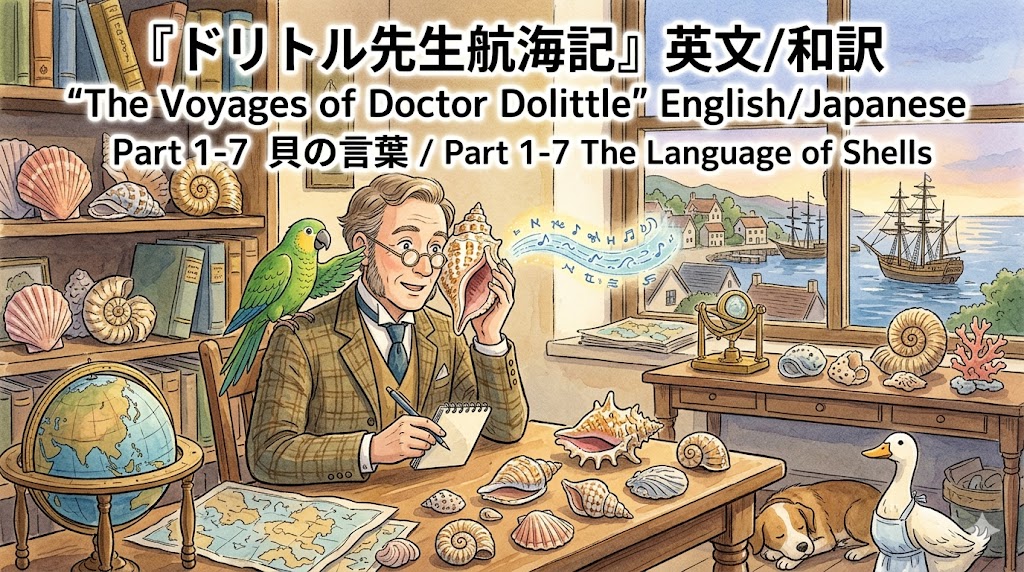
SHELLFISH TALK
トミーが早朝にドリトル先生の家を訪れ、ポリネシアと話し、先生の書斎でウィフワフの言葉について聞く場面です。朝の描写、研究室、貝類の言葉、深海への憧れなど、読解上重要な表現を多めに色分けしています。
表示設定
THE next morning, although I had gone to bed so late the night before, I was up frightfully early.
翌朝、前の晩あれほど遅く寝たにもかかわらず、私はものすごく早く起きた。
The first sparrows were just beginning to chirp sleepily on the slates outside my attic window.
屋根裏部屋の窓の外のスレート屋根では、最初のスズメたちが眠そうにさえずり始めたばかりだった。
Then I jumped out of bed and scrambled into my clothes.
私はベッドから飛び起き、急いで服を着た。
I could hardly wait to get back to the little house with the big garden—to see the Doctor and his private zoo.
大きな庭のある小さな家へ戻り、先生とその私設動物園を見るのが待ちきれなかった。
For the first time in my life I forgot all about breakfast.
私は生まれて初めて、朝食のことをすっかり忘れてしまった。
And creeping down the stairs on tip-toe, so as not to wake my mother and father, I opened the front door and popped out into the empty, silent street.
母と父を起こさないように、つま先立ちで階段をそっと降り、玄関の扉を開けて、人けのない静かな通りへひょいと出た。
When I got to the Doctor’s gate I suddenly thought that perhaps it was too early to call on any one.
先生の家の門に着くと、誰かを訪ねるには早すぎるのではないかと、ふと思った。
And I began to wonder if the Doctor would be up yet.
そして先生はもう起きているだろうかと思い始めた。
I looked into the garden. No one seemed to be about.
私は庭をのぞき込んだ。誰もあたりにいないようだった。
So I opened the gate quietly and went inside.
そこで私は静かに門を開け、中へ入った。
As I turned to the left to go down a path between some hedges, I heard a voice quite close to me say, “Good morning. How early you are!”
生け垣のあいだの小道を進もうと左へ曲がると、すぐ近くで声がした。「おはよう。ずいぶん早いのね!」
I turned around, and there, sitting on the top of a privet hedge, was the gray parrot, Polynesia.
振り返ると、イボタノキの生け垣の上に、灰色のオウム、ポリネシアが座っていた。
“Good morning,” I said. “I suppose I am rather early. Is the Doctor still in bed?”
「おはよう」と私は言った。「少し早すぎたかもしれません。先生はまだ寝ていますか?」
“Oh no,” said Polynesia. “He has been up an hour and a half.”
「いいえ」とポリネシアは言った。「先生は一時間半も前から起きているわ」
“You’ll find him in the house somewhere. The front door is open. Just push it and go in.”
「家のどこかにいるはずよ。玄関は開いているわ。ただ押して入ればいいの」
“He is sure to be in the kitchen cooking breakfast—or working in his study. Walk right in.”
「きっと台所で朝食を作っているか、書斎で仕事をしているわ。遠慮なく入りなさい」
“I am waiting to see the sun rise. But upon my word I believe it’s forgotten to rise.”
「私は日の出を待っているの。でもまったく、太陽は昇るのを忘れたんじゃないかしら」
“It is an awful climate, this.”
「ここの気候はひどいものね」
“Now if we were in Africa the world would be blazing with sunlight at this hour of the morning.”
「もしアフリカにいたなら、この朝の時間には世界中が太陽の光で輝いているはずよ」
“Just see that mist rolling over those cabbages.”
「あのキャベツの上を転がるように流れている霧を見てごらんなさい」
“It is enough to give you rheumatism to look at it. Beastly climate—Beastly!”
「見ているだけでリウマチになりそうだわ。ひどい気候、本当にひどい!」
“Really I don’t know why anything but frogs ever stay in England.”
「本当に、カエル以外の生き物がどうしてイギリスに住み続けるのか、私にはわからないわ」
“Well, don’t let me keep you. Run along and see the Doctor.”
「まあ、私が引き止めてはいけないわね。さあ、先生に会いに行きなさい」
“Thank you,” I said. “I’ll go and look for him.”
「ありがとう」と私は言った。「先生を探してみます」
When I opened the front door I could smell bacon frying, so I made my way to the kitchen.
玄関の扉を開けると、ベーコンの焼ける匂いがしたので、私は台所へ向かった。
There I discovered a large kettle boiling away over the fire and some bacon and eggs in a dish upon the hearth.
そこでは、大きなやかんが火の上でぐつぐつ沸いており、暖炉の前の皿にはベーコンエッグが置かれていた。
It seemed to me that the bacon was getting all dried up with the heat.
ベーコンは熱で乾ききってしまいそうに見えた。
So I pulled the dish a little further away from the fire and went on through the house looking for the Doctor.
そこで私は皿を火から少し遠ざけ、それから先生を探して家の中を進んだ。
I found him at last in the Study.
ついに私は書斎で先生を見つけた。
I did not know then that it was called the Study.
そのとき私は、それが書斎と呼ばれる部屋だとは知らなかった。
It was certainly a very interesting room, with telescopes and microscopes and all sorts of other strange things.
そこはたしかにとても興味深い部屋で、望遠鏡や顕微鏡、その他あらゆる不思議なものがあった。
I did not understand about them but wished I did.
私はそれらについて理解できなかったが、理解できたらいいのにと思った。
Hanging on the walls were pictures of animals and fishes and strange plants.
壁には、動物や魚、不思議な植物の絵が掛かっていた。
There were also collections of birds’ eggs and sea-shells in glass cases.
また、ガラスケースに入った鳥の卵や貝殻のコレクションもあった。
The Doctor was standing at the main table in his dressing-gown.
先生は部屋着を着て、中央のテーブルのところに立っていた。
At first I thought he was washing his face.
最初、私は先生が顔を洗っているのだと思った。
He had a square glass box before him full of water.
先生の前には、水でいっぱいの四角いガラス箱があった。
He was holding one ear under the water while he covered the other with his left hand.
先生は片方の耳を水の中に入れ、もう片方の耳を左手でふさいでいた。
As I came in he stood up.
私が入っていくと、先生は立ち上がった。
“Good morning, Stubbins,” said he. “Going to be a nice day, don’t you think?”
「おはよう、スタビンズ」と先生は言った。「今日はいい日になりそうだね、そう思わないかい?」
“I’ve just been listening to the Wiff-Waff.”
「私はちょうどウィフワフの声を聞いていたところだ」
“But he is very disappointing—very.”
「だが、彼はとても期待外れだ。本当にね」
“Why?” I said. “Didn’t you find that he has any language at all?”
「なぜですか?」と私は言った。「彼には言葉がまったくないとわかったのですか?」
“Oh yes,” said the Doctor, “he has a language. But it is such a poor language.”
「いや、言葉はあるよ」と先生は言った。「だが、とても貧弱な言葉なんだ」
“Only a few words, like ‘yes’ and ‘no’—‘hot’ and ‘cold.’ That’s all he can say.”
「『はい』や『いいえ』、『暑い』や『寒い』のような、ほんの少しの単語だけだ。彼が言えるのはそれだけなんだ」
“It’s very disappointing. You see he really belongs to two different families of fishes.”
「とても期待外れだよ。彼は本当は二つの異なる魚の系統に属しているんだ」
“I thought he was going to be tremendously helpful—Well, well!”
「私は彼がものすごく役に立つと思っていたんだがね。まあ、まあ!」
“I suppose,” said I, “that means he hasn’t very much sense—if his language is only two or three words?”
「つまり」と私は言った。「言葉が二、三語しかないなら、彼にはあまり知性がないということですか?」
“Yes, I suppose it does. Possibly it is the kind of life he leads.”
「そういうことなのだろうね。おそらく、彼の送っている生活のせいだろう」
“You see, they are very rare now, these Wiff-Waffs—very rare and very solitary.”
「つまり、ウィフワフは今ではとても珍しいんだ。とても珍しく、とても孤独な生き物だ」
“They swim around in the deepest parts of the ocean entirely by themselves—always alone.”
「彼らは海の最も深いところを、完全に一匹だけで泳ぎ回っている。いつも一人なんだ」
“So I presume they really don’t need to talk much.”
「だから、彼らは実際あまり話す必要がないのだろうと私は思う」
“Perhaps some kind of a bigger shellfish would talk more,” I said.
「もっと大きな貝類なら、もっと話すかもしれませんね」と私は言った。
“After all, he is very small, isn’t he?”
「結局、彼はとても小さいですからね」
“Yes,” said the Doctor, “that’s true. Oh I have no doubt that there are shellfish who are good talkers.”
「そうだね」と先生は言った。「それは本当だ。話し上手な貝類がいることは、まったく疑っていないよ」
“Not the least doubt. But the big shellfish—the biggest of them, are so hard to catch.”
「少しも疑っていない。だが、大きな貝類、とくに最大級のものは、とても捕まえるのが難しいんだ」
“They are only to be found in the deep parts of the sea.”
「彼らは海の深いところでしか見つからない」
“And as they don’t swim very much, but just crawl along the floor of the ocean most of the time, they are very seldom taken in nets.”
「しかも彼らはあまり泳がず、たいていは海底を這っているだけなので、網にかかることはめったにないんだ」
“I do wish I could find some way of going down to the bottom of the sea.”
「海の底へ降りていく方法を見つけられたらどんなにいいだろう」
“I could learn a lot if I could only do that.”
「それさえできれば、私は多くのことを学べるだろう」
“But we are forgetting all about breakfast—Have you had breakfast yet, Stubbins?”
「でも、朝食のことをすっかり忘れているね。スタビンズ、君はもう朝食を食べたかい?」
I told the Doctor that I had forgotten all about it and he at once led the way into the kitchen.
私は先生に、朝食のことをすっかり忘れていたと話した。すると先生はすぐに台所へ先に立って進んだ。
“Yes,” he said, as he poured the hot water from the kettle into the tea-pot.
「そうだ」と先生は、やかんの熱い湯をティーポットへ注ぎながら言った。
“If a man could only manage to get right down to the bottom of the sea, and live there a while, he would discover some wonderful things.”
「もし人間がなんとか海の底まで降りて、そこでしばらく暮らすことができたなら、すばらしいものを発見するだろう」
“Things that people have never dreamed of.”
「人々が夢にも思わなかったようなものをね」
“But men do go down, don’t they?” I asked—“divers and people like that?”
「でも人間は海に潜りますよね?」と私は尋ねた。「潜水夫のような人たちが」
“Oh yes, to be sure,” said the Doctor. “Divers go down.”
「ああ、もちろんだ」と先生は言った。「潜水夫は潜るよ」
“I’ve been down myself in a diving-suit, for that matter.”
「実を言えば、私自身も潜水服を着て潜ったことがある」
“But my!—they only go where the sea is shallow.”
「だが、なんといっても、彼らが行けるのは海が浅いところだけなんだ」
“Divers can’t go down where it is really deep.”
「潜水夫は、本当に深いところまでは潜れない」
“What I would like to do is to go down to the great depths—where it is miles deep.”
「私がしたいのは、何マイルもの深さがある深海へ降りていくことなんだ」
“Well, well, I dare say I shall manage it some day. Let me give you another cup of tea.”
「まあ、まあ。いつかきっと何とかやってみせるさ。もう一杯お茶を入れてあげよう」