
カラフル対訳で紹介している作品について
カラフル対訳で紹介している作品は、すべてパブリックドメインの作品です。
このサイトで使われている作品は、著作権の切れた名作などの全文を電子化し、インターネット上で公開している Project Gutenberg(プロジェクト・グーテンベルク)、 および朗読音声を公開している LibriVox(リブリヴォックス/朗読図書館) の作品を出典としています。
原文はProject Gutenberg、音声はLibriVoxで公開されているパブリックドメイン作品を出典としています。
PART FOUR
THE SIXTH CHAPTER
THE JABIZRI
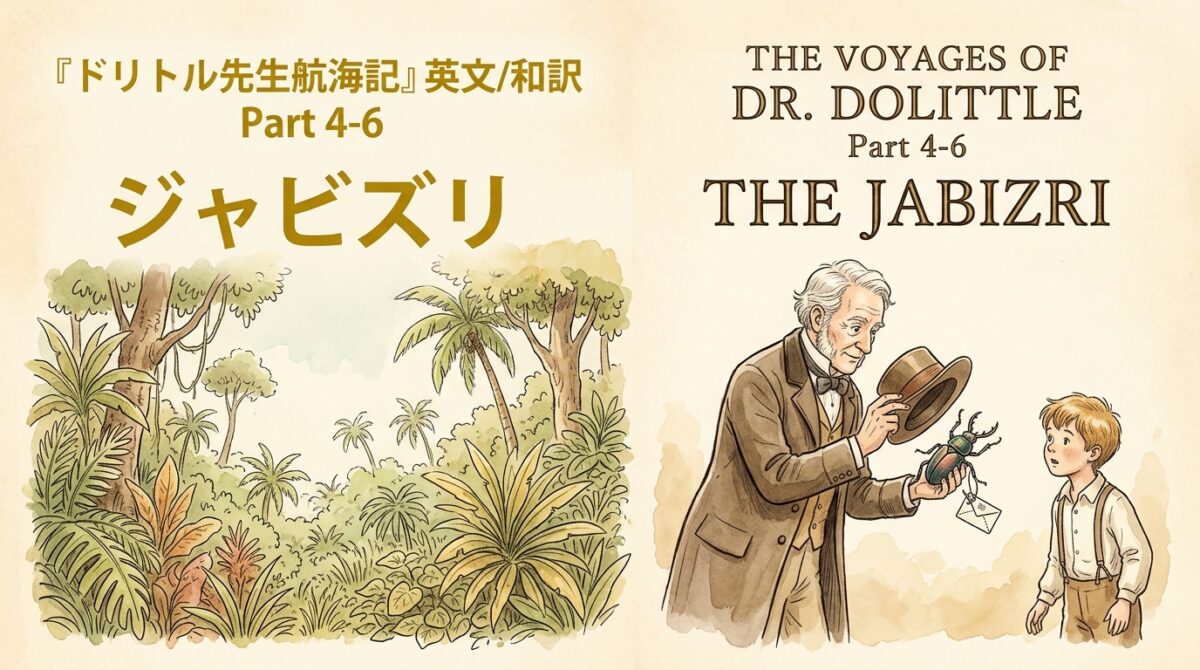
スパイダーモンキー島の山へ向かった一行は、森の中で食べ物と水を確保しながら進みます。やがてドリトル先生は、世界でもっとも珍しい甲虫ジャビズリの羽音を聞きつけ、帽子で見事に捕まえます。ところが、その虫の脚には、血で描かれた絵文字の手紙が結びつけられていました。先生はそれをロング・アローからの救助要請だと読み解き、一刻も早く山中の洞窟を探す決意をします。森・昆虫・発見・暗号・救助に関する重要表現を多めに色分けしています。
WE found the woods at the feet of the hills thick and tangly and somewhat hard to get through.
私たちは、丘のふもとの森が密生して絡み合い、かなり通り抜けにくいことに気づいた。
On Polynesia’s advice, we kept away from all paths and trails, feeling it best to avoid meeting any Indians for the present.
ポリネシアの助言で、私たちはすべての道や小道を避けた。今のところ先住民に会わないほうがよいと考えたからだ。
But she and Chee-Chee were good guides and splendid jungle-hunters.
しかし彼女とチーチーは、よい案内役であり、すばらしいジャングルの狩人でもあった。
And the two of them set to work at once looking for food for us.
そして二人はすぐに、私たちのための食べ物を探す仕事に取りかかった。
In a very short space of time they had found quite a number of different fruits and nuts which made excellent eating, though none of us knew the names of any of them.
ごく短い時間のうちに、二人はさまざまな果物や木の実をかなりたくさん見つけた。それらはとてもおいしかったが、私たちはどれ一つ名前を知らなかった。
We discovered a nice clean stream of good water which came down from the mountains.
私たちは、山から流れ下ってくる、きれいでよい水の小川を見つけた。
So we were supplied with something to drink as well.
そのため、飲み物も手に入れることができた。
We followed the stream up towards the heights.
私たちはその小川に沿って、高地のほうへ登っていった。
And presently we came to parts where the woods were thinner and the ground rocky and steep.
やがて私たちは、森がまばらになり、地面が岩だらけで急になっている場所へ来た。
Here we could get glimpses of wonderful views all over the island, with the blue sea beyond.
そこからは、島全体に広がるすばらしい眺めと、その向こうの青い海をちらちらと見ることができた。
While we were admiring one of these the Doctor suddenly said, “Sh!—A Jabizri!—Don’t you hear it?”
私たちがその景色の一つに見とれていると、先生が突然言った。「しっ! ジャビズリだ! 聞こえないか?」
We listened and heard, somewhere in the air about us, an extraordinarily musical hum—like a bee, but not just one note.
私たちは耳をすませた。すると、周囲の空中のどこかから、非常に音楽的な羽音が聞こえた。蜂のようだったが、単調な一音ではなかった。
This hum rose and fell, up and down—almost like some one singing.
その羽音は上がったり下がったりし、まるで誰かが歌っているようだった。
“No other insect but the Jabizri beetle hums like that,” said the Doctor.
「ジャビズリ甲虫以外に、あんな羽音を出す昆虫はいない」と先生は言った。
“I wonder where he is—quite near, by the sound—flying among the trees probably.”
「どこにいるのだろう。音からすると、かなり近い。たぶん木々の間を飛んでいるのだろう」
“Oh, if I only had my butterfly-net!”
「ああ、虫取り網さえあれば!」
“Why didn’t I think to strap that around my waist too.”
「どうしてそれも腰に巻きつけておこうと思わなかったのだろう」
“Confound the storm: I may miss the chance of a lifetime now of getting the rarest beetle in the world—Oh look! There he goes!”
「あの嵐め。世界で最も珍しい甲虫を手に入れる一生に一度の機会を逃してしまうかもしれない。あっ、見ろ! 飛んでいく!」
A huge beetle, easily three inches long I should say, suddenly flew by our noses.
私の見るところ、ゆうに三インチはある巨大な甲虫が、突然私たちの鼻先を飛んで通り過ぎた。
The Doctor got frightfully excited.
先生はものすごく興奮した。
He took off his hat to use as a net, swooped at the beetle and caught it.
先生は帽子を脱いで網代わりにし、甲虫にさっと飛びかかって捕まえた。
He nearly fell down a precipice on to the rocks below in his wild hurry, but that didn’t bother him in the least.
先生は無我夢中で急いだあまり、下の岩場へ崖から落ちそうになったが、そんなことは少しも気にしなかった。
He knelt down, chortling, upon the ground with the Jabizri safe under his hat.
先生はジャビズリを帽子の下にしっかり閉じ込め、うれしそうに笑いながら地面にひざまずいた。
From his pocket he brought out a glass-topped box, and into this he very skilfully made the beetle walk from under the rim of the hat.
先生はポケットからガラス蓋つきの箱を取り出し、帽子の縁の下から甲虫をその中へ、実に巧みに歩いて入らせた。
Then he rose up, happy as a child, to examine his new treasure through the glass lid.
それから先生は子どものように幸せそうに立ち上がり、ガラスの蓋越しに新しい宝物を調べた。
It certainly was a most beautiful insect.
それは確かに、この上なく美しい昆虫だった。
It was pale blue underneath; but its back was glossy black with huge red spots on it.
腹側は淡い青色だった。しかし背中はつやのある黒で、大きな赤い斑点があった。
“There isn’t an entymologist in the whole world who wouldn’t give all he has to be in my shoes to-day,” said the Doctor.
「世界中のどんな昆虫学者でも、今日の私の立場になれるなら持っているものをすべて差し出すだろう」と先生は言った。
“Hulloa! This Jabizri’s got something on his leg—Doesn’t look like mud. I wonder what it is.”
「おや! このジャビズリは脚に何かつけているぞ。泥ではなさそうだ。いったい何だろう」
He took the beetle carefully out of the box and held it by its back in his fingers, where it waved its six legs slowly in the air.
先生は甲虫を箱から慎重に取り出し、背中を指でつまんだ。甲虫は空中で六本の脚をゆっくり振っていた。
We all crowded about him, peering at it.
私たちはみな先生の周りに群がり、それをじっとのぞき込んだ。
Rolled around the middle section of its right foreleg was something that looked like a thin dried leaf.
その右前脚の中央部分には、薄い乾いた葉のように見えるものが巻きつけられていた。
It was bound on very neatly with strong spider-web.
それは強いクモの糸で、とてもきちんと結びつけられていた。
It was marvelous to see how John Dolittle with his fat heavy fingers undid that cobweb cord and unrolled the leaf, whole, without tearing it or hurting the precious beetle.
ジョン・ドリトルが太く重い指で、そのクモの糸のひもをほどき、葉を破ることも貴重な甲虫を傷つけることもなく、完全なまま広げた様子は驚くべきものだった。
The Jabizri he put back into the box.
先生はジャビズリを箱の中へ戻した。
Then he spread the leaf out flat and examined it.
それから先生は葉を平らに広げ、それを調べた。
You can imagine our surprise when we found that the inside of the leaf was covered with signs and pictures, drawn so tiny that you almost needed a magnifying-glass to tell what they were.
葉の内側が記号や絵で覆われており、それらがあまりに小さく描かれていて、何なのか見分けるには拡大鏡がほとんど必要だとわかったときの私たちの驚きは、想像できるだろう。
Some of the signs we couldn’t make out at all.
記号のいくつかは、私たちにはまったく理解できなかった。
But nearly all of the pictures were quite plain, figures of men and mountains mostly.
しかし絵のほとんどはかなりはっきりしていて、主に人間と山の姿だった。
The whole was done in a curious sort of brown ink.
全体は、奇妙な種類の茶色のインクで描かれていた。
For several moments there was a dead silence while we all stared at the leaf, fascinated and mystified.
しばらくの間、完全な沈黙があった。私たちはみな、魅了され、当惑しながら、その葉を見つめていた。
“I think this is written in blood,” said the Doctor at last.
「これは血で書かれていると思う」と、ついに先生が言った。
“It turns that color when it’s dry.”
「血は乾くとこの色になるんだ」
“Somebody pricked his finger to make these pictures.”
「誰かが指を刺して、これらの絵を描いたのだ」
“It’s an old dodge when you’re short of ink—but highly unsanitary.”
「インクが足りないときの古い手口だ。だが、非常に不衛生だ」
“What an extraordinary thing to find tied to a beetle’s leg!”
「甲虫の脚にこんなものが結びつけられているとは、なんと並外れたことだろう!」
“I wish I could talk beetle language, and find out where the Jabizri got it from.”
「甲虫の言葉を話せたらよかったのに。そうすれば、このジャビズリがそれをどこで手に入れたのかわかるのだが」
“But what is it?” I asked—“Rows of little pictures and signs. What do you make of it, Doctor?”
「でも、それはいったい何なんですか」と私は尋ねた。「小さな絵と記号の列です。先生はそれをどう解釈しますか?」
“It’s a letter,” he said—“a picture letter.”
「これは手紙だ」と先生は言った。「絵文字の手紙だ」
“All these little things put together mean a message.”
「これらの小さなものをすべて合わせると、一つの伝言になる」
“But why give a message to a beetle to carry—and to a Jabizri, the rarest beetle in the world?—What an extraordinary thing!”
「しかし、なぜ伝言を甲虫に運ばせるのだろう。しかも、世界で最も珍しい甲虫、ジャビズリに。なんという並外れたことだ!」
Then he fell to muttering over the pictures.
それから先生は、その絵についてぶつぶつ言い始めた。
“I wonder what it means: men walking up a mountain; men walking into a hole in a mountain; a mountain falling down—it’s a good drawing, that.”
「これは何を意味しているのだろう。人々が山を登っている。人々が山の穴へ入っている。山が崩れ落ちている。これはよく描けている」
“Men pointing to their open mouths; bars—prison-bars, perhaps; men praying; men lying down—they look as though they might be sick.”
「人々が開いた口を指さしている。格子――たぶん牢屋の格子だろう。人々が祈っている。人々が横たわっている。病気なのかもしれないように見える」
“And last of all, just a mountain—a peculiar-shaped mountain.”
「そして最後に、ただ山だけがある。独特な形をした山だ」
All of a sudden the Doctor looked up sharply at me, a wonderful smile of delighted understanding spreading over his face.
突然、先生は私を鋭く見上げた。その顔には、理解した喜びから来るすばらしい笑みが広がっていた。
“Long Arrow!” he cried, “don’t you see, Stubbins?—Why, of course!”
「ロング・アローだ!」と先生は叫んだ。「わからないか、スタビンズ? そうだ、もちろんだ!」
“Only a naturalist would think of doing a thing like this: giving his letter to a beetle.”
「こんなことを考えるのは博物学者だけだ。自分の手紙を甲虫に託すなんて」
“Not to a common beetle, but to the rarest of all, one that other naturalists would try to catch.”
「普通の甲虫ではなく、あらゆる甲虫の中で最も珍しいもの、ほかの博物学者たちが捕まえようとするものにだ」
“Well, well! Long Arrow!—A picture-letter from Long Arrow. For pictures are the only writing that he knows.”
「いやはや! ロング・アローだ! ロング・アローからの絵文字の手紙だ。彼が知っている文字は絵だけだからね」
“Yes, but who is the letter to?” I asked.
「ええ、でもその手紙は誰宛てなんですか」と私は尋ねた。
“It’s to me very likely. Miranda had told him, I know, years ago, that some day I meant to come here.”
「おそらく私宛てだ。ミランダは何年も前に、私がいつかここへ来るつもりだと彼に話していたはずだ」
“But if not for me, then it’s for any one who caught the beetle and read it. It’s a letter to the world.”
「だが、もし私宛てでないとしても、それはこの甲虫を捕まえて読んだ誰かへ宛てたものだ。世界へ向けた手紙なのだ」
“Well, but what does it say? It doesn’t seem to me that it’s much good to you now you’ve got it.”
「でも、何と書いてあるんですか。手に入れたところで、あまり役に立たないように私には思えます」
“Yes, it is,” he said, “because, look, I can read it now.”
「いや、役に立つ」と先生は言った。「なぜなら、見てごらん。私は今、それを読み解けるからだ」
“First picture: men walking up a mountain—that’s Long Arrow and his party.”
「最初の絵。人々が山を登っている。これはロング・アローとその一行だ」
“Men going into a hole in a mountain—they enter a cave looking for medicine-plants or mosses.”
「人々が山の穴へ入っている。彼らは薬草か苔を探して洞窟に入ったのだ」
“A mountain falling down—some hanging rocks must have slipped and trapped them, imprisoned them in the cave.”
「山が崩れ落ちている。張り出した岩が滑り落ちて、彼らを洞窟の中に閉じ込め、幽閉してしまったに違いない」
“And this was the only living creature that could carry a message for them to the outside world—a beetle, who could burrow his way into the open air.”
「そして、外の世界へ彼らの伝言を運べる唯一の生き物がこれだった。穴を掘って外気へ出ていくことのできる甲虫だ」
“Of course it was only a slim chance that the beetle would be ever caught and the letter read.”
「もちろん、その甲虫がいつか捕まり、手紙が読まれる可能性はわずかだった」
“But it was a chance; and when men are in great danger they grab at any straw of hope.”
「だが、それでも可能性ではあった。人は大きな危険の中にいるとき、どんなわずかな希望にもすがるものだ」
“All right. Now look at the next picture: men pointing to their open mouths—they are hungry.”
「よし。次の絵を見てごらん。人々が開いた口を指さしている。彼らは空腹なのだ」
“Men praying—begging any one who finds this letter to come to their assistance.”
「人々が祈っている。この手紙を見つけた誰かに、助けに来てくれと懇願しているのだ」
“Men lying down—they are sick, or starving.”
「人々が横たわっている。彼らは病気か、飢えかけている」
“This letter, Stubbins, is their last cry for help.”
「この手紙は、スタビンズ、彼らの最後の助けを求める叫びなのだ」
He sprang to his feet as he ended, snatched out a note-book and put the letter between the leaves.
そう言い終えると先生は跳び上がり、ノートをひったくり出して、その手紙をページの間にはさんだ。
His hands were trembling with haste and agitation.
先生の手は、急ぎと動揺で震えていた。
“Come on!” he cried—“up the mountain—all of you. There’s not a moment to lose.”
「さあ行こう!」と先生は叫んだ。「山へ登るんだ。全員だ。一刻も無駄にできない」
“Bumpo, bring the water and nuts with you. Heaven only knows how long they’ve been pining underground.”
「バンポ、水と木の実を持ってきてくれ。彼らが地下でどれほど長く衰弱しているかは、神のみぞ知るだ」
“Let’s hope and pray we’re not too late!”
「手遅れでないことを願って祈ろう!」
“But where are you going to look?” I asked.
「でも、どこを探すつもりなんですか」と私は尋ねた。
“Miranda said the island was a hundred miles long and the mountains seem to run all the way down the centre of it.”
「ミランダは島が百マイルの長さだと言っていましたし、山々は島の中央をずっと走っているように見えます」
“Didn’t you see the last picture?” he said, grabbing up his hat from the ground and cramming it on his head.
「最後の絵を見なかったのか」と先生は言い、地面から帽子をつかみ上げて、頭に押し込むようにかぶった。
“It was an oddly shaped mountain—looked like a hawk’s head.”
「それは奇妙な形の山だった。タカの頭のように見えた」
“Well, there’s where he is—if he’s still alive.”
「そこに彼はいるのだ。もしまだ生きているなら」
“First thing for us to do, is to get up on a high peak and look around the island for a mountain shaped like a hawks’ head.”
「まず私たちがすべきことは、高い峰へ登り、島を見回して、タカの頭のような形をした山を探すことだ」
“Just to think of it! There’s a chance of my meeting Long Arrow, the son of Golden Arrow, after all!”
「考えてもみたまえ! 結局、私がゴールデン・アローの息子、ロング・アローに会える可能性があるのだ!」
“Come on! Hurry! To delay may mean death to the greatest naturalist ever born!”
「さあ行こう! 急げ! 遅れることは、かつて生まれた中で最も偉大な博物学者の死を意味するかもしれない!」