
カラフル対訳で紹介している作品について
カラフル対訳で紹介している作品は、すべてパブリックドメインの作品です。
このサイトで使われている作品は、著作権の切れた名作などの全文を電子化し、インターネット上で公開している Project Gutenberg(プロジェクト・グーテンベルク)、 および朗読音声を公開している LibriVox(リブリヴォックス/朗読図書館) の作品を出典としています。
原文はProject Gutenberg、音声はLibriVoxで公開されているパブリックドメイン作品を出典としています。
PART SIX
THE FIFTH CHAPTER
THE SHELLFISH RIDDLE SOLVED AT LAST
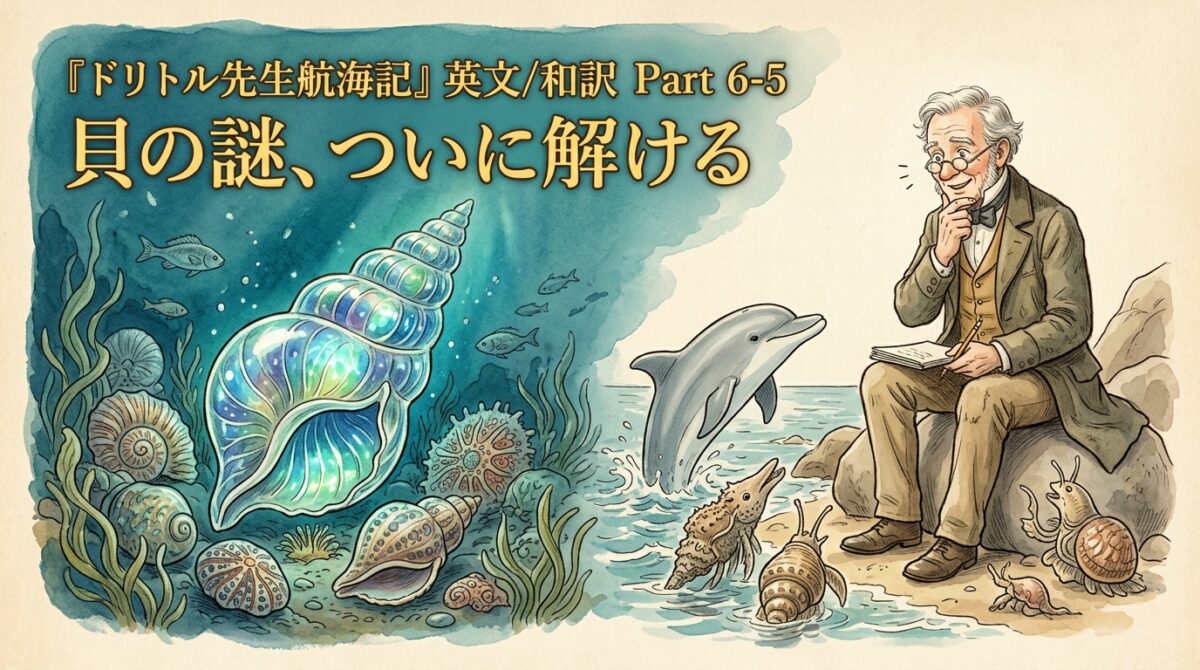
ドリトル先生はついに、長年の難問だった「貝類の言葉」に近づきます。ネズミイルカ、ウニ、ヒトデを通訳として、大ガラス海巻貝との奇妙な会話が始まります。先生は少しずつ言葉を聞き取り、自分でも話せるようになり、さらに巻貝のけがを治療します。この章では、通訳・貝類語・観察・治療・王としての休暇に関する重要表現を多めに色分けしています。
表示設定
カテゴリ別ハイライト
SO Doctor Dolittle, with a crown on his head, sat down upon the shore like King Knut, and waited.
そこでドリトル先生は、頭に王冠をのせたまま、クヌート王のように岸辺に座って待った。
And for a whole hour the porpoises kept going and coming, bringing up different kinds of sea-beasts from the deep to see if they could help him.
そしてまるまる一時間、ネズミイルカたちは行ったり来たりしながら、先生の助けになるかどうかを確かめるため、深みからいろいろな種類の海の生き物を連れてきた。
Many and curious were the creatures they produced.
彼らが連れてきた生き物たちは、数も多く、奇妙なものばかりだった。
It would seem however that there were very few things that spoke shellfish except the shellfish themselves.
しかし、貝類そのものを除いて、貝類語を話すものはほとんどいないようだった。
Still, the porpoises grew a little more hopeful when they discovered a very old sea-urchin.
それでもネズミイルカたちは、とても年老いたウニを見つけたとき、少し希望を持った。
He was a funny, ball-like, little fellow with long whiskers all over him.
それは全身に長いひげのある、妙な球のような小さなやつだった。
He said he could not speak pure shellfish, but he used to understand starfish—enough to get along—when he was young.
彼は純粋な貝類語は話せないが、若いころには、何とかやっていける程度にはヒトデ語を理解していたと言った。
This was coming nearer, even if it wasn’t anything to go crazy about.
これは、たとえ大騒ぎするほどではないにしても、かなり近づいたということだった。
Leaving the urchin with us, the porpoises went off once more to hunt up a starfish.
ウニを私たちのところに残して、ネズミイルカたちはもう一度ヒトデを探し出しに行った。
They were not long getting one, for they were quite common in those parts.
そのあたりではヒトデはかなり普通にいたので、彼らはすぐに一匹を連れてきた。
Then, using the sea-urchin as an interpreter, they questioned the starfish.
それから、ウニを通訳として使い、彼らはヒトデに質問した。
He was a rather stupid sort of creature; but he tried his best to be helpful.
それはかなり鈍い種類の生き物だったが、役に立とうと一生懸命だった。
And after a little patient examination we found to our delight that he could speak shellfish moderately well.
そして少し辛抱強く調べたあと、私たちはうれしいことに、そのヒトデが貝類語をそこそこ話せることを知った。
Feeling quite encouraged, the Doctor and I now got into the canoe.
かなり励まされた気持ちで、先生と私はカヌーに乗り込んだ。
And, with the porpoises, the urchin and the starfish swimming alongside, we paddled very gently out till we were close under the towering shell of the Great Snail.
そしてネズミイルカ、ウニ、ヒトデがそばを泳ぐ中、私たちはとてもそっと漕ぎ出し、大巻貝のそびえ立つ貝殻のすぐ下まで近づいた。
And then began the most curious conversation I have ever witnessed.
そしてそこで、私がこれまで目撃した中で最も奇妙な会話が始まった。
First the starfish would ask the snail something.
まずヒトデが巻貝に何かを尋ねる。
And whatever answer the snail gave, the starfish would tell it to the sea-urchin, the urchin would tell it to the porpoises, and the porpoises would tell it to the Doctor.
そして巻貝がどんな答えを返しても、ヒトデがそれをウニに伝え、ウニがネズミイルカに伝え、ネズミイルカが先生に伝えるのだった。
In this way we obtained considerable information, mostly about the very ancient history of the Animal Kingdom.
このようにして、私たちはかなりの情報を得た。その大部分は、動物界の非常に古い歴史についてだった。
But we missed a good many of the finer points in the snail’s longer speeches on account of the stupidity of the starfish and all this translating from one language to another.
しかし、ヒトデの鈍さと、言語から言語へと何度も翻訳することのせいで、巻貝の長い話の細かな点の多くは聞き逃してしまった。
While the snail was speaking, the Doctor and I put our ears against the wall of his shell.
巻貝が話しているあいだ、先生と私は耳を彼の貝殻の壁に当てた。
And found that we could in this way hear the sound of his voice quite plainly.
すると、そうすることで彼の声の音をかなりはっきり聞けることがわかった。
It was, as the fidgit had described, deep and bell-like.
それはフィジットが説明していたように、深く、鐘のような声だった。
But of course we could not understand a single word he said.
しかしもちろん、彼が言うことは一語も理解できなかった。
However the Doctor was by this time terrifically excited about getting near to learning the language he had sought so long.
しかしこのころには先生は、長いあいだ求めてきた言葉を学ぶところまで近づいたことに、ものすごく興奮していた。
And presently, by making the other fishes repeat over and over again short phrases which the snail used, he began to put words together for himself.
そしてやがて、巻貝が使った短い句をほかの魚たちに何度も何度も繰り返させながら、先生は自分で語を組み合わせ始めた。
You see, he was already familiar with one or two fish languages; and that helped him quite a little.
というのも、先生はすでに一つ二つの魚の言葉に慣れていたので、それがかなり役に立ったのだ。
After he had practised for a while like this, he leant over the side of the canoe and, putting his face below the water, tried speaking to the snail direct.
このようにしばらく練習したあと、先生はカヌーの側面から身を乗り出し、顔を水の下に入れて、巻貝に直接話しかけようとした。
It was hard and difficult work; and hours went by before he got any results.
それは大変で難しい作業だった。そして成果が出るまでに何時間も過ぎた。
But presently I could tell by the happy look on his face that little by little he was succeeding.
しかしやがて、彼の顔に浮かぶ幸せそうな表情から、少しずつ成功していることが私にはわかった。
The sun was low in the West and the cool evening breeze was beginning to rustle softly through the bamboo-groves when the Doctor finally turned from his work and said to me,
太陽が西に低くなり、涼しい夕方の風が竹林をやわらかくさらさら鳴らし始めたころ、先生はついに作業から顔を上げて私に言った。
“Stubbins, I have persuaded the snail to come in on to the dry part of the beach and let me examine his tail.”
「スタビンズ、私は巻貝を説得して、浜辺の乾いた部分へ来てもらい、尾を診察させてもらえることになった」
“Will you please go back to the town and tell the workmen to stop working on the theatre for to-day?”
「町へ戻って、作業員たちに今日の劇場の作業はやめるよう伝えてくれないか」
“Then go on to the palace and get my medicine-bag.”
「それから宮殿へ行って、私の医療かばんを取ってきてくれ」
“I think I left it under the throne in the Audience Chamber.”
「たぶん謁見の間の王座の下に置いてきたと思う」
“And remember,” Polynesia whispered as I turned away, “not a word to a soul.”
私が立ち去ろうとすると、ポリネシアがささやいた。「それから忘れるんじゃないよ。誰にも一言も言ってはだめだ」
“If you get asked questions, keep your mouth shut.”
「質問されても、黙っていなさい」
“Pretend you have a toothache or something.”
「歯痛か何かのふりをしなさい」
This time when I got back to the shore—with the medicine-bag—I found the snail high and dry on the beach.
今度、医療かばんを持って岸へ戻ると、巻貝は浜辺にすっかり陸へ上がっていた。
Seeing him in his full length like this, it was easy to understand how old-time, superstitious sailors had called him the Sea-serpent.
こうして全長を見ると、昔の迷信深い船乗りたちが彼を「海蛇」と呼んだ理由は簡単に理解できた。
He certainly was a most gigantic, and in his way, a graceful, beautiful creature.
彼は確かに、非常に巨大で、彼なりに優美で美しい生き物だった。
John Dolittle was examining a swelling on his tail.
ジョン・ドリトルは彼の尾の腫れを診察していた。
From the bag which I had brought the Doctor took a large bottle of embrocation and began rubbing the sprain.
先生は私が持ってきたかばんから大きな塗り薬の瓶を取り出し、捻挫したところをこすり始めた。
Next he took all the bandages he had in the bag and fastened them end to end.
次に先生は、かばんの中にある包帯をすべて取り出し、端と端をつなぎ合わせた。
But even like that, they were not long enough to go more than halfway round the enormous tail.
しかしそうしてもなお、それは巨大な尾の半分以上を巻くには長さが足りなかった。
The Doctor insisted that he must get the swelling strapped tight somehow.
先生は、何とかしてその腫れをしっかり固定しなければならないと主張した。
So he sent me off to the palace once more to get all the sheets from the Royal Linen-closet.
そこで先生は、王室リネン庫からすべてのシーツを取ってくるように、私をもう一度宮殿へ送り出した。
These Polynesia and I tore into bandages for him.
それらをポリネシアと私は、先生のために包帯に裂いた。
And at last, after terrific exertions, we got the sprain strapped to his satisfaction.
そしてついに、すさまじい努力の末、私たちは捻挫したところを先生が満足するように固定した。
The snail really seemed to be quite pleased with the attention he had received.
巻貝は、自分が受けた手当てにかなり満足しているように見えた。
And he stretched himself in lazy comfort when the Doctor was done.
そして先生が終えると、彼はのんびりと心地よさそうに体を伸ばした。
In this position, when the shell on his back was empty, you could look right through it and see the palm-trees on the other side.
この姿勢では、背中の貝殻が空になっていると、その中を透かして向こう側のヤシの木を見ることができた。
“I think one of us had better sit up with him all night,” said the Doctor.
「私たちのうち誰か一人が、彼に夜通し付き添ったほうがいいと思う」と先生は言った。
“We might put Bumpo on that duty; he’s been napping all day, I know—in the summer-house.”
「その役目はバンポに任せてもよいかもしれない。彼は一日中、夏の小屋で昼寝をしていたのを私は知っているからね」
“It’s a pretty bad sprain, that; and if the snail shouldn’t be able to sleep, he’ll be happier with some one with him for company.”
「かなりひどい捻挫だ。もし巻貝が眠れないなら、誰かがそばにいて話し相手になるほうがうれしいだろう」
“He’ll get all right though—in a few days I should judge.”
「とはいえ、彼は大丈夫になるだろう。私の判断では、数日でよくなるはずだ」
“If I wasn’t so confoundedly busy I’d sit up with him myself.”
「私がこんなにひどく忙しくなければ、私自身が彼に付き添うのだが」
“I wish I could, because I still have a lot of things to talk over with him.”
「そうできればよかったのにと思う。まだ彼と話し合いたいことがたくさんあるからだ」
“But Doctor,” said Polynesia as we prepared to go back to the town, “you ought to take a holiday.”
町へ戻る準備をしていると、ポリネシアが言った。「でも先生、あなたは休暇を取るべきだよ」
“All Kings take holidays once in a while—every one of them.”
「王様はみんな時々休暇を取るものだよ。一人残らずね」
“King Charles, for instance—of course Charles was before your time—but he!—why, he was always holiday-making.”
「たとえばチャールズ王だよ。もちろんチャールズはあなたの時代より前だけどね。彼なんか、いつも休暇を楽しんでいたんだ」
“Not that he was ever what you would call a model king.”
「もっとも、彼がいわゆる模範的な王だったというわけではないけれど」
“But just the same, he was frightfully popular.”
「それでも彼は、ものすごく人気があった」
“Everybody liked him—even the golden-carp in the fish-pond at Hampton Court.”
「誰もが彼を好きだった。ハンプトン・コートの池の金色の鯉でさえね」
“As a king, the only thing I had against him was his inventing those stupid, little, snappy dogs they call King Charles Spaniels.”
「王として私が彼に不満を持つ唯一の点は、キング・チャールズ・スパニエルと呼ばれる、あのばかげた小さな噛みつきそうな犬を作り出したことだよ」
“There are lots of stories told about poor Charles; but that, in my opinion, is the worst thing he did.”
「かわいそうなチャールズについてはいろいろな話が語られているけれど、私に言わせれば、それが彼のした最悪のことだね」
“However, all this is beside the point.”
「とはいえ、この話はすべて本題から外れている」
“As I was saying, kings have to take holidays the same as anybody else.”
「私が言っていたように、王様もほかの人と同じように休暇を取らなければならないんだ」
“And you haven’t taken one since you were crowned, have you now?”
「それにあなたは戴冠して以来、一度も休暇を取っていないだろう?」
“No,” said the Doctor, “I suppose that’s true.”
「そうだね」と先生は言った。「たしかにその通りだと思う」
“Well now I tell you what you do,” said she.
「じゃあ、こうするといいよ」と彼女は言った。
“As soon as you get back to the palace you publish a royal proclamation that you are going away for a week into the country for your health.”
「宮殿に戻ったらすぐ、健康のため一週間田舎へ行くという王の布告を出すんだ」
“And you’re going without any servants, you understand—just like a plain person.”
「しかも召使いは一人も連れて行かないんだよ。わかるね。普通の人みたいにね」
“It’s called traveling incognito, when kings go off like that.”
「王様がそうやって出かけることを、身分を隠して旅をする、と言うんだ」
“They all do it—It’s the only way they can ever have a good time.”
「王様はみんなそうするんだよ。楽しく過ごすにはそれしかないからね」
“Then the week you’re away you can spend lolling on the beach back there with the snail.”
「そうすれば、その一週間は、あそこの浜辺で巻貝と一緒にのんびり過ごせる」
“How’s that?”
「どうだい?」
“I’d like to,” said the Doctor.
「そうしたいね」と先生は言った。
“It sounds most attractive.”
「とても魅力的に聞こえる」
“But there’s that new theatre to be built; none of our carpenters would know how to get those rafters on without me to show them.”
「しかし、あの新しい劇場を建てなければならない。私が見せてやらなければ、大工たちは垂木をどう取り付ければいいかわからないだろう」
“And then there are the babies: these native mothers are so frightfully ignorant.”
「それに赤ん坊たちもいる。ここの母親たちはひどく無知だからね」
“Oh bother the theatre—and the babies too,” snapped Polynesia.
「ああ、劇場なんかどうでもいい。赤ん坊たちもだよ」とポリネシアはぴしゃりと言った。
“The theatre can wait a week.”
「劇場は一週間くらい待てる」
“And as for babies, they never have anything more than colic.”
「それに赤ん坊なんて、せいぜい疝痛くらいしか起こさないものだよ」
“How do you suppose babies got along before you came here, for heaven’s sake?”
「あなたがここへ来る前、赤ん坊たちはどうやってやっていたと思っているんだい、まったく」
“Take a holiday…. You need it.”
「休暇を取りなさい。あなたにはそれが必要なんだ」