
『白痴』のカラフル対訳について
カラフル対訳で紹介している『白痴』は、パブリックドメインの作品を出典としています。
このサイトで使われている作品は、ロシアの文豪フョードル・ドストエフスキーによる小説 The Idiot を出典としています。 英文は Eva M. Martin による英訳版をもとにしています。 原文は、著作権の切れた名作などの全文を電子化し、インターネット上で公開している Project Gutenberg(プロジェクト・グーテンベルク)、 朗読音声は LibriVox(リブリヴォックス/朗読図書館) の公開音声を出典としています。
原文はProject Gutenberg、音声はLibriVoxで公開されているパブリックドメイン作品を出典としています。
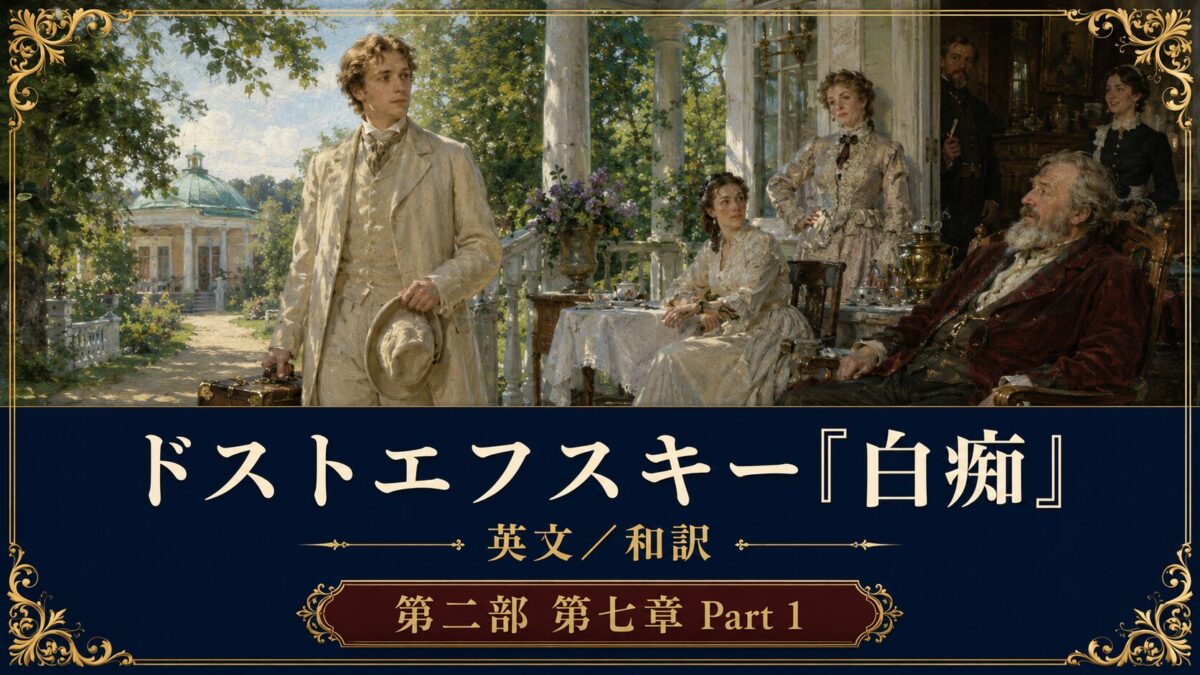
“`『白痴』英文/和訳 PART II CHAPTER VII 貧しき騎士の朗読とパヴリシチェフの息子
『The Idiot』PART II CHAPTER VII を、英語学習用に「英文→和訳」の順で読みやすく整理し、重要語句を多めに色分けしています。上部の操作パネルで、和訳・色分け・ミニ訳・カテゴリ別ハイライトを切り替えられます。
The young man who accompanied the general was about twenty-eight years old, tall and well built, with a handsome, intelligent face and bright black eyes full of fun and cleverness.
将軍に同行していた若い男は、二十八歳ほどで、背が高く、体格もよかった。顔立ちは端正で知的であり、明るい黒い目には、陽気さと才気が満ちていた。
Aglaya did not even glance at the new arrivals. She went on with her recitation, looking all the while at the prince, and at him alone, in a deliberately affected manner.
アグラーヤは新しく来た人たちを一瞥もしなかった。彼女は朗読を続け、その間ずっと、公爵だけを芝居がかった様子で見つめていた。
The prince could see clearly that she was doing all this with some special purpose.
公爵には、彼女が何か特別な目的を持ってこうしていることが、はっきり分かった。
Still, the entrance of the newcomers somewhat relieved his strained and uncomfortable position.
それでも、新しい客たちが入ってきたことで、張りつめて気まずかった彼の立場は、いくらか楽になった。
Seeing them approach, he rose, nodded kindly to the general, and made a sign that the recitation should not be interrupted.
彼らが近づいてくるのを見ると、公爵は立ち上がり、将軍に親しげにうなずき、朗読を中断しないよう合図した。
Then he moved behind his chair and stood with his left hand resting on its back. Thanks to this change of position, he could listen to the ballad with far less embarrassment.
それから彼は自分の椅子の後ろへ回り、左手を椅子の背に置いて立った。この位置に変わったおかげで、彼はずっと気まずさを感じずにそのバラードを聞くことができた。
Mrs. Epanchin also motioned twice to the new arrivals to be quiet and remain where they were.
エパンチン夫人もまた、新しく来た二人に、静かにしてその場にいるよう二度合図した。
The prince was much interested in the young man who had just entered. He easily guessed that this was Evgenie Pavlovitch Radomski, whose name he had already heard several times.
公爵は、入ってきた若い男に強い関心を持った。彼はそれが、すでに何度か名前を聞いていたエヴゲーニー・パヴロヴィッチ・ラドムスキーだとすぐに察した。
He was puzzled, however, by the young man’s plain clothes, for he had always heard of Evgenie Pavlovitch as a military man.
しかし、公爵はその若者の私服に戸惑った。というのも、エヴゲーニー・パヴロヴィッチは軍人だといつも聞かされていたからである。
An ironical smile played on Evgenie’s lips while the recitation went on, and it suggested that he too was probably in the secret of the “poor knight” joke.
朗読が続いている間、エヴゲーニーの唇には皮肉な笑みが浮かんでいた。その様子から、彼もまた「貧しき騎士」の冗談の秘密を知っているらしいと感じられた。
But with Aglaya herself the matter had now changed completely.
しかし、アグラーヤ本人においては、事態はすっかり変わっていた。
All the affectation she had shown at the beginning disappeared as the ballad continued.
朗読が進むにつれ、最初に見せていた芝居がかった様子はすべて消えていった。
She recited the lines with such seriousness, such exaltation, and such taste that the exaggerated solemnity with which she had stepped forward seemed almost justified.
彼女は詩句を、非常に真剣に、高揚した調子で、しかも趣味よく朗読した。そのため、先ほど彼女が大げさに厳かに進み出たことさえ、ほとんど正当化されるように思えた。
It was now impossible to see in her anything but a deep feeling for the spirit of the poem she had undertaken to interpret.
今の彼女には、自分が解釈しようとしている詩の精神に対する深い感情以外のものは、何も見えなかった。
Her eyes shone with inspiration, and once or twice a slight tremor of delight passed over her beautiful features.
彼女の目は霊感に輝き、一度か二度、歓喜のかすかな震えが美しい顔立ちをよぎった。
“Once there came a vision glorious,
Mystic, dreadful, wondrous fair;
Burned itself into his spirit,
And abode for ever there!”
「かつて栄光ある幻が現れた。神秘的で、恐ろしく、驚くほど美しい幻が。その幻は彼の魂に焼きつき、永遠にそこに住みついた。」
“Never more—from that sweet moment—
Gazed he on womankind;
He was dumb to love and wooing,
And to all their graces blind.”
「その甘美な瞬間以来、彼は二度と女性たちを見つめなかった。愛の言葉にも求愛にも口を閉ざし、あらゆる女性の魅力にも目を閉ざした。」
“Full of love for that sweet vision,
Brave and pure he took the field;
With his blood he stained the letters
N. P. B. upon his shield.”
「その甘美な幻への愛に満ち、勇敢で清らかな彼は戦場へ向かった。そして自分の血で、盾の上に N. P. B. の文字を染めた。」
“Lumen caeli, sancta Rosa!”
Shouting on the foe he fell,
And like thunder rang his war-cry
O’er the cowering infidel.
「『天の光よ、聖なる薔薇よ!』そう叫びながら彼は敵へ襲いかかった。彼の鬨の声は、恐れおののく異教徒の上に雷のように鳴り響いた。」
“Then within his distant castle,
Home returned, he dreamed his days—
Silent, sad,—and when death took him
He was mad, the legend says.”
「やがて遠い城へ帰った彼は、夢見るように日々を過ごした。沈黙し、悲しみに沈み、死が彼を連れ去った時、彼は狂っていたと伝説は語る。」
Afterwards, when the prince recalled all this, he could not understand how to reconcile the girl’s beautiful, sincere, pure nature with the irony of this jest.
後になって公爵がこのことを思い返した時、彼はこの少女の美しく誠実で清らかな性質と、この冗談の皮肉をどう結びつければよいのか、理解できなかった。
That it was a jest there could be no doubt. He knew it well, and he had good reason for his certainty.
それが冗談であることは疑いようがなかった。彼はそれをよく知っていたし、そう確信する十分な理由もあった。
During her recitation, Aglaya had deliberately changed the letters A. N. B. into N. P. B.
朗読の途中で、アグラーヤは A. N. B. という文字を、わざと N. P. B. に変えていたのである。
The prince was quite sure that she had not done it by accident, and that his ears had not deceived him.
公爵は、それが偶然ではなく、自分の耳が欺かれたわけでもないと確信していた。
In any case, her performance, though of course a joke and a rather crude one, was premeditated.
いずれにしても、彼女の朗読は、もちろん冗談であり、しかもかなり粗野な冗談ではあったが、前もって計画されたものだった。
They had evidently been talking and laughing about the “poor knight” for more than a month.
彼女たちは明らかに、一か月以上も「貧しき騎士」について話し、笑っていたのである。
Yet Aglaya pronounced the letters N. P. B. without the slightest appearance of irony, without even giving them any special emphasis.
それにもかかわらず、アグラーヤは N. P. B. という文字を、少しの皮肉も見せず、特別な強調さえせずに発音した。
Her seriousness was so smooth and unbroken that anyone might have supposed those initials were the original ones in the ballad.
彼女の真剣さはあまりに滑らかで乱れがなかったため、誰もがその頭文字こそ詩の本来の文字なのだと思ったかもしれなかった。
This made a painful impression on the prince.
そのことは公爵に不快な印象を与えた。
Mrs. Epanchin, of course, saw nothing either in the change of initials or in the hidden allusion.
もちろん、エパンチン夫人は、頭文字の変更にも、そこに込められたほのめかしにも、何も気づかなかった。
General Epanchin merely knew that some verses were being recited, and took no further interest in the matter.
エパンチン将軍は、詩が朗読されているということだけを知っており、それ以上この件に関心を持たなかった。
Many of the others, however, understood the allusion and wondered at the daring of the young lady and the motive beneath it.
しかしそのほかの多くの人々は、そのほのめかしを理解し、若い令嬢の大胆さと、その下にある動機に驚いていた。
Still, they tried to show nothing. But Evgenie Pavlovitch, as the prince was ready to wager, both understood and tried his best to show that he understood.
それでも彼らは何も表に出さないようにしていた。しかしエヴゲーニー・パヴロヴィッチは、公爵が賭けてもよいと思うほど、理解していただけでなく、自分が理解していることを示そうとしていた。
His mocking smile left no doubt on that point.
彼の嘲るような笑みは、その点について疑いの余地を残さなかった。
“How beautiful that is!” cried Mrs. Epanchin, with sincere admiration. “Whose poem is it?”
「なんて美しいのでしょう!」とエパンチン夫人は心から感嘆して叫んだ。「誰の詩ですか。」
“Pushkin’s, mamma, of course! Don’t disgrace us all by showing your ignorance,” said Adelaida.
「もちろんプーシキンです、お母さま! 無知を見せて私たち全員に恥をかかせないでください」とアデライーダが言った。
“As soon as we reach home, give it to me to read.”
「家に帰ったらすぐ、それを私に読ませなさい。」
“I don’t think we have a copy of Pushkin in the house,” said one of the girls.
「家にはプーシキンの本がないと思います」と娘の一人が言った。
“There are a couple of torn volumes somewhere; they have been lying about from time immemorial,” added Alexandra.
「どこかに破れた本が二冊ほどあります。ずっと昔からそのあたりに転がっています」とアレクサンドラが付け加えた。
“Then send Feodor or Alexey up by the first train to buy a copy,” said Mrs. Epanchin. “Aglaya, come here and kiss me, dear. You recited beautifully.”
「それなら、最初の列車でフョードルかアレクセイを町へやって、一冊買わせなさい」とエパンチン夫人は言った。「アグラーヤ、こちらへ来てキスしなさい。とても美しく朗読しましたよ。」
Then she whispered, “But if you were sincere, I am sorry for you. If it was a joke, I do not approve of the feelings that led you to it.”
それから彼女は小声で言った。「でも、もしあなたが本気だったのなら、私はあなたが気の毒です。もし冗談だったのなら、それをさせた感情を私は認めません。」
“In any case, it would have been better not to recite it at all. Do you understand? Now come along, young woman. We have sat here too long. I will speak to you about this another time.”
「いずれにしても、朗読しないほうがよかったでしょう。分かりましたか。さあ、こちらへ来なさい、お嬢さん。ここに長居しすぎました。このことはまた別の時に話します。」
Meanwhile the prince took the opportunity to greet General Epanchin, and the general introduced Evgenie Pavlovitch to him.
その間に公爵はエパンチン将軍に挨拶し、将軍はエヴゲーニー・パヴロヴィッチを公爵に紹介した。
“I met him on the way to your house,” explained the general. “He had heard that we were all here.”
「あなたの家へ来る途中で彼に会ったのです」と将軍は説明した。「私たちが皆ここにいると聞いていたそうです。」
“Yes, and I heard that you were here too,” added Evgenie Pavlovitch.
「ええ、それにあなたもこちらにいらっしゃると聞きました」とエヴゲーニー・パヴロヴィッチが付け加えた。
“I have long promised myself the pleasure of seeking not only your acquaintance, but your friendship. So I did not want to waste time, and came straight here.”
「私は以前から、あなたと知り合いになるだけでなく、友情を求める楽しみを自分に約束していました。ですから時間を無駄にしたくなく、まっすぐこちらへ来たのです。」
“I am sorry to hear that you are unwell.”
「ご病気とうかがい、残念に思っています。」
“Oh, I am quite well now, thank you. I am very glad to make your acquaintance. Prince S. has often spoken to me about you,” said Muishkin.
「ああ、今はすっかり元気です。ありがとうございます。お知り合いになれてとても嬉しいです。S公爵からあなたのことはよく聞いていました」とムイシュキンは言った。
For an instant the two men looked intently into one another’s eyes.
一瞬、二人は互いの目をじっと見つめ合った。
The prince noticed that Evgenie Pavlovitch’s plain clothes had made a strong impression on the company.
公爵は、エヴゲーニー・パヴロヴィッチの私服が、その場の人々に強い印象を与えていることに気づいた。
Indeed, all other interests seemed to fade before this surprising fact.
実際、この意外な事実の前では、ほかの関心ごとはすべて薄れてしまったようだった。
His change of dress was clearly a matter of some importance.
彼が服装を変えたことは、明らかに何か重要な意味を持っていた。
Adelaida and Alexandra poured out questions; Prince S., who was related to the young man, looked annoyed; and Ivan Fedorovitch became quite excited.
アデライーダとアレクサンドラは次々に質問を浴びせた。その若者の親戚であるS公爵は不機嫌そうに見え、イワン・フョードロヴィッチはかなり興奮していた。
Aglaya alone seemed uninterested. She merely looked closely at Evgenie for a moment, perhaps wondering whether civilian or military clothes suited him better, and then turned away.
アグラーヤだけは関心がなさそうだった。彼女はただ一瞬エヴゲーニーをじっと見た。おそらく、私服と軍服のどちらが似合うか考えたのだろう。それから顔を背けた。
Lizabetha Prokofievna asked no questions, but it was clear that she was uneasy. The prince fancied that Evgenie was not in her good graces.
リザヴェータ・プロコフィエヴナは何も質問しなかったが、落ち着かない様子であることは明らかだった。公爵には、エヴゲーニーが彼女のお気に入りではないように思えた。
“He has astonished me,” said Ivan Fedorovitch. “I nearly fell over with surprise when I met him in Petersburg just now.”
「彼には驚かされました」とイワン・フョードロヴィッチは言った。「さっきペテルブルクで彼に会った時、驚きのあまり倒れそうになりました。」
“Why this haste? That is what I want to know. He has always said himself that there is no need to break windows.”
「なぜこんなに急ぐのか。それが知りたいのです。彼はいつも自分で、窓を壊す必要はないと言っていたのですから。」
Evgenie Pavlovitch remarked that he had spoken of leaving the service long ago.
エヴゲーニー・パヴロヴィッチは、軍務を離れるつもりだとはずっと前から話していたと言った。
However, he had always joked about it more or less, so no one had taken him seriously.
しかし、彼はいつもその話を多少冗談めかしてしていたので、誰も本気にはしていなかった。
For that matter, he joked about everything, and his friends never knew what to believe when he did not want them to understand him.
そもそも彼は何についても冗談を言う人物であり、彼が相手に理解させたくない時には、友人たちは何を信じればよいのか分からなかった。
“I have retired only for a time,” he said, laughing. “For a few months, at most for a year.”
「退役したのは一時的なことです」と彼は笑って言った。「数か月、長くても一年です。」
“But there is no necessity for you to retire at all, as far as I know,” complained the general.
「しかし私の知る限り、君が退役する必要などまったくないはずだ」と将軍は不満を述べた。
“I want to go and look after my country estates. You yourself advised me to do that,” replied Evgenie. “And then I wish to go abroad.”
「領地の世話をしに行きたいのです。あなたご自身がそう勧めたではありませんか」とエヴゲーニーは答えた。「それから外国へも行きたいのです。」
After a few more objections, the conversation drifted elsewhere. But the prince, who had listened attentively, thought this excitement over such a small matter very curious.
さらにいくつか反論があった後、会話は別の方向へ移った。しかし注意深く聞いていた公爵は、このような小さなことにこれほど興奮するのはたいへん奇妙だと思った。
“There must be more in it than appears,” he said to himself.
「見た目以上の何かがあるに違いない」と彼は心の中で言った。
“I see the ‘poor knight’ has appeared again,” said Evgenie Pavlovitch, stepping to Aglaya’s side.
「どうやら『貧しき騎士』がまた現れたようですね」とエヴゲーニー・パヴロヴィッチはアグラーヤのそばへ寄りながら言った。
To the prince’s amazement, Aglaya looked at him haughtily and inquiringly, as though to make him understand once for all that there could be no conversation between them about the “poor knight.”
公爵が驚いたことに、アグラーヤは彼を高慢に、問い返すように見た。まるで、「貧しき騎士」について彼と話すことなどあり得ないと、一度できっぱり分からせようとしているかのようだった。
“But not now! It is too late to send to town for Pushkin now,” Colia was exclaiming loudly. “I have told you so at least a hundred times.”
「でも今はだめです! 今から町へプーシキンを買いに行かせるには遅すぎます」とコーリャが大声で叫んでいた。「少なくとも百回はそう言いましたよ。」
“Yes, it really is too late to send to town now,” said Evgenie Pavlovitch, who had escaped from Aglaya as quickly as possible.
「ええ、本当に今から町へ使いを出すには遅すぎます」と、アグラーヤのそばからできるだけ早く離れたエヴゲーニー・パヴロヴィッチが言った。
“I am sure the shops are closed in Petersburg. It is past eight o’clock,” he added, looking at his watch.
「ペテルブルクの店はもう閉まっているはずです。八時を過ぎていますから」と彼は時計を見ながら付け加えた。
“We have done without him so far,” interrupted Adelaida. “Surely we can wait until tomorrow.”
「これまでプーシキンなしでやってきたのです」とアデライーダが口を挟んだ。「明日まで待てるでしょう。」
“Besides,” said Colia, “it is quite unusual, almost improper, for people in our position to take any interest in literature.”
「それに」とコーリャが言った。「僕たちのような立場の人間が文学に関心を持つなんて、かなり珍しい、ほとんど不作法なことです。」
“Ask Evgenie Pavlovitch if I am not right. It is much more fashionable to drive a waggonette with red wheels.”
「僕が正しいかどうか、エヴゲーニー・パヴロヴィッチに聞いてみてください。赤い車輪のワゴネットに乗るほうが、ずっと流行なのです。」
“You got that from some magazine, Colia,” remarked Adelaida.
「それはどこかの雑誌から取ってきたのでしょう、コーリャ」とアデライーダが言った。
“He gets most of his conversation that way,” laughed Evgenie Pavlovitch.
「彼の会話の大部分はそうやってできています」とエヴゲーニー・パヴロヴィッチは笑った。
“He borrows whole phrases from the reviews. I have long had the pleasure of knowing Nicolai Ardalionovitch and his conversational methods.”
「彼は批評誌から文章を丸ごと借りてくるのです。私はニコライ・アルダリオノヴィッチとその会話術を、以前からよく存じています。」
“But this time he is not repeating something he has read. He is no doubt alluding to my yellow waggonette, which has, or had, red wheels.”
「しかし今回は、読んだものを繰り返しているのではありません。おそらく彼は、赤い車輪のついた、あるいは以前ついていた、私の黄色いワゴネットのことを言っているのです。」
“But I have exchanged it, so you are rather behind the times, Colia.”
「ただ、もう交換してしまったので、君は少し時代遅れだね、コーリャ。」
The prince listened carefully to Radomski’s words and found his manner very pleasant.
公爵はラドムスキーの言葉を注意深く聞き、その態度をとても感じのよいものだと思った。
When Colia teased him about the waggonette, he answered with perfect ease and friendliness. This pleased Muishkin.
コーリャがワゴネットのことで彼をからかった時、彼は実に自然に、友好的に答えた。そのことがムイシュキンには好ましく思えた。
At that moment Vera came up to Lizabetha Prokofievna, carrying several large, beautifully bound books that seemed quite new.
その時、ヴェーラがリザヴェータ・プロコフィエヴナのところへやって来た。彼女は、かなり新しそうな、美しく装丁された大きな本を数冊抱えていた。
“What is it?” demanded the lady.
「それは何ですか」と夫人が尋ねた。
“This is Pushkin,” replied the girl. “Papa told me to offer it to you.”
「プーシキンです」と少女は答えた。「父があなたにお渡しするようにと言いました。」
“What? Impossible!” exclaimed Mrs. Epanchin.
「何ですって。あり得ません!」とエパンチン夫人は叫んだ。
“Not as a present, not as a present! I should not have taken such a liberty,” said Lebedeff, suddenly appearing from behind his daughter.
「贈り物としてではありません、贈り物としてではありません! そんな失礼をするつもりはございません」とレベージェフが、娘の後ろから突然現れて言った。
“It is our own Pushkin, our family copy, Annenkoff’s edition. It could not be bought now.”
「これは私どものプーシキンです。家に伝わる本で、アンネンコフ版でございます。今では買うことのできないものです。」
“I respectfully suggest that your excellency should buy it, and thus quench the noble literary thirst which is consuming you at this moment,” he concluded grandly.
「つきましては、閣下にこれをお買い上げいただき、今まさに閣下を燃え立たせている高貴な文学的渇望を癒やされることを、謹んで提案いたします」と彼は大げさに締めくくった。
“Oh! If you will sell it, very good, and thank you. You shall not lose by it,” said Mrs. Epanchin.
「まあ! 売ってくださるなら結構です。ありがとう。あなたが損をすることはありません」とエパンチン夫人は言った。
“But for goodness’ sake, don’t twist about like that, sir! I have heard of you; they tell me you are very learned. We must have a talk one day.”
「でもお願いですから、そんなふうに体をくねらせないでください! あなたのことは聞いています。たいへん学識のある方だそうですね。いつかお話ししましょう。」
“Will you bring me the books yourself?”
「その本はあなたご自身で持ってきてくださいますか。」
“With the greatest respect and veneration,” replied Lebedeff, making extraordinary grimaces.
「最大の敬意と崇敬をもって」とレベージェフは、奇妙なしかめ面をしながら答えた。
“Well, bring them with or without respect, provided you do not drop them on the way,” said the lady.
「では、敬意があってもなくてもよいので、途中で落とさないように持ってきてください」と夫人は言った。
“But on one condition,” she added, looking straight at him, “you are not to cross my threshold. I do not intend to receive you today.”
「ただし一つ条件があります」と彼女は彼をまっすぐ見て付け加えた。「あなたは私の家の敷居をまたいではいけません。今日はあなたを迎えるつもりはありません。」
“You may send your daughter Vera at once, if you like. I am very pleased with her.”
「望むなら、娘のヴェーラをすぐによこしてもよいですよ。私は彼女がとても気に入りました。」
“Why don’t you tell him about them?” said Vera impatiently to her father.
「なぜあの人たちのことをお話ししないのですか」とヴェーラは父にいらだって言った。
“They will come in whether you announce them or not, and they are beginning to make a disturbance.”
「紹介しようとしまいと、あの人たちは入ってきます。それに、もう騒ぎ始めています。」
“Lef Nicolaievitch,” she said, turning to the prince, “four men are here asking for you. They have waited some time, and papa refuses to bring them in.”
「レフ・ニコライエヴィッチ」と彼女は公爵に向き直って言った。「四人の男性があなたに会いに来ています。しばらく待っていますが、父が中へ通そうとしないのです。」
“Who are these people?” asked the prince.
「その人たちは誰ですか」と公爵は尋ねた。
“They say they have come on business. They look like the kind of men who will follow you in the street if you do not see them here.”
「用件があって来たと言っています。ここで会わなければ、通りまであなたを追いかけてきそうな人たちです。」
“It would be better to receive them and get rid of them. Gavrila Ardalionovitch and Ptitsin are both there, trying to reason with them.”
「会ってしまって、それで追い払うほうがよいと思います。ガヴリーラ・アルダリオノヴィッチとプチーツィンがそこにいて、説得しようとしています。」
“Pavlicheff’s son! It is not worth while!” cried Lebedeff.
「パヴリシチェフの息子です! 会う価値などありません!」とレベージェフが叫んだ。
“There is no necessity to see them, and it would be most unpleasant for your excellency. They do not deserve—”
「お会いになる必要はございませんし、閣下にとって非常に不愉快なことになります。あの者たちにはその資格が……。」
“What? Pavlicheff’s son!” cried the prince, deeply disturbed. “I know, I know. But I entrusted this matter to Gavrila Ardalionovitch. He told me—”
「何ですって。パヴリシチェフの息子ですか!」と公爵はひどく動揺して叫んだ。「知っています、知っています。しかし私はこの件をガヴリーラ・アルダリオノヴィッチに任せました。彼は私に……。」
At that moment Gania, accompanied by Ptitsin, came out onto the terrace.
その時、ガーニャがプチーツィンを伴ってテラスへ出てきた。
From the next room came the sound of angry voices, and General Ivolgin could be heard loudly trying to shout them down.
隣の部屋からは怒った声が聞こえ、イヴォルギン将軍が大声でそれを抑えようとしているのが聞こえた。
Colia rushed off at once to discover the cause of the uproar.
コーリャは騒ぎの原因を調べるため、すぐに走っていった。
“This is most interesting!” observed Evgenie Pavlovitch.
「これはたいへん興味深いですね」とエヴゲーニー・パヴロヴィッチが言った。
“I expect he knows all about it,” thought the prince.
「彼はこの件をすべて知っているに違いない」と公爵は思った。
“What, the son of Pavlicheff? And who may this son of Pavlicheff be?” asked General Epanchin in surprise.
「何だ、パヴリシチェフの息子だって。そのパヴリシチェフの息子とはいったい誰なのだ」とエパンチン将軍は驚いて尋ねた。
Looking curiously around, he discovered that he alone had no clue to the mystery.
彼は興味深そうにあたりを見回し、この謎について何も知らないのは自分だけだと気づいた。
Expectation and suspense were written on every face, except the prince’s.
公爵を除くすべての顔には、期待と緊張が表れていた。
The prince stood gravely, wondering how an entirely personal affair could have awakened such lively and widespread interest so quickly.
公爵は真剣な顔で立ち、まったく個人的な事柄が、どうしてこれほど素早く、これほど広範な関心を呼び起こしたのかと不思議に思っていた。
Aglaya went up to him with a particularly serious expression.
アグラーヤは、ひときわ真剣な表情で彼のところへ近づいた。
“It will be best,” she said, “if you put an end to this affair yourself at once. But you must allow us to be your witnesses.”
「この件は」と彼女は言った。「あなたご自身が今すぐ終わらせるのが一番です。ただし、私たちを証人にすることを許してください。」
“They want to throw mud at you, prince, and you must be triumphantly vindicated. I congratulate you beforehand.”
「彼らはあなたに泥を投げつけようとしているのです、公爵。あなたは堂々と潔白を証明されなければなりません。あらかじめお祝い申し上げます。」
“And I too wish justice to be done, once for all,” cried Madame Epanchin, “about this impudent claim.”
「私もまた、この厚かましい要求について、きっぱり正義が行われることを望みます」とエパンチン夫人が叫んだ。
“Deal with them promptly, prince, and do not spare them! I am sick of hearing about this affair, and I have had many quarrels in your cause.”
「すぐに対処しなさい、公爵。そして容赦してはいけません! 私はこの件について聞くのにうんざりしていますし、あなたのために何度も口論してきたのです。」
“But I confess I am anxious to see what happens, so do make them come out here, and we shall remain.”
「とはいえ、何が起こるか見たいのは正直なところです。だから彼らをこちらへ出してください。私たちは残ります。」
“You have heard people talking about it, no doubt?” she added, turning to Prince S.
「あなたもきっと、この件について人々が話しているのを聞いたことがあるでしょう」と彼女はS公爵に向き直って付け加えた。
“Of course,” said he. “I have heard it spoken about at your house, and I am curious to see these young men.”
「もちろんです」と彼は言った。「あなたのお宅でその話を聞いたことがありますし、その若者たちを見てみたいと思います。」
“They are Nihilists, are they not?”
「彼らはニヒリストなのでしょう。」
“No, they are not Nihilists,” explained Lebedeff, growing excited.
「いいえ、彼らはニヒリストではありません」とレベージェフは興奮しながら説明した。
“They are a different lot, a special group. According to my nephew, they are even more advanced than the Nihilists.”
「彼らは別種の者たちです。特別な一派です。私の甥によれば、彼らはニヒリストよりさらに進んでいるのです。」
“You are quite wrong, your excellency, if you think your presence will frighten them. Nothing frightens them.”
「閣下、あなたがいらっしゃれば彼らが恐れると思うなら、それはまったくの間違いです。彼らは何も恐れません。」
“Educated men, even learned men, may be found among Nihilists. But these people go further: they are men of action.”
「ニヒリストの中には、教養ある人間、学識ある人間さえいます。しかし彼らはさらに先へ行っています。彼らは行動の人なのです。」
“The movement is, properly speaking, a derivative of Nihilism, though known only indirectly and by hearsay.”
「正確に言えば、その運動はニヒリズムから派生したものです。ただし、間接的に、噂によって知られているだけですが。」
“They do not advertise themselves in the newspapers. They go straight to the point.”
「彼らは新聞で自分たちの行動を宣伝したりしません。彼らはまっすぐ核心へ向かうのです。」
“For them, it is not a question of proving that Pushkin is stupid or that Russia must be torn to pieces.”
「彼らにとって問題なのは、プーシキンが愚かだと示すことでも、ロシアをばらばらにすべきだと主張することでもありません。」
“No; if they strongly desire something, they believe they have a right to get it, even at the cost of eight lives, if necessary.”
「そうではなく、彼らは何かを強く望むと、それを得る権利が自分たちにはあると信じるのです。必要なら八人の命を犠牲にしてでも。」
“No obstacle stops them. In fact, prince, I should not advise you—”
「どんな障害も彼らを止めません。実際、公爵、私はあなたにお勧めしません……。」
But Muishkin had already risen and was going to open the door for his visitors.
しかしムイシュキンはすでに立ち上がり、訪問者たちのために扉を開けに行こうとしていた。
“You are slandering them, Lebedeff,” he said, smiling.
「あなたは彼らを中傷しています、レベージェフ」と彼は微笑みながら言った。
“You are always thinking about your nephew’s conduct. Do not believe him, Lizabetha Prokofievna.”
「あなたはいつも自分の甥の行動を基準に考えています。信じないでください、リザヴェータ・プロコフィエヴナ。」
“I can assure you, Gorsky and Daniloff are exceptions. These people are only mistaken.”
「断言できますが、ゴルスキーやダニロフは例外です。この人たちはただ思い違いをしているだけです。」
“Still, I do not care to receive them here in public. Excuse me, Lizabetha Prokofievna.”
「とはいえ、ここで人前で彼らを迎えるのは気が進みません。失礼します、リザヴェータ・プロコフィエヴナ。」
“They are coming, and you can see them. Then I shall take them away. Please come in, gentlemen!”
「彼らが来ますので、皆さんも見ることはできます。その後、私が連れて行きます。どうぞお入りください、皆さん!」
Another thought tormented him: could this have been arranged to happen when he had guests in the house, in anticipation of his humiliation rather than his triumph?
もう一つの考えが彼を苦しめた。これは、彼の勝利ではなく屈辱を見越して、客がいる時に起こるよう仕組まれたことなのだろうか。
He bitterly reproached himself for such a suspicion and felt he would die of shame if it were discovered.
彼はそんな疑いを抱いた自分を激しく責め、それが知られたら恥ずかしさで死んでしまうだろうと感じた。
When the visitors appeared, he was ready to believe himself infinitely less worthy of respect than any of them.
訪問者たちが現れた時、公爵は自分が彼らの誰よりもはるかに尊敬に値しない人間だと信じる用意ができていた。
Four people entered, led by General Ivolgin, who was in a state of great excitement and talking eloquently.
四人の人物が入ってきた。先頭に立っていたのはイヴォルギン将軍で、彼はひどく興奮し、雄弁に語っていた。
“He is undoubtedly on my side,” thought the prince, with a smile.
「彼は間違いなく私の味方だ」と公爵は微笑みながら思った。
Colia too had joined the group and was talking animatedly to Hippolyte, who listened with a mocking smile on his lips.
コーリャもその一団に加わっており、イッポリートに生き生きと話しかけていた。イッポリートは唇に嘲るような笑みを浮かべて聞いていた。
The prince asked the visitors to sit down. They were all so young that the whole affair seemed even more extraordinary.
公爵は訪問者たちに座るよう頼んだ。彼らは皆あまりに若く、そのためこの出来事全体がいっそう異様に見えた。
Ivan Fedorovitch, who really understood nothing of what was happening, felt indignant at the sight of these youths.
実際には何が起きているのか何も理解していなかったイワン・フョードロヴィッチは、この若者たちを見て憤慨した。
He would have interfered in some way, had it not been for his wife’s intense interest in the affair.
もし妻がこの件に強い関心を示していなければ、彼は何らかの形で口を出していただろう。
So he remained, partly out of curiosity and partly from good nature, hoping his presence might be useful.
そのため彼は残った。半分は好奇心から、半分は善意からであり、自分がいれば何か役に立つかもしれないと思ったのである。
But the bow with which General Ivolgin greeted him irritated him again, and he decided to remain absolutely silent.
しかしイヴォルギン将軍が彼に向かってしたお辞儀が彼をまたいら立たせ、彼は完全に沈黙することに決めた。
One of the visitors was a man of thirty, the retired officer who had been with Rogojin, now a boxer.
訪問者の一人は三十歳ほどの男で、かつてロゴージンと一緒にいた退役士官、今では拳闘家だった。
In happier days, he had given fifteen roubles at a time to beggars.
彼は羽振りのよかったころ、一度に十五ルーブルを乞食に与えたこともあった。
Evidently he had joined the others as a comrade, to give them moral and, if necessary, physical support.
明らかに彼は仲間として加わり、彼らに精神的な、必要なら肉体的な支援を与えるつもりだった。
The man spoken of as “Pavlicheff’s son,” though he gave the name Antip Burdovsky, was about twenty-two years old, fair, thin, and rather tall.
「パヴリシチェフの息子」と呼ばれていた男は、アンチープ・ブルドフスキーと名乗ったが、二十二歳ほどで、色白で痩せており、やや背が高かった。
His appearance was notable for poverty, not to say uncleanliness.
その外見は、貧しさで目立っていた。いや、不潔さで目立っていたと言ってもよいほどだった。
The sleeves of his overcoat were greasy; his dirty waistcoat, buttoned to the neck, showed no trace of linen.
外套の袖は脂じみており、首元までボタンを留めた汚れたチョッキからは、シャツの気配さえ見えなかった。
A filthy black silk scarf, twisted until it looked like a cord, was wound around his neck, and his hands were unwashed.
黒い絹のスカーフはひどく汚れており、紐のようにねじれて首に巻かれていた。手も洗っていなかった。
He looked around with an air of insolent effrontery.
彼は厚かましく挑発的な態度であたりを見回した。
His face, covered with pimples, showed neither thoughtfulness nor even contempt. It expressed only complacent satisfaction at claiming his rights and appearing as an injured party.
にきびに覆われたその顔には、思慮深さも、軽蔑さえも表れていなかった。ただ、自分の権利を要求し、被害者として振る舞うことへの自己満足だけがあった。
His voice trembled, and he spoke so quickly and with such stammering that one might have taken him for a foreigner, though the purest Russian blood ran in his veins.
声は震え、話し方はあまりに早口でどもりがちだったため、彼は外国人と間違えられそうだった。もっとも、その血筋は純粋なロシア人だった。
Lebedeff’s nephew, whom the reader already knows, accompanied him, as did the youth named Hippolyte Terentieff.
読者がすでに知っているレベージェフの甥も彼に同行していた。また、イッポリート・テレンチェフという若者も一緒だった。
The latter was only seventeen or eighteen.
後者はまだ十七、八歳にすぎなかった。
He had an intelligent face, though its usual expression was irritated and fretful.
彼は知的な顔をしていたが、その表情はたいてい苛立ち、不機嫌だった。
His skeleton-like body, ghastly complexion, bright eyes, and red spots on his cheeks revealed the victim of consumption at a glance.
骨ばった体、死人のような顔色、輝く目、頬の赤い斑点は、彼が肺病に侵されていることを一目で示していた。
He coughed constantly and gasped for breath; it seemed as though he had only a few weeks left to live.
彼は絶えず咳をし、息を切らしていた。まるで余命が数週間しかないように見えた。
He was almost dead with fatigue, and fell rather than sat into a chair.
彼は疲労でほとんど死にかけており、椅子に座ったというより、崩れ落ちたようだった。
The rest bowed as they entered, and being somewhat abashed, put on an air of extreme self-assurance.
ほかの者たちは入ってくるとお辞儀をし、いくらか気後れしていたため、極端に自信ありげな態度を装った。
In short, their manner was not what one would expect from men who professed to despise all trivialities, all foolish social conventions, and everything except their own personal interests.
要するに、彼らの態度は、あらゆる些事、愚かな世間的慣習、そして自分たちの個人的利益以外のすべてを軽蔑すると公言する人々に期待されるものではなかった。
“Antip Burdovsky,” stammered the son of Pavlicheff.
「アンチープ・ブルドフスキー」とパヴリシチェフの息子はどもりながら言った。
“Vladimir Doktorenko,” said Lebedeff’s nephew briskly, with a certain pride, as if boasting of his name.
「ウラジーミル・ドクトレンコ」とレベージェフの甥はきびきびと言った。どこか誇らしげで、自分の名前を自慢しているかのようだった。
“Keller,” murmured the retired officer.
「ケラー」と退役士官はつぶやいた。
“Hippolyte Terentieff,” cried the last-named youth in a shrill voice.
「イッポリート・テレンチェフ」と最後の若者は甲高い声で叫んだ。
They now sat in a row facing the prince, frowning and playing with their caps.
彼らは今、公爵に向かい合って一列に座り、眉をひそめながら帽子をいじっていた。
All seemed ready to speak, and yet all were silent.
皆が話す準備はできているようだったが、それでも全員が黙っていた。
Their defiant faces seemed to say: “No, sir, you will not deceive us.”
彼らの挑戦的な顔つきは、こう言っているようだった。「だめだ、あなたは我々をだませない。」
It could be felt that the first word spoken by anyone present would release a torrent of speech from the whole deputation.
その場の誰かが最初の一言を発すれば、この代表団全体から言葉の奔流が一気に流れ出すだろうと感じられた。